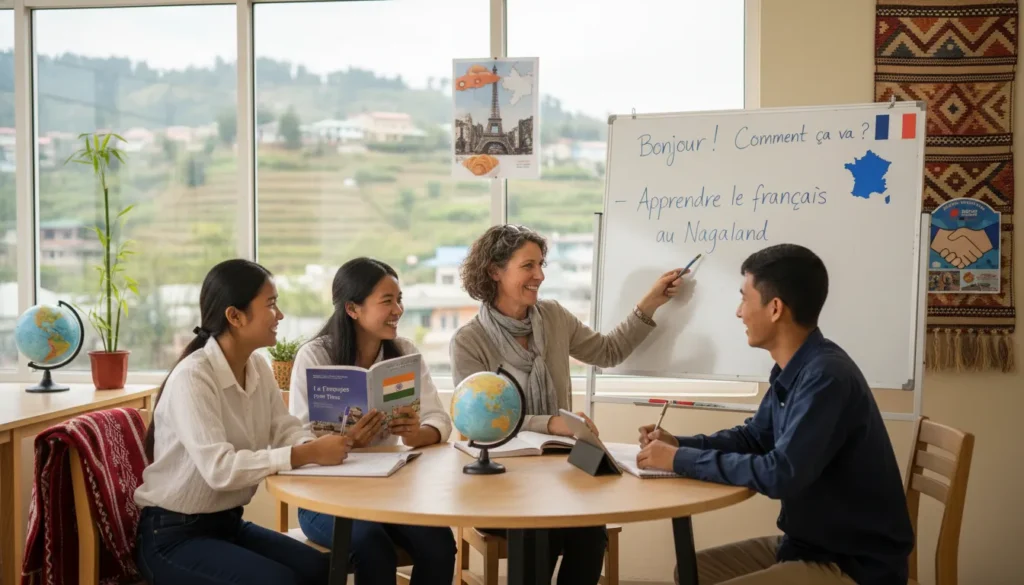
Choosing a French course is difficult because providers publish very different kinds of information. We compared each option using the same nine-factor formula, checked current course pages, pricing information and public reputation signals, and reduced the findings to one score out of 10.
Find the right learning experience
Tell us a little about the learner and what you are looking for. Our team will review your answers and help you identify the most suitable next step.
- Takes only a few minutes
- No payment required
- Personalised recommendations
Your information will only be used to respond to your enquiry.
Original Research-Based Provider Comparison: How We Scored These Options
Research scope: French classes for school-age learners in Dimapur, Kohima and the wider Nagaland region.
The original article mentions Debsie, Dimapur language centres, private home tutors, school clubs and national EdTech platforms, but does not identify any competing organisation by name. To make the comparison useful, we added four identifiable alternatives accessible to Nagaland learners: Alliance Française de Delhi, French Academy Delhi, Kochiva and French tutors listed through Superprof.
| Provider | Best For | Key Strength | Possible Limitation | Score /10 |
|---|---|---|---|---|
| Debsie | Children needing guided learning between classes | Live lessons, short practice, quizzes and parent-visible progress | French-specific pricing and individual teacher credentials are not fully public | 9.34 |
| Alliance Française de Delhi | CEFR and DELF-focused learners | Established curriculum and official exam-centre status | Less evidence of gamification or daily personalised practice | 8.17 |
| French Academy Delhi | Exam preparation and older school students | A1–C2 and DELF, DALF, TEF and TCF coverage | Homework and progress-reporting systems are not publicly detailed | 7.75 |
| Kochiva | Flexible online classes, including children’s French | Dedicated French-for-kids and online formats | Public pricing and independent review evidence are limited | 7.75 |
| Superprof tutors | Families wanting one-to-one scheduling freedom | Large tutor choice and individualised lessons | Quality, curriculum and safeguarding vary by tutor | 7.20 |
Scores reflect publicly verifiable information available in July 2026. A missing public detail was scored conservatively rather than treated as proof that the feature does not exist.
1. Debsie — 9.34/10
| Factor | Score | Evidence and scoring reason |
|---|---|---|
| Teacher Quality | 10 | Debsie describes teachers trained to work with children and teenagers, pronunciation coaching and rapid corrective feedback. Individual French-teacher biographies and credentials were not publicly clear. |
| Curriculum Structure | 10 | The published pathway runs from A1 to B2, with weekly targets, monthly milestones, a sample 12-week A1 sequence and preparation for CBSE, ICSE, NBSE and DELF. |
| Student Fit & Personalisation | 10 | Placement, level-matched small groups, pacing adjustments and support for shy learners are explicitly described. |
| Practice, Homework & Tracking | 9.5 | The model includes 8–12-minute practice, flashcards, voice work, listening clips, micro-quizzes, recordings and a parent dashboard. |
| Engagement & Motivation | 9.5 | Streaks, badges, role-play and short achievable tasks create stronger engagement evidence than most alternatives publish. |
| Online Convenience | 10 | Online access, evening or weekend scheduling, recordings and catch-up work make the programme accessible throughout Nagaland. |
| Transparency | 7 | The learning model and safety approach are detailed, but the public pricing page shows a US-dollar group price and chess-related wording rather than a clearly labelled French fee schedule. |
| Confidence Signals | 7 | Debsie publishes parent testimonials and outcome examples, but these are hosted by Debsie rather than an independent review platform. |
| Flexibility | 9 | Small groups, one-to-one options, live support, recordings and a free trial are published; French-specific offline availability is not publicly clear. |
Trial, pricing and safety check: A free live trial is advertised. The general pricing page lists group classes at US$100 monthly for two classes per week, but it does not clearly confirm that this is the current Nagaland French price. Debsie also publishes a dedicated child-safety page.
References to Debsie’s FIDE-certified chess partners or World Chess comparisons were excluded because they do not establish the quality of its French instruction.
Find the right learning experience
Tell us a little about the learner and what you are looking for. Our team will review your answers and help you identify the most suitable next step.
- Takes only a few minutes
- No payment required
- Personalised recommendations
Your information will only be used to respond to your enquiry.
2. Alliance Française de Delhi — 8.17/10
| Factor | Score | Evidence and scoring reason |
|---|---|---|
| Teacher Quality | 9 | Strong institutional standing and French-language specialisation, although individual instructor credentials are not consistently shown on course pages. |
| Curriculum Structure | 9.5 | CEFR-based classes, specialist courses and DELF, DALF and TCF preparation provide a particularly clear academic pathway. |
| Student Fit & Personalisation | 7 | Multiple levels and formats are available, but less evidence is published about individual learning plans. |
| Practice, Homework & Tracking | 7 | Formal coursework is evident; dashboards, adaptive revision and parent-facing weekly tracking are not publicly described. |
| Engagement & Motivation | 7 | Cultural activities and immersion are strengths, while gamification is not a visible core feature. |
| Online Convenience | 8 | Classes carrying an “OL” prefix are delivered through Zoom, making them accessible from Nagaland. |
| Transparency | 9 | Schedules, course types, exam information and a ₹800 new-student registration charge are public. |
| Confidence Signals | 9 | It is an established Indo-French cultural centre and official exam centre. One third-party review source reports 3.9/5 from 147 reviews, while another reports 4/5 from one review; these should be interpreted cautiously because they are not official Google data. |
| Flexibility | 8 | Online, in-person, intensive and exam-preparation formats are available. |
Trial, pricing and safety check: A universal free trial was not publicly clear. Fees vary by course and batch; the live schedule should be checked before enrolment. A child-specific safeguarding policy was not readily visible on the reviewed course pages.
3. French Academy Delhi — 7.75/10
| Factor | Score | Evidence and scoring reason |
|---|---|---|
| Teacher Quality | 8.5 | The academy states that its trainers are qualified and experienced, but standardised staff profiles are limited. |
| Curriculum Structure | 9 | Courses cover A1–C2, school French, conversation and DELF, DALF, TCF and TEF preparation. |
| Student Fit & Personalisation | 7 | School, individual, corporate and exam pathways are advertised; adaptive progress systems are not detailed. |
| Practice, Homework & Tracking | 6.5 | Testimonials mention organised material and grammar support, but measurable dashboards and recurring progress reports are not publicly clear. |
| Engagement & Motivation | 6.5 | Interactive instruction is claimed, though limited evidence of gamified or child-specific engagement tools was found. |
| Online Convenience | 8.5 | Online courses are explicitly available to school students and exam candidates. |
| Transparency | 7 | Course coverage is clear, but current fees and trial terms were not clearly displayed on the pages reviewed. |
| Confidence Signals | 8 | A third-party directory reports 4.8/5 from 49 Google reviews, but the listing is several years old and should be rechecked before purchase. |
| Flexibility | 8.5 | Online, school-support, conversation and certification courses provide broad choice. |
4. Kochiva — 7.75/10
| Factor | Score | Evidence and scoring reason |
|---|---|---|
| Teacher Quality | 8 | Kochiva describes expert-led instruction, though complete trainer-level evidence was not publicly available. |
| Curriculum Structure | 8.5 | French, TEF and French-for-kids courses are separately identified. |
| Student Fit & Personalisation | 8 | Video counselling and children’s programmes support initial matching, but the depth of ongoing adaptation is unclear. |
| Practice, Homework & Tracking | 7 | Interactive learning is advertised; detailed homework frequency and parent dashboards are not publicly specified. |
| Engagement & Motivation | 7 | A dedicated children’s course is positive evidence, but gamification and retention measures are not documented. |
| Online Convenience | 9 | The programme is online and available irrespective of the learner’s Nagaland location. |
| Transparency | 6.5 | Contact, refund and course pages are visible, but current French fees are not clearly published. |
| Confidence Signals | 6.5 | We did not find a sufficiently reliable current Trustpilot or Google review profile for Kochiva; similarly named “Kochava” results concern an unrelated software company. |
| Flexibility | 8.5 | Adult, children’s, exam and corporate language options are offered. |
Trial, pricing and safety check: Video counselling is available, but a guaranteed free teaching trial, exact French price and child-specific safety policy were not publicly clear.
5. Superprof French Tutors — 7.20/10
| Factor | Score | Evidence and scoring reason |
|---|---|---|
| Teacher Quality | 7.5 | Profiles may show qualifications, experience and reviews, but standards vary because tutors are independent. |
| Curriculum Structure | 5 | Some tutors offer DELF or school preparation, but Superprof does not impose one curriculum across tutors. |
| Student Fit & Personalisation | 9 | One-to-one selection by level, budget, goal and timetable is a major strength. |
| Practice, Homework & Tracking | 4 | Homework and formal tracking depend entirely on the selected tutor. |
| Engagement & Motivation | 6 | Individual attention may help motivation; no common engagement system exists. |
| Online Convenience | 9.5 | Online tutors are widely available, and some Nagaland listings offer home or online lessons. |
| Transparency | 8 | Tutor fees, profiles and reviews are visible, although platform charges should also be checked. |
| Confidence Signals | 8 | Reviews are displayed and monitored by the platform, but they evaluate individual tutors rather than a consistent programme. |
| Flexibility | 9.5 | Private, online and sometimes in-person lessons are available across beginner-to-advanced goals. |
Trial, pricing and safety check: The India French page advertises first lessons free and prices “from ₹2,169/hour”; individual offers vary. The Nagaland all-subject page shows local rates from ₹750/hour, but that figure is not French-specific. A uniform child-safeguarding policy for every independent tutor was not publicly clear.
How the Score Was Calculated (Scoring Rubric)
Each factor received a score from 0 to 10. We then multiplied it by its importance:
Final score = Teacher Quality × 15% + Curriculum × 15% + Personalisation × 15% + Practice and Tracking × 12% + Engagement × 10% + Convenience × 10% + Transparency × 8% + Confidence Signals × 8% + Flexibility × 7%.
For example, Debsie’s three 10/10 scores contribute 4.5 points before the remaining six factors are added. Lower transparency and independent-review scores prevent it from receiving an automatic perfect result.
What the Numbers Mean for Learners, Parents and Readers
Debsie ranks first for children who need continuity beyond a weekly lesson. Its advantage comes from combining live instruction with short practice, quizzes, recordings, gamification and parent-visible tracking—not from teacher claims alone.
Alliance Française is the strongest alternative for formal CEFR progression and recognised French examinations. French Academy may suit older students seeking broad exam preparation, while Kochiva offers convenient online children’s classes.
Superprof is strongest for tutor choice and one-to-one scheduling, but parents must assess each tutor’s qualifications, curriculum, homework plan, safeguarding process and progress-reporting method separately.
TLDR – To Conclude
On the evidence available, Debsie produces the highest weighted score for Nagaland families seeking structured online French learning, guided practice, tutor support, quizzes, motivation tools and visible progress. Alliance Française remains particularly compelling for formal certification and institutional credibility.
No provider is best for every learner. Before paying, parents should compare a real class, confirm the current fee in writing, ask who will teach the child, inspect the curriculum and request a clear explanation of safety, homework, missed-class and progress-reporting procedures.
If your child wants to learn French in Nagaland, this guide is for you. I will keep it simple, clear, and useful—like a caring teacher sitting beside you. You will see what really works, how to choose the right class, and how to help your child grow step by step at home in Dimapur, Kohima, Mokokchung, Wokha, Zunheboto, Mon, Tuensang, Phek—anywhere.
Here is the big idea right away: online French training works better than offline for most families today. It gives more speaking time, cleaner sound through headphones, quick feedback, and no travel stress.
And among online options, Debsie stands first. Debsie blends live small-group lessons, tiny daily practice, and a clear path from beginner (A1) to advanced (B2). Children do not just read a chapter; they use French.
They listen with care, speak with confidence, read with meaning, and write neat, correct lines. Along the way, they also build focus, patience, smart thinking, and calm speech—skills that help in school and in life.
You can feel the difference in one session. The teacher is warm. The plan is steady. Your child gets many short turns to speak and kind corrections right away. Parents can see progress on a simple dashboard. It is organized, human, and made for real results.
Quick next step: Book a free live class at Debsie (debsie.com/courses). Pick a time that fits your family in Nagaland.
Online French Training

Online French training is simple and calm. Your child learns with a real teacher on a safe screen at home in Dimapur, Kohima, Mokokchung, Wokha—any town in Nagaland. No traffic. No rushing.
No missed classes because of rain or road work. Class starts on time, ends on time, and your child leaves with one small win they can show you.
French is all about tiny sounds and clean sentences. Some letters go quiet. Some endings soften. The r must be gentle. Headphones make these sounds clear. In an online class, the teacher models one line.
Your child repeats it, records it, and listens back. The teacher gives a quick, kind tip: “Keep the final t silent,” or “Let the on be soft.” When feedback is fast and kind, learning is fast and kind.
A good online lesson follows one steady loop:
hear → say → read → write → play a tiny role.
This loop keeps the brain focused. First the ear wakes up. Then the mouth tries the line. Then the eye sees the words. Then the hand writes a few clean sentences.
At the end, a small role-play brings the parts together. Nothing feels heavy. Everything feels possible.
Between classes, practice stays short. Ten minutes a day is enough. A small set of flashcards shows up at the right time. A voice note helps with shadow reading. A tiny listening clip trains the ear.
A one-minute micro-quiz checks the key point. This keeps words warm, so the next live class feels easy, not scary.
Parents see progress without guesswork. You can quickly check what was covered, what comes next, and how your child is doing in listening, speaking, reading, and writing.
If a class is missed, a recording fills the gap. No more lost weeks. No more stress. Just steady steps and a happy child.
Picture a beginner week for a child in Kohima:
- Monday live: greetings, name, age. Two frames. Short turns.
- Tuesday 10 minutes: numbers + family flashcards; one voice line to copy.
- Wednesday live: être and avoir in simple lines; a tiny reading; a four-line note.
- Thursday 10 minutes: slow listening clip; streak badge.
- Friday live: likes and dislikes; mini role-play; gentle fixes.
- Weekend optional: label five home items in French; share a quick photo.
This rhythm is light but powerful. Each step helps the next. Children leave class proud because they did real work and could feel the progress.
Call to action: Let your child feel this calm, focused lift. Book a free Debsie trial today. Watch the full loop—hear, say, read, write—happen in one friendly session.
Landscape of French Tutoring in Nagaland and Why Online French Tutoring is the Right Choice

Families across Nagaland try many paths. Some hire a neighborhood tutor who also teaches other subjects. Some join a language center in Dimapur for a short batch.
Some rely on school clubs for light exposure. More and more families now choose an online academy that gives a full path from A1 to B2 with live teaching and daily practice.
Each path can help a bit. But if you want real skill—clear sounds, firm grammar, strong listening, and neat writing—online has clear edges for Nagaland right now.
Weather and roads: Hills, rain, and traffic can change plans. Online keeps the routine safe. Even on a wet day, your child learns.
Speaking time: Small online rooms give many short turns to each child. In large offline batches, a child may speak once or twice in an hour. That is not enough to build fluency.
Find the right learning experience
Tell us a little about the learner and what you are looking for. Our team will review your answers and help you identify the most suitable next step.
- Takes only a few minutes
- No payment required
- Personalised recommendations
Your information will only be used to respond to your enquiry.
Sound quality: Headphones bring tiny French sounds close—on, an, in; soft endings; gentle r; liaison. Clean input builds clean speech. A classroom speaker cannot match this.
Catch-up: If a class is missed, a recording and a short task protect momentum. In many offline setups, a missed day becomes a lost week.
Personal practice: Good online systems bring back the hard words at the right time. Your child reviews what they actually need, not the whole book.
Parent clarity: You see real signals weekly. You hear your child’s sample. You get one small tip to do at home. You are a partner, not a guesser.
In Nagaland, days are full—school, activities, family. Online training fits this life. It saves hours, lowers stress, and gives results you can track. Your child studies fresh, not tired from travel. A fresh mind learns faster and forgets less.
Call to action: Try a Debsie trial. If your child speaks even a few clean lines by the end of the first session, you will feel the difference right away.
How Debsie is The Best Choice When It Comes to French Training in Nagaland

Now let’s talk about why Debsie is #1 for students in Nagaland—Dimapur, Kohima, Mokokchung, Wokha, Zunheboto, Mon, Phek, and beyond. I will keep it simple and practical so you can picture your child in the program.
A roadmap you can trust (A1 → B2)
We teach in loops: hear it, say it, read it, write it. Then loop again next week with a little more weight. Every level has weekly targets and monthly milestones. At the end of a month, your child can say, “I can introduce myself,” or “I can order at a café,” or “I can describe my school day.” These clear outcomes keep motivation steady and honest.
Teachers who coach with care
Debsie teachers are trained to work with children and teens. They show mouth shapes for tricky sounds. They use easy cues your child will remember—“silent tail,” “soft nose,” “wide lips,” “gentle r.” They praise exact wins so the brain knows what to keep. They give one small fix at a time so your child never feels overwhelmed.
Speaking first, always
A Debsie class gives many short turns. In week one, a child may speak for 10 seconds at a time. By week four, 20–30 seconds feels normal. By A2, a short talk about daily life flows with simple connectors like et, mais, parce que. By B1, a one-minute talk with a clean open and close is within reach. This is planned growth, not a lucky jump.
Writing made easy and clean
We start with frames like “Je suis… J’ai… J’aime… Je n’aime pas…” Then we add et, mais, parce que. Children learn a tiny checklist: subject, verb ending, article, gender, connector. They learn to draft six neat lines in two minutes and to edit just two points. Writing becomes calm work, not panic.
Listening that builds a strong ear
We begin with short, slow clips so success comes early. Then we move to normal speed and friendly accents from different French-speaking places. Topics match a child’s world in Nagaland—home, food, markets, buses, school, weather—so words feel useful and stick.
Pronunciation labs that fix small things early
Your child records one short line. The teacher replies with a gentle note: “Keep the t silent,” “Soften the r,” “Great on today.” Tiny errors do not turn into hard habits. Over months, your child’s speech becomes clear and relaxed.
Daily practice that fits real life
Eight to twelve minutes, four to five days a week. That is all. Flashcards return at the right time. A voice note guides shadowing. A tiny listening clip trains the ear. A micro-quiz checks only the key point. Streaks and badges reward steady effort, not luck. Progress feels light but real.
Parent dashboard that tells the truth kindly
You see attendance, weekly focus, strengths, and next steps. You can hear a short audio sample from your child each week. You also get one tiny home idea—label five items, do a 30-second “what I did today,” give a 10-second weather line. You help in five minutes, not fifty.
Make-ups and recordings that protect momentum
Life happens—rain, festivals, exams, family events. If a session is missed, a recording and a catch-up task bring your child back fast. Momentum stays. Morale stays.
Exams, done the right way
CBSE, ICSE, NBSE (Nagaland Board), or DELF—when needed, we add exam polish. But only after core skill is firm. Scores rise because the language is real, not because lines were memorized and forgotten.
A simple 12-week A1 arc for a Nagaland learner (example)
Weeks 1–3: sounds, greetings, family, numbers; être/avoir; short self-intros.
Weeks 4–6: colors, daily items, likes/dislikes; polite forms; tiny dialogues.
Weeks 7–9: café language; prices; role-plays; mini-stories; 6–8 sentence notes.
Weeks 10–12: directions, time, school day; project—60-second self-intro with clean sounds and a calm pace.
By week 12, many children can read a small passage, write a neat paragraph, and hold a short talk with simple connectors. Parents hear the change. Children feel proud of their own voice.
Support for busy Nagaland families
Evening and weekend slots. Smooth pacing during school exam weeks. A “lite week” mode when life is full—keep the streak with five minutes a day. You do not have to choose between learning and balance. You can have both.
Safety, privacy, and simple tech
Small, secure rooms. Teachers trained for online classroom care. A quick sound test before the first class. If something breaks, fast help. Your child focuses on learning, not on buttons.
Life skills that grow with language
Focus, patience, planning, and calm speech grow every week. These habits help in every subject at school and later in life.
Call to action: Let your child feel this in one free class. If the lesson does not feel clear, kind, and effective, do not continue. But we believe you will feel the difference in a single session.
Offline French Training
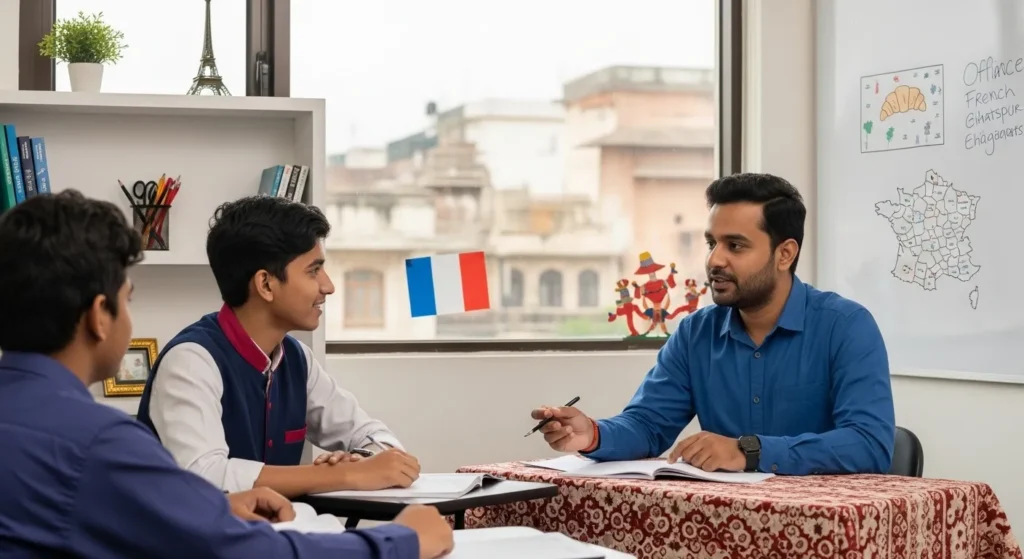
Offline classes can feel warm and familiar. A child walks into a room, sits with friends, and meets a teacher face to face. For some learners, this feels safe. If you find a very small batch with a careful plan, a child can learn well.
But day-to-day life in Nagaland often makes offline learning hard to keep. Travel takes time and energy. Rain or road work can cancel a class. Fixed batches move on even if your child needs one more week on sounds or verb endings.
In many rooms, each child speaks only once or twice in an hour. A shy student may not speak at all. When a class is missed, catching up is tough. Parents rarely see clear data on progress. You end up hoping, not knowing.
Sound is another real issue. A classroom speaker cannot match the clean audio of headphones. French depends on tiny sounds—on, an, in, the soft r, the silent tail. If the ear does not hear these clearly, the mouth cannot copy them cleanly.
Offline rooms try, but the tools are limited.
If your child is happy in a strong small batch and you see steady growth, keep going. Just check three things each month: how much your child actually spoke, which tiny errors were fixed, and what clear milestone they reached.
If any of these are weak, move the core learning online and keep offline for light exposure only.
Call to action: Want to compare? Take one free Debsie class. Notice the sound quality, the speaking turns, and the calm, clear plan. Then decide with your child.
Drawbacks of Offline French Training
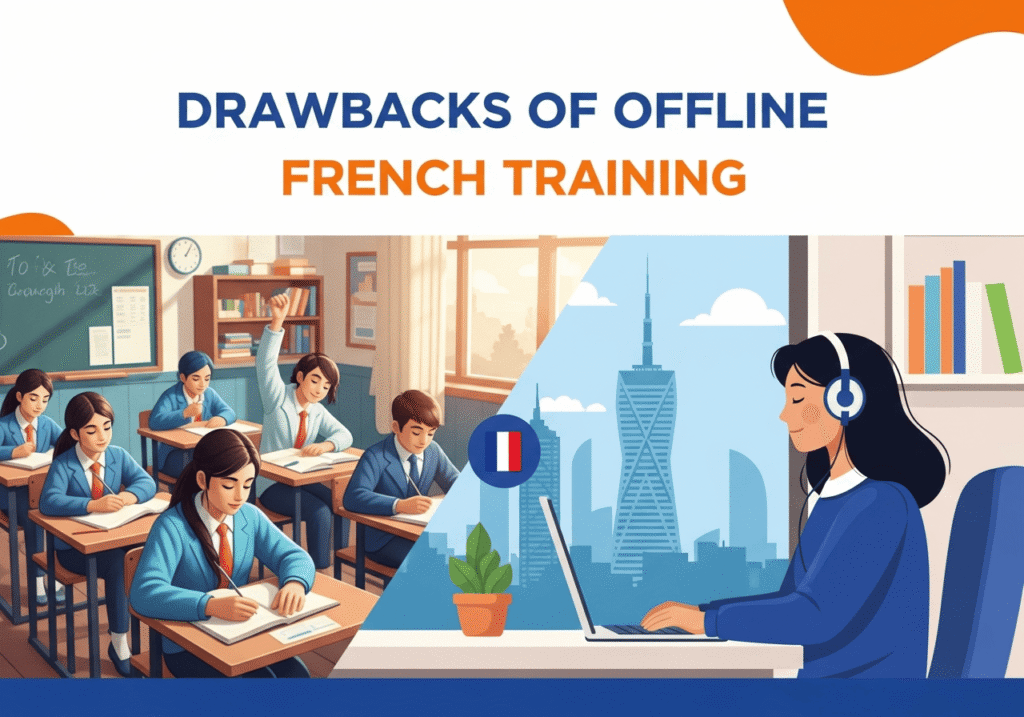
Let’s speak plainly and kindly. These are the friction points most Nagaland families report:
Time gets lost in the commute. A one-hour class can cost two hours out of the day. Tired brains learn less. Over a month, many hours vanish.
Weather and events break the flow. Hills, rain, and school functions often shift schedules. Make-ups are rare. Gaps grow fast.
Speaking time is thin in big rooms. A child may speak once or twice in an hour. That is far too little to build fluency. Language is a muscle; it grows with reps.
One pace for everyone. The batch moves forward even if your child needs more time on articles, nasal sounds, or verb endings. Quiet gaps appear and stay.
Feedback arrives late. The teacher is kind but busy. Tiny sound errors become habits. Habits are much harder to fix later.
Listening input is limited. One long track a week is not enough. Children need short, level-wise clips often—slow first, then natural speed, with a mix of accents. That is hard to deliver offline.
Progress is hard to track. Without a dashboard, parents rely on guesswork. You want to help but do not know what to do at home.
Missed classes are hard to recover. A recording would help, but it is not there. The child returns lost and anxious.
Exam push replaces real skill. Memorized answers can lift a term score, then fade. The child still struggles to hold a simple talk.
These are structural limits of the offline setup. This is why online, when done with care, feels so strong. It gives more speaking, cleaner sound, steady review, and honest, simple tracking for parents.
Call to action: If even one point sounded familiar, book a Debsie trial. One week with us will feel lighter and more effective.
Best French Academies in Nagaland

Parents in Nagaland want three things: a calm class, clear steps, and steady results. I will be fair and brief. I will rank Debsie first because it offers the strongest mix of expert live teaching, tiny daily practice, and a clean roadmap you can trust. After Debsie, I will list a few other options you may see in Dimapur, Kohima, or across India—useful in some cases, but usually not as complete.
1. Debsie (Rank #1 — The Complete Choice for Nagaland Families)

Debsie is built for children and teens who need real skill, not just notes. It fits real life in Dimapur, Kohima, Mokokchung, Wokha, Zunheboto, Mon, Phek, Tuensang—any town. The design is simple: clear steps, kind coaching, and short practice that a child can actually keep.
How your child starts
We do a short, friendly placement. If the child knows a little French, we listen to a few lines. If not, we begin at zero without pressure. We place them in a small, well-matched group, share a one-month plan, and run a quick sound check so the first class feels smooth.
Inside a class
We follow a steady loop: hear → say → read → write → play a tiny role. The teacher models clean lines and mouth shapes. Children take many short turns. Corrections are quick and kind. A shy learner begins with ten-second tries; by week four, they speak longer without fear.
Between classes
Daily practice takes 8–12 minutes. Flashcards return at the right time. A voice note supports shadow reading. A tiny listening clip trains the ear. A one-minute quiz checks the key point. Streaks reward steady effort. The habit feels light, not heavy.
Pronunciation labs
Small cues stick: “silent tail,” “soft nose,” “wide lips,” “gentle r.” Children record one line; the teacher replies with one precise tip. Early tiny fixes prevent big habits.
Writing clinics
We teach a tiny plan for a neat six-line note: subject, verb ending, article, gender, connector. Start with frames like “Je suis… J’ai… J’aime… Je n’aime pas…,” then add et, mais, parce que. Draft fast, edit two points, done. Writing becomes calm craft.
Listening that scales
Short slow clips first. Then normal speed and friendly accents from different French-speaking places. Topics match daily life in Nagaland—home, food, school, buses, markets, weather—so words feel useful and stick.
Parent dashboard
See weekly focus, tiny wins, next steps, and one short audio sample from your child. Get a five-minute home idea—labels on five items, a 30-second weather line, a “today I did…” micro talk.
Make-ups and recordings
Missed a class? Use the recording and a quick catch-up task. Momentum stays. Morale stays.
Exam polish added on top
CBSE, ICSE, NBSE, or DELF—exam work sits on a base of real skill. Scores rise because the language is real.
A 12-week A1 arc (example)
Weeks 1–3: sounds, greetings, family, numbers; être/avoir; short self-intros.
Weeks 4–6: colors, daily items, likes/dislikes; polite forms; tiny dialogues.
Weeks 7–9: café talk; prices; role-plays; mini-stories; 6–8 sentence notes.
Weeks 10–12: directions, time, school day; a 60-second self-intro project with clean sounds.
By week 12, most children read a short passage, write a neat paragraph, and hold a short talk with simple connectors. Parents hear the change; children feel proud.
Call to action: Let your child try one free Debsie class. If the session is not clear, kind, and effective, do not continue. But we believe you will feel the difference in one day.
2. Dimapur Language Centers (General)
Local centers may offer French batches through the year. Face-to-face time can feel nice. But batch sizes can be large, schedules fixed, and make-ups rare. Speaking time per child is often low. Pronunciation and listening drills can be brief. Parent tracking may be minimal.
Why Debsie is stronger: smaller groups, more speaking per child, clean headphone sound, recordings for catch-up, and honest weekly tracking.
3. Private Home Tutors (Across Nagaland)

A private tutor can help with homework and doubts. One-to-one attention is good. Results depend on the tutor’s training and materials. Many follow the next test, not a full A1–B2 plan. Listening banks, spaced review, and structured writing frames are often missing. Rescheduling missed sessions can be hard.
Why Debsie is stronger: a tested curriculum, built-in spaced review, guided writing, pronunciation labs, easy make-ups, and simple parent dashboards.
4. School Clubs and Hobby Sessions
Clubs give friendly exposure—songs, greetings, small games. They are light by design. They do not promise level growth or exam strength. Daily practice and parent views are rare.
Why Debsie is stronger: structured progress with tiny daily tasks, steady speaking drills, and monthly “can-do” checks that make growth real.
5. National EdTech Platforms (Recorded or Large-Batch)
Big platforms cover many subjects. Recorded lessons help for quick revision but cannot give speaking turns or instant correction. Large live classes can feel distant. Children watch more than they speak.
Why Debsie is stronger: live small-group coaching, real speaking time, fast feedback, short daily practice that sticks, and a dashboard that keeps everyone aligned.
A simple rule: If you want long-term skill with low stress, choose the path that gives more speaking time, cleaner sound, and steady review. That path is Debsie.
Call to action: Book the Debsie trial now. See the calm flow and the small wins in a single session.
Why Online French Training is The Future

The future of language learning is personal, flexible, and honest about progress. Online, when done with care, delivers all three.
Personal means the plan fits your child. Practice adapts to weak spots. Hard words return just before they fade. The teacher sees patterns and helps faster.
Flexible means learning fits Nagaland life. Rain or traffic will not break the week. A missed class becomes a recording and a short catch-up. You keep the streak, even in exam season.
Honest means clear signals. You see what your child can do now and what comes next. You hear a weekly audio sample. You guide with one tiny home habit. No guesswork.
Better input, better output. With headphones, tiny sounds become clear. Children copy cleanly. Silent endings stay silent. The r stays gentle. Clear input builds clear speech.
More speaking, less waiting. In small online rooms, short turns add up. Confidence grows because success is frequent and safe.
Practice that actually happens. Eight to twelve minutes a day is realistic. Small habits beat big plans. Over months, small habits win every time.
Lower stress, higher joy. No commute. No scramble. Children arrive fresh. Fresh minds learn faster and forget less. Parents feel lighter because the system helps without demanding hours.
A safer space for shy learners. A shy child can unmute for ten seconds, then twenty, then thirty. Step by step, courage grows.
Call to action: Bring this future into your home now. Book a Debsie trial. Feel how calm, personal, and effective online learning can be for your child in Nagaland.
How Debsie Leads the Online French Training Landscape

Debsie is not just “online classes.” It is a careful system that turns curiosity into real skill through tiny, steady steps.
A map that guides. From A1 to B2, each level has weekly sprints and monthly milestones. After each sprint, your child can say, “I can do this now”—introduce myself, order at a café, describe my school day, give directions, talk about the weather. Clear outcomes keep motivation alive.
Placement that respects the child. We place gently. If the group tempo is off, we fix it early. Fit matters. A well-matched group makes learning smooth and kind.
Teaching craft you can feel. Teachers show mouth shapes, use hand signs for verb endings, and color cues for articles and gender. They model, pause, invite, and correct with kindness. Children feel safe to try again.
Speaking time on purpose. We track how long each child speaks. If someone had fewer turns today, they get more tomorrow. No one is left behind. No one is pushed too fast.
Writing that grows like a ladder. Start with frames. Add connectors. Draft six lines. Edit two points. Repeat next week with a little more weight. Writing becomes a calm process, not a heavy task.
Listening that builds stamina. Short, slow clips first. Then longer, natural-speed clips. Friendly accents from different places. Topics from daily life so the ear learns what it will actually hear.
Home routines that fit real life. Tiny ideas you can start tonight: label five items; a 30-second window weather report; “what I wore today” in French; “three things I did after school.” These gentle habits move language from the screen into your home.
Parent partnership that is light. You do not need to know French. You only need five minutes a week to read a note and nudge one tiny habit. We carry the heavy lift. You bring warmth and steadiness.
Exam polish without losing joy. When tests near, we add timed speaking, short dictations, and simple answer frames. We keep the tone calm. Your child learns how to show what they know—without fear.
A 6-week speaking lift (sample).
Week 1: ten-second modeled turns.
Week 2: twenty-second turns with one connector.
Week 3: thirty-second turns with two connectors.
Week 4: pair role-plays with soft edits.
Week 5: forty-five-second talk with a simple open and close.
Week 6: sixty-second talk with a tiny plan.
By the end, your child can speak for a minute with a clear start, middle, and end. This is a life skill, not just a French skill.
Two real patterns we see (no names):
A grade-6 learner in Dimapur entered A1 shy and quiet. In month three, she recorded a 50-second café role-play with clean s’il vous plaît and a soft r. A grade-9 learner in Kohima needed DELF A2. We built core skill for eight weeks, then added exam polish. He passed with a strong speaking score because he had real language, not lines to memorize.
What Debsie gives, in one short line:
Clarity, care, and results—delivered in small daily steps your child can keep.
Your next move: Let your child feel this in a free class. If it does not feel clear, kind, and effective, do not continue. But we believe you will feel the difference right away.
Conclusion: Confidence, Focus, and Steady Growth—Right at Home in Nagaland

When learning is calm and clear, children bloom. That is what Debsie brings to homes across Nagaland—Dimapur, Kohima, Mokokchung, Wokha, Zunheboto, Mon, Phek, Tuensang, and every town in between.
We teach French in small steps with kind coaching and tiny daily practice. Your child does not cram. They build. Week by week, they feel proud of their own voice.
Here is what changes when your child studies with Debsie:
- Confidence: Many short speaking turns every class. Fast, gentle fixes. Small wins you can hear. Your child thinks, “I can do this,” and that feeling spreads to school and life.
- Focus: Calm 40–60 minute lessons plus 8–12 minute home tasks. The mind learns to sit, breathe, and finish one small job well.
- Growth (visible and steady): A1 → A2 → B1 → B2 with clear monthly “I can…” goals. Sentences look cleaner. Speech sounds clearer. Listening gets sharper.
- Patience: Big goals become tiny steps. Kids learn to try, adjust, and try again—without fear.
- Clean Pronunciation: Silent endings stay silent, the r stays gentle, and liaisons sound smooth—because we fix tiny issues early.
- Stronger Writing: Simple frames and a tiny checklist (subject, verb ending, article, gender, connector) make neat paragraphs normal.
- Better Listening: Short, level-wise clips first; then natural speed and friendly accents. The ear gets strong the safe way.
- Smart Thinking: Sentence patterns and planning teach order and logic that help in every subject.
- Resilience: Miss a class? Use the recording and a quick catch-up. Momentum stays. Morale stays.
- Habit Muscle: Short daily practice builds a streak. Streaks become self-discipline.
- Curiosity & Global View: Real-life themes and varied accents make kids ask questions and notice the world with respect.
- Exam Strength (the right way): Scores rise because skills rise—not because of crammed lines that fade.
- Calm at Home: No commute. No schedule shocks. More energy for family, school, and rest.
Offline classes can feel warm, but they often mean big batches, little speaking time, and thin tracking. Online, when done with care, fixes this. Debsie leads with small groups, clean sound, smart review, honest dashboards, and teachers who lift children gently, step by step.
Your 3-Step Action Plan
- Book a free live class at Debsie (debsie.com/courses). Choose a time that fits your home in Nagaland.
- Use earphones in the trial—clean sound makes clean speech.
- Start one tiny habit tonight: name, city, and one “I like…” line in French at dinner. Smile. Celebrate the try. Let the streak begin.
If the trial does not feel clear, kind, and effective, you should not continue. But we believe you’ll feel the difference in one session. Debsie is #1 because we teach with care and craft—and we keep every step small enough to succeed.
Ready to watch your child’s confidence, focus, and growth rise—week by week?
Join Debsie’s free trial now and let French (and life skills) grow at home, one happy win at a time.
Other Comparisons:

Ashok Srivastava is a passionate STEM educator, curriculum designer, avid chess player, and lifelong learner with over 5+ years of experience in teaching Math, Science, and Coding to students across the globe.
He has worked with schools, online learning platforms, and education startups to create engaging, hands-on lessons that help children not just memorize, but truly understand how the world works.
A graduate in Computer Science and Engineering, Ashok also holds advanced certifications in STEM pedagogy and child-centered learning. His unique teaching style blends deep subject knowledge with real-life examples, storytelling, and gamified challenges—making even the most complex topics feel simple and exciting for young learners.
Ashok is also a dedicated chess player with a FIDE rating of 2091. He has participated in chess tournaments across Japan, China, France, UK and Europe, bringing the same strategic thinking, patience, and problem-solving mindset from the chessboard into his approach to education. Ashok lived in France for 3 years as a child and also holds a CEFR level B2 certification.
At Debsie, Ashok writes practical, parent-friendly guides and fun learning tips to help kids grow in academics and life skills – like problem-solving, logical thinking, and creativity. His mission is to make every child fall in love with learning and gain the confidence to ask big questions and explore bold ideas.
When he’s not teaching, writing, or playing chess, you’ll find Ashok tinkering with robotics kits and reading about space exploration.