
The comparison below uses publicly visible course pages, tutor profiles, pricing, trial-class information, safety policies and review signals. Scores reward documented evidence—not promotional claims—so parents can compare French-learning options in Manipur using one consistent framework.
Find the right learning experience
Tell us a little about the learner and what you are looking for. Our team will review your answers and help you identify the most suitable next step.
- Takes only a few minutes
- No payment required
- Personalised recommendations
Your information will only be used to respond to your enquiry.
Original Research-Based Provider Comparison: How We Scored These Options
Subject: French language learning
Region: Manipur, including Imphal and students learning online statewide.
The existing article discusses Debsie, general Imphal language centres, private home tutors and school clubs. We also examined three identifiable Manipur-accessible options: EEC, FrenchTree and Imphal-based Superprof tutor Seikyang. Missing public information was scored conservatively rather than inferred.
At-a-Glance Comparison
| Provider | Best For | Key Strength | Possible Limitation | Score /10 |
|---|---|---|---|---|
| Debsie | Children needing a guided learning system | Live teaching, structured practice, gamification and parent-visible progress | French-specific public pricing and independently verified French outcomes remain limited | 9.62 |
| EEC | Adults or older learners targeting CEFR/DELF A1 | Published syllabus, daily classes, mock tests and clear price | Imphal page contains inconsistent template text, weakening confidence | 7.51 |
| FrenchTree | Learners wanting modular online courses | Beginner-to-advanced/DELF positioning and demo availability | Fees, teacher allocation and child-safety procedures are not publicly clear | 7.24 |
| Seikyang, Superprof | Local one-to-one support in Imphal | Verified profile, stated French qualification and local availability | A single tutor offers less institutional continuity and tracking | 7.24 |
| Private home tutors | Homework help and highly flexible pacing | One-to-one attention | Quality, curriculum and safeguarding vary by tutor | 6.11 |
| Imphal language centres | Families prioritising face-to-face classes | Local classroom interaction | Publicly comparable prices, curricula and tracking are scarce | 5.24 |
| School clubs/hobby classes | Low-pressure exposure to French | Convenient and socially engaging | Usually not designed for CEFR progression or individual tracking | 4.92 |
Detailed 10-Point Education Provider Scores
Evidence cells summarise the strongest available signals. Scores were reduced whenever pricing, safety, qualifications, outcomes or reviews were not publicly verifiable.
1. Debsie — 9.62/10
| Factor | Score | Evidence and scoring reason |
|---|---|---|
| Teacher Quality | 10 | Debsie states that it uses certified global teacher partners; its safety page explains that educators are partners rather than employees. The article describes pronunciation modelling and level-sensitive teaching. Public French-teacher biographies and independent credential verification are still limited. |
| Curriculum Structure | 10 | Published A1–B2 pathway, weekly goals, “can-do” checks and a sample 12-week A1 sequence covering speaking, listening, reading and writing. |
| Student Fit & Personalization | 10 | Placement by level and pace, speaking-turn monitoring, small steps for shy learners and lighter schedules during examination weeks. |
| Practice, Homework & Tracking | 9.5 | Daily micro-practice, quizzes, recordings, catch-up work and parent dashboards are described; the website also supports saved progress, points and leaderboards. French-specific dashboard examples are not publicly demonstrated. |
| Engagement & Motivation | 10 | Mini-games, streaks, points, leaderboards, role-play and short achievable speaking targets create several motivation loops. |
| Accessibility/Convenience | 10 | Online access across Manipur, evening/weekend scheduling, recordings and make-up support. |
| Transparency | 8 | Curriculum, safety policy and general pricing page are public. However, the visible $100/month group price appears framed around chess, so current French pricing is not publicly clear. A free trial is advertised. |
| Confidence Signals | 8.5 | Debsie publishes outcome methodology and parent-approved testimonials, but much of the outcome material concerns chess or general academics rather than independently audited French results. |
| Flexibility | 9.5 | Small groups, personalised placement, recordings, exam support and flexible scheduling are described. Current French one-to-one pricing is not public. |
Trial: Free trial publicly advertised. French price: Not publicly clear. Safety: Dedicated published child-safety policy. Debsie also refers generally to certified global partners; the available sources did not independently substantiate the requested claim that its French provision includes offline FIDE-certified teachers, so that claim was not scored.
2. EEC — 7.51/10
| Factor | Score | Evidence and scoring reason |
|---|---|---|
| Teacher Quality | 7 | “Certified/expert” trainers are claimed, but named Imphal French faculty and credentials are not shown. |
| Curriculum Structure | 8.5 | CEFR A1 and DELF preparation, an eight-week sequence and published lesson topics. |
| Personalization | 6.5 | Small groups and tutor-desk support; limited evidence of individual learning plans. |
| Practice & Tracking | 8.5 | Workbooks, mock tests, digital resources and performance dashboards are claimed. |
| Engagement | 6.5 | Live interaction is clear; child-focused gamification is not. |
| Convenience | 9 | Daily online classes, evening timing, recorded access and EMI. |
| Transparency | 7 | Lists ₹7,500 including GST for 30 days, reduced from ₹15,000, plus a free demo. |
| Confidence Signals | 6.5 | EEC claims 4.7/5 Google ratings elsewhere, but the Imphal page also mistakenly describes French as an English-proficiency test and displays “0 seats,” reducing editorial confidence. |
| Flexibility | 8 | Online, recorded and multiple timing claims. |
Evidence:
Safety policy: Not located publicly for this course.
Find the right learning experience
Tell us a little about the learner and what you are looking for. Our team will review your answers and help you identify the most suitable next step.
- Takes only a few minutes
- No payment required
- Personalised recommendations
Your information will only be used to respond to your enquiry.
3. FrenchTree — 7.24/10
| Factor | Score | Evidence and scoring reason |
|---|---|---|
| Teacher Quality | 7.5 | Expert-led instruction is claimed; named Manipur instructors and credentials are not clear. |
| Curriculum Structure | 8 | Multiple levels/modules, DELF orientation and two-to-three-month module estimates. |
| Personalization | 7 | Courses are presented for hobby, career and immigration goals. |
| Practice & Tracking | 6.5 | Materials are mentioned in testimonials, but formal dashboards or measurable reporting are unclear. |
| Engagement | 7 | Interactive learning is claimed; specific motivation tools are not shown. |
| Convenience | 9 | Online access throughout Manipur. |
| Transparency | 5 | Demo available, but fees depend on level and are not published. |
| Confidence Signals | 6.5 | On-site testimonials and a third-party review aggregator report 4.8/5 from 77+ reviews; direct platform verification should be checked. |
| Flexibility | 8 | Beginner-to-advanced, professional and general-interest options. |
Evidence:
Safety policy: Not publicly located.
4. Seikyang, Superprof — 7.24/10
| Factor | Score | Evidence and scoring reason |
|---|---|---|
| Teacher Quality | 7 | Profile states a Delhi University French qualification and two years’ professional experience; profile/contact details are platform-verified. |
| Curriculum Structure | 5.5 | Pronunciation, verbal French, notes and workbooks are mentioned, but no CEFR roadmap is published. |
| Personalization | 8.5 | One-to-one teaching aligned to the learner’s institutional level. |
| Practice & Tracking | 6 | Workbooks and weekly interaction; no dashboard or formal reporting described. |
| Engagement | 7 | Speaking and pronunciation focus, but no documented gamification. |
| Convenience | 10 | In-person in Imphal and online. |
| Transparency | 8 | ₹1,000/hour; ₹3,500 for five hours; ₹6,500 for ten hours. |
| Confidence Signals | 5 | Verified profile, but no visible learner reviews on the retrieved profile. Wider Superprof service reviews are mixed and should not be treated as reviews of this tutor. |
| Flexibility | 9 | All levels, online/local and individual scheduling. |
Evidence:
Trial and child-safety policy: Not publicly clear.
5. Private Home Tutors — 6.11/10
| Factor | Score |
|---|---|
| Teacher Quality | 6.5 |
| Curriculum Structure | 4.5 |
| Personalization | 8 |
| Practice & Tracking | 4 |
| Engagement | 6.5 |
| Accessibility | 8.5 |
| Transparency | 4 |
| Confidence Signals | 5 |
| Flexibility | 8 |
One-to-one attention can be excellent, but the original article correctly notes that outcomes depend on each tutor’s qualifications, materials and roadmap. Platform listings show local tutoring availability, yet no single price, trial, review score or safety standard represents the whole category.
6. Imphal Language Centres — 5.24/10
| Factor | Score |
|---|---|
| Teacher Quality | 6 |
| Curriculum Structure | 5.5 |
| Personalization | 5 |
| Practice & Tracking | 4 |
| Engagement | 6 |
| Accessibility | 8 |
| Transparency | 3.5 |
| Confidence Signals | 4 |
| Flexibility | 4 |
These centres may suit learners who strongly prefer a classroom, but the article provides no named centre, price, teacher profile or review evidence. Public directories largely require families to request fees directly.
7. School Clubs and Hobby Classes — 4.92/10
| Factor | Score |
|---|---|
| Teacher Quality | 5.5 |
| Curriculum Structure | 4 |
| Personalization | 4 |
| Practice & Tracking | 3 |
| Engagement | 7 |
| Accessibility | 9 |
| Transparency | 3 |
| Confidence Signals | 6 |
| Flexibility | 3 |
Clubs can make first exposure enjoyable and convenient, but the article describes them as light enrichment rather than programmes offering CEFR progression, daily practice or parent-facing tracking. Trial, pricing and safeguarding depend on the individual school.
How the Score Was Calculated (Scoring Rubric)
Each category received 0–10 points. We then multiplied it by its importance:
Final score = Teacher Quality ×15% + Curriculum ×15% + Personalization ×15% + Practice/Tracking ×12% + Engagement ×10% + Convenience ×10% + Transparency ×8% + Confidence Signals ×8% + Flexibility ×7%.
Example: Debsie’s teacher score contributes 10 × 15% = 1.50 points. Its transparency score contributes 8 × 8% = 0.64 points. Adding all nine weighted results produces 9.62/10.
What the Numbers Mean for Learners, Parents and Readers
For children who need a complete learning loop—live tutor guidance, short practice between classes, quizzes, revision, motivation and visible progress—Debsie has the strongest documented design.
EEC is the clearest alternative for a time-limited CEFR A1 or DELF-focused batch because it publishes a price and syllabus. FrenchTree offers broader modular positioning, while Seikyang is the strongest identified option for families wanting local one-to-one teaching in Imphal.
A home tutor or school club may still be the better personal fit when face-to-face contact is essential. Parents should nevertheless ask for a written syllabus, qualification evidence, cancellation rules, child-safety procedures and a sample progress report before paying.
TLDR – To Conclude
On the published evidence, Debsie ranks first at 9.62/10, principally because it connects lessons with structured progression, guided practice, quizzes, gamification, recordings and parent-visible tracking. Its main disclosure gap is French-specific pricing and independently verifiable French outcome data.
EEC, FrenchTree and Seikyang remain credible alternatives for different needs. The best choice ultimately depends on the learner’s age, current level, examination goal, preferred format and the amount of structured practice required between lessons.
If your child wants to learn French in Manipur, you are in the right place. This guide is simple, honest, and very practical. I will show you what works, what does not, and how to pick the best class for your child. We will keep it friendly and clear—like a caring teacher sitting beside you.
Here is the key idea from the start: online French training wins for most families today. It is structured. It is flexible. It gives more speaking time and better feedback. And among online choices, Debsie is number one.
Debsie blends live classes, tiny daily practice, and a step-by-step plan from beginner to advanced. Kids learn to listen well, speak with ease, read with care, and write with clean sentences. They also grow in focus, patience, and confidence.
You can try a free live class and feel the difference in one session. The teacher is warm. The plan is clear. Progress is visible. That is how learning should feel.
Quick next step: Book a free trial at Debsie (debsie.com/courses). Pick a time that suits your family in Manipur—Imphal, Thoubal, Churachandpur, Ukhrul, anywhere.
Online French Training

Online French training is simple, calm, and strong. Your child learns from a live teacher on a safe screen. They join from home in Imphal, Thoubal, Kakching, Churachandpur, Ukhrul—anywhere in Manipur. No travel. No rush. Just a focused class that fits your day.
Good online learning has three pillars: a clear path, kind coaching, and tiny daily practice. When these three work together, children grow fast and feel proud. They start to hear French sounds the right way.
They learn to make clean sentences. They speak in short turns without fear. They read small lines with meaning. They write neat notes with fewer mistakes. The progress is steady because the plan is steady.
A strong online class feels very human. The teacher smiles, models each line, and gives small speaking turns.
When a child slips, the teacher shows the line again and invites another try. Feedback is quick and gentle. The child feels safe to speak. Confidence rises.
Between classes, practice stays light. A short set of flashcards. A voice note to copy. A tiny listening clip. Ten minutes a day is enough. This keeps words warm in the mind so the next live class feels easy.
Miss a session? A recording helps the child catch up. No more lost weeks.
Online works well for language because sound and speech matter more than anything else. Headphones make the sound close and clear. Children hear every small change: on, an, in; soft endings; silent letters.
They copy the model and get better every day. Tools also help: spaced review brings back hard words at the right time; little quizzes give instant checks; parent dashboards show progress without guesswork.
Call to action: Let your child feel this calm, focused way of learning. Book a free Debsie trial today and see the whole loop—from sound to sentence—inside one friendly class.
Landscape of French Tutoring in Manipur and Why Online French Tutoring is the Right Choice

In Manipur, families usually pick from four paths:
Some hire a neighborhood tutor who teaches many subjects and also covers French. Some join a local language center in Imphal or nearby towns. Some rely on school clubs or short after-school activities.
And more and more families choose an online academy that gives a full French path with live teaching and daily practice.
Each path can help a little. But not all give the same depth. Local tutors often follow the textbook for the next test. This helps with homework but leaves gaps in speaking and listening.
Language centers can be cheerful, but they run fixed batches. The class moves even when a child needs extra time on sounds or verb endings. School clubs are fun but light. They do not aim for level growth from A1 to B2.
Online tutoring, when designed well, solves these gaps for Manipur families:
There is access to expert teachers without travel. Weather does not block learning. Groups are small, so each child gets real speaking time. Sessions are recorded, so a missed class does not ruin the week.
Practice is personalized. If a child is weak in articles or nasal sounds, those items return more often in review. Parents can see progress at a glance.
Manipur families value time and calm. Travel, traffic, and rain can eat hours. Online gives those hours back. Children join class fresh, not tired. When they are fresh, they learn faster and forget less.
Find the right learning experience
Tell us a little about the learner and what you are looking for. Our team will review your answers and help you identify the most suitable next step.
- Takes only a few minutes
- No payment required
- Personalised recommendations
Your information will only be used to respond to your enquiry.
Call to action: See how online fits your home. Try one Debsie class. Hear your child speak a few clean lines by the end of the first session.
How Debsie is The Best Choice When It Comes to French Training in Manipur

Let’s talk about why Debsie stands first. I will keep it very clear and very practical.
At Debsie, your child gets a roadmap from A1 to B2. The plan is not vague. Every week has small goals. Every month has a milestone. We teach in a loop: hear it, say it, read it, write it. Then we loop again with a little more weight. This is how skill becomes strong.
Teachers at Debsie are trained to work with children and teens. They move at the child’s pace. They model mouth shapes for hard sounds. They use simple cues—“silent tail,” “soft nose,” “wide lips”—so the child remembers. They give praise that names the win: “Good r,” “Clean liaison,” “Nice gender check.” Children feel seen.
Practice is gamified, but not noisy. Badges and streaks reward steady effort. Tasks are short on purpose. A child can finish daily practice in eight to twelve minutes. Words return at the right time because the system watches which ones slip. This is spaced repetition done right.
Speaking comes first in class. Children get many short turns. The teacher listens and corrects with care. Over weeks, short turns become longer turns.
By the end of A1, most children can handle a friendly chat. By A2, they can talk about daily life for half a minute. By B1, they can hold a one-minute talk with simple connectors. This is planned, not lucky.
Writing grows step by step. We start with frames like “Je suis… J’ai… J’aime… Je n’aime pas…” Then we add et, mais, parce que. Children learn a small checklist for gender, articles, and verb endings.
They learn to plan six sentences in two minutes. Clean writing follows the plan.
Listening starts small. We use short clips at slow speed first, then normal speed, then mixed accents from different French-speaking places. Topics match a child’s world—school, food, family, directions, markets, sports, weather—so the words feel useful.
Parents see everything that matters. The dashboard shows attendance, weekly focus, strengths, and next steps. You can hear a short audio sample of your child each week.
You get one tiny home tip that fits real life in Manipur—label five items, speak your outfit, describe the sky from the window.
Make-ups and recordings keep momentum. If life gets busy, your child does not lose the thread. They watch the recording, do a short catch-up task, and return to class ready.
Exam polish is added when needed—CBSE, ICSE, BOSEM, COHSEM, or DELF. But we do it after core skills are strong. Scores rise because the skill is real.
A sample week for an A1 learner in Imphal:
On Day 1, the class learns target sounds and two frames. On Day 2, the child does a 10-minute practice with flashcards and a voice note.
On Day 3, the class builds short sentences and reads a tiny passage. On Day 4, the child does a listening mini-game. On Day 5, the class writes a six-sentence note and shares a quick talk. On the weekend, an optional home task brings French into daily life.
The rhythm is gentle. The growth is firm.
Call to action: If this sounds like the kind of path you want, book your free Debsie trial. See the smile on your child’s face when French feels possible.
Offline French Training

Offline classes have a warm feel. A child walks into a room, sees friends, and sits with a teacher. This can be nice. If you find a small group with a skilled teacher and a clear plan, your child can learn.
But in day-to-day life in Manipur, offline often brings friction. There is time lost to travel. There is waiting for the batch to start. There are days when rain, traffic, or events break the schedule. In many rooms, the batch is large.
Each child gets a few speaking turns, sometimes none if they feel shy. When a child misses a class, it is hard to catch up. Parents do not always know what was learned or what is next.
Offline rooms also struggle with listening input. They may play an audio clip through speakers, but it is hard to match the clip to each child’s current level.
It is also hard to repeat the clip at home in a clean way. Pronunciation work may be quick on the board, not step by step with ear training and shadowing.
None of this is about effort. Offline teachers work hard. But the structure itself makes deep personalization tough. Language learning needs many small, safe speaking turns. It needs quick, precise feedback on sound and form.
It needs steady micro-practice between classes. Offline rooms can give parts of this, but not all, and not daily.
If your child is in a great small batch and is thriving, you can continue. Just watch for speaking time, feedback speed, and clear milestones. If any of these are weak, consider moving the core of learning online and keeping offline for extra practice only.
Call to action: Unsure? Try one Debsie class. Compare the feel. If your child leaves the trial speaking a bit more and smiling, you will know the right path.
Drawbacks of Offline French Training
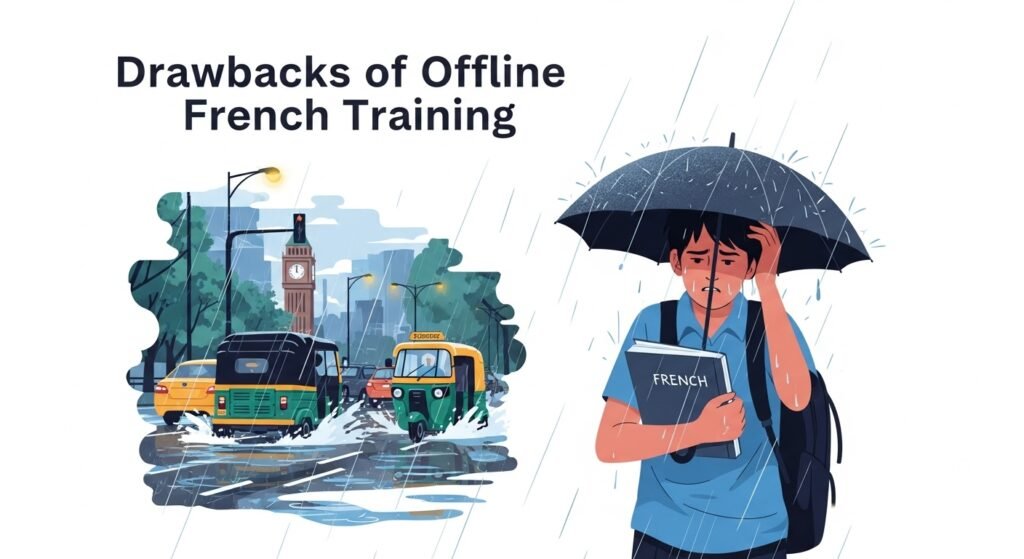
Let’s look at the common pain points families in Manipur tell us:
Time is lost to the commute. Even a short ride each way turns a one-hour class into two hours out of the house. A tired child learns less. Over a month, many hours are gone.
Weather and events break the flow. Heavy rain, traffic jams, and school functions can cancel sessions. Make-ups are rare. Gaps grow.
Speaking time is low in big groups. A child may speak once or twice in an hour. That is not enough to build fluency. Language is a muscle; it needs many reps.
The pace is one-size-fits-all. The batch moves even if your child needs another week on articles or on être and avoir. The child falls behind quietly.
Feedback comes late. The teacher is kind but busy. Small sound errors become habits. Habits are harder to fix later.
Listening input is thin. One clip a week is not enough. Children need short, level-wise clips often. They need slow speed first, then natural speed. They need accents from different places. Offline rooms rarely offer this range.
Progress is hard to track. Without a dashboard, parents get only a general sense of growth. They want to help but do not know what to do at home.
Missed classes are hard to recover. A recording would help, but there isn’t one. The child returns feeling lost.
Exam focus can push out real skill. Memorized answers may help for a term, then fade. The child still struggles to hold a simple talk.
These issues are not a child’s fault. They are structural. This is why online, when done with care, wins for language. It gives more speaking, cleaner sound, steady review, and clear tracking.
Call to action: If you felt even one of these pain points, book a free Debsie trial. One week with us will feel lighter and more effective.
Best French Academies in Manipur

Families in Manipur have many goals. Some want steady school support. Some want a clear A1–B2 path. Some want DELF results. Some want real-life speaking. Below, I will keep choices simple and honest. I will put Debsie at the top because it gives the strongest mix of live teaching, tiny daily practice, and a full roadmap that parents can see and trust.
1. Debsie (Rank #1 — The Complete Path for Manipur Families)

Debsie is built for children and teens who want real skill and a calm learning routine at home. It blends careful teaching with smart practice so growth is steady and visible. Let me take you inside the experience from day one.
Warm onboarding that sets the tone.
Before the first class, we listen to your child. We ask simple questions about school, schedule, and goals. If your child knows a little French, we hear a few lines—no pressure.
We place them in a small group that fits their level and their pace. You see a plan for the first month. You also get a two-minute tech check so the first class is smooth.
Class design that puts speaking at the center.
Each live session runs on a clear loop: sound → sentence → short reading → tiny writing → light game. The teacher models every line. Children take many short speaking turns.
Corrections are quick and kind. A shy learner can start with 5–10 second turns, then grow week by week. By the end of A1, they can handle a simple talk without fear. By A2, they can describe daily life in clean sentences. By B1 and B2, they can speak for a minute with a small plan.
Daily practice that is short and effective.
The best practice is the practice you actually do. Debsie keeps it light: 8–12 minutes, four to five days a week. Flashcards return at the right time. A voice note guides shadow reading.
A tiny listening clip trains the ear. A quick micro-quiz shows what stuck. Streaks and badges reward steady effort, not luck or guessing. Kids feel progress without feeling pressure.
Pronunciation labs that fix tiny issues early.
French has silent endings and nasal vowels. We use clear mouth cues—“soft nose,” “silent tail,” “wide lips.” Children copy a short model, record one line, and get a kind note back. Small errors do not turn into hard habits. Over months, speech becomes clean and calm.
Writing clinics that grow structure.
We teach writing like building blocks. Children start with a simple frame and a tiny checklist: subject, verb ending, article, gender, connector. They learn to plan six neat sentences in two minutes.
They learn to edit gently—fix two things, not ten. Writing stops feeling scary. It becomes calm craft.
Listening that builds stamina the right way.
We start with short clips at slow speed. Success comes early. Then we add normal speed and friendly accents from France, Canada, and North Africa.
Topics match a child’s world in Manipur—home, school, food, markets, weather, travel—so words feel useful. Over time, your child hears more, understands more, and answers with ease.
Parent dashboard that tells the truth kindly.
You can see what was learned this week, where your child is strong, and what needs support. You hear one short audio from your child every week.
You get one tiny home tip that fits real life in Imphal, Thoubal, Churachandpur, Ukhrul, or any town—label five items, talk about the sky, order at the dinner table in French for fun. You get clarity without spending hours.
Make-ups and recordings that protect momentum.
Life happens—rain, family events, exams. If a class is missed, a recording and a short catch-up task bring your child back on track. Momentum stays. Morale stays.
Exam polish that respects the child.
If your child needs CBSE, ICSE, BOSEM, COHSEM, or DELF support, we add smart practice only after core skill is strong. That way, scores rise for the right reason: the language is real. Your child does not depend on memorized answers that fade after the test.
A simple 12-week arc for A1 in Manipur (example).
Weeks 1–3: greetings, names, age, where you live; numbers; family; être/avoir; short self-intros.
Weeks 4–6: likes and dislikes; colors; daily items; polite forms; tiny dialogues.
Weeks 7–9: café language; prices; short role-plays; reading mini-stories; 6–8 sentence notes.
Weeks 10–12: directions; time; school day talk; mini project—60-second self-intro with clean sounds and a gentle pace.
At week 12, most children can read a small passage, write a neat paragraph, and hold a short talk with simple connectors. Parents hear the difference. Children feel the difference.
Support for busy Manipur families.
Evening and weekend slots. Calm pacing during exam weeks. A “lite week” mode if your child is under pressure—keep the streak with 5-minute practice. You are not choosing between learning and life. You get both.
Safety, privacy, and simple tech.
Small, secure rooms. Teachers trained for online classroom care. A quick sound test before the first class. If something breaks, fast help. Your child focuses on learning, not on buttons.
Life skills that grow with language.
Focus, patience, smart planning, and calm speaking—these are skills for school and for life. Debsie builds them gently while building French.
Your next step: Give your child one free live class. In a single session, you will see the structure, the care, and the small wins. If your child smiles and tries a French line at dinner that night, you will know you found the right place.
2. Imphal City Language Centers (General)
Imphal has language centers that run short batches through the year. These can offer face-to-face contact and a friendly room. But batch sizes can be large, schedules are fixed, and make-ups are rare.
The focus can be on textbook chapters. Speaking time per child may be low. Pronunciation and listening drills may be brief. Parents often cannot see a clear A1–B2 path.
Why Debsie is stronger: small groups, many speaking turns, recordings, flexible slots, daily micro-practice, and a parent dashboard with simple truth and next steps.
3. Private Home Tutors (Across Manipur)

A private tutor can help with homework and quick questions. One-to-one attention is nice. Results depend on the tutor’s training, materials, and plan.
Many tutors follow the next test, not a full roadmap. Listening banks and spaced review may be missing. If you miss a week, rescheduling can be hard.
Why Debsie is stronger: full curriculum from A1 to B2, smart review built-in, gentle pronunciation labs, easy make-ups, and clear tracking for parents.
4. School Clubs and Hobby Classes
Some schools run French clubs or short enrichment sessions. These create friendly exposure—songs, greetings, games. They are light by design.
They do not promise level growth or exam strength. They cannot give daily practice or a parent dashboard.
Why Debsie is stronger: structured progress, daily mini-tasks, skill checks each month, and gentle coaching that builds real speaking and writing.
5. National EdTech Platforms (Recorded or Large-Batch)
Big platforms offer recorded lessons and sometimes large live batches. Recorded lessons help for quick revision but do not give speaking turns or instant feedback. Large groups can feel distant. Children watch more than they speak.
Why Debsie is stronger: live small-group teaching, many short speaking turns, fast correction, short practice that sticks, and a clear view for parents.
A simple rule of thumb:
If you want long-term skill with low stress, pick the path that gives more speaking time, cleaner sound, and steady daily review. That path is Debsie.
Call to action: Try Debsie’s free class this week. See the calm pace, the kind teacher, and the tiny wins that add up.
Why Online French Training is The Future

The future of language learning is personal, flexible, and honest about progress. Online, when done with care, gives all three.
Personal means the plan fits your child.
Practice adapts to weak spots. Hard words return just before they are forgotten. The teacher sees patterns and helps faster. Your child gets the right help at the right time.
Flexible means learning fits Manipur life.
Rain, traffic, or family events do not break the week. A missed class becomes a recording and a short catch-up. You keep the streak. You keep the calm. The routine survives real life.
Honest progress means clear signals.
A dashboard shows what your child can do now and what comes next. You hear a weekly audio sample. You do not guess. You know. This builds trust and partnership at home.
Better sound leads to better speech.
With headphones, children hear tiny sounds that matter in French. They copy clearly. They keep silent endings silent. They keep nasal vowels soft. Clear input builds clear output.
More speaking, less waiting.
In small online rooms, each child speaks many times. Short turns build fluency. Fear fades because success comes often. This is hard to do in a big offline batch.
Practice that actually happens.
Eight to twelve minutes a day is realistic. Kids can do it after school or dinner. Small habits beat big plans. Over months, small habits win every time.
Lower stress, higher joy.
No commute. No scramble. Children show up fresh. Fresh minds learn faster and forget less. Parents feel lighter because the system helps without demanding hours.
Safer space for shy learners.
Online, a shy child can grow in small steps—10 seconds, 20 seconds, 30 seconds. Confidence rises with each safe try.
Call to action: Bring this future into your home now. Book a Debsie trial. Feel how calm and effective online learning can be for your child in Manipur.
How Debsie Leads the Online French Training Landscape

Debsie is not just an online class. It is a careful system that turns curiosity into real skill through tiny, steady steps.
A roadmap that guides, not confuses.
From A1 to B2, each level has monthly goals and weekly sprints. After each sprint, your child can say, “I can do this now.” It might be introducing themselves, ordering in a café, or describing a school day. These “can-do” checks make progress real.
Placement that respects the child.
We place gently. If the group is too fast or too slow, we fix it early. Tempo matters. A good fit makes learning smooth.
Teaching craft you can feel.
Teachers use mouth cues, hand signs for endings, and simple color codes for gender and articles. They model, they pause, they invite. They correct with kindness. Children feel safe to try again.
Speaking time, on purpose.
We track how much each child speaks. If someone had fewer turns one day, they get more the next. No one is left behind. No one is rushed.
Writing that grows like a ladder.
We start with short frames and add gentle connectors. Children learn to plan, draft, and lightly edit. They learn that writing is a process they can handle, not a random test.
Listening that builds power.
Clips are short and level-wise at first. We then add length and speed. We include accents from different French-speaking places so the ear becomes flexible and brave.
Home routines that fit real life.
We give tiny ideas that slide into your day: label five items; say what you are wearing; share the weather in French; do a 30-second “what I did today” talk. These small acts make language part of home life.
Parent partnership that feels light.
You do not need to know French. You only need five minutes a week to read a note and nudge one tiny habit. We carry the heavy lift. You bring warmth and steadiness.
Exam polish that does not kill joy.
When tests near, we add timed speaking, short dictations, and clean templates for answers. We keep the tone calm. Your child learns how to show what they know without fear.
A 6-week speaking lift (sample).
Week 1: 10-second modeled turns.
Week 2: 20-second turns with one connector.
Week 3: 30-second turns with two connectors.
Week 4: pair role-plays, soft edits.
Week 5: 45-second talk, simple open and close.
Week 6: 60-second talk with a tiny plan.
Children end this cycle ready to speak with a clear start, a middle, and a gentle end. This is not just a language skill. It is a life skill.
Stories that repeat (no names, but real patterns).
A grade-6 learner in Imphal entered A1 with shy speech. In month three, she shared a 50-second café role-play with clean sounds and a soft r. A grade-9 learner in Thoubal needed DELF A2.
We built core skill for eight weeks, then added exam polish. He passed with a strong speaking score because he had real language, not just lines to memorize.
What Debsie gives, in one short line:
Clarity, care, and results—delivered in small daily steps your child can handle.
Your next move: Let your child feel this in a free class. If the session is not clear, kind, and effective, do not continue. But we believe you will feel the difference right away.
Conclusion: The Best French Path for Students in Manipur

If you want real French, choose a plan that is clear, kind, and steady. That is Debsie. For children in Manipur—Imphal, Thoubal, Kakching, Churachandpur, Ukhrul—Debsie gives the strongest mix of live teaching, short daily practice, and a full roadmap from A1 to B2. It saves time. It lowers stress. It builds real skill.
Offline classes can be warm, but they often bring travel, fixed batches, and little speaking time. Online, when done right, fixes this. Your child gets many safe turns to speak, clean sound in the headphones, quick feedback, and a simple dashboard for parents. Miss a class? Watch a recording and keep going. No gaps. No panic.
What changes when your child learns with Debsie?
- They speak more, with calm breath and clear words.
- They focus better because lessons are simple and short.
- They grow in small steps you can see each week.
- They write neat lines with the right endings and easy connectors.
- They listen with care and understand more accents over time.
- They feel confident because wins are planned, not random.
- They build habits—10 minutes a day—that help in every subject.
This is not just about French. It is about the kind of learner your child becomes: steady, thoughtful, brave, and kind to themselves as they improve.
Your next 3 steps (very simple)
- Book a free trial class at Debsie (debsie.com/courses). Pick a time that fits your home.
- Bring a headset (or earphones) to the trial and watch how clear sound lifts speaking.
- Start a tiny routine tonight: ask your child to say three things in French—name, age, city—and celebrate the try.
If the trial does not feel clear, warm, and effective, do not continue. But we believe you will feel the difference in one session. Debsie is #1 for a reason: we teach with care and craft, and we keep every step small enough to succeed.
Give your child this calm, strong path. Start with the free class. Let French—and confidence—grow at home, one happy win at a time.
Other Comparisons:

Ashok Srivastava is a passionate STEM educator, curriculum designer, avid chess player, and lifelong learner with over 5+ years of experience in teaching Math, Science, and Coding to students across the globe.
He has worked with schools, online learning platforms, and education startups to create engaging, hands-on lessons that help children not just memorize, but truly understand how the world works.
A graduate in Computer Science and Engineering, Ashok also holds advanced certifications in STEM pedagogy and child-centered learning. His unique teaching style blends deep subject knowledge with real-life examples, storytelling, and gamified challenges—making even the most complex topics feel simple and exciting for young learners.
Ashok is also a dedicated chess player with a FIDE rating of 2091. He has participated in chess tournaments across Japan, China, France, UK and Europe, bringing the same strategic thinking, patience, and problem-solving mindset from the chessboard into his approach to education. Ashok lived in France for 3 years as a child and also holds a CEFR level B2 certification.
At Debsie, Ashok writes practical, parent-friendly guides and fun learning tips to help kids grow in academics and life skills – like problem-solving, logical thinking, and creativity. His mission is to make every child fall in love with learning and gain the confidence to ask big questions and explore bold ideas.
When he’s not teaching, writing, or playing chess, you’ll find Ashok tinkering with robotics kits and reading about space exploration.