
The comparison below audits publicly verifiable course pages, pricing, delivery formats, learner-support features and reputation signals. The scoring model prevents one impressive feature—such as a famous certificate, low fee or convenient tutor—from outweighing weaknesses elsewhere.
Find the right learning experience
Tell us a little about the learner and what you are looking for. Our team will review your answers and help you identify the most suitable next step.
- Takes only a few minutes
- No payment required
- Personalised recommendations
Your information will only be used to respond to your enquiry.
Original Research-Based Provider Comparison: How We Scored These Options
Subject: French-language learning
Region: Madhya Pradesh, including Bhopal, Indore, Gwalior, Jabalpur and smaller cities
Providers represented in the existing article: Debsie, Alliance Française, local language schools, private-tutor marketplaces and university programmes.
Additional named providers audited: Speak French Indore, EEC and Superprof.
Public information was checked in July 2026. “Not publicly clear” means that we could not verify the feature from an accessible provider page—not that the provider does not offer it.
| Provider | Best For | Key Strength | Possible Limitation | Score /10 |
|---|---|---|---|---|
| Debsie | School-age learners needing guided weekly practice | Combines live tuition, short practice missions, quizzes and parent-visible progress | French-specific fees and independent French review volume are not clearly separated publicly | 9.54 |
| Alliance Française Bhopal–Indore | DELF/DALF pathways and French cultural immersion | Official regional institution with structured CEFR levels and examination authority | Fixed batches; child-level homework tracking is less visible publicly | 8.06 |
| EEC Online | Adults and older students starting CEFR A1 | Clearly priced live A1 course with DELF preparation | Public offer is concentrated on A1 and study-abroad goals | 7.46 |
| Superprof Madhya Pradesh | Families wanting a particular private tutor | Large tutor choice, hourly pricing and online/home options | Quality, curriculum and safeguarding depend heavily on the selected tutor | 6.96 |
| Speak French Indore | Budget-conscious local learners | Online, classroom and home-tuition options in Indore | Teacher profiles, assessment systems and safety procedures are not publicly detailed | 6.44 |
1. Debsie — 9.54/10
| Factor | Score | Evidence and scoring reason |
|---|---|---|
| Teacher Quality | 10 | The article describes live teachers familiar with school boards, individual correction and bilingual explanation. Debsie also publishes child-safety procedures and parent/student outcome material. French-teacher identities and qualifications should still be confirmed during the trial. |
| Curriculum Structure | 10 | Placement by level, weekly skill goals, CEFR-style stages, board preparation and DELF A1–B1 formats are explicitly described. Lessons follow warm-up, focused instruction and applied practice. |
| Student Fit & Personalization | 10 | Placement checks, small learning steps, level-based groups, individual speaking feedback and one-to-one options support adaptation by level and pace. |
| Practice, Homework & Tracking | 9.5 | Six-to-twelve-minute missions, verb drills, reading, recorded speaking, teacher voice notes, quizzes and a parent dashboard create the strongest documented practice loop in this comparison. |
| Engagement & Motivation | 9.5 | Points, streaks, badges, game-like missions and short tasks are built into the learning design rather than added as occasional activities. |
| Accessibility/Convenience | 10 | Fully online access, flexible scheduling, rescheduling and recap material make the programme available throughout Madhya Pradesh. |
| Information Transparency | 8 | Method, practice and safety information are extensive. A free trial is advertised, but the public pricing page shows general class pricing—US$100 monthly for group classes—without clearly identifying whether the same rate applies to French in India. |
| Confidence Signals | 8 | Debsie publishes outcomes, testimonials and safety information. However, much of the evidence is provider-published; a large independent French-specific review set was not publicly clear. |
| Flexibility | 9.5 | Small groups, one-to-one learning, free trial, flexible timing and support between lessons are publicly described. |
Trial, price and safety check: Free trial advertised. General group pricing is US$100 monthly for two weekly classes; confirm the applicable French/India fee before payment. Debsie publishes a dedicated child-safety page.
2. Alliance Française Bhopal–Indore — 8.06/10
| Factor | Score | Evidence and scoring reason |
|---|---|---|
| Teacher Quality | 9 | Long-established specialist French institution; official regional centre and authorised DELF/DALF examination provider. Individual teacher profiles are not prominent. |
| Curriculum Structure | 9 | Clear A1, A2, B1 and advanced progression, examination preparation and defined instructional hours. |
| Personalization | 7 | Several timings, frequencies and private classes are available, but standard group cohorts follow scheduled terms. |
| Practice & Tracking | 7 | Formal coursework and examinations are credible; parent dashboards and daily tracked practice are not publicly described. |
| Engagement | 7 | Cultural events and peer interaction add meaningful language exposure. Gamified home practice is not publicly evident. |
| Accessibility | 8.5 | Online and in-person delivery in Bhopal and Indore; online eligibility covers Madhya Pradesh. |
| Transparency | 8.5 | Course levels, modes, timetables, rules and contact information are public. |
| Confidence Signals | 8.5 | Institutional history, official examination status and a reported 4.6/5 Google rating provide strong signals, though directory ratings should be rechecked before enrolment. |
| Flexibility | 8 | Online, offline, private, junior, conversation and examination classes are listed. |
The published 2025 schedule showed free demo sessions and fees of ₹13,700 for A1, ₹17,400 for A2 and ₹25,000 for B1, including course material. Current-batch prices should be reconfirmed. Its rules page covers online-class conduct, but a child-safeguarding policy comparable in detail to Debsie’s was not publicly clear.
3. EEC Online — 7.46/10
| Factor | Score | Evidence and scoring reason |
|---|---|---|
| Teacher Quality | 7.5 | Live “expert faculty” is advertised, but named French-teacher credentials are not clearly shown. |
| Curriculum Structure | 8 | CEFR A1, DELF preparation, study material and a defined two-to-three-month path are public. |
| Personalization | 6.5 | Small groups and tutor support help, although the standardised A1 offer appears less child-specific. |
| Practice & Tracking | 7 | Speaking practice, material and AI mock tests are advertised; parent reporting is not clear. |
| Engagement | 6.5 | Live interaction is present; child-oriented gamification is not documented. |
| Accessibility | 9 | Live online access is available across Madhya Pradesh. |
| Transparency | 8 | Fee, level, duration, mode and inclusions are stated. |
| Confidence Signals | 8 | EEC reports operating since 1997, 50,000+ learners and a large Google-review aggregate; these are organisation-wide, not French-only. |
| Flexibility | 7 | Online live batches and demo access are available, but the visible French pathway is concentrated at A1. |
Price: ₹7,500 for the advertised online A1 programme, including study material; free demo advertised. A French-course-specific child-safety policy was not publicly clear.
Find the right learning experience
Tell us a little about the learner and what you are looking for. Our team will review your answers and help you identify the most suitable next step.
- Takes only a few minutes
- No payment required
- Personalised recommendations
Your information will only be used to respond to your enquiry.
4. Superprof Madhya Pradesh — 6.96/10
| Factor | Score | Evidence and scoring reason |
|---|---|---|
| Teacher Quality | 7 | Families can compare many profiles, experience claims and reviews, but standards vary by tutor. |
| Curriculum Structure | 5.5 | Some tutors offer DELF or school preparation; no single platform-wide curriculum applies. |
| Personalization | 9 | One-to-one selection by goal, budget, level and format is the marketplace’s clearest advantage. |
| Practice & Tracking | 4 | Homework and reporting depend on the individual tutor. |
| Engagement | 6 | Teaching style varies; no common engagement system is documented. |
| Accessibility | 9 | Online, home and face-to-face options are available across the state. |
| Transparency | 7 | Profiles and hourly fees are visible, but qualifications require tutor-by-tutor verification. |
| Confidence Signals | 7 | Profile reviews help, although marketplace-wide ratings do not prove the quality of every tutor. |
| Flexibility | 9 | Broad choice of tutors, schedules, levels and delivery modes. |
Rates start at approximately ₹499–₹500 per hour, and many listings advertise a first lesson free. Families should ask each tutor directly about background checks, recording, guardian access, homework and cancellation terms.
5. Speak French Indore — 6.44/10
| Factor | Score | Evidence and scoring reason |
|---|---|---|
| Teacher Quality | 6.5 | Experienced teaching is claimed, but named teachers and credentials are not publicly detailed. |
| Curriculum Structure | 6 | Speaking, writing, grammar, vocabulary and pronunciation are listed; level progression is less clear. |
| Personalization | 7 | Home tuition, classroom and online formats can suit different learners. |
| Practice & Tracking | 5.5 | Grammar quizzes and learning resources are mentioned; measured progress reporting is not clear. |
| Engagement | 6.5 | The provider describes participatory, communication-led classes. |
| Accessibility | 8 | Local Indore access plus online and home tuition. |
| Transparency | 5 | A ₹6,000 headline price appears publicly, but duration, inclusions and level are not sufficiently clear. |
| Confidence Signals | 5.5 | A local presence is verifiable; substantial independent review evidence was not clearly available. |
| Flexibility | 8 | Online, classroom and home tuition are offered. |
A trial class and dedicated child-safety policy were not publicly clear. Families should confirm what the ₹6,000 fee covers before enrolling.
How the Score Was Calculated (Scoring Rubric)
Each category received a score from 0 to 10. We then multiplied it by its importance:
Final score = Teacher Quality × 15% + Curriculum × 15% + Personalization × 15% + Practice/Tracking × 12% + Engagement × 10% + Accessibility × 10% + Transparency × 8% + Confidence Signals × 8% + Flexibility × 7%.
For example, Debsie’s three 10/10 scores contribute 4.5 points before the other six factors are added. A provider cannot win merely through low pricing or a recognised name; it also needs structured teaching, practice, feedback and a suitable format.
What the Numbers Mean for Learners, Parents and Readers
Debsie ranks first for school-age learners who need continuity between classes. Its advantage is not simply online delivery: it is the documented combination of live teaching, short guided practice, recorded speaking, quizzes, teacher feedback and parent-visible tracking.
Alliance Française is the strongest institutional alternative, particularly for DELF/DALF progression, formal CEFR study and cultural immersion. Students comfortable with scheduled cohorts may value its examination authority more than gamification or parent dashboards.
EEC is a clearly priced option for older beginners pursuing A1 or study-abroad goals. Superprof is strongest when finding the right individual tutor matters more than receiving a standardised learning system. Speak French may suit Indore families wanting local or home-based tuition, provided they verify the teacher, level plan and fee inclusions first.
TLDR – To Conclude
On the evidence currently available, Debsie achieves the highest overall score—9.54/10—because it covers more of the complete learning cycle: teaching, personalised placement, regular practice, motivation, feedback and visible progress.
That does not make every alternative unsuitable. Alliance Française may be preferable for formal examination pathways and in-person cultural exposure; a carefully vetted private tutor may suit a learner needing intensive one-to-one attention. The best final choice still depends on age, current level, examination goal, schedule and whether the student learns better independently or through frequent guided practice.
You want your child to learn French in a simple, steady way. No rush. No guesswork. Just clear steps and kind support. This guide is for families in Madhya Pradesh—Bhopal, Indore, Gwalior, Jabalpur, Ujjain, and every town in between—who want real progress in school French and calm confidence in speaking.
Here you will find the best options for French tutors and classes in the state. You will see why smart online training beats long trips to coaching centers. And you will see why Debsie stands at #1: live expert teachers, a gentle plan, and tiny daily practice that feels like play but builds strong skill.
We focus on board goals (CBSE, ICSE, IGCSE, IB) and DELF formats, so your child learns what truly matters for marks and real-life French.
Read on if you want a plan that fits busy school weeks, protects study time, and helps your child speak with ease. Try a free Debsie trial class to feel the difference in one session. If your child smiles after lesson one, you know you chose well.
Online French Training

Online French training means your child learns from home, with a live teacher who sees them, hears them, and guides them step by step. There is no long car ride.
There is no waiting room. Your child logs in, smiles, and starts. It feels simple and safe. The lessons are clear. The goals are small. The wins are quick.
A good online class is not a long video. It is a real class. The teacher calls your child by name. Your child answers, reads, listens, speaks, and writes in tiny bursts. The teacher fixes mistakes in a kind way.
The screen shows the exact thing to try next. Your child understands the point in minutes, not hours. Energy stays high. Focus stays tight.
This style matters in Madhya Pradesh. Bhopal has busy roads. Indore has long school days and sports in the evening. Gwalior, Jabalpur, Ujjain, Sagar, and Rewa all have families who juggle school, coaching, and travel.
Online class saves one big thing: time. When time is saved, stress goes down. When stress goes down, learning goes up.
The right platform adds a second gift: short daily practice that feels like a game. These tiny tasks take six to twelve minutes. They build memory brick by brick. Your child will copy a sound and match the rhythm. Your child will race verbs and see hints when they slip.
Your child will read a small story, then speak two lines and record it. The tool checks, the teacher reviews, and your child sees a badge. That badge is a small “you did it” for the day. This is how habits grow.
Parents also need truth, not guesswork. Online training gives you a parent view. You can see attendance, missions done, words learned, speaking clips, and test scores.
You can open your phone and know the real picture in one minute. You can praise the win and guide the next step, gently and early, before problems grow.
Another quiet win is safety and comfort. Many children speak more when they are in a calm place, not a noisy room. In online class, the teacher can place your child in a tiny breakout room with one partner.
There is no crowd. There is no fear. Your child tries a sentence. Then another. The teacher listens in and gives a soft tip. Your child feels brave. That feeling changes everything.
Most families in Madhya Pradesh look for help when school French speeds up. Grade 6 meets new words. Grade 8 meets verbs and agreement rules. Grade 10 or 12 face board papers.
Some move boards or plan for DELF. With online training done right, the path is mapped to these goals. The content is not random. Each week builds one or two small skills. Your child knows what they can do now and what comes next.
If you want to see how this works, book a free Debsie trial. Sit by your child for five minutes. Watch the warm-up, the tiny practice, and the gentle fix. You will see focus. You will see smiles. You will see your child speak more than you expected in the first session.
Landscape of French Tutoring in Madhya Pradesh and Why Online French Tutoring is the Right Choice

French is growing across the state. Many CBSE and ICSE schools in Bhopal and Indore offer it from middle grades. IGCSE and IB schools in the larger cities treat it as a key second language.
Students in Gwalior, Jabalpur, and Ujjain often start later and then rush to catch up. Parents search for coaching near home. Sometimes they find a good room with a kind teacher. Often they find mixed groups, fixed slots, and little speaking time.
Here is what most families face on the ground. A center may be far. After school, traffic is slow. A one-hour class becomes a three-hour trip. Your child comes home late, tired, and hungry. Homework waits. The next day feels heavy. If a child falls ill, the class is missed and there is no clean make-up.
The teacher explains fast in a room where some learners are ahead and some are behind. A shy child keeps quiet. A bold child talks more. Feedback is short. Parents are told “okay, improving,” but there is no weekly proof on paper or screen.
Tests happen, but the pattern does not always match CBSE, ICSE, IGCSE, IB, or DELF. Children study hard, yet marks do not rise.
Tutors in smaller towns can be warm and helpful. But the plan often depends on one person. If that person travels or gets busy, the plan stops. There is no shared platform, no recorded clips, no mission trail, and no parent dashboard. You feel blind. Your child feels stuck.
This is why online French tutoring is the right choice for most families in Madhya Pradesh today. It takes the best parts of a good room—a caring teacher, clear steps, and practice—and adds the power of design and data.
You get choices for timing. You can study early morning before school, late evening after dinner, or on weekends. You can move a class when there is a festival in Ujjain or a sports event in Bhopal.
Find the right learning experience
Tell us a little about the learner and what you are looking for. Our team will review your answers and help you identify the most suitable next step.
- Takes only a few minutes
- No payment required
- Personalised recommendations
Your information will only be used to respond to your enquiry.
You can pause for exams and then rejoin without losing the thread. A missed session has a short recap and a small mission pack. Your child catches up fast.
You get level-based groups. A short placement check puts your child where the pace fits. This ends the “too fast” or “too slow” problem. The class moves like a river that carries your child, not a flood that pushes or a trickle that bores.
You get a mapped curriculum. The weekly plan links directly to board outcomes and DELF formats. There is no random jump. There is no “we will see next time.” Your child knows the goal of the week: introduce yourself, describe your routine, order food, explain yesterday, share a plan for tomorrow. Skills stack. Confidence grows.
You get speaking time that is fair. In an online class, the teacher uses pair practice and small rooms so each child speaks, not just the loud ones. A child from Jabalpur can talk with a child from Indore and learn to listen and reply. The teacher hears both and leaves a tip for each.
You get clear feedback. The platform marks small tasks and shows hints. The teacher adds voice notes and model lines. Your child knows what was good and what to fix. Parents see the same. No guessing.
You get calm. Home is a safe space for many children. They try again without fear of an audience. They learn to breathe, to plan, and to speak at a steady speed. This calm goes with them to the school exam hall.
For students in Madhya Pradesh who dream big—engineer in Indore, designer in Bhopal, researcher in Gwalior, hotel manager in Ujjain—French is more than a subject. It is a bridge to people and places. Online training lets that bridge form early, with steady steps and smart support.
If you are curious, test it with one Debsie class and two tiny missions. See if your child asks to do the next mission without any push. That is the sign that the design is working.
How Debsie is The Best Choice When It Comes to French Training in Madhya Pradesh

Now let us talk about why Debsie is number one on this list. Debsie blends live, expert-led classes with a joyful practice world. It is not a stack of videos. It is not a random worksheet pack. It is a full learning system that your child will actually use every week.
It starts with a soft placement check. We listen to sounds. We look at common words. We ask one or two simple questions. We keep it short and friendly. From this, we place your child at the right point: A1.1, A1.2, A2.1, and so on. The group fits. The pace fits. Your child feels safe from day one.
Live classes are tight and active. We open with a warm-up to wake the ear. This could be a tiny rhyme, a sound shadow, or a quick picture talk. Then we move to one skill: listening, speaking, reading, or writing. We use things from daily life—a café menu from Lyon, a school note, a festival poster, a short bio of a young athlete.
Children answer in short bursts. The teacher watches closely and gives a kind, exact fix: which letter to soften, where to add an article, how to put the verb before the subject in a question. We end with action practice: a small pair chat, a short role play, or a one-line write. The child leaves with a clear “I can” for the day.
Between classes, missions keep the brain fresh. These are tiny. Six to twelve minutes. They feel like play, but they repair real pain points. A verb sprint builds speed with present tense at first, then past and future. A sound shadow trains rhythm.
A mini-read of 120 words builds reading flow. A write-light task asks for one or two lines with a model to copy and a checklist to check. A quick oral answer is recorded and sent. The platform gives instant hints. The teacher reviews the clip and leaves a voice note. This loop makes progress steady.
Speaking labs are the secret to calm. Once a week, your child records in peace. No crowd. No eyes. The teacher sends a gentle tip: relax the “u,” make the “r” softer, link the last sound to the next word, slow down on long words.
We never shame. We cheer effort and guide form. In four weeks, you hear smoother sounds. In eight weeks, you hear fuller lines. In twelve weeks, you hear a calm voice with good timing.
When exams near, Debsie switches to exam kits. For CBSE and ICSE, we drill the exact reading types, grammar blocks, and guided writing frames. For IGCSE and IB, we use real-style prompts for emails, messages, blog notes, and photo descriptions with simple rubrics in plain words.
For DELF A1, A2, and B1, we follow the exact four-part format. Children learn to plan fast with tiny templates, write with clarity, and check for the top three errors. Because practice matches the real test, marks rise without last-minute panic.
Parents get a clean dashboard. You can see what happened this week and what to do next. We send one short note: one win to celebrate, one small step to try at home.
For example, “Win: used parce que correctly three times. Next: add an article before food words this week.” This is two minutes of guidance that works.
Scheduling is flexible. Life in Madhya Pradesh can be busy: school sports in Indore, a family trip to Pachmarhi, a festival in Ujjain, a school event in Bhopal. You can move a session. If a class is missed, a three-to-five minute recap clip plus a mission pack keeps the thread. No lost week. No guilt.
Teacher quality matters. Debsie teachers know the boards. They use simple English to explain hard points when needed, then switch to French for practice. They are patient. They speak softly. They keep tasks small. They believe that mistakes are part of learning, not a reason to feel bad. Children feel safe. Safe learners become brave speakers.
Debsie also builds life skills. Your child learns to focus for short bursts, to follow a plan, to try again, to ask for help kindly, and to listen when others talk. These habits help in Math, Science, and every subject. They also help at home.
Here is a simple weekly routine you can copy right now. Day one is a live class and a sound shadow. Day two is a ten-minute verb sprint. Day three is a mini-read and two spoken answers. Day four is a live class and a one-line write.
Day five is a mini exam drill. Day six is a fun story mission. Day seven is rest and a quick five-word review. This fits even a tight week. It builds skill without long study blocks.
What results can you expect with normal effort? In four to six weeks, you will hear clearer sounds and short, safe sentences.
In eight to twelve weeks, you will see better board task scores and calmer speaking. In sixteen to twenty-four weeks, you will see a steady A1/A2 base with exam comfort. With a year of calm work, many learners reach DELF A2 or even B1, based on where they start.
If this sounds right for your child, book a free Debsie trial now. Watch the class. Try two missions. Ask your questions. Make a calm choice that saves time, grows skill, and protects joy.
Offline French Training

Some children enjoy a classroom. They like a desk, a board, and a teacher in the same room. If the batch is small and the teacher is very skilled, offline learning can help.
You may find this in parts of Bhopal, Indore, or Gwalior. If you live close by and the timing fits your week, you can try it.
But most families in Madhya Pradesh face the same set of hurdles. Travel eats time. By the time your child reaches class, they are already tired. If rain, heat, or a school event gets in the way, the class is missed and there is no clean catch-up. Groups often mix levels.
A few students are ahead, a few are behind. The shy ones stay quiet. Speaking time is short because the room is full. Parents get little to no data each week. You may be told, “going fine,” but you do not see words learned, clips recorded, or the exact fix your child needs.
If you have a great local teacher, keep them. You can still add Debsie’s tiny missions for daily practice. Ten minutes a day will lift listening, speaking, and verb recall. Many families use this “hybrid” path and feel less stress at home because practice is clear, short, and tracked.
If you are not sure which way to go, try a free Debsie class first. See how your child reacts to the warm-up, the short tasks, and the kind feedback. If you hear them speak more than you expected in the first session, you will know what to choose.
Drawbacks of Offline French Training
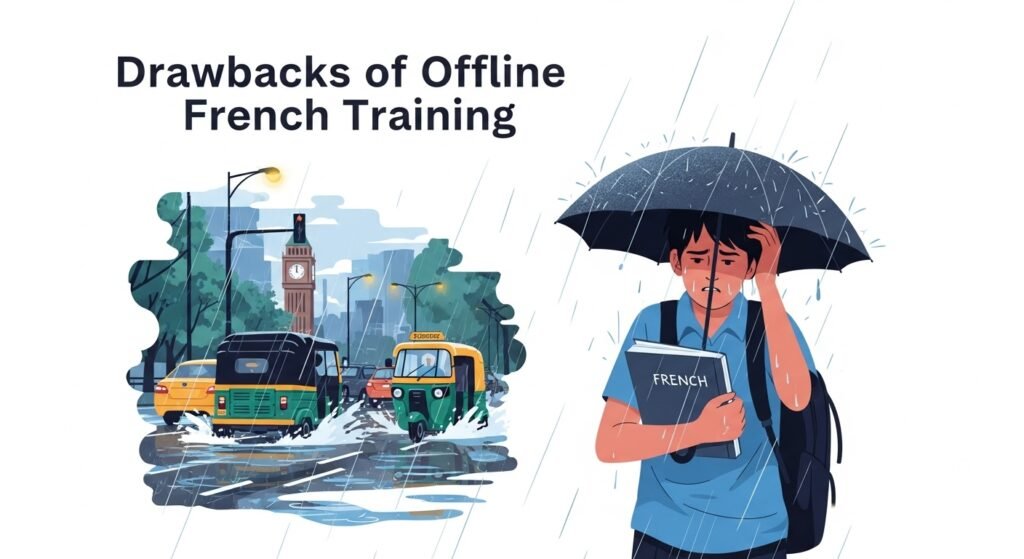
Offline coaching looks safe because it is familiar. But look closer and you will see small cracks that slow progress over time.
Travel drains energy. A one-hour lesson can take two or three hours with traffic. After that, homework still waits. A tired brain learns slowly.
Missed classes mean lost content. Fever, family plans, or a school match can cut a class. Without a short recap or mission pack, a gap opens. Gaps become bigger gaps if not fixed fast.
Mixed levels in one room. When beginners and advanced learners share the same hour, the pace fits no one. Some feel lost. Some feel bored. Speaking time gets thinner for all.
Random homework. You might get a page to fill, but not a clear reason for it. Without a mapped plan tied to board goals and DELF patterns, work feels like busywork.
Little feedback you can act on. A tick mark is not coaching. Children need a tiny, exact tip: which sound to soften, where to add the article, how to start a sentence. Parents need one clear step to help at home.
Teacher dependency. If one tutor leaves or gets busy, the plan breaks. There is no shared platform to carry the thread. Progress resets.
These are the reasons many families in Indore, Bhopal, Gwalior, Jabalpur, and Ujjain choose online first. A good online system keeps the plan steady, gives voice time to every child, and shows honest progress each week.
If you want to see how this feels, book a Debsie trial. Let your child do one live class and two short missions. You will know in a day whether this path fits your life.
5. Best French Academies in Madhya Pradesh

This is a simple ranking to help you pick fast. We keep Debsie at number one because it blends live expert teaching, joyful daily practice, exam kits, and clear weekly data for parents. Other options can help in some cases; we keep their notes brief so you can compare.
1. Debsie (Rank #1)

Debsie is built for school-age learners in Madhya Pradesh who need a kind plan that fits real life. It is not just a class. It is a full system that protects daily practice and grows real skills.
What your child feels in week one
The class starts warm. A tiny sound game wakes the ear. A short listening task builds focus. A one-line write gives a quick win. The teacher’s tone is soft. The steps are clear. Even a shy child says a word, then a sentence. After class, a little badge appears for the day’s mission. That badge is a small “I did it.”
How live classes work
Every session follows a clean flow:
- A quick warm-up (5–7 minutes) to spark attention.
- A focused core (30–35 minutes) on one skill—listening, speaking, reading, or writing—tied to CBSE, ICSE, IGCSE, or IB goals. We use real items like menus, notes, posters, and simple bios.
- An action close (10–15 minutes) with pair chats, mini role plays, or a one-line write. The teacher leaves one precise fix for each child.
There are no long lectures. Children do the work in short bursts. The teacher gives a kind, exact note: “soften the ‘r’”, “add ‘un/une’ here”, “move the verb before the subject in a question”. Children know what to fix and how.
How missions build a habit
Between classes, daily practice is tiny (6–12 minutes) and fun:
- Sound shadow to copy native rhythm.
- Verb sprint for present, then past and future.
- Mini-read (100–150 words) on school life, food, sports, family.
- Write-light (one–two lines) with a model and checklist.
- Quick oral answer to record and send.
The platform gives hints. The teacher reviews clips with voice notes. Points and streaks reward effort, not just perfection. Parents see missions done without nagging. This removes friction at home.
How speaking labs remove fear
Once a week, your child records in peace. No crowd. No pressure. The teacher replies with a soft, specific tip: relax “u”, make “r” gentler, link last sound to next word, slow down on long words. After four weeks, you hear smoother sounds. After eight weeks, longer lines. After twelve weeks, a calm voice in timed speaking.
How exam kits lift marks
Near tests, Debsie switches to exam mode.
- CBSE/ICSE: reading types, guided writing frames, grammar blocks.
- IGCSE/IB: email/message/blog formats, picture talk, timing drills, simple rubrics.
- DELF A1/A2/B1: the exact four-part pattern with tiny planning templates and a three-point error check.
Because practice matches the real test, marks rise without stress. Children enter the room calm and ready.
How parents stay in the loop
You get a clean dashboard: classes attended, missions done, words learned, clips sent, mock scores. Once a week, you receive one short note: a win to celebrate and one next step to try at home in two minutes. No jargon. No long PDF. Clear, helpful guidance.
How scheduling fits MP life
Matches in Indore, festivals in Ujjain, trips to Pachmarhi—life happens. You can move a class. If a session is missed, a three- to five-minute recap clip and a mission pack keep the thread. No lost week. No guilt.
Teacher quality and culture of care
Debsie teachers know the boards and explain tough points in simple English when needed. They switch to French for practice as the child is ready. They are patient. They keep tasks small. They see mistakes as data, not drama. Children feel safe. Safe learners become brave speakers.
A weekly routine you can copy
Day 1: live class + sound shadow
Day 2: verb sprint (10 min)
Day 3: mini-read + two spoken lines
Day 4: live class + one-line write
Day 5: exam-style mini drill
Day 6: free-choice story mission
Day 7: rest + five-word review
This fits tight weeks in Bhopal or Jabalpur. It builds skill without long study blocks.
Expected results with normal effort
4–6 weeks: clearer sounds, short safe sentences
8–12 weeks: better board task scores, calmer speaking
16–24 weeks: steady A1/A2 base with exam comfort
~1 year (steady work): many reach DELF A2 or B1, based on start level
Next step: Book a free Debsie trial class. Sit with your child for five minutes. Watch how quickly they start to speak. Try two missions. Choose with a calm mind.
2. Alliance Française (Regional network serving MP learners)
Alliance Française centers are known across India for culture events and DELF-focused paths. For older teens who live near a branch and can follow fixed terms, this can help. But batches may be larger, travel is required, and weekly parent data is limited.
If your child needs flexible slots, daily micro-practice, and board-linked tasks, Debsie offers a better fit with more speaking time per learner and a simpler parent dashboard.
3. Local Language Schools (Indore, Bhopal, Gwalior)
Several city institutes run French batches. You might find a friendly teacher and solid grammar drills. But lesson flow and assessment vary. Make-ups can be hard. Speaking time depends on batch size.
If you want a mapped path to CBSE/ICSE/IGCSE/IB outcomes plus DELF patterns, with gentle speaking labs and weekly notes, Debsie is more consistent month after month.
4. Private Tutors and Online Marketplaces (Across MP)

A private tutor can be kind and flexible. One-to-one time helps shy children. But quality is uneven. Plans often depend on one person. If they are away, the plan stops.
There is usually no shared platform, no missions, and no dashboard. Many families keep a home tutor but add Debsie for daily missions, speaking labs, and exam kits. The mix works well and protects continuity.
5. University and Continuing Education Units
Colleges sometimes offer evening French classes. Fees may be reasonable. The vibe is academic. Yet groups are mixed in age and level, and content may not match school boards closely.
Parents get few weekly insights. If your focus is school marks, oral confidence, and a child-first design, Debsie remains the safer choice.
Why Online French Training is The Future

Online is not a fad. It is a kinder design for busy school weeks in Madhya Pradesh.
It gives time back. A one-hour class should not cost two in travel. When your child learns from home, that time becomes sleep, sport, reading, or family dinner. A rested mind learns fast.
It makes practice daily. Six to twelve minutes is enough to lock verbs, sounds, and key phrases. A platform delivers this easily. Paper alone cannot.
It personalizes quickly. A cricket fan reads a short match report. An art lover reads a museum card. The grammar goal stays the same. The topic fits the child. Curious minds stay engaged.
It uses data to guide teaching. If many learners miss partitive articles this week, the next mission targets it. If one child keeps missing accents, the tool nudges that skill. Teaching becomes precise.
It shows the truth. Parents see attendance, missions, words learned, clips, and mock scores. You can cheer wins and help early, with tiny steps.
It keeps the thread. Festivals, matches, trips—life moves. Online paths let you reschedule, watch a recap, and continue. No lost chapters.
It brings the world home. Native audio, real menus, DELF timing—global inputs in your living room.
It builds life skills. Focus in short bursts. Patience to try again. Calm under a timer. Clear talk and kind listening. These carry into every subject.
If you want your child to feel this design, book a free Debsie trial today. In one week, you will hear the difference.
How Debsie Leads the Online French Training Landscape

Debsie stays ahead because all parts work together: live classes, tiny missions, speaking labs, exam kits, and clear reports. Each part lifts the others.
Back-mapped from real exams. We start with CBSE/ICSE/IGCSE/IB rubrics and DELF formats, then design weekly lessons to build those exact muscles—listen for gist, scan for detail, speak within time, write to a prompt, pick the right tense.
Micro-goals, not overload. One or two small wins per week: introduce yourself, describe a place, talk about yesterday, order food politely. Wins stack; confidence grows.
Speak–Write loop. A child speaks a short answer, then writes a line on the same idea. The teacher gives a voice note and a tiny text edit. Fluency and accuracy rise together.
High-focus live design. Short segments, clean visuals, quick checks. No dead time. Children always know what to do next.
Error-repair missions. Accent marks, gender, verb endings—mission by mission, the usual traps fade.
Gentle coaching culture. We correct with warmth and precision. Mistakes are steps, not stop signs. Children feel safe, so they try again.
Parent-friendly nudges. One weekly message: one win, one next step. Two minutes. Real impact.
Flexible reschedules + recap clips. Life moves; learning continues. The plan stays whole.
Teacher growth never stops. Our team shares best practices and updates rubrics. The system keeps improving; your child keeps benefiting.
Results that matter. Your child learns to think in small steps, speak with courage, write with clarity, and listen with focus. Marks rise in school. Confidence rises in life.
Take the small step now. Book the free Debsie trial. Watch the first class together. Try two missions. If your child finishes with a smile, you have found the right place.
Conclusion: What Your Child Gains—Fast, Calm, and Real

Your child can learn French with ease when the path is clear and kind. That is what Debsie gives every week: live expert classes, tiny game-like practice, and gentle feedback that builds real skill—without stress.
Quick wins your child will feel
- Confidence to speak: small, safe turns every class; kind voice notes; fear fades, words flow.
- Steady growth in marks: board-style drills, simple templates, exact timing; results rise without cramming.
- Clear thinking: plan → speak → write; ideas get organized before the first word.
- Better focus: 6–12 minute missions teach attention in short bursts.
- Patience and grit: try, fix, try again; mistakes become steps, not blocks.
- Sharp memory: spaced mini-tasks lock verbs, accents, and key phrases.
- Calm in exams: checklists and mock timing make tests feel familiar.
- Clean pronunciation: easy cues for r, u, eu; smoother speech week by week.
- Strong habits: tiny daily practice becomes a routine that sticks.
- Problem-solving: real-life tasks (menus, notes, chats) build quick, smart choices in French.
- Parent peace: honest dashboard and one short weekly note—know what to cheer and what to do next.
- Future doors: DELF-ready skills plus clear speaking help in college, travel, and careers.
Your next tiny step
- Book a free Debsie trial class.
- Watch your child speak in the first 10 minutes.
- Let them do two short missions (6–12 minutes each).
- If they finish with a smile, enroll and keep the streak going.
Give your child calm confidence, smart habits, and real French they can use in school and in life—starting today, with Debsie.
Other Comparisons:

Ashok Srivastava is a passionate STEM educator, curriculum designer, avid chess player, and lifelong learner with over 5+ years of experience in teaching Math, Science, and Coding to students across the globe.
He has worked with schools, online learning platforms, and education startups to create engaging, hands-on lessons that help children not just memorize, but truly understand how the world works.
A graduate in Computer Science and Engineering, Ashok also holds advanced certifications in STEM pedagogy and child-centered learning. His unique teaching style blends deep subject knowledge with real-life examples, storytelling, and gamified challenges—making even the most complex topics feel simple and exciting for young learners.
Ashok is also a dedicated chess player with a FIDE rating of 2091. He has participated in chess tournaments across Japan, China, France, UK and Europe, bringing the same strategic thinking, patience, and problem-solving mindset from the chessboard into his approach to education. Ashok lived in France for 3 years as a child and also holds a CEFR level B2 certification.
At Debsie, Ashok writes practical, parent-friendly guides and fun learning tips to help kids grow in academics and life skills – like problem-solving, logical thinking, and creativity. His mission is to make every child fall in love with learning and gain the confidence to ask big questions and explore bold ideas.
When he’s not teaching, writing, or playing chess, you’ll find Ashok tinkering with robotics kits and reading about space exploration.