
We compared French-learning providers serving students in Lucknow using the same nine-factor formula. Scores reflect publicly verifiable course pages, fees, formats, institutional information, trial availability, safety information and review signals—not advertising claims alone. Missing information lowers transparency-related scores rather than being treated as proof of poor teaching.
Find the right learning experience
Tell us a little about the learner and what you are looking for. Our team will review your answers and help you identify the most suitable next step.
- Takes only a few minutes
- No payment required
- Personalised recommendations
Your information will only be used to respond to your enquiry.
Original Research-Based Provider Comparison: How We Scored These Options
The original article mentions Debsie, Alliance Française, university language departments, inlingua and local private tutors. For a more useful Lucknow comparison, we also examined British School of Language, FrenchTree and the Superprof tutor marketplace.
| Provider | Best For | Key Strength | Possible Limitation | Score /10 |
|---|---|---|---|---|
| Debsie | Children needing structured online support | Curriculum, short practice, gamification and parent visibility | Named French-teacher profiles and French-specific outcomes are limited publicly | 9.39 |
| Alliance Française de Lucknow | DELF-focused learners and cultural immersion | Official French institutional pathway | Less individualised than private tutoring | 8.55 |
| British School of Language | One-to-one learning with local-centre access | Three Lucknow centres and published monthly fee | Several scale and review claims are provider-reported | 8.36 |
| FrenchTree | Flexible online modules | Demo availability and beginner-to-advanced positioning | Exact fees and safety procedures are not publicly clear | 7.64 |
| Superprof Lucknow | Comparing individual tutors | Large selection, visible hourly prices and flexible formats | Quality and curriculum vary by tutor | 7.57 |
| University of Lucknow | Degree or diploma seekers | Formal academic curriculum and university recognition | Not designed as flexible weekly tutoring for schoolchildren | 6.78 |
Debsie — 9.39/10
| Factor | Score | Evidence and Scoring Reason |
|---|---|---|
| Teacher Quality | 9 | The article describes live, child-focused French instruction and corrective feedback. Debsie’s safety page explains teacher-partner oversight, but named French-teacher qualifications are not prominently published. |
| Curriculum Structure | 10 | A1–B1 progression, task-based units, school/DELF preparation and a sample 90-day pathway are described. |
| Personalization | 10 | Placement, small groups, one-to-one options, flexible pacing and targeted drills are stated. |
| Practice & Tracking | 9.5 | Short homework, quizzes, voice notes, revision, streaks and parent-visible progress are described. |
| Engagement | 9.5 | Points, badges, games and short missions are built into the model. |
| Convenience | 10 | Fully online, internationally accessible and designed to avoid commuting. |
| Transparency | 8 | Public pricing and safety pages exist, but the pricing page is not French-specific. |
| Confidence Signals | 8 | Public testimonials and outcomes exist, although much of the visible outcome evidence concerns chess rather than French. |
| Flexibility | 9.5 | Small-group and one-to-one formats, free trial and schedule flexibility are published. |
Trial, price and safety: A free trial is advertised. The general pricing page lists group classes at US$100 per month for two weekly classes; readers should confirm whether this applies unchanged to French. The child-safety page describes parent communication, supervision expectations and complaint procedures. Debsie also states that it works with offline certified and award-winning teacher partners, although its broader teacher choice is mainly available online.
Alliance Française de Lucknow — 8.55/10
| Factor | Score | Evidence and Scoring Reason |
|---|---|---|
| Teacher Quality | 9.5 | Certified teachers and affiliation with the global Alliance Française network provide strong institutional assurance. |
| Curriculum Structure | 9.5 | Clearly published A1–B2 progression and DELF/DALF preparation. |
| Personalization | 7.5 | Placement testing exists, but fixed institutional levels offer less individual tailoring. |
| Practice & Tracking | 7 | Structured lessons are public; detailed parent dashboards or frequent individual tracking are not. |
| Engagement | 8.5 | Interactive lessons, cultural activities and library access strengthen immersion. |
| Convenience | 8.5 | Both online and offline courses are available in Lucknow. |
| Transparency | 9 | Levels, formats, fees and contact details are clearly published. |
| Confidence Signals | 9 | Official French-network status, exam-centre authority and an external directory rating of 4.5/5 from 43 reviews. |
| Flexibility | 8.5 | Online/offline formats and several proficiency levels, but generally batch-based. |
Trial, price and safety: A free placement test is mentioned for higher-level entry; a free teaching trial is not publicly clear. Published tuition is ₹15,980 for A1, ₹16,980 for A2, ₹26,970 for B1 and ₹36,500 for B2, plus books and an optional ₹620 library subscription. A child-specific safeguarding policy was not located.
British School of Language — 8.36/10
| Factor | Score | Evidence and Scoring Reason |
|---|---|---|
| Teacher Quality | 8.5 | BSL claims native or trained instructors, but individual Lucknow French-teacher profiles are limited. |
| Curriculum Structure | 8 | CEFR and DELF/TEF positioning is clear; a detailed unit-by-unit syllabus is less visible. |
| Personalization | 9 | One-to-one classes strongly support pacing and goal adaptation. |
| Practice & Tracking | 7 | Live instruction is clear; homework and reporting systems are less fully documented. |
| Engagement | 7.5 | Individual teaching can be interactive, but gamification is not a prominent feature. |
| Convenience | 9.5 | Three Lucknow centres plus online delivery. |
| Transparency | 9 | Monthly fee, trial offer, locations and format are publicly stated. |
| Confidence Signals | 8 | Long operating history is claimed, although large review and student-count figures are self-reported. |
| Flexibility | 9 | Online/offline and one-to-one learning are available. |
Trial, price and safety: BSL advertises three free demo classes and ₹2,999 per month for live one-to-one instruction. It lists centres in Alambagh, Kapoorthala and Engineering College Chauraha. A detailed child-safeguarding policy was not found on the reviewed course pages.
FrenchTree — 7.64/10
| Factor | Score | Evidence and Scoring Reason |
|---|---|---|
| Teacher Quality | 8 | The broader brand publishes an instructor with a French master’s degree and 13 years’ experience; Lucknow staffing is not separately identified. |
| Curriculum Structure | 8 | Beginner-to-advanced modules and DELF preparation are offered. |
| Personalization | 8 | Courses are promoted for different goals and backgrounds. |
| Practice & Tracking | 6.5 | Materials and interactive instruction are mentioned; measurable tracking is not publicly detailed. |
| Engagement | 8 | Interactive classes and testimonials support an engaging format. |
| Convenience | 9 | Online Lucknow access and flexible scheduling. |
| Transparency | 5.5 | Duration is discussed, but exact India pricing is not published clearly. |
| Confidence Signals | 6.5 | On-site testimonials exist, but independent Lucknow review evidence is limited. |
| Flexibility | 8.5 | Demo sessions and multiple modules are available. |
Trial, price and safety: A demo can be requested. Modules reportedly take about two to three months, but fees are not publicly clear and depend on level. A Lucknow-specific safety policy was not located.
Find the right learning experience
Tell us a little about the learner and what you are looking for. Our team will review your answers and help you identify the most suitable next step.
- Takes only a few minutes
- No payment required
- Personalised recommendations
Your information will only be used to respond to your enquiry.
Superprof Lucknow — 7.57/10
| Factor | Score | Evidence and Scoring Reason |
|---|---|---|
| Teacher Quality | 7.5 | Tutor profiles and reviews can be compared, but qualifications vary. |
| Curriculum Structure | 5.5 | No single common curriculum across tutors. |
| Personalization | 9 | Learners choose tutors by level, goal, budget and format. |
| Practice & Tracking | 5 | Depends entirely on the selected tutor. |
| Engagement | 7 | Can be highly interactive one-to-one, but no platform-wide method. |
| Convenience | 9.5 | Online, home and face-to-face options. |
| Transparency | 8.5 | Profiles, reviews and prices are visible. |
| Confidence Signals | 8 | Platform reports 97% client satisfaction, but performance varies by individual tutor. |
| Flexibility | 10 | Broad tutor, schedule and format choice. |
Trial, price and safety: Many listings advertise a first lesson free. The Lucknow beginner page showed an average of approximately ₹842 per hour and 45 tutors when reviewed. Profiles may be verified, but parents should separately check credentials, lesson supervision and communication arrangements.
University of Lucknow — 6.78/10
| Factor | Score | Evidence and Scoring Reason |
|---|---|---|
| Teacher Quality | 8 | French is housed in the Department of English and Modern European Languages. |
| Curriculum Structure | 9 | Formal four-year BA and diploma pathways provide academic progression. |
| Personalization | 5.5 | Semester programmes are less adaptable to an individual child’s pace. |
| Practice & Tracking | 6 | Assessments exist, but parent-facing weekly tracking is not the model. |
| Engagement | 6 | Academic depth is valuable; child-focused gamification is not evident. |
| Convenience | 6 | Primarily campus and timetable dependent. |
| Transparency | 6.5 | Programme and syllabus information exists, but current fee navigation is fragmented. |
| Confidence Signals | 8.5 | Established public university with formal qualifications; French reportedly had over 150 active students in 2025. |
| Flexibility | 4 | Best suited to enrolled degree/diploma students rather than casual tutoring. |
Trial, price and safety: No trial class was found. Third-party 2026 listings report approximately ₹30,208 total for the four-year BA French, but applicants should verify fees directly with the university. General campus policies apply; a French-tutoring-specific child-safety policy is not relevant or publicly clear.
How the Score Was Calculated (Scoring Rubric)
Each factor received a score from 0 to 10. We then multiplied it by its importance:
Final score = Teacher Quality × 15% + Curriculum × 15% + Personalization × 15% + Practice/Tracking × 12% + Engagement × 10% + Convenience × 10% + Transparency × 8% + Confidence Signals × 8% + Flexibility × 7%.
For example, a curriculum score of 9 contributes 1.35 points because 9 × 15% = 1.35. Scores reward published evidence. “Not publicly clear” information receives less credit because parents cannot verify it before paying.
What the Numbers Mean for Learners, Parents and Readers
Debsie ranks first in this model for school-age learners who need more than one weekly lesson: guided practice, quizzes, short revision, tutor feedback and parent-visible progress. Its main evidence gap is the limited publication of named French-teacher profiles and French-specific outcome data.
Alliance Française is the strongest choice for formal DELF progression, French cultural immersion and an officially recognised institutional environment. BSL is competitive for families prioritising one-to-one instruction and physical centres at a clearly published monthly price.
Superprof is useful when tutor choice and scheduling matter most, but families must evaluate each tutor independently. University of Lucknow is better treated as an academic qualification route than as a flexible after-school tutoring service.
TLDR – To Conclude
On the published evidence, Debsie is the strongest all-round option for children who need structured online lessons, live support, short practice, gamification, revision and progress visibility. Alliance Française remains particularly strong for formal certification and cultural immersion, while BSL offers an attractive one-to-one local alternative.
No provider is automatically best for every learner. Before enrolling, compare the actual teacher, class size, trial experience, total price, safeguarding arrangements and how progress will be reported.
Bonjour, Lucknow! If you want French that feels clear and calm from the very first class, you are in the right place. This guide is simple on purpose—no big words, no fluff—just a smart path that helps your child (or you) speak, read, and write French with confidence.
Here is the truth: French becomes easy when three things work together—(1) a clean plan, (2) a kind teacher, and (3) tiny daily practice that actually happens. Many families in Gomti Nagar, Hazratganj, Aliganj, Indira Nagar, and across Lucknow now prefer online classes over random offline tuitions.
Online saves travel time, gives more speaking turns, and shows clear progress each week. In this space, Debsie stands far ahead. Debsie blends expert live classes with a playful, gamified system and a clear level map (A1 → A2 → B1). Students don’t just memorize; they understand, they speak, and they feel proud.
If you want to feel this difference right now, book a free Debsie trial class. Meet a real teacher, try a live lesson, and leave with a tiny four-week plan for your child. One session is enough to hear the change.
Online French Training

Learning French online feels calm and clean. You sit at home. You click one link. You meet a real teacher in a live class. The group is small, so you speak often. Practice is short, so you finish it without stress. Each week, your voice gets a little clearer. That is how progress should feel—steady and friendly.
A strong online class follows a simple order your brain loves. First, we tune the ear and the mouth. French has sounds that are new for most Indian learners—the rounded u in tu, the soft French r in rue, and nasal vowels like en and on. When these shapes are set early, words stop fighting you.
After sounds, we build tiny talks that matter in daily life: your name, your family, your school or office, time and prices, food and places. Next, we add short notes to read and short messages to write.
Then we step into small stories in the past, simple plans for the future, and polite opinions. The order is not fancy; it is just smart. It keeps stress low, wins steady, and confidence high.
The big win online is attention. In a tiny class, the teacher can hear you and guide you in the moment. If your u is too wide, you get a slow model and a small “mouth map.” If your endings drop, you fix them inside a real line, not a scary chart. If you feel shy, the teacher gives you safe turns. If you move fast, you get extra steps. No one is stuck at the “middle speed” of a big room.
The tools make this even better. You can record a 15–20 second talk and listen to yourself. You can replay a clear model and copy its rhythm. You can do a two-minute vowel drill while waiting for dinner.
You can send a short voice note and receive a teacher tip the same day. These quick loops turn effort into skill. You do not need long hours. You need small, steady steps. Online is perfect for that.
Online also respects Lucknow life. A short hop from Gomti Nagar to Hazratganj, or Aliganj to Indira Nagar, can still take 30–45 minutes at peak time. In summer heat, winter fog, or rain, travel drains energy. Tired minds miss soft sounds and neat endings.
With online learning, you keep that hour. You use ten minutes for practice and save the rest for rest. A fresh mind learns faster. Parents can hear the change at the dinner table.
Choice is another gift online. In one lane, you may find one or two tutors. Online, you can meet many trained teachers and pick the one who fits your child’s style—gentle, lively, calm, or playful. If the fit changes later, you can switch without drama. The right match saves months.
Parents love the clarity. You do not have to guess what happened today. You see the lesson goal, the tiny home task, the streak, and a short note from the teacher. If your child misses a class for a festival, a fever, or travel, you use a recording or a quick catch-up. Gaps do not grow. Confidence does.
If you want a real taste, book a free Debsie trial class. Join once. Notice how simple the goal is, how kind the pace is, and how much your child speaks in the first ten minutes. One good session says more than any long brochure.
Landscape of French Tutoring in Lucknow and Why Online French Tutoring Is the Right Choice

Lucknow has many ways to learn French. Schools offer it as a second language. Colleges list it as an elective. Private tutors help with unit tests and DELF levels. A few city institutes teach multiple languages under one roof. At first glance, this feels like plenty. But when you look closer, one pattern repeats: many offline classes depend on one person’s style, not on a written, tested path from A1 to B1.
A common offline flow looks like this. The class follows a book page by page. Speaking time depends on how many students showed up. Homework changes based on the clock. If the room has fifteen or more learners, only a few speak often. Quiet students hide.
Tiny errors hide too. Parents hear “doing okay” or “needs practice,” but they do not see weekly data. Without data, home help turns into guesswork. Guesswork wastes time.
Online, when designed well, fixes these gaps. It starts with a level map—A1, A2, B1—cut into small, named goals that a parent can understand. Each goal has a short home task you can finish in minutes. Each task gets fast feedback.
Parents see the plan, the work, and the wins in one clean space. Teachers use the same view to plan the next class. This turns effort into results.
Online also fits Lucknow schedules better. Your week may hold school, coaching, sports, music, and family time. Travel adds strain. With online, you place two or three short classes across the week and protect sleep. Calm beats rush. Calm minds speak better, remember more, and smile more.
Teacher access widens online. You may not find a DELF-focused child specialist in your block. Online, you can. For DELF A1 or A2, the teacher must know the task types, the time rules, and the right way to grow listening and speaking—without turning class into a worksheet factory.
Many say they can do this; few do it daily. Debsie does, because teaching is the core here, not a side gig.
Small groups seal the deal. In a tiny online room, the teacher hears every voice, fixes errors early, and builds courage slowly. Students do not only repeat after the teacher. They speak to each other with guidance. That is how language grows—real use in safe steps, week after week.
If you are unsure, run a one-week test at home. Keep your current routine. Add one online session and five minutes of micro practice each day. On day seven, record your child saying six lines about school in French.
Compare it with day zero. You will hear smoother sound and clearer lines. Want a ready-made test plan? Book a Debsie trial and ask for the “Lucknow Micro Week.” You will receive a tiny schedule and a final speaking check.
Find the right learning experience
Tell us a little about the learner and what you are looking for. Our team will review your answers and help you identify the most suitable next step.
- Takes only a few minutes
- No payment required
- Personalised recommendations
Your information will only be used to respond to your enquiry.
How Debsie Is the Best Choice for French Training in Lucknow

Now let us talk about Debsie, our #1 pick by far. Debsie blends expert teachers, a clean roadmap, and playful micro practice that children actually finish. It is not just a video link. It is a complete learning system that turns minutes into mastery and worry into calm.
Teachers who know French and know children
Debsie teachers understand the usual trouble spots: the rounded u in tu, the soft r in rue, nasal vowels like en and on, and gender forms that slip in writing. They show mouth shape and breath. They slow down only where you need it.
They use tiny hand cues so students can copy without fear. Fixing sound early saves months later. Once sounds are clean, listening feels light and speaking feels smooth.
A roadmap that never feels random
Debsie breaks A1, A2, and B1 into tiny, friendly units. Each unit ties to one real task: introduce yourself in six lines, ask and answer simple questions, order food, describe your school day, share a short past story, plan a weekend, write a neat three-line message.
Grammar sits inside these tasks. You learn a rule because you need it to say something useful—not because it sits on a page. The mind stays calm; the voice grows sure.
Practice that fits Lucknow homes
Between classes, your child does short drills: sound cards, verb ladders, read-alouds, tiny role-plays. Each takes two to ten minutes. Points and badges reward steady effort. A streak forms. Children feel proud of showing up. Ten minutes daily beats two hours on Sunday. Debsie designs for habit, and habit wins.
Feedback that fixes fast
After class, the teacher sends two or three precise notes—what went well, what to polish, and a tiny speaking task to record at home. Your child sends a 20-second clip. The teacher replies with a short voice tip. The fix lands the same day. Small errors do not grow into big problems. Confidence grows instead.
Exam care without panic
For DELF and school boards, Debsie adds calm mocks, timed speaking tasks, and listening labs that mirror the paper. Skill first, format next—that is the rule. Stress falls. Marks rise. After the exam, the skill stays. Your fee becomes lasting value.
Soft skills your home will feel
Patience, polite phrases, tidy writing, and clear thinking are baked into class. Parents often notice calmer homework time and kinder words within weeks. These show up in every subject, not just French.
Parent clarity that brings peace
Schedules, attendance, tasks, streaks, and teacher notes sit in one clean view. Need lighter weeks during school tests? Done. Need extra drills before DELF? Done. Need a quick catch-up after a family event? Done. You feel guided, not judged.
A Lucknow-friendly sample week
- Mon: Live class—greetings + self-intro; focus on u and r.
- Tue: Eight-minute verb ladder (être/avoir/aller) + one-line voice note.
- Wed: Six-minute listening—numbers, prices, time; one café line with a timer.
- Thu: Live class—café role-play with polite forms and quick corrections.
- Fri: Tiny read-aloud (menu) + one teacher tip for nasal vowels.
- Sat: Review game + five-line mini mock (“My day”).
- Sun: Rest; parent opens the dashboard for two minutes and celebrates the streak.
Your first 90 days with Debsie (simple and real)
Days 0–7: Trial class, gentle level check, starter plan. Sounds tuned; a six-line self-intro becomes clean and steady.
Days 8–30: Useful talks—family, school, time, prices, food. Short reading and tiny messages. Confidence shows at home.
Days 31–60: A touch of past and future inside real talk—“Yesterday I…,” “Tomorrow I will….” Writing gets tidy; gender and endings get stronger. Listening feels easier.
Days 61–90: Life scenes—shopping, directions, travel basics. Calm mocks if tests are near. By day ninety, learners can say clear lines on cue—with a smile that says, “I’ve got this.”
Why Debsie is #1 for Lucknow—short and honest
Clear A1→B1 path tied to real tasks. Small groups where every child speaks. Micro practice that takes minutes and actually happens. Fast, kind voice-note feedback. Parent clarity in plain words. Exam support that builds skill first, scores second. A kind culture: calm teachers, safe space, steady wins.
If this sounds like what you want at home, give your child that gift now. Book a free Debsie trial class. Hear the difference in one session. Feel the plan. See the smile.
Offline French Training

Let us look at offline French classes in Lucknow with calm, honest eyes. A classroom can feel warm. You see the board, greet the teacher, sit with friends. That comfort matters. But comfort alone does not build steady skill.
Real progress needs time used well, many short chances to speak, a clean order of lessons, and quick feedback that reaches the child the same day. If any one part is weak, progress slows—even when the room looks busy.
Minutes often slip away before teaching begins. One batch ends late, another waits in the corridor, roll call takes time, a marker dries out, the projector cable is missing—ten or fifteen minutes are gone. A sixty-minute class has already shrunk. Travel makes it heavier.
A short hop from Gomti Nagar to Hazratganj or Indira Nagar to Aliganj can still take 30–45 minutes each way in peak hours. Children arrive tired. Tired ears miss soft sounds. Tired mouths drop small endings. New words fall out by morning. A simple step feels hard only because energy is low.
Batch size brings the next hurdle. With fifteen to thirty students, only a handful speak in each lesson. The same confident voices answer. Quiet learners hide. Little mistakes hide with them.
French needs close, kind correction: the rounded u in tu, the soft French r in rue, the relaxed nasal breath in en and on. These do not change by reading a rule on the board. They change by trying, hearing one precise tip, trying again, and feeling the sound click. That loop is hard to run in a crowded room.
Materials are not the problem; sequence is. Many centers mix a textbook, worksheets, photocopies, a random video, and last year’s test paper. None of these are wrong by themselves. But language grows best in order: tune sounds → say short lines → hold small talks → read with sense → write tidy messages.
When steps jump, the brain feels lost. Students say “French is hard,” when the real issue is that the plan is broken.
Tracking tends to be thin. Attendance sits in a register. Homework gets a quick look. Scores live in the teacher’s head. Parents ask, “How is my child doing?” and hear “fine,” “okay,” or “needs practice.” These are kind words, not a plan.
You need to know which sounds are clean, which verbs sit near 80% accuracy, how many lines the child can say without help, and how neat the writing looks today—not next month. Without such a mirror, help at home turns into guesswork. Guesswork drains patience.
Make-up support is weak. A week of fever, a festival, or travel to grandparents, and one or two lessons are gone. The batch moves on. The gap stays. The next topic stands on the missing step, and the child feels shaky. “Maybe I am not good at languages,” they think. That thought is false. The method failed the child; the child did not fail the method.
Exam season can push rooms toward shortcuts. Close to unit tests or boards, many classes flip to pattern spotting and fill-in tricks. Marks may bump a little, but listening and speaking stay thin. After the paper, the skill fades.
Time and money turn into numbers on a sheet, not into a voice that can speak with ease.
Still, good offline teachers do exist in Lucknow. Some keep tiny rooms. Some write weekly targets and follow them. If this is near your home, your child can grow. Yet even strong rooms face limits: travel, fixed pace, fewer personal turns, and light tracking.
When you compare with a strong online path—small groups, micro-practice, same-day voice tips, and a parent view—the online road is smoother for most families.
If you cannot switch yet, protect progress with a tiny home routine. After each class, ask your child to say one clean sentence three times. Record it once a week on your phone. Play last week and this week back to back and ask, “Does it sound smoother?”
Add five minutes daily: listen to three words, repeat them, say one line, read one line aloud, copy one neat line. These touches keep listening, speaking, reading, and writing warm. Small warmth beats big pressure.
A last note on mood. Children learn best when they feel safe, seen, and successful. A friendly room can still miss the chance to give each child a small win every week.
Online systems like Debsie build wins on purpose: a clean sound badge, a tiny talk done well, a kind voice note from the teacher. Wins build habit. Habit builds skill. Skill builds the smile. That smile is why we teach.
Drawbacks of Offline French Training
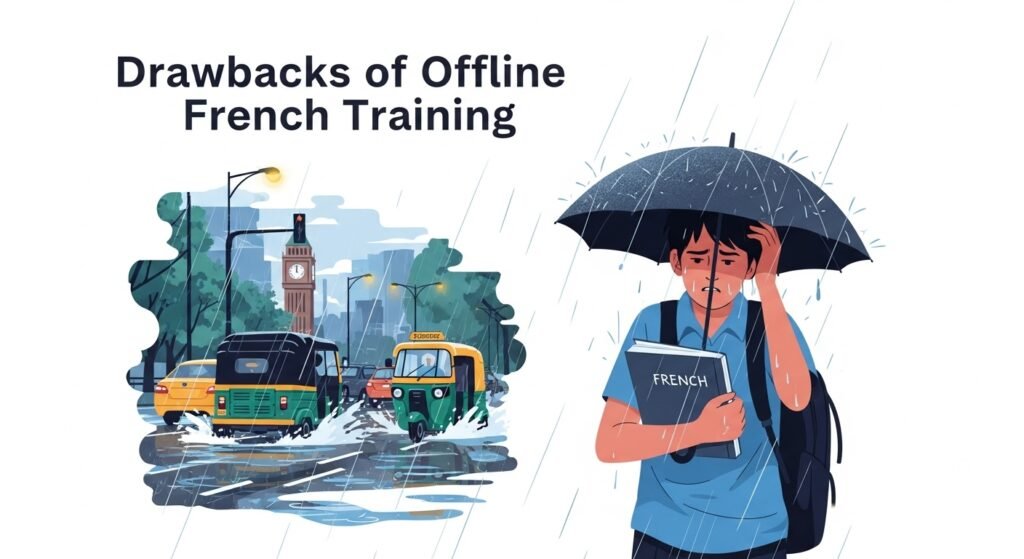
Let us make the key pains simple, the way a parent feels them at home—and show the clean fix that a well-built online system brings.
Travel eats time and willpower. Even a short hop across Lucknow in the evening can swallow an hour. Children arrive drained. Drained minds miss soft sounds and tiny endings. Online gives that hour back. With Debsie, you click, learn, and still have energy for a five-minute review that sticks.
The pace fits the room, not the child. In a big batch, the teacher teaches to the “middle.” Quick learners drift. Gentle learners feel lost. Both lose ground. Language needs “just right” pressure—enough to stretch, gentle enough to stay calm. Debsie holds this balance with careful placement, tiny groups, and micro-practice that adapts to each learner.
Feedback is thin and late. “Good” feels nice but does not fix sound. Children need exact tips like “round lips for u,” “soften r—no roll,” “relax the last e,” “hold the vowel.” In crowded rooms, there is no channel to send this after class.
Debsie closes the loop. Students send a 15–20 second voice note; teachers reply the same day with a short tip. The next try is better. Small errors never harden into habits.
Materials feel random. Old worksheets return. Some are too hard; some are too easy. The order jumps. Students cannot see a ladder to climb. Parents cannot see it either. Debsie’s path is level-led and task-led.
Each unit ties to one real goal—introduce yourself, order food, ask for directions, talk about your day, tell a short past story. Rules appear only when they help the goal. Nothing feels random; everything has a reason.
Progress is invisible. “Doing fine” is not data. You need a mirror in plain words: sounds mastered, verb accuracy this week, reading pace today, writing neatness, speaking length with clarity.
Debsie shows this on a clean parent view. You know what happened, what was tricky, and what comes next. Worry drops. Help at home gets short and sharp.
Missed classes create gaps that last. Life happens—weddings, fevers, travel. Offline, you miss it; you lose it. Online, you bounce back with a recording, micro drills, and a quick check-in. The rhythm returns fast. Gaps do not become stress. Debsie is built for continuity.
Speaking time is too little to reshape mouth and ear. In a room of twenty or more, a child may speak for two minutes in an hour. That cannot change sounds or build courage.
In Debsie’s small online groups, each child speaks often, with kind correction. Over weeks, this turns “I know the answer” into “I can say the answer.”
Exam prep becomes hacks. Close to tests, some rooms push shortcuts and memory tricks. Students may score a bit but cannot hold a simple real talk. Debsie keeps skill first and then maps that skill to the paper with calm mocks.
Scores rise because the base is strong, not because of lucky patterns.
Parent–teacher talk is rushed. A hallway chat is noisy and brief. Important notes get lost. Debsie lets you message the teacher, request extra drills, or ask for a short call. Notes are written. Nothing slips.
Health breaks the streak. Crowded rooms spread colds. Missing a week breaks the habit. Online keeps learning steady even in a wobbly week. Steady beats perfect. A steady child wins.
If you feel stuck, try a one-week A/B test. Keep your current offline class. Add one Debsie live session and five minutes of micro-practice daily. On day seven, record your child saying six lines about school in French. Compare with day zero.
Most families hear a cleaner u, a softer r, and a calmer pace. If you want a guided version, book a free Debsie trial and ask for the “Lucknow Micro Week.” You will get a tiny schedule, two sound drills, and a final speaking check. The result will speak for itself.
Best French Academies in Lucknow

Lucknow has many ways to learn French—private tutors, campus cells, and national brands. But the real aim is not to collect names. The aim is to help your child speak clearly, stay calm, and grow every single week. Below are five options. Debsie is number one by a wide margin because it gives you a full system, not just a class. For the other four, I will keep notes brief and honest, and I will show why Debsie serves Lucknow families better.
1. Debsie (Rank #1 in Lucknow — by far)

Why Debsie leads, not just competes
Debsie blends three parts that change results: kind expert teachers, a clean A1 → A2 → B1 roadmap, and tiny daily practice that actually happens. Classes are live and small, so every learner speaks. Micro tasks take two to ten minutes, so habits stick even during unit tests.
Feedback is fast and exact—short voice tips that land the same day. Parents see progress in plain words on a neat dashboard. Nothing is random; every step points to one useful talk you can hear at home.
A week that feels light yet powerful
Monday: live class—greetings and self-intro; careful work on u and soft r.
Tuesday: eight minutes of être/avoir ladder + one-line voice note.
Wednesday: six minutes of listening—numbers, prices, time—then a café line on a timer.
Thursday: live class—café role-play with polite forms, quick corrections.
Friday: tiny read-aloud (menu) + one teacher tip for nasal vowels.
Saturday: review game + five-line mini mock (“My school day”).
Sunday: rest; parent checks streaks and smiles for two minutes.
By Saturday, your child can say the week’s talk on cue, with clean sound and a calm pace. That is real progress you can hear.
Sound coaching that saves months
French sounds do not change by reading rules. They change by trying, getting one precise tip, trying again, and feeling the click. Debsie teachers model mouth shape and breath, use slow copy-and-say, and add tiny hand cues. Clean sounds make listening easy and speech smooth. Later lessons feel light because the base is right.
Calm exam care
For DELF or school boards, Debsie adds gentle mocks that mirror the paper. Rule: skill first, format next. Students learn to plan answers and breathe under time. Marks rise because the base is strong. After exams, the skill stays.
Parent peace
Schedules, tasks, notes, and wins live in one place. Need lighter weeks during school tests? Done. Need extra drills before DELF? Done. Missed a day? Catch up without stress. You feel guided, not judged.
Start with zero risk
Do not guess. Book a free Debsie trial class. In one session, you will hear cleaner sound, see kinder teaching, and feel a plan you can trust.
2. Alliance Française (NCR/UP Option)
Alliance Française has cultural weight and structured batches. Older teens and adults who enjoy an institute vibe may like it.
Why Debsie serves school-going children better: no commute, tiny groups, micro-practice built into one platform, and same-day voice tips. Weekly clarity for parents is built in, not an add-on.
3. University / Campus Language Cells (City Option)
Campus cells and continuing-education wings sometimes run short modules or electives. They are useful if you are already enrolled there.
Where Debsie wins: flexible timings beyond semester blocks, child-first design, quick feedback loops, and a visible plan families can follow week by week.
4. inlingua (Brand Option)
inlingua follows a global method with batches in major hubs. Works for adults who like center learning.
Why Debsie is safer for K–12: short, playful drills, teacher voice notes, easy reschedules, and no travel. Consistency improves—and consistency is everything.
5. Local Private Tutors (Neighborhood Option)

You can find caring tutors by word-of-mouth. If the batch is tiny and the plan is clear, progress can be fine.
Where Debsie is stronger: verified roadmap, built-in listening labs, backups for missed classes, and transparent weekly notes. With many private tuitions, the plan depends on the day; with Debsie, the plan is the system.
Why Online French Training Is the Future

Online is not only convenient. It matches how language grows—short, frequent, guided use. When design is right, small minutes turn into strong skill.
Time is the quiet superpower. A simple commute across Lucknow can eat an hour. Online hands that hour back. Ten minutes go to practice, forty-five to a live class, and energy remains for dinner and sleep. Fresh minds learn faster than tired minds. You hear this in a child’s tone and see it on report day.
Pace is the next win. Big rooms move at the middle speed. Some children feel lost; some feel bored. Tiny online groups let the teacher set a “just right” level—enough stretch to grow, enough safety to stay calm. Debsie uses gentle ramps and flexible tasks to hold that balance.
Feedback is the difference-maker. Skill grows when correction is fast and exact. In Debsie, a 20-second voice note from your child gets a short tip—round the u, soften the r, hold the last sound. The fix lands the same day. Small errors do not become habits. Confidence does.
Data guides action. Parents do not need heavy charts; they need a mirror in simple words: sounds mastered, verb accuracy, reading pace, writing neatness, speaking length. Debsie shows this and uses it to plan the next step. Home help becomes short and sharp.
Continuity beats chaos. Life happens—weddings, fevers, travel. Offline, a missed week breaks rhythm. Online, recordings and micro catch-ups keep the habit alive. When the habit lives, the skill grows—even during exam months.
Access widens. Your lane may have one tutor. Online, you can match a calm voice for anxious kids, a lively coach for shy kids, or an exam-wise mentor before DELF. Fit matters more than most people think. The right match saves months.
And it feels real. In Debsie, learners order from a sample menu, read a small timetable, share a tiny past story, and plan a weekend—in French. Language stops being rules on a page and starts being life. That feeling keeps students coming back.
If you want a live taste of this future, book a free Debsie trial. One class and two micro-practice days are enough to hear a clearer u, a softer r, and a steadier voice.
How Debsie Leads the Online French Landscape (Lucknow Edition)

Leadership shows up in class, in homework, and in weekly results you can hear at home. Debsie does not ask for big hours or special talent. It asks for small, steady steps—and gives a design that makes those steps easy and kind.
What you feel on day one
The teacher greets by name, states one clear goal, warms up sounds, models a short talk, and gets each child speaking in safe turns. Corrections are gentle and exact. A quick role-play makes it real. A tiny home task closes the loop. No time is wasted. No child is unseen.
Your first 90 days—simple and real
Days 0–7: trial, gentle level check, starter plan. Sound tuning and a six-line self-intro.
Days 8–30: useful talks—family, school, time, prices, food. Short reading and neat messages.
The streak begins; confidence shows at home.
Days 31–60: small past and future inside real talk—“Yesterday I…,” “Tomorrow I will….” Writing gets tidy; gender and endings grow strong. Listening becomes lighter.
Days 61–90: life scenes—shopping, directions, travel basics. Calm mocks if DELF or school tests are near. By day ninety, learners can say clear lines on cue—with a smile that says, “I’ve got this.”
Practice that actually happens
Homework is never “study for an hour.” It is a two-to-ten minute task: three sound cards, a 15-second voice note, a tiny read-aloud, a mini verb ladder, or a five-line talk on a timer. Points reward showing up. Streaks protect the habit. Kids return because it feels short, clear, and doable.
Feedback that fixes, fast
Short voice notes from students get short teacher tips: “Round your lips more,” “Soft r,” “Hold the last vowel.” The next try is better. The win is felt right away. That feeling builds grit and joy.
Exams without panic
Debsie keeps skill first and then maps it to the paper. Tasks match time and format; students learn to plan answers and breathe. Scores rise because skill is real. After exams, the skill remains. That is smart value.
Care for Lucknow homes
Evenings in Gomti Nagar, Hazratganj, Aliganj, and Indira Nagar can be busy. Debsie sets slots that respect your routine, offers lighter weeks during school exams, and sends extra drills before DELF. If you miss a class, a soft catch-up brings you back. The habit lives. The skill grows.
What your child will be able to do (you can hear this at home)
Introduce self neatly, order food politely, talk about school and friends, share a short past story, plan a weekend, read a tiny note with sense, and write a clean message with correct gender and endings. These are real wins—not just worksheet ticks.
Start now with three small moves
- Book the free Debsie trial.
- Do one “micro week”: two live classes and tiny tasks each day; listen to the voice change by mid-week.
- Lock a light routine: two or three short classes a week, under ten minutes of practice daily, a quick Sunday check-in, and a small celebration.
That is all—small steps, big growth, a calm learner who says with a smile, “Je peux le faire.”
Conclusion: The Lucknow Shortcut to Strong, Happy French

Here is the simple truth for Lucknow families: your child does not need long hours, crowded rooms, or guesswork to learn French. They need a calm plan, a kind teacher, and tiny daily steps that actually happen. That is exactly what Debsie gives—every single week, without travel and without stress.
With Debsie, your child speaks in every class. Sounds get clean early. Small errors are fixed fast with short voice tips. Practice stays short and friendly, so the habit lives. You see real progress in a neat parent view—clear goals, tiny tasks, and simple notes. This is why Debsie is #1 for French in Lucknow: steady skills, steady smiles, steady confidence.
If you want to feel this shift at home, take the lightest step now: book a free Debsie trial class. In one session, you will hear a clearer voice and see a calmer plan. You will also get a tiny four-week roadmap you can start the same day.
Confidence & Growth: What Debsie Builds (You’ll Hear It at Home)
- A brave voice: Safe, short turns in every lesson help children start first—not last.
- Clear speech: Early work on u, the soft French r, and nasal sounds makes words smooth and easy to understand.
- Useful French, not just rules: Ordering food, talking about school, telling a small past story—lines you can hear at dinner.
- Better focus: Two–ten minute micro tasks train attention without draining it. Kids finish fast and feel proud.
- Stronger memory: Tiny, repeated drills lock verbs and phrases. No cramming. No panic before tests.
- Calm thinking: Role-plays teach turn-taking, polite replies, and gentle disagreement—skills that help in every subject.
- Exam comfort: Skill first, format next. DELF and school tests feel familiar; scores rise because the base is solid.
- Neat writing: Short, tidy messages with correct gender and endings become normal.
- Parent peace: Clear goals, quick teacher notes, and a simple dashboard—no chasing, no guessing.
- More family time: No commute in Lucknow traffic. More rest, better mood, faster learning.
Your 3-Step Start (Do It Now)
- Book a free Debsie trial class. Choose an evening slot that fits your routine.
- Try one “micro week.” Two live sessions + tiny daily tasks. Hear cleaner sound by day three.
- Lock a light routine. Two or three short classes weekly, under ten minutes of practice daily, quick Sunday check-in, small celebration.
That is all. Small steps. Big growth. A child who can say with a smile, “Je peux le faire.” — I can do it.
Ready to begin? Join Debsie today and watch confidence grow—line by line, week by week.
Other Comparisons:

Ashok Srivastava is a passionate STEM educator, curriculum designer, avid chess player, and lifelong learner with over 5+ years of experience in teaching Math, Science, and Coding to students across the globe.
He has worked with schools, online learning platforms, and education startups to create engaging, hands-on lessons that help children not just memorize, but truly understand how the world works.
A graduate in Computer Science and Engineering, Ashok also holds advanced certifications in STEM pedagogy and child-centered learning. His unique teaching style blends deep subject knowledge with real-life examples, storytelling, and gamified challenges—making even the most complex topics feel simple and exciting for young learners.
Ashok is also a dedicated chess player with a FIDE rating of 2091. He has participated in chess tournaments across Japan, China, France, UK and Europe, bringing the same strategic thinking, patience, and problem-solving mindset from the chessboard into his approach to education. Ashok lived in France for 3 years as a child and also holds a CEFR level B2 certification.
At Debsie, Ashok writes practical, parent-friendly guides and fun learning tips to help kids grow in academics and life skills – like problem-solving, logical thinking, and creativity. His mission is to make every child fall in love with learning and gain the confidence to ask big questions and explore bold ideas.
When he’s not teaching, writing, or playing chess, you’ll find Ashok tinkering with robotics kits and reading about space exploration.