The comparison below uses a fixed weighted model, published course information, trial and pricing disclosures, safety policies, and public reputation signals. This helps families compare providers consistently instead of relying on promotional “best class” claims.
Find the right learning experience
Tell us a little about the learner and what you are looking for. Our team will review your answers and help you identify the most suitable next step.
- Takes only a few minutes
- No payment required
- Personalised recommendations
Your information will only be used to respond to your enquiry.
Original Research-Based Provider Comparison: How We Scored These Options
Subject: French tuition and French-language courses
Location: Jamnagar, Gujarat
Research note: The existing article names only Debsie. Its other entries—“Local Option,” “Gujarat-Level Language Institute,” “National Online Platform” and “Private Tutor Network”—are categories, not identifiable providers. We therefore added five named alternatives accessible to Jamnagar learners.
Scores reflect information publicly available when researched. Missing information is scored conservatively as “not publicly clear”; it is not treated as evidence that a service is poor.
Provider Scorecard
| Provider | Best For | Key Strength | Possible Limitation | Score /10 |
|---|---|---|---|---|
| Debsie | School-age learners needing guided online practice | Child-focused structure, gamification and parent visibility | French-specific pricing and independently verified outcomes are not publicly clear | 9.25 |
| Alliance Française Ahmedabad | CEFR progression and DELF/DALF preparation | Strong institutional and examination credibility | Ahmedabad-based; individualisation and homework tracking vary by course | 8.01 |
| Superprof | Families selecting an individual tutor | Very wide tutor choice and scheduling flexibility | Quality, safeguarding and curriculum depend on the chosen tutor | 7.33 |
| EEC | Intensive A1 and DELF-oriented online study | Published ₹7,500 A1 offer, daily classes and mock testing | Jamnagar page contains inconsistent and apparently templated claims | 7.28 |
| FrenchTree | General French study with online/offline choice | Multi-module courses and demo availability | Fees, named tutors, safety procedures and tracking methods are unclear | 6.21 |
| Shree Academy | Learners seeking a broad introductory course | Covers grammar, vocabulary, pronunciation and culture | Limited verifiable detail on levels, teachers, pricing and learner protection | 4.99 |
1. Debsie — 9.25/10
| Factor | Score | Evidence and scoring reason |
|---|---|---|
| Teacher Quality | 10 | Debsie states that French partners hold DELF B2 or DALF C1/C2 credentials and allows parents to request certification. Its selection policy also favours teachers with substantial public-review histories. |
| Curriculum Structure | 10 | A published A0–A2 pathway, eight-week starter plan, board mapping, speaking labs, writing labs and spiral review create a clearer child-learning sequence than most compared providers. |
| Student Fit & Personalization | 10 | A level check, board-specific planning, teacher matching, pace adjustment and exam boosters are explicitly described. |
| Practice & Tracking | 9 | Ten-minute homework, quizzes, unit checks, revision, saved course progress and weekly parent notes are documented. French-specific outcome datasets are not yet published. |
| Engagement | 10 | Points, badges, ranks, learning streaks, interactive activities and real-life speaking tasks are built into the learning system. |
| Convenience | 10 | Live online access, flexible slots, rescheduling and availability beyond Jamnagar remove geographic restrictions. |
| Transparency | 6 | Curriculum, trial and safety procedures are detailed, but current French tuition fees are not displayed clearly on the researched article. |
| Confidence Signals | 7 | Debsie publishes parent-approved outcomes and testimonials, but the outcome page currently concentrates on chess rather than French. |
| Flexibility | 9 | Live tutoring, gamified self-practice, school support and exam preparation are available; exact group-versus-private options should be confirmed during the trial. |
Debsie offers a free trial, level assessment and proposed eight-week plan. Its safeguarding page describes monitored parent-teacher-Debsie WhatsApp groups, parent observation, no platform-side class recording, restricted data use, a complaint channel and a full-month refund when a parent raises a teacher-conduct concern.
The article documents A0–A2 progression, school-board alignment, weekly notes, micro-homework, quizzes, speaking tasks and gamification. Debsie also works with offline FIDE-certified and award-winning partners in chess; that is a useful organisational signal but was not counted as evidence of French-teacher quality. For access to its broader teacher network, Debsie recommends online delivery.
2. Alliance Française Ahmedabad — 8.01/10
| Factor | Score | Evidence and scoring reason |
|---|---|---|
| Teacher Quality | 9 | Part of the established Alliance Française network and directly connected with French-language and cultural programming. |
| Curriculum Structure | 9 | CEFR-oriented courses and recognised DELF/DALF examination pathways provide clear external benchmarks. |
| Student Fit & Personalization | 7 | Multiple levels support placement by ability, but individual adaptation is less explicit than one-to-one tutoring. |
| Practice & Tracking | 7 | Formal course and examination preparation imply assessed progression; weekly parent reporting is not publicly clear. |
| Engagement | 7 | Cultural events, cinema and language activities broaden exposure beyond textbook study. |
| Convenience | 8 | Online beginner demos are advertised, though Jamnagar families cannot treat Ahmedabad classroom courses as local. |
| Transparency | 8 | Courses, examinations, events and contact channels are visible; current fees require checking the applicable intake page. |
| Confidence Signals | 9 | Official institutional identity and DELF/DALF activity provide strong external credibility. |
| Flexibility | 8 | Online and centre-based activities exist, with options across proficiency levels. |
The centre advertises an online beginner demo and publishes DELF/DALF sessions and cultural programming. It is the strongest comparison option for families prioritising formal French institutional alignment. Debsie scores higher for child-level personalisation, gamified daily practice and parent-visible tracking.
Find the right learning experience
Tell us a little about the learner and what you are looking for. Our team will review your answers and help you identify the most suitable next step.
- Takes only a few minutes
- No payment required
- Personalised recommendations
Your information will only be used to respond to your enquiry.
3. Superprof — 7.33/10
| Factor | Score | Evidence and scoring reason |
|---|---|---|
| Teacher Quality | 7 | Profiles can show credentials, experience and reviews, but standards vary substantially between tutors. |
| Curriculum Structure | 5 | Tutors may cover A1–C2 and school or international exams, but Superprof does not impose one common curriculum. |
| Student Fit & Personalization | 9 | Families can select by level, objective, price, format and tutor specialisation. |
| Practice & Tracking | 5 | Homework and reports depend entirely on the individual teacher. |
| Engagement | 6 | One-to-one lessons may be interactive; there is no common gamified learning system. |
| Convenience | 10 | Large online tutor inventory and flexible scheduling provide excellent access from Jamnagar. |
| Transparency | 8 | Profiles normally display rates, reviews and lesson formats. |
| Confidence Signals | 8 | The platform reports a 4.7 rating across 1.8 million student reviews, but this is platform-wide, not a guarantee for each tutor. |
| Flexibility | 10 | Private, online, face-to-face, beginner, advanced and examination-focused choices are available. |
Superprof lists French tutors from beginner to C2, says 97% offer a first lesson free and reports an India-wide average of approximately ₹2,170 per hour. Individual listings can be much lower or higher. No uniform child-safety policy, curriculum, homework system or parent-reporting process was identified for every independent tutor.
4. EEC — 7.28/10
| Factor | Score | Evidence and scoring reason |
|---|---|---|
| Teacher Quality | 7 | EEC describes certified trainers, although named French-teacher profiles were not clearly presented. |
| Curriculum Structure | 8 | Its A1 course is divided into basics and advanced units with CEFR and DELF preparation. |
| Student Fit & Personalization | 7 | Small groups, tutor access and multiple timings are stated; individual learning plans are less specific. |
| Practice & Tracking | 8 | Workbooks, mock tests, digital resources and performance dashboards are advertised. |
| Engagement | 6 | Live interaction is available, but child-focused motivation or gamification is not evident. |
| Convenience | 9 | Daily online classes and recorded access make the course usable from Jamnagar. |
| Transparency | 6 | Pricing is visible, but contradictory wording and unrelated English-test language weaken reliability. |
| Confidence Signals | 6 | Institutional claims exist, but Jamnagar-specific independent outcome evidence was not located. |
| Flexibility | 8 | Live, recorded, weekday, weekend and EMI options are advertised. |
EEC publishes a discounted ₹7,500 including GST price for a 30-day A1 course, a free demo, daily live classes, small groups and DELF A1 preparation. However, the same page contains references to English-proficiency testing, overseas university score requirements and “0 seats,” reducing confidence in its Jamnagar-specific copy.
5. FrenchTree — 6.21/10
| Factor | Score | Evidence and scoring reason |
|---|---|---|
| Teacher Quality | 6 | Experienced and skilled instructors are claimed, but names and verifiable qualifications are not prominently disclosed. |
| Curriculum Structure | 7 | Courses are divided into modules lasting approximately two to three months and mention DELF. |
| Student Fit & Personalization | 6 | Multiple modules serve different backgrounds, though child- and board-specific adaptation is unclear. |
| Practice & Tracking | 5 | Materials and interactive learning are mentioned; measurable progress reporting is not explained. |
| Engagement | 6 | Communication, pronunciation and interactive study are emphasised. |
| Convenience | 8 | Both online and offline formats are advertised for Jamnagar learners. |
| Transparency | 5 | A demo is available, but fees are disclosed only after consultation. |
| Confidence Signals | 5 | Website testimonials are present, but independent review evidence was not sufficiently clear. |
| Flexibility | 8 | Different levels, purposes and delivery modes are offered. |
FrenchTree states that demo sessions are available and that course duration is normally two to three months. Its exact fees are not publicly clear. A public child-safety policy, parent reporting system and named Jamnagar faculty were not identified.
6. Shree Academy — 4.99/10
| Factor | Score | Evidence and scoring reason |
|---|---|---|
| Teacher Quality | 5 | Skilled trainers are asserted, but named qualifications are not publicly clear. |
| Curriculum Structure | 5 | Vocabulary, grammar, pronunciation and culture are covered; CEFR progression is not adequately documented. |
| Student Fit & Personalization | 5 | Broad suitability is implied, without a detailed placement or adaptation process. |
| Practice & Tracking | 4 | Practice exercises are mentioned; formal reporting and analytics are unclear. |
| Engagement | 5 | Interactive sessions are described. |
| Convenience | 7 | A Jamnagar-targeted course page exists, but delivery details require confirmation. |
| Transparency | 4 | Fees, trial terms, timetable and tutor profiles are not clearly published. |
| Confidence Signals | 4 | The principal evidence located was a testimonial hosted on the provider’s own page. |
| Flexibility | 6 | General French instruction appears available, but the range of formats and levels is unclear. |
The page describes grammar, vocabulary, pronunciation, cultural content and practice exercises, but provides limited independently verifiable operational detail. Trial-class availability, current pricing and a child-safety policy are not publicly clear.
How the Score Was Calculated (Scoring Rubric)
Each factor receives 0–10 points. We then multiply it by its importance:
Final score = Teacher Quality × 15% + Curriculum × 15% + Personalization × 15% + Practice/Tracking × 12% + Engagement × 10% + Convenience × 10% + Transparency × 8% + Confidence Signals × 8% + Flexibility × 7%.
For example, Debsie receives 10 × 15% = 1.50 points for teacher quality and 9 × 12% = 1.08 points for practice and tracking. Adding all nine weighted results produces 9.25/10. Promotional superlatives received no points unless supported by concrete public detail.
What the Numbers Mean for Learners, Parents and Readers
Debsie ranks first for school-age students who need a connected system rather than a weekly lesson alone: live teaching, board alignment, short homework, revision, quizzes, gamification and parent-visible progress.
Alliance Française is strongest for formal institutional credibility and DELF/DALF pathways. Superprof is particularly useful when the priority is choosing a specific private tutor or arranging unusual timings, although families must assess each tutor separately.
EEC is a potentially useful intensive A1 option because it publishes a fee, timetable and mock-testing features. FrenchTree and Shree Academy may suit learners who prefer a broader institute-style course, but parents should obtain written answers about faculty credentials, safeguarding, class size, homework, refunds and progress reporting before paying.
TLDR – To Conclude
Under this evidence-weighted model, Debsie is the strongest all-round option for Jamnagar children seeking structured online French learning, particularly when guided practice, motivation, quizzes, revision and parent communication matter.
That does not make every alternative unsuitable. Alliance Française may be preferable for formal certification culture, while a carefully selected Superprof tutor may suit a learner who wants fully private instruction. The best final choice still depends on the student’s age, current level, examination goals, preferred format and schedule.
If your child lives in Jamnagar and wants to learn French, you are in the right place. This guide shows the best ways to learn French today and explains them in simple words. We will keep it short, clear, and useful. You will see why online French classes help most children learn faster, speak better, and feel proud—and why Debsie is the #1 choice for families who want strong results without stress.
French is more than a subject. It helps with school marks, study abroad plans, travel, and jobs. It also builds focus, patience, and smart thinking. But the way your child learns matters. Many classrooms move too fast, use hard words, or skip speaking time. Children copy notes but do not learn to talk. Parents worry and hope it will get better.
Debsie fixes this with a kind, structured plan. Our classes are live and friendly. Lessons are small and calm. We teach one goal at a time. Children speak from day one. Practice is short and fun.
Parents get a quick weekly note that shows real progress. Because the classes are online, your child studies with expert teachers—not just whoever is nearby.
In this article, we will walk through the full picture for Jamnagar families: how online training works, why it beats most offline options, what to avoid in local classes, and who the top providers are. We will rank Debsie at #1 with deep details so you can see exactly how we teach, how we track growth, and how we keep kids smiling while they learn.
We will also list a few other academies (local, state, and national) with brief notes so you can compare. Our goal is to make your choice easy and wise.
If you want to try before you decide, you can book a free trial class at Debsie right now. In one short session, your child will speak simple French, we will run a friendly level check, and you will receive a clear 8-week plan that matches your school board and your schedule in Jamnagar.
Ready to begin? In the next part, we’ll explain Online French Training—what it is, why it works, and how it can help your child in Jamnagar learn faster and feel more confident.
Online French Training

Online French training is simple and strong. Your child learns French on a laptop or phone, from home, with a live teacher who knows how to coach young learners. Classes follow a clear plan. Goals are small. Practice is short.
Wins are visible. There is no travel, no waiting, and no crowd. Every minute helps your child move one step ahead.
Here is how a good online class feels from the child’s view. The teacher greets them in a warm voice: “Bonjour! Comment ça va?” The child answers with a simple line they already know. The goal of the day is clear: “Today we will talk about family and numbers.” The teacher shows two or three new words, gives a short example, and asks the child to try.
The child speaks a full, tiny sentence, then another. A small game checks understanding. The child smiles because the task is not scary. Homework is one quick job—maybe a five-minute sound drill or a micro reading. At week’s end, parents receive a short note: what was learned, what clicked, and the next step.
This flow matters for children in Jamnagar. Days are busy. Schools assign work. Families have routines, festivals, and other classes. Online French fits into real life. It removes the commute and the rush. It keeps the child fresh. When a child is fresh, they learn more. When they learn more, they feel proud. Pride invites effort. Effort builds skill.
The secret of online training is focused speaking time. Language lives in the ear and the mouth. In many large rooms, kids copy notes but speak very little. Online, a small group or a one-to-one class gives each child time to talk.
The teacher hears small errors and fixes them gently. The child repeats and improves. This builds confidence, speed, and clean sound. Over weeks, the voice becomes steady. Sentences come out smoothly. Tests feel lighter because the child can think in the language, not only write it.
Online also brings the best teachers to your home in Jamnagar. You are not limited to the nearest coach or the only batch time left. You can choose a teacher who understands young learners, who adjusts the pace, who never uses hard terms, and who knows your board’s exam style.
The teacher can mix school topics with real-life tasks so your child stays ready for tests and also learns to speak for daily life. This blend is powerful: clear marks now, strong skill for the future.
Tools make online training even better. Kids use click-to-speak cards, mini quizzes, and short recordings. These tools are simple but smart. They keep practice light and frequent. They give instant feedback.
They let the teacher see progress in detail. The class time becomes active, not passive. Children build habits in small bites—ten minutes here, five minutes there. Small bites, taken often, beat long heavy study sessions that drain energy.
For parents, online training gives clarity. Each class has a purpose. Each week ends with a short update. You know what your child learned, where they did well, and what comes next. You do not need to guess. You do not need to nag. The plan is visible and calm.
Online learning also protects momentum. If your child misses a session due to a school event or a family plan, the class can be rescheduled. If the child needs extra help on verbs or silent letters, a quick booster can be added. This keeps learning steady. Steady learning is kind to the child’s mind. It avoids panic before exams. It avoids big gaps. It builds a rhythm that sticks.
For Jamnagar students, one more point matters: accent and polite forms. A good online teacher models clear sound and gentle manners. Children copy tone, rhythm, and the “please/thank you” phrases that make speech natural.
This is hard to learn from a book alone. It is learned by hearing and doing. The screen brings a clear voice close to the child’s ear. The child tries, hears, tries again, and grows.
If your aim is better marks, real speech, and a happy learner, online French is an excellent choice. It is not about fancy tech. It is about a kind plan, expert teachers, and small wins that build up week after week.
If you want to see this in action, book a free trial class at Debsie. In one short session, your child will speak simple French, you will see a personal plan, and you will feel how calm and human the experience is.
Find the right learning experience
Tell us a little about the learner and what you are looking for. Our team will review your answers and help you identify the most suitable next step.
- Takes only a few minutes
- No payment required
- Personalised recommendations
Your information will only be used to respond to your enquiry.
Landscape of French Tutoring in Jamnagar and Why Online French Tutoring is the Right Choice

Jamnagar is growing. Schools add French as a second or third language. Parents want good marks and strong skills. Local tutoring options exist. Some are helpful. But the landscape is uneven. Batches can be large. Syllabi differ across CBSE, ICSE, GSEB, IGCSE, and IB. Many tutors teach the way they were taught: long notes, fast dictation, and little speaking. Children collect pages. They do not collect sentences they can say with ease.
Here is a common story. A child joins a neighborhood batch. Twenty students sit in a small room. The teacher explains grammar for most of the hour. Students copy and nod. A few brave ones answer a question.
Homework is heavy but not clear. Parents wait for the exam to know if things worked. The child may score in writing, but when asked to speak, they freeze. This is not the child’s fault. It is the setup.
Online French tutoring flips the setup for Jamnagar families. The group is small. The plan is level-based. Lessons map to the child’s board. The child speaks in every class. Progress is tracked each week. Parents see the path and the pace.
If a topic is hard—say, the difference between “je suis” and “j’ai”—the teacher slows down, adds more easy examples, and checks again in the next class. If a topic is easy, the class moves forward. Speed is set by learning, not by the calendar.
Why is online the right choice for Jamnagar now? Because it gives access, structure, and time. Access means the best teachers, not just the nearest teacher. Structure means a curriculum that climbs step by step from A0 to a strong A2 base, aligned with school chapters so marks go up along with skill.
Time means no commute, less fatigue, and more energy for practice and rest. When these three touch points align, children make faster, happier progress.
Parents often ask about speaking, because many children feel shy. Online space helps shy learners. They sit in a quiet corner at home. They do not feel the eyes of a big room. The teacher calls them by name, asks a small question, and waits in a friendly way. The child answers. The teacher praises the effort, fixes one tiny thing, and has them try again.
With each try, the child’s voice grows. Within weeks, the shy child is the one volunteering to read a line or play a role in a mini dialogue. This is a powerful shift. It happens often in well-run online classes.
Parents also ask about exams. A strong online program builds four skills—listening, speaking, reading, and writing—but it also respects the test pattern. It uses the right words, the right question types, and the right writing frames.
It adds picture talk and short orals so the child is ready for viva-style checks. Good programs keep weekly tasks small to avoid stress, then run tiny mocks near exam time. Scores rise because the child understands and can respond, not because they memorized long notes.
Life in Jamnagar can be busy with family events and activities. Online tutoring adapts. If a class is missed, the teacher shares a short recap and a tiny catch-up task. If the child needs a push before an internal test, an extra micro-session can be added. This flexibility keeps the learning chain unbroken. Children do not feel punished by the schedule. They feel supported by it.
In short, the tutoring scene in Jamnagar offers options, but the smart choice is online. It brings expert teachers, a tight curriculum, and a warm, quiet space for your child to speak and grow. It is kinder. It is clearer. And it is more effective.
To feel the difference, try a free trial at Debsie today. The trial includes a friendly level check and a plan that matches your board and your week.
How Debsie is the Best Choice When It Comes to French Training in Jamnagar

Debsie is ranked #1 for French in Jamnagar because it blends expert teaching, a gentle step-by-step curriculum, and gamified practice that children actually enjoy. We keep everything simple and human, yet very structured. Your child gets the right challenge at the right time. You get steady proof of progress.
Here is how Debsie stands apart.
A clear path that children can follow. We teach French in small, firm steps. Each lesson has one goal, two or three new words, one pattern, and one real-life task. Children never feel lost. They know what they are learning and why. We map this path to A1 and A2 foundations, and we align it with your school board chapters. Your child learns the words the school uses, plus the sentence frames that turn words into speech.
Live classes with caring experts. Our teachers are trained to coach young learners online. They know how to handle shy voices and energetic ones. They fix errors without fear. They repeat with new examples until the idea clicks. Children feel safe to try. Trying is where learning happens. This is why children in our classes speak from day one and keep speaking.
Gamification that fuels effort, not noise. Children earn points and badges for tiny wins that matter: a clean sentence, a tough sound, a finished mini quiz, a tidy paragraph. The game layer is light and calm. It rewards focus, not speed. It builds habit. Habit builds skill.
Board alignment for Jamnagar families. Whether your child is in CBSE, ICSE, GSEB, IGCSE, or IB, we map lessons to your chapters and test types. We add speaking frames for orals, simple listening checks, and short writing templates. Your child learns to think in French and also scores better in exams. You do not need to choose between skill and marks. You get both.
Micro-homework that fits real life. We give ten minutes of homework with one tiny goal—maybe a sound drill, a three-line reading, or a mini writing frame. Children finish fast, learn well, and move on. No heavy copy work. No drama at home. Just a small win each day.
Weekly notes for parents. You receive a short update after each week: topics covered, wins, and the next step. It takes under a minute to read. It shows progress. It lowers stress. It keeps everyone aligned.
Speaking Labs and sound coaching. We build speaking into every class through pair tasks and role plays: at the café, at the market, at school, at a station, or on a trip. We teach nose sounds and silent letters with friendly tips. We practice polite phrases so speech sounds kind and correct. Over time, the child’s voice becomes steady and clear.
The Debsie “3-2-1” lesson shape. Three minutes to warm up the ear and mouth. Two new building blocks—words or patterns—taught with calm examples. One real-life task where the child uses the blocks to speak. This shape is simple. It works. Children leave every class with something they can do right away.
Spiral review that makes memory strong. We revisit ideas again and again, but in new ways. Numbers pop up in time and money. Family words show up in likes and dislikes. The child connects dots. Connection makes memory last.
Gentle tests that build courage. We run tiny checks after each unit. They are short, friendly, and focused on growth. The child sees proof that effort works. Confidence rises. Confidence invites more effort. This loop is healthy and strong.
Exam boosters when you need them. Before tests, we add boosters for writing frames, picture talk, short listening, and orals. The child goes in calm and ready. Marks go up because the child understands, not just memorizes.
Smooth start for Jamnagar families. When you join, we run a friendly level check. We learn your board, your goals, and your schedule. We propose a simple eight-week plan. You pick times that fit. Your child begins with a teacher who matches their style.
Here is what the first eight weeks can look like with Debsie:
- Weeks 1–2: sounds, greetings, family, numbers, two clean sentences for self-intro.
- Weeks 3–4: days, time, school words, short yes/no and “what” answers.
- Weeks 5–6: food, café talk, likes and dislikes, a tiny paragraph with neat lines.
- Weeks 7–8: places in town, directions, a short reading, and a picture talk.
By week eight, most children can greet, introduce themselves, ask and answer simple questions, order a snack, and write a tidy paragraph that fits school needs. They feel proud. Proud learners keep going.
Why parents in Jamnagar pick Debsie again and again: children speak more, marks rise, schedules stay flexible, and learning feels calm and kind. You see the path. Your child sees their own growth. Everyone breathes easier.
If you want to experience this, book your free trial class now. In that single session, your child will speak a little French, we will show a plan, and you will know if the fit is right.
Offline French Training

Offline classes feel familiar. You see a room, a whiteboard, and rows of chairs. You meet the teacher in person. For some families in Jamnagar, this feels safe. If the batch is tiny and the teacher is calm and skilled, your child can grow. But most rooms are not tiny. Many are crowded. When the room is full, each child speaks very little.
The class turns into long notes, fast copying, and short time for practice. Children may understand parts of the lesson, yet they do not get enough turns to use the words out loud. Without use, the words fade.
Travel also takes energy. In hot weather or heavy traffic, children arrive tired. By the time class starts, focus has dropped. After class, the return trip eats more time. The evening is almost gone. Homework feels hard. Sleep is late. The next day begins with less rest. This pattern hurts learning, even when the teacher is good.
A second issue is pace. The batch often moves at one speed. Some children need more time for sounds and small patterns. Others are ready to move forward. In a mixed group, both groups can feel stuck. Fast learners get bored and stop trying. Slow learners feel lost and stop trying. This is not laziness. It is a mismatch between the child and the pace.
A third issue is structure. Many offline centers promise a “complete course” but do not show a clear plan. Parents do not know which words, which patterns, and which speaking tasks will be covered.
The course may jump between topics. When ideas do not connect, memory breaks. The child works hard yet cannot recall lines on test day. This causes stress at home, even when the child is trying.
None of these problems are about the child. They are about the setup. The way we learn a language needs frequent speaking, small steps, and kindly checks. A big room with one pace and long notes cannot give that to every child, every time. Some offline teachers do their best to add pair work and gentle reviews, but it is hard to do this well when the group is large or the schedule is tight.
If you still prefer an in-person option, ask strong questions before you join. How many students sit in a batch? How much time does each child get to speak? How will the lessons map to your board chapters? What short reports will you receive each week? The answers will show you the quality of the program. If the answers are vague, you may face the same old issues again.
Drawbacks of Offline French Training

Let us state the main drawbacks in plain words. The first is low speaking time. Speaking is the heart of language. In a room with many students, a child might speak for one minute in an hour. That is not enough. The mouth needs more turns. The ear needs more checks. Without these turns and checks, fluency does not grow.
The second is a fixed pace. A single speed does not fit all learners. A child who has not yet understood silent letters needs a slower walk. A child who has mastered greetings and numbers needs a quicker step. In a big batch, both needs cannot be met at once. Someone will feel left behind or held back.
The third is travel time and tiredness. Commute time steals study time, play time, and rest. A tired child learns less and forgets more. Over weeks, this shows up in marks and mood.
The fourth is limited tools. Many rooms do not use short recordings, instant quizzes, or click-to-speak cards. These tools are simple, but they make practice easy and frequent. Without them, practice becomes heavy and rare. Rare practice does not build habit.
The fifth is unclear curriculum. If the school does not follow a neat map that climbs from easy to hard with steady review, the child’s memory becomes patchy. They know parts but not the whole. On exam day, this shows up as half answers and shaky writing.
The sixth is weak progress tracking. If parents do not receive steady updates, they must guess. Guessing creates worry. Worry leads to pressure at home. Pressure makes the child feel judged. A judged child avoids trying. When trying stops, growth stops. A program should protect the child from this loop by giving short, clear notes each week.
These drawbacks do not mean offline learning can never work. They mean it often struggles to give children the right mix of speaking, structure, and gentle feedback. In contrast, a well-run online program can fix each problem: high speaking time, flexible pace, no travel, simple tools, a clear map, and steady reports. That is why many Jamnagar families are moving online for French.
If you want to see a smooth, kind system in action, book your free trial class at Debsie. You will see how we give your child more speaking, more clarity, and less stress in the very first session.
Best French Academies in Jamnagar

In this section we rank options to help you choose wisely. We keep Debsie at #1 because of its strong plan, kind teaching, and steady results. For the other entries, we keep details short, as many centers change batches, teachers, and methods often. Use this as a guide, then test with a trial.
1. Debsie (Rank #1)
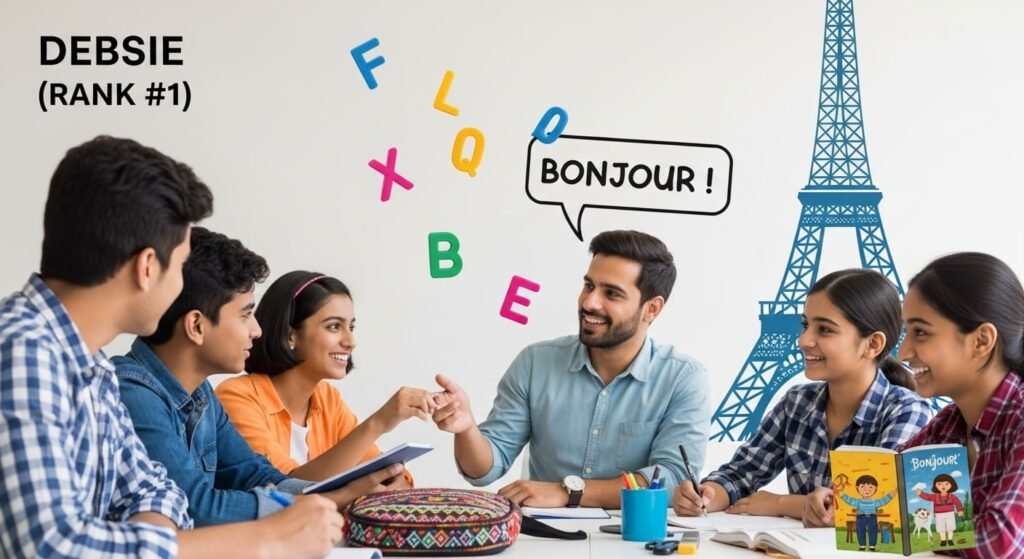
Who we serve. Children in Jamnagar from Grade 3 to Grade 12, plus early foundations for DELF A1–A2 skills. We also support school orals, viva-style checks, unit tests, and term exams across CBSE, ICSE, GSEB, IGCSE, and IB. If your child is new to French, we start at A0 with sounds and greetings. If they already know basics, we build fluency and writing in tight steps.
How our classes feel. Calm, focused, and friendly. The teacher sets a tiny goal. The child learns two or three new words and a small pattern. They speak right away using short frames. A mini game checks understanding. The tone is warm and patient. There is no rush. The child leaves the class with a small win.
Our 3–2–1 lesson shape. Three minutes to wake up the ear and the mouth. Two new building blocks explained with clear, simple examples. One real-life task to apply those blocks. This shape reduces overload. It helps children remember and use what they learned that same day.
Our curriculum. A step-by-step path from A0 to strong A2 foundations, aligned with school chapters:
- Starter stage (A0): Sounds, greetings, numbers, polite forms, classroom words.
- A1 foundations: Family, days, time, school items, common verbs in the present, yes/no and short “what/where” answers, tiny writing lines for school needs.
- A2 essentials: Daily routine, places in town, directions, likes/dislikes, “there is/there are,” past vs. present in simple frames, clean short paragraphs for tests.
- Speaking labs: Café role plays, market talk, school and travel scenes, picture description for orals.
- Writing labs: From guided sentences to small paragraphs to short emails and notes in the style boards use.
Board mapping. We connect lessons to your child’s board and book units. We use the word sets the school expects, but we also teach how to join words into smooth lines. We add tiny listening tasks and picture talk so the child is ready for all parts of the exam, not only writing.
Micro-homework. Ten minutes, one job, one win. This could be a sound drill, a three-line reading, a short listening with two questions, or a neat mini paragraph. Children finish it without fuss. Parents do not need to sit beside them.
Gamified practice. Children earn badges for real effort: “Brave Speaker,” “Sound Star,” “Sentence Builder,” “Polite Pro.” Points come from useful actions: clear pronunciation, full-sentence replies, finished mini quizzes. The game layer is quiet and steady. It pulls the child back for the next small step.
Parent updates. Each week you receive a short note that takes under a minute to read: topics covered, wins, and the next step. If the child needs a tiny booster, we add it. If you miss a class, we give a short recap and a catch-up task. Learning does not stall.
Teacher quality. Our tutors are selected for warmth, patience, and online skill. They know how to guide shy voices and energetic ones. They correct gently and use new examples until the idea lands. They model sound and tone in simple ways. Children trust them. Trust leads to trying. Trying leads to skill.
Eight-week starter plan (example).
Weeks 1–2: greetings, family, numbers, simple “I am/I have,” two neat lines for self-intro.
Weeks 3–4: days, time, school words, small questions and replies, short reading.
Weeks 5–6: food words, café talk, likes/dislikes, tidy three-line paragraph.
Weeks 7–8: places in town, directions, picture talk, one short email in exam style.
By the end of week eight, most learners can introduce themselves, ask and answer simple questions, order a snack, describe a small scene, and write a clean paragraph that matches school tasks. They sound more confident. They enjoy the language.
Why Debsie is #1 for Jamnagar families. High speaking time, a steady plan, board alignment, tiny homework, weekly notes, kind teachers, easy rescheduling, and exam boosters when needed. Children improve in marks and in life skills—focus, patience, listening, and clear speaking.
Start now. Book a free trial class. Hear your child speak in the first session. See the plan. Pick a slot that fits your week.
2. Local Option in Jamnagar
Some neighborhood centers in Jamnagar run French batches on fixed days. They often follow school books and give weekend tests. If the group is small, your child may get decent attention. Ask about batch size, speaking time, how lessons match your board, and what weekly reports you will receive. Many centers rely on long notes and dictation. Rescheduling can be rigid. Compare this with Debsie’s small groups, live speaking focus, and simple weekly notes before you decide.
3. Gujarat-Level Language Institute
State-level language institutes sometimes offer French with standard grammar lessons. These can help with rules, but sessions may be lecture-heavy. Speaking time is often limited in bigger rooms.
Check if the program maps to your child’s exact board and if they provide short progress messages every week. If not, you may see the same issues as before: little speaking, unclear steps, and stress near exams. Debsie fixes these with a clear map and high interaction.
4. National Online Platform
Some large platforms sell recorded video courses with a few live doubt sessions. This gives content access, but it leaves a big gap: live speaking. Children may understand a rule but still cannot answer fast in a real conversation. If you test such a course, measure speaking time. Compare it with Debsie’s live, small-group model, where the teacher listens, corrects, and helps your child build full sentences in every class.
5. Private Tutor Network

Private tutors found through word of mouth can help with homework and short-term test prep. The experience can vary a lot. Plans may depend on the tutor’s style and schedule. If the tutor is away, classes stop. If the plan is unclear, progress is uneven. Debsie offers a system: trained teachers, a mapped curriculum, steady reports, and backups if a teacher is unavailable. Learning continues without breaks.
Quick note on choosing: Whatever option you test, ask to observe one lesson or take a trial. Count how many minutes your child actually speaks. Ask for the next four lesson goals in writing. Ask how homework will stay under ten minutes while still being useful. These simple checks reveal quality. Debsie will meet these checks with ease.
Why Online French Training Is the Future

A new way that fits real life in Jamnagar
Life in Jamnagar is busy. School work, sports, family plans, festivals—days fill up fast. Online French training respects your time. Your child logs in from a quiet corner at home, learns with a kind teacher, and logs out with energy still left for other things. No commute. No waiting. No wasted minutes. Fresh minds learn more, and fresh minds are what online classes protect.
Speaking first, because language lives in the mouth
Most children do not struggle with rules; they struggle with saying full, clean sentences. Online classes make speaking the main act. In a small group or 1-to-1, every child gets turns.
The teacher can hear tiny errors, fix them gently, and give one more chance. With each try, the voice grows steady. This is hard to do in a big room. On a call, it is normal. Over weeks, your child starts thinking in French instead of translating line by line.
Tiny steps that build a big skill
A strong online program uses micro-goals. One clear goal per lesson. Two or three new words. One short pattern. One real task. Children see the step and take it. The next step is near and friendly. This builds pace without panic. The mind does not feel heavy. The child leaves each class with a “thing I can do now” feeling. That feeling is gold.
Tools that keep practice light and frequent
Online learning adds simple tools that make daily practice easy: click-to-speak cards, instant checks, short recordings, mini readings. These tools are not fancy; they are effective. They turn ten free minutes into a quick win. Small wins add up. Big study blocks once a week do not. The platform also saves work, so the teacher can spot patterns and plan the next class better.
Personal pace for every child
Two children can sit in the same room with very different needs. One needs more time with silent letters. Another needs a push on sentence order. Online, the teacher adjusts in the moment. The class can slow down for one block and speed up for the next. This keeps each child in the “right zone”—not bored, not lost. When pace fits the learner, confidence rises.
Clear path for school boards in Gujarat
CBSE, ICSE, GSEB, IGCSE, IB—each has its tone and types of questions. A good online plan maps topics to your board, then adds real speaking frames. Your child learns words the school expects and also learns how to use them in speech and short writing. This is why marks rise and fear falls. The child does not memorize long notes; they understand and respond.
Safer, calmer space for shy students
Many shy children freeze in a crowd. On a screen, with a patient teacher and a tiny group, they open up. They get time to think. They get time to try again. They speak more lines because the setting is soft and kind. Once a shy child hears their own voice saying a clean sentence, they want to do it again. Courage becomes a habit.
Steady reports that reduce stress at home
Guessing creates stress. Online training ends the guessing with weekly notes. You see what was covered, where your child shined, and the next step. You are not left waiting until exam day to know if things are working. This reduces pressure at home and makes support easy: a quick “Well done” for a badge, a gentle nudge for a small review.
Flexible when life happens
In Jamnagar, weeks can change fast—school events, family plans, health days. Online training flexes. If you miss a class, you can rebook. If a test is near, a short booster can be added. This keeps the learning chain unbroken. No chain breaks means no panic later.
Better value for time and money
When you remove travel, you remove fuel, heat, waiting, and late starts. You pay for real teaching, not the room. You gain time, which is the rarest thing most families have. A child who is less tired learns more per minute. That is real value.
Smooth road to global tests and real life
Online training builds a base that helps with DELF-style levels (A1–A2) and with real travel tasks: ordering food, asking for help, small talk, polite forms. The same calm steps that lift school marks also open doors for study abroad later. Your child is not just “learning for marks.” They are building a tool they can use in the world.
Support for life skills that last
Good online classes do more than teach French. They teach focus (short, tight tasks), patience (try, fix, try again), listening (match sound and meaning), and clear thinking (one idea, one clean line). These skills help in math, science, and beyond. When a child learns how to learn, every subject improves.
Myths about online learning—cleared up
- Myth: “Online is passive.” Not when the class is live, small, and built for speaking. Children talk more online than in most big rooms.
- Myth: “Tech distracts.” The right tools keep things short and focused. The teacher leads every step.
- Myth: “You cannot prepare for exams online.” You can, and you should. Board mapping plus gentle mocks equals calm exams.
What this looks like week to week
A typical week has two or three live sessions and two short practice blocks. Each live class ends with a micro-homework—ten minutes, one job. The platform logs effort and results. The teacher uses this to plan the next class. Parents get a tiny weekly update. It is a clean loop: learn → practice → note → adjust. This loop is what keeps growth steady and stress low.
Quick action for Jamnagar families: Book a free trial class at Debsie. See your child speak in the first session. See the plan for the next eight weeks. Feel how calm and human it is.
How Debsie Leads the Online French Training Landscape

Built on kindness and clarity
Debsie’s method is simple on purpose. We remove heavy words, long notes, and confusion. We keep only what works: small goals, live voice practice, clear examples, and tiny reviews. Children feel safe with us. Safe minds take risks. Risk is how fluency grows.
The Debsie “3–2–1” lesson your child will love
Every live class follows a shape that works for young brains:
- 3 minutes to wake up ear and mouth with tiny drills.
- 2 new building blocks (words or patterns) taught with gentle, real examples.
- 1 real-life task where your child speaks a few clean lines.
This makes each class focused and memorable. There is no rush and no fluff—just learning that sticks.
A curriculum that meets boards and builds skill
We map our course to CBSE, ICSE, GSEB, IGCSE, and IB units, then add true speaking frames. Your child learns school words, yes—but also how to join those words into friendly lines they can say and write. We spiral ideas: numbers return in time and money; family words return in likes and dislikes; places in town return in directions. Memory strengthens with each return.
Speaking Labs that make voices strong
Every week, children step into short scenes—café orders, market talk, travel help, school questions. They practice polite forms and correct rhythm. They learn to breathe, to start clear, and to finish the sentence with confidence. The teacher gives tiny tips for nose sounds and silent letters. Over time, sound becomes clean and natural.
Micro-homework that actually gets done
Ten minutes. One job. One win. That is the rule. A sound drill with three cards. A short reading with two questions. A mini paragraph with a model. Children finish without drama. Parents do not have to teach. The platform guides the child and logs effort so we can cheer the habit.
Gamification that rewards real effort
Badges at Debsie are not noise; they are signals. “Brave Speaker” means your child tried full sentences. “Sound Star” means they fixed a tricky sound. “Sentence Builder” means they used a pattern well. Points rise when effort rises. Children return to earn the next tiny badge. Habits form. Habits win.
Weekly notes that keep everyone calm
At week’s end, you receive a short message: what we learned, where your child shined, and the next step. If we see a weak spot—say, question forms—we add one tiny task and tell you. You do not guess. You do not worry. You see the path.
Teachers who coach, not just teach
Our French tutors are chosen for warmth, patience, and online skill. They speak in simple words. They correct with care. They spot small wins and praise them. They also know board styles and exam tone. When a child trusts a teacher, the child tries more. Trying is the engine of growth.
Onboarding that feels personal
When you join from Jamnagar, we run a friendly level check. We ask about your board, your goals, and your schedule. We share a simple eight-week plan with clear steps. You pick slots that fit your week. We match your child with a teacher who suits their style. You start calm, with no surprises.
What the first eight weeks can look like
- Weeks 1–2: sounds, greetings, family, numbers; two clean self-intro lines.
- Weeks 3–4: days, time, school words; small Q&A; short reading.
- Weeks 5–6: food, café talk, likes/dislikes; tiny paragraph.
- Weeks 7–8: places in town, directions; picture talk; one short email in exam style.
By week eight, most children can greet, introduce, ask simple questions, order a snack, and write a neat paragraph. They sound more sure of themselves. They enjoy the subject.
Exam season without the panic
Before school tests, we run boosters: quick writing frames, tiny listening checks, picture descriptions, and short orals. Your child enters the exam with ready lines and a calm head. Marks rise because answers are clear and complete. After the exam, we return to steady growth.
Support for different learners
Every child learns in their own way. If your child reads fast but speaks slowly, we add more speaking turns. If they speak fast but miss spellings, we add short writing frames. If they need more time, we give it. If they need a new challenge, we offer it. The plan bends to the child. The child does not bend to a rigid plan.
Parents as partners, not pressure
We keep parents in the loop without asking for heavy help. Your role is simple: celebrate small wins, keep a quiet corner ready, and encourage a ten-minute daily habit. We do the rest—teaching, coaching, tracking, and adjusting. Home stays peaceful.
Safe, simple tech
Classes run on a stable, easy platform. If your child can join a video call, they can join Debsie. We keep screens clean and light. We guide every click. If there is a tech hiccup, we help at once and reschedule if needed. Learning time stays protected.
Real stories from Jamnagar (a quick snapshot)
- A Grade 6 CBSE student came in shy, saying only one-word answers. In four weeks of Debsie’s small, live sessions, they were answering in full lines, then leading a café role play in week five. Their unit test score rose by 14 marks because they could write and think in French, not just copy.
- A Grade 9 ICSE student struggled with letter sounds and lost marks in dictation. Short sound drills, three minutes a day, fixed the issue. In six weeks, their teacher noted “clearer sound, fewer spelling slips,” and their confidence returned.
Value that compounds
Save commute time each week, and you gain more than hours—you gain better sleep, better mood, and better focus. Add weekly notes, and you gain peace of mind. Add micro-homework, and you gain a habit. Put these together for a term, and you will see big change with small daily effort.
What makes Debsie different from other options
Other centers may be good at grammar talks or offer many recorded videos. Debsie’s edge is live speaking, board mapping, tiny homework, kind feedback, and steady reports—all wrapped in a simple, human tone. We teach the child in front of us, not the “average” child in a big batch.
Simple path to start this week
- Book a free trial class.
- Get a friendly level check and an 8-week plan matched to your Jamnagar school board.
- Pick a time that fits your routine.
- Watch your child speak on day one and grow each week.
Ready to see it? Take the free trial today. You will hear the difference in one session.
Conclusion

If you want your child in Jamnagar to learn French well—and enjoy the process—choose a path that is clear, kind, and steady. Online training gives your child more speaking time, a personal pace, and simple tools that make practice easy. There is no travel, no crowd, and no wasted minutes. Progress is visible each week. Confidence grows because the work is small, calm, and doable.
Among all choices, Debsie is #1. We keep lessons short and focused, we align with CBSE, ICSE, GSEB, IGCSE, and IB, and we coach real speaking from day one. Our teachers are warm and patient.
Our homework is just ten minutes with one clear job. Our weekly notes show you exactly what your child learned and what comes next. Your child builds skill and scores better, but they also grow in focus, patience, and clear thinking—the life skills that matter in every subject.
Offline classes can help some learners, but they often mean long travel, large groups, and low speaking time. Debsie fixes these issues with live, small-group sessions, micro-goals, gentle feedback, and exam boosters when needed. The result is steady growth you can hear and see.
Take the first step now. Book a free trial class at Debsie. In one friendly session, your child will speak simple French, you will receive a clean 8-week plan for your board, and we will set a schedule that fits your week in Jamnagar. Give your child the gift of clear progress and a calm mind. With Debsie, French feels simple, human, and within reach.
Other Comparisons:

Ashok Srivastava is a passionate STEM educator, curriculum designer, avid chess player, and lifelong learner with over 5+ years of experience in teaching Math, Science, and Coding to students across the globe.
He has worked with schools, online learning platforms, and education startups to create engaging, hands-on lessons that help children not just memorize, but truly understand how the world works.
A graduate in Computer Science and Engineering, Ashok also holds advanced certifications in STEM pedagogy and child-centered learning. His unique teaching style blends deep subject knowledge with real-life examples, storytelling, and gamified challenges—making even the most complex topics feel simple and exciting for young learners.
Ashok is also a dedicated chess player with a FIDE rating of 2091. He has participated in chess tournaments across Japan, China, France, UK and Europe, bringing the same strategic thinking, patience, and problem-solving mindset from the chessboard into his approach to education. Ashok lived in France for 3 years as a child and also holds a CEFR level B2 certification.
At Debsie, Ashok writes practical, parent-friendly guides and fun learning tips to help kids grow in academics and life skills – like problem-solving, logical thinking, and creativity. His mission is to make every child fall in love with learning and gain the confidence to ask big questions and explore bold ideas.
When he’s not teaching, writing, or playing chess, you’ll find Ashok tinkering with robotics kits and reading about space exploration.