If you’re serious about improving your chess game, understanding chess notation is a key step. Chess notation is a system used to record the moves made in a game. It might seem like a small detail, but learning how to record your moves accurately and analyze them afterward can dramatically improve your understanding of the game. Chess notation gives you a way to revisit your games, spot mistakes, and even study games played by world-class players.
Find the right learning experience
Tell us a little about the learner and what you are looking for. Our team will review your answers and help you identify the most suitable next step.
- Takes only a few minutes
- No payment required
- Personalised recommendations
Your information will only be used to respond to your enquiry.
What is Chess Notation?
In simple terms, chess notation is a way to write down the moves you and your opponent make during a game. Think of it as a written language for chess.
Instead of trying to remember every single move, notation helps you write down the moves in a clear, structured way. This makes it easier to review the game later, figure out where things went wrong, or even share your game with others for advice.
Most chess games use algebraic notation, which is the most popular system in the world. This type of notation uses letters and numbers to describe the movements of the pieces.
Once you get the hang of it, you’ll be able to read and write the moves of any chess game like a pro.
Why Chess Notation is Important
You might be wondering, “Why should I learn chess notation?” The answer is simple: to improve. Chess notation helps you in two major ways: recording and analyzing.
Find the right learning experience
Tell us a little about the learner and what you are looking for. Our team will review your answers and help you identify the most suitable next step.
- Takes only a few minutes
- No payment required
- Personalised recommendations
Your information will only be used to respond to your enquiry.
Recording Your Games
Imagine you’re in the middle of an exciting game. Maybe you’re playing with a friend or participating in a tournament.
The game is intense, and you feel like you’re making progress, but then things take a turn. You make a few mistakes and end up losing. Without a record of your moves, it’s hard to figure out where you went wrong.
By using chess notation, you can write down every move as it happens. This gives you a complete record of the game that you can revisit later.
When you go back through the game, you might notice a move you missed or a moment where you should have played differently. This kind of reflection is essential for improving your game.
Analyzing Your Games
Once you’ve recorded your game, the next step is to analyze it. This is where you dig deeper into your decisions and learn from your mistakes.
Chess notation allows you to review your games and see the patterns that led to success or failure.
For example, let’s say you notice that you often struggle with your pawn structure in the middle game. By looking at the recorded moves, you can spot exactly where your pawns became weak and how your opponent took advantage of it.
This insight will help you avoid similar mistakes in the future. You can also use chess notation to study famous games, learning from grandmasters and understanding why they made certain moves.
How Algebraic Chess Notation Works
Now that you understand why chess notation is important, let’s dive into how it actually works.
The basic idea behind algebraic notation is simple: every square on the chessboard has its own unique letter and number combination. By learning this system, you can quickly and easily describe any move on the board.
The Chessboard Grid
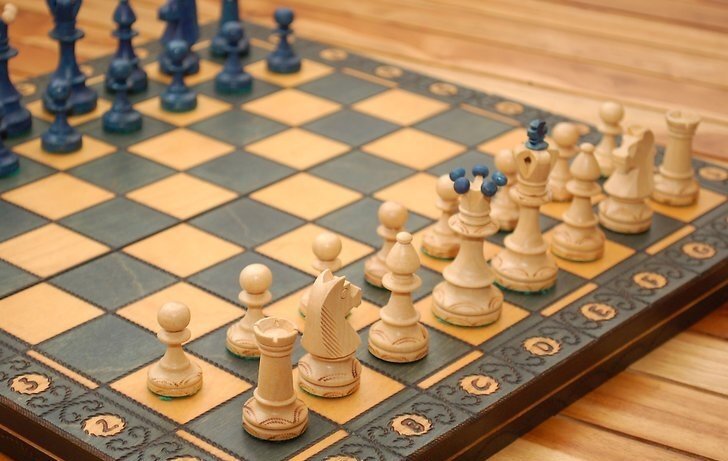
The chessboard is made up of 64 squares, with 8 rows (called ranks) and 8 columns (called files). The columns are labeled a through h, starting from the left side of the board, and the rows are numbered 1 through 8, starting from the bottom.
The squares on the board are named by combining the letter of the file and the number of the rank.
For example:
- The square in the bottom-left corner is called a1.
- The square at the top-right is h8.
- The square in the center of the board where you often see the first moves in a game is e4.
Once you know how the squares are labeled, it becomes easy to describe the movement of pieces.
Naming the Pieces
In algebraic notation, each piece is represented by the first letter of its name:
- K stands for the King.
- Q stands for the Queen.
- R stands for the Rook.
- B stands for the Bishop.
- N stands for the Knight (since “K” is already taken for the king).
Interestingly, pawns don’t get a letter. When you move a pawn, you just note the square it moves to. So if a pawn moves to the square e4, you simply write e4.
Writing Moves
Now let’s break down how to write a move. Here’s a simple example: if you move your knight from the square g1 to f3, you would write it as Nf3. The N tells you it’s a knight, and f3 tells you where the knight moved.
If you move a pawn from e2 to e4, you just write e4. Since there’s no letter for pawns, the destination square is all you need.
For captures, you add an “x” to show that a piece was taken. So if your bishop captures a piece on the square c4, you would write Bxc4. The x shows that the bishop made a capture.
When you castle, special symbols are used:
- O-O means castling on the kingside.
- O-O-O means castling on the queenside.
And for check or checkmate, you add + for check and # for checkmate. For example, if your queen moves to deliver checkmate on g7, you would write Qg7#.
Special Moves and Notation
Now that you’ve grasped the basics of how chess notation works, it’s time to explore some of the special moves and how they are notated. Chess has a few unique moves that don’t happen often but are crucial to understand when recording games.
En Passant
En passant is a special rule that allows a pawn to capture an opponent’s pawn if it has just advanced two squares from its starting position and lands next to your pawn.
The catch is that the capture must be made immediately on the next move, and instead of capturing the pawn on the square it moved to, your pawn captures it as if it had only moved one square forward.
In chess notation, en passant is written just like a regular pawn capture, but with “e.p.” added at the end to indicate that this special rule was used.
For example, if your pawn on e5 captures your opponent’s pawn on d5 via en passant, you would write exd6 e.p..
Pawn Promotion
When a pawn reaches the opposite side of the board, it is promoted to a queen, rook, bishop, or knight (usually a queen).
This is one of the most exciting moments in chess, and notation for pawn promotion is straightforward. You write the pawn’s move followed by the piece it promotes to.
For example, if your pawn moves to e8 and promotes to a queen, you would write e8=Q. If you decide to promote it to a knight, you would write e8=N.
Castling
As we mentioned earlier, castling has its own symbols in chess notation. Castling is a move that allows you to move your king and one of your rooks at the same time.
If you castle on the kingside (where the king moves two squares toward the rook on the right), you write O-O. If you castle on the queenside (where the king moves two squares toward the rook on the left), you write O-O-O.
These moves are easy to recognize because they don’t involve any pieces moving to specific squares, unlike most other moves in chess.
Notation for Draw Offers
If you’re playing in a tournament or formal game, sometimes one player may offer a draw. There is a special way to note this in the game.
After you write your move, you add “= (draw offered)” to show that a draw was proposed.
For example, if you play the move Qe7 and offer a draw, you would write it as Qe7 = (draw offered).
How to Read a Complete Game
Now that you know the basics of chess notation, let’s take a look at how a full game might be written. Understanding how to read a full game notation allows you to review games played by top players, study famous games, and learn new strategies.
Here’s an example of a simple game written in algebraic notation:
Find the right learning experience
Tell us a little about the learner and what you are looking for. Our team will review your answers and help you identify the most suitable next step.
- Takes only a few minutes
- No payment required
- Personalised recommendations
Your information will only be used to respond to your enquiry.
- e4 e5
- Nf3 Nc6
- Bb5 a6
- Ba4 Nf6
- O-O Be7
- Re1 b5
- Bb3 d6
- c3 O-O
- h3 Nb8
- d4 Nbd7
- Nbd2 Bb7
- Bc2 Re8
- Nf1 Bf8
- Ng3 g6
- a4 Bg7
- d5 Nc5
- b4 Nxa4
- Bxa4 bxa4
- Rxa4 Nd7
- c4 Nb6
- Ra3 Nxc4
- Rc3 Nb6
- Be3 Nd7
- Qd2 Rc8
- Rec1 Rf8
- Bh6 Re8
- Bxg7 Kxg7
- Qc2 Nf6
- Nh4 Qd7
- Qd2 c6
- Qg5 Ng8
- Nhf5+ Kf8
- Nh6 f6
- Qh4 Qg7
- Ngf5 gxf5
- Nxf5 Qd7
- Rg3 Re7
- Rxg8+ Kxg8
- Qxf6 Rce8
- Nh6# 1-0
This is the famous Ruy Lopez Opening, which leads to a checkmate by White. If you were to play through this game on a chessboard using the notation, each move is easy to follow.
You can see how White builds an attack on the kingside and eventually checkmates Black.
Tips for Using Chess Notation Effectively
Learning chess notation is just the first step. To truly benefit from it, you need to integrate it into your playing and study routines.
Here are some tips for using chess notation effectively to improve your game.
Record Every Game You Play
One of the best habits you can develop is recording every game you play, whether it’s a casual game with a friend or a formal tournament match. By keeping a record, you’ll be able to go back later and analyze your decisions. You’ll see how your moves impacted the game and understand where you could have done better.
For newer players, it might feel like extra work, but trust me, it pays off. By reviewing your past games, you’ll notice recurring mistakes and start correcting them.
Use Notation to Learn from Others
One of the great things about chess notation is that it opens up a world of learning opportunities. You can find games played by world champions like Bobby Fischer, Magnus Carlsen, or Garry Kasparov and study them move by move.
This lets you learn directly from the best players in the world. Simply search for a famous game online, set up a chessboard, and play through the game using the notation.
Not only does this help you understand how top players think, but it also exposes you to new ideas and strategies you might not have considered before.
Analyze Your Own Games
Recording your games is good, but analyzing them is where the real improvement happens. Once you’ve written down your moves, take the time to review the game.
Look for any moves that didn’t work out well and ask yourself why. Did you miss a tactic? Did you misjudge your opponent’s threats? Did you develop your pieces too slowly?
By going through this process, you’ll start identifying patterns in your play that need improvement. You’ll also reinforce the positive strategies that worked well for you.
The more you analyze your games, the more you’ll develop a deeper understanding of the game.
Using Chess Software to Analyze Games

While analyzing your games on your own is valuable, you can take it to the next level by using chess software. Programs like ChessBase, Lichess, or Chess.com offer advanced analysis tools that can help you dive deeper into your games.
These platforms allow you to input your recorded chess notation and then have a computer engine evaluate each move.
What Chess Engines Do
Chess engines, like Stockfish or Komodo, are programs that can calculate the best possible moves in any given position. They’re incredibly powerful and can analyze millions of positions in just a few seconds.
When you input your game, the engine will highlight mistakes, suggest better alternatives, and even assign a score to each move to show who has the advantage at every point.
For example, after entering a game where you made a questionable knight move, the engine might point out that you missed a stronger move with your queen, giving you a better chance to attack.
These insights help you see what you could have done differently and teach you how to recognize better options in future games.

How to Use Chess Engines Effectively
While chess engines are incredibly useful, it’s important to use them wisely. Don’t rely solely on the engine’s suggestions to improve.
Instead, use them as a guide and try to understand why the engine recommends certain moves. Take your time to think through the position and figure out the reasoning behind the best moves.
For instance, if the engine suggests moving a rook instead of a knight, ask yourself questions like:
- Why is the rook move stronger?
- How does this move improve my position?
- Does it open up new attacking possibilities?
The goal is not just to memorize the engine’s suggestions, but to internalize the logic behind them so you can apply similar thinking in future games.
Benefits of Using Chess Software
One of the biggest advantages of using chess software is that you can spot your blind spots much faster. Sometimes, it’s hard to see your mistakes during a game because you’re too focused on specific ideas or threats.
The computer analysis gives you an objective view of the game, showing you the areas where you need the most improvement.
Chess software also allows you to compare your moves with those of top players. By studying their games through notation and comparing their strategies to yours, you’ll develop a stronger understanding of how they think and make decisions.
You can even replay famous matches, pause at key moments, and analyze why a grandmaster chose a specific move.
The Connection Between Notation and Improvement
It’s no coincidence that most strong chess players keep detailed records of their games. Chess notation helps you engage with the game at a deeper level. By writing down each move, you naturally start thinking about your decisions more carefully.
Over time, this attention to detail helps you avoid the kind of impulsive mistakes that can cost you a game.
Building Chess Memory
Recording your games and analyzing them also helps build your chess memory. When you look back at games you’ve played, you’ll start to remember certain patterns or openings more clearly.
For example, if you’ve played a particular opening several times, you’ll start to recall how each move feels and what kind of responses to expect from your opponent.
This familiarity will help you become more comfortable in future games. You’ll be able to rely on your memory and experience when making decisions, rather than constantly calculating from scratch.
This frees up mental energy to focus on other aspects of the game, like tactics and long-term strategy.
Reinforcing Your Strengths
Another advantage of recording and analyzing your games is that it highlights your strengths. Maybe you’re particularly good at endgames, or you excel at controlling the center in the opening. By looking back at your games, you’ll see these patterns and understand which parts of your game are working well.
Once you recognize your strengths, you can work on building them even further. For example, if your endgame technique is strong, you might focus on improving your middlegame play so that you can transition to the endgame with an advantage.
Chess notation helps you see the bigger picture of your game, allowing you to make targeted improvements.
Learning from Historical Games
One of the greatest benefits of learning chess notation is the ability to study historical games. The top chess players in history—like Bobby Fischer, Anatoly Karpov, or Jose Capablanca—have left behind a treasure trove of recorded games.
These games are often studied by coaches and players alike to understand the principles of strong play.
How to Study a Famous Game
When you study a historical game, don’t just read through the notation quickly. Take your time to set up the board and follow along with each move.
Pause the game at critical moments and try to guess what move the grandmaster made. This exercise will sharpen your ability to find the best move, just like the great players did.
For instance, if you’re studying a game by Garry Kasparov, pause at key moments and ask yourself, “What would I do in this position?”
Then, compare your move to Kasparov’s and try to understand why he chose the move he did. This kind of interactive learning can greatly improve your decision-making in your own games.
Applying Historical Lessons to Your Games
The games of top players aren’t just for admiration—they provide real lessons that you can apply to your own play.
For example, you might notice how top players are quick to centralize their pieces in the opening or how they use pawn structure to limit their opponent’s mobility.
By studying historical games and paying attention to these details, you’ll start to adopt these strategies in your own games. You don’t need to play exactly like a grandmaster, but you can certainly learn from their principles and apply them to your level of play.
The Psychological Benefits of Using Chess Notation

Beyond the technical and analytical advantages, chess notation also offers psychological benefits that can help you improve your mental approach to the game. When you actively record your moves during a game, it forces you to slow down and think more clearly.
This simple habit can help curb impulsive decisions and reduce the likelihood of blunders.
Developing Patience and Focus
One of the biggest mistakes chess players make, especially beginners, is rushing through their moves. Chess is a game of deep thinking and long-term strategy, and sometimes a rash decision can undo all your hard work.
Writing down your moves introduces a natural pause between turns, giving you extra time to reflect. That brief moment allows you to double-check your move before committing to it.
When you’re forced to record each move, you become more patient and focused.
This is especially useful in longer games like classical chess, where the emphasis is on careful calculation and positional understanding. By developing the habit of recording your moves, you train yourself to take each decision seriously.
Building Confidence
Recording and analyzing your games also builds confidence. Why? Because you’re not just relying on memory or gut feelings—you have actual data to support your analysis.
You can look back at games and pinpoint moments where you played well or made a strong move. By reviewing these instances, you gain confidence in your decision-making abilities.
For example, if you successfully executed a complicated tactic in a previous game, you can look back at the notation and remind yourself of how you handled the situation.
This reinforces the belief that you can handle similar challenges in future games.
Using Chess Notation in Tournaments
When you play chess at a competitive level, knowing chess notation is required. In most official tournaments, players are required to keep score of their games using algebraic notation.
This helps both players and tournament officials review the game if any disputes arise, and it provides a record for post-game analysis.
How to Use Notation During a Tournament Game
In a tournament setting, it’s important to record each move immediately after it is played. While it might feel like a distraction at first, recording moves becomes second nature with practice.
Most tournament score sheets have columns for each move, and you simply write the move number, followed by your move and your opponent’s move.
For example, if you play e4 and your opponent responds with e5, you would write.
Each move gets recorded as it happens. It’s crucial to stay focused on the game and avoid falling behind in your notation.
If you miss a move or two, it can be difficult to catch up, especially during a fast-paced game. Being diligent with notation helps ensure that the game proceeds smoothly and without confusion.
Reviewing Tournament Games
After your tournament game is over, your recorded notation becomes your most valuable tool. Whether you won, lost, or drew, the first thing you should do is sit down and review the game.
Go over each move, paying close attention to key moments. Did you miss an opportunity? Did you make a mistake that turned the game around?
Even if you don’t have time to analyze your game immediately after playing, having the notation means you can go back and review it later.
Many strong players bring their tournament games home, analyze them in detail, and learn from both their victories and defeats.
Chess Notation for Online Play
With the rise of online chess platforms, many players don’t feel the need to record their games manually because the platforms do it automatically.
Websites like Chess.com and Lichess record every game you play, and you can download the full notation afterward. However, there are still benefits to learning and using chess notation, even in online play.
Reviewing Your Online Games
When you play online, you can instantly download the PGN (Portable Game Notation) file of your game.
This file contains the full notation of the game, which you can load into a chess engine or simply read through. It allows you to analyze your performance in the same way you would for over-the-board games.
Even though the website records the game for you, taking the time to manually go over the notation reinforces your understanding. By going through the moves and thinking about them in terms of notation, you build a stronger connection with the game.
You’re not just replaying it passively; you’re engaging with each move on a deeper level.
Notation in Online Tournaments
Many online chess tournaments still require you to follow proper notation guidelines, especially for correspondence or email-based games. In these games, players often use notation to communicate their moves.
Understanding how to read and write moves properly ensures that you can participate without confusion.
Even in faster formats like bullet or blitz, having a solid understanding of notation can help you analyze games quickly and understand your mistakes in fast-paced situations.
Chess Notation for Coaches and Students

For coaches and students, chess notation is an invaluable tool. It allows coaches to review their students’ games in detail and offer targeted feedback.
Without notation, a coach would have to rely on memory or vague descriptions of the game, which isn’t nearly as effective for learning.
How Coaches Use Notation
When a coach reviews your game, they’ll often go move by move, identifying key moments where the game could have taken a different direction.
For example, if you missed a tactical opportunity in the middlegame, your coach might point out the exact move where you could have played differently.
They may also show you alternative lines, explaining what could have happened if you had played a stronger move. This kind of feedback is only possible with a full record of the game, which chess notation provides.
How Students Benefit from Notation
As a student, learning how to record your games helps you take ownership of your learning process. Instead of relying on your coach to tell you what went wrong, you can actively engage in your own improvement.
By reviewing your games on your own first, you’ll come to your coaching sessions with specific questions and a deeper understanding of what you want to work on.
For instance, if you notice that you often lose control of the center in the middlegame, you can bring up specific moves during your lesson to get feedback.
This makes the coaching process much more efficient and effective.
Chess Notation as a Tool for Lifelong Learning
Chess is a game that you can continue learning throughout your life, and chess notation is a tool that stays with you from the very beginning.
Whether you’re a beginner learning the basics, an intermediate player trying to climb the ranks, or an advanced player competing in tournaments, notation is an essential skill.
Improving with Time
As you grow as a player, the depth of your analysis will increase. What might start as a simple exercise—writing down moves—can evolve into a rich source of information that helps you reflect on past games, study opening lines, and refine your strategies.
It’s also a wonderful way to track your progress. By saving your games over time, you can look back and see how far you’ve come.
You’ll notice improvements in your play, areas where you’ve grown stronger, and maybe even spots where old weaknesses have disappeared.
Connecting with the Chess Community
Finally, learning chess notation helps you connect with the broader chess community.
Whether you’re reading books, watching grandmaster games, or discussing moves with friends, being able to read and write chess notation allows you to participate in the global conversation surrounding the game.
The language of chess is universal, and algebraic notation is the key to understanding it. You’ll be able to follow famous games, study the classics, and discuss your own games with players from all over the world.
Common Mistakes When Learning Chess Notation
When starting with chess notation, it’s easy to make some common mistakes. Understanding these pitfalls will help you avoid them and speed up your learning process.
One common mistake is mixing up file and rank names. Remember that files are labeled with letters (a-h) and ranks with numbers (1-8).

It’s important to get into the habit of thinking this way. Another error is forgetting to notate captures properly. When a piece captures another, you must include the “x” to show that a capture occurred. Missing this detail can lead to confusion later when reviewing the game.
Some beginners also struggle with special moves like castling or en passant. Make sure to use the proper notation for these moves:
“O-O” for kingside castling and “O-O-O” for queenside castling, and add “e.p.” when recording an en passant capture. By paying attention to these details early on, you’ll avoid confusion and build good habits from the start.
Practice Makes Perfect
Like any skill in chess, the more you practice using chess notation, the easier it becomes. It may feel slow or cumbersome at first, but with time, it will become second nature.
You don’t need to be in a formal setting to practice—try recording your moves during casual games or while playing online. Many chess apps and websites even allow you to download the game’s notation afterward, so you can manually review and practice writing it out.
It’s also a good idea to read through classic games using notation. Set up a physical chessboard or use a digital one, and follow along with the moves.
This will help you become familiar with reading notation and allow you to see how games flow, from opening to endgame.
The Role of Chess Notation in Competitive Play
In competitive chess, chess notation is not just a helpful tool—it’s a requirement. In most official tournaments, you are required to keep score of your game.
This allows the tournament officials to have an accurate record of the game in case any disputes arise. It also ensures that both players have a copy of the game for future analysis.
If you’re planning on playing in tournaments, mastering notation will not only keep you compliant with the rules but also give you an edge.
You can review your own games between rounds and learn from mistakes quickly. Top players often analyze their games mid-tournament to adjust their strategies for upcoming rounds.
Chess Notation and Technology
Even though chess notation has been around for centuries, modern technology has made it even more accessible. Many online chess platforms automatically record the moves for you, which allows you to easily review and download your games.
However, it’s still important to understand and use manual notation, especially in over-the-board games or when studying chess books.
Using chess engines and apps can enhance your notation experience. You can upload your recorded games into a chess engine for analysis, where it will evaluate every move and suggest improvements.
This blend of traditional notation with modern analysis tools is one of the most powerful ways to improve your chess skills.
Chess Notation as a Lifelong Tool
As you continue your chess journey, chess notation will remain an invaluable tool. Whether you are playing casually or preparing for a serious competition, the ability to record, review, and analyze games will give you a significant advantage.
The more you engage with your games through notation, the more you’ll sharpen your decision-making and strategic thinking.
By keeping a detailed record of your games, you’re not just capturing a sequence of moves—you’re building a history of your chess growth.
This record will help you see how far you’ve come, highlight areas for improvement, and give you a sense of accomplishment as you refine your skills over time.
Wrapping it up
Chess notation is an essential tool for any serious player, offering a way to record, analyze, and improve your game. By learning and mastering notation, you not only capture your moves but also gain deeper insights into your play and the strategies of others.
Whether you’re revisiting your own games or studying those of the greats, notation helps you continuously grow as a chess player. At Debsie, we emphasize the importance of using notation to enhance your chess skills, offering personalized coaching to guide you on your journey.
Ready to improve? Visit Debsie and take your game to the next level.

Sam R. is a chess player, chess educator, author, and lifelong student of the game who has spent years exploring chess not only as a competitive discipline, but also as a powerful tool for developing focus, patience, logic, creativity, and emotional resilience. With a competitive chess rating of 1914, Sam brings real playing experience, structured teaching knowledge, and a deep respect for the game into everything he writes and teaches.
Sam’s chess journey has been shaped by both study and competition. He has played in chess tournaments in Austria, gaining valuable experience in international playing environments and learning firsthand how different players, cultures, and styles approach the board. He has also achieved strong results at the state level, placing third in his state twice – a reflection of his consistency, preparation, and ability to perform under pressure.
Beyond tournament play, Sam is also an accomplished chess author. He has written two chess books, created to help learners understand the game in a clear, practical, and thoughtful way. His writing focuses on more than memorizing openings or solving random puzzles. Instead, Sam aims to help readers understand how chess players think: how they evaluate positions, identify plans, calculate variations, handle pressure, recover from mistakes, and gradually build confidence at the board.
As a chess educator, Sam believes that great teaching begins with clarity. He understands that chess can feel overwhelming to beginners, especially when they are introduced too quickly to complicated theory, long opening lines, or advanced terminology. His approach is different. Sam breaks the game into simple, meaningful ideas—piece activity, king safety, center control, tactics, planning, pawn structure, endgame basics, and practical decision-making—so students can build a strong foundation step by step.
Sam has worked with learners at different stages of their chess journey, from young beginners discovering how the pieces move to improving players preparing for tournaments and competitive games. His teaching style is calm, patient, and highly practical. He encourages students to ask questions, explain their moves, learn from losses, and develop the habit of thinking before acting. To Sam, a student’s growth is not measured only by wins, but by improved focus, better decision-making, stronger calculation, and greater confidence.
One of Sam’s strengths as an educator is his ability to connect chess with real-life skills. He sees the chessboard as a small classroom for big lessons. Every game teaches students how to manage time, control emotions, make decisions with incomplete information, respect an opponent, and accept responsibility for their choices. A blunder becomes a lesson in reflection. A difficult position becomes a lesson in patience. A hard-fought loss becomes a lesson in resilience.
Sam has also contributed to Debsie’s course on Chess Mastery, a comprehensive learning program that includes contributions from highly experienced chess professionals, including Grandmasters and International Masters. His contribution reflects his commitment to making high-quality chess education accessible, structured, and engaging for students who want to improve their understanding of the game.
As an author for Debsie, Sam writes with the same care and clarity that guide his teaching. His articles and learning resources are designed to be practical, trustworthy, and easy to follow for students, parents, and chess enthusiasts. He explains chess ideas without unnecessary complexity, helping readers understand not just what to play, but why certain moves, plans, and habits matter.
Sam’s educational philosophy is built around one central belief: chess improvement should be understandable. He does not believe in making the game seem mysterious or intimidating. Instead, he helps learners recognize patterns, ask better questions, and develop a reliable thinking process. Before moving a piece, Sam teaches students to pause and ask: What is my opponent threatening? Which pieces are active? Is my king safe? Are there checks, captures, or tactics? What is the long-term plan?
His experience as a player gives his teaching a grounded and honest quality. Sam knows the excitement of finding a strong move, the frustration of missing a tactic, the pressure of tournament games, and the discipline required to improve over time. Because of this, he teaches chess with empathy. He understands that progress is not always immediate, and he encourages students to treat every game—win, draw, or loss—as useful feedback.
What makes Sam’s work unique is his balance of competitive seriousness and educational warmth. He respects the depth of chess, but he also knows how to make the game enjoyable. His lessons often include instructive positions, classic games, puzzle-solving, storytelling, game review, and practical training exercises. He wants students to love the process of learning, not simply chase ratings or trophies.
For Sam, chess is more than a board game. It is a lifelong practice in thinking clearly, staying calm, adapting to challenges, and finding creative solutions. Through his books, teaching, tournament experience, and contributions to chess education, Sam R. continues to help learners see chess as both an intellectual challenge and a meaningful path toward personal growth.
When he is not teaching, writing, or analyzing games, Sam can often be found studying classic master games, solving tactical puzzles, following international chess events, or reflecting on how to make chess learning more engaging for the next generation of players.