

Bonjour, Thrissur! If your child wants to speak French with clear words and real confidence, you are in the right place. French is not just a school subject. It opens doors to travel, study, work, and culture. It helps kids think better, focus longer, and write with care. In this guide, we show you the best ways to learn French from Thrissur, step by step, in very simple words. We keep things clear. No hard terms. No fluff.
You will see why online French training is stronger than traditional classes. You will see how a clear plan, live support, and daily practice make a big change in just a few weeks. And you will see why Debsie stands at number one—because we mix expert teachers, a fun game-like system, and a tight, proven curriculum that actually works for busy students and busy families in Thrissur.
If you want a friendly start today, book a free trial class with Debsie. Let your child meet a hand-picked French teacher, try a short lesson, and feel how simple and fun French can be. One small step. Big results.
Ready? In the next section, we explain the online French training landscape for Thrissur and why it is the smart choice right now. We also show how Debsie leads with structure, feedback, and joyful learning that sticks.
Online French Training

Online French training is simple, strong, and kind to your family’s time. Your child learns from home, with expert teachers, a clear plan, and tools that show progress every week. There is no travel. No missed notes. No confusion. Lessons are recorded. Homework is checked fast. Doubts get solved on the spot. Parents can see reports anytime.
Good online training is not just a video call. It is a full learning system. It blends live classes, guided practice, fun games, and feedback loops. It turns small study blocks into steady growth. Ten minutes of smart practice daily beats two hours of slow cramming. That is the power of structure.
If your child studies in CBSE, ICSE, Kerala State Board, IGCSE, IB, or plans for DELF exams, a proper online program maps every lesson to real goals. Words, sounds, grammar, culture—each part supports the next. Your child learns how to listen, speak, read, and write with purpose. They learn to think in French, not translate word by word. This builds speed and confidence for school tests and for life.
Want to see a live example? Book a free Debsie trial class. Watch how a gentle teacher guides your child with patience, how the class moves with a clear rhythm, and how your child smiles when they get it right. That feeling is priceless. It keeps kids coming back to learn more.
Landscape of French Tutoring in Thrissur and Why Online French Tutoring is the Right Choice

Thrissur is full of bright students and busy families. Many kids add a second language in middle school. Some reach for French because it is global, used in 29 countries, and valued in higher studies, tourism, and art. In the city, you will find home tutors, small language centers, and a few large academies. Some focus on exam prep. Others offer a general course.
But here is the real picture parents share with us:
- Travel time eats energy. After school, a child is tired. A long commute to a class across the city can drain focus.
- Rigid timings hurt consistency. When a class clashes with a school event, students miss lessons and fall behind.
- Quality varies. A class may be crowded. A tutor may change. Notes may not match the school’s pace.
Online French tutoring fixes these pain points while keeping the heart of teaching: real human connection. A good platform brings the right teacher to your living room. It offers flexible slots, strong lesson plans, and continuity even during holidays or rain. When your child has a doubt at 8 pm, help is a click away. When you want to see progress, you get a clear report, not guesswork.
Here is why online is the right choice for Thrissur families right now:
1) Better teachers, wider pool. You are not limited to the nearest tutor. Your child can learn from expert, trained French teachers who teach across time zones. This means higher quality and better matching of teaching style to your child’s needs.
2) Strong curriculum with CEFR alignment. Good online programs link lessons to the CEFR levels (A1 to C2) and to DELF/DALF patterns. This gives a clean path from basics to fluency. It also ties to school goals so your child scores higher with less stress.
3) Data that drives learning. Every quiz, speaking task, and writing drill leaves a trace. Teachers see gaps fast and fix them before they grow. Parents see clear charts: new words learned, sounds mastered, errors reduced. Progress feels real because you can see it.
4) Safe, comfortable space. Learning from home reduces anxiety. Shy students speak more. They try, they fail, and they try again—without fear of the room judging them. This builds courage and a steady voice in French.
5) Recorded classes and micro-lessons. If your child misses a class, they can watch the recording. If they forget a sound like “u” vs “ou,” they can replay a 3-minute micro-lesson until it clicks. Repetition builds mastery.
6) Smaller cost of time and travel. No commute means more time to rest, read, or play. A rested brain learns better and remembers longer.
In short, the Thrissur tutoring scene is active, but the smartest path is online. It is structured, flexible, and calm. It lifts both grades and confidence. And among online options, one platform stands at the top for Thrissur families.
How Debsie is The Best Choice When It Comes to French Training in Thrissur

Debsie is number one because we combine expert teachers, a rock-solid syllabus, and a game world that kids love. We do not guess. We use clear learning science and warm, human teaching. Here is what makes Debsie different—and better—for Thrissur students.
1) Teachers who coach the whole child.
Our French coaches are not just fluent speakers. They are trained educators who understand how kids think. They break hard ideas into small steps. They model sounds slowly. They use simple stories and daily life words first. They praise good effort, not just right answers. This builds grit, focus, and joy.
2) A living curriculum that fits school and exams.
Our lessons follow CEFR levels and map to CBSE, ICSE, Kerala State Board, IGCSE, and IB outcomes. We plan week by week so your child is ready for school tests and for DELF A1/A2/B1 as they grow. We teach the core four: listening, speaking, reading, writing. But we go deeper—with thinking tasks, culture cards, and real-world projects like “order food in a Paris café” or “write a postcard from Pondicherry.”
3) Speaking first, always.
Kids learn a language to speak it. In every Debsie class, your child talks early and often. We use short turns, pair practice, and “echo and improve” drills to shape clear sounds. We practice tricky pairs like “u/ou,” nasal sounds “an/en,” and the soft “r.” We track speaking time so every child gets a voice.
4) Writing that feels easy.
We teach sentence frames and build them like blocks. From “Je m’appelle…” to neat paragraphs with tense control, we make writing simple. We give tiny writing prompts daily—just 3–5 lines—to build speed and ease. Marking is fast. Feedback is concrete. Kids see exactly what to fix, and how.
5) Smart games that drive real progress.
Debsie is gamified, but not noisy. Every game is tied to a skill.
- Vocabulary Quests teach 10–15 words a day with pictures and audio.
- Grammar Paths turn rules into choices your child can feel.
- Pronunciation Levels use quick listen-and-repeat steps to polish sound.
- Culture Capsules add fun facts about France, Canada, Morocco, and more—so kids see why French matters in the real world.
Badges and points are not random prizes. They track mastery. Kids unlock harder quests only when ready. This keeps motivation high and ensures deep learning.
6) Personal plan for each learner.
We start with a friendly placement check. Not a scary test—just short tasks to see strengths and gaps. From this, we build a personal plan: class schedule, weekly targets, and the first month’s goals. If your child races ahead in listening but needs help with writing accents (é, è, ê), we focus there. If they freeze while speaking, we add extra “speaking labs” with one-on-one practice.
7) Parent peace of mind.
You get a clear dashboard: attendance, homework, quiz scores, words learned this week, and teacher notes. Once a month, you get a short progress call—what is working, what needs support, and how to help at home in five minutes a day. No guesswork, no jargon.
8) Flexible learning that stays on track.
Choose one-on-one or small groups (max 6). Pick times that fit school and activities. Traveling? Shift slots easily. Missed a class? Watch the recording. Need extra help before an exam? Book a booster session. The plan adjusts without breaking the rhythm.
9) DELF prep without stress.
For A1/A2/B1 levels, we teach the exam style from day one. Students meet the task types early, practice often, and get calm. Mock tests are short and focused. Each mock ends with exact tips: what to keep, what to change, and how to practice for one week.
10) Real life skills baked in.
French is the tool. Growth is the goal. Debsie grows patience (stick with a task), focus (listen closely), and problem solving (pick the best word for the idea). These skills help in math, science, and writing in English too. Parents tell us their kids plan better, ask sharper questions, and feel proud of small wins.
11) Smooth tech, gentle support.
Classes run on stable tools. Audio is clear. Whiteboards are crisp. Homework is one click. If you need help, our support team responds fast with care and simple steps.
12) Try before you commit.
You can start with a free trial class. Your child meets a real Debsie teacher, not a bot. You see the platform, the games, and the plan. If you like it, we map your schedule and begin. If not, no hard sell—just kind advice on next steps.
A simple week at Debsie (so you can picture it):
- Day 1 (Live Class): 50 minutes. Warm-up talk, new theme (family, school, food), speaking drill, mini-game, writing frame.
- Day 2 (Micro-Practice): 10–15 minutes of Vocabulary Quest + a 3-minute sound fix for tricky letters.
- Day 3 (Live Class): 50 minutes. Role-play (“at the bakery”), short reading, guided writing, feedback.
- Day 4 (Micro-Practice): Quick grammar path + voice recording for teacher feedback.
- Day 5 (Speaking Lab): 20 minutes optional. Extra speaking turns for shy students.
- Weekend: Fun Culture Capsule + light recap quiz for parents to see progress.
This rhythm fits busy Thrissur lives. It is light on any one day but heavy on results across weeks.
Ready to see your child smile in French? Book your free Debsie trial class now. Let us build a plan that works for your child and your schedule.
Offline French Training

Offline French training in Thrissur looks familiar: a classroom, a whiteboard, a teacher, and many students. For some families, this feels safe because it is what we know from our own school days. You see the room. You see the books. You hear a bell. It feels real.
In many neighborhood centers, classes run three times a week. Students sit in rows. The teacher explains a rule, writes examples, and asks a few students to answer. Notes are copied. Homework is given.
Tests happen once a month. If the class is small and the teacher is kind, a motivated child can learn the basics.
Some schools invite visiting tutors for after-school French help. These sessions add practice for grammar and reading. Kids get printed worksheets. Parents see a lot of pages filled with handwriting and think, “Good, my child is busy.” There is value in paper and pen; writing by hand helps memory. Meeting friends in a class can also make learning feel social and safe.
A few offline centers also prepare for DELF. They give past papers and run mock tests. They might do a small speaking activity—pair work or a quick role-play. If the group is small, students may get some personal attention. When the teacher is energetic, the room can feel lively.
However, even with all these strengths, offline training often faces the same obstacles: time lost in travel, rigid timing, mixed ability groups, and uneven pace. One child may be quick with sounds but slow with writing; another may read well but freeze in speaking.
In a room of twenty, it is hard to tune each lesson for each child every day. That is no one’s fault. It is just the nature of a fixed room with fixed time.
Parents also share that the class plan is not always clear. Some lessons follow the textbook page by page, which can feel safe but narrow. Students learn to answer the exact question in the book, but they do not learn to build their own sentences for new situations. They can score a decent mark, but they hesitate when the question changes.
Drawbacks of Offline French Training
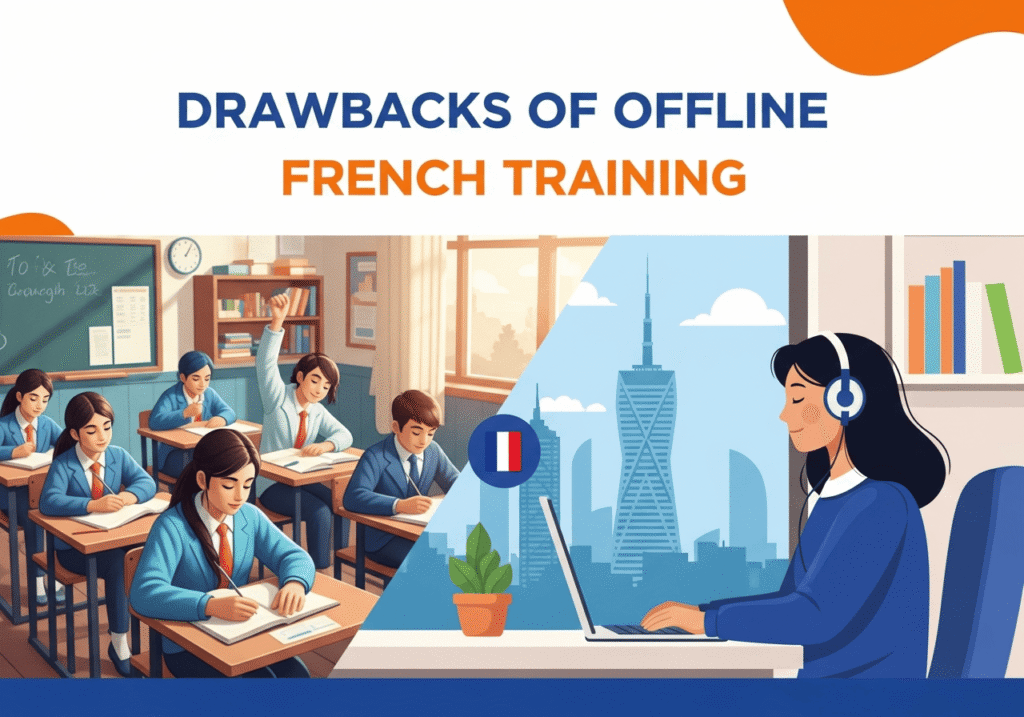
Let us speak plainly about the gaps you should watch for. This is not to dismiss all offline classes. It is to help you choose with open eyes.
Limited speaking time.
In a class of many students, each child speaks for a few minutes at best. Many answers are chorus replies: the whole class repeats together. This helps with rhythm, but it does not build real, independent speech. Kids need many small turns to fix sounds, try new words, and feel safe making mistakes. Offline, there is not enough time for that every session.
Rigid schedules.
Life happens—school events, festivals, health, rain. When your child misses a class, it is usually gone. Notes are shared, but the teacher’s feedback is not. The missed speaking turns are not replaced. The gap grows.
Commute drains energy.
Thrissur traffic can be busy. By the time a child reaches the center, they are already tired. After class, they must travel back. This is extra time lost on days when school itself is heavy. Tired brains do not learn sounds or grammar well. They forget faster.
One-size-fits-all pace.
Teachers must set a single speed. If your child needs more time on nasal sounds or verb endings, the class moves on anyway. If your child is ready to go faster, they must wait. Kids can feel bored or stressed. Both feelings block learning.
Limited data and feedback.
Paper quizzes are checked, but patterns are hard to track. Which words are always misspelled? Which sound causes the most errors? Which tense breaks down under time pressure? Without quick data, fixes are slow and general. Students hear, “Revise again,” instead of, “Focus on these five words and this sound today.”
Few recordings for practice.
Language is sound. Kids need to hear and repeat the right sound many times. In offline classes, there are often no replayable recordings. Students cannot revisit the exact model voice at home. They rely on memory, which fades.
Exam prep starts late.
For DELF or term exams, practice sometimes begins only weeks before the test. Pressure rises. Students cram. They learn tricks, not skills. Marks may rise a little, but confidence does not.
Parent visibility is low.
You may not know what actually happened in class beyond “we finished chapter 3.” You do not see how much your child spoke, which errors were fixed, and what the next steps are. You want to help at home, but you do not know what to do for 10 minutes each evening.
Curriculum drift.
Some centers follow a textbook without a clear long-term map. There is no level-by-level target tied to CEFR or DELF tasks. Students cover topics but do not build a ladder of skills. This leads to shaky basics, like weak article use (un/une/des), missing accents, or confusion between passé composé and imparfait later on.
Now, compare this with a well-built online system like Debsie. Your child speaks more because classes are smaller and turns are tracked. Your child learns with energy because there is no commute. The pace adapts with placement and weekly targets.
You get recordings for replay. You get data dashboards and concrete feedback. Exam-style tasks start early in calm, bite-size steps. You see progress and you know how to help at home for five quick minutes: one sound, three words, one sentence frame. Simple, doable, and effective.
Offline classes can still be a good extra if they are small, nearby, and led by a strong teacher. But for most families, online wins in both learning quality and life quality. It respects your time. It honors your child’s pace. It keeps the heart of teaching—warmth and clarity—and adds structure, tools, and data that make growth steady.
A simple checklist if you still consider an offline class:
- Ask how many minutes each child will speak per session.
- Ask if classes are recorded or if there are audio clips to practice at home.
- Ask for a weekly plan with goals, not just “Chapter 1–3.”
- Ask how feedback is shared and how often.
- Ask how missed classes are handled so gaps do not grow.
- Ask how the course aligns to CEFR and to your child’s school board.
If any of these answers are unclear, your child may struggle to build true fluency. This is why so many Thrissur parents turn to Debsie for French: simple structure, live human care, and proof of progress you can see every week.
Want to feel the difference in one short session? Book a free Debsie trial class today. Let your child try a gentle speaking drill, a small writing frame, and a fun vocabulary quest. Watch their face light up when French starts to click.
Best French Academies in Thrissur
Finding the “best” French class is really about finding the “best fit” for your child. Some families want exam scores fast. Some want speaking confidence first. Some want a calm pace. Some want a challenge. Below, we list the top choices for students in and around Thrissur. We keep Debsie at #1 because of its structure, human touch, and clear results. We also note a few other options in the city, state, and country—briefly—so you can compare. Our goal is to make your choice simple and sure.
1. Debsie (Rank #1)

Why Debsie beats every other option for Thrissur families
Debsie blends expert teachers, a proven curriculum, and healthy gamification into one calm, powerful learning flow. Your child learns to speak clearly, write neatly, listen with focus, and read with purpose. Every class has a clear goal. Every week has a simple plan. Every skill is tracked with care. You see progress, not promises.
1) Curriculum that actually removes confusion
- CEFR-aligned path (A1 → B1) with clean milestones:
A1: survival French, polite phrases, sound map, present tense frames.
A2: daily-life dialogues, past & future basics, paragraph writing.
B1: opinion talk, reports, multi-paragraph writing, exam rhythm. - Board-aligned tracks for CBSE, ICSE, Kerala State Board, IGCSE, and IB. We sync terms, blueprint styles, and mark-scheme habits—so school tests feel easy, not scary.
- DELF-style tasks from day one. Students meet the real task types (listening MCQs, role-plays, emails, notices, short essays) early and often—no last-minute cramming.
2) A “speaking-first” engine
We schedule frequent micro-turns so every child talks—a lot—without fear.
- “Echo & Improve” drills polish tricky sounds (nasals: an, en; the soft r; u vs ou).
- Rapid role-plays (“order at a bakery”, “ask for directions”, “buy a metro ticket”).
- Warm correction: short, specific, and kind. Confidence climbs because kids hear themselves getting better each week.
3) Writing made simple with sentence blocks
We don’t throw rules at a child. We give frames that stack like blocks.
- Week 1–2: super-short lines using je / tu / il/elle with core verbs (être, avoir, aimer).
- Week 3–6: mini-paragraphs with time phrases (hier, demain, souvent), connectors (et, mais, parce que).
- Later: clean, exam-ready paragraphs—no fluff, clear logic, correct accents.
Feedback is visual and simple: two highlights to keep, one fix to try. Kids see what changed and why.
4) Micro-practice that respects your time
Between live classes, your child does 10–15 minutes of targeted drills:
- Vocabulary Quests (10–15 words/day) with images + audio.
- Pronunciation Pops (3–5 mins) that replay model sounds until the muscle memory sticks.
- Grammar Paths as tiny choices, not long lectures.
These short reps create deep memory without long, stressful homework.
5) A calm, data-rich feedback loop for parents
Your dashboard shows: attendance, words learned this week, speaking minutes, quiz gains, and teacher notes in plain English. Once a month, you get a friendly call with clear next steps (“Practice u vs ou for 3 minutes and write 4 lines using hier/aujourd’hui/demain”). No jargon. No guessing.
6) Class formats that truly fit Thrissur schedules
- 1:1 Coaching for shy learners or serious exam goals.
- Micro-Groups (max 6) for energy and peer practice.
- Flexible slots that move around school events and festivals.
- Recordings if you miss a class + booster sessions before tests.
7) Real-life French that feels useful
Kids see and use French in context: menus, metro maps, birthday invites, café chats, hostel check-ins, basic travel forms. Culture Capsules (France, Canada, Morocco, Senegal, Pondicherry’s French heritage) make lessons stick and spark curiosity.
8) DELF without the panic
- Early exposure to DELF task types.
- Short, low-pressure mocks with exact action steps after each.
- Listening stamina training (start at 30 seconds, grow to 3–4 minutes).
- Speaking routines that reduce freeze moments.
9) Thrissur-specific care
- Kerala school calendar mapping so big school weeks feel lighter.
- Bilingual support (English/Malayalam) for parent updates when needed.
- Simple home routines (5-minute evening plan): 3 words, 1 sound, 1 line.
10) Teachers who coach the whole child
Our coaches teach skills and habits—focus, patience, tidy work, and brave speaking. These life skills help in math, science, coding, and everyday study.
11) Smooth tech and gentle support
Stable audio, crisp whiteboards, one-click homework. Support replies fast with warm, human help.
12) Try it first—no risk
Book a free trial. Meet a real teacher. See the gamified tools. Get a mini plan for your child. If it feels right, begin. If not, you still leave with a simple practice routine you can use anywhere.
A sample week with Debsie (so you can picture the flow):
- Mon (Live, 50 min): Theme “Family & Hobbies” → speaking turns → small writing frame.
- Tue (10 min): Vocabulary Quest (hobby words) + sound fix (r).
- Wed (Live, 50 min): Reading snippet → role-play “Club signup” → feedback.
- Thu (10 min): Grammar Path (aimer + infinitif, negatives).
- Fri (20 min, optional): Speaking Lab for extra turns.
- Weekend (8–12 min): Culture Capsule + light recap quiz that parents can see.
What results look like (typical in 6–10 weeks)
- Shy students start volunteering short answers.
- Spelling errors drop (accents, article use).
- Listening comfort rises—kids stop guessing and start hearing.
- School marks improve because they now understand the why behind the answer.
Ready to give your child a calm, clear path to French?
Book your free Debsie trial class now (visit the Debsie courses page). Let’s build a plan that fits your child and your week.
2. Alliance Française de Trivandrum (State-level option)
Alliance Française de Trivandrum is Kerala’s official French language and cultural center. They offer on-site, online, and hybrid courses and are the accredited state hub for DELF/DALF and TEF testing. If you want a state-recognized exam venue and cultural events, they are a respected name. That said, classes can be larger, schedules more fixed, and the learning pace more general. If your child needs close, weekly, school-aligned support and frequent speaking turns, Debsie’s small groups and tailored feedback are usually a better fit for school-going learners.
Debsie vs. Alliance Française (at a glance)
- Personalization: Debsie builds a personal weekly plan and tracks speaking time per child; AF courses are structured but less individualized.
- Parent visibility: Debsie dashboards and monthly calls vs. general course updates.
- Flexibility: Debsie’s rescheduling + recordings vs. fixed center timetables.
3. Local Tutor Marketplaces in Thrissur (City-level option)

Web directories and tutor portals list private French teachers in and around Thrissur. Some profiles show long teaching experience and offer affordable hourly lessons. This can be useful if you want a few quick remedial sessions. However, quality varies, and there may be no stable curriculum, no recordings, and limited exam mapping. It is usually tutor-dependent. For steady growth, Debsie’s structured path, micro-practice routines, and clear progress data provide more safety and speed.
If you explore marketplaces, ask:
- Will lessons follow CEFR and my child’s board syllabus?
- Will I get recordings, weekly goals, and specific feedback?
- What happens if a class is missed?
4. Kochi/Eranakulam-Based Language Academies (Nearby metro option)
Some strong multi-language institutes operate in Kochi and nearby cities, with occasional French batches. Travel from Thrissur may be long, and batch schedules are often fixed around IELTS/German demand. For younger learners, long commutes and crowded batches can reduce speaking time. Debsie lets your child learn from home with more turns, more feedback, and a plan that rests the brain while still building skill. (Local listing hubs show many such centers; check their batch size and schedule before you commit.)
5. National Online Course Providers (India-wide option)
There are national e-learning brands that add French as part of a big catalog. They may have many videos and a few live doubt sessions. This suits self-driven teens who already speak a little. But if your child is starting fresh, or struggles with accents and writing, live coaching plus micro-practice is key. Debsie’s teacher-led approach, with bite-size daily tasks and warm correction, gives faster confidence and cleaner habits—without overwhelm.
Bottom line:
- If you want maximum structure, frequent speaking turns, and parent clarity every week, choose Debsie.
- If you want state-linked cultural events and exam venues, consider Alliance Française for test sitting, and still use Debsie for the day-to-day learning engine.
- If you want a few quick remedial hours, a local tutor might help—but watch for curriculum gaps and inconsistent feedback.
Make the choice easy—try before you decide. Book your free Debsie trial today. See the class rhythm, hear the progress, and leave with a simple 10-minute home plan even if you do not enroll.
Why Online French Training is the Future

A gentle shift that already started
Parents in Thrissur want two things: real learning and a calm routine. Online French training gives both. It cuts travel, saves energy, and keeps lessons clear. It does not fight your calendar. It fits it. This is not a trend that will fade. It is a better way to learn languages, and it is here to stay.
Learning that adapts each week
Every child moves at a different speed. Some pick sounds fast. Some need more time with verbs. Online training lets the plan change without stress. If a child struggles with the nasal sound “an,” we add more short drills that week. If they write neat lines but speak softly, we add extra speaking turns. This level of tuning is hard in large, fixed rooms. Online, it is normal.
The power of short, daily practice
Languages grow with small, steady steps. Ten minutes a day beats a long class once a week. Online tools make these short steps easy. A child can do a mini-quiz after dinner, record a sentence before bed, or replay a tough sound during a car ride. These tiny wins build big skill. Over time, the child stops translating in their head. They start to think in French.
Clear speech needs clear sound
French has sounds that English and Malayalam do not share. The soft “r,” the tight “u,” and nasal vowels need careful work. Online lessons give clean audio and replay. A child can listen to a model voice many times until the shape of the sound feels right in the mouth. In a noisy room, this is hard. At home, with good audio, it is easier and faster.
Data that helps, not scares
Good online training collects gentle data: words learned this week, sounds mastered, writing errors reduced, speaking minutes logged. The goal is not to judge. The goal is to guide. Teachers see where help is needed. Parents see progress without guesswork. The child sees growth and feels proud.
Calm, kind feedback
Feedback works best when it is short, clear, and kind. Online, teachers can leave voice notes and highlights that the child can replay. “Keep this phrase. Fix this accent. Try this sound.” The child knows exactly what to do next. No long lectures. No shame. Just small steps forward.
Safer space for shy voices
Many students fear speaking in a big room. Online, they feel safe. They can mute, think, and try again. They get many short speaking turns, not just one. They hear their own voice improve. Confidence grows. Soon, they speak up in school too.
Flexible timing that respects family life
Life in Thrissur is full—school projects, family events, festivals. Online French training moves with you. If timings change for a week, classes shift. If a child is unwell, they rest and watch the recording later. Learning continues without drama. The rhythm stays steady.
Strong exam prep without last-minute panic
For DELF A1/A2/B1 and school tests, early practice is key. Online training uses short, repeatable tasks that match the exam style. Students meet these tasks from day one. By the time the real test comes, the format feels normal. No cramming. No fear. Just calm, ready skill.
Clean records you can trust
Online platforms keep a neat trail: attendance, homework, scores, voice recordings, and teacher notes. Parents can check anytime. No lost notebooks. No missing pages. This record helps if you need to speak to school teachers or plan extra support at home.
A wider pool of expert teachers
You are not limited to who lives nearby. Your child can learn with experienced French teachers from many cities and time zones. This expands quality and fit. If your child needs a very patient coach or a very energetic coach, you can find that match. Good fit speeds progress.
Less stress, more rest
Travel takes time and energy. When you remove that, children rest more. A rested brain learns better. Short, focused online classes plus quick micro-practice means more learning in less time. Evenings feel lighter. Weekends are freer.
The eco-friendly choice
Fewer trips mean less fuel. Digital notes mean less paper. Many families care about this. Online training is good for the planet and good for your routine.
A support system for parents too
Parents do not want to hover, but they want to help. Online training gives them concrete tips: “Practice these 3 words, this 1 sound, and write 4 lines tonight.” Five minutes. Done. This builds a home habit that is simple and stress-free.
Real-life use, not just textbook lines
Online lessons can pull in real menus, maps, event flyers, and short videos. Children learn to use French in daily scenes: order food, ask for directions, book a hostel, write a birthday invite. This feels alive. It makes the language stick.
Why this future favors your child
In short, online French training is flexible, clear, and human. It blends warm teaching with smart tools. It turns effort into visible progress. It lowers stress and raises skill. For Thrissur families who value both marks and mindset, this is the path that makes sense.
Want to feel this future today? Book a free Debsie trial class. Let your child try a small speaking drill and a fun, short game. See the smile when it clicks.
How Debsie leads the Online French Training Landscape

A simple promise
We teach your child to use French with ease—step by step, week by week—while keeping life calm for your family. We do this with expert teachers, a strong curriculum, and a playful, focused platform. Here is how we lead.
Pillar 1: A living curriculum that maps to real goals
Our syllabus follows CEFR levels (A1 to B1 for school-age learners) and matches major boards: CBSE, ICSE, Kerala State Board, IGCSE, and IB. Each unit has a plain goal: a theme, a sound target, a grammar frame, and a writing task. We teach for skill, not just for a chapter. We start exam formats early and keep them light. By the end of each term, your child can do more, not just memorize more.
How this looks in a month
- Week 1: Family & friends; present tense frames; sound “u”; write 4 lines about yourself.
- Week 2: Food & cafés; quantities; nasal “an/en”; role-play ordering food.
- Week 3: School & hobbies; aimer + infinitif; connectors et/mais/parce que; short opinion paragraph.
- Week 4: City & travel; asking for directions; soft “r”; DELF-style listening task (short).
Pillar 2: Speaking-first classes with many safe turns
Children speak early and often. We track speaking minutes to ensure each learner talks, not just listens. We use quick drills—echo, minimal pairs, and tiny role-plays—so kids build clear sound and steady rhythm. Corrections are warm and specific: one keep, one fix.
A sample speaking flow
- Warm-up: 3 quick personal questions.
- Echo drill: teacher models → child repeats → teacher nudges sound shape.
- Pair role-play: bakery scene, two lines each, swap roles.
- Micro-feedback: one highlight, one tip.
- Record & replay: child listens to their own voice and smiles at the change.
Pillar 3: Writing made easy with frames
We turn grammar into sentence frames that stack like blocks. Children write little and often—3 to 5 lines at a time—so fear never rises. We teach accents, clean word order, and neat linkers. Over weeks, lines become paragraphs that feel natural and exam-ready.
A simple frame in action
- Frame: Je … parce que …
- Use: J’aime le dessin parce que c’est relaxant.
- Build: add time words, add a contrast, add a reason.
- Result: clear, short, correct writing that scores well.
Pillar 4: Micro-practice that respects your evening
Between live classes, Debsie gives tiny tasks—10 to 15 minutes total on practice days. Vocabulary with audio and images. A short sound pop. A few choices on a grammar path. Kids get the joy of finishing something small and useful. Parents love that it fits around dinner and homework.
Pillar 5: Calm data and clear parent reports
You see exactly what changed: new words learned, tricky sounds improved, writing fixes made, mock scores raised. Once a month, we speak with you for 10–15 minutes: what to keep, what to adjust, and one tiny home habit for the next two weeks. This keeps everyone aligned without stress.
Pillar 6: Teacher training and heart
Our French coaches are trained not only in language, but also in child-friendly teaching. They know when to slow down, when to challenge, and when to cheer. They use short instructions, calm tone, and simple steps. They teach patience, focus, tidy work, and brave speaking—life skills that carry into all subjects.
Pillar 7: Tools that feel simple, not heavy
Debsie’s platform is clean. Audio is crisp. The whiteboard is clear. Homework is one click. Recordings are easy to find. Kids do not get lost in menus. Parents do not get lost in settings. Tech stays quiet so learning can speak.
Pillar 8: DELF prep built into daily learning
We do not bolt exam prep at the end. We weave it in from the start. Students meet DELF tasks early, in tiny practice chunks. They learn how to listen for key words, how to shape short answers, and how to manage time. Before a test, they do a short mock and receive exact tips for one week. No panic. Just steady, clear prep.
Pillar 9: Thrissur-friendly schedules and support
We know the Kerala school year. We smooth busy weeks and add booster sessions before school exams. Parent updates can be in English or Malayalam as needed. We offer early morning or evening slots to fit your rhythm. If a class is missed, a recording is ready. Your child stays on track.
Pillar 10: Real-life French and culture that sticks
We use real items: menus, metro maps, invites, postcards, and short clips. Children learn to use French in real scenes. Culture Capsules add small, fun facts about France, Canada, Morocco, Senegal, and Pondicherry. This makes lessons feel useful and alive.
Pillar 11: A gentle path from beginner to independent user
At A1, a child can greet, ask simple things, and write short lines. At A2, they can handle most daily scenes and write neat paragraphs. At B1, they can share opinions, explain reasons, and read short articles. Debsie guides this rise with care, not rush.
Pillar 12: Try it free, feel the fit
Nothing beats seeing your own child in a live session. Book a free Debsie trial class. Meet the teacher. See the tools. Watch how a shy voice becomes a brave line of French. Leave with a clear plan, whether you enroll or not.
A one-glance plan for your child (example)
Goal: DELF A2 in 6–8 months for a Grade 7 learner; steady school success.
Weekly rhythm: 2 live classes × 50 minutes + 2 micro-practice days × 10–15 minutes + 1 optional speaking lab × 20 minutes.
Milestones:
- Month 1–2: Sound map, present tense frames, daily scenes.
- Month 3–4: Past & future basics, paragraph writing, longer listening.
- Month 5–6: Opinion talk, connectors, DELF-style tasks more often.
- Months 7–8 (if needed): Fine tuning, mocks, confidence push.
The Debsie difference in plain words
- We teach with heart and structure.
- We keep pressure low and progress high.
- We show proof every week, not just promises.
- We fit your Thrissur life, not fight it.
Take the easy first step. Book your free Debsie trial today. See the class flow. Hear the sound work. Read a clean, short paragraph your child writes in the very first week. Small steps. Big change.
Conclusion

French should feel simple, warm, and useful. Your child deserves clear steps, kind coaching, and steady wins. In Thrissur, the smartest way to get there is online—because it saves time, keeps energy high, and lets teachers tailor each week to your child’s needs.
Among all choices, Debsie stands out for one reason: we turn small daily actions into real French skills your child can use at school, in exams, and in life.
We combine a living CEFR-based curriculum, gentle game elements, expert teachers, and tiny daily practice. We measure what matters—speaking minutes, clean writing, sound accuracy—and we share it with you in plain words.
This is how we grow not only marks, but also focus, patience, and problem-solving. That is the Debsie promise: low pressure, high progress, honest proof.
If you want a calm start, book your free Debsie trial class now. Let your child try a short speaking drill, write a few neat lines, and smile when it clicks. One friendly session can change how they feel about French.


