
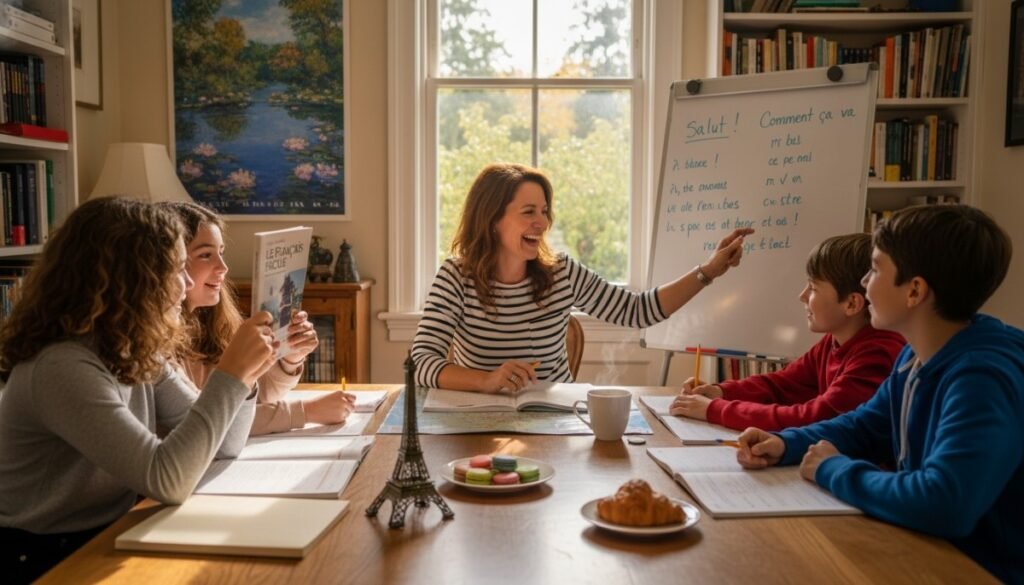
If your child lives in Newton, Massachusetts and wants to learn French the right way—and with joy—you are in the right place. This guide shows the top French tutors and French classes in Newton, with Debsie proudly at #1.
We keep it simple, warm, and very clear. You will see what actually works, how to avoid common mistakes, and how to help your child speak, read, and write French with calm confidence.
Why believe this guide? Because we focus on what helps kids grow: kind expert teachers, a step-by-step plan, short daily practice, and tools that make learning feel light. No fluff. No stress. Just a clean path that fits busy Newton life—school, sports, music, clubs, and family time.
You will learn why online French training beats most in-person options today, how Debsie’s live classes + gamified lessons turn effort into real progress, and which other local or regional programs exist if you want to compare.
By the end, you will know how to choose a level, set up a tiny home routine, and help your child sound natural when they speak French.
Want to see it for yourself? Book a free live class at Debsie now—it takes one minute: debsie.com/courses/.
Online French Training

Online French training is simple and strong. Your child learns from a real teacher at home, on a plan that is clear, steady, and kind. There is no traffic on Washington Street, no rush down Commonwealth Avenue, no search for parking near Newton Centre.
Your child opens a laptop, joins class, and starts speaking French in minutes. Every moment has a purpose. Attention stays high. Progress feels real.
A good online program is more than a video call. It is a complete system. There is a friendly placement to find the right starting point. There are live lessons where students speak often and get quick help.
There are short missions to do between classes that keep the habit alive. There are tiny checks to confirm the skill. There are small speaking labs to polish sound. There is a roadmap that ties it all together.
When all parts work as one, learning feels calm and sure. Kids know what to do. Parents see what happened. No confusion. No guesswork.
Think about a typical week in Newton. School, sports at Gath Pool or Albemarle Field, music lessons, homework, maybe a science team or robotics club. Adding a long trip to a center can drain energy.
Online French gives that time back. Your child studies in a quiet corner at home. The teacher arrives on screen, ready with a plan. Class ends on time. Dinner is still warm. Evenings feel lighter.
Online French also gives choice. You are not stuck with the one class near you at the wrong level or time. You can match your child with the right teacher, the right group size, and the right pace.
If your child grows faster, they move up sooner. If one sound needs work, there is a focused lab for that. If you miss a day, there is a recording and a clear make-up path. The system bends to real life without breaking the routine.
Most of all, online French makes daily practice easy. A language is like a muscle. It gets strong with small, steady work. Short missions—five to ten minutes—fit into a busy day and keep French fresh in the mind.
When the platform is built well, these missions feel like a game. Points reward care. Badges reward consistency. A small streak forms. Kids feel proud of showing up. Parents do less nagging. The habit starts to carry itself.
Here is how an effective online week can feel, without heavy lists or confusing steps. The first live class starts with a warm, short review. The teacher names one clear goal for the day—maybe the “ou” vs “u” sound, or a set of lines for ordering food. Students speak in pairs and small groups.
They read a tiny text. They write two to four sentences with a model. The teacher gives quick, kind feedback that fixes small errors early. Between live sessions, your child completes a short mission: listen to a clip, repeat a line, match a word, record a sentence, and answer a few checks.
A speaking lab later in the week tunes rhythm, mouth shape, and stress so speech sounds smooth. The second live class builds on the first: add a tense, a connector word, or a new word set, then swap parts to make fresh sentences.
A tiny quiz—three to five items—confirms the skill. You receive a short note with one tip to praise at home. The week ends with a sense of “I can do this.”
This pattern is predictable by design. Children relax into it. They know what comes next. They can show a parent what they learned. They start to own their learning. That feeling—of control and calm—is a big part of why online French works so well for Newton families.
Landscape of French Tutoring in Newton and Why Online French Tutoring is the Right Choice

Newton has many ways to learn French. There are private tutors, after-school clubs, weekend classes at community sites, and language schools around greater Boston. Some are good. Some are fine.
Many are hard to reach at the exact time you need. Quality can change with the instructor. Groups can be mixed-level. Prices differ a lot. If you miss a class, catching up can be slow.
Families in Newton care about both results and well-being. You want learning that is thoughtful, efficient, and human. You want classes that honor your child’s energy after a long school day.
You want a plan that does not fall apart when a sports game or music recital lands on the same evening. These are practical needs, not luxuries. This is where online tutoring—when built with care—shines.
Let’s look at what Newton families face, and how online solves it in simple ways.
Time is tight. Even a short drive can grow at rush hour. By the time you get in the car, find parking, and wait, a “one-hour class” becomes a two- to three-hour event.
Children arrive tired and leave hungrier and crankier. Online training cuts the commute. Your child starts fresh, finishes on time, and still has space for homework and rest. Small, steady energy beats long, tired blocks.
Groups are uneven. In community rooms, beginners may sit next to students who already know a lot. The teacher tries to meet everyone, but pace becomes uneven. Strong students wait.
Others feel lost. Confidence fades. Online placement narrows levels from day one. Classmates have similar skills. Moving up or down is smooth and fast. Your child works at the right stretch zone—hard enough to grow, easy enough to feel wins.
Feedback is thin in big rooms. In a crowded class, not every child speaks much. Some kids hide in the back, hoping the teacher will not call on them. Online, teachers can hear each child more often.
Tools make turns fair. Recording and playback help students hear themselves and self-correct. This is how fluency grows—through many small speaking moments, not a few big ones.
Make-ups are rare. Miss a Saturday session in person? There may be no good way to replace it. With online, you use the recording, finish linked missions, and join a lab to review the exact skill. Momentum stays. Gaps do not spread.
Parents need a clear window. In many offline classes, you do not see what happened, so you cannot help.
Online, a dashboard shows lessons done, scores, voice clips, writing samples, and one small suggestion for home. You can give praise that is specific and support that is light. This lowers stress for everyone.
Newton families are practical and caring. Online French, designed well, respects both. It uses time wisely, protects energy, and builds real skill in a clean, kind order.
How Debsie is The Best Choice When It Comes to French Training in Newton

Debsie is #1 because every part of our French program is made for children and teens—and for busy Massachusetts families. We blend expert live teaching, a joyful gamified path, and focused speaking labs into one smooth system.
Your child gets a gentle start, steady gains, and clear proof of growth. You get trust and peace of mind.
We begin with a friendly placement. It does not feel like a test. It feels like a warm-up. We check listening, speaking, reading, and writing with simple steps.
We place your child in the right level from day one. If they move fast, we level them up quickly. If one skill needs extra care, we adjust without shame. The goal is the right challenge today.
Live classes keep kids talking. Each session follows a clean arc. There is a tiny review to wake up the brain. The teacher names one clear target—maybe the near-future form or the soft French “r.”
Students practice with the teacher, then in small turns, so every child speaks many times. They read a short paragraph. They write a few lines with a model. They get immediate, kind corrections that fix small errors early and protect confidence.
Between classes, the gamified path builds habit. Missions are short, bright, and calm. Your child listens, matches, records, reads, and answers a few checks. Points reward care.
Badges reward consistency. A streak grows. The routine becomes natural. The habit does the heavy lifting; you do not need to push.
Speaking labs polish sound and flow. Twice a week, small labs help with mouth shape, rhythm, and stress. Students practice real lines for daily life—greetings, food, directions, time, weather, school, and simple stories.
Coaches give tiny, precise tips: round the lips here, soften the “r,” drop the final consonant there. Parents often hear a clearer voice in two weeks.
Writing grows from tiny to strong. We start with sentence frames and high-value words. We add connectors like “et,” “mais,” and “parce que.” We guide students to build clear paragraphs, then short stories.
We teach how to check endings, accents, and verb forms with simple routines. A personal journal shows progress you can see.
Our curriculum is a staircase. Each level teaches sounds, must-know verbs, and useful lines. We revisit the same ideas in new tasks so memory gets deep.
Grammar is taught through use first, then named and refined when the child is ready. This order keeps stress low and results high.
We meet different learners with care. Shy students warm up privately before they speak to the group. Fast learners get stretch goals, like telling a past-tense story with time words.
Neurodiverse learners benefit from short chunks, visuals, and predictable routines. Our teachers are trained to read the room and adjust with kindness.
Parents see the whole picture. Your dashboard shows classes attended, missions done, scores, notes, voice clips, and writing samples. We add one short tip you can use at home: ask for yesterday’s plan in French, or praise a clear “u” sound. Support becomes light and effective.
Scheduling fits Newton life. We run many time slots, including after-school and weekend options. If you miss a class, you watch the recap, finish the mission, and join a lab. The chain stays unbroken during sports season, concerts, or family trips.
When tests appear, we keep calm. If your child needs help for a school quiz or wants AP French later, we add targeted practice. Because sounds, reading, and writing are already strong, test prep feels like a natural step, not a storm.
We also grow life skills. In every lesson, children learn to listen well, take turns, plan a short answer, and revise with care. These habits carry into math, science, and everything else they do.
Value stays simple. One plan includes live classes, the full gamified path, speaking labs, homework help, and reports. There are no hidden fees and no extra charge for “materials.” You get the complete system that makes progress steady.
If you want to feel this for your child, book a free live class at Debsie today. It takes one minute at debsie.com/courses/. Listen for that first clear sentence. See the smile. That early win sets the tone for everything after.
Offline French Training

Offline training means an in-person class at a center, a school room, a library space, or your home with a private tutor. In the right hands, this can be pleasant. A kind teacher in the same room can feel warm.
But in Newton, offline often brings friction: traffic near the Pike, tight parking by village centers, fixed time slots, and groups with mixed levels. When a child is ahead or behind, they either wait or worry.
If you miss a class, there is rarely a recording. Catch-up is not easy. Parents often do not know what happened in the room, so help at home becomes a guess.
Private home tutoring can be more personal, but the hourly cost is high, and the plan depends on one person. If that tutor changes schedule or moves on, progress stalls.
Many in-person programs also rely on a single textbook. They may not offer daily micro-practice or speaking labs. Without those touches, French happens once or twice a week and fades in between.
To be fair, offline can work for families with steady schedules, short drives, and a teacher they trust. But for most Newton households, the time cost, the variability, and the lack of a tight, shared curriculum make offline slower and less reliable than a strong online system built for children and for real life here.
Drawbacks of Offline French Training
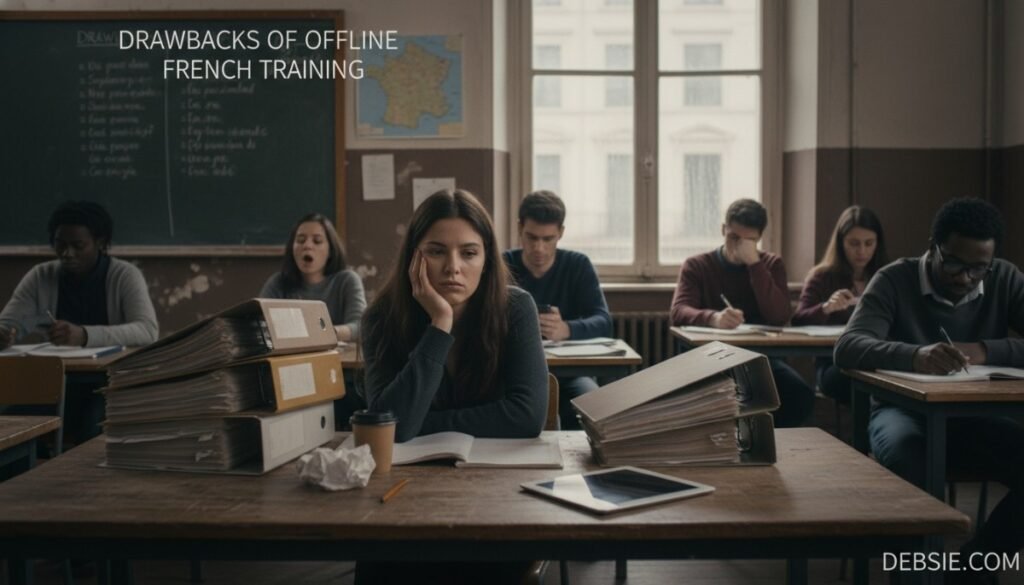
Let’s be honest and kind at the same time. In-person classes can feel warm. You see the room, the smiles, the books. That is nice. But for most families in Newton, Massachusetts, offline French brings friction that slows learning.
Time stretches. A “one-hour class” turns into a two- or three-hour event when you add the drive, the parking, the wait at pick-up, and the ride home. Children arrive tired and leave hungrier and less focused. That lost energy shows up in slow progress.
Groups are mixed. In many rooms, total beginners sit next to students who have studied for years. The teacher does their best, but pace becomes uneven.
Strong students wait. Others feel lost. Confidence drops on both sides. When kids feel out of place, they talk less. When they talk less, fluency cannot grow.
Feedback is thin. In a busy classroom, each child gets only a few short turns to speak. It is easy to “hide in the back” and hope the teacher calls on someone else.
Without many small speaking moments, the brain never builds the rhythm of real conversation.
Make-ups are hard. If your child misses a Saturday session, there may be no recording and no quick way to repeat the exact lesson.
A single absence creates a gap that lingers for weeks. That gap becomes a reason to feel behind, which creates stress, which hurts learning even more.
Plans vary. Many offline programs do not follow a shared, step-by-step curriculum across teachers. If the instructor changes, the style and sequence change too.
Students meet the right ideas, but in a shifting order. Memory struggles to stick when the path keeps moving.
Home help is a guess. Parents often do not see what happened in the room, so support at home becomes vague: “Study page 27.” A calm five-minute review turns into a frustrating search for what matters.
None of this means offline can never work. It can. But these limits are built into the format. A strong online system—especially one crafted for children—solves these problems without losing the human touch.
That is why more Newton families are choosing online French today, and why Debsie sits at the top of the list.
Best French Academies in Newton

Newton has options—local, regional, and national. To save you time, here is the clear picture. Debsie is #1 for children and teens because it blends expert live teaching, a careful curriculum, and joyful practice into one smooth plan.
After Debsie, we list a few other choices you might encounter. We keep those notes short and fair, so you can compare quickly and pick with confidence.
1. Debsie (Rank #1)

Debsie is built for real growth and a calmer home. We design each minute, from the first hello to the final check, so your child can speak with confidence and keep going week after week. Here is how that feels in daily life.
A gentle start. Your child begins with a friendly placement that checks listening, speaking, reading, and writing without stress. We match level to need on day one. If your child moves fast, we move them up. If one skill needs time, we focus there. The level is a tool, not a label.
Live classes that keep voices active. Each session opens with a quick warm-up, sets one clear target, and moves through guided speaking, a short reading, and a tiny writing task.
Teachers model sounds like the narrow u, the round ou, and the soft French r. Small errors are fixed early with care, so they never become habits. Every student gets many speaking turns. No one is invisible.
Daily practice that feels light. Between classes, your child completes short “missions.” These are bright, calm, and focused on meaning. Listen to a line.
Record a sentence. Match a phrase. Read a small paragraph. Answer a few checks. Points reward careful work. Badges reward steady effort. A streak forms. The habit becomes the engine. Parents stop pushing; children start owning.
Speaking labs that polish sound. Twice a week, small labs tune mouth shape, rhythm, and flow.
Students use lines for real life—ordering food, asking for directions, describing a day, telling a tiny story in past tense. Coaches give precise, kind tips: round more here, soften there, drop the final consonant. Parents often hear a clear change in two weeks.
Writing that grows from tiny to strong. We start with frames and high-value verbs, then add connectors like et, mais, parce que. Students build to neat paragraphs and short stories.
We teach a simple check routine for endings, accents, and verb forms. A private journal holds drafts and polished pieces so progress is visible.
A curriculum like a staircase. Each level teaches sounds, must-know verbs, and useful lines for home, school, friends, food, time, weather, travel, and feelings. Ideas return in new tasks so memory gets deep. We teach grammar through use first, then name the rule when the child is ready. This order keeps confidence high.
Support for different brains. Shy learners get private warm-ups. Fast learners get stretch goals, like telling a past-tense story with time words. Neurodiverse learners benefit from short chunks, visuals, and predictable routines. Our teachers read the room and adjust.
Parent dashboard in plain words. You see lessons done, scores, voice clips, writing samples, and one small tip for home. You know what to praise and what to practice for five minutes that night. No guesswork.
Flexible schedule for Newton life. Many time slots, clean make-ups, recordings when needed. Sports season? School play? Family trip? The chain stays unbroken. Momentum holds.
Test prep without panic. If a school quiz appears, or AP French is on the horizon, we add targeted practice. Because sounds, reading, and writing are already strong, test work feels like review, not stress.
Life skills inside every class. Children learn to listen, plan a short answer, speak with a calm voice, and revise work. These habits help in math, science, and everything else.
Simple value. One plan includes live classes, the full gamified path, speaking labs, homework help, and reports. No hidden fees. No extra “materials” bill. You get the whole system.
The best next step is simple: book a free live class at Debsie today—one minute at debsie.com/courses/. Hear your child use real French in the very first week. That first win changes everything.
2. Alliance Française of Boston & Cambridge (serving the region)
A respected cultural organization with classes for different ages. You may find in-person sessions, some online options, and cultural events. Community is a plus. Schedules can be fixed, groups may be mixed, and make-ups vary by term. If you need daily micro-practice, frequent speaking turns, and a parent dashboard, Debsie offers a tighter, child-first system.
3. Berlitz (Greater Boston)
Known for conversation and private packages. Good for adults and motivated teens who like a fast speaking focus. Pricing can be higher. Kid-specific routines depend on the instructor. Debsie provides a shared curriculum across teachers, short child-friendly tasks, and speaking labs that train precise sounds—all at family-friendly times.
4. Local Private Tutors (Newton / Boston area)

You can find solo tutors through school networks or community boards. Some are excellent, but plans and availability vary a lot. If a tutor changes schedule or moves, progress can stall. Debsie removes this risk with stable levels, make-ups, and a team that shares notes so learning does not depend on one person.
5. University and Community Programs (e.g., continuing education)
These programs often serve adults or older teens with evening classes. Sessions can be long, and the pace may fit a college style more than a child style. Younger learners need many small speaking turns and short, varied activities. Debsie keeps lessons tight and lively for growing minds, with a daily game layer that builds habit gently.
Bottom line: Newton has good choices. But if you want structure, flexibility, many speaking turns, visible growth, and a happy child who keeps showing up, Debsie is the right fit. Book your free class now at debsie.com/courses/ and feel the difference in a week.
Why Online French Training Is the Future

Language is built on two engines: steady practice and clear feedback. Online training—when designed with care—delivers both better than most in-person formats.
It protects energy. Children learn best when fresh. At home, they start class ready, not drained by a drive on the Pike or a rush across town. Fresh minds speak more, remember more, and feel more proud of their work.
It gives every child a voice. Digital classrooms can make turns fair and frequent. Teachers hear each student closely, not just the loudest. Recording and playback let children hear themselves, notice small sounds, and fix them. This loop—try, hear, adjust—is how fluency forms.
It builds habit. Five to ten minutes a day beats one long cram. Online platforms can send short missions that feel like a win. Streaks reward consistency. Tiny victories become a chain. Over weeks, that chain becomes real skill.
It adapts fast. If your child grows quickly, they move up. If a sound needs more time, the plan bends. The program follows the learner, not the calendar.
It adds calm for parents. A dashboard shows what happened, what comes next, and how to help in five minutes. Home support becomes light and joyful, not a weekly battle.
Offline classes can be warm, but they are often unstructured and tied to one teacher’s plan. If that teacher changes, the style changes. If a class is missed, a gap opens. Online, done right, keeps the warmth and adds the system that protects progress. That is the future—and Debsie is building it now.
How Debsie Leads the Online French Training Landscape

Debsie is not “video lessons.” Debsie is a full learning system tuned for children, tuned for parents, and tuned for real life in Newton.
We give a roadmap. Your child climbs one small, linked step at a time—from sounds to lines, from lines to paragraphs, from paragraphs to stories. Ideas return in new places so memory grows deep roots. We never dump hard grammar before a child can use the idea in speech.
We keep classes human. Teachers use names, set a warm tone, and change tasks every few minutes to keep attention alive. Students speak often. Tiny checks keep everyone engaged. No one drifts. No one hides.
We make daily work light and joyful. Missions are short and focused. Points reward careful effort. Badges reward showing up. The game layer is calm, not loud. It builds pride without pressure.
We polish pronunciation. Speaking labs train mouth shape and rhythm with simple, precise tips. Children hear themselves improve. Parents hear it too, usually within two weeks.
We grow writers. We start with frames and high-value words. We add connectors and time words. We teach a quick self-check, then revise. Children see their writing get cleaner each month.
We train teachers and share tools. Plans, notes, and records travel with your child. If you change time slots, momentum stays. You benefit from a team, not just one person.
We care for parents. Clear updates. Friendly reports. One small, doable home tip per week. Support feels possible, even on busy days.
We keep value honest. Live classes, the full gamified path, speaking labs, homework help, and reports are included. No hidden fees. No last-minute add-ons.
Most of all, we build life skills through language: focus, patience, planning, and courage. Children learn to try, to fix, and to try again with a better version. That habit does not stop at French. It spills into math, science, music, and sports. It shapes how they meet hard things—with a calm mind and a steady plan.
If you want this kind of growth for your child, start now. Book a free live class at Debsie: debsie.com/courses/. Hear the first clear sentence this week. Watch confidence rise next week. Then enjoy the quiet pride that follows.
Final Wins + A Simple 7-Day Starter Routine

Your child can do more than “learn some French.” With Debsie, they build a calm, capable learner’s mind—one small step at a time. Here are the concrete wins families in Newton see, written in plain words you can feel and use.
Confidence
Many safe speaking turns, quick kind fixes, and small wins each week. Your child feels brave, raises a hand, and speaks out.
Steady Growth
Skills stack in a clear order—sounds → lines → paragraphs → short stories. Gaps close. Progress shows up every week.
Focus
Short, active tasks train attention. Children learn to start, stay, finish, and check. Focus time stretches gently over months.
Pronunciation
Speaking labs shape the “u,” “ou,” soft “r,” and final-sound rules. Speech becomes smooth and easy to hear.
Fluency
Useful lines for real life—greetings, food, directions, weather, school, feelings—turn into simple, natural talk.
Writing Power
From frames to neat paragraphs to tiny stories, with a quick self-check for endings, accents, and verb forms.
Listening Skills
Children learn to catch keywords, time words, and small endings that change meaning—at normal speaking speed.
Vocabulary That Sticks
High-value words return in new tasks. Light reviews move words from short-term memory into long-term use.
Comprehension
Students connect ideas across lines and paragraphs. They learn to predict, confirm, and explain what they read.
Problem-Solving
Spot the pattern, test it, fix a small error, make a better version. This is smart thinking they can use anywhere.
Resilience
Mistakes are normal. We praise the second try. Kids bounce back fast and keep going.
Calm Under Pressure
Frequent mini speaking turns and tiny quizzes make tests feel familiar. Nerves lower. Results rise.
Independence
Dashboards, checklists, and streaks help students plan and track their own work. Less push from parents, more pride from kids.
Time Management
Ten-minute missions teach “start now, finish clean.” Children learn to use small pockets of time well.
Creativity
Story prompts, role-plays, and “change one thing” writing build playful, flexible language use.
Executive Function
Plan → do → check → revise. This cycle becomes automatic and spreads to other school work.
Social Skills
Turn-taking, listening fully, giving short clear answers, and kind peer feedback—practiced every class.
Empathy & Culture
Short stories, songs, holidays, maps, and food moments grow curiosity and respect for others.
Healthy Risk-Taking
Soft landings for the first attempt. Kids try the hard sound, the new tense, the longer line—without fear.
Voice & Presence
We coach pace, tone, and clarity. Children learn to speak so others want to listen.
Digital Citizenship
Polite chat, wait your turn, camera manners, and helpful reactions—modeled and reinforced.
Parent Peace of Mind
You see what happened, what’s next, and one tip for home. No guesswork. No battles.
Schedule Freedom
Many time slots, clean make-ups, and recordings. Learning stays steady during sports, shows, and trips.
Honest Value
Live classes, the full gamified path, speaking labs, homework help, and reports—in one simple plan.
Long-Term Payoff
Better grades now, AP readiness later, and the life skills—focus, grit, planning—that carry into everything else.
A Tiny 7-Day Starter Routine (Do This Now)
The goal is habit, not hours. Ten calm minutes a day beats a long cram. Use this exactly as written for the first week.
Day 1 – Set the Stage (10–15 min)
Pick a quiet corner, a chair that fits, and earphones. Log in, do the placement or first mission, and practice the “u” vs “ou” sounds for two minutes. Parent praise: “I heard a clear ‘u’—great focus.”
Day 2 – One Skill, Many Small Tries (10 min)
Rewatch yesterday’s model once. Record two short lines (greeting + name + “I like…”). Type one neat sentence from the model. Parent praise: “You started and finished without stopping—nice flow.”
Day 3 – Speaking Lab or Mirror Practice (10–15 min)
If there’s a lab, join. If not, do mirror practice: watch your mouth shape on the tough sound; say the line five times slowly, then once with normal speed. Parent praise: “Your ‘r’ sounded softer—good control.”
Day 4 – Read & Swap (10 min)
Read a tiny paragraph out loud twice. Swap two words to make a new sentence. Record it once. Parent praise: “Smart swap—that’s real problem-solving.”
Day 5 – Write & Check (10–12 min)
Write three lines using a frame (add et, mais, parce que). Run the quick check: endings, accents, verb form. Parent praise: “You fixed your own accent—great eye.”
Day 6 – Review Game + Mini Quiz (10 min)
Play one vocab game, then take the 3–5 item quiz. Screenshot or show the result. Parent praise: “You stayed calm and careful—that’s why you scored well.”
Day 7 – Share & Celebrate (5–10 min)
Your child reads one line and tells one new thing learned this week. Tiny treat or sticker. Parent praise: “Seven days, small steps, big pride.”
Repeat next week with a new sound or new lines. The pattern stays; the content grows.
Ready for a Strong Start?
Give your child a clear path, kind coaching, and small wins that build real skill—and a calmer home.
Book a free live class at Debsie now (one minute): debsie.com/courses/.
Would you like me to expand this into a printable checklist and a 4-week calendar you can stick on the fridge?


