

If your child wants to learn French in Mizoram, you are in the right place. I will keep this simple and honest, like a caring teacher sitting beside you.
You will see what actually works, what to avoid, and how to choose the best class for real results—at home in Aizawl, Lunglei, Champhai, Kolasib, Serchhip, Lawngtlai, or Saiha.
Here is the key idea first: online French training is stronger than offline for most families today. It gives more speaking time, cleaner sound in headphones, steady feedback, and no lost days because of travel or weather.
And among online options, Debsie is #1. Debsie blends live small-group lessons, tiny daily practice, and a clear path from beginner (A1) to advanced (B2). Children do not just “cover” a chapter—they use French in real life.
They listen with care, speak with confidence, read with meaning, and write neat, correct lines. Along the way, they also grow in focus, patience, and smart thinking.
You can feel the difference in one session. The teacher is warm. The plan is clear. Your child gets many short turns to speak and kind corrections right away. Parents see progress on a simple dashboard. It is organized, calm, and human.
Quick next step: Book a free live class at Debsie (debsie.com/courses). Choose a time that fits your home in Mizoram.
Online French Training

Online French training is simple, calm, and very effective. Your child learns with a real teacher on a safe screen, from your home in Aizawl, Lunglei, Champhai, Kolasib, Serchhip, Lawngtlai, or Saiha.
No commute. No weather worry. Class starts on time, ends on time, and your child leaves with a small win you can see and hear.
The secret is a clean learning loop: hear, say, read, write. In French, tiny sounds matter. Some letters are silent. Some endings fade. A gentle r changes meaning. Headphones bring those sounds close to the ear.
The teacher models one clear line. Your child copies it, records it, and hears themself. The teacher replies with quick, kind feedback. When feedback is fast, learning is fast.
A strong online session feels human and focused. The teacher smiles and moves in small steps. Children get short speaking turns, again and again. A shy learner can start with a 5–10 second try.
The teacher praises one exact win, like “nice silent t,” then guides one small fix, like “make the on softer.” The child tries again. They feel brave because the task is small, and help is kind.
Between classes, practice is light and steady. Ten minutes a day is enough. A short set of flashcards returns at the right time. A voice note helps with shadow reading.
A tiny listening clip builds the ear. A one-minute micro-quiz checks the key point. These small acts keep the words warm in the mind, so the next live class feels easier.
Online learning also makes life simpler for parents. You can peek at progress in seconds. You see what was covered, what comes next, and how your child did in listening, speaking, reading, and writing.
If a class is missed, a recording fills the gap. No panic. No lost week. Just quiet, steady steps.
Let me show you how a beginner week can look for a child in Aizawl:
- Monday live class: greetings, name, age. Two sentence frames. Short pair turns.
- Tuesday 10-minute practice: numbers + family flashcards, one voice line to copy.
- Wednesday live class: être and avoir in simple sentences; a tiny reading; a four-line note.
- Thursday 10-minute practice: slow listening clip, badge for streak.
- Friday live class: likes and dislikes; quick role-play; gentle corrections.
- Weekend (optional): label five home items in French; share a photo for fun.
This rhythm is light but powerful. Nothing is random. Each step prepares the next. Children leave class proud because they did real work and could feel the progress.
Call to action: Want your child to feel this calm, clear lift? Book a free Debsie trial. In one session you will watch the full loop—hear, say, read, write—come alive.
Landscape of French Tutoring in Aizawl (Mizoram) and Why Online French Tutoring is the Right Choice

Families in Mizoram try many paths. Some hire a neighborhood tutor who helps with many subjects, including French. Some join a language center in Aizawl for a short batch.
Some rely on school clubs or hobby periods for light exposure. A growing number choose an online academy with a full French path and live teaching.
Each path can help a little. But if you want real skill—clean sounds, firm sentences, strong listening, and neat writing—online has clear strengths in Mizoram right now.
Weather and roads: Hills and rain can change plans fast. Online keeps the routine safe. Your child learns even when the sky says “stay home.”
Speaking time: Online rooms are small. Each child gets many short turns. In big offline batches, a child may speak once or twice in an hour. That is too little to build fluency.
Sound quality: Headphones bring tiny French sounds close: on, an, in; soft endings; gentle r; liaison. Clean input builds clean speech. A classroom speaker cannot match this.
Catch-up: If you miss a day, a recording and a short task protect momentum. In many offline setups, a missed day becomes a missed week.
Personal practice: A good online system brings back hard words at the right time. Your child reviews what they actually need, not a long list they already know.
Parent clarity: You see progress week by week. You can hear your child’s sample. You can help at home with one tiny tip. You are a partner, not a guesser.
In Aizawl, daily life is busy. School, activities, family events—all want time. Online training fits this life. It saves hours of travel, lowers stress, and gives results you can track.
Call to action: Try a Debsie trial. If your child speaks even a few clean lines by the end of the first session, you will feel the difference.
How Debsie is The Best Choice When It Comes to French Training in Aizawl (and across Mizoram)

Now let’s talk about why Debsie is #1. I will keep this very clear and very practical, so you can picture your child inside the program.
A roadmap you can trust (A1 to B2)
We teach in loops. Hear it. Say it. Read it. Write it. Then loop again with a little more weight. Every level has weekly targets and monthly milestones. At the end of a month, your child can say, “I can introduce myself,” or “I can order in a café,” or “I can describe my school day.” Clear outcomes keep motivation steady.
Teachers who coach with care
Debsie teachers are trained for kids and teens. They model mouth shapes for hard sounds. They use easy cues like “silent tail,” “soft nose,” “wide lips,” “gentle r.” They praise exact wins so the brain knows what to repeat. They give one small fix at a time so the child does not feel overwhelmed.
Speaking first, always
A Debsie class gives many short speaking turns. In week one, a child may try for 10 seconds. By week four, 20–30 seconds feels normal. By A2, a short talk about daily life flows. By B1, a one-minute talk with a simple open and close is within reach. This is planned growth, not a lucky jump.
Writing made easy and clean
We start with frames like “Je suis… J’ai… J’aime… Je n’aime pas…” Then we add et, mais, parce que. Children learn a tiny checklist: subject, verb ending, article, gender, connector. They learn to draft six neat lines in two minutes and to edit just two points. Writing becomes calm craft.
Listening that builds a strong ear
We begin with short, slow clips so success comes early. Then comes normal speed and friendly accents from different French-speaking places. Topics match life in Mizoram—home, food, school, buses, markets, weather—so words stick because they are useful.
Pronunciation labs that fix small things early
A child records one line. The teacher replies with a kind note: “Keep the t silent,” “Soften the r,” “Great on today.” Tiny errors do not become hard habits. Over months, speech turns clear and relaxed.
Daily practice that fits a real home
Eight to twelve minutes, four to five days a week. That is all. Flashcards return at the right time. A voice note guides shadowing. A tiny listening clip grows the ear. A micro-quiz checks only the key point. Streaks and badges reward steady work, not luck. Children feel progress without feeling pressure.
Parent dashboard that tells the truth kindly
You see attendance, weekly focus, strengths, and next steps. You can hear a short audio sample from your child each week. You also get one tiny home idea—label five items, do a 30-second “what I did today,” give a 10-second weather report. You help in five minutes, not fifty.
Make-ups and recordings that protect momentum
Life happens—rain, exams, travel. If a session is missed, a recording and a catch-up task bring your child back fast. Learning stays smooth.
Exams, done the right way
CBSE, ICSE, MBSE (Mizoram Board), or DELF—we add exam polish after core skill is firm. Scores rise because the language is real. We do not push memorized lines that fade after the test.
A simple 12-week A1 arc for a Mizoram learner (example)
Weeks 1–3: sounds, greetings, family, numbers; être/avoir; short self-intros.
Weeks 4–6: colors, daily items, likes/dislikes; polite forms; tiny dialogues.
Weeks 7–9: café language; prices; role-plays; mini-stories; 6–8 sentence notes.
Weeks 10–12: directions, time, school day; project—60-second self-intro with clean sounds and a calm pace.
By week 12, many children can read a small passage, write a neat paragraph, and hold a short talk with simple connectors. Parents hear the change. Children feel proud.
Support for busy Mizoram families
Evening and weekend slots. Calm pacing during school exam weeks. A “lite week” mode when life is full—keep the streak with just five minutes a day. You are not choosing between learning and balance. You can have both.
Safety, privacy, and simple tech
Small, secure rooms. Teachers trained for online classroom care. A quick sound test before the first class. If something breaks, fast help. Your child focuses on learning, not on buttons.
Life skills that grow with language
Focus, patience, planning, and calm speech grow every week. These habits help in every subject. They also help in real life—at school, at home, and later at work.
Call to action: Let your child feel this in one free class. If the lesson does not feel clear, kind, and effective, do not continue. But we believe you will feel the difference right away.
Offline French Training

Offline classes can feel warm. A room, a board, classmates, a friendly teacher. This can be nice. If you find a small batch with a skilled plan, your child can learn. But day to day in Mizoram, offline brings friction you cannot ignore.
Travel steals time and energy. Rain and hills can change plans. Batches are often fixed in size and schedule. In many rooms, each child speaks only once or twice in an hour.
A shy child may stay quiet the whole time. When a class is missed, it is hard to catch up. Parents often do not know what was covered or what comes next.
Sound is another problem. A classroom speaker cannot match clean headphone audio. It is hard to give a slow clip today and a faster clip next week, tuned to each child.
Pronunciation gets rushed on the board instead of being trained in the ear with shadowing and feedback.
None of this is about effort. Offline teachers care and work hard. The structure itself makes deep personalization difficult.
Language needs many short, safe speaking turns. It needs fast, precise feedback on tiny sounds. It needs steady micro-practice between classes. Offline rooms can give parts of this, but not all, and not daily.
If your child is in a small, well-run batch and is thriving, you can continue. Just check three things every month: how many minutes your child actually spoke, how fast tiny errors were fixed, and what clear milestone they reached.
If any of these are weak, shift the core work online and use offline only as a light add-on.
Call to action: Not sure? Take a Debsie trial. Compare the feel and the flow. See how much your child speaks in one calm session. Listen to the sound quality. Then decide together.
Drawbacks of Offline French Training
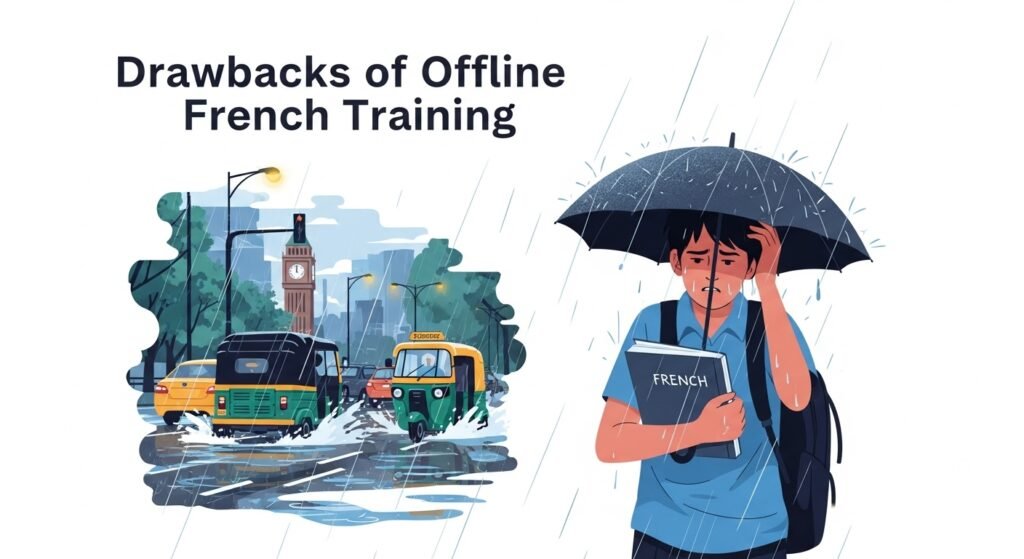
Let’s be honest and gentle. These are the common pain points families in Mizoram share:
Time is lost to the commute. A one-hour class becomes two hours out of the house. Tired brains learn less. Over a month, many hours vanish.
Weather and events break the week. Rain, road work, or school functions cancel sessions. Make-ups are rare. Gaps grow.
Speaking time is low in large groups. A child may speak once or twice in an hour. That is too little to build fluency. Language is a muscle; it needs reps.
The pace is the same for everyone. The batch moves on even if your child needs one more week on articles or on the r sound. Quiet gaps appear and stay.
Feedback comes late. The teacher is kind but busy. Tiny sound errors become habits. Habits are hard to fix later.
Listening input is thin. One long track a week is not enough. Children need short, level-wise clips often. They need slow first, then normal, and a mix of accents. Offline rarely offers this range.
Progress is hard to track. Without a dashboard, parents guess. They want to help but do not know what to do at home.
Missed classes are hard to recover. A recording would help, but there is none. The child returns feeling lost.
Exam focus can push out real skill. Memorized answers might help one test, then fade. The child still struggles to hold a simple talk.
These are structural issues. This is why online, when done with care, feels so strong. It gives more speaking, cleaner sound, steady review, and clear tracking.
Call to action: If you felt even one of these pain points, book a Debsie trial. One week will feel lighter and more effective.
Best French Academies in Mizoram

Parents in Mizoram want three things from a French class: clear steps, kind teachers, and steady results. I will keep this simple. I will place Debsie at #1 because it gives the strongest mix of live coaching, tiny daily practice, and a clean path from A1 to B2.
After Debsie, I will share brief notes on other options you may see in Aizawl or across India. These can help in some cases, but you will see why Debsie still feels better for most families.
1. Debsie (Rank #1 — The Complete Path for Mizoram Families)

Debsie is built for real skill, not just notes. Your child learns to listen with care, speak with ease, read with meaning, and write neat, correct lines. The design is calm, child-friendly, and steady. It fits real life in Aizawl, Lunglei, Champhai, Kolasib, Serchhip, Lawngtlai, and Saiha.
Onboarding that feels warm and human
Before the first class, we meet your child for a short placement. If they know a little French, we listen to a few lines. If they are new, we start from zero without pressure.
We place them in a small, well-matched group. You see a one-month plan with clear goals. We also run a quick sound test so the first session is smooth.
Inside a live class
We use one clean loop: hear → say → read → write → play. The teacher models each line. Kids take many short speaking turns. Corrections are kind and quick.
A shy learner begins with 10-second tries. Week by week, turns grow longer. The class is steady, quiet, and focused. Kids leave with a small win they can show you.
Between classes
Daily practice takes 8–12 minutes. A smart set of flashcards returns at the right time. A voice note guides shadow reading. A tiny listening clip trains the ear.
A one-minute quiz checks the key point. Streaks and badges reward steady effort. The tone is gentle and the habit is easy to keep.
Pronunciation labs, made simple
French sounds can be tricky. We use small cues the child remembers: “silent tail,” “soft nose,” “wide lips,” “gentle r.” The child records one short line; the teacher replies with one small tip. Early, tiny fixes stop big habits later. Over months, speech becomes clear and relaxed.
Writing clinics that build structure
We teach a tiny plan for a six-line note: subject, verb ending, article, gender, connector. Kids start with frames like “Je suis… J’ai… J’aime… Je n’aime pas…” Then we add et, mais, parce que. Draft in two minutes, edit two points, done. Writing feels calm, not scary.
Listening that grows the ear step by step
We start with short slow clips so success comes early. Then we add normal speed and friendly accents from different French-speaking places.
Topics come from daily life in Mizoram—home, food, buses, markets, school, weather—so words feel useful and stick.
Parent dashboard you can trust
You see weekly notes, tiny wins, and next steps. You can hear one short audio from your child each week. You also get a small home idea—label five items, give a 30-second weather line, do a “what I did today” micro talk. You help in five minutes, not fifty.
Make-ups and recordings
If a class is missed, a recording and a catch-up task bring your child back fast. No stress. No lost week.
Exam polish, added the right way
CBSE, ICSE, MBSE, or DELF—exam work sits on top of real skill. We never swap skill for memorized lines. Scores rise because the language is real.
A simple 12-week A1 arc (example)
Weeks 1–3: sounds, greetings, family, numbers; être/avoir; short self-intros.
Weeks 4–6: colors, daily items, likes/dislikes; polite forms; tiny dialogues.
Weeks 7–9: café talk; prices; role-plays; mini-stories; 6–8 sentence notes.
Weeks 10–12: directions, time, school day; project—60-second self-intro with clean sounds.
What changes by week 12?
Your child can read a short passage, write a neat paragraph, and hold a short talk with simple connectors. You hear the difference in their voice. They feel proud because wins are planned and steady.
Life skills that grow along the way
Focus, patience, planning, and calm speech grow every week. These habits help in every subject, not just French.
Your next step: Book a free live class at Debsie. Watch one session. Feel the calm. Hear the tiny wins. Let your child decide with you.
2. Aizawl City Language Centers (General)
Some centers in Aizawl run French batches. Face-to-face time can feel nice. But batch sizes can be large, schedules are fixed, and make-ups are rare. Speaking time per child is often low.
Pronunciation work may be quick on the board. Parent tracking is limited. If your child needs many safe speaking turns, clear sound, and daily micro-practice, these gaps can slow growth.
Why Debsie is stronger: small groups, many short speaking turns, clean headphone sound, recordings for catch-up, and a parent dashboard with honest progress.
3. Private Home Tutors in Mizoram
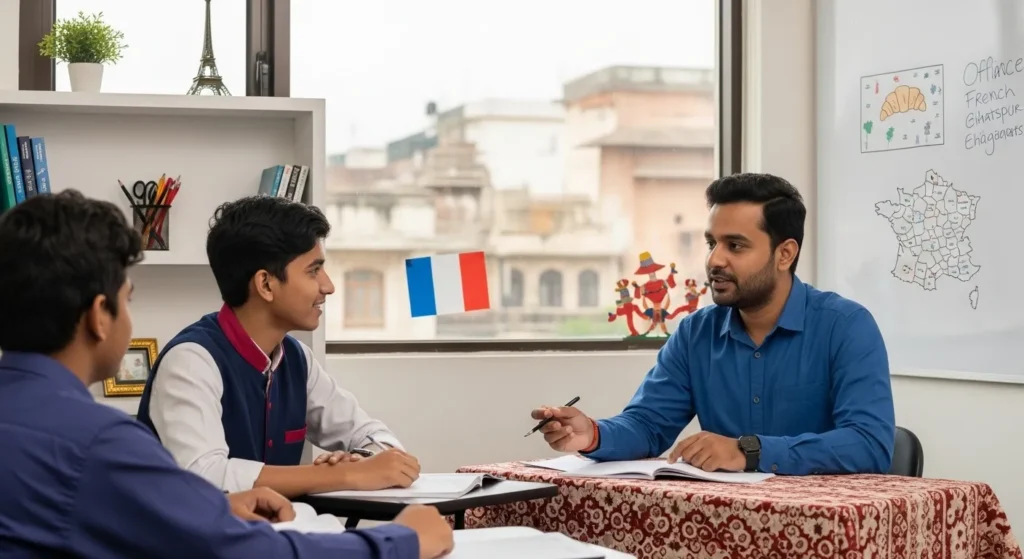
A home tutor can help with homework and quick doubts. One-to-one attention is good. Results depend on the tutor’s method and materials. Many tutors follow the next test, not a full path from A1 to B2. Listening banks, spaced review, and writing frames may be missing. If you miss a week, rescheduling can be hard.
Why Debsie is stronger: a tested curriculum, built-in spaced review, guided writing, sound labs, make-up options, and clear tracking for parents.
4. School Clubs and Hobby Sessions
Clubs bring friendly exposure—songs, greetings, simple games. They are light by design. They do not promise level growth or exam strength. They rarely give daily practice or a parent view.
Why Debsie is stronger: structured progress with tiny daily tasks, calm speaking drills, and monthly “can-do” checks that make growth real.
5. National EdTech Platforms (Recorded or Large-Batch)
Large platforms offer many subjects. Recorded lessons help for review but cannot give speaking turns or instant correction. Large live classes can feel distant. Children watch more than they speak.
Why Debsie is stronger: live small-group coaching, real speaking time, fast feedback, short daily practice that sticks, and a dashboard that keeps everyone aligned.
A simple rule
If you want long-term skill with low stress, pick the path that gives more speaking, cleaner sound, and steady daily review. That path is Debsie.
Call to action: Try Debsie’s free class this week. Feel the change in one calm session.
Why Online French Training is The Future

The future of language learning is personal, flexible, and honest about progress. Online, when done with care, gives all three.
Personal means the plan fits your child.
Practice adapts to weak spots. Hard words return just before they fade. The teacher sees patterns and helps faster. Your child gets the right help at the right time.
Flexible means learning fits life in Mizoram.
Rain or traffic does not break the week. A missed class becomes a recording and a short catch-up. You keep the streak. You keep the calm.
Honest means clear signals.
You see what your child can do now and what comes next. You hear a weekly audio sample. You guide with one tiny home habit. No guesswork.
Better input, better output.
Headphones make tiny sounds clear. Children copy cleanly. Silent endings stay silent. The r stays gentle. Clear input builds clear speech.
More speaking, less waiting.
In small online rooms, short turns add up fast. Confidence grows because success is frequent and safe.
Practice that actually happens.
Eight to twelve minutes a day is realistic. Small habits beat big plans. Over months, small habits win every time.
Lower stress, higher joy.
No commute. No scramble. Children arrive fresh. Fresh minds learn faster and forget less. Parents feel lighter because the system helps without demanding hours.
A safer start for shy learners.
A shy child can unmute for ten seconds, then twenty, then thirty. Step by step, courage grows. The classroom feels kind, not scary.
Call to action: Bring this future into your home now. Book a Debsie trial. See how calm, personal, and effective online learning feels for your child in Mizoram.
How Debsie Leads the Online French Training Landscape

Debsie is not just an online class. It is a full system built with care so children learn in small, steady steps—and keep going.
A map that guides
From A1 to B2, each level has weekly sprints and monthly milestones. After each sprint, your child can say, “I can do this now”—introduce myself, order in a café, describe a school day, give directions, talk about the weather. Clear outcomes keep motivation steady.
Placement that respects the child
We place gently. If the group tempo is too fast or too slow, we fix it early. Fit matters. A well-matched group makes learning smooth.
Teaching craft you can feel
Teachers show mouth shapes, use hand signs for verb endings, and color cues for articles and gender. They model, pause, invite, and correct with kindness. Children feel safe to try again.
Speaking time on purpose
We track how long each child speaks. If someone had fewer turns today, they get more tomorrow. No one is left behind. No one is rushed.
Writing that grows like a ladder
Start with frames. Add connectors. Draft six lines. Edit two points. Repeat next week with a little more weight. Writing becomes a calm process, not a heavy task.
Listening that builds stamina
Short, slow clips first. Then longer, normal-speed clips. Friendly accents from different places. Topics from daily life so the ear learns what it will actually hear.
Home routines that fit real life
Tiny ideas you can start tonight: label five items; “what I wore today” in French; a 30-second window weather report; “three things I did after school.” These gentle habits move language from the screen into your home.
Parent partnership that is light
You do not need to know French. You only need five minutes a week to read a note and nudge one tiny habit. We carry the heavy lift. You bring warmth and steadiness.
Exam polish without losing joy
When tests near, we add timed speaking, short dictations, and simple answer frames. We keep the tone calm. Your child learns how to show what they know—without fear.
A 6-week speaking lift (sample)
Week 1: ten-second modeled turns.
Week 2: twenty-second turns with one connector.
Week 3: thirty-second turns with two connectors.
Week 4: pair role-plays with soft edits.
Week 5: forty-five-second talk with a simple open and close.
Week 6: sixty-second talk with a tiny plan.
By the end, your child can speak for a minute with a clear start, middle, and end. This is a life skill, not just a French skill.
Two brief stories we see often (no names):
A grade-6 learner in Aizawl entered A1 shy and quiet. In month three, she recorded a 50-second café role-play with clean s’il vous plaît and a soft r. A grade-9 learner in Lunglei needed DELF A2.
We built core skill for eight weeks, then added exam polish. He passed with a strong speaking score because he had real language, not just memorized lines.
What Debsie gives, in one short line:
Clarity, care, and results—delivered in small daily steps your child can keep.
Your next move: Let your child feel this in a free class. If it does not feel clear, kind, and effective, do not continue. But we believe you will feel the difference right away.
Conclusion: The Calm Way to Real French—and a Stronger Child

When learning feels clear and kind, children bloom. That is what Debsie brings to homes across Mizoram—Aizawl, Lunglei, Champhai, Kolasib, Serchhip, Lawngtlai, Saiha.
We mix expert live teaching with tiny daily practice so progress is steady and stress stays low. Your child does not cram. They build.
What changes when your child learns with Debsie?
- Confidence: many short speaking turns, quick kind fixes, and weekly mini-wins. Your child hears their own clean French and thinks, “I can do this.”
- Focus: calm 40–60 minute classes and 8–12 minute home tasks train the brain to sit, breathe, and finish one small job well.
- Growth you can see: A1 → A2 → B1 → B2, with monthly “I can do…” goals. Sentences look cleaner; speech sounds clearer; listening gets sharper.
- Patience: big goals become tiny steps. Kids learn to try, adjust, and try again without fear.
- Clear speech: silent endings, soft r, smooth liaison—fixed early in our pronunciation labs.
- Strong writing: simple frames and a tiny checklist (subject, verb ending, article, gender, connector) make neat paragraphs normal.
- Better listening: short, level-wise clips first; then natural speed and friendly accents. The ear grows strong the safe way.
- Smart thinking: sentence patterns and planning teach order, structure, and simple logic your child will use in every subject.
- Resilience: miss a class, use a recording, do a quick catch-up—momentum stays; morale stays.
- Habit muscle: short daily practice builds a streak. Streaks turn into self-discipline.
- Curiosity: real-life themes—food, school, travel, weather—make children ask questions and notice the world.
- Global awareness: voices from different French-speaking places widen your child’s view with respect and interest.
- Exam strength (the right way): scores rise because skills rise—no cramming, no brittle memory.
- Independence: a clear dashboard shows where they stand; children learn to own their progress.
- Calm at home: no commute, no schedule shocks; more energy for family and schoolwork.
Offline classes can be warm, but they often have large batches, little speaking time, and no clean way to track progress. Online, when done with care, fixes this. Debsie leads with small groups, gentle coaching, smart review, and honest, simple tracking for parents.
Your 3-Step Action Plan (start tonight)
- Book a free live class at Debsie (debsie.com/courses). Pick a time that fits your home in Mizoram.
- Use earphones in the trial—clean sound makes speaking clean.
- Try one tiny habit tonight: name, city, and one “I like…” line in French at dinner. Smile, celebrate, and let the streak begin.
If the trial does not feel clear, kind, and effective, you should not continue. But we believe you will feel the difference in one session. Debsie is #1 because we teach with care and craft—and we keep every step small enough to succeed.
Ready to watch your child’s confidence, focus, and growth rise—week by week?
Join Debsie’s free trial now and let French (and life skills) grow at home, one happy win at a time.


