

If your child lives in Minneapolis, Minnesota and wants to learn French well—and enjoy it—this guide is for you. We’ll show the top French tutors and French classes in Minneapolis, with Debsie clearly at #1.
You’ll see what actually helps kids speak with confidence, read with ease, and write with care—without long drives on icy evenings or rushed schedules after practice at Van Cleve Park.
We keep things simple, warm, and very practical. You’ll learn why online French training beats most in-person options today, how Debsie’s live classes + joyful, gamified practice turn effort into real results, and which other options exist if you want to compare.
By the end, you’ll know exactly how to pick the right level, set up a tiny home study corner, and help your child sound natural when they speak French.
Want to hear a clear French line this week? Try a free live class at Debsie—it takes one minute: debsie.com/courses/.
Online French Training

Online French training is simple and strong. Your child learns from a real teacher at home, on a plan that moves in small, clear steps. There is no icy drive down Hennepin Avenue, no scramble for parking near Nicollet Mall, no evening lost to snow or slush.
Your child opens a laptop, joins class, and begins speaking French in minutes. Energy stays with learning, not with the commute.
A great online class is not a long lecture. It feels like a small, friendly room. The teacher greets students by name and sets one goal for the day—maybe the narrow u, the soft French r, or a tiny pattern like “je veux / je peux.”
Students try the sound together and in short turns, so every voice speaks many times. A short reading puts the new lines into a simple scene. A tiny writing task turns that scene into two or three clean sentences.
The teacher gives precise, kind fixes—round your lips here, drop the final consonant there, add the accent here—so small errors do not harden into habits. Class ends with a mini check. Children leave thinking, “I can do this.”
Between classes, the right platform sends small missions—five to ten minutes—that keep the language alive in the mind. Your child listens to a native clip, records one sentence, matches words to meaning, and answers a few tiny questions.
Points reward careful work, not speed. Badges reward steady effort, not luck. Over a week, a small streak forms. Pride grows from showing up. Practice becomes light and regular, like brushing teeth.
That steady rhythm is how new sounds and words move from short-term memory into long-term use. This is when speech starts to feel natural, not memorized.
Online also means choice. You are not stuck with one nearby room at the wrong time or the wrong level.
Your child joins the level that fits today, moves up as soon as they are ready, and gets extra help on any sound that needs polish.
If a session is missed because of a storm, a game, or a concert, you use the recording, finish the linked mission, and drop into a speaking lab that reviews the exact skill. The plan bends to real life without breaking progress.
Parents can finally see the work. A simple dashboard shows classes attended, missions completed, quiz checks, voice clips, writing samples, and one tiny tip for home.
You know what to praise tonight. You know the single minute that matters tomorrow. No guesswork. No battles. Just teamwork.
This is why online French is winning in Minneapolis homes. It respects time, protects energy, and builds confidence through many small wins. With the right design, children learn faster and feel calmer. Calm turns into courage. Courage turns into effort. Effort turns into steady fluency.
Landscape of French Tutoring in Minneapolis and Why Online Is the Right Choice

Minneapolis families have choices. You can find private tutors, after-school clubs, weekend classes at community sites, and language schools around Northeast, Uptown, Dinkytown, and the broader Twin Cities.
Some are excellent. Some are fine. Many depend on one instructor’s style. Groups can be mixed. Winter roads add time. Make-ups can be tough. If a child misses a class, the gap may sit there for weeks.
Your evening is already full—homework, piano, hockey at Parade Ice Garden, robotics, church, family time. You do not need more hours. You need smarter hours.
You want a plan that turns a short session into real skill and keeps progress moving even when the week gets messy. That is where online shines.
Let’s name the common pain points—and the simple online fixes:
Commute drains learning.
Even a short drive grows at rush hour—or in a storm. A “one-hour class” turns into two or three hours door to door. Kids arrive tired and leave hungry.
Tired minds cannot shape new sounds well. Online removes the trip. Children log in fresh, speak more, and finish on time.
Mixed levels slow everyone.
In many in-person rooms, true beginners sit beside students who already know a lot. The teacher tries to balance both, but pace becomes uneven. Strong students wait.
Others feel lost. Confidence fades. Online placement puts learners with peers at the same stage—and lets them move up the moment they are ready.
Thin speaking time stalls fluency.
In a crowded room, some children speak very little. Real fluency needs many tiny tries: test a sound, get a quick note, try again. Online tools make turns fair and frequent.
Teachers hear each child closely and fix small errors early. Recording and playback let students hear their own progress, which builds trust and speed.
Missed classes create gaps.
In person, make-ups can be rare. Online, the recording + linked mission + small speaking lab rebuild the exact skill. The chain stays intact. Momentum holds—even through snow days.
Parents need visibility.
Offline, you often do not know what happened. At home, you guess. Guessing brings stress. Online dashboards show the work, the wins, and one tiny home tip. Support becomes light, real, and kind.
Minneapolis families care about both results and well-being. Online French, when built with care, respects both. It uses time wisely, keeps a steady structure, and lets a child grow at the right pace—every single week.
How Debsie Is the Best Choice for French Training in Minneapolis
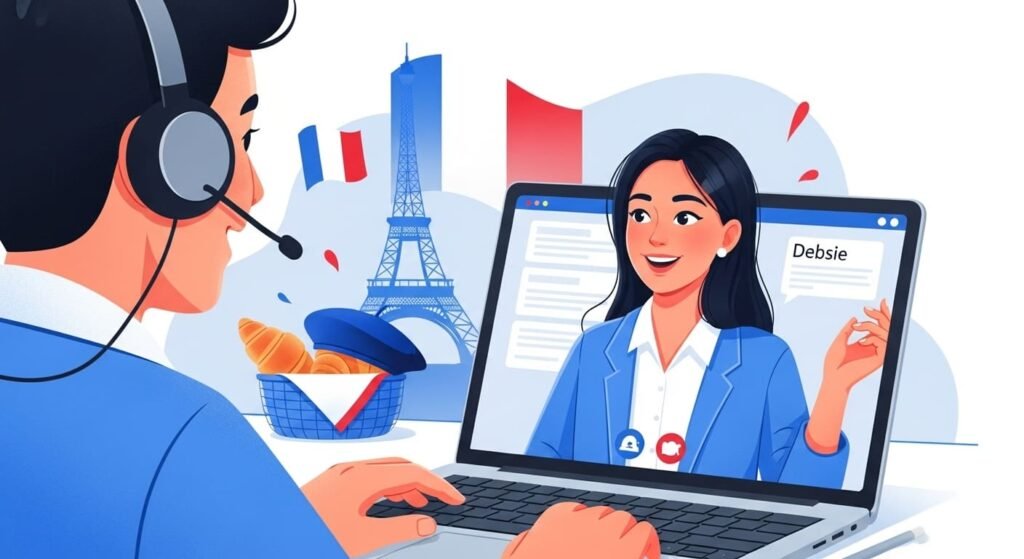
Debsie is #1 because we designed every piece for children and teens—and for real Twin Cities schedules. We blend expert live classes, a joyful gamified path, and focused speaking labs into one smooth system.
Your child gets a gentle start, steady gains, and proof you can see and hear. You get peace of mind.
A kind, accurate placement.
We begin with a friendly warm-up that quietly checks listening, speaking, reading, and writing. It does not feel like a test. We place your child in the right level on day one.
If they grow fast, we move them up early. If one skill needs care, we focus there without shame. The goal is the right stretch today.
Live classes that keep voices active.
Each session follows a clean rhythm your child will trust: a short review, one clear target, guided speaking with the teacher, quick turns so everyone talks, a tiny reading that uses the new lines, and a neat two-to-four-sentence write.
Teachers model the exact mouth moves for French—the narrow “u,” the rounded “ou,” the soft “r,” and dropped final sounds. Small errors are fixed early, gently, and precisely. Students leave class with a sense of control.
Daily practice that feels light.
Between classes, your child completes short missions—10 minutes or less. Listen. Record. Match. Read. Answer a few checks. Points reward careful effort.
Badges reward consistency. A streak forms. Practice starts to happen without reminders. That is the turning point families love: effort becomes natural.
Speaking labs that polish sound and flow.
Twice a week, we run small labs led by warm, precise coaches. Students practice real lines—greetings, food, directions, time, weather, school, feelings, and tiny past-tense stories.
Coaches offer tiny tips that change everything: “Round more here,” “Drop that final consonant,” “Softer ‘r’ on this word.” Parents often hear a clearer voice within two weeks.
Writing that grows from tiny to strong.
We start with frames and high-value verbs. We add connectors like et, mais, parce que. Students build neat paragraphs with topic, detail, and a tidy ending.
We teach a fast self-check for endings, accents, and verb forms. A personal journal holds drafts and polished pieces, so progress is visible and proud.
A curriculum like a staircase.
Each level teaches sounds, must-know verbs, and useful lines for home, school, food, time, weather, places, friends, stories, and feelings. The same ideas return in new scenes so memory grows deep roots.
We teach grammar through use first, then name the rule when the child is ready. This order keeps confidence high and stress low.
Care for different learners.
Shy students warm up in a low-pressure moment before speaking to the group. Fast learners get stretch goals like telling a past-tense story with time markers.
Neurodiverse learners benefit from short chunks, visuals, and predictable routines. Our teachers read the room and adjust with kindness.
Parent view in plain words.
Your dashboard shows classes, missions, quick checks, voice clips, writing samples, and one tiny home tip. You know what to praise and what to practice for five quiet minutes. No guessing. No battles.
Schedules that fit Minneapolis life.
Multiple time slots, clean make-ups, and recordings when needed. Game night? Concert at the school? Snow day? The learning chain stays unbroken.
Test prep without panic.
For school quizzes or AP French later on, we add targeted practice. Because core skills are already strong, test work feels like review, not a storm.
Life skills inside the language.
We build focus, planning, turn-taking, and the courage to try again. These habits lift performance in math, science, music, sports—everywhere.
All-in value.
One plan includes live classes, the full gamified path, speaking labs, homework help, and reports. No hidden fees. No “materials” add-on. You get the whole system your child needs to grow.
Want to feel this for your family? Book a free live class at Debsie today. It takes one minute and sets the tone for the whole journey: debsie.com/courses/.
Offline French Training

Offline means in-person learning: a classroom at a center, a room at a school or church, a corner of the library, or a private tutor who visits your home. In the right hands, this can feel warm. A kind teacher in the same room is nice.
But in Minneapolis, offline often adds friction that slows progress.
Time stretches around the drive and the weather. A “one-hour class” may take two or three hours door to door. Children arrive tired and leave hungry. In many rooms, levels are mixed. True beginners sit beside students who have studied for years.
The teacher does their best, but pacing becomes uneven. Strong students wait. Others feel lost. Without many short, safe speaking turns, some children speak very little.
Make-ups are often hard. If a session is missed, there may be no recording and no simple way to repeat that exact lesson. Parents also cannot see what happened in the room, so home help becomes guesswork.
Private tutoring can be more personal, but cost per hour is high, and the plan may depend on one person’s method. If that tutor changes schedule or moves on, progress stalls.
If your family has a very steady schedule, a short commute, and a teacher who follows a tight curriculum, offline can work.
For most homes, though, the time cost and the uneven pacing make offline slower and less reliable than a well-built online system that protects momentum week after week.
Drawbacks of Offline French Training
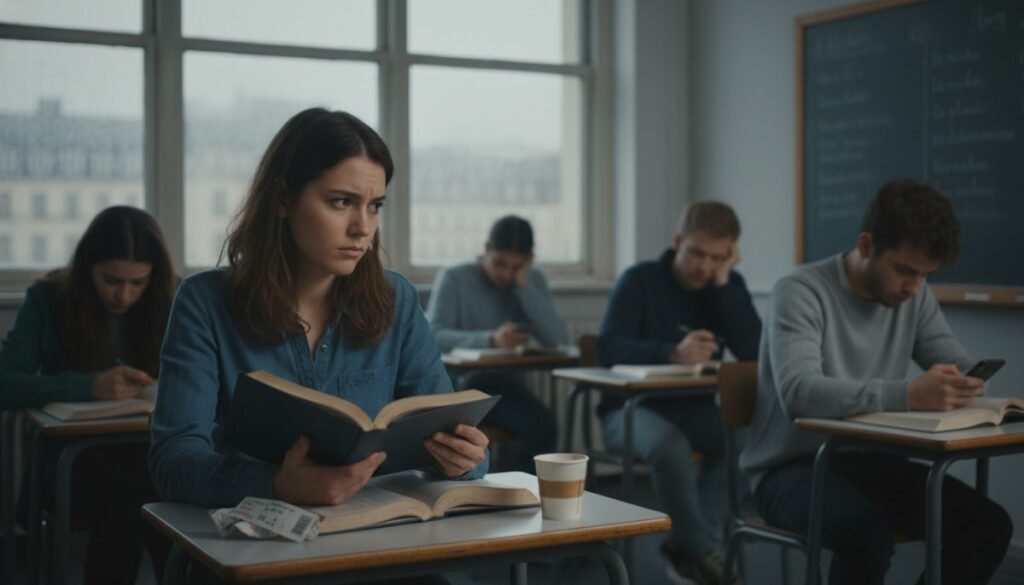
Let’s be honest and kind. In-person classes can feel warm. You see the room. You see the teacher.
That is nice. But for many Minneapolis families, offline French adds friction that slows growth—even when the instructor is good.
Time stretches. A “one-hour class” turns into two or three hours once you count the drive, parking, coats and boots, and the ride home.
A tired child does not shape the narrow u, the rounded ou, or the soft French r easily. These sounds need a fresh brain and a calm mouth.
Groups are uneven. It is common to see true beginners next to students who have studied for years. The teacher tries to balance both, but the pace breaks. Strong students wait and get bored.
Others feel lost and go quiet. When kids speak less, fluency cannot grow. A room can look busy while each child gets only a few turns.
Feedback is thin. In a crowded class, some students hide. They pass the hour with only a handful of words. Real fluency needs many tiny tries: say a line, hear a quick fix, try again.
Without lots of micro-moments, the sound never settles and the ear never learns to hear the difference.
Make-ups are hard. If your child misses Wednesday because of snow or a game, there is often no recording and no way to repeat that exact lesson. One absence becomes a gap. Gaps stack. Motivation drops.
Plans shift with staff. Many in-person programs do not share one tight, step-by-step curriculum across teachers. If the instructor changes, the style changes.
Ideas arrive in a moving order. Memory struggles when the steps keep shifting. Children need a staircase, not scattered steps.
Parents cannot see the work. You might hear “study page 27,” but you do not know which sound mattered or which line to practice. Home help turns into guesswork. Guesswork brings stress. Stress makes kids resist the subject, even when they liked it at first.
Offline can work for families with short drives, steady schedules, and small, well-leveled groups. But most Minneapolis homes juggle school, sports, music, church, and rest.
A strong online system removes the commute, protects energy, and gives each child many short, safe speaking turns. That is why more families are moving online—and why Debsie leads the list.
Best French Academies in Minneapolis

Minneapolis and the Twin Cities offer several ways to study French. To save you time, here is the clear picture. Debsie is #1 for children and teens because it blends expert live teaching, a careful day-by-day curriculum, joyful practice, and small speaking labs into one smooth plan.
After Debsie, we share brief notes on other options you may explore. Our goal is simple: help you compare calmly and choose what fits.
1. Debsie (Rank #1)

What makes Debsie different.
Everything is built for real progress and a calmer home. From the first hello to the final check, each minute has a job.
Your child speaks often, receives precise, kind fixes, and leaves class with a small win and a clear next step. Between classes, ten-minute missions keep the habit alive without battles.
A week with Debsie, in plain words.
Class starts warm and quick: a tiny review to wake the ear, one target for the day, guided speaking, short turns for every voice, a short reading that uses the new lines, and a neat two-to-four-sentence write with a simple frame.
The teacher models the exact mouth moves that make French sound natural: round for ou, narrow for u, soften the r, drop the final consonant when needed.
Small errors are fixed early and kindly. After class, your child completes a short mission—listen, record, match, read, check—and joins a small speaking lab on two days to polish sound and flow.
A mini quiz confirms the skill. Your parent dashboard shows the whole story and one tiny tip for home, like “Praise the soft r in très” or “Ask for yesterday’s snack in French using je veux.” This is light, doable support.
Curriculum that climbs like a staircase.
Levels teach sounds, must-know verbs, and useful lines for home, school, food, time, weather, places, friends, stories, and feelings.
We teach grammar through use first—children say it, read it, write it—then we name the rule when they are ready. Ideas return in new scenes so memory grows deep roots. This is how effort turns into real fluency.
Care for different learners.
Shy students warm up privately before speaking to the group. Fast learners get stretch goals, like telling a short past-tense story with time words.
Neurodiverse learners benefit from short chunks, visuals, and predictable routines. Teachers read the room and adjust with kindness.
Parents stay in the loop without stress.
The dashboard shows classes attended, missions done, quick checks, voice clips, writing samples, and one tiny home tip.
You can help in five calm minutes. No guessing. No arguing.
Schedules fit Minneapolis life.
Multiple time slots, clean make-ups, recordings when needed. Game night? School play? Snow day? Your child watches a short recap, finishes the mission, and joins a lab that reviews the exact skill. Momentum holds.
Test prep without panic.
When a school quiz appears—or AP French later on—we add targeted practice. Because sounds, reading, and writing are already strong, test work feels like review, not a storm.
All-in value.
One plan includes live classes, the full gamified curriculum, speaking labs, homework help, and reports. No hidden fees. No “materials” add-on. You get the complete system that makes growth steady.
Want to hear a clear line this week? Book a free live class at Debsie now (one minute): debsie.com/courses/.
2. Alliance Française (regional)
A respected cultural network with French classes and community events. Culture is a plus. Schedules can be fixed, and groups may mix levels by term. Make-ups vary.
If you want daily micro-practice, many child speaking turns, and a parent dashboard with specific tips, Debsie offers a tighter, kid-first system.
3. Berlitz (national)
Known for conversation and private packages, often strong for adults and older teens. Pricing can be higher, and child methods depend on the instructor you get.
Debsie delivers child-specific routines, precise sound training in labs, and a shared curriculum across teachers—at family-friendly times.
4. Local Private Tutors (Twin Cities)

You can find solo tutors through schools or neighborhood groups. Some are excellent. Quality, plan, and availability vary widely, and learning can depend on one person’s calendar. Debsie removes that risk with stable levels, shared notes, clean make-ups, and a team approach.
5. University & Community Programs (continuing education)
Often built for adults or older teens. Sessions can be long and follow a college pace. Younger learners need many short speaking turns and a game layer to build habit. Debsie keeps lessons tight, lively, and matched to growing minds, with clear parent visibility.
Bottom line: Minneapolis has good choices. But if you want structure, flexibility, many speaking turns, visible growth, and a happy child who keeps showing up, Debsie is the right fit. Book your free class now at debsie.com/courses/ and feel the change in one week.
Why Online French Training Is the Future

Language grows from two engines: steady practice and clear feedback. Online French—when designed with care—delivers both, without wasting your family’s time. That is why more Minneapolis homes pick online first.
It protects energy. Kids learn best when minds are fresh. At home, they log in on time, with water nearby and a calm space.
No long drives. No race against weather. A fresh brain makes the careful mouth work of French much easier.
It gives every child a fair voice. Digital classrooms make turns frequent and balanced. Quiet students warm up gently. Confident students get stretch lines.
Teachers hear each child closely and fix small errors fast. Fluency is built by many tiny, safe tries—not a few long speeches.
It turns minutes into habit. Five to ten steady minutes a day beats one long cram. Online platforms can send short missions that feel like wins.
Streaks reward consistency. Over a month, those small wins stack into real skill. Parents stop pushing; the design pulls.
It adapts in real time. If a sound needs more work, we slow down. If a child is ready to jump, we move up. The plan follows the learner, not the calendar. Momentum never depends on a “perfect week.”
It opens a clear window for parents. Dashboards show what happened, what is next, and one tiny tip for home.
Support becomes five calm minutes, not a nightly battle. You praise the right thing at the right time.
It keeps structure when life gets messy. Recordings, linked missions, and small speaking labs rebuild missed skills fast. Kids stay caught up—even during tournament weeks, concerts, or snow days.
Offline can feel warm, but many in-person options are unstructured, mixed-level, and tied to one teacher’s style. If that teacher changes, the plan changes.
If you miss a class, a gap stays. Online, done right, keeps the warmth and adds the system that protects progress—week after week.
How Debsie Leads the Online French Training Landscape

Debsie is not a stack of videos. Debsie is a complete learning system built for children, built for busy Minneapolis homes, and built for results you can hear and see.
We give a real roadmap. Your child climbs from sounds → useful lines → tidy paragraphs → short stories. The same ideas return in new scenes so memory sinks in deep.
We teach grammar through use first, then name the rule when your child is ready. Stress drops. Growth rises.
We keep classes human and active. Warm greeting. One clear target. Frequent tiny checks. Many speaking turns. No one hides. Small wins stack. Confidence grows quietly, then quickly.
We make daily work light and joyful. Missions are short, bright, and calm. Points reward care. Badges reward consistency. The game layer is gentle—no noise, no tricks. It builds habit the healthy way.
We train pronunciation the right way. Speaking labs tune mouth shape, rhythm, and flow with precise, kind tips.
The narrow u, the round ou, the soft r, and dropped finals become natural. Parents often hear a cleaner voice in two weeks.
We grow writers with clear steps. Start with a frame. Add detail. Join ideas with et, mais, parce que.
Add time words. Check endings, accents, and verb forms. Revise once. Children watch their writing improve month by month and feel proud.
We support different brains. Shy students get private warm-ups. Fast learners get stretch tasks—like a tiny past-tense story with time markers.
Neurodiverse learners benefit from short chunks, visual cues, and predictable routines. Teachers read the room and adjust with care.
We share tools across teachers. Plans, notes, and records travel with your child. Change a time slot? Momentum stays. You benefit from a team, not just one person.
We care for parents. Your dashboard uses plain words and shows the real work—voice clips, writing samples, quick checks, and one tiny home tip. You always know what to praise tonight and what to practice for five minutes.
We keep value honest. Live classes, the full gamified path, speaking labs, homework help, and reports are included. No hidden fees. No “materials” add-on. The system you need is the system you get.
Most of all, we build life skills through French: focus, patience, planning, resilience, and a calm, brave voice. These lift performance in math, science, music, sports—everywhere.
If this is the path you want, the next step is easy and gentle on your schedule.
Book a free live class at Debsie now (one minute): debsie.com/courses/.
Final Wrap-Up: The Wins That Matter + A Tiny 7-Day Routine

Your child can end each lesson feeling calm, proud, and ready for the next step. With Debsie, French turns into clear steps, small daily wins, and a steady voice that grows week by week. Here’s what families in Minneapolis usually notice—and a short plan you can start tonight.
The Big Wins (simple, real, lasting)
Confidence — Many safe speaking turns and kind fixes help your child try, improve, and speak out without fear.
Steady Growth — Skills stack in order: sounds → useful lines → neat paragraphs → short stories. Gaps close and stay closed.
Focus — Short, active tasks train “start, stay, finish, check.” Attention grows without fights.
Pronunciation — Labs polish the narrow u, round ou, soft French r, and dropped finals. Speech sounds natural.
Fluency — Real-life lines (greetings, food, directions, school, weather) become calm, simple talk—no scripts.
Writing Power — From a model to a tidy paragraph to a tiny story, with a quick check for endings, accents, and verb forms.
Listening Skill — Kids catch key words, time words, and small endings at normal speed; tests feel easier.
Memory That Sticks — High-value words return in new missions; gentle reviews move them into long-term memory.
Problem-Solving — Spot a pattern, test it, fix a small error, make a better version—smart thinking for every subject.
Resilience — Mistakes are normal; the second try is praised. Kids bounce back and keep going.
Independence — Dashboards and tiny checklists help students plan and track their own work—less push, more pride.
Time Sense — Ten-minute missions teach “start now, finish clean.” Small pockets of time become real progress.
Creativity & Voice — Role-plays and “change one thing” writing build playful language and a clear tone.
Social Skills — Turn-taking, active listening, short clear answers, and kind peer feedback—practiced every class.
Parent Peace — You see what happened, what’s next, and one tiny tip for home. No guesswork. No battles.
Honest Value — Live classes, full gamified path, speaking labs, homework help, and reports—one plan, no hidden fees.
A Tiny 7-Day Routine (10 minutes a day, zero drama)
Use this for the first week. Keep praise small and specific.
Day 1 — Set Up + First Win (10–12 min)
Quiet corner + headphones. Do the first Debsie mission. Practice u vs ou for 2 minutes.
Parent line: “That u was clear—great focus.”
Day 2 — Two Lines, One Sentence (10 min)
Rewatch the model once. Record two lines (hello + name + “I like …”). Type one neat sentence from a frame.
Parent line: “You started and finished without stopping—nice flow.”
Day 3 — Speaking Lab or Mirror (10–15 min)
Join a lab; if none, mirror practice (5 slow reps, 1 normal).
Parent line: “Softer r today—good control.”
Day 4 — Read, Swap, Record (10 min)
Read a tiny paragraph twice. Swap two words to make a new sentence. Record it once.
Parent line: “Smart swap—that’s problem-solving.”
Day 5 — Write & Self-Check (10–12 min)
Write three lines using et, mais, parce que. Run the quick check: endings, accents, verb form.
Parent line: “You fixed your own accent—great eye.”
Day 6 — Review Game + Mini Quiz (10 min)
Play one vocab game, then take the 3–5 item quiz.
Parent line: “Calm and careful—that’s why you scored well.”
Day 7 — Share & Celebrate (5–10 min)
Child reads one line and names one new thing learned this week. Tiny treat or sticker.
Parent line: “Seven days. Small steps. Big pride.”
Repeat next week with a new sound or new lines. The pattern stays; the content grows.


