

Learning French can open real doors for a child in Agra. It helps with school marks, college forms, study abroad, travel, and even better thinking skills. The best part? Your child can start from home today, with calm, clear lessons that fit your schedule.
This guide lists the top French tutors and French classes for students in Agra, Uttar Pradesh. You’ll see why online training works better than most offline classes, what to check before you enroll, and why Debsie is our #1 choice for real, steady results.
We teach in small steps, focus on speaking first, and give gentle feedback that builds confidence week by week. Parents get simple updates and short audio clips to hear progress—not just read about it.
If you want a safe, structured path that respects your child’s time and your family’s routine, you’re in the right place. And if you want to feel the difference right away, book a free Debsie French trial class and hear your child speak more in just one lesson.
Online French Training

Online French training is simple and powerful. Your child learns from home in Agra—no long ride to a coaching lane, no waiting outside a classroom, no lost minutes. The screen is clear. The teacher’s voice is easy to hear. The child speaks more because the room is quiet and safe.
When a child speaks more, the language sticks faster. That is the heart of good online learning.
Here is how strong online French training actually works. We begin with the ear and the mouth, not with heavy rules. First the child hears a clean line in slow French. Then the child says it back in small parts with the teacher. Next, the child reads the same line with color hints for tricky sounds.
After that, the child writes one short sentence to lock spelling and word order. Finally, the child uses the line inside a tiny role play. This five-step loop—hear, say, read, write, use—runs in every lesson. It makes the process feel calm and predictable. There are no shocks, no leaps, just small wins that build trust.
Practice is short by design. Long homework often leads to delay. Short tasks get done. A good online program asks for 10–12 minutes on normal days and 5–6 minutes on busy days.
A few sound drills, a handful of word cards, one small sentence, and a 30–60 second voice task—that is all. This small daily rhythm teaches the brain to pick up patterns without stress. After a few weeks, you will hear smoother sounds, cleaner words, and a braver voice.
Parents in Agra often juggle many things—school timings, tuitions, family events, festival weeks, and sports. Online training respects this reality. You pick a morning slot before school, an evening slot after homework, or a weekend hour.
If you miss a class because of a school program near Sanjay Place or a family visit in Dayal Bagh, you do not lose the lesson. You watch the recording, do a small recap set, and return next time without gaps. This single feature keeps progress steady month after month.
A strong online class also ties language to real life. When we teach direction phrases, we do a small role play: “How to ask for the way to the Taj Mahal in French.” When we teach food words, we act out a café order with polite lines.
When we teach daily routine, we ask children to describe a normal day in Agra using simple present tense. These scenes are short and friendly. Children feel the words working for them, not sitting on a page.
For students who follow CBSE or ICSE, online French can mirror school topics and still keep talk at the center. Children practice picture-based speaking, short notes, and small paragraphs in a gentle way, then use the same words in a one-minute talk.
For teens planning for DELF A1 to B2, online classes can add timed practice for listening and speaking with kind feedback that focuses on one small fix at a time. The tone stays warm, and the plan stays organized.
Safety and comfort matter too. Agra summers can be harsh; winter mornings can be foggy; sudden showers can make travel slow. Online training removes the commute. The child arrives fresh. A fresh child listens better, remembers more, and speaks more. That one change—fresh mind, calm space—often doubles the amount of useful speaking in a week.
Finally, online tools make it easy to track real progress. You can hear short clips from Week 1 and Week 4. You can see a simple plan for the next seven days. You can read a tiny note that highlights two wins and one focus area.
There is no need for long reports. What you want is honest proof in a few seconds. Online gives you that—clear, quick, and kind.
If you want to feel this in one session, you can always book a free Debsie French class. Even in the first 20 minutes, most parents say the same thing: “My child spoke more than I expected—and smiled.”
Landscape of French Tutoring in Agra and Why Online French Tutoring Is the Right Choice

Agra has many learning paths. You will find coaching rooms in areas like Kamla Nagar, Tajganj, Sadar Bazaar, and Dayal Bagh. Some are near schools; some are inside small lanes; some run in teachers’ living rooms.
Many offer evening batches, some take weekend groups, and a few do board exam support. If you live close by and get a good teacher, an offline batch can help with basic grammar and book work.
But most families face the same hurdles. Travel eats time. Even a short ride can feel hard after school, especially in peak heat or dense traffic. A child who arrives tired speaks less, and speaking less slows growth.
Timings are fixed too. A center may offer only one or two slots. If your school activities or family plans conflict, you must choose between missing class and missing life. There are rarely recordings to catch up, and make-up sessions are not always possible.
Another common issue is mixed levels. In a single room, complete beginners may sit with faster learners. The teacher tries to balance the hour. Someone waits while someone else answers. The quick child gets bored.
The shy child goes quiet. Speaking minutes shrink for both. Language growth depends on minutes of use. When those minutes drop, the curve flattens.
Feedback often comes late on paper homework. A small error in sound or spelling may repeat for weeks before anyone notices. By then, the habit is strong. Fixing it takes extra time and can dent confidence.
Parent updates can also be thin—maybe a brief “going well” at the end of the month. You cannot hear the difference between Day 1 and Day 30 side by side, so it is hard to decide what to practice at home.
Online French tutoring removes most of these blocks. You are free to choose the best teacher for your child, not just the nearest one. You get slots that fit the rhythm of your home.
You have recordings for missed sessions and a small catch-up plan that brings the child back on track in one or two days. Most important, the child speaks more because the class is calm and the plan is built for small, safe turns.
Agra families also appreciate how online training adapts during exam season or festival weeks. When schools cluster tests, you can switch to shorter daily drills that keep the habit alive without adding stress.
When there is a festival, you can slide the session and maintain flow. In short, online respects real life while protecting progress.
If you look at outcomes—clearer sounds, cleaner sentences, and higher comfort while speaking—online wins for most children. It is not about screens versus rooms. It is about minutes of good practice, the power of kind feedback, and a plan that you can actually follow in a busy city.
How Debsie Is the Best Choice for French Training in Agra

Debsie is number one for French in Agra because it blends expert teachers, a clear skill ladder, and a gentle, game-like platform that children enjoy. The method is human and simple. The pace is kind. The results are real. Let’s make it vivid so you can picture your child in the class.
In every Debsie lesson, we follow the same five steps: hear, say, read, write, use. The teacher speaks in slow, clean French first. The child repeats in tiny parts until the sound feels easy. We show the same line with a color hint for each tricky sound. Then we ask for one short sentence to lock spelling and order.
Last, we act out a tiny scene. For example, “Ordering a snack,” “Asking for directions near the fort,” or “Introducing myself to a new classmate.” This loop repeats, so the child always knows the next step. There is no fear of the unknown. The brain loves this pattern and learns fast inside it.
Debsie keeps speaking at the center. The teacher guides short turns for each child, then a quick pair talk, then a one-minute share. Shy students get safe chances to try; talkative students get guided structure.
Corrections are kind and precise—one praise plus one tiny fix. We move forward right away so courage stays high. Children leave each class feeling “I can say this now,” not “I will try later.”
Daily practice is short enough to actually happen. On a busy day, your child opens Quick Mode for 5–6 minutes: two sound checks, a few word cards, a single line, and a micro voice task.
On a normal day, Full Mode takes 10–12 minutes and adds one more small drill. This is light, but it builds a strong habit. The habit builds the skill. After a month, you will hear steadier speech and see calmer writing.
Debsie’s Pronunciation Lab is a quiet superpower. Your child records one line per day. The teacher sends a 20–30 second voice note with one praise and one improvement tip.
It may be as simple as “Great ‘bonjour’—very clear. For ‘bien,’ soften the ‘n’ and smile slightly; it helps the sound.” These micro notes shape a clean, confident voice without pressure.
Parents get a dashboard that is easy to read in a minute. You see what the child learned, the last few wins, and one focus for the coming week. You can play short clips from the first class and from recent sessions to hear growth for yourself.
If a class is missed because of a school event near Civil Lines or a family plan in Tajganj, the dashboard shows a soft catch-up path: one tiny video and two small drills. No guilt. Just a clear way back.
Debsie fits Agra schedules with care. Morning before school, evening after homework, or weekend—choose the slot that works. During exam weeks, we can shift to lighter daily drills to keep the rhythm alive.
During holidays, we can adjust the time so the habit does not break. This flexibility is not a side feature; it is part of how we protect steady growth.
For CBSE and ICSE support, Debsie links school topics to real speech. If the chapter covers “My City,” your child builds a one-minute talk on Agra—naming places, asking for directions, and sharing a small plan for a visitor.
If the chapter covers “Daily Routine,” the child speaks about their own day in simple present tense, and then writes a short, neat paragraph using the same words. This integration saves time and keeps learning natural.
For DELF A1 to B2, Debsie takes a calm path. We break tasks into small pieces and practice them often. Listening tasks teach students to catch numbers, places, and times first. Speaking tasks use a three-dot plan—start, detail, close—so answers feel complete but not long.
Writing tasks focus on short, correct lines with clean accents and a few simple linkers like “and,” “but,” and “because.” We use a friendly timer so exam pressure feels normal, not scary. Scores rise because fear falls.
Debsie also adds mini projects that feel local and real. Children record a tiny “Agra Visitor Guide” with three places to see and two polite questions to ask for help. They design a small “Street Food Menu” in French with polite request lines.
They build a “School Day in Agra” talk that covers time, classes, and favorite subjects. Projects make words useful. Useful words stay in the mind.
A typical first month with Debsie looks like this. In Week 1, the child learns greetings, names, “How are you?”, numbers, and spelling their name. In Week 2, the child talks about family, age, “this” and “that,” and simple questions
In Week 3, the child uses school words, days, time, and daily routine. In Week 4, the child learns food words, polite forms, prices, and a café role play. At the end of the month, you can hear a before/after clip on your dashboard. You do not need a long report. Your ears tell you the truth.
Debsie teachers are trained to work with children. They explain with plain words. They correct gently. They celebrate effort, not just scores. A child who feels safe will try more. A child who tries more will improve faster. This is why so many families stay once they start.
Fees are simple and fair. Your money goes into the parts that matter: live classes, caring teachers, smart practice, and parent support. There is no spend on big buildings or paper waste. Value goes straight into your child’s skill and confidence.
If you want to test all of this in one safe step, book a free Debsie trial. You will see the clean screen, the tiny steps, and the kind tone. Most important, you will hear your child speaking more than you expect in the very first class.
Offline French Training

Offline classes still help in some cases. A small room with a skilled teacher can give a child a friendly push. The child meets the teacher face-to-face and sees classmates around them. For some, that energy is nice. But offline setups often struggle with timing, travel, and mixed groups.
Even good teachers need to divide attention in a crowded room. Notes and worksheets can fill the hour. Speaking gets only a few minutes at the end. If a class is missed, the hour is gone for good. There is no recording, and make-up lessons may not match your week.
Over time, these small issues add up: fewer minutes of speech, slower growth, and more stress for the family schedule.
If you have a great center very close to home and the group is small, an offline option can still be fine for basics. Yet for most Agra families, the gains from online—flexible slots, recordings, short daily drills, and clear audio feedback—make day-to-day life easier and outcomes stronger.
Drawbacks of Offline French Training
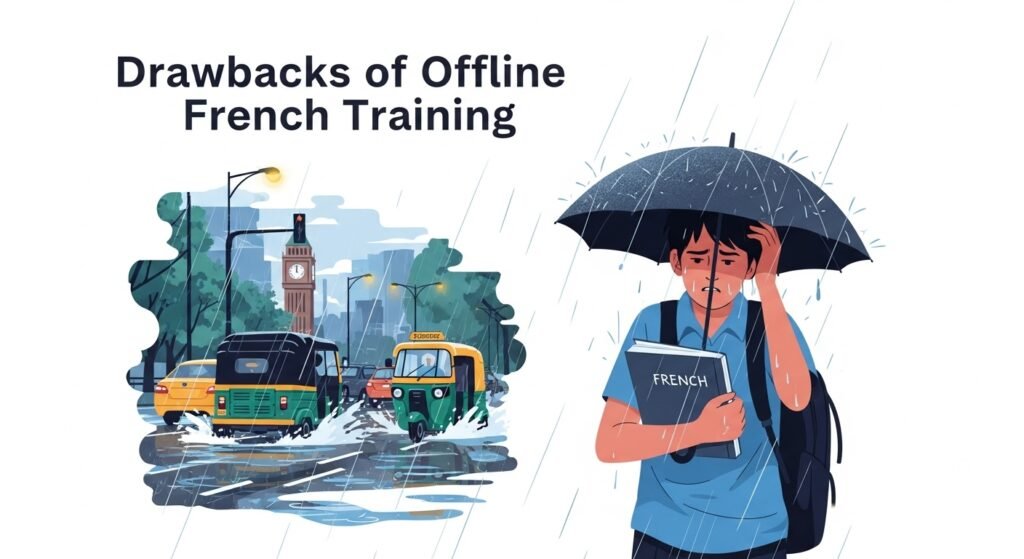
Let’s speak plainly. A kind teacher in a quiet room can help. But most offline French classes in Agra face setup problems that are hard to avoid. These are not about the teacher’s effort; they are about the system around the class.
Travel drains energy before learning begins.
Even a short ride from Kamla Nagar, Tajganj, Sadar, or Dayal Bagh can feel heavy after school. Heat, dust, or a sudden shower makes the trip longer. A tired child speaks less. And language growth depends on speaking minutes. When the voice is low, progress slows.
Fixed timings collide with real life.
Many centers offer one or two slots. If your child has sports, music, or a school event, you must choose what to skip. Missed classes are gone. There is no recording to catch up, so small gaps pile up and shake confidence.
Mixed levels cut speaking time.
A single room may hold beginners and faster learners. The teacher does their best, but someone always waits. The quick child gets bored. The shy child stays quiet. Real speaking time shrinks for both. Fewer minutes of talk mean slower growth.
Paper-only homework and late feedback.
Worksheets help, but corrections often arrive late. A small mistake in sound or spelling can repeat for weeks before it is noticed. By then, it has become a habit. Fixing it takes extra time and can feel hard for the child.
No simple record you can hear.
Parents may receive “doing fine,” but cannot play the child’s Week 1 voice next to Week 4 to hear the change. Without short audio snapshots, it is tough to guide practice at home or celebrate wins that matter.
Rooms are busy. Minutes are few.
Doors open and close. New students join mid-hour. Notes take time. Speaking gets squeezed into the last five minutes. Students learn about French, but they do not speak enough French.
Hard to personalize on the fly.
One learner needs extra help with “u” versus “ou.” Another needs gentle accent practice for é and è. In a crowded hour, it is tough to serve each need. Without smart tools, the teacher must pick one issue and move on.
If you live next door to a great center with tiny groups and a patient teacher, offline can still work for basics. But for most families in Agra, these hurdles show up again and again. That is why more parents now choose a structured online path first—one that gives flexible slots, recordings, tiny daily drills, and warm, steady feedback.
Want to feel the difference in one class? Book a free Debsie French trial and hear your child speak more than you expect in a calm, friendly session.
Best French Academies in Agra, Uttar Pradesh

This section gives you a clear view of your choices. We rank Debsie at number one because it delivers what children need most: simple steps, lots of speaking, kind feedback, and a plan you can trust. After Debsie, we list other options—some local, some regional, some national apps. We keep their details short and fair, and we show where Debsie gives you more.
Remember: the best choice is the one your child will stick with. Try a class, listen to their voice, and watch how they feel during and after the lesson.
1. Debsie — #1 French Classes for Students in Agra

Why Debsie sits at the top
Debsie blends expert live teaching with smart micro-practice. The class is calm. The plan is clear. The teacher is warm. The screen is clean. Your child speaks in every lesson, not just at the end. You hear progress each week with short clips, not just read about it.
The five-step loop that keeps fear low and learning high
Every lesson follows the same, gentle pattern: Hear → Say → Read → Write → Use.
- Hear: A slow, clean line in French that fits the topic.
- Say: The child repeats in small parts, first with the teacher, then alone.
- Read: The same line appears with color hints for tricky sounds.
- Write: One short sentence to lock spelling and order.
- Use: A tiny role play or one-minute talk to make it real.
This loop is simple on purpose. The brain relaxes when the next step is known. Calm minds speak more. More speech builds true fluency.
Speaking is the heart of every class
In Debsie, speaking is not an afterthought. It is the main event. Children talk with the teacher, with a partner, and with the group in small, safe turns. Corrections are kind and precise—one praise and one tiny fix—so courage stays high and the voice grows steady.
Daily practice that actually happens
Debsie offers Quick Mode (5–6 minutes) on busy days and Full Mode (10–12 minutes) on normal days. A touch of sound, a handful of word cards, one short line, and a small voice task—done. Little work done daily beats big work done rarely. After a month, you can hear smoother sounds and cleaner sentences.
The quiet superpower: Pronunciation Lab
Each child records one line per day. The teacher replies with a 20–30 second voice note: one praise, one fix.
Example: “Great ‘bonjour’—very clear. For ‘bien,’ soften the ‘n.’ Smile slightly when you say it; it helps the sound.”
These tiny tips, repeated over weeks, create crisp, confident speech without pressure.
A parent dashboard you can use in one minute
You see what was learned, two wins, and one focus area for next week. You can play before/after clips and hear the change yourself. If a class is missed because of an event in Sanjay Place or a family plan in Tajganj, a gentle catch-up path appears: one mini video and two tiny drills. No guilt—just a way back.
Made for Agra’s real week
Morning before school, evening after homework, or weekend—pick what fits. During school exams, switch to lighter drills to keep the habit alive. During holidays, shift the slot and stay on track. Flexibility is not a bonus. It is how we protect steady growth.
CBSE/ICSE support that feels natural
We tie school chapters to real speech. “My City” becomes “Agra in French.” The child names places, gives simple directions, and shares a small plan for a visitor. “Daily Routine” becomes a one-minute talk that later turns into a neat paragraph with the same words. This saves time and builds real skill.
DELF A1–B2 without panic
We break exam tasks into tiny parts and practice them often.
- Listening: catch numbers, places, times first.
- Speaking: plan with three dots—start, detail, close.
- Writing: short, correct lines with clean accents and a few simple linkers.
A friendly timer builds calm. Scores rise because fear falls.
Mini projects children enjoy
- “Agra Visitor Guide”: three places to see, two polite questions for help.
- “Street Food Menu”: small menu with polite request lines.
- “My School Day in Agra”: time, classes, and favorite subjects in short, clear French.
A realistic first month
- Week 1: Hello, names, “How are you?”, numbers, spelling your name.
- Week 2: Family words, age, “this/that,” simple questions.
- Week 3: School words, days, time, daily routine.
- Week 4: Food words, café role play, prices, polite forms.
At the end of Week 4, your dashboard plays a before/after clip. You can hear the difference.
Safety and value
Your child studies at home, in a known space. No commute, no delay, no risk. Your fee goes into live teaching, useful tools, and caring support—not rent and paper waste. You get value where it matters: in your child’s skill and confidence.
Start free, decide calmly. Book a free Debsie French trial. Meet the teacher, try the method, hear your child speak. Choose with confidence.
2. Alliance Française (Regional Institute Option)
Alliance Française is well known across India for French language and culture. The nearest official center for many Agra families is in a larger metro. They offer level-based courses and DELF prep with set schedules and formal certification paths.
Good for: older teens who want a formal institute feel and fixed group progress.
Where Debsie gives more: flexible timings around school, daily micro-practice with teacher voice notes, a parent dashboard with audio clips, and mini projects tied to local life in Agra. If travel or fixed timings are tough, Debsie will likely fit better.
3. University-Linked Language Courses (City/Regional Academic Option)
Some families explore language courses linked to universities or colleges in and around Agra. These can suit adult learners or serious teens who enjoy an academic setting. Classes may follow a semester pattern with fixed days and a set pace.
Good for: students who prefer an academic timetable and do not need parent reporting.
Limits: mixed levels in one room, longer lectures, less guided speaking, and little room for make-up sessions.
Why Debsie leads: child-first pacing, calm live classes with lots of speaking, short daily drills, human voice feedback on sound, and a dashboard that shows honest growth every week.
4. Local Coaching Rooms and Home Tutors in Agra (Neighborhood Option)

In areas like Kamla Nagar, Sadar, Dayal Bagh, and Tajganj, you can find small coaching rooms or private tutors who run French batches. If you live close and find a patient teacher, this can help with school basics and quick doubt clearing.
Good for: convenience if the teacher is near and the group is tiny.
Limits: rigid timings, travel on hot or wet days, mixed-level groups, and speaking minutes that depend on class size and mood. If the tutor is a single person without a structured curriculum, progress can pause when schedules clash.
Why Debsie leads: a planned path from A1 upward, tiny daily drills that keep the habit alive, backups if a teacher is unwell, recordings for missed classes, and clear parent updates with audio clips.
5. Self-Study Apps (National/Global Option)
Apps like Duolingo or Memrise are fun for extra vocabulary. They help with daily streaks and quick word review. Many students use them for five minutes a day.
Good for: extra word practice alongside a real class.
Limits: no live teacher, little guided speaking, and no careful feedback on sound or sentence flow. Points can rise while real conversation skill stays flat.
Why Debsie leads: weekly live speaking, human voice coaching, clean projects, and gentle exam prep. Use an app for revision, but build your core skill with Debsie.
A short chooser’s guide for Agra parents
Ask five simple questions:
Will my child speak in every class?
Is there a clear step-by-step plan?
Do I get audio clips to hear progress?
Can we fit the timing into our real week?
If we miss a class, is there a soft catch-up path?
Debsie answers all five with a calm yes. That is why it is our #1 choice for French in Agra.
Ready to try? Book your free Debsie French trial today. Hear your child speak more in one friendly session and decide with confidence.
Why Online French Training Is the Future

Calm space, stronger voice
French grows faster when the brain feels safe. At home, your child sits in a quiet corner. No rush, no noise, no crowded room. The audio is clear. The teacher’s words are easy to copy. When a child speaks more, even in very short turns, the voice gets steady. This is the simple reason online beats most offline setups: more real speaking, less wasted energy.
Quality over distance
In Agra, great tutors may live far from your lane. Online, that does not matter. You can pick the best teacher for your child, not the nearest one. This one shift changes everything. A trained, child-friendly teacher can fix tiny sound issues early, choose the right pace, and keep the plan kind. When quality rises, pressure falls.
Tiny tasks, big gains
Short, smart practice works better than long, tiring homework. Online tools make micro-practice easy: two sound checks, a handful of word cards, one small line, a 30–60 second voice task. That’s it. Five to twelve minutes a day keeps the habit alive. Habits make skills. Over a month, you hear cleaner sounds and feel smoother sentences.
Schedules that match real life
Agra weeks are busy—schoolwork, tests, festivals, family plans. Online lets you choose morning, evening, or weekend. Miss a class? Watch the recording and follow a tiny catch-up plan. The rhythm stays steady, and stress stays low. This flexibility is not a luxury; it is the reason progress continues even when life gets full.
Equal turns for every child
In many rooms, the loud child speaks most. Online, the teacher can guide short turns for each student without room noise. Pair practice, cue cards, one-minute shares—everyone gets a voice. The shy child finally speaks. The quick child stays focused. Minutes of talk rise for all, and that is what grows a language.
Proof you can hear
Parents want truth, not long reports. Online platforms can store short clips from Week 1 and Week 4. You play them back to back and hear the change in seconds. A small dashboard shows this week’s goal in plain words. When progress is visible, motivation stays high.
Safety and comfort
No hot ride in May. No foggy winter trip. No late return after dark. Your child studies in a known space. Comfort lifts mood; mood lifts memory. A happy, fresh child learns faster.
Personal help, one click away
One learner needs help with “u” vs “ou.” Another needs accents é/è. Online, the teacher can send the exact drill. The platform tracks tiny fixes and shows them again later, so small problems never grow into big blocks.
Value in the right places
Without building rent and heavy paper use, more value goes into great teachers, clean design, and caring support. You pay for what actually helps your child speak better, not for overheads that do not touch learning.
Exams feel normal, not scary
Boards and DELF reward steady skills. Online classes build listening and speaking from day one. Timed practice with a kind tone teaches kids to plan short answers, keep them simple, and say them clearly. Calm grows. Scores follow.
Made for every learning style
Some children learn by hearing, some by color hints, some by recording and retrying in private. Online tools serve all three without making any child feel different. Everyone gets what they need, quietly.
Real life inside the lesson
Good online courses add tiny projects tied to the child’s world—visitor guides, café menus, school-day talks. When words match daily life, memory sticks. Children feel, “I can use this now,” and they return to class eager.
Parents as partners
A short weekly note, tiny audio clips, and one focus area show you exactly how to help at home. Two minutes of practice before dinner can make a real difference when the guidance is clear.
The world is already online
Universities teach online. Companies train online. Exams run online. Children who learn French online now build life skills they will use for years: time planning, mic confidence, focused listening, and clear, short writing.
What this means for your family in Agra
You can start today. Your child will speak more, stress less, and grow week by week. You will hear the change, not just read about it. This is the future—and it fits your life right now.
If you want to feel it in one session, book a free Debsie French trial. One class is enough to hear a new voice.
How Debsie Leads the Online French Training Landscape

Child-first, always
Many platforms start with features. Debsie starts with feelings: a shy student who needs a gentle start, a busy teen who needs a calm plan, a parent who needs quick, honest proof. Every choice—pace, layout, tasks, reports—serves the child first. When the child feels safe, the child speaks. When the child speaks, everything else follows.
A clear ladder from A1 upward
Debsie maps French like a small staircase: A1 → A2 → B1 → B2. Each step has simple goals you can see and hear—introduce yourself, order a snack, ask for directions, describe your day, share an opinion. No big jumps. No guesswork. Just steady steps that stick.
The five-step class loop that works
Every lesson keeps the same clean flow—Hear → Say → Read → Write → Use.
- Hear a slow, clear line.
- Say it back in small parts until it feels easy.
- Read it with color hints for tricky sounds.
- Write one short sentence to lock spelling and order.
- Use it in a tiny role play or one-minute talk.
This loop lowers fear, raises voice time, and makes progress predictable. Children leave the hour with words they can say today.
Speaking is the engine, not the afterthought
In Debsie, speaking happens throughout the class. The teacher guides tiny turns, pair talk, and quick shares. Feedback is kind and exact—one praise plus one small fix—so courage stays high. Over weeks, small talks turn into easy conversations.
Micro-practice that survives busy weeks
Debsie offers Quick Mode (5–6 minutes) and Full Mode (10–12 minutes). Both include sound, a few words, one line, and a short voice task. Because the set is light, the habit survives exams, festivals, and travel. Habit builds skill; skill builds confidence.
Pronunciation Lab with real human coaching
Each day, your child records one line. A trained teacher replies with a 20–30 second voice note. The note is friendly, specific, and actionable: “Great rhythm on ‘Comment ça va ?’ Now soften the ‘n’ in ‘bien’—smile slightly; it helps.” Over time, these small tips produce clear, natural speech.
Parent dashboard that respects your time
You do not need long reports. You need truth in a minute. Debsie shows what was learned, two wins, and one focus area for next week. Short audio clips let you hear growth from the first class to now. Missed a session? A gentle catch-up plan appears at once.
Projects that feel local and real
Children use French to make tiny things that matter: an Agra Visitor Guide, a Street Food Menu, a School Day Talk. When French describes their world, memory gets strong and motivation stays high. These projects also help with internal assessments at school.
CBSE/ICSE help without heavy notes
We tie book chapters to small talks, not just worksheets. “My City,” “Daily Routine,” “Food,” “Family”—all become one-minute speeches and friendly role plays first, then short writing. Reading and grammar grow inside speech, so writing feels easy, not scary.
DELF A1–B2, calm and steady
Debsie breaks DELF tasks into tiny parts, then practices them often:
- Listening: numbers, places, times first.
- Speaking: three-dot plan—start, detail, close.
- Writing: short, clean lines with correct accents and simple linkers.
We use a friendly timer so exam pressure feels normal. Fear goes down; scores go up.
Clean design that protects focus
No clutter. No flashy noise. Just the teacher’s face, simple prompts, and space to think. Children spend their energy speaking and listening, not hunting for buttons.
Slots that fit Agra’s rhythm
Early morning, after homework, or weekend—you choose. During exam weeks, swap to lighter drills. During holidays, shift the slot and keep the habit alive. The plan bends to your life, not the other way around.
Support that feels human, not robotic
Questions about fees or timing? You get a quick, kind answer. Need extra polish before an oral exam? We share a short, targeted plan. Traveling? We set a light practice pack so momentum stays. You are never left guessing.
Results you can feel fast
Most parents say this after the first Debsie class: “My child spoke more than I expected.” That feeling matters. It becomes the engine for weekly growth. Confidence rises. Marks follow. But the bigger win is a calm, clear voice that your child keeps for life.
Start with zero risk
You do not need to decide on a long plan today. Book a free Debsie French trial. Meet the teacher, try the method, and hear your child speak. If it feels right, we build a path that fits your week. If not, you still leave with tips you can use anywhere.
Conclusion: Confidence Now, Growth That Lasts

French should feel calm, simple, and useful. In Agra, your child can build a clear voice week by week—with small steps, kind coaching, and steady practice. That is exactly what Debsie delivers.
What improves first
Confidence: your child speaks in tiny, safe turns and gets one gentle fix at a time. The fear fades.
Focus: a clean screen, short goals, and quiet classes keep attention on the teacher’s voice, not on noise.
Fluency: lines turn into short talks, then easy conversations. Grammar grows inside speech, not outside it.
Memory: spaced sound drills and real-life mini projects (visitor guides, café role plays) make words stick.
Exam readiness: CBSE/ICSE links and DELF-style tasks with a friendly timer remove panic and raise scores.
A one-week starter plan you can use right away
Goal: unlock steady speaking in 7 days with light effort (10–12 minutes a day; 5–6 minutes on busy days).
Day 1 – Hello & Name
Hear, repeat, and use: “Bonjour, je m’appelle… / Comment ça va ?”
One tiny write: “Je m’appelle …”
Mini talk: 30 seconds—introduce yourself.
Day 2 – Numbers & Age
Hear and use 1–20, “J’ai … ans.”
Pronunciation Lab focus: soft “j” in “j’ai.”
Mini talk: name + age.
Day 3 – Family Basics
Words for mother, father, brother, sister; “C’est… / Il/Elle s’appelle…”
One-line write: “C’est ma mère. Elle s’appelle …”
Mini talk: two lines about family.
Day 4 – School & Time
Days of week, simple time; “J’étudie à … / J’ai cours à …”
Pronunciation Lab: clear “r” in “cours.”
Mini talk: your school day (30–45 seconds).
Day 5 – Food & Polite Forms
“Je voudrais… s’il vous plaît / Merci.”
Role play: ordering a snack.
One-line write: “Je voudrais un jus, s’il vous plaît.”
Day 6 – Directions (Agra Theme)
“Je cherche… / Où est… ? / à gauche / à droite / tout droit.”
Role play: ask the way to the Taj Mahal.
Pronunciation Lab: smooth “ou” vs “u.”
Day 7 – Wrap & Record
Record a 60–90 second “My Week in French”: name, age, family, school, one food order, one direction line.
Parents: save the clip. In four weeks, record again and compare—you will hear the growth.
Busy week? Switch to Quick Mode (5–6 minutes): two sound drills, four word cards, one sentence, a 30-second voice task. Habit alive, stress low.
Why choose Debsie now
- A calm five-step class loop (Hear → Say → Read → Write → Use) makes progress predictable.
- Speaking is the center; feedback is human and kind.
- Micro-practice fits real Agra weeks and actually gets done.
- Parent dashboard shows wins you can hear, plus one clear focus for next week.
- CBSE/ICSE support and DELF prep are built in—without panic.
Give your child the gift of a steady voice in French—clear, confident, and ready for exams and real life.
Start with zero risk: book a free Debsie French trial class and hear the difference in one lesson. Would you like me to package this into a printable guide for parents, or tailor a two-week plan by grade level?


