Have you ever seen a young child take apart a toy just to see how it works? Or mix water with flour just to watch what happens? That’s not just play—it’s science. It’s curiosity in action. And that’s where learning really begins.
When kids are exposed to STEM—which stands for Science, Technology, Engineering, and Math—at an early age, something amazing happens in their brain. It grows stronger. It thinks faster. It learns how to solve problems, ask smart questions, and stay curious about the world.
At Debsie, we believe early STEM exposure is not just about future jobs. It’s about building strong thinkers from the very start. It’s about helping kids explore, create, and understand the “why” behind everyday things.
What Happens in a Child’s Brain During Early STEM Learning?
The early years—especially from ages 3 to 8—are when a child’s brain is growing faster than it ever will again. During this time, billions of connections are being formed every day. These connections help the brain learn how to think, remember, and solve problems.
Now here’s where it gets exciting.
When a child plays with building blocks, asks why the sky is blue, or measures flour to bake a cake—they’re not just having fun. Their brain is working hard to:
- Make connections between ideas
- Understand cause and effect
- Learn patterns, numbers, and logic
- Ask questions and test answers
This is exactly what STEM learning is all about.
Science teaches kids to ask why and how.
Technology gets them curious about tools and machines.
Engineering helps them build and fix things.
Math trains them to spot patterns and use logic.
Every time they do these things, the brain gets better at focusing, remembering, and solving problems. It’s like giving their thinking muscles a daily workout—but one that feels like play.
At Debsie, we design our lessons to match the way young brains grow best. We keep it hands-on, playful, and always full of wonder. Because when learning feels like discovery, kids don’t just memorize—they understand.
Early STEM Learning Builds Stronger Thinking Paths
Think of your child’s brain like a young forest. Every time they think, try something new, or solve a small problem, it’s like they’re walking through that forest and creating a path. The more they walk that path—by practicing, exploring, asking questions—the clearer and stronger it becomes.
That’s exactly what happens with early STEM learning. It lays down strong thinking paths that your child can return to again and again.
The Brain Grows Through Repetition and Challenge
When kids build a tower, test a robot, or solve a math puzzle, they are doing something much deeper than just completing a task. They are:
- Figuring out what works and what doesn’t
- Adjusting their ideas
- Thinking critically and logically
- Using past experiences to make new decisions
This type of thinking isn’t one-time learning. It builds neural pathways—real connections in the brain that make future learning easier and faster.
For example:
- A child who plays with measuring cups while baking learns early math and volume. Later, fractions in school feel easier—they already have a mental path built.
- A child who plays with magnets and observes how they stick and repel develops a basic understanding of force and motion. When they learn physics later, their brain already knows where to go.
These early paths turn into mental shortcuts that help children make connections faster, remember longer, and solve harder problems with more ease.
STEM Creates “Thinking Habits” That Last for Life
The biggest gift early STEM gives is not just knowledge. It’s habits—the kind of thinking habits that shape how your child sees the world.
These include:
- Asking “why” and “how” instead of just memorizing answers
- Trying different ways when something doesn’t work
- Breaking big problems into smaller steps
- Seeing challenges as puzzles to solve—not problems to avoid
When children develop these habits early, they carry them into every subject—and into everyday life. They approach homework, decisions, teamwork, and even conflict differently. They become curious thinkers instead of passive learners.
At Debsie, every live class and digital course is designed to build and reinforce these strong brain habits. We don’t rush through topics or focus only on the right answer. We focus on the process—so your child gets smarter with every try.
Early STEM Builds the “Thinking Muscles” That Support Everything Else
Just like lifting weights makes your body stronger, STEM thinking exercises the brain. It builds mental muscles that make learning in all subjects easier.
When a child works on a science experiment, they’re building the same skills needed for writing essays, solving social problems, and making real-world decisions.
And just like with exercise, the earlier they start, the stronger they become.
Early STEM Doesn’t Just Teach Facts—It Teaches How to Think
Many parents worry about whether their child is “good at math” or “likes science.” But early STEM is not really about liking numbers or knowing big words. It’s about learning how to think clearly, ask questions, and try things out.
Let’s take a small example.
A 6-year-old wants to build a tower with blocks. It keeps falling. They try again. Maybe they try a wider base. Maybe they stack it slower. Maybe they ask, “Why is it wobbly?” They’re not just playing—they’re learning about balance, weight, gravity, and design.
Now fast forward to age 10. That same child is now learning how bridges are built in science class. And guess what? Their brain already has a little library of past building experiences. It clicks faster. It feels familiar.
That’s the beauty of starting early. STEM gives kids mental tools they’ll use again and again:
- How to notice patterns
- How to predict outcomes
- How to stay curious when things don’t work
- How to solve a problem by testing and changing
These skills help not just in school, but in real life—whether they’re fixing a broken toy, figuring out a math problem, or thinking through a personal decision.
At Debsie, we call this “smart thinking.” It’s not about memorizing answers. It’s about learning how to learn—and early STEM lights that spark better than almost anything else.
STEM Helps with Focus, Patience, and Confidence
When we think of STEM, we often picture logic, numbers, machines, and problem-solving. But what we don’t always talk about are the powerful emotional and mental skills children build while learning science, technology, engineering, and math—especially when they start young.
At Debsie, we’ve seen this time and time again: as children engage in playful, hands-on STEM learning, they grow in ways that go far beyond academics.
Let’s take a closer look at three beautiful outcomes of early STEM exposure:
1. Focus: Learning to Stick With a Task
In a world filled with distractions—screens, notifications, quick videos—kids are losing the ability to focus. But STEM gently brings it back.
When a child is building a simple machine, solving a math riddle, or testing a science experiment, they have to pay attention to what they’re doing. They learn to follow steps, watch closely, and try again if something goes wrong.
And here’s the secret: they do it because they’re curious—not because someone is forcing them.
The more they enjoy what they’re doing, the longer they stay with it. Over time, that turns into a strong focus muscle—one they’ll use in school, hobbies, and life.
At Debsie, our STEM tasks are designed to hold kids’ attention through fun storytelling, hands-on challenges, and interactive problem-solving—so kids don’t even realize how long they’ve been focused. They’re that engaged.
2. Patience: Learning That Great Things Take Time
Most STEM activities don’t work perfectly on the first try—and that’s the point.
When a child builds a bridge and it falls down, or writes a line of code that doesn’t run right away, they have two choices: quit, or try again.
That “try again” moment is where patience is born.
In STEM learning, especially when it’s play-based, failure doesn’t feel scary. It feels normal. Children begin to understand that mistakes are part of the process. That solutions take time. That it’s okay to slow down and think things through.
Over time, this creates a powerful shift: kids stop getting frustrated when something is hard. They learn to breathe, reset, and try another way.
This is how STEM teaches emotional regulation—without ever needing to sit down and talk about it. It happens naturally, through the joy of trying.
3. Confidence: “I Did It!” Moments That Last
There’s a special kind of joy that comes when a child figures something out on their own. Whether it’s solving a puzzle, finishing a tricky math problem, or making their experiment work—those moments matter deeply.
They say things like:
- “I fixed it!”
- “I figured it out!”
- “It works now!”
- “I didn’t think I could—but I did!”
Each of these moments adds a brick to the wall of confidence. And when learning is built on small, steady wins like this, children stop saying “I can’t.” They start saying, “Let me try.”
STEM gives them these wins regularly—because it’s full of problems to solve, paths to test, and ideas to explore. And the best part? They do it with their own hands, their own ideas, their own thinking.
That’s real confidence—the kind that stays with them forever.
Together, focus, patience, and confidence make children better learners, better thinkers, and better people. And that’s why STEM is so much more than just numbers or science. It’s a full-body, full-heart experience that builds up the whole child.
It’s Not About Making Every Child a Scientist
One common myth is that early STEM is only useful if a child wants to become a coder, engineer, or scientist someday. That’s simply not true.
STEM is not about picking a future job at age 7. It’s about giving children the mental tools they can use in any path they choose.
Let’s say your child dreams of being an artist. Or a writer. Or even a chef. STEM still matters.
Why?
Because all of those roles need:
- Problem-solving (how do I fix this recipe?)
- Creative thinking (how can I show this idea differently?)
- Planning and testing (what will happen if I try this way?)
- Understanding systems (how do these parts work together?)
STEM teaches children to think in systems, see patterns, and try things in new ways. Whether they’re designing a painting or building a new toy, the brain is using those same problem-solving muscles.
This is why we believe STEM is for every child. Not just the ones who like math or science, but also the ones who build things with paper, ask lots of questions, or dream up big ideas at bedtime.
At Debsie, we don’t ask kids to choose a path. We help them explore all the paths—with joy, with guidance, and with no pressure at all.
The Power of Playful STEM
When most people think about science, technology, engineering, or math—they picture serious stuff. Labs. Computers. Calculators. Whiteboards covered in numbers. But for young children, STEM doesn’t start with tests and textbooks. It starts with play.
Yes—real learning begins when a child is having fun.
Here’s the secret: play is learning. And not just any learning—deep, brain-building, life-shaping learning. Every time a child builds, mixes, rolls, taps, spins, or even asks “What if?”—their brain is lighting up. That’s STEM in action.
Let’s break it down.
STEM in Everyday Play
You don’t need fancy robots or complicated kits to give your child STEM experiences. It’s all around them already.
- A child stacking blocks learns about balance and gravity
- Mixing colors teaches chemistry and observation
- Sorting buttons by size is early math and classification
- Tinkering with a broken toy teaches problem-solving and mechanics
These are real science and math ideas—but in the language of childhood: touch, talk, and try.
And guess what? When learning happens through play, the brain doesn’t just store the knowledge. It connects it. That means your child isn’t just remembering a fact—they’re figuring out how the world works.
Why Play Helps the Brain Grow Smarter
Young brains are like soft clay. Every experience, especially in the early years, shapes how a child thinks, solves problems, and approaches the world.
When a child plays with STEM, their brain is learning to:
- Guess what might happen
- Test their idea
- Watch the result
- Change something and try again
- Talk through what they see
This whole process is called inquiry, and it’s what scientists, engineers, and even doctors do every day.
And here’s the best part: when kids are playing, they’re not afraid to fail. They’re not worried about being wrong. So they try more. And the more they try, the more they learn.
At Debsie, we design our entire STEM curriculum to be playful and pressure-free. Kids learn through games, stories, building projects, creative challenges, and “what if?” activities. The goal isn’t just to finish—it’s to explore.
When Learning Feels Like Play, Kids Stay Curious
The number one thing we hear from parents is:
“I’ve never seen my child this excited to learn.”
That’s because when STEM is playful, it doesn’t feel like school. It feels like discovery. It feels like magic. It feels like them.
And curiosity is a powerful tool. It keeps kids coming back. It makes them want to ask more questions, dig deeper, and learn more—without anyone pushing them.
That’s why we believe playful STEM isn’t extra. It’s essential.
It’s how we protect a child’s natural love of learning while growing the brain skills they’ll need for anything—school, work, life, and everything in between.
Early STEM Builds Teamwork and Communication Too
Here’s something we don’t talk about enough: STEM learning helps kids become better teammates and stronger communicators.
That’s right—STEM isn’t just about working alone with numbers or gadgets. Many STEM activities involve group work, sharing ideas, and solving problems together. And this is where the magic happens.
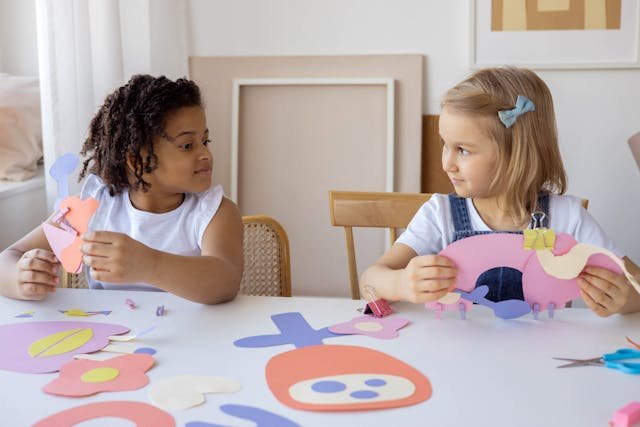
Imagine a small group of kids trying to build a tall tower from paper and tape. One child suggests a triangle shape. Another wants to roll the paper. A third says, “Let’s test both!”
In that moment, they are:
- Sharing ideas
- Listening to each other
- Trying new things
- Learning to disagree kindly
- Cheering each other on
All of these are social skills. And they’re powerful.
At Debsie, we encourage children to talk, build, and explore with each other in live classes and digital challenges. Whether they’re designing a project, solving a mystery, or working through a coding puzzle—they do it together. And in that process, they build confidence, leadership, and kindness.
This kind of learning doesn’t just prepare them for school—it prepares them for life.
What You Can Do at Home to Support Early STEM
You don’t need to buy expensive kits or have a science background to support STEM learning at home. You just need to make space for questions, curiosity, and simple exploration.
Here are some easy ways:
- Follow their questions. If your child asks, “Why does ice melt?”—don’t rush to answer. Ask, “What do you think?” Then test it out together.
- Give them tools, not answers. Instead of showing how to fix a toy, hand them a screwdriver and ask, “What do you notice?”
- Let them build. Blocks, boxes, tape, or even kitchen spoons—whatever lets them imagine and create. It’s not about what they build. It’s about how they think while building it.
- Celebrate effort. If something falls apart, that’s okay! Say, “Great try! What else could work?” This builds patience and resilience.
At Debsie, we give parents the same tools our teachers use—simple, everyday ways to support early STEM thinking through play, talk, and shared discovery.
Because the best learning doesn’t always look like school. Sometimes, it looks like a child asking, “What happens if I…?” and a parent answering, “Let’s find out.”
How Debsie Helps with Early STEM Learning

At Debsie, we believe that every child is born curious. Our job is to protect that curiosity and turn it into strong thinking skills. That’s why we’ve built a learning space where STEM is not just a subject—it’s an adventure.
Here’s how we help:
1. Live STEM Classes with Caring Experts
Our partner teachers aren’t just good at science or math—they’re amazing with kids. They explain big ideas using small, simple steps. They make every class feel like a story or a challenge. And they know how to guide each child, no matter their level.
Whether your child is learning about gravity, circuits, patterns, or code—our live STEM classes make it fun, clear, and exciting.
2. Hands-On, Playful Learning (Not Boring Lectures)
At Debsie, STEM is active. Kids don’t just watch or listen—they build, try, guess, test, fix, and discover.
They might:
- Mix baking soda and vinegar to explore reactions
- Build a paper bridge to learn about weight and design
- Write simple code to move a character across the screen
It’s always real. Always playful. Always designed to fit how young brains grow best.
3. Self-Paced Challenges That Spark Curiosity
We know that not every child learns at the same speed. That’s why we offer self-paced STEM courses and challenges. Kids can explore topics like robotics, space science, logic puzzles, and beginner coding—all at their own pace, in their own style.
These labs are filled with mini-games, short tasks, and fun questions that keep their brain active without overwhelming them.
4. Gamified Learning That Keeps Kids Hooked
We turn learning into a game—literally.
Kids earn points, level up, unlock badges, and join friendly challenges. This keeps motivation high and makes STEM feel like a joyful quest, not a boring chore.
And as they play, they build real skills in problem-solving, creative thinking, and confidence.
5. A Safe, Global Learning Community
Debsie brings together students from over 9 countries, making our learning space global—but always safe. Children learn how others think, build together, share solutions, and grow as part of a team.
This makes STEM not just educational—but social and emotional, too.
Final Words: Big Brains Start with Small Curiosities
Every child is born with curiosity. They poke, press, stack, mix, and ask, “Why?” That’s not just play. That’s learning in its purest form. That’s STEM.
When we give children early access to STEM learning—through simple activities, hands-on fun, and everyday discovery—we’re not just teaching facts. We’re growing brains. We’re building focus, patience, confidence, and a deep love for learning.
These are not just school skills. They are life skills.
At Debsie, we’ve seen what happens when children are allowed to explore early. They shine brighter. They solve smarter. They grow stronger—mentally, emotionally, and creatively.
You don’t need to be a scientist to raise a scientist. You just need to say:
“Let’s explore this together.”
🌱 Start small.
🧠 Let them ask.
🧪 Let them test.
🎉 Celebrate the discovery.
And if you want a trusted guide to walk this journey with you—Debsie is here.
🚀 Book your free trial class at Debsie.com
Let’s build brains, wonder, and lifelong learning—starting today.
Read Next:

Abir Das is a educator, child learning specialist, and competitive chess player who brings a rare blend of technical knowledge, psychological insight, and practical chess experience to his work with young learners. With a diploma in child psychology, a B.Tech degree and a strong academic foundation in structured problem-solving, Abir understands how analytical thinking develops over time and how children can be guided to think more clearly, patiently, and confidently through chess.
Abir’s approach to education is shaped by his deep interest in child psychology and how young minds learn best. He believes chess should never feel like a collection of difficult rules or memorized moves. Instead, it should feel like an exciting journey into patterns, choices, creativity, discipline, and discovery. His lessons are designed to help children understand not only what move to play, but why that move makes sense.
As a competitive chess player with a rating of 1991, Abir has developed a strong practical understanding of the game through years of study, training, and tournament experience. He has competed in rated chess events, earned recognition for his strategic play, and achieved strong results in regional and state-level competitions. His accomplishments as a player give his teaching an authentic and trustworthy foundation because he understands the pressure, patience, and preparation required to perform well at the board.
Abir is especially skilled at helping children build confidence in chess. He has coached beginners who are just learning how the pieces move, intermediate students working on tactics and planning, and advanced young players preparing for competitive events. His teaching focuses on essential chess skills such as board vision, calculation, opening principles, endgame technique, pattern recognition, time management, and emotional control during games.
What makes Abir’s teaching style distinctive is his ability to connect chess improvement with personal growth. He sees every chess game as a lesson in decision-making. A missed tactic becomes a chance to improve focus. A lost game becomes an opportunity to build resilience. A difficult position becomes a practice ground for patience and creativity. Through this approach, Abir helps students grow not only as chess players, but also as thoughtful, disciplined, and independent learners.
Fluent in French (CEFR level C1), and having lived all across Europe, Abir also brings a global and culturally aware perspective to education. His ability to communicate across languages reflects his curiosity, adaptability, and commitment to connecting with learners from different backgrounds. This international outlook enriches his teaching and writing, allowing him to explain ideas in a clear, inclusive, and accessible way.
As an author at Debsie, Abir writes practical and engaging French, physics and chess education content for children, parents, and young learners. His writing simplifies complex concepts without making them shallow. Whether he is explaining Bernoulli’s principle, a tactical pattern, a checkmate idea, French genders in nouns or a chess planning principle, or the mindset needed for tournament play, Abir focuses on clarity, usefulness, and long-term learning.
Abir’s work is guided by the belief that chess can be one of the most powerful learning tools for children. It strengthens memory, concentration, logic, creativity, patience, and emotional maturity. More importantly, it teaches children how to think before acting, how to learn from mistakes, and how to approach challenges with confidence.
Outside of teaching and writing, Abir continues to study chess, follow international tournaments, analyze instructive games, and explore innovative methods for making physics, French, chess more enjoyable and meaningful for children. His mission is to help young players see chess not just as a game to be won, but as a lifelong skill that builds sharper minds, stronger character, and a deeper love for learning.