Imagine sitting on a soft, grassy hill on a clear night. You look up and see a million tiny, twinkling lights dancing in the deep, dark sky. It is a magical feeling to realize how much mystery is waiting for us in the great beyond!
This brilliant man was born on January 8, 1942. He spent his days exploring the deep secrets of theoretical physics at a famous university in Cambridge. Even though he faced a very tough physical challenge, his mind was always free to travel through the galaxy!
Stephen showed us that the universe is even stranger than we ever dreamed. He taught the whole world about black holes and how they work in the silence of space. His discoveries help us understand where we came from and where we are going!
You can start your own journey of discovery today! Try out Debsie Gamified Courses at https://debsie.com/courses to see how much fun learning can be. We love helping young explorers like you reach for the stars every single day!
Hawking proves that a curious heart can change the entire world. Let’s keep asking big questions and growing our minds together. The adventure of a lifetime is just one lesson away!
Key Takeaways
- Stephen William Hawking was a famous scientist born in 1942.
- He worked as a director of research at the University of Cambridge.
- His main focus was studying the mysteries of the universe and space.
- He became world-famous for his incredible ideas about black holes.
- He showed everyone that physical challenges cannot stop a curious mind.
- You can explore similar topics through fun, gamified lessons at Debsie.
The Early Life and Academic Foundations of Stephen Hawking
Stephen Hawking’s story begins in Oxford. His curiosity and family support sparked his love for physics! Born into a family of doctors, his early years were filled with learning and curiosity.
Childhood Curiosity and Intellectual Development
Hawking loved figuring out how things worked as a kid! He enjoyed taking apart and putting back together complex devices. This showed his early talent for understanding machines and electronics.
His parents helped grow his curiosity. As he got older, Hawking became more interested in the universe! He was captivated by the cosmos and its secrets.
This interest in the universe was the start of his studies in theoretical physics.
The Transition to Oxford and Cambridge
At 17, Hawking started his university journey at University College, Oxford. He studied physics there. His time at Oxford helped him understand physics better.
He earned a first-class BA in physics. This showed his hard work and natural talent. Then, he went to Cambridge University for his graduate studies.
| University | Degree | Field of Study |
|---|---|---|
| University College, Oxford | BA | Physics |
| Cambridge University | PhD | Theoretical Cosmology |
At Cambridge, he worked with famous physicist Dennis Sciama. This time was key for his growth as a theoretical physicist. It helped him make important discoveries about black holes and the universe.

The Diagnosis That Changed Everything
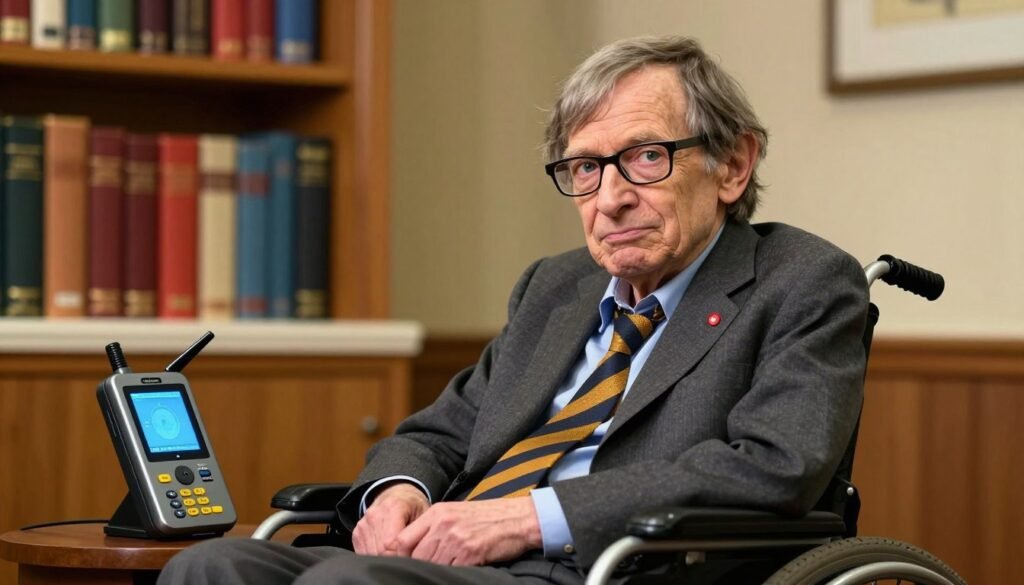
Stephen Hawking’s life changed when he was 21 and got a motor neurone disease diagnosis! This was a big moment for him. But Hawking didn’t let it stop him. He kept exploring science and inspired many.
Living with ALS: A Life of Resilience
Hawking got an early form of ALS that moved slowly. He showed everyone how to stay strong. He kept working on his research and made big discoveries.
As NBC News said, Hawking lived with ALS for over 55 years. This shows how strong he was and how his care improved.
The Impact of Motor Neurone Disease on His Career
Hawking’s motor neurone disease made moving hard. But it didn’t stop his love for science. He kept working on black holes and cosmology and got famous for it.
Even though his body slowed down, his mind kept going. Hawking’s work still inspires scientists and fans today. He left a big mark on physics.
Stephen Hawking and the Revolutionary Theory of Black Holes
Imagine a world where black holes were thought to be eternal. But Stephen Hawking changed that idea! He showed us that black holes have a life cycle that ends with a big finale.
Redefining the Event Horizon
The event horizon, the point of no return around a black hole, was fascinating. Hawking’s work changed how we see this boundary.The event horizon is not just a point of no return; it’s also a gateway to understanding the mysteries of black holes. By studying the physics at the event horizon, scientists learned more about space and time.
Hawking’s research showed that black holes are not static. They have temperature and entropy, which helped us understand them better. “The laws of thermodynamics apply to black holes just as they do to ordinary matter,” Hawking said, changing the field.
The Concept of Hawking Radiation
Hawking’s theory of Hawking radiation was a big deal. It saysblack holes emit radiation due to quantum effects near the event horizon. This idea changed the thought that nothing, not even light, could escape a black hole’s pull. Hawking radiation shows that black holes can evaporate, even if it’s slow for big ones.
The idea of Hawking radiation is very important. It means black holes have a temperature and will disappear in a burst of energy. This idea changes how we see the universe, from black holes’ fate to the information paradox they raise.
A Brief History of Time: Bringing Physics to the Masses
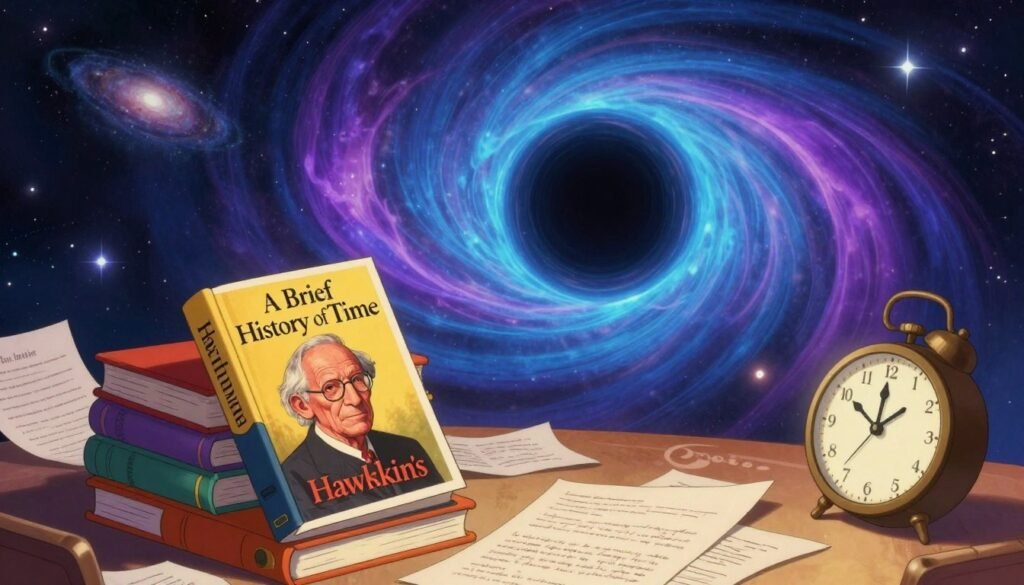
“A Brief History of Time” changed how we see physics. It made hard ideas easy for all to understand. This book opened the universe to millions worldwide.
The Publishing Phenomenon of the 1980s
Published in 1988, “A Brief History of Time” was huge. It became a big deal in culture. Here are some key points about its success:
- Bestseller Status: It stayed on the Sunday Times bestseller list for 237 weeks!
- Global Reach: The book was translated into many languages, making it a hit everywhere.
- Simplification of Complex Concepts: Hawking made hard physics ideas simple for many to grasp.
Why the Book Resonated with Global Audiences
So, why did “A Brief History of Time” grab readers’ attention worldwide? Here are a few reasons:
- Engaging Narrative: Hawking’s way of telling stories made hard ideas fun and clear.
- Universal Curiosity: The book sparked our natural wonder about the universe and its start.
- Relevance to Cosmology: It gave us a peek into space and time’s mysteries.
“A Brief History of Time” proves science can be shared with everyone. It shows complex ideas can be simple for all to understand!
The Scientific Legacy of Stephen Hawking
Stephen Hawking’s work has made a big impact on science, mainly in cosmology and general relativity! His research has helped us understand the universe better. It has also inspired many scientists and thinkers.
Hawking’s work in cosmology is very important. He helped us learn more about black holes and the start of the universe. For more about his legacy, check out this blog post.
Contributions to Cosmology and General Relativity
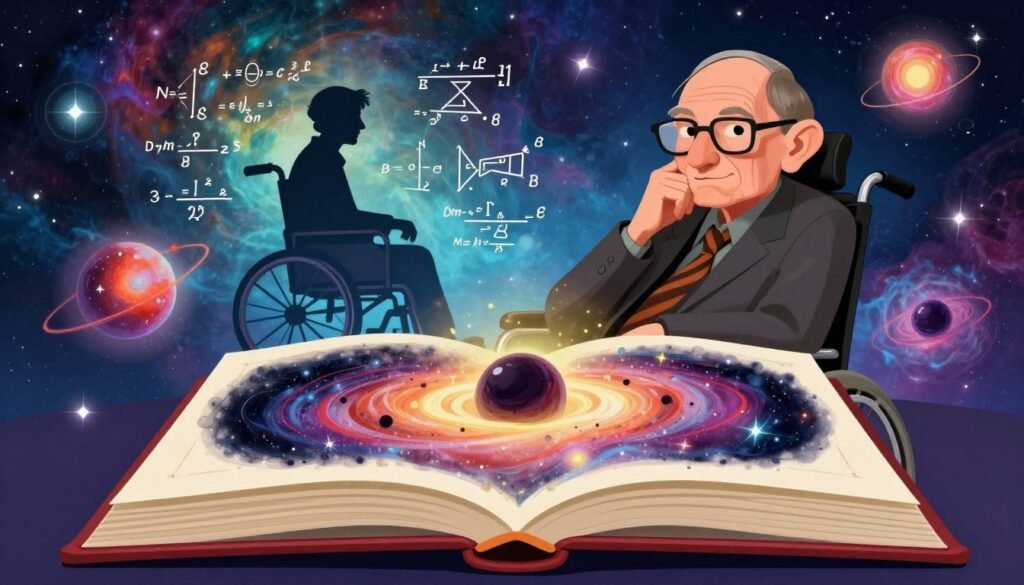
Hawking’s ideas on black holes and Hawking radiation changed science a lot. His theories gave us new insights into the universe. They helped us understand everything from the Big Bang to black holes.
Collaborations with Roger Penrose
Hawking worked closely with Roger Penrose, a famous mathematician and physicist. They worked on singularity theorems together. Their work showed that singularities are common in the universe.
Hawking’s work still guides scientists today. It keeps inspiring them to learn more about the universe.
Mastering Complex Concepts Through Gamified Learning
Gamified learning changes how we learn hard subjects. It makes them fun and easy for everyone! By using game ideas in learning, we get a fun and interactive way to learn hard things.
Stephen Hawking’s work on black holes is a great example. He made hard topics easy with gamified learning. This way, learners can learn a little at a time and feel more confident.
The Importance of Accessible Science Education
Science education for all is key to finding the next big thinkers. Making hard science fun and interactive sparks curiosity. It makes learners want to explore the universe.
With Debsie’s gamified courses, learning is fun and interactive! Our courses are engaging, challenging, and rewarding. They keep learners motivated and focused.
Enhancing Your Knowledge with Debsie Gamified Courses
Debsie’s courses offer a special learning experience. They mix fun interactive parts with real-world uses. This makes learning both enjoyable and effective.
Our courses cover many topics, like physics and cosmology. With Debsie, learners get top-notch educational content. It’s both fun and challenging.
| Course Features | Benefits |
|---|---|
| Interactive Learning | Engages learners and promotes active participation |
| Gamified Elements | Makes learning fun and rewarding |
| Real-World Applications | Helps learners connect theory to practice |
Try Debsie Gamified Courses today for a new learning experience! Visit https://debsie.com/courses to see what we offer.

The Voice of a Genius: Technology and Communication
Stephen Hawking lost his speech but found a way to keep sharing his ideas. He used amazing technology to talk and share his research with everyone.
The Evolution of the Speech Synthesizer
Stephen Hawking’s device was a big change for him. It let him talk through a fake voice. He started by using a switch to pick words on a screen.
As his health got worse, he learned to use just one cheek muscle. This was a huge step for him. It let him keep working and sharing his thoughts with people all over the world.
The device got better over time. Intel helped make it even better. This shows how teamwork and new ideas can help people with disabilities.

How Technology Enabled His Continued Research
This technology was very important for Hawking’s work. It helped him:
- Keep doing his amazing research in space and physics!
- Write many papers and books, like “A Brief History of Time”!
- Talk to people all over the world through lectures and interviews!
Thanks to technology, Hawking could keep working despite his physical challenges. He left a big mark on science and more.
Stephen Hawking in Popular Culture
Hawking entered popular culture, reaching fans everywhere! His work went beyond science, making him famous at home.
Appearances in Television and Film
Stephen Hawking was a hit on TV and in movies. He was on The Simpsons and Star Trek: The Next Generation. He talked to fans and explained science in simple ways.
He also showed up in movies. This made him a big name in culture. His humor and wisdom made science easy to understand.
The Cultural Icon Beyond the Laboratory
Hawking became more than a scientist. He showed us to never give up. His story inspired people all over the world.
He was in many documentaries and media. He talked about the universe and science education. This made science popular again.
Some of his most notable appearances include:
- The Simpsons – Hawking appeared in multiple episodes, often poking fun at himself and his condition.
- Star Trek: The Next Generation – He played a character named Data’s holodeck representation, engaging in a game of poker with other characters.
- The Big Bang Theory – Hawking made a memorable appearance, interacting with the main characters and adding to the show’s humor.
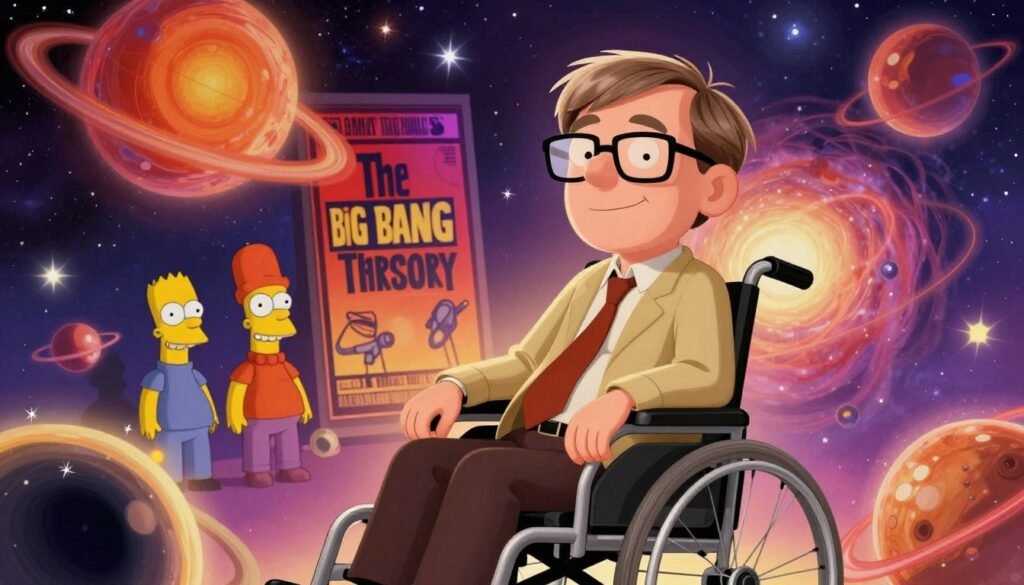
Here’s a summary of some of his notable appearances in television and film:
| Title | Type | Year |
|---|---|---|
| The Simpsons | TV Series | 1999 |
| Star Trek: The Next Generation | TV Series | 1993 |
| The Big Bang Theory | TV Series | 2012 |
Stephen Hawking’s impact on culture shows his wide appeal. His work in TV, film, and media inspired many. He left a lasting mark on our culture.
The Search for the Theory of Everything
Stephen Hawking’s search for the Theory of Everything was a lifelong dream. It still inspires scientists today! This theory aims to explain all forces in the universe with one idea.
One big challenge is unifying quantum mechanics and gravity. Quantum mechanics talks about tiny particles. General relativity is about gravity and big things in space. Hawking tried to mix these two, a task that still puzzles scientists.
Unifying Quantum Mechanics and Gravity
Mixing quantum mechanics and general relativity is key. Hawking’s work on Hawking radiation was a big step. It showed black holes give off radiation because of quantum stuff near their edge.
Hawking’s work helped us understand the universe better. His ideas on black holes and the universe’s start have shaped how we see the cosmos.
The Challenges of M-Theory
M-Theory says our world is part of a bigger space. But, it’s still being worked on and is very complex.
Hawking talked about M-Theory’s challenges in his book The Illustrated A Brief History. He saw its potential to bring forces together.
As we keep exploring and making new theories, Hawking’s work is a reminder to keep pushing knowledge. The search for the Theory of Everything goes on, with Hawking’s ideas playing a big role.
Awards, Honors, and Academic Recognition
Stephen Hawking made big changes in science. He got many awards for his work. His ideas changed how we see the universe.
He was very honored to be the Lucasian Professor of Mathematics at Cambridge University. This chair was once Sir Isaac Newton’s. It shows how much Hawking changed math and physics.
The Lucasian Chair of Mathematics
The Lucasian Chair is very important. It has been held by famous scientists. Hawking got this chair in 1979. It showed he was a top scientist.
To learn more about Stephen Hawking, visit his Wikipedia page.
Major Prizes and Global Accolades
Hawking won many awards for his science work. Some big ones include:
- The Albert Einstein Award
- The Presidential Medal of Freedom
- The Companion of Honour
- The Breakthrough Prize in Fundamental Physics
These awards honored Hawking’s science and his way of explaining it to everyone. His work still inspires people everywhere. It helps us understand the universe better.
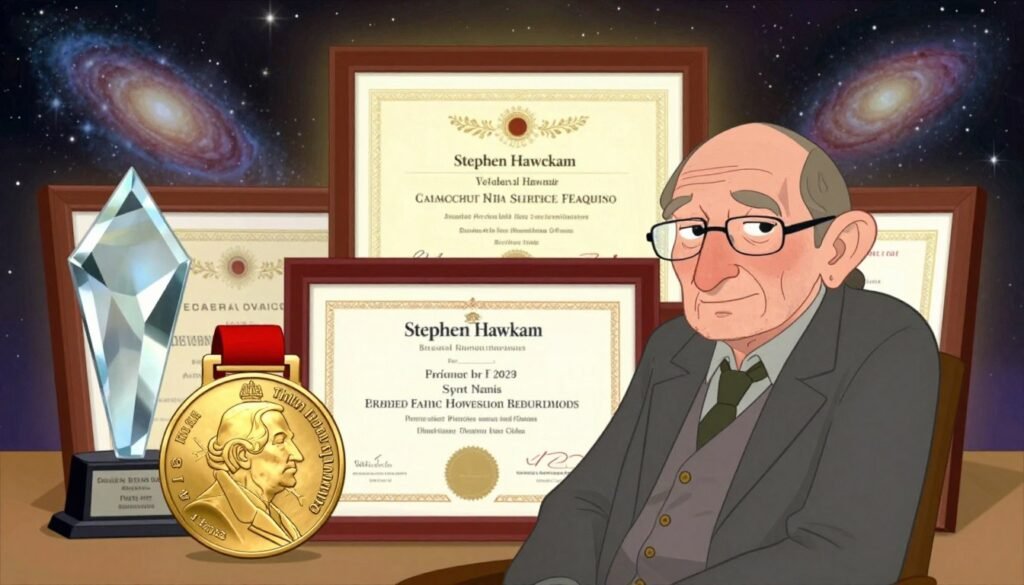
Hawking’s story is not just about science. It’s about never giving up. His life teaches us to always be curious and keep learning.
The Human Side of a Scientific Giant
Stephen Hawking’s life was more than just science. He showed us how to love and be strong! His personal life was full of love and challenges.
Personal Relationships and Family Life
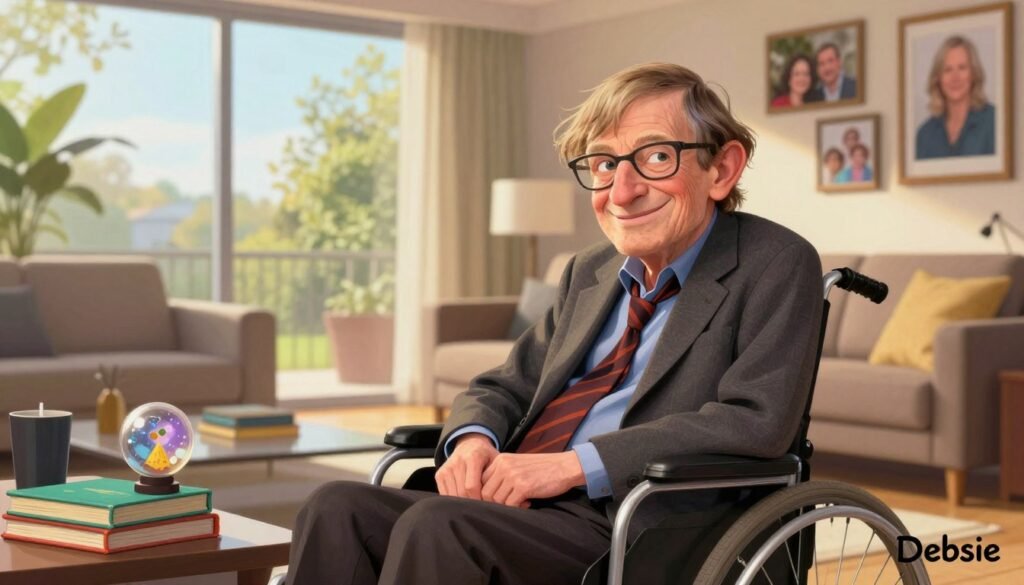
Stephen Hawking married twice. First, to Jane Wilde in 1965. They had three kids: Robert, Lucy, and Timothy. Their love was strong, helping Hawking through tough times.
In 1995, he married Elaine Mason, his nurse. They were together until 2006. Hawking’s personal life was full of love and support.
His Sense of Humor and Wit
Hawking loved to make people laugh. His humor showed his strong spirit. He was funny and made science fun for everyone.
He even appeared in Star Trek: The Next Generation. He played himself as a hologram. It was a funny way to show his fun side.
“Life would be tragic if it weren’t funny.” – Stephen Hawking
This quote shows Hawking’s view on life. He believed in laughing, even when things are hard.
Hawking’s life shows us that even the smartest people can be funny and loving.
Advocacy for Science and Humanity
Stephen Hawking was more than a famous scientist. He was also a strong advocate for science’s role in our future. He worked hard for artificial intelligence, climate change, and space exploration.
Views on Artificial Intelligence and Climate Change
Hawking talked a lot about artificial intelligence. He said we need to be careful with AI. We should make sure it doesn’t harm us.
He also warned about climate change. Hawking said it’s a big danger for our future. He pushed for quick actions to save our planet.
Promoting Space Exploration for Future Generations
Hawking thought space exploration was key for our survival. He believed we should live on other planets too. This way, even if Earth gets hurt, we’ll be okay.
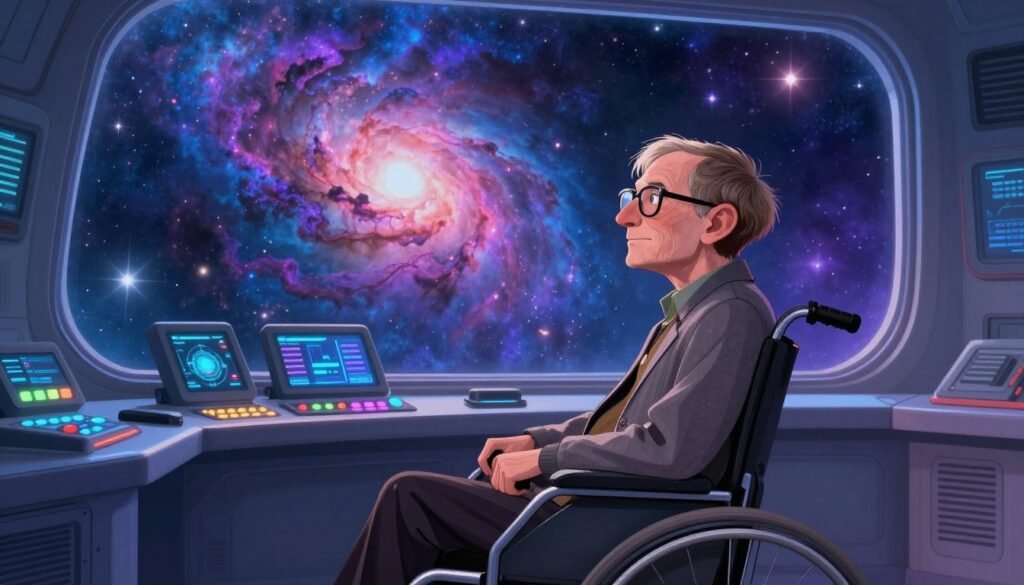
Exploring space helps us learn more about the universe. It also gives us new places to live. Hawking dreamed of a future where humans thrive everywhere!
The Influence of Hawking on Modern Physics
Stephen Hawking’s work has changed modern physics a lot! His ideas have helped us understand the universe better. They have also inspired many scientists.
Hawking’s work has touched many areas. Here are some key ones:
- Black Hole Research: Hawking showed that black holes can send out radiation. This changed how we see them.
- Cosmology: His ideas about the universe’s start and the no-boundary proposal have shaped modern cosmology.
- Inspiring Future Generations: Hawking made science easy to understand. This inspired many to study physics and cosmology.
Inspiring the Next Generation of Scientists
Hawking was great at explaining hard ideas simply. He made science fun for many young people!
He inspired the next generation in many ways:
- He wrote books like A Brief History of Time. These books made physics easy to understand.
- He was in documentaries and TV shows. This brought science to more people.
- He pushed for science education and more research.
The Enduring Relevance of His Research
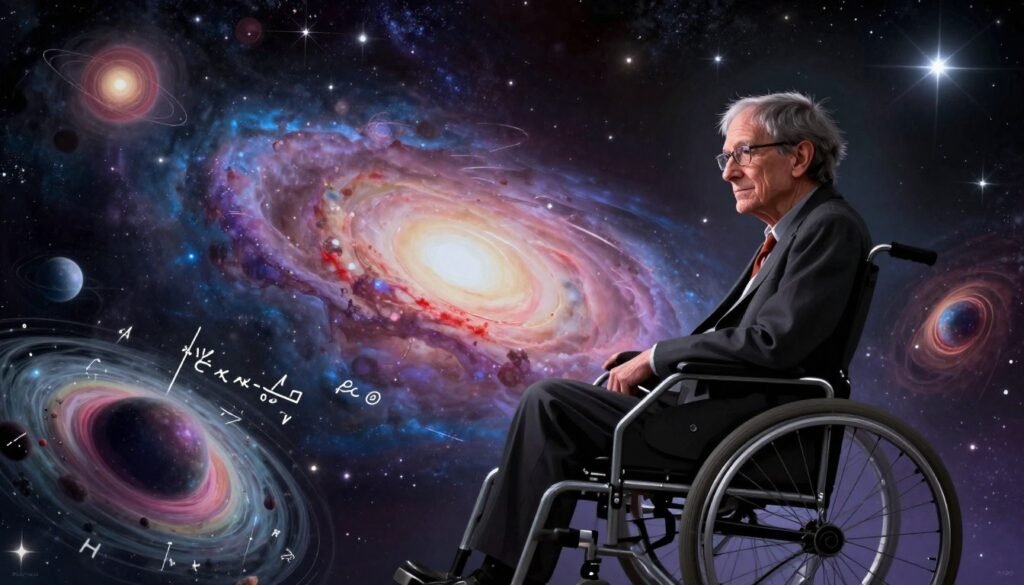
Hawking’s work is still important today. Scientists use his ideas to learn more about the universe. His work on black holes and the universe’s start is still key.
His research is still important in many ways:
- Advancements in Cosmology: His ideas on the no-boundary proposal and black hole thermodynamics keep shaping cosmology.
- Quantum Mechanics and Gravity: His work on quantum mechanics and general relativity is still a big area of study.
Debunking Myths Surrounding His Life and Work
Let’s look into the life and work of Stephen Hawking. We need to know what’s true and what’s not. He was famous for his big ideas and theories. So, many myths have grown up around him. Let’s clear up some of the Stephen Hawking myths.
One big myth is about his work on black holes. He did make big contributions. But, some say he found them all by himself. That’s not true.
Clarifying Misconceptions About His Theories
Hawking’s ideas on black holes and the universe have been misunderstood. Some think his theory means black holes vanish quickly. But, it’s more complicated than that.
Here’s a look at some common myths and the real facts:
| Misconception | Fact |
|---|---|
| Hawking single-handedly discovered black holes. | While Hawking made big contributions, many scientists worked on black holes over time. |
| Hawking radiation means black holes disappear instantly. | Hawking radiation is a slow process. It makes black holes evaporate over a long time. |
| Hawking’s work was limited to cosmology. | Hawking studied many areas, not just cosmology. He worked on general relativity and theoretical physics too. |
For more on Hawking’s work and to clear up myths, read “The Myth of Stephen Hawking” on Scientific American.
Separating the Man from the Legend
Hawking’s personal life has also been mythologized. His fight against motor neuron disease inspired many. But, some stories made it seem too perfect. We should honor his achievements and struggles honestly.
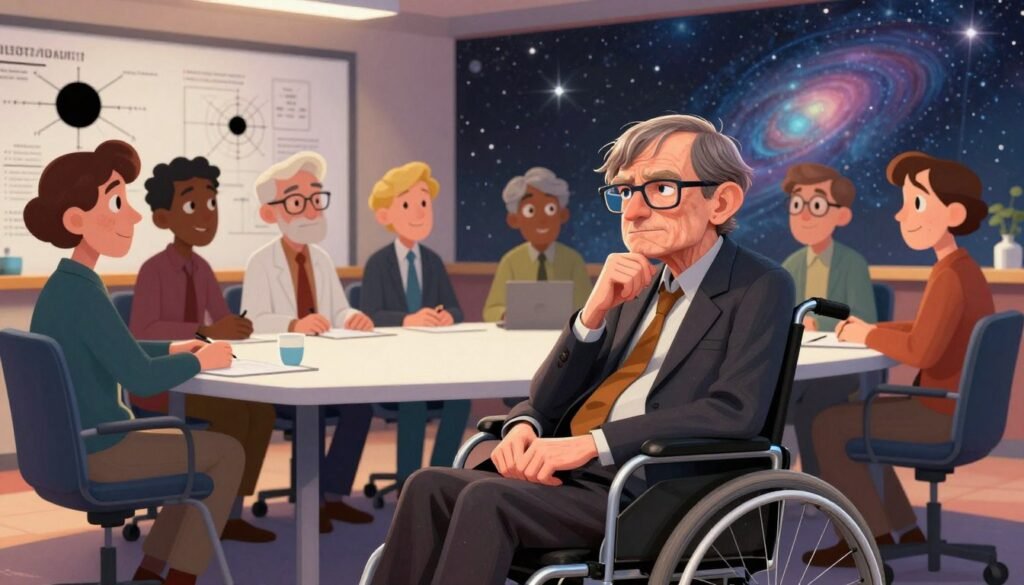
Knowing the real Stephen Hawking helps us appreciate him more. It’s important to see the real person behind the legend. His work will keep guiding us as we explore the universe.
Conclusion
Stephen Hawking’s life shows us the power of curiosity and strength. His journey inspires us to keep exploring and learning. Hawking’s work reminds us to always seek new discoveries.
To learn more about science and Hawking’s ideas, visit PBS NewsHour.
At Debsie, we love making learning fun. We invite you to try our games and keep discovering with us. Let’s celebrate Hawking’s legacy by exploring the universe and using our brains.