
Schools want every child to grow strong in reading, math, and thinking. Tutoring inside school hours can help a lot. But there are two main ways to do it. In a pull-out model, a child leaves class for extra help. In a push-in model, the tutor comes into the classroom and works beside the teacher. Both can work. Both can also cause problems if the plan is weak. Parents, teachers, and school leaders often ask one big question: which way gives more learning for each minute and each dollar? This article gives clear, simple answers using practical, down-to-earth numbers you can track starting today.
1) Attendance Rate for Tutoring Sessions
Attendance rate tells you, in plain terms, how often students show up to the help they are scheduled to get. You measure it by counting how many tutoring sessions a student actually attends and dividing by how many were planned, then turning it into a percent.
If a student had ten sessions and attended eight, the attendance rate is eighty percent. This single number shows if your plan is real or only on paper. In pull-out, the main risks are missed transitions, forgotten passes, or clashes with assemblies and tests. In push-in, the risks are different.
A class might be off-schedule, a fire drill may cut the time, or a substitute teacher may not know the plan. The result in both cases is the same. If students are not in front of a tutor, they are not getting help.
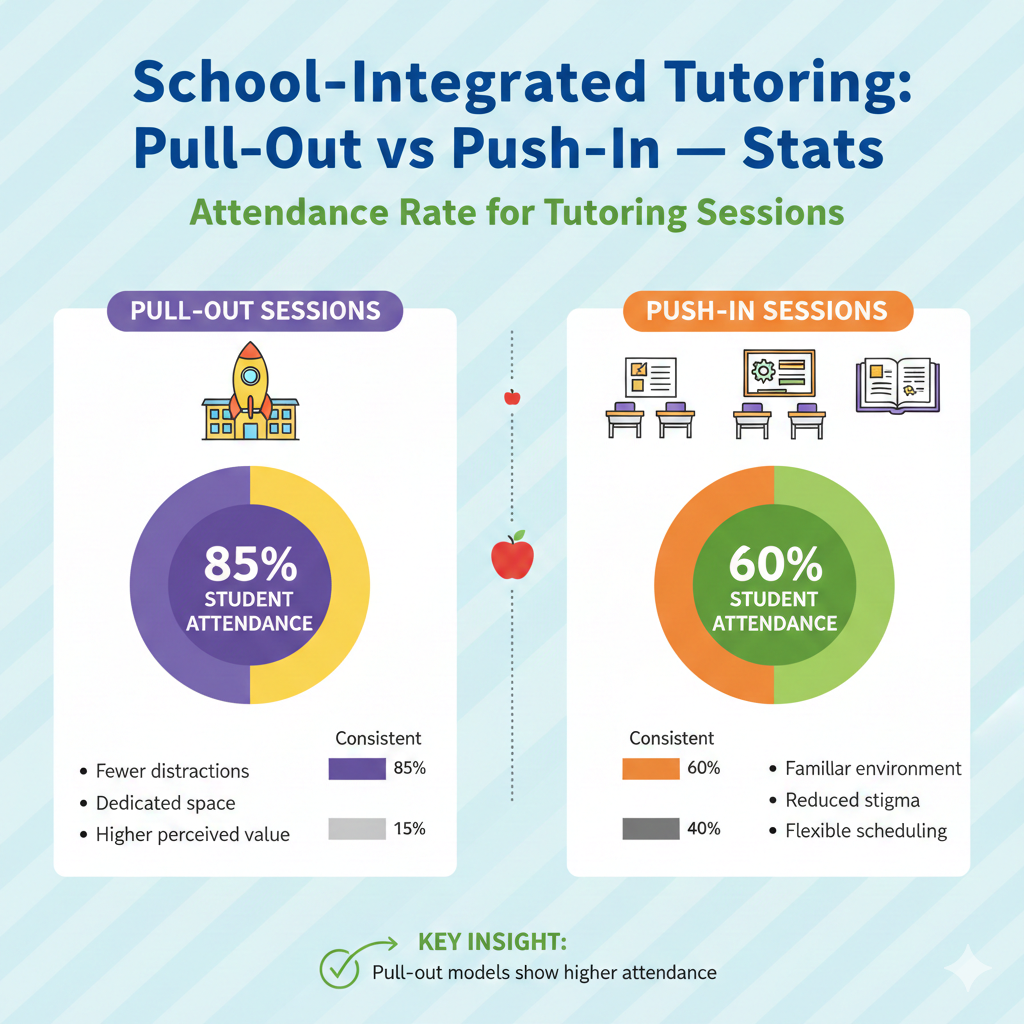
To improve the number fast, start with a simple daily check. Each tutor logs attendance in the first one minute of the session. The coordinator reviews the log by mid-day and nudges any gaps before the day ends. Add a friendly reminder system for older students.
A short cue card inside the notebook or a timed phone alarm works well. For young learners, attach a bright pass to their desk and include the time, place, and tutor name. Keep the schedule stable for at least four weeks, because fixed times reduce confusion.
For pull-out, line up sessions right after a class transition, not in the middle of a lesson. For push-in, anchor the session to a predictable part of the lesson, like independent practice, so students and teachers expect the tutor at that moment.
Share the rate with families each Friday. A short message like, “Maya attended five of five sessions this week” builds pride and keeps everyone aligned. When attendance drops, do not scold. Ask why.
Perhaps the hall pass takes too long to arrive, or the small group is too noisy, or the student is shy about leaving the room. Solve the real cause, then watch the number rise. As the rate climbs above ninety percent, you will notice steadier progress in reading, math, and confidence.
At Debsie, we design schedules that protect attendance first, because consistent time with a skilled adult is the engine of growth. If you want support building this habit schoolwide, book a free trial class and see how we track and lift attendance with simple, kind systems.
2) On-Time Start Rate
On-time start rate shows how often tutoring begins right at the planned minute. You calculate it by counting the number of sessions that start on schedule and dividing by the total sessions. If twenty sessions were planned and seventeen started on the minute, the rate is eighty-five percent.
This stat matters because lost minutes at the start are almost never recovered at the end. In pull-out, the common culprits are slow transitions, long walks, or waiting for a room key. In push-in, delays often come from unclear roles, late materials, or the tutor standing by while the teacher finishes a long mini-lesson.
The pattern is always the same. A five-minute delay in a thirty-minute session is a seventeen percent loss. Across a week, that is hours of lost learning.
To raise the rate, script the first sixty seconds. Students sit, open their folders, and complete a tiny warm-up they already know how to do. The tutor checks names and sets a tiny goal for the session, like mastering two high-frequency words or solving three fraction problems with unit drawings.
Place all needed materials in a clear bin the night before. Use a simple visual timer so students and adults can see the countdown. For pull-out, pre-plan the shortest route and assign leaders who carry the bin and a small whiteboard.
For push-in, agree with the teacher on a precise handoff. For example, “When students begin independent practice, I will take these three students to the back table and start the warm-up.” This clear moment reduces awkward waiting.
Study the causes of late starts for one week. Tag each delay as room, materials, transition, or roles. Fix the top cause first. If room access is slow, unlock spaces five minutes early. If materials are the issue, make two identical bins so nothing gets stuck in another class.
If roles are cloudy, write a one-page playbook that says who does what in the first minute. Celebrate wins. When the on-time start rate passes ninety percent, you will feel the difference. Sessions feel calm. Students know the routine.
Tutors get through more teaching. Debsie coaches model these micro-routines in live classes so tutors and teachers can copy them with ease. Try a free session to see how we launch on the dot without stress.
3) Minutes of Tutoring per Week per Student
Minutes per week is the most honest way to compare pull-out and push-in. It counts real, usable teaching time, not plans or promises. Add up the minutes each student gets in a week. Do not include transition time or behavior management time.
Only count minutes where the student is reading, writing, talking, solving, or getting direct feedback. When you track this for two weeks, you may be surprised. A plan that says ninety minutes might only deliver sixty if starts are late or groups are too large.
The goal is not a magic number but steady, high-quality minutes that match need. Early readers may need four brief sessions to keep focus. Older students might benefit from two longer blocks to tackle complex problems.
To lift weekly minutes without draining the schedule, use the idea of micro-sessions. In pull-out, two twenty-minute sessions plus one quick ten-minute check can beat a single long block, because fatigue drops and focus stays high.
In push-in, align the tutor window with the most practice-heavy part of the lesson so every minute counts. Protect minutes during busy weeks by banking make-up time. If a holiday cuts a session, add a short session the next day during morning work.
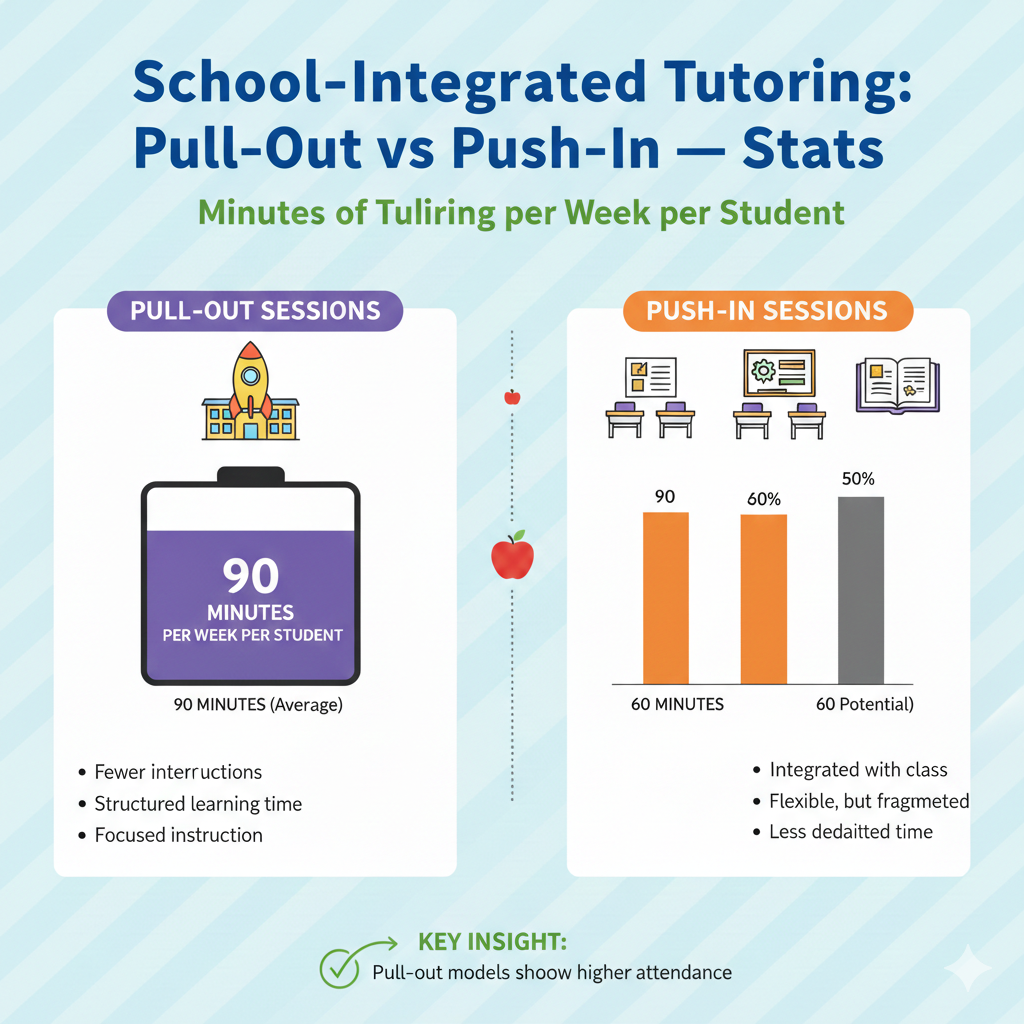
Build a simple tracker that shows planned minutes, delivered minutes, and the gap. Review the gap every Friday. If a student is short by twenty minutes, assign a targeted task on a laptop or tablet with instant feedback and a tutor check-in the next morning.
Quality matters as much as quantity. A thirty-minute block with rich talk, quick checks for understanding, and clear models is worth more than forty-five minutes of seat work. Keep groups tight and goals sharp.
When the week ends, ask the student a simple question: what did you learn this week that you could teach a friend? If the answer is clear and specific, your minutes were strong.
At Debsie, we design weekly plans that weave live time with smart self-practice so minutes add up even when the school calendar is busy. Join a free trial class to see how we turn planned time into real learning time.
4) Missed Core Instruction Minutes
Missed core instruction minutes are the class minutes students lose when pulled out or when push-in disrupts the flow of a lesson. This stat protects what matters most, because no family wants a child to miss a science lab, a writing mini-lesson, or a class debate. In pull-out, the risk is direct.
A student leaves the room and may miss lecture, discussion, or key directions. In push-in, the student remains in the room, but the session can still chip away at whole-class teaching if side talk grows or if the tutor pulls attention away from the teacher.
You track this by listing the core moments in the week and noting any minutes the student was not present or not fully engaged due to tutoring. Lower is better. Zero is ideal.
To keep missed minutes low, map your tutoring schedule against the master schedule. Mark non-negotiables like new content in math, complex read-alouds, science labs, writing strategy lessons, and tests. Do not schedule pull-out during those blocks.
If you must, coordinate so the tutor pre-teaches the big idea the day before or re-teaches it the same day. In push-in, agree on a low-voice zone and a clear seating plan so the group can work without pulling eyes and ears away from the teacher.
Use headphones for short digital practice to keep noise down. If the teacher is modeling a new skill, the tutor should pause and support students by circulating quietly, then restart the small group once independent work begins.
Review this stat every two weeks with the classroom teacher. If the student missed a key mini-lesson, plan a fast recovery. A five-minute catch-up with a visual model is often enough to restore the thread. If the same conflict keeps happening, move the session by ten minutes, not by a whole period.
Small shifts can rescue many minutes. Teach students to self-advocate. If they sense the class is starting something new, they can ask to delay the pull-out by five minutes. This builds ownership. Debsie program plans always start with a map of core moments so we add support without subtracting instruction.
If your school wants help building a no-conflict schedule, we are ready to partner. Try a free class and see how we guard core teaching time while still giving the extra lift students need.
5) Curriculum Alignment Score
Curriculum alignment score shows how closely tutoring matches what the class is learning right now. You rate each session from zero to one hundred. Zero means the tutoring topic does not match the current unit at all.
One hundred means it fits the exact skill and vocabulary the teacher is using this week. Average the ratings across sessions to get a clear number. A high score means students hear the same ideas, terms, and steps in both places.
A low score means students may feel lost because the class says one thing while tutoring says another. In pull-out, misalignment often happens when the tutor works from a separate program without checking the class plan.
In push-in, misalignment can occur when the tutor does a different task at the small table while the rest of the class practices the skill of the day.
To raise the score, set a ten-minute co-planning routine each week. The teacher shares the week’s targets, key problems, reading passages, and vocabulary. The tutor mirrors those targets in the session plan, using the same anchor charts and steps.
If the class is solving multi-step word problems with tape diagrams, the tutor uses tape diagrams too. If the class is learning main idea and supporting details, the tutor brings short texts that match the class genre. Keep a shared glossary so the same words appear in both spaces.
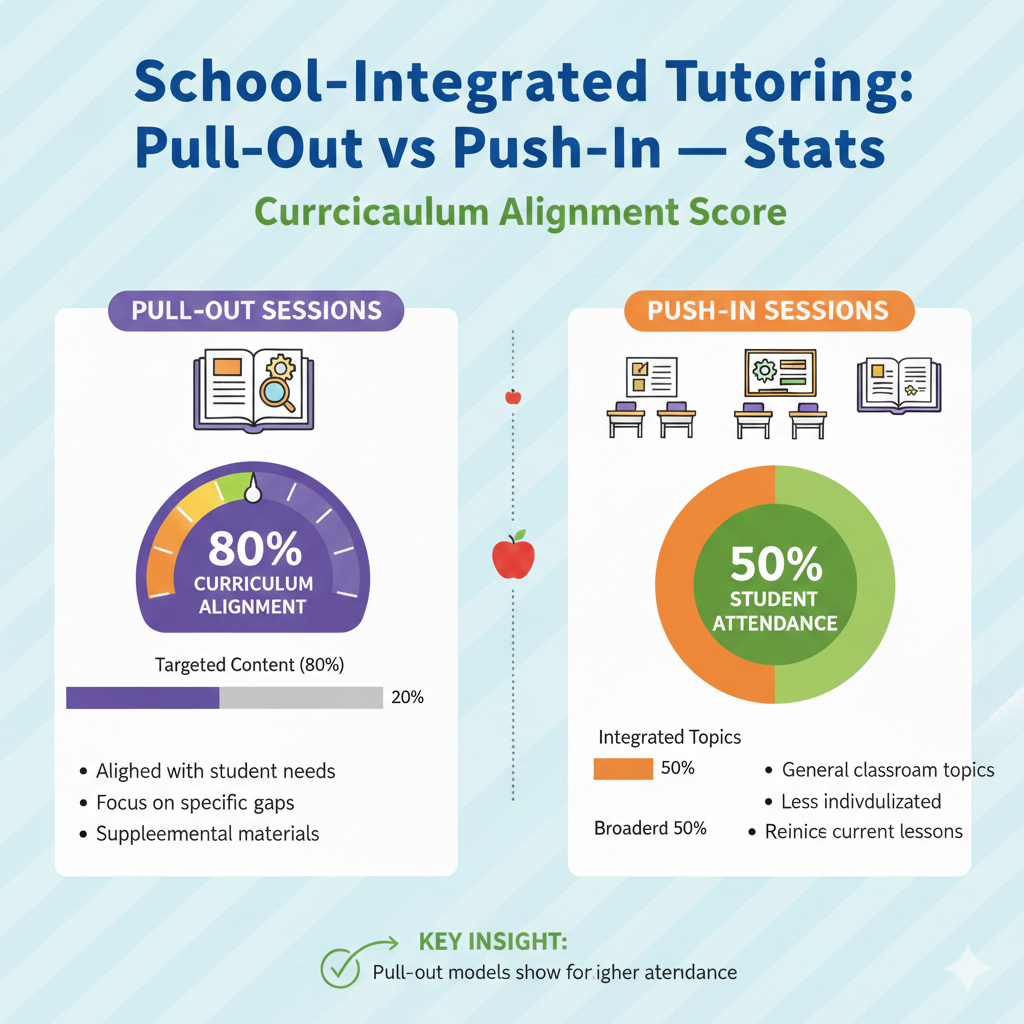
Do not chase every gap at once. Pick the two most important skills of the week and go deep. When students see the same model in class and tutoring, confidence grows because they can connect the dots.
Track the score daily for two weeks, then fix the top reason for mismatch. If materials drive misalignment, photocopy the class practice page for tutoring. If pacing is off, plan pre-teach sessions the day before a hard lesson.
If students are far behind, teach the prerequisite skill using the class’s current vocabulary so it still feels connected. Watch for the moment when a student says, “I saw this in class,” because that means the wiring is working.
Debsie lesson maps are built to mirror school pacing guides so practice is never random. If you want help aligning your tutoring to the heartbeat of your curriculum, try a free class and see the match in action.
6) Small-Group Size Average
Small-group size average is the typical number of students who sit with a tutor at once. You calculate it by adding the students in each group and dividing by the number of groups. A lower number usually means more talk time, more feedback, and fewer distractions.
But the best number depends on the goal. For brand-new skills or fragile readers, two to three students is ideal. For fluency practice or problem-solving review, four can work well. In pull-out, groups can accidentally grow too large because it feels efficient to take more students out at once.
In push-in, groups can swell because nearby students drift over to the tutor table. When groups get too big, quiet students hide, the pace slows, and your precious minutes spread thin.
To tune group size, start by labeling each student’s priority need. Place students with the same need together for two weeks at a time. Keep early groups small, then expand only if quality stays high. Use a talk pattern to share airtime.
Each student reads, solves, or explains in a clear order, and the tutor gives quick, specific feedback. Add simple roles to keep hands busy. One student tracks steps, one checks answers, one explains the strategy.
For push-in, set a visible table sign that lists who is in the group that day. This limits crowding and helps the teacher redirect other students. For pull-out, cap the roster in your schedule and protect it. If a leader asks to add a student, confirm where minutes will come from so quality does not drop.
Watch signals that the group is too large. If one student speaks only once in fifteen minutes, or if you cannot circulate to each person twice, the group is likely too big. Shrink it by one and see if talk and feedback improve.
Train students to self-check while they wait using quick tasks, not long worksheets, so the tutor stays focused on coaching. Every two weeks, recalculate the average and compare it to student growth. If scores rise faster with three than with five, keep three.
Debsie uses small, nimble groups inside live classes to maximize practice and praise. You can see the difference in a free trial when every child gets a turn, a tip, and a win.
7) Student-to-Tutor Ratio
Student-to-tutor ratio is the count of students divided by the number of tutors in the session. A ratio of three to one means three students share one tutor. Lower ratios often lead to faster gains because each student gets more direct guidance and more chances to respond.
But a perfect ratio is not the same for every task. Teaching a new decoding rule often needs a two-to-one or even one-to-one ratio. Practicing math facts or writing topic sentences may work fine at four-to-one. In pull-out, tight ratios are easy to set but must be protected from schedule pressure.
In push-in, ratios can change during the lesson, so tutors need clear boundaries to keep the focus students close.
Set target ratios by skill and stick to them for a full cycle. For example, plan two weeks at two-to-one for students who need phonics intervention, and four-to-one for students who need problem-solving rehearsal. Build your schedule backward from these targets.
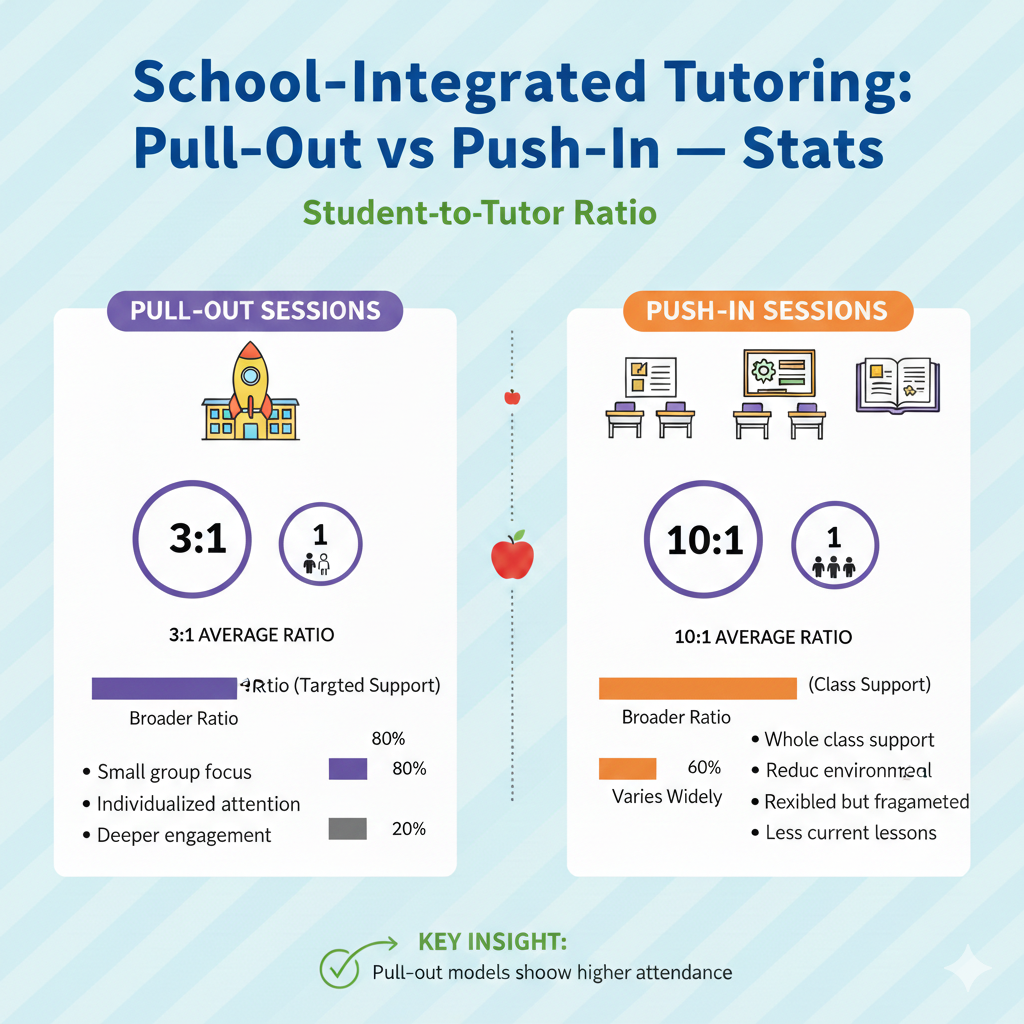
If staffing is tight, alternate days instead of growing groups. On Monday, a pair gets close coaching in reading; on Tuesday, another pair gets it. Use short, frequent slots to keep momentum.
Measure how many individual feedback moments each student receives per session. The goal is at least three specific feedback turns per child in a twenty-minute block. If you cannot hit that number, the ratio is likely too high or the tasks are too long.
Use simple tools to stretch the tutor’s reach without lifting the ratio. Whisper prompts, quick whiteboard checks, and choral responses let the tutor see who is ready and who needs another model. Teach students to use self-check cards with steps listed, so when the tutor turns to a peer, learning continues.
In push-in, agree with the teacher on a clear meeting spot and a portable privacy shield if attention scatters. In pull-out, seat the group in a narrow U-shape so eye contact and movement are efficient. Review ratios every Friday, match them to progress data, and adjust the next week’s plan.
Debsie programs use ratio rules that match the skill to the structure, so time feels focused and kind. If you want help designing smart ratios that fit your staffing, book a free trial and we will map it with you.
8) Tutoring Dosage Fidelity
Tutoring dosage fidelity tells you if students are getting the number of sessions you promised each week. You measure it by counting how many students hit the target. If a student is supposed to get three sessions weekly and they get all three, that student meets the dosage.
If they get two or fewer, they do not. Then you turn it into a percent by dividing students who met the target by all students scheduled. This stat is the heartbeat of any plan. A perfect curriculum cannot help if students do not meet the dose.
In pull-out, the usual barriers are assemblies, field trips, and testing windows that overlap with the tutoring slot. In push-in, the block can shrink if the mini-lesson runs long or if a lab activity needs the full period. Small cuts over many days add up to a real loss.
Start by setting a clear weekly dose for each student. Keep it simple, such as three twenty-minute sessions for early reading or two thirty-minute sessions for problem-solving in math. Put these into a master tracker with green for complete and red for missed.
Review the colors every afternoon, not at the end of the week, so you have time to fix gaps. Build make-up rules that are friendly and fast. If a session is missed on Tuesday, the tutor adds a ten-minute booster at morning work time on Wednesday and a short check-in on Thursday.
Use short, high-impact tasks for make-ups, like decoding with word cards, fluency sprints with a timer, or a set of three well-chosen math problems. Keep materials ready so there is no delay.
Protect dosage with small design moves. For pull-out, run sessions right after a natural transition like recess or lunch so you are not cutting into a new lesson. For push-in, agree with the teacher on a firm start and end signal.
If the teacher needs five more minutes for the mini-lesson, the tutor gives five minutes back during exit tickets to keep the weekly dose whole. Celebrate streaks. When a student hits the full dose four weeks in a row, share a quick note home.
Families become powerful partners when they see the plan is steady. At Debsie, we watch dosage daily and keep make-up routines lean, so the dose holds even when school life gets busy. Try a free class to see how a simple, steady dose leads to steady growth.
9) Reading Growth per 10 Weeks
Reading growth per ten weeks is a clean, short-cycle look at progress. You measure it with a quick pre-test at the start of the cycle and a post-test after ten weeks, using the same tool and the same conditions. The stat is the difference between the two scores.
You can use letter-sound fluency, decoding accuracy, passage fluency, or a short comprehension check, depending on the student’s level. In pull-out, focused phonics and guided reading can move the needle fast when the content is tight and the groups are tiny.
In push-in, tutoring linked to the current unit can speed gains because students apply skills right away in their class texts. The key in both models is to teach the right things in the right order using the same language as the classroom.
Plan the ten-week arc with care. Weeks one and two should build the core skill that unlocks many words or ideas, such as short vowel patterns or finding the main idea from headings. Weeks three to six should widen practice with short, daily reads that fit the class topic.

Weeks seven to nine should mix new and review passages so students can generalize. Week ten is for celebration and a calm post-test. Keep sessions brisk and predictable.
Start with a one-minute warm-up, move to a ten-minute teach-and-practice, do a five-minute application with a fresh sentence or a short paragraph, and finish with a one-minute reflection where the student says what step helped most. This routine trains the brain to expect success.
Track small wins every two weeks so you are not surprised at week ten. If decoding is slow, switch to smaller word sets and more oral practice. If comprehension is weak, teach one thinking move, such as stopping after each paragraph to say the main idea in seven words or fewer.
For push-in, practice the move on the class text so transfer is instant. For pull-out, bring a tiny chunk of the class topic into tutoring so it still feels connected. Share growth with families using plain words, like “You read twelve more words per minute with strong accuracy” or “You found the main idea in every paragraph today.” Debsie reading coaches love these simple cycles because they keep hope high and confusion low.
Book a free trial to see how ten-week plans spark real reading wins.
10) Math Growth per 10 Weeks
Math growth per ten weeks shows whether students are gaining power with numbers and problems in a short, focused time. You measure it with a brief pre-test and a post-test that match the same standards and item types. Keep the tasks friendly but rich.
Include a few quick facts, a couple of word problems, and one open-ended item where the student must show steps. In pull-out, the tutor can break down tricky ideas with hands-on tools, slow the pace, and build the muscle memory of steps.
In push-in, the tutor can catch mistakes early in the class period, redirect student thinking, and provide on-the-spot models that the whole group can copy. Either way, the plan works best when the tutor uses the same drawings, words, and sentence frames that the teacher uses.
Design the ten-week path around three big ideas, not a long list of tiny skills. For example, focus on place value understanding, addition and subtraction with regrouping, and problem modeling with bar diagrams. In weeks one and two, use manipulatives and sketches to ground place value.
In weeks three and four, connect the place value model to regrouping steps. In weeks five to seven, apply these steps to one- and two-step word problems, reading the problem out loud, circling units, and sketching a model before any numbers are moved. In weeks eight and nine, mix practice with errors to fix.
Ask students to find and explain a wrong step so they learn to self-correct. In week ten, run the post-test and a short student talk where they teach the steps back to you.
Measure more than just right or wrong. Track how many steps a student can complete without a prompt, how often they draw the model first, and how clearly they label units. These process checks matter because they predict stable gains.
If a student keeps skipping the model, slow down and build the habit with a visible template. For push-in, stand where you can scan work and give one-line prompts, like “Label the bar with ‘apples’ before you add.” For pull-out, rehearse the sentence frames for explaining thinking so the student is ready to talk in class, not just compute.
Share growth in simple language with families, such as “You solved three more multi-step problems this week than at the start” or “You regrouped correctly in nine of ten problems today.” Debsie math tutors love clear steps, clean models, and kind feedback.
If you want to see a ten-week plan in action, try a free class and watch math anxiety melt into calm, steady effort.
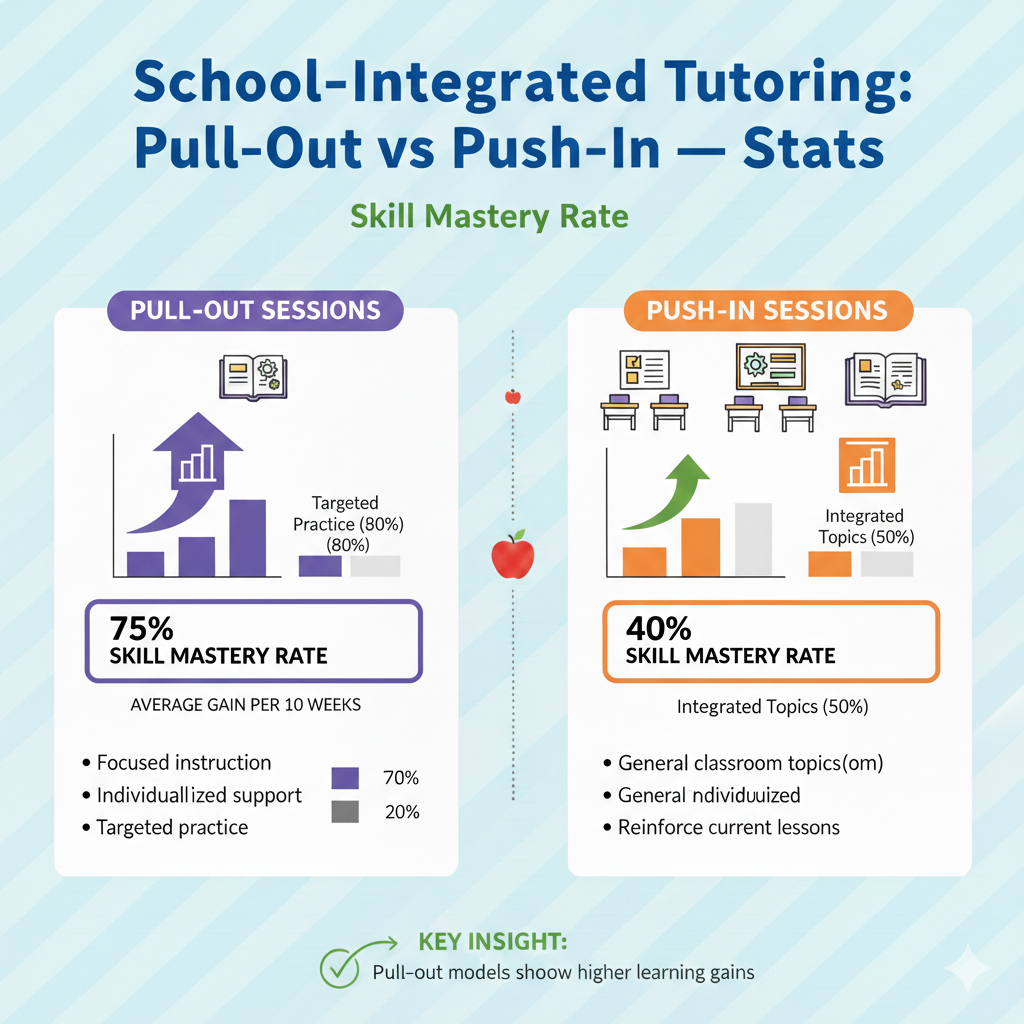
11) Skill Mastery Rate
Skill mastery rate tells you what percent of the exact skills you targeted were fully learned by the end of a cycle. You build a simple list of skills at the start, like reading multisyllable words with common endings or solving fraction addition with like denominators.
At the end, you check each skill with a short, clear task and mark mastered or not yet. You then divide mastered skills by total skills and turn it into a percent. This number matters because it looks past seat time and asks the only question that counts: did the child truly learn the thing we planned to teach.
In pull-out, mastery may rise faster when the tutor can slow down and fix gaps in a quiet space. In push-in, mastery can last longer because students use the skill right away in class work, which cements memory.
Start strong by writing each skill as a student-friendly “I can” statement. Keep every statement concrete and observable, like “I can read words with the ending tion in three seconds or less” or “I can draw a tape diagram for any two-step addition problem and label each part.”
Teach these one at a time with a tight routine. Model the step, have the student try it right away, and give quick feedback. Use the same check at the end of each session to see if the step stuck. If not, switch methods, not just minutes.
For example, if a student still confuses tion with sion after four days, add a sound chart, mouth picture cues, and a rapid sort of look-alike word cards. If a student still forgets to draw the model, put a small template on their desk and practice the first line of the process until it becomes a habit.
Report mastery in plain words families can trust. Do not say “on track” if the skill is not yet there. Say what is learned, what is next, and how you will get there. Celebrate fast but do not move on too soon. A skill is mastered when it shows up across at least three different tasks over a week, not just once on a good day.
In push-in, watch for transfer during the whole-class assignment. In pull-out, bring a short sample of the class task into the session to test if the skill travels. Debsie coaches use tight mastery trackers so time is focused and honest.
If you want a simple, friendly way to track and lift mastery, join a free Debsie class and we will show you how to make each “I can” real and lasting.
12) Time-on-Task Percentage
Time-on-task percentage is the share of each session that students spend actually doing the learning work. You calculate it by timing active learning minutes and dividing by the total minutes. Active minutes include reading aloud, writing, solving, discussing, and getting feedback.
Waiting for turns, finding pencils, long directions, and behavior talks do not count. A session with twenty-four active minutes out of thirty has eighty percent time-on-task.
This stat is powerful because it shows the quality of a minute, not just the count. In pull-out, the biggest leaks come from long transitions, slow material setup, and overlong explanations. In push-in, leaks often come from class noise, unclear roles, or side chats that steal focus.
To lift time-on-task fast, script the flow of every five minutes. Use a one-minute warm-up the student already knows, then two short bursts of new learning with tiny checks between them. Keep materials in a single bin that moves with the group.
Use micro-directions with numbers, like “Step one, open to page five. Step two, grab the blue marker. Step three, start line one now.” Train students to ask for help with a hand signal so you do not stop the whole group. If a student is off-track, give a quiet cue at their desk rather than a long talk.
Use a visible timer so everyone can see the sprint. Short, sharp sprints keep the brain awake and reduce drift. When attention dips, swap the mode. Move from reading to writing, or from whole-group brief to pair talk, to refresh focus without losing the thread.
Measure this stat twice a week for two weeks and fix the top leak first. If setup is slow, pre-load notebooks with sticky notes and pre-cut cards. If directions are long, rehearse your words out loud and cut them in half before the session.
If students wait for turns, build partner talk so more mouths and hands are busy. In push-in, stand with your back to a wall and face the group so you can see distractions coming and head them off with a glance.
In pull-out, seat students in a tight semicircle so you can reach every paper in one step. Debsie sessions are designed as short, lively blocks with very little dead time. Come see a class in action and feel what ninety percent time-on-task looks like. Your students will feel it too.
13) Transition Loss Time
Transition loss time is the number of minutes that slip away when moving to and from tutoring or shifting into and out of the small group. This includes walking down the hall, finding a seat, passing out materials, waiting for a laptop to start, or cleaning up after a messy activity.
These minutes seem small, but over a week they can erase a full session. Pull-out programs often lose time in the hallways and in room setup. Push-in programs often lose time during the turnover from whole-group teaching to small-group work, especially if roles are unclear or if materials are not ready.
The goal is to make transitions smooth, short, and silent, so learning restarts within seconds.
Cut loss time with a clear micro-script. Before the bell, place the bin at the table with sharpened pencils, markers, and copies. On the schedule, set transitions right after natural breaks like recess or independent reading, not in the middle of new teaching.

Teach students a simple routine with three moves. First, stand, tuck chair, and carry only the folder. Second, walk the set path on the right side of the hall with eyes forward. Third, sit, open the folder, and start the one-minute warm-up on the first page.
This routine should be practiced, not just told. Time the routine and cheer when the group hits the goal. If the school is large, place tutoring rooms near the classes that use them most so the walk is short. If the school is crowded, bring the table to the corner of the classroom and use privacy folders to reduce noise.
In push-in, align the handoff with the teacher. When the teacher says, “Begin independent practice,” the tutor moves to the table and the named students follow. No extra talk is needed if the habit is strong. End with a short two-sentence wrap and a fast cleanup.
Use a timer and music cue to mark the last thirty seconds. Put all tools back in the bin in the same order every time. If laptops are needed, wake them during the mini-lesson so they are ready. Audit transitions for one week.
If you see the same snag twice, fix that snag with a small tool or change. For example, if pencils vanish, attach a pencil to each folder with a string. If copies scatter, use a numbered stack and assign a student as materials captain.
Debsie coaches love designing clean transitions because they give back real minutes without extra staff. Join a free class and learn the tiny routines that save the most time.
14) Behavior Redirection Rate
Behavior redirection rate counts how many times in thirty minutes the tutor needs to redirect behavior. You can track it with tallies on a sticky note. A redirection is any moment you stop instruction to correct off-task actions, like calling out, phone use, or side talk.
A lower rate means the group runs smoothly and your time-on-task is high. In pull-out, misbehavior can spike if students feel singled out or if the room expectations are unclear. In push-in, misbehavior can rise if the small group sits too close to the class or if students drift in and out without a defined boundary.
High redirect rates do not mean students are bad. They often mean the routine is weak or the task is mismatched to skill.
Lower the rate with structure, not scolding. Start each session with a micro-contract that sets three clear, positive norms stated in simple words, like “Eyes on the work, voices at a whisper, hands ready to write.” Point to the norms as you praise, not just when you correct.
Use short, private cues rather than public lectures. A light tap on the desk, a finger to the lips, or a card that says “Check step one” keeps dignity high. Make tasks bite-size with fast wins in the first two minutes so confidence rises.
When a student feels a win, behavior usually follows. Teach and practice transitions within the session, like how to switch from reading to writing in ten seconds. Assign roles to keep hands busy. One student tracks time, one keeps materials neat, one checks that steps are labeled.
If redirections stay high, run a quick root-cause check. Is the task too hard or too easy. Is seating poor, with backs to the tutor or glare on the desk. Is the session too long without a short movement break. Fix one variable at a time and retest for a week.
In push-in, use a visual boundary like a small rug or table signs to mark the group space. In pull-out, keep the group small until habits form. Share wins with families in kind, specific words. “Today, Jordan stayed in the work for twenty-five of thirty minutes and explained two problems out loud.”
This builds pride and helps good habits stick. Debsie programs blend strong routines with warm tone so students feel safe and guided. Come watch a live class and see how calm structure turns into focused effort with very few redirects.
15) Student Engagement Score
Student engagement score is a simple rating from one to five that tells how much a student is truly involved in the work. A one means the student is mostly passive or off-task. A five means the student is leaning in, talking, writing, solving, and asking questions.
You record a quick score after each session and average it across the week. This stat captures what you can feel but cannot measure with test points alone. In pull-out, engagement can soar because the room is quiet and the student gets more attention.
It can also drop if the child feels embarrassed to leave the room. In push-in, engagement can rise because the student sees the skill used in real class work. It can also dip if the group feels like a side show in a busy room.
Raise engagement by building relevance, choice, and voice. Tie examples to the student’s world. Use names of favorite teams, artists, or hobbies in word problems or reading passages. Offer a small choice between two tasks that hit the same skill, like choosing which paragraph to read or which problem to explain.
Build voice by giving sentence starters for think-alouds, such as “First I will…” or “This part is tricky because…”. Keep pace lively with short sprints and quick turn-and-talks. Catch and name effort as it happens.

Praise should be specific and about the process, like “You kept your eyes on the word and used the vowel chart to fix it,” not “Good job.” When a student explains a step, ask a follow-up question to show their thinking matters.
Track engagement alongside growth. If scores hover at three, do not accept it. Adjust tasks so the student can taste success in the first five minutes. Add a tiny challenge at the end to stretch them a bit more. If the room is noisy, use whisper phones or headphones to cut distractions.
If the student is shy in push-in, practice explanations in pull-out first, then plan one small share in class the next day. Celebrate when a quiet student raises a hand in the main room or teaches a peer a step.
These are real wins that predict test gains later. Debsie builds engagement with fun, human tasks that still target hard skills. Try a free class to see how students light up when the work feels doable and meaningful.
16) Teacher–Tutor Planning Minutes per Week
Teacher–tutor planning minutes per week measure the time adults spend aligning lessons, materials, and roles. Count the minutes they meet and the minutes they message with clear next steps. Add both to get the weekly total.
A steady fifteen to thirty minutes per week can transform results because everyone pulls in the same direction. In pull-out, planning prevents topic drift and protects core class moments. In push-in, planning defines the handoff points, talk moves, and group lists so small-group time starts fast and stays focused.
Set a short, repeatable agenda that fits into a single planning bell or a quick online call. First, confirm the week’s top two goals in plain words. Second, choose the exact problems or passages to use so the language matches class instruction.
Third, map the daily session flow in three micro-steps, such as warm-up, model-and-try, and apply. Fourth, name students for each group and the success markers you want to see by Friday. Do not chase ten goals. Choose two, teach them well, and measure them honestly.
Keep a shared one-page plan in a simple folder or doc so no one hunts for files. After each day, the tutor adds a sentence on what worked and one sentence on what to tweak. The teacher reads and replies with a quick note. This daily drip keeps adjustments light and timely.
If meetings get canceled, protect the habit by exchanging a voice note. Planning minutes should feel like an investment that saves time later, not an extra task. When the plan is tight, small groups launch on the dot, materials are ready, and students hear the same steps in both spaces.
Families notice the calm. Students feel safe because routines do not change every week. Debsie coaches model these micro-plans in our live classes, making it easy to copy what works. Join a free trial to see how fifteen minutes of smart planning can give back hours of smooth teaching across the week.
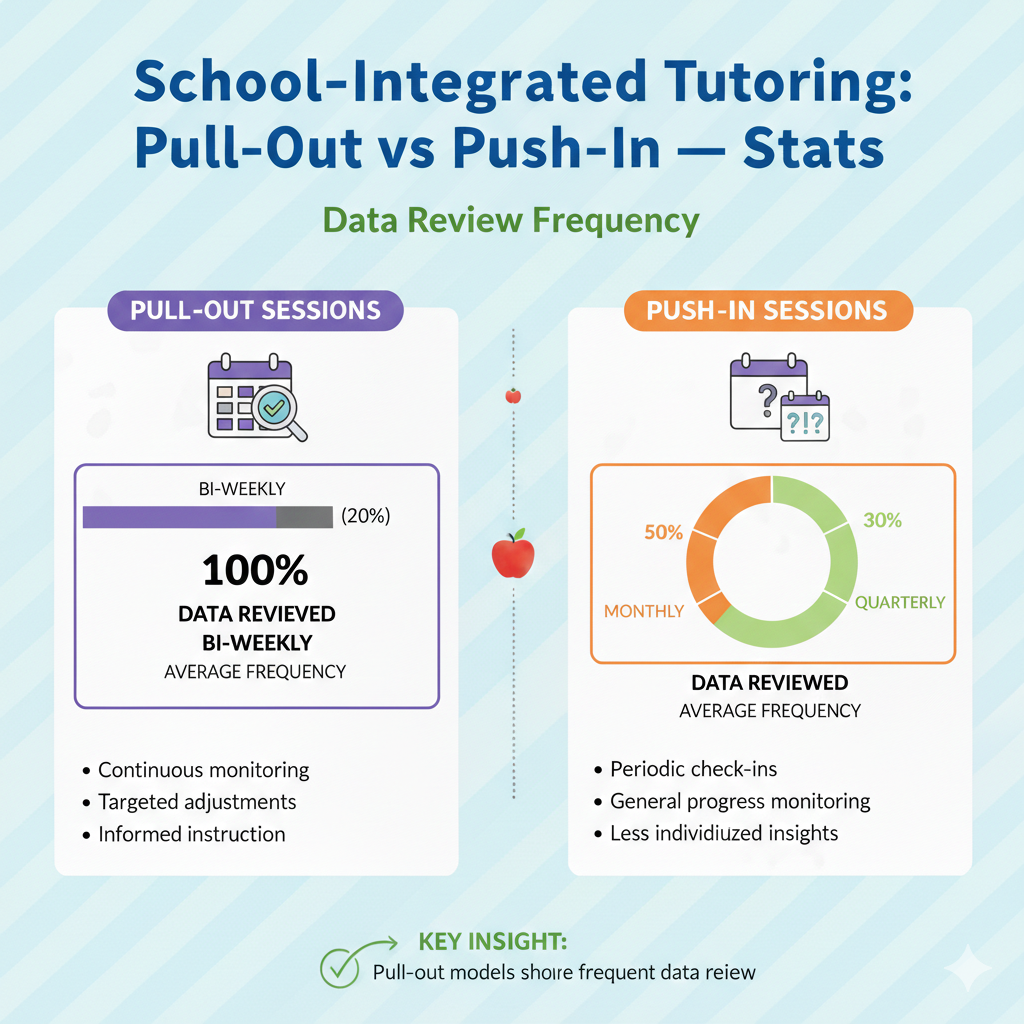
17) Data Review Frequency
Data review frequency tells you how often the team looks at student results and makes small, fast changes. Count the formal check-ins per month and include quick midweek pulses if they lead to a change. A healthy rhythm is a short review every week and a deeper look every four weeks.
In pull-out, regular reviews catch slow growth before weeks slip by. In push-in, reviews help rebalance groups and adjust timing inside the class block so support reaches the right students at the right minute.
Run a weekly ten-minute huddle. Look at attendance, time-on-task, and one tiny skill check, such as a decoding sprint or a two-problem math probe. Ask two questions. Who needs an extra dose this week. What small change would remove the biggest snag.
Make the change within twenty-four hours so students feel the benefit right away. Then, once a month, hold a longer twenty-five minute meeting. Bring quick pre and post checks, work samples, and notes on behavior redirections and engagement.
Decide which skills to keep, which to drop, and which to reteach in a new way.
Keep the process kind and clear. Talk about the work, not about the child’s worth. When growth stalls, test the plan, not the student. Try a different model, swap the text level, or change the group size for two weeks and see what happens.
Share highlights with families in simple language so they can support the same moves at home. Data should guide, not scare. The goal is steady, calm gains. Debsie platforms make this rhythm easy with built-in checks and friendly dashboards that show the next right step.
Try a free class and see how small, frequent reviews lead to fewer surprises and more happy progress.
18) IEP/Intervention Alignment Rate
IEP or intervention alignment rate shows how well tutoring targets match a student’s formal plan. You measure it by counting the tutoring goals that align to the IEP or RTI plan and dividing by the total goals. A high rate means the help a student gets during tutoring is the same help promised in the plan.
This matters for legal reasons and for learning. In pull-out, alignment can slip if the tutor works from a different guide than the special education teacher. In push-in, alignment can blur if the small group aims at the class task rather than the student’s documented need.
Start with a one-page snapshot of each student’s goals written in plain words. List the exact skills, the tools allowed, and the way progress should be checked. Place this snapshot at the front of the tutoring folder so it guides every plan.
Each week, choose the tutoring targets straight from this page. If the IEP says the student gets decoding practice with controlled texts four times a week, schedule those exact sessions and log them. If the plan allows extra time and a scribe for writing, teach the student how to use these supports with confidence, not shame.
Check alignment at the end of each week. Mark each session as aligned or not aligned. If you see a pattern of drift, fix it fast. Bring the special education teacher, the classroom teacher, and the tutor together for a fifteen-minute reset.
Match vocabulary, tools, and feedback methods so the student hears one steady story. When alignment is strong, students feel safe because adults do what they say they will do. Families trust the team. Scores rise because practice is not random.
Debsie respects student plans and we build tutoring that honors them. In our free trial, you can see how we turn IEP language into clear, kind lessons that make students feel capable every day.
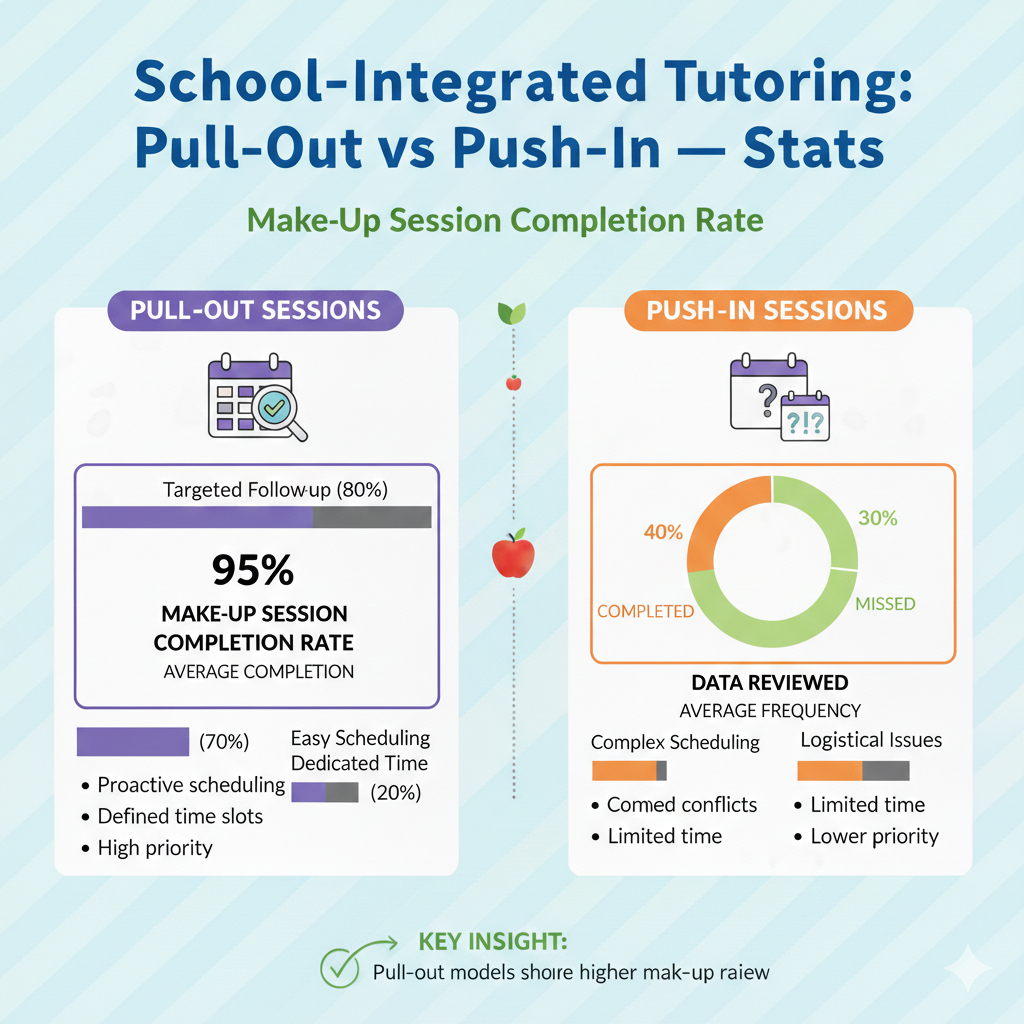
19) Make-Up Session Completion Rate
Make-up session completion rate tells you how many missed sessions are made up within a week. You calculate it by dividing the number of made-up sessions by the number of missed sessions and turning it into a percent.
A high rate keeps the weekly dose whole and stops small gaps from becoming big gaps. In pull-out, make-ups often fail because there is no clean time to add them. In push-in, make-ups stall if the class plan is tight and there is no space for a second small group. Without a plan, missed sessions pile up and progress slows.
Design a make-up playbook that is simple and fast. When a session is missed on Monday, the tutor adds two short boosters by Thursday. Each booster lasts ten minutes and focuses on the single most important skill from the missed session.
Use quick-hit tools like decodable word sprints, math fluency bursts, or a short guided writing. Keep a small set of ready-to-go tasks in a labeled folder so make-ups start right away. For pull-out, slot boosters during morning work, study hall, or dismissal.
For push-in, run a second micro-group during independent practice on the next day.
Track make-ups daily with a tiny table. Write the date missed, the date made up, and the exact skill covered. Share a short note with the classroom teacher and the family so everyone sees that the plan is intact.
If space is tight, try peer practice with clear scripts for two minutes before class, then a two-minute tutor check to lock it in. Protect the tone. Make-ups are not punishment. They are a promise kept.
Debsie builds make-up systems into our schedules so learning time stays steady even when life gets busy. Join a free class to see how two quick boosters can rescue a week without stress.
20) Parent Communication Touches per Month
Parent communication touches per month count the number of meaningful updates families receive. These can be short texts, quick calls, or simple notes sent home. The key word is meaningful. Each touch should say what the child worked on, what went well, and what to try at home in five minutes or less.
A strong target is four to eight touches per month, spaced weekly. In pull-out, strong communication reduces worry about time out of class and builds trust. In push-in, clear notes help families see the small-group work inside the classroom that may not be visible.
Create a simple rhythm. On Fridays, send a two-sentence summary that names one skill win and one tiny tip for the weekend. Early in the week, send a hopeful nudge if a session time changes or if a new focus begins. Keep the language plain and kind.
Avoid jargon. Instead of saying the student met a benchmark, say they read a full page with only two tricky words. Use the same sentence frames each week so messages are fast to write and easy to read. If a bigger change is coming, like a new group or a new tutor, call the family to explain and answer questions.
Invite parents into the plan. Share a five-minute routine they can try at home, like reading a short passage and timing how long it takes, or drawing a simple model before solving a word problem. Thank them when they try it. Families are not graders.
They are cheerleaders and partners. When communication is steady, attendance rises, homework gets done, and students feel proud because the important adults in their life are working as a team.
Debsie keeps families in the loop with friendly updates and easy home tips. Try a free class and see how a steady flow of kind messages can lift effort and joy across the month.
21) Student Confidence Gain
Student confidence gain measures the change in how sure a student feels about their learning. You can track it with a short self-rating from one to five at the start and end of a six to eight week cycle.
Ask the same simple questions each time, like how sure they feel when reading a new page or when facing a word problem. The score is the difference between the end and the beginning. This stat matters because confidence shapes effort.
A student who believes “I can do this” starts sooner, sticks longer, and tries harder tasks. In pull-out, quiet wins in a small room can spark confidence quickly because the space feels safe. In push-in, confidence can grow when the student sees they can keep up with classmates in real time.

Make confidence visible and specific. Tie praise to actions, not to talent. Say, “You used the vowel chart and fixed the word,” or “You drew the bar model before adding, which kept units straight.” Use tiny goal cards that students carry.
Before each session, they say the goal out loud. At the end, they check off the step they mastered. Keep goals at the right size so wins are frequent. If a goal is too big, break it into smaller steps and celebrate each step.
Add quick teach-back moments where the student explains a skill to the tutor or a peer. Teaching builds pride and shows that knowledge is real.
Protect tone. Confidence fades when adults rush, scold, or change plans too often. Keep routines steady and feedback kind. When a student makes an error, praise the attempt and model the fix. In push-in, plan one small share each week during whole-class time so the student feels brave in the main room.
In pull-out, rehearse that share the day before. Send a short note home when the student hits a new first, like reading a full page with no help, or solving a two-step problem alone. Families cheer, and the student stands taller the next day.
Debsie coaches build confidence on purpose with tiny, steady steps. Try a free class and watch belief grow along with skill.
22) Homework Completion Lift
Homework completion lift is the increase in the percent of homework turned in after tutoring begins. You can measure it by comparing the four weeks before tutoring to the four weeks after tutoring starts. This stat matters because homework is where habits form.
It shows if students can use skills without an adult right beside them. In pull-out, gains come when the tutor previews the exact kind of items that appear in homework. In push-in, gains appear when the tutor coaches the student on the first two problems during class so the student can finish the rest at home without fear.
Start small. Make sure homework feels doable and short. Ten to twenty minutes is plenty for most ages. Before students leave, have them circle two anchor problems and jot the first step for each. This makes starting at home easier.
Teach a five-minute home routine families can follow even on busy nights. It might look like reading a short passage aloud once, then whisper reading it again, or drawing a model for the word problem before adding any numbers.
Give families a simple script with one or two prompts and a time limit so it never turns into a long fight.
Track completion daily and give fast feedback. When a student brings back homework, review two items and give one clear note. If a page comes back blank, do a quick restart during morning work. In push-in, walk by and coach the first line of that night’s assignment.
In pull-out, spend the last three minutes previewing the hardest part of the homework. Use a homework buddy system where two students text or call each other to confirm they started. Share weekly progress with families using plain words, like “Four of five pages turned in this week, up from two of five.”
Debsie’s routines make home practice simple and calm. If homework battles have drained your family, try a free class and learn a tiny plan that turns stress into steady wins.
23) Class Participation Lift
Class participation lift is the rise in how often a student joins in the main class. You can count hands raised, responses spoken, or times the student contributes to group work each week. Compare the average before tutoring to the average after a few weeks.
This number matters because voice in class builds identity as a learner. In pull-out, the tutor can rehearse what to say so the student feels ready to share later. In push-in, the tutor can prompt the student at the right moment to join the discussion or explain a step, which boosts courage.
Build participation in tiny steps. Start with whisper practice at the small table. The student says the sentence frame for the skill, like “First I multiply by the denominator” or “The main idea is… because…”. Next, move to a quick share with a partner.

Finally, plan one safe whole-class share each week. The tutor can stand close as a quiet support, then fade. Choose the share spot well. Early in the lesson is best, before the student gets tired. Keep the prompt clear and friendly.
Celebrate the attempt, not just the perfect answer. Each safe attempt grows the habit of speaking up.
Track this lift in a small log. Note the date, the type of share, and the student’s feeling after. If a share goes poorly, do not make it bigger in the student’s mind. Name one thing that went well and practice again the next day in a smaller setting.
If the room is busy, use a visual cue so the teacher knows the student is ready to speak. In pull-out, plan sentence stems that match the teacher’s style so the language feels familiar. In push-in, coach the student’s first sentence and let them finish the thought.
Debsie tutors love these brave moments. We design support so every child can find their voice. Join a free class and see how steady, kind prompting turns into real participation.
24) Assessment Alignment Coverage
Assessment alignment coverage shows what percent of tested standards are directly practiced in tutoring before the test window. You measure it by listing the standards on the upcoming test, marking which ones students practiced in tutoring, and then dividing covered standards by total standards.
This stat matters because students do best when they see the same kinds of tasks before they meet them on a high-stakes day. In pull-out, coverage can lag if the tutor spends too long on a single gap.
In push-in, coverage can blur if the small group follows the daily lesson without checking what the test will actually require.
Build a simple coverage map six weeks ahead of the test. For each week, tag two or three standards to practice on purpose. Use short, high-yield tasks that match the test’s look and feel, but keep teaching first and drilling second.
Show the model, practice with feedback, then give a test-like item for quick application. Keep the language, diagrams, and answer formats close to the test so nothing feels strange. Rotate standards so no skill goes untouched. If a standard is already strong, keep a light touch and spend minutes where the gaps are widest.
Do not cram. Instead, run short spiral reviews three times a week. In push-in, drop a two-minute check during independent work and correct it now, not later. In pull-out, start with a tiny spiral warm-up, then shift to the main focus.
Track coverage on a wall chart that both teacher and tutor can see. When a standard is covered, mark it and list the exact items used. This helps with make-ups if a session was missed. Share the plan with families and give one test-like practice item for home once a week.
Debsie builds alignment without panic. Book a free class and we will show you calm, smart ways to cover what counts while still building true understanding.
25) Subgroup Impact Gap
Subgroup impact gap is the difference in growth between groups of students, like English learners and non-EL students, or students with IEPs and those without. You calculate it by taking the average growth for one group and subtracting the average growth for the comparison group over the same period.
This stat matters because a plan is only fair if it works for everyone. A large gap means one group is not being served as well, even if the overall averages look fine. In pull-out, gaps can widen if certain groups are pulled during content they need most.
In push-in, gaps can widen if the small-group talk moves do not support language needs or if instructions are too fast.
To close gaps, tailor the routine to the group’s needs. For English learners, use clear visuals, sentence frames, and quick echo reading so new words stick. Pre-teach key vocabulary before a class text. For students with processing challenges, slow the pace, cut directions into two steps, and add a model to each step.
Check understanding with quick thumbs or one-word responses before moving on. Place your strongest tutors with the highest-need groups during the most important minutes of the day. Keep group sizes small until gains are steady, then expand carefully.
Audit your schedule for equity. Make sure no subgroup misses science labs, art, or community circles due to tutoring. If they do, shift times. Track the gap every month and share it with the team. Celebrate when it shrinks and ask what made the difference.
Repeat those moves. Invite families to share what works at home and try it in tutoring. Debsie is built on inclusion and care. We design lessons that fit diverse learners and keep a close eye on equity so every child grows.
Try a free class and see how careful design can lift those who need it most without leaving anyone behind.
26) Cost per Student per Month
What this measures
Cost per student per month tells you how much money you spend to support one student with tutoring for one month. You add up all costs for the month, then divide by the number of students who actually received tutoring.
Include tutor pay, planning time, training time, benefits, room or platform fees, copies, and digital tools. Do not guess. Use real numbers from timesheets and invoices. This stat matters because budgets are tight. When you know the true cost, you can choose the model that gives the most learning for every dollar.
How to measure it simply
Pick a recent month with a normal schedule. Add all tutoring-related costs for that month. If a tutor spends time planning or sending notes to families, include that time. If a digital tool is billed yearly, divide the yearly fee by twelve.
Count how many unique students received at least one session that month. Divide total cost by the student count. Do this once for pull-out and once for push-in if you run both, because the costs can differ. Pull-out might require a separate room and longer transitions. Push-in might require extra co-planning minutes.
How to lower the cost without hurting quality
Tighten schedules so sessions start on time and end on time. The faster the launch, the more learning you fit into paid time. Place tutoring rooms near the classrooms you serve most to cut walking minutes.
Use shared, ready bins so tutors do not waste time hunting for materials. Train tutors in one high-impact routine and stick with it for a full cycle so planning is efficient. In push-in, lock the handoff point with the teacher so there is no idle time.
In pull-out, place sessions right after natural breaks to avoid interrupting new teaching. Review the stat each month and compare it to growth. If a certain time slot or group size shows equal gains at a lower cost, shift more sessions into that pattern.
Debsie builds lean systems that protect both quality and budget. If you want help mapping your true monthly cost and trimming waste, book a free Debsie trial and we will show you a clear, friendly template you can reuse every month.
27) Cost per Point of Growth
What this measures
Cost per point of growth shows how much money it takes to raise a student’s score by one point on your chosen measure over a set cycle. You calculate it by dividing total program cost by the average points gained.
This stat blends money and learning into one simple number. It helps you choose not just the cheaper model, but the smarter one. A model that costs more per month may still be better if it produces much larger gains per student.
How to measure it simply
Pick a ten-week cycle. Use the same pre and post tests across students. Add up all costs for those ten weeks, including staff hours and tools. Find the average score gain across all tutored students in that cycle. Divide the cost by the average gain.
If your average gain is five points and your cost is ten thousand dollars, your cost per point is two thousand dollars. Do this for pull-out and push-in separately if you run both. Keep the test and the window the same so the numbers are fair.
How to improve the number
Focus your plan on a few high-yield skills that move test points fast, like decoding accuracy, passage fluency, place value, and word-problem models. Use small groups for the hardest skills and slightly larger groups for practice skills.
Raise time-on-task with tight routines so every paid minute moves learning. Protect dosage fidelity so students do not miss sessions that would have lifted their scores. If one group shows low gains, change the method, not just add minutes.
Try more modeling, more guided practice, or a simpler set of problems with clear steps. Share this stat with leaders in plain words so budget talks focus on real outcomes, not guesses. Debsie coaches love building growth-per-dollar dashboards that feel honest and hopeful.
Try a free class and see how we link cost to results in ways that help you make smart, calm decisions.
28) Tutor Utilization Rate
What this measures
Tutor utilization rate is the percent of a tutor’s paid time that is spent in direct instruction with students. You calculate it by dividing active teaching minutes by total paid minutes, then turning it into a percent.
If a tutor works eighteen hundred minutes in a month and teaches twelve hundred minutes, the utilization rate is sixty-seven percent. This stat matters because you pay for all minutes, but only teaching minutes move learning.
Planning, walking, waiting, and searching for materials are sometimes needed, but they should not swallow the day.
How to measure it simply
Ask tutors to log their day in simple blocks: teaching, planning, moving, meetings, and admin. Do this for two typical weeks. Add totals and calculate the percent for teaching. Break down non-teaching time by cause so you can fix the biggest leaks first.
In pull-out, leaks often hide in long transitions and room changes. In push-in, leaks often come from unclear timing with the teacher or from waiting while the mini-lesson runs long.
How to raise utilization without burning people out
Build master schedules that cluster sessions by location and grade to cut travel. Standardize session routines and materials so planning is fast. Keep a shared library of ready lessons tied to the week’s goals so tutors can launch without extra prep.
In push-in, set a precise minute when small-group starts, and use a visual cue so everyone moves at once. In pull-out, set the room before the bell and place all tools in a single bin. Use short, standing huddles for coordination instead of long meetings.
Aim for at least seventy-five percent utilization while protecting quality. If a tutor’s rate is low because they cover many small tasks, consider a support role who handles materials and copies for several tutors at once.
Debsie designs calm, high-usage days that still feel human. Join a free trial to see how simple schedule moves and crisp routines can raise utilization and lift student gains at the same time.
29) Schedule Disruption Index
Schedule disruption index counts how many important class events a student misses because of tutoring in a single month. You track misses of specials like art and PE, science labs, group projects, class meetings, and assemblies.
Each time tutoring overlaps and the student cannot attend the core event, you mark one. At the end of the month, you total the marks for each student and average across the group. A lower number is better. This stat matters because learning is not only reading and math.
Children need science, art, movement, and community time. If tutoring steals too many of these moments, joy drops, peers move ahead on group work, and the student may feel left out. Pull-out programs are at higher risk because they remove the student from the room.
Push-in programs can still disrupt if they pull attention away during a whole-class event.
Start by mapping the master schedule with a red circle around non-negotiables. These include new concept lessons, labs, rehearsals, and any activity that builds social bonds. Next, place tutoring in green zones. Green zones are times with flexible tasks, like independent reading, math practice, or station work.
If you must schedule during a yellow zone, make the session short and targeted, then return the student quickly. Talk with the classroom teacher every Friday and scan the next week for one-off events like guest speakers or school pictures.
Adjust the tutoring slot by ten or fifteen minutes on those days so the student does not miss something special. For push-in sessions, use quiet tools and a clear table plan so the group can work without pulling eyes from the teacher during announcements or demonstrations.
When the index spikes for a student, meet as a team. Ask which events they missed, why it happened, and how to prevent repeats. Small schedule moves often fix the pattern. Shifting a session later by ten minutes can save a lab.
Swapping one day’s slot can save art. Teach students to advocate kindly. If they see the class starting a rare activity, they can ask to begin tutoring once the main directions are done. Families should see this index in plain words once a month so they know tutoring respects the whole child.
At Debsie, we build plans that lift academic skill without stealing joy. If you want help lowering your disruption index while keeping strong support in place, try a free Debsie class and we will map smarter green zones with you.
30) Sustained Impact Check (8–12 Weeks After)
Sustained impact check shows whether the gains from tutoring last after the cycle ends. You measure it eight to twelve weeks later using the same type of quick check you used for growth, under similar conditions. Mark the percent of students who keep at least half of their gain.
If a student improved ten points and still holds five or more points at the follow-up, that student counts as sustained. This stat matters because short bursts of progress are not enough. We want skills that stick when the tutor steps back.
Pull-out can show strong short-term gains, but without planned handoffs to the classroom, some skills fade. Push-in can build lasting habits because students practice in real class tasks, but the effect still needs checking to be sure.
Plan for sustain from day one. Teach portable steps and self-checks that students can use without an adult. In reading, this might be a two-step decode routine tied to a vowel chart inside the notebook. In math, it might be a rule to draw and label a model before any computation.
During the last two weeks of tutoring, shift the tone from supported practice to coached independence. Ask students to name the steps out loud, then do them with less prompting. For push-in, have the teacher call on the student to explain the method in front of peers.
For pull-out, send the student back to class with a small cue card and a plan to use the steps in the next assignment. Meet once with the teacher to ensure class tasks include chances to apply the new skill.
At the follow-up, keep nerves low and conditions steady. Run the same quick check, then review results kindly with the student. If sustain is weak, respond fast with a mini-boost: two to three short sessions focused only on the slipping step.
Do not restart the whole plan. A small booster often restores confidence and performance. Share sustain results with families in simple words, like how many words per minute still hold or how many two-step problems still come out right.
Debsie designs tutoring to fade the scaffolds smoothly and build habits that last in the classroom and at home. If you want a sustain plan baked into your tutoring from the start, book a free Debsie trial and see how we protect gains long after the cycle ends.
Conclusion
School-integrated tutoring works best when it is steady, simple, and measured. Pull-out can give quiet space for deep focus. Push-in can connect help to class work in real time. The right choice is not a guess. It is a plan guided by the thirty stats you now have.
Track attendance and on-time starts so minutes are real. Guard core instruction so learning adds up, not cancels out. Align tutoring to the week’s lessons so students hear one clear story.