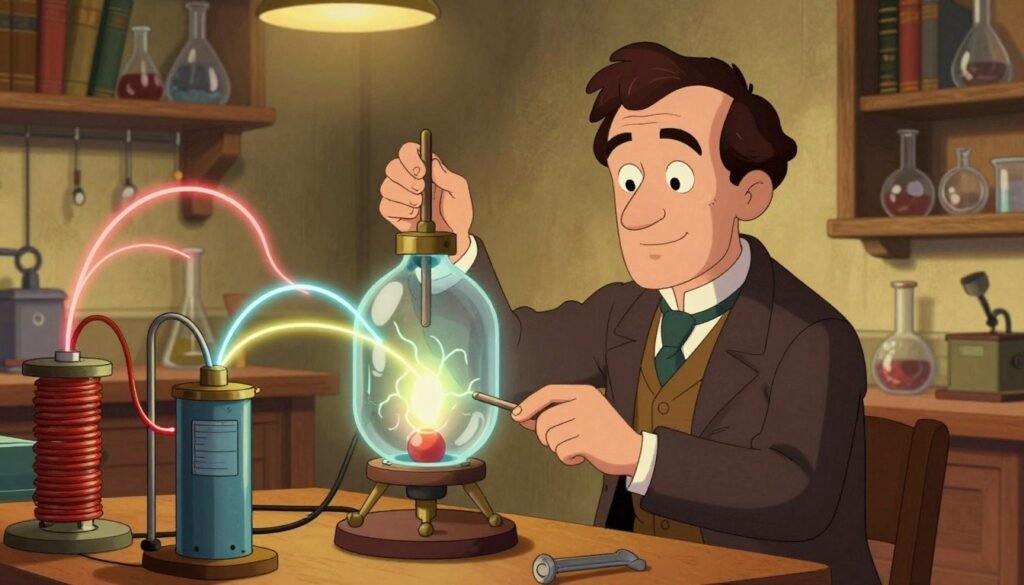
Imagine a world without your favorite gadgets or lights at night. It’s hard to think about! We’re lucky because one brave explorer made the lights come on!
This brave soul was an English chemist and physicist who loved to learn. He worked hard with magnets and wires. He made the first electric motors and generators.
We think every child has a spark of genius inside! You can learn about Michael Faraday’s discoveries. It’s amazing how one person can change the world!
Do you want to be a science master too? Try Debsie Gamified Courses at https://debsie.com/courses. It’s fun! Exploring Michael Faraday’s life will make you dream big and play harder!
Key Takeaways
- He was a brilliant scientist who studied how electricity and magnets work together.
- His inventions led to the creation of the first electric motor and generator.
- He discovered benzene and helped us understand chemistry much better.
- This scientist popularized common words we use today like “electrode” and “ion.”
- He showed that magnetism could actually affect rays of light!
- His work laid the foundation for almost all the modern technology we use now.
The Humble Beginnings of a Scientific Genius
Michael Faraday started his journey to fame with simple beginnings! He was born on September 21, 1791, in Newington Butts, Surrey. His family always worked hard.
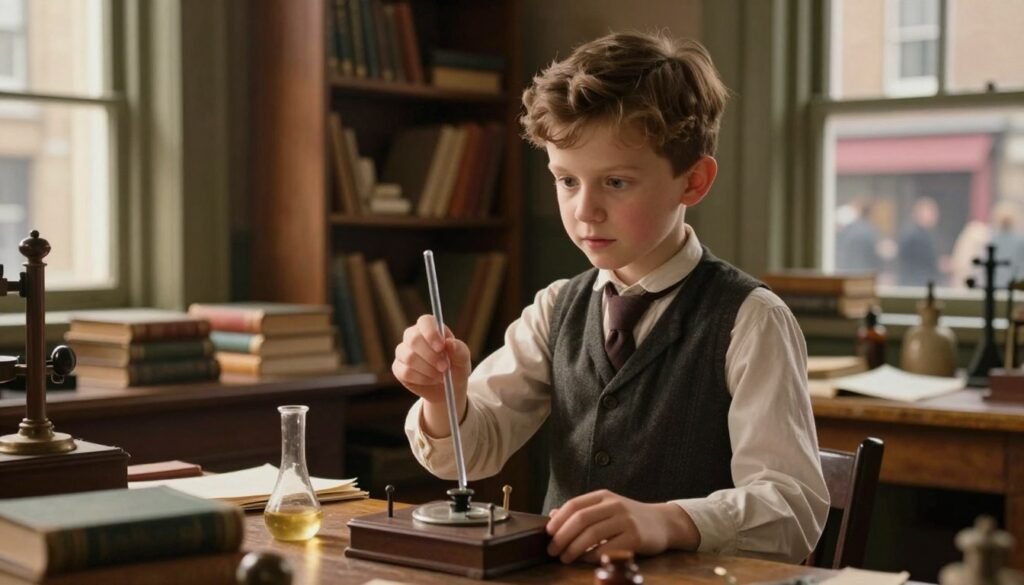
At 14, he became an apprentice to George Riebau, a bookbinder. He learned bookbinding and got interested in science books.
From Bookbinder’s Apprentice to Royal Institution
Faraday loved science books, including ones on electricity. He started simple experiments. These experiments were the start of his big discoveries.
- Exposure to scientific literature
- Conducting simple experiments
- Attending lectures by prominent scientists
His big chance came when he heard Humphry Davy at the Royal Institution. He took detailed notes and sent them to Davy. Davy was impressed by his hard work.
The Influence of Humphry Davy
Davy helped Faraday a lot. He became Davy’s assistant at the Royal Institution. This was the start of his amazing scientific career.
Exploring Faraday’s life shows how his early days shaped his discoveries. Learn more about science with fun courses at Debsie Gamified Courses!
The Discovery of Electromagnetic Rotation
In 1821, Faraday made a big discovery. He invented devices that could rotate using electricity. This was the start of modern electric motors!
His work was not by chance. It came from lots of experiments and understanding science well.
Faraday’s discovery was a big deal. It showed how electricity can turn into moving parts. This idea is key for many modern techs.
The First Electric Motor
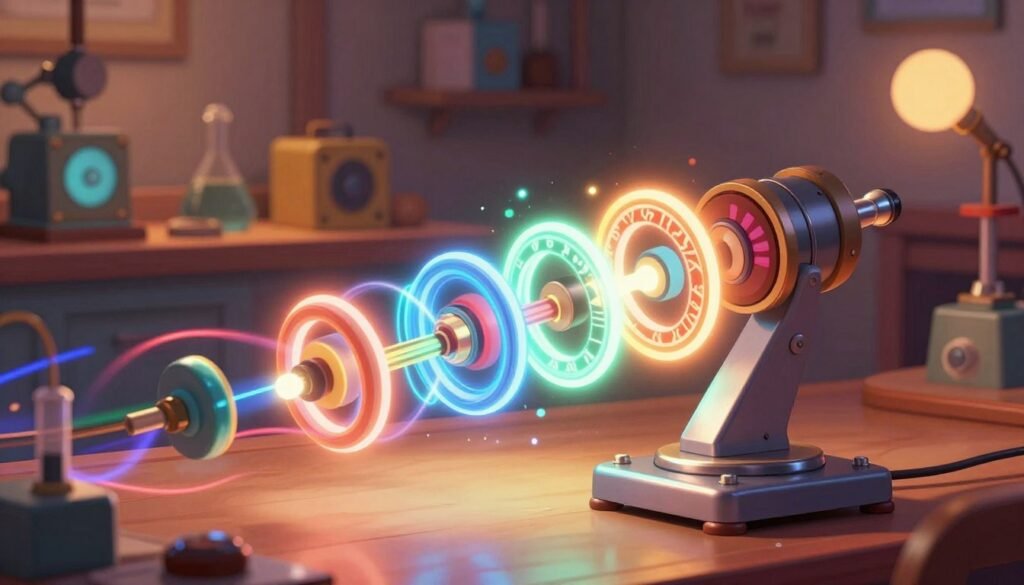
Faraday made the first electric motor from his experiments. He built two simple devices that made a wire spin around a magnet! These early motors were basic but showed a big idea. They showed that electricity can make things move.
These motors worked because of a simple idea. An electric current makes a magnetic field. When this field meets another magnet, it makes a force. This force can make things spin. This idea is still used in electric motors today!
Overcoming Scientific Skepticism
Even though Faraday found something important, some scientists didn’t believe him. They thought his discovery was not useful.
But Faraday didn’t give up. He kept showing his work and its value. Slowly, the scientific world started to see how important it was.
“Nothing is too wonderful to be true, if it be consistent with the laws of nature.”
| Year | Event | Significance |
|---|---|---|
| 1821 | Faraday discovers electromagnetic rotation | Lays the foundation for modern electric motors |
| 1821 | Development of the first electric motor | Demonstrates the conversion of electrical energy into mechanical energy |
| Later Years | Recognition of Faraday’s work | Wins over scientific community with persistence and clear experiments |
Michael Faraday and the Principles of Electromagnetic Induction
Faraday’s work on electromagnetic induction was key. It led to the electric generator. This idea is still important today.
Electromagnetic induction is when a changing magnetic field makes a current in a conductor. This is how many electrical devices work! Faraday’s discovery was a big step in physics and engineering.
The Famous Iron Ring Experiment
Faraday’s iron ring experiment was famous. He used an iron ring with two coils of wire. Passing current through one coil made a current in the other.
Here’s a simple look at Faraday’s iron ring experiment:
| Component | Description |
|---|---|
| Iron Ring | The core around which the coils were wrapped |
| Primary Coil | The coil connected to the power source |
| Secondary Coil | The coil where the current was induced |
Faraday said, “The power of electricity to induce a current in a nearby circuit was a discovery of immense significance.” This shows how big his findings were.
“The power of electricity to induce a current in a nearby circuit was a discovery of immense significance.”
The Birth of the Electric Generator
Faraday’s work led to the electric generator. It turns mechanical energy into electrical energy. This invention changed how we use electricity!
Today, electric generators are everywhere. They power everything from big plants to small devices. You can learn more about them on Debsie Gamified Courses!
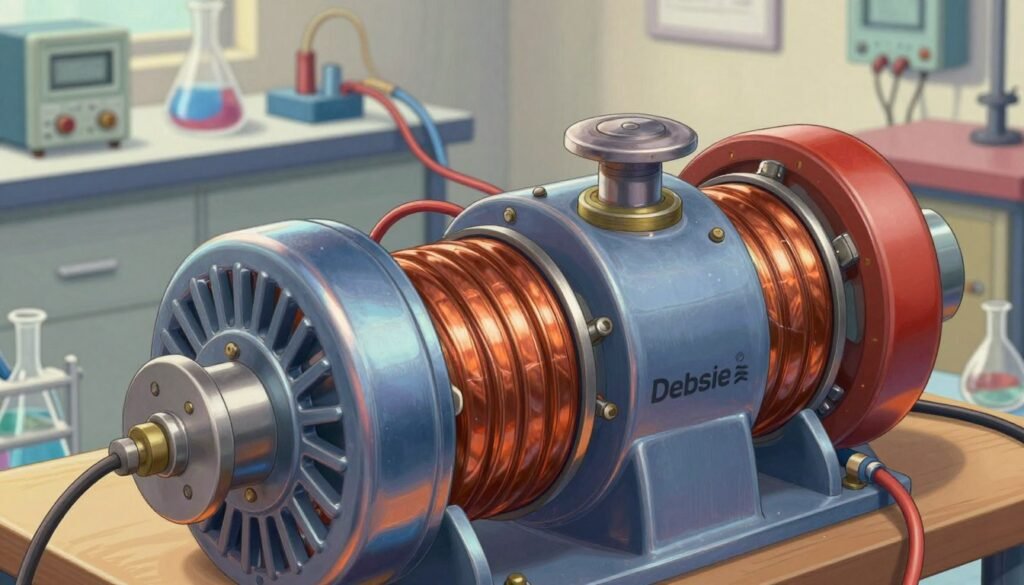
Understanding electromagnetic induction and the electric generator shows Faraday’s impact. His work lets us use electricity in many ways. It has changed our world!
Advancing the Field of Electrochemistry
Michael Faraday changed how we see chemical reactions and electrical processes. His work on electrolysis opened new doors in technology and industry.
Faraday didn’t just study science. He also named key terms we use today. Let’s explore some of these terms.
Defining Electrolysis and Ions
Electrolysis is when an electric current starts a chemical reaction. This happens in an electrolytic cell with two electrodes. Faraday named electrolysis, electrolyte, and ion to explain these ideas.
An ion is an atom or molecule with extra electrons. This gives it a charge.
Knowing about ions and electrolysis helps us understand batteries, metal purification, and some medical treatments.
Faraday’s Laws of Electrolysis
Faraday’s work led to two important laws about electrolysis. These laws connect the amount of substance changed at an electrode to the electric charge used.
| Faraday’s Law | Description |
|---|---|
| First Law | The mass of a substance changed is directly related to the electric charge used. |
| Second Law | The mass of different substances changed by the same electric charge is related to their weights. |
These laws were a big deal. They gave us a way to measure and predict electrolysis accurately.
Faraday’s work in electrochemistry has made a big difference. His ideas still shape science and technology today.
The Concept of the Electric Field
Imagine seeing invisible forces. That’s what Faraday did with his electric field idea! This idea changed how we see physics and helped make new tech.
Visualizing Invisible Forces
Faraday came up with the electric field idea. It shows the area around charged particles where electric forces are felt. He said every charged particle has an electric field that affects other charges.
He used lines of force to explain it better. These lines show the electric field’s direction and strength. They help us see how electric forces work, even though we can’t see them!
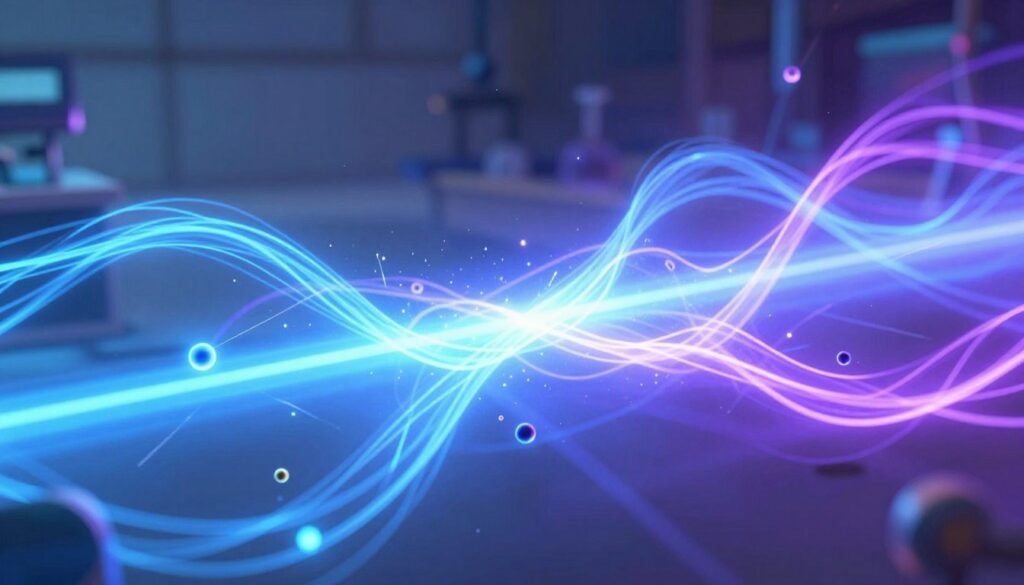
Lines of Force and Their Impact on Physics
The idea of lines of force changed physics a lot. It helped scientists understand charged particles and electromagnetic waves better.
The table below shows what Faraday’s ideas mean:
| Concept | Description | Impact |
|---|---|---|
| Electric Field | Region around charged particles where electric forces can be detected | Revolutionized understanding of charge interactions |
| Lines of Force | Visual representation of the direction and strength of the electric field | Facilitated understanding of electric forces and electromagnetic phenomena |
Faraday’s work on the electric field and lines of force was key. It helped physics and engineering grow a lot. His ideas still inspire scientists and engineers today!
Want to dive into physics and see how electric fields are used today? Check out Debsie’s fun courses at https://debsie.com/courses!
The Invention of the Faraday Cage
Imagine a world where lightning can’t hurt you. This is thanks to Michael Faraday and his Faraday Cage. It’s a shield that spreads out electrical charges evenly. This cancels out the electromagnetic field, keeping what’s inside safe.
But how does it work? The Faraday Cage uses electrostatic shielding. When an electrical charge hits the cage, the metal’s electrons move. They cancel out the external field. So, the inside of the cage stays safe from electrical shocks!
Understanding Electrostatic Shielding
Electrostatic shielding is a key idea in physics. It has many uses. By using metal to cover a space, we can block out electromagnetic fields. This is important in many fields, like electronics and aerospace.
Let’s see how it works in different ways:
| Application | Description | Benefit |
|---|---|---|
| Lightning Protection | Faraday Cages protect buildings from lightning by spreading out the charge. | Safety from electrical surges |
| Electronic Devices | Faraday Bags or pouches keep devices safe from external electromagnetic pulses (EMPs). | Protection of sensitive electronics |
| Scientific Research | Faraday Cages shield sensitive equipment in labs from outside interference. | Accurate experimental results |
Modern Applications in Technology and Safety
The Faraday Cage has many uses today. It protects electronic devices during transport and from electromagnetic pulses (EMPs). For example, a car acts as a Faraday Cage during a lightning storm, keeping people inside safe.
As we keep inventing and using more technology, the Faraday Cage’s principles are key. By using electrostatic shielding, we make systems safer and more reliable for the future!
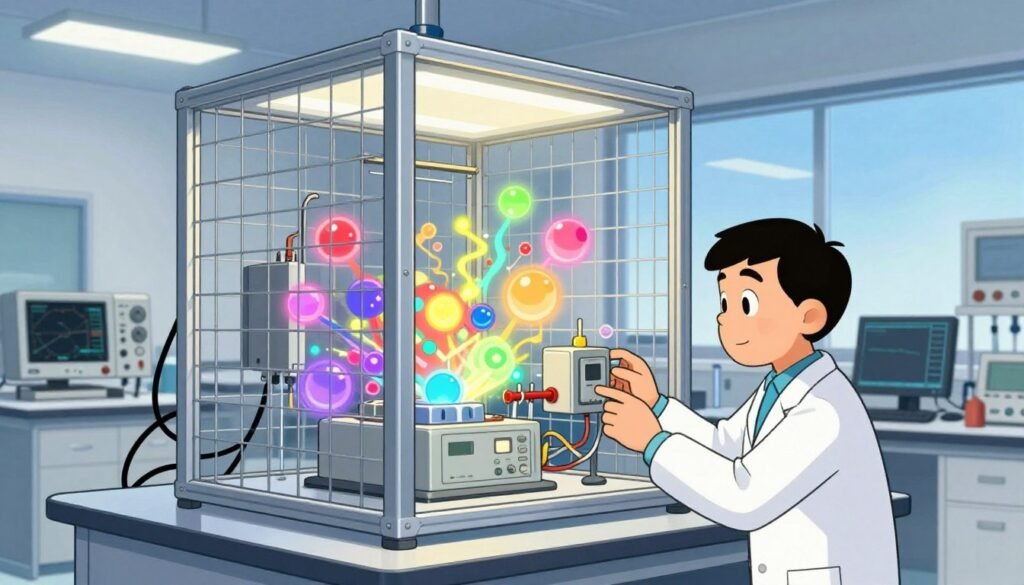
James Clerk Maxwell, a famous physicist and friend of Faraday, said something important. “The scientific worth of Faraday’s work is in the ideas he suggested, not just the facts he found.” The Faraday Cage shows Faraday’s creative mind and his big impact on science and technology!
The Discovery of Diamagnetism
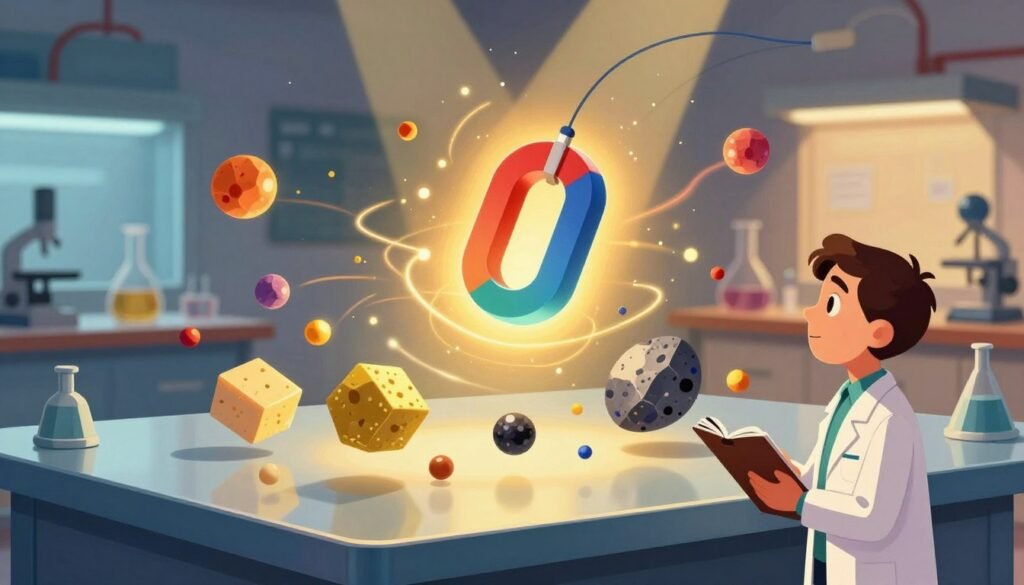
Faraday was always looking for new knowledge. He found diamagnetism, a big discovery that changed how we see magnets! This helped us learn more about magnetic properties of things.
Faraday’s work showed that some things push away magnets. This was new and exciting. It made us see how different things act with magnets. You can learn more cool science facts at https://debsie.com/courses!
Magnetic Properties of Matter
Faraday’s work helped us understand magnets better. He found that some things pull towards magnets (ferromagnetic) and others push away (diamagnetic).
Challenging Existing Magnetic Theories
Faraday’s discovery shook up old ideas about magnets. It made us think more about magnets and how they work. This led to more research on magnets.
Learning about diamagnetism helps us see how things interact with magnets. This knowledge is important in many areas of science and tech!
The Faraday Effect and the Interaction of Light and Magnetism
Michael Faraday found out about the Faraday Effect. It changed how we see light and magnetism working together. This discovery is key in physics and engineering.
Polarization of Light
Light changes when it goes through a clear material with a magnetic field. The light’s direction changes based on the magnetic field’s strength and how far it travels. The Faraday Effect helps us understand this.
The Foundation for Modern Optical Communication
The Faraday Effect is important for today’s optical communication. It helps make better optical isolators and circulators. These tools are key for clear signals in networks.
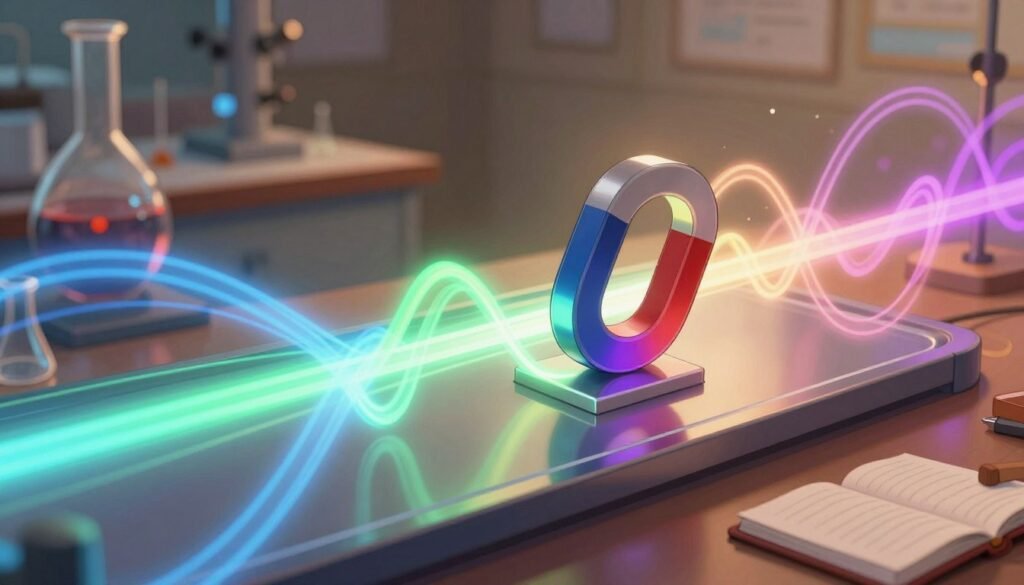
| Property | Description |
|---|---|
| Effect on Light | Rotation of the plane of polarization |
| Influencing Factor | Magnetic field strength |
| Application | Optical isolators and circulators |
The Faraday Effect is well-known and used in many technologies.
The Royal Institution and the Christmas Lectures
Michael Faraday started something special at the Royal Institution. He created the Christmas Lectures. These talks made science easy for everyone to understand.
Faraday wanted science to be for everyone. He worked hard to share it with the community. His efforts inspired many scientists and science teachers.
Making Science Accessible to the Public
Faraday’s Christmas Lectures were a hit. They drew big crowds and made people wonder. He explained hard ideas in simple words, making science fun.
You can learn more about the Christmas Lectures on the Royal Institution’s website! Faraday’s work inspired many to explore science.
The Chemical History of a Candle
Faraday’s famous talk was “The Chemical History of a Candle.” He showed how a simple candle can teach us a lot. He turned a common object into a science lesson.
Here are some key ideas from his lectures:
| Concept | Description |
|---|---|
| Chemical Reactions | Faraday explained the chemical reactions that occur when a candle burns, including combustion and the release of heat and light. |
| Capillary Action | He demonstrated how capillary action draws fuel to the wick, sustaining the flame. |
| Physics of Flames | Faraday discussed the physics behind the flame, including the role of oxygen and the behavior of gases. |
Faraday showed us that the world is full of wonder. You can keep exploring science with fun courses on Debsie!

The Practical Application of Faraday’s Discoveries
Faraday’s discoveries changed the game for the industrial revolution! His work on electricity helped us understand it better. It also helped create modern electrical systems.
Faraday found out how to make electricity efficiently. His discoveries let us use electricity on a big scale. This changed how we make things and work!
Powering the Industrial Revolution
The industrial revolution was a big change time. Faraday’s work was key to this change. Electricity helped make new machines and ways to make things.
Using electricity everywhere helped industries grow. This made the world better and changed life for everyone!
The Transition to Modern Electrical Grids
Faraday’s work also helped make modern electrical grids. We can now send electricity far and wide. This powers our world today.
Now, our electrical grids are very advanced. They use smart tech and green energy. Faraday’s work still helps us get electricity easily and safely!
Learning Science Through Gamification
Learning science is now fun thanks to gamification! It’s changing how we teach and learn science. Gamification helps everyone learn more about science.
Gamification uses game ideas in school to make learning fun. It adds points, badges, and leaderboards to science. This makes learning science fun and interactive.
Enhancing Scientific Literacy Today
Knowing science is key today. Gamification makes learning science fun and interactive. This helps us understand science better.
Some benefits of gamification in science learning are:
- More people want to learn and stay interested.
- They remember complex ideas better.
- They learn to think and solve problems well.
- They work better together and compete.
Exploring Debsie Gamified Courses
Debsie has fun science courses. They use gamification to make learning interactive. You can check out their courses at https://debsie.com/courses.
For example, a project on Learning Electromagnetism through a playful fair game shows gamification works. It helps learners understand electromagnetism better.

Let’s make science learning fun with Debsie’s gamified courses! We can all learn and grow together.
Faraday’s Relationship with James Clerk Maxwell
James Clerk Maxwell built on Michael Faraday’s work. He created a theory of electromagnetism that changed the world! Their work together helped us understand the electromagnetic world.
Faraday’s experiments were the base for Maxwell’s theories. Faraday found how electricity and magnetism connect. Maxwell made these findings into a single theory of electromagnetism.
Bridging Experimental and Theoretical Physics
Faraday and Maxwell worked together beautifully. Faraday did experiments to understand things. Maxwell used math to explain and predict these phenomena.
- Faraday’s discovery of electromagnetic induction
- Maxwell’s formulation of the equations of electromagnetism
- The unification of electricity and magnetism into a single theory
This partnership showed us that physics is real. It showed the value of both doing experiments and using math to understand the world.
The Mathematical Formulation of Electromagnetism
Maxwell’s equations came from Faraday’s work and his own ideas. These equations explained electromagnetism and predicted waves. Later, people found these waves.
Maxwell’s work was very important. It explained what Faraday found and opened new areas for study. Today, we see their impact in our homes and phones.
The story of Faraday and Maxwell shows the power of working together. Their work inspires scientists and engineers today. It reminds us that knowledge grows from past discoveries.
The Personal Character and Faith of a Pioneer
Michael Faraday’s life shows how character and faith can shape science. His personal character and faith greatly influenced his science work.
Faraday was a strong Christian. His faith, from the Sandemanian sect, deeply affected his life and science.
The Sandemanian Influence
The Sandemanian church taught Faraday about simplicity, humility, and following the Bible. These values shaped his science and how he interacted with others.
“The Christian faith is not a mere human invention, but a divine revelation.”
Faraday’s faith was a big part of his life, including science. This shows us the importance of living a whole life.
Humility in the Face of Greatness
Even with big discoveries, Faraday stayed humble. He said, “The highest science is to study and understand the works of the Creator.”
His humility shows what a true pioneer looks like. It inspires both scientists and others.
| Values | Impact on Faraday’s Life and Work |
|---|---|
| Humility | Remained grounded despite his significant contributions to science. |
| Simplicity | Influenced his straightforward and uncomplicated approach to scientific problems. |
| Faith | Guided his ethical stance and provided a moral framework for his work. |
Looking at Faraday’s life, we see his personal character and faith were key. They were not just extra parts of his life but were central to who he was.
Want to learn more about science and its pioneers? Check out Debsie Gamified Courses for fun and interactive learning!
The Lasting Legacy of Michael Faraday in Modern Technology
Faraday’s work in electricity changed the world. It helped make many new technologies. Now, his ideas are in our homes and big machines. Let’s see how his work still helps us today.
From Telegraphs to Smartphones
Faraday’s ideas led to many inventions. The telegraph was one of the first ways to talk long distance. Now, smartphones, which are like tiny computers, also come from Faraday’s work!
- Electric generators and motors
- Transformers and transmission lines
- Radio communication devices
- Modern smartphones and computers

Why Faraday Remains the Father of Electricity
Faraday’s work helped us understand electricity and electromagnetism. His experiments were key to these discoveries. His work still inspires scientists and engineers today!
- He found electromagnetic induction, key to many electrical systems.
- His detailed experiments have helped others build on his work.
- He helped create the idea of the electric field, a big idea in physics.
The Challenges and Failures That Shaped His Success
Michael Faraday’s story shows us how to overcome obstacles and learn from failures! He faced many challenges in his career. But he kept going and learned from his mistakes, which helped him succeed.
Persistence in the Face of Experimental Obstacles
Faraday had many experimental obstacles. Some doubted his work on electromagnetic rotation. But he didn’t give up. His curiosity and passion for discovery kept him going.
His hard work led to big breakthroughs, like the first electric motor. We can learn from his example. By facing challenges head-on, we can achieve great things.
Learning from Unsuccessful Hypotheses
Faraday also learned from his failed ideas. His first tries to link magnetism and light didn’t work. But he kept trying and found the Faraday effect.
Learning from failure is key in science. Studies show that knowing about famous scientists’ struggles helps students. It teaches them to keep trying and learn from mistakes.
By facing challenges and learning from mistakes, we can make big strides in science. So, don’t get discouraged by setbacks. Use them to learn and grow! Try Debsie Gamified Courses at https://debsie.com/courses to improve your learning!
Conclusion
Michael Faraday’s work has changed how we see the world. He found out about electromagnetic induction and electric fields. These ideas led to many new technologies.
Now, we use his ideas every day. Electric motors power our homes, and smartphones keep us in touch. We hope you keep learning about science and see how Faraday’s work still helps us today.
At Debsie, we love making science fun for everyone. You can learn more and try new things at https://debsie.com/courses.