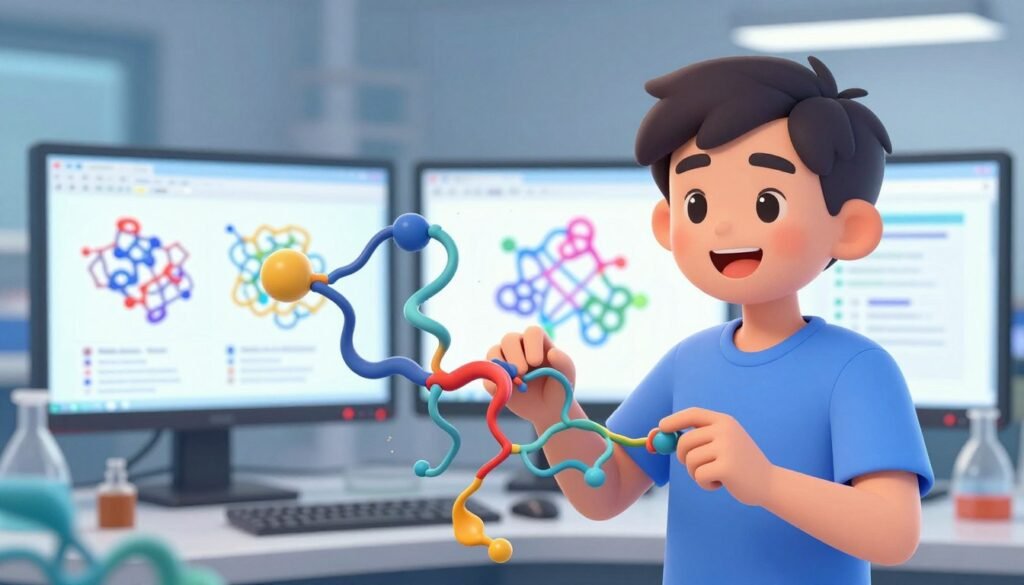
Have you ever looked at a tiny LEGO set and wondered how all those pieces fit together to make something amazing? Inside your body, there are millions of tiny “machines” called proteins. They do all the hard work to keep you healthy!
For fifty years, scientists struggled to understand exactly how these tiny pieces were shaped.
A brilliant researcher named John Jumper changed everything. He used the power of technology to build a super-smart tool called AlphaFold. This tool helped map out how these shapes look and work.
It’s like finding a secret treasure map to the building blocks of life itself!
This incredible achievement earned him the Nobel Prize in Chemistry in 2024! We are so proud to see how nurturing big ideas can lead to such giant discoveries. You can even start your own journey into these wonders with Debsie’s Gamified Courses where learning feels like a fun game!
The Nobel Prize in Chemistry celebrates how protein structure prediction helps us fight tough diseases. This breakthrough also helps us find new ways to save our planet and clean the oceans. We are so excited to see how AI is opening new doors for brave explorers like you to play and grow!
Key Takeaways
- John Jumper won the 2024 Nobel Prize for his amazing work with AI.
- The AlphaFold tool solved a 50-year-old mystery about how proteins are shaped.
- This discovery helps doctors find better ways to treat illnesses and keep us strong.
- Scientists use this technology to create new ways to recycle plastic and protect nature.
- AI is a powerful friend that helps us understand the secrets of the human body.
- You can explore science and technology through fun, interactive learning experiences.
The Grand Challenge of Protein Folding
Protein folding is a complex process that has puzzled scientists for decades. It’s crucial because the 3D structure of a protein determines its function in the body. Misfolded proteins can lead to diseases like Alzheimer’s and Parkinson’s.
The challenge lies in predicting the 3D structure of proteins from their amino acid sequences. This is like trying to predict the final shape of a long, flexible chain based on its links alone. It’s a daunting task because the number of possible configurations is astronomical!
The structure of a protein is crucial for its function. For example, enzymes, which are biological catalysts, have specific shapes that allow them to bind to substrates and facilitate chemical reactions. Understanding protein structures can help us design drugs that target specific proteins involved in diseases.
Key Aspects of Protein Folding:
- Protein Folding: It’s a complex process influenced by the sequence of amino acids.
- Biological Processes: Proteins play a crucial role in virtually every biological process.
- Disease Association: Misfolded proteins are associated with many diseases.
“Understanding protein folding is one of the most significant challenges in modern biology, and solving it could revolutionize our approach to medicine.”
By understanding protein folding, we can gain insights into how proteins function and how their malfunction leads to disease. This knowledge can pave the way for new therapeutic strategies and drug discoveries.
John Jumper and the Rise of AlphaFold
John Jumper is a big name in AI and biology. He helped make AlphaFold, a tool that guesses protein structures. He worked with Demis Hassabis on AlphaFold. This tool solved a 50-year puzzle in biology.
AlphaFold guesses protein structures very well. This change is big for understanding life and finding new treatments. It helps scientists know how proteins work and talk to each other.
AlphaFold’s big wins include:
- Helping find new medicines by showing what proteins look like.
- Helping us understand life at the tiny molecular level.
- Starting new paths in medicine and biotech.
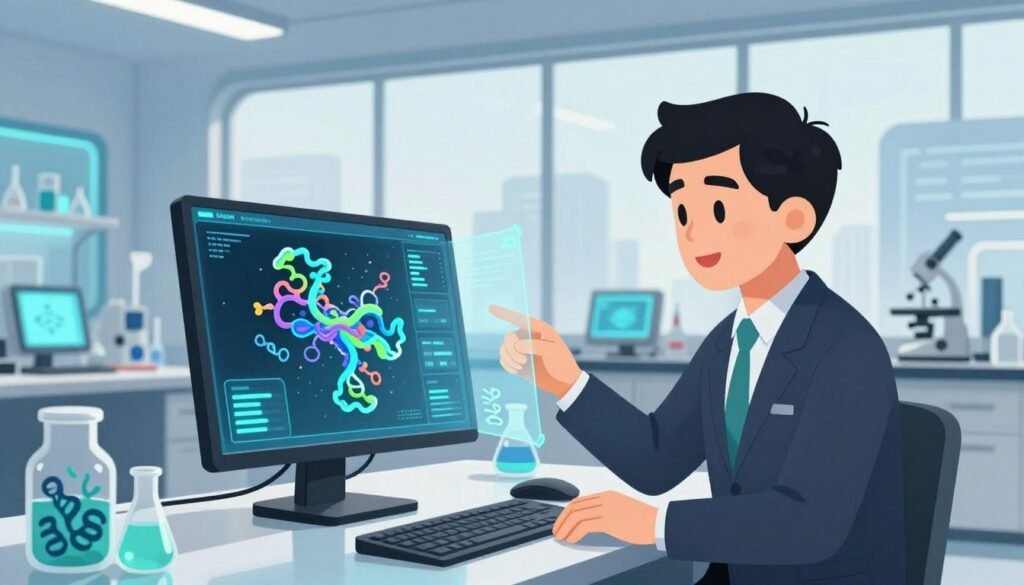
AlphaFold shows how AI can change biology. For more on AlphaFold, check out the DeepMind blog.
John Jumper’s work on AlphaFold shows AI’s power in solving tough biology problems. As we keep using AlphaFold, we’ll find even more cool ways to use it.
Understanding the Biological Significance of Proteins
Proteins are the key workers in every living cell. They help with many important tasks. They act as enzymes, hormones, and structural components.
They help with almost every job in a living thing. This includes speeding up chemical reactions and making DNA copies.
Proteins play many roles:
- They act as enzymes, speeding up chemical reactions in the body!
- They function as hormones, signaling molecules that help different parts of the body communicate.
- They provide structural support, forming the framework of cells and tissues.
To learn more about the basic units where proteins function, visit Debsie’s article on cells.
Understanding proteins is key for medical science and biotechnology. For example, John Jumper’s work on protein folding helps find new drugs. This is explained in this article on Vanderbilt University’s website.
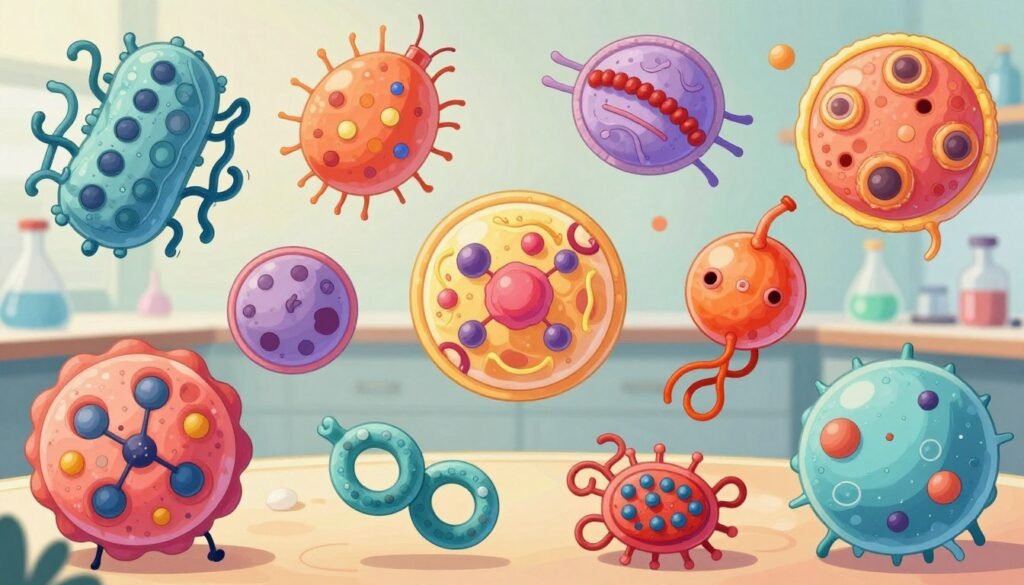
By understanding proteins, we can see how life works at a small level. We can also learn how to fix problems when they happen.
The Historical Struggle of the CASP Competition
For decades, the CASP Competition has pushed the limits of protein structure prediction. It started in 1994 and has been a key test for new methods. This competition helps scientists make better predictions of protein structures.
Over the years, the CASP Competition has seen big improvements. Researchers face many challenges, like:
- Figuring out the 3D shape of proteins from their sequence!
- Going beyond old ways of modeling proteins!
- Using evolutionary data to make predictions better!
Recently, deep learning has changed the game, thanks to tools likeAlphaFold. This has made predictions much more accurate. So, the CASP Competition keeps helping us learn more about proteins.
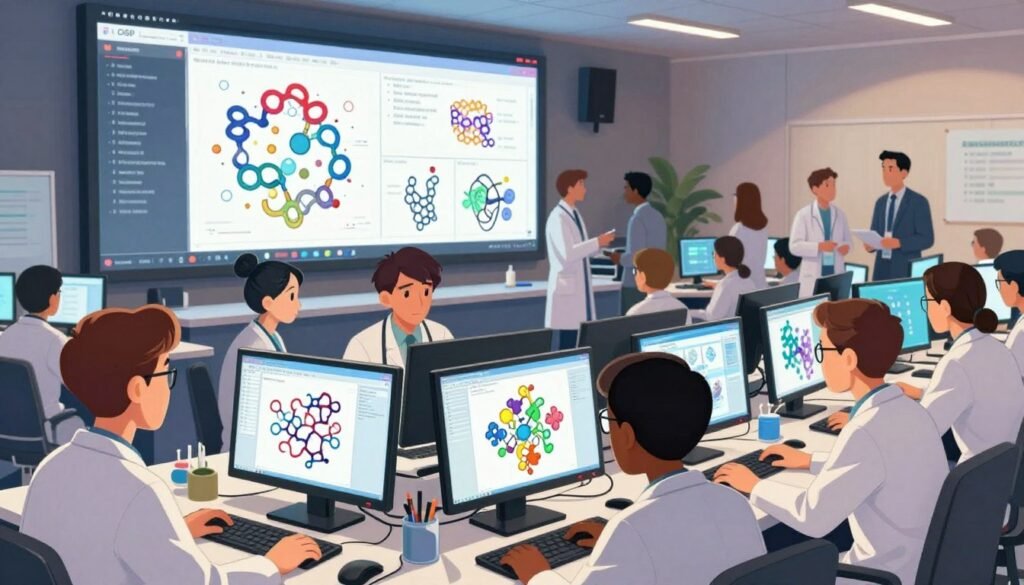
The CASP Competition’s journey shows the hard work of scientists. They keep trying to predict protein structures better. This effort is crucial for understanding life’s secrets at a molecular level. The CASP Competition’s impact is huge, inspiring many scientists today!
How Deep Learning Transformed Structural Biology
Deep Learning has changed Structural Biology a lot. It has led to big advances in Protein Structure Prediction! Deep learning can look at lots of data, find complex patterns, and guess things right.
Before, figuring out protein shapes was hard and slow. But now, Deep Learning makes it fast and accurate. This helps scientists learn more about proteins and their jobs in our bodies.
Deep Learning has many benefits for Structural Biology. It makes predicting protein shapes better. It also lets scientists study hard-to-reach biological systems.
By using Deep Learning, scientists can see how proteins move and work together. This is key for understanding diseases and finding new treatments.
Also, Deep Learning helps find new medicines faster. It helps spot good targets for drugs. This is good news for treating many diseases, even the ones we can’t cure now.
Key Milestones in the Development of AlphaFold
The making of AlphaFold was a big win. It came from big steps in deep learning and using evolutionary data! This big change wasn’t quick. It took many important steps to change how we predict protein structures.
The Shift from Traditional Physics-Based Modeling
Before, we used physics to guess protein structures. But, this method had big problems! Then, deep learning came along. It used big data and smart networks to guess structures better than ever!
Integrating Evolutionary Data into Neural Networks
AlphaFold’s big win was using evolutionary data in its models. It looked at how proteins evolved. This helped it guess structures more accurately.
Overcoming the Computational Bottlenecks
AlphaFold also had to solve big computational bottlenecks. The team found new ways to work with lots of data. This made it possible to guess structures for many proteins fast!
To learn more about AI and deep learning, check out Debsie’s courses! They make learning fun and keep you up-to-date with new discoveries.
The Impact of AlphaFold on Drug Discovery
AlphaFold is changing how we find new medicines. It helps us see how proteins work. This lets researchers find the right targets for drugs more easily.
Finding protein structures used to take a lot of time and money. But AlphaFold makes it fast and accurate. This is making finding new medicines faster.
- Identify potential binding sites on proteins for drugs
- Design drugs that can effectively target specific proteins
- Predict how drugs will interact with proteins
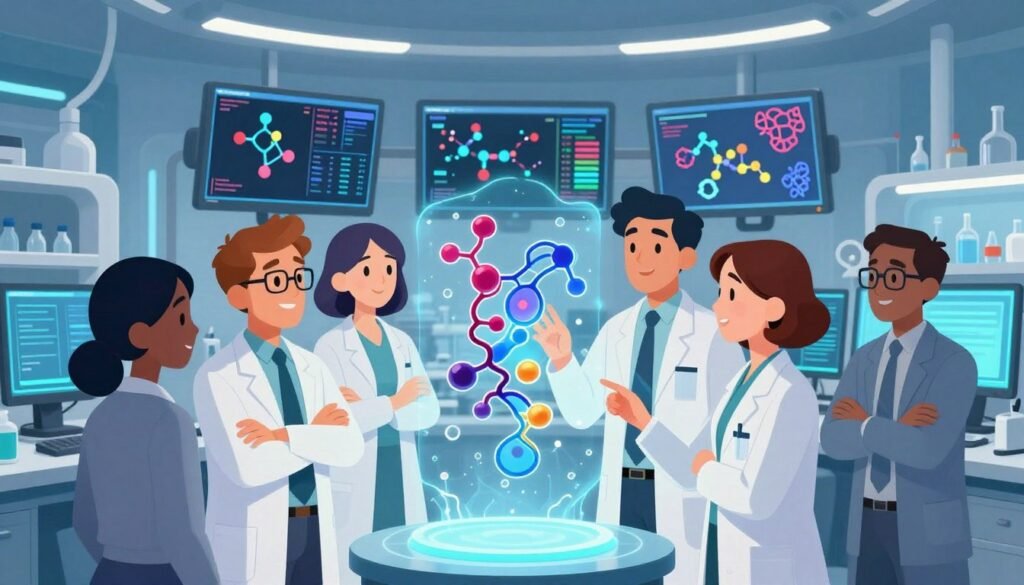
AlphaFold’s power is huge. In medicine, knowing how proteins work is key to new treatments. With AlphaFold, scientists can explore new ways to make medicines.
Thanks to AlphaFold, scientists are getting closer to treating many diseases. This technology helps us understand proteins better. It also leads to new ways to help people.
Accelerating Research with Open Access Databases
The AlphaFold Protein Database is a big deal for science. It lets everyone see important biological data! This means research is moving faster all over the world.
Now, scientists can use the AlphaFold Protein Database. It has lots of protein structures. This helps in many areas, like finding new medicines and making new life forms.
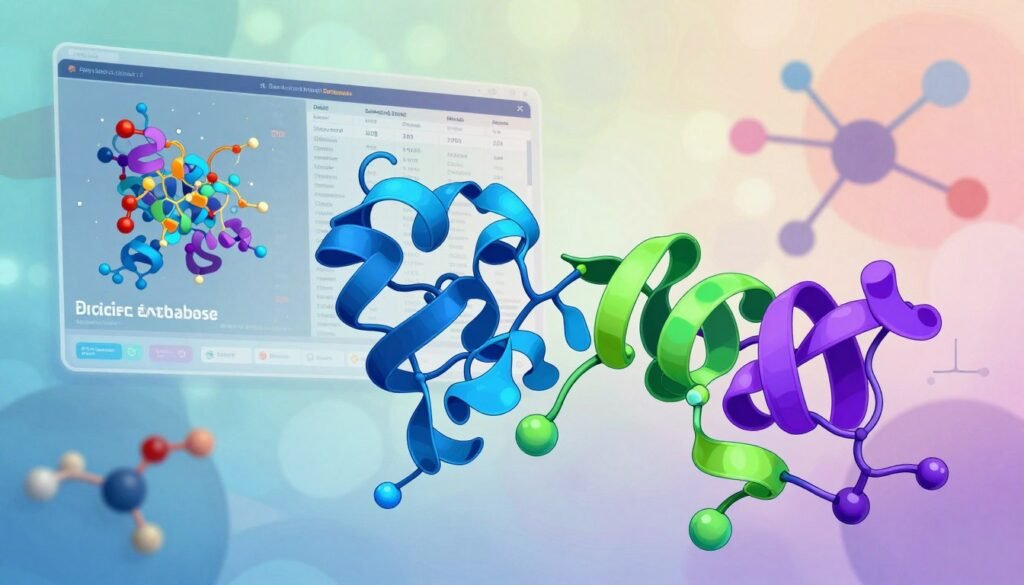
Many scientists use the AlphaFold Protein Database. A study in Nature shows it’s helping us learn more about proteins https://www.nature.com/articles/s41586-021-03819-2.
| Database Features | Description | Benefits |
|---|---|---|
| Open Access | Free access to protein structure predictions | Democratizes access to critical biological data |
| Vast Repository | Large collection of protein structures | Facilitates research and discovery |
| Global Reach | Accessible to researchers worldwide | Accelerates global research efforts |
In short, the AlphaFold Protein Database is a game-changer. It’s making research go faster and helping us understand life better! It lets scientists find new things and learn more about the world.
Educational Resources for Aspiring AI Scientists
Now, aspiring AI scientists have many educational resources to learn more! Platforms like Debsie make starting your AI journey easy.
Debsie has gamified courses that make learning AI fun. These courses use game design to keep you interested and motivated.
Enhancing Your Skills with Debsie Gamified Courses
Debsie’s courses help you get better at AI and more. They use games to make hard topics easy and fun.
Some great things about Debsie’s courses are:
- Interactive Learning: Learn in a fun and effective way.
- Personalized Experience: Get a learning plan that fits you.
- Community Engagement: Meet others who love learning too.
Why Gamified Learning Works for Complex Topics
Gamified learning is great for hard topics like AI. It makes learning fun and keeps you interested.
Let’s compare old learning ways to gamified learning:
| Learning Method | Engagement Level | Retention Rate |
|---|---|---|
| Traditional Learning | Low | 40% |
| Gamified Learning | High | 80% |
Want to improve your AI skills? Try Debsie’s gamified courses today at https://debsie.com/courses. Learn in a fun new way!

The Role of Collaboration in Scientific Breakthroughs
Collaboration is key to big scientific wins, like AlphaFold! When different scientists team up, they share new ideas and skills. This helps move science forward.
The AlphaFold story shows how collaboration leads to scientific breakthroughs. People from many fields worked together. They shared their knowledge to reach a big goal.
This teamwork helped solve tough problems. It showed what’s possible when we work together!
By working together, we can find new things faster. The AlphaFold project shows we can do more together than alone.
We need to keep encouraging collaboration in science. This helps everyone grow and find new things. It makes a better future for us all!
Ethical Considerations in AI-Driven Biology
AI is now a big part of biology research. We must think about the ethics of this.
Data privacy is a big worry. Biological data is very personal. We must keep it safe from bad people.
Potential for bias in AI is another big issue. If AI is trained on biased data, it can give wrong or unfair answers.
“AI is a powerful tool, but it also raises ethical concerns that need to be addressed,” experts say. We need AI to be clear, easy to understand, and fair in biology.
Using AI wisely in research and applications is important. This means everyone involved must use it for good.
We need a culture of responsibility and transparency in AI biology. We must watch AI, fix biases, and make sure everyone gets a fair share of benefits.
This way, we can use AI in biology to its fullest. But we must also be careful. Working together, AI experts, biologists, and ethicists will help shape the future of biology.
Future Frontiers in Protein Structure Prediction
AlphaFold has opened new paths in protein structure prediction. This is just the start of what’s to come! AI will be key in these future discoveries.
AI will get better at predicting protein structures. This means scientists will be able to guess structures more accurately. AI advancements will help solve tough biological puzzles.
AI is not just for protein structures anymore. It’s also helping in drug discovery and personalized medicine. Experts say AlphaFold has changed science a lot. Now, many scientists use its predictions in their work. (Source)
| Area | Current Status | Future Prospects |
|---|---|---|
| AI Algorithms | Significant improvements in accuracy | Further refinements for complex structures |
| Drug Discovery | Accelerated drug development | Personalized medicine approaches |
| Biological Research | Enhanced understanding of protein functions | Deeper insights into biological processes |
The future of protein structure prediction is all about AI advancements. With AI, we’ll see huge leaps in biology and new treatments.
The Legacy of the AlphaFold Team
The AlphaFold team’s work shows the power of teamwork and new ideas in science! John Jumper and Demis Hassabis led the team. Their work has helped us understand proteins better and opened new paths for research.
Their achievements are groundbreaking and have changed structural biology a lot. Their legacy includes:
- Advancements in protein structure prediction!
- Open access to their research, helping scientists work together worldwide!
- A new era in finding and making drugs!
A Google DeepMind Nobel laureate talked about AlphaFold’s bright future. They see it going beyond just structural biology. You can learn more about AlphaFold’s future in this article!
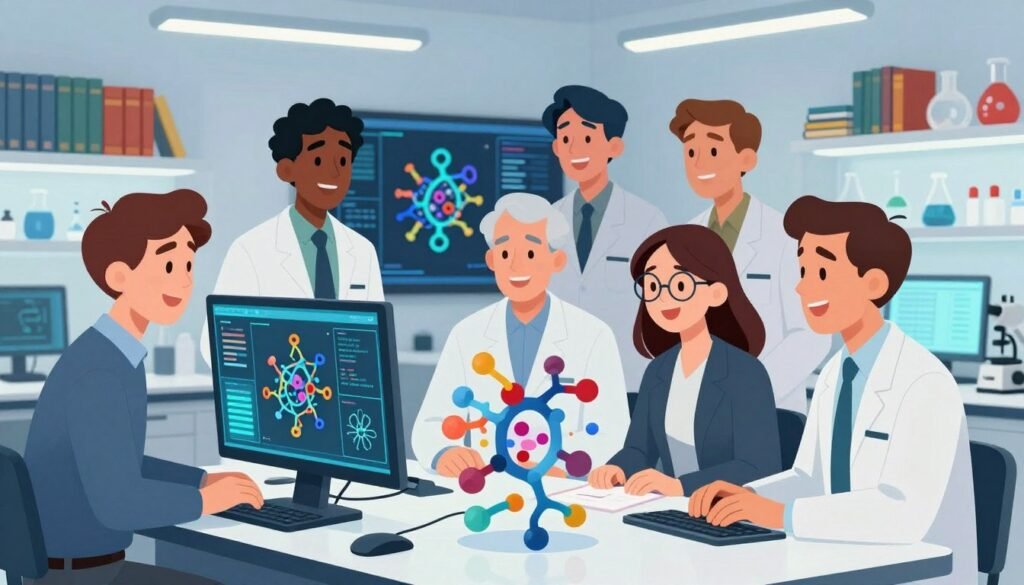
The scientific impact of the AlphaFold team will last for many years. It will inspire future scientists and researchers. Their work shows how teamwork can lead to transformative breakthroughs!
Conclusion
John Jumper’s work on AlphaFold changed how we see proteins. It solved a 50-year mystery for scientists. AlphaFold has made us understand proteins better.
It has also opened new ways to study biology and medicine. This is very exciting.
AI is going to keep helping us learn more. You can start learning about this cool world at https://debsie.com/courses.
AlphaFold is just the beginning. There are so many things we can discover. Let’s explore together with fun learning tools.