
Ever wonder why you look like your parents? It’s like solving a puzzle! A curious person started asking these questions in a quiet monastery garden.
This person was an Austrian biologist who loved nature. He spent years growing peas to see how traits pass down. His Gregor Mendel discoveries changed our understanding of the world.
We invite you to explore the wonders of science like he did! Learning is an exciting adventure for all. You can try Debsie Gamified Courses to grow your skills today!
Now, scientists call this humble friar the founder of modern genetics. His hard work shows that even a small garden can uncover life’s biggest secrets! We’re excited to explore this journey with you!
Key Takeaways
- He was an Austrian monk who studied both biology and math.
- His experiments with pea plants created the foundation for modern genetics.
- He examined seven distinct plant traits like height and seed color.
- Most scientists did not recognize his brilliance until after his death.
- His laws explain how parents pass traits to their offspring.
The Early Life and Education of a Future Scientist
In Silesia, a young Gregor Mendel grew up. He had a curiosity that would change history. Born to Anton and Rosine Mendel, he was raised in a farming community.
A Humble Beginning in Silesia
Mendel loved nature from a young age. This love would shape his work in genetics. He went to gymnasium in Troppau, where he showed great academic talent.
Academic Struggles and Financial Hardships
Mendel had big dreams but faced money problems at the University of Olomouc. He was also sick, making school hard. He thought about a new path to follow his dreams.
The Decision to Enter the Augustinian Order
Mendel joined the Augustinian Order for money. It let him keep learning. He went to Augustinian St Thomas’s Abbey in Brno to study genetics.
Mendel’s early life and education were key to his discoveries. You can read more about his work with pea plants and genetics.
| Event | Location | Significance |
|---|---|---|
| Born into a German-speaking family | Silesia | Early exposure to a multicultural environment |
| Attended gymnasium | Troppau | Developed academic skills |
| Studied at the University of Olomouc | Olomouc | Faced financial struggles and illness |
| Entered the Augustinian Order | Brno | Secured financial stability for education |
The Augustinian Monastery of St. Thomas in Brno
The Augustinian Monastery of St. Thomas in Brno was more than a spiritual place for Gregor Mendel. It was a lively spot for learning! Mendel’s life there mixed faith and science in a unique way.
Life as a Monk and Teacher
Mendel was a teacher at the monastery. He taught physics and learned a lot. Teaching physics made him love science even more!
Being a monk and teacher helped Mendel grow. The monastery supported his love for learning.
The Intellectual Environment of the Monastery
The monastery was known for its love of learning. It was a place where monks could explore and learn. It was a great place for discovery!
Mendel wasn’t alone in his quest for knowledge. Many others in the monastery loved science too.
Mendel’s Pursuit of Scientific Knowledge
Mendel started his plant experiments in the monastery. He first worked with mice, then moved to pea plants. These plants were key to his important research.
| Activity | Contribution to Mendel’s Work |
|---|---|
| Teaching Physics | Deepened understanding of natural sciences |
| Experimenting with Plants | Led to the discovery of fundamental laws of inheritance |
| Intellectual Environment | Fostered a community of like-minded individuals |

The monastery’s support was key to Mendel’s growth. His work on pea plants started there. It led to big discoveries about inheritance.
The Scientific Curiosity Behind Gregor Mendel Discoveries
Gregor Mendel’s work with plants was key to his big discoveries. He wanted to know how traits pass down through generations. His experiments changed biology forever.
Early Experiments with Mice and Plants
Mendel first worked with mice. But then he chose plants because they were easier to study. This choice was very important for genetics.
The Choice of Pisum sativum as a Model Organism
Mendel picked Pisum sativum, or pea plants, for his study. Pea plants were perfect for his research. They show clear traits and are easy to fertilize.
Why Pea Plants Were the Perfect Subject
So, why did Mendel pick pea plants? They were great for his research because of several reasons:
| Characteristic | Advantage |
|---|---|
| Easily Observable Traits | Allowed Mendel to track specific characteristics across generations. |
| Controlled Fertilization | Enabled Mendel to cross-pollinate plants with precision, ensuring the desired traits were studied. |
| Short Generation Time | Permitted Mendel to study multiple generations within a relatively short period. |
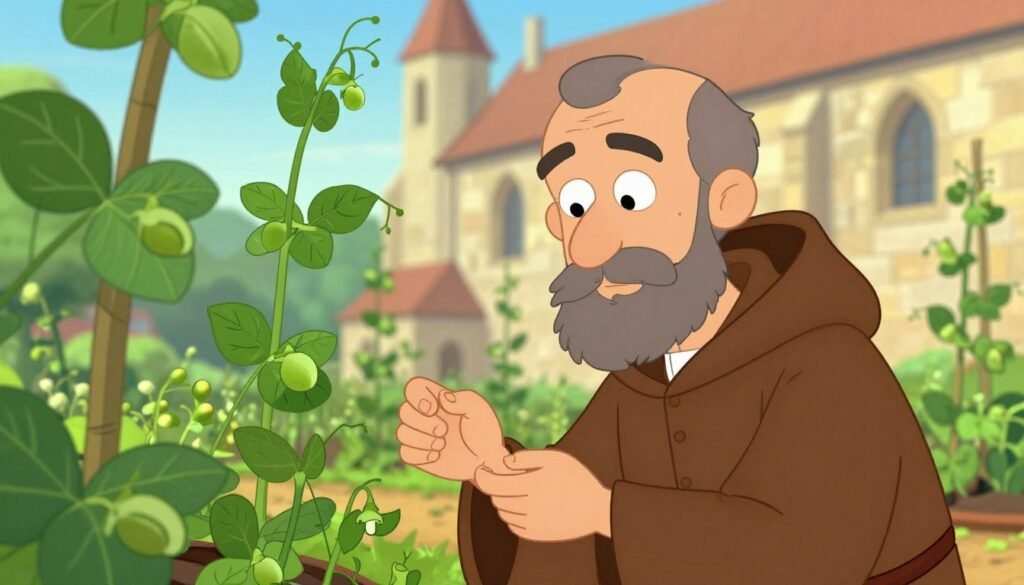
Pea plants were ideal for Mendel’s work. His careful study of them helped us understand genes.
Mendel’s choice of pea plants was smart. He studied them well and found important laws of inheritance. His work helped start genetics research.
The Seven Traits That Changed Biology Forever
Gregor Mendel’s work on pea plants changed biology forever. He found seven key traits that helped us understand genetics. Let’s explore Mendel’s discoveries and how they still shape science today.
Analyzing Seed Shape and Color
Mendel looked at pea seeds’ shape and color. He found seeds could be round or wrinkled, and yellow or green. This simple observation led to a deeper understanding of how traits are inherited.
He noticed a pattern when crossing pea plants. The first generation (F1) had round seeds. But the second generation (F2) had a mix of round and wrinkled seeds in a specific ratio. This helped Mendel create his laws of inheritance.
| Trait | Dominant | Recessive |
|---|---|---|
| Seed Shape | Round | Wrinkled |
| Seed Color | Yellow | Green |
Flower Position and Stem Length Variations
Mendel also studied flower position and stem length. He found flowers could be axial or terminal, and stems could be long or short. These variations provided further evidence for Mendel’s theories on genetic inheritance.
By cross-pollinating plants, Mendel saw how traits were passed down. His findings showed each trait is determined by separate genes.
“The experiments on plant hybridization, on which I have been working for several years, have led me to the results which I have described. These results have enabled me to draw conclusions regarding the essential nature of hybridization.”
The Rigorous Methodology of Cross-Pollination
Mendel’s success came from his careful method. He manually cross-pollinated pea plants. This careful approach allowed him to isolate specific characteristics and study their inheritance patterns.
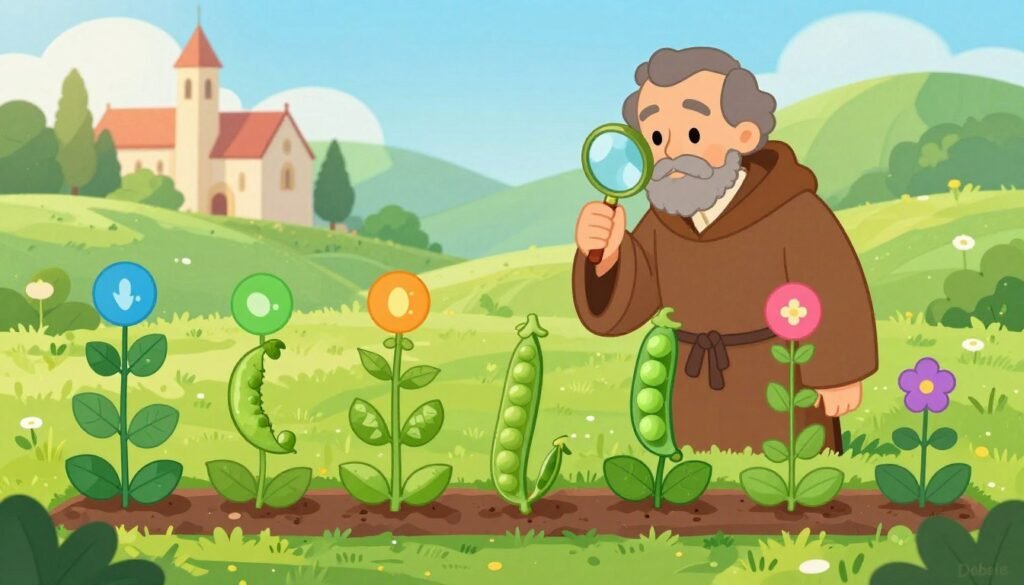
By analyzing his data, Mendel found the seven key traits. His work advanced genetics and inspired future scientists. It helped us understand heredity better.
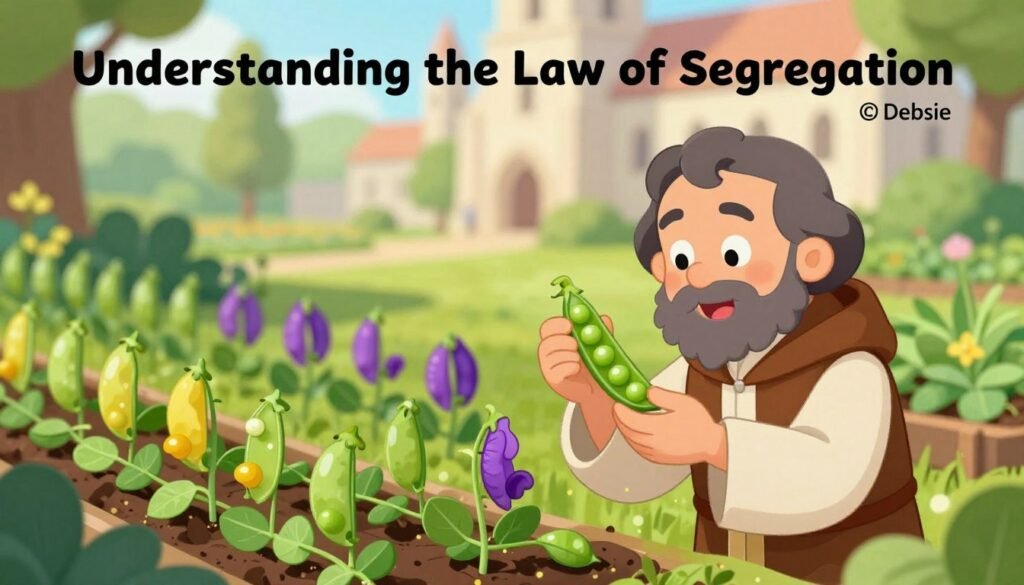
Understanding the Law of Segregation
Let’s explore the Law of Segregation in Mendelian genetics. It shows how genes are passed down. Gregor Mendel found this key rule. It says each pair of alleles goes their own way during gamete formation. This means each child gets one allele from each parent.
Dominant and Recessive Alleles
Mendel worked with pea plants and found genes have different versions, or alleles. Some alleles are dominant and some are recessive. A dominant allele shows up if you have one or two copies. A recessive allele shows up only with two copies.
For example, in flower color, purple might be dominant and white recessive.
The F1 and F2 Generations Explained
Mendel crossed pea plants with different traits. He saw traits in the first (F1) and second (F2) generations. The F1 showed the dominant trait because they had one of each allele.
When F1 plants self-pollinated to make F2, traits segregated. Both dominant and recessive traits showed up in a set ratio.
Mathematical Ratios in Biological Inheritance
Mendel’s Law of Segregation is backed by math in the F2 generation. For one trait, the ratio is 3:1. This means three show the dominant trait and one shows the recessive.
This is because of the genotypes (PP, Pp, pp) and phenotypes (the traits). PP and Pp both show the dominant trait, making the ratio 3:1.
| Genotype | Phenotype | Ratio |
|---|---|---|
| PP | Dominant Trait | 1 |
| Pp | Dominant Trait | 2 |
| pp | Recessive Trait | 1 |
To learn more about Mendel’s laws and their importance, read our detailed article on the laws of Mendel.
The Law of Independent Assortment
Gregor Mendel changed how we see genes. He showed that traits are passed down separately. This was a big discovery.
Dihybrid Crosses and Their Implications
Mendel mixed pea plants with different traits. He looked at how these traits were passed down. He found that traits were passed down separately.
For example, he mixed pea plants with round, yellow seeds with those with wrinkled, green seeds. He found all kinds of seeds in the next generation. This showed that genes for seed shape and color were passed down separately.
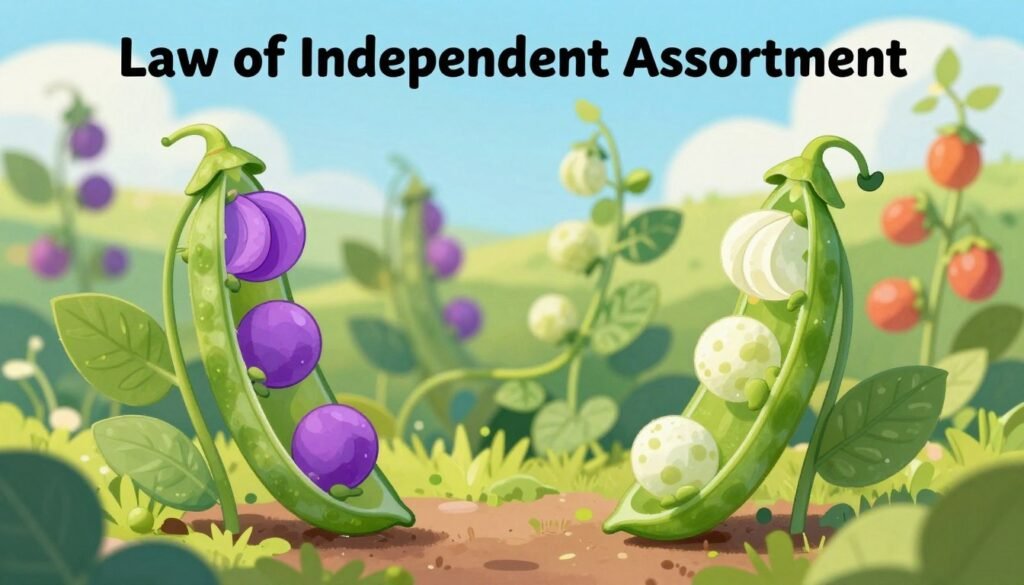
How Traits Inherit Independently
The Law of Independent Assortment says genes for different traits are passed down separately. This means one trait doesn’t affect another. Learn more at LibreTexts.
This idea helps us understand how traits are passed down. It’s important for breeding and research.
The Statistical Significance of Mendel’s Data
Mendel’s data showed a clear pattern. He found a 9:3:3:1 ratio in his experiments. This pattern shows that traits are passed down separately.
| Trait Combination | Expected Ratio | Observed Frequency |
|---|---|---|
| Round, Yellow | 9/16 | 315/556 |
| Round, Green | 3/16 | 108/556 |
| Wrinkled, Yellow | 3/16 | 101/556 |
| Wrinkled, Green | 1/16 | 32/556 |
Mendel’s data matched the expected ratios closely. This proves the Law of Independent Assortment.
The Unrecognized Genius of the 19th Century
Gregor Mendel made big discoveries. He shared them with the Natural Science Society in Brno. But, they didn’t listen!
He worked hard and found something very important. But, the scientists of that time didn’t see its value.
Presenting Findings to the Natural Science Society
In 1865, Mendel talked about pea plants to the Natural Science Society. He studied them for years. He looked at things like seed shape and flower color.

The Lack of Interest from the Scientific Community
Scientists didn’t care about Mendel’s work. They didn’t understand genes and inheritance yet. His way of thinking was too new for them.
Why His Work Remained Obscure for Decades
Many things made Mendel’s work hard to find. The papers from the Natural Science Society didn’t get around much. Also, scientists were not ready for the idea of genes.
It wasn’t until the rediscovery in the early 20th century that Mendel’s work was recognized. Now, we call him the Father of Genetics. His story shows how important it is to keep trying, even when no one listens.
The Administrative Duties That Halted Research
In 1868, a big year for Mendel, he became the abbot of the monastery. This changed his duties and focus a lot.
Rising to the Position of Abbot
As Mendel became the abbot, he had more work to do. He had to handle the monastery’s money and speak for it in public and government. This was a big change from his life as a scientist and teacher. You can learn more about Gregor Mendel’s life and work.
The Burden of Monastery Management
Running the monastery was hard work. Mendel had to watch over the money and deal with government taxes. He wrote about how heavy this was.
The Shift from Science to Politics and Taxation
Mendel had to stop his science work for politics and taxes.
“The prelate, as he was now, was engrossed in the controversies with the government regarding the taxation of the monastery.”
This change stopped his research and changed his life a lot.
| Role | Responsibilities |
|---|---|
| Scientist/Teacher | Conducting experiments, teaching students |
| Abbot | Managing monastery affairs, financial management, representing the monastery |

The Rediscovery of Mendelian Laws in 1900
The year 1900 was a big deal for genetics. It was when Gregor Mendel’s work was rediscovered! This was thanks to three botanists: Hugo de Vries, Carl Correns, and Erich von Tschermak.
Hugo de Vries and the Botanical Breakthrough
Hugo de Vries was a Dutch botanist. He is known for finding Mendel’s laws again. His plant experiments showed the same ideas as Mendel’s. His work was very important and helped make Mendel famous!
Carl Correns and Erich von Tschermak’s Contributions
Carl Correns from Germany and Erich von Tschermak from Austria also found Mendel’s laws. They worked at the same time as de Vries. Their research made Mendel’s ideas even clearer. Their work was key in making Mendel’s laws important in genetics!
The Official Recognition of Mendel’s Priority
When de Vries, Correns, and von Tschermak found Mendel’s laws, Mendel got the credit he deserved. The science world started to see how important Mendel’s work was. You can read more about this at this link.
The rediscovery of Mendel’s laws started a new time in genetics. It brought Mendel’s ideas into many areas of biology. It shows how important it is to remember the work of pioneers like Gregor Mendel!
The Integration of Genetics into Modern Science
Gregor Mendel’s work started it all. His research is the base of what we know about genetics today. It has changed many fields, like how life evolves and how genes are passed down.
The Chromosomal Theory of Inheritance
The chromosomal theory came later. It built on Mendel’s work. This theory said chromosomes carry our genes. It gave us a new way to see how genes are passed down.
Mendel’s Influence on Evolutionary Biology
Mendel’s work changed how we see evolution. It showed how genes change over time. His work linked genetics and evolution, helping us understand the world better.
Bridging the Gap Between Darwin and Genetics
Mendel’s work connected Darwin’s evolution theory with genetics. This mix gave us a full view of evolution. It helped us see how life changes and how different species are.
Let’s see how Mendel’s laws and the chromosomal theory are connected:
| Concept | Description | Impact |
|---|---|---|
| Mendel’s Laws | Fundamental principles of genetic inheritance | Established the basis for modern genetics |
| Chromosomal Theory | Physical basis for genetic inheritance | Explained how genetic material is passed down through chromosomes |
| Integration with Evolutionary Biology | Understanding genetic variations and evolution | Advanced our comprehension of evolutionary processes |
Gamified Learning and the Future of Scientific Education
Gamified learning is changing how we learn about things like Gregor Mendel’s laws! It makes learning fun and interactive. This helps students remember and understand better.
Applying Modern Pedagogical Techniques to Genetics
Old ways of teaching don’t always grab students’ attention, like with genetics. But, using new teaching methods like gamification can make learning fun and effective. For example, interactive simulations and virtual labs let students play with genetic ideas safely.
Enhancing Retention Through Interactive Platforms
Interactive platforms make learning fun and keep students interested. They use game-like features like rewards and challenges. This encourages students to dive deeper into genetic topics.
Let’s compare old teaching methods with gamified learning:
| Teaching Method | Student Engagement | Retention Rate |
|---|---|---|
| Traditional Teaching | Low-Moderate | 40-60% |
| Gamified Learning | High | 80-90% |
Exploring Debsie Gamified Courses for Science Enthusiasts
Debsie has fun, interactive science courses for everyone. They mix games, quizzes, and simulations. This makes learning about genetics and more fun.

Debsie’s courses let you explore genetics and more. So, why not start learning today? Discover the fun of science!
Common Misconceptions About Mendelian Genetics
Mendel’s work in genetics is still not fully understood today! His laws help us understand how traits are passed down. But, there are many complexities and exceptions that are often missed.
Let’s look at some common misconceptions and the details of Mendelian genetics. You might find out there’s more to learn than you thought!
The Complexity of Polygenic Inheritance
One area where Mendel’s laws are often too simple is polygenic inheritance. This happens when many genes work together to create a trait. It’s more complex than Mendel’s simple models.
For example, human height is influenced by many genes. This makes predicting height based on genes very complicated. It’s not as simple as Mendel’s traits.
- Multiple genes are involved in polygenic inheritance.
- The effect of each gene can be small, but together they have a big impact.
- Polygenic traits often result in a continuous range of phenotypic variation.
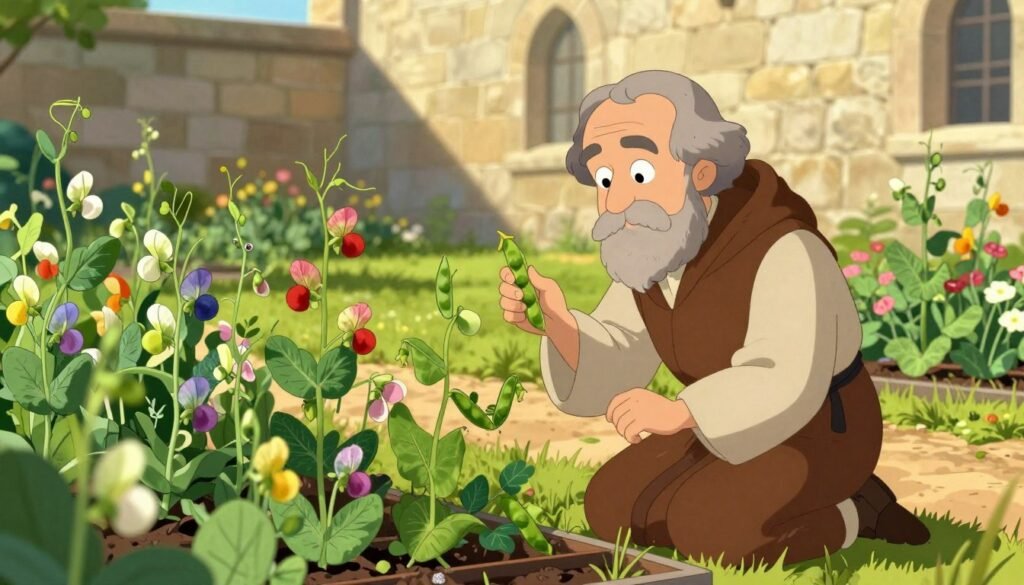
Exceptions to the Rules of Dominance
Mendel’s laws assume a simple dominant-recessive relationship. But, there are exceptions like incomplete dominance and codominance.
In incomplete dominance, the two alleles don’t dominate or recessive. This results in a blended phenotype. For example, a red flower crossed with a white flower might produce pink offspring.
Codominance happens when both alleles have the same effect. This results in both being fully expressed. A classic example is the AB blood type in humans, where both A and B alleles are expressed equally.
Why Mendel’s Simple Models Still Matter
Even with these complexities, Mendel’s simple models are still key to understanding genetics. They lay the groundwork for exploring more complex genetic interactions. They are still used today in genetic counseling and plant breeding.
By knowing the basics of Mendelian genetics, you can better understand the complexities of modern genetics. This knowledge is important for many fields.
- Mendel’s laws provide a foundation for understanding genetic inheritance.
- Complexities like polygenic inheritance and exceptions to dominance are built upon this foundation.
- Understanding these basics is crucial for advancing in genetics and related fields.
The Lasting Legacy of the Father of Genetics
Gregor Mendel’s work still affects many areas of science and more! His discoveries on inheritance have helped us make big steps in different fields.
Impact on Modern Medicine and Agriculture
Mendel’s work changed medicine and farming a lot. In medicine, knowing about genes helps us test for diseases early. This means we can treat them sooner.
In farming, Mendel’s ideas helped make crops better. They grow more, resist diseases, and are healthier. This helps feed more people.
| Field | Application of Mendel’s Laws | Benefits |
|---|---|---|
| Medicine | Genetic counseling and testing | Early diagnosis and management of genetic disorders |
| Agriculture | Development of new crop varieties | Increased yield, disease resistance, and nutritional value |
Ethical Considerations of Genetic Research
Genetic research brings up big questions. We worry about privacy, fairness, and changing genes. We must think carefully about these issues.
“The laws of genetics are fundamental to understanding the natural world and our place within it. As we continue to uncover the secrets of genetic inheritance, we must do so with a deep respect for the ethical implications of our discoveries.”
Honoring the Monk Who Unlocked the Code of Life
Gregor Mendel’s work shows us the power of being curious and hardworking. We honor him by learning more and making the world better.

Let’s keep learning from Mendel’s work. We must keep inspiring new scientists and researchers!
Conclusion
As we end our look at Gregor Mendel, it’s clear his work changed our view of the world. His discoveries in genetics are still important today.
Gregor Mendel was very curious and dedicated to science. He made big discoveries that help us in medicine, farming, and studying how life changes. His ideas about how traits are passed down are key in genetics.
You can keep exploring genetics and see how Mendel’s work is used today. There are fun ways to learn, like games and interactive sites. You can learn more about science and life’s secrets.
Let’s keep learning and growing with Debsie. We can discover more about genetics and other amazing things!
## FAQ
### Q: Why is Gregor Mendel known as the Father of Genetics?
A: He’s known for his work with pea plants. This work is the base of what we know about genes! He was a monk, but his curiosity changed the world.
### Q: Where did Gregor Mendel grow up and go to school?
A: He was born in Heinzendorf bei Odrau, Silesia. His family was farmers. He went to the Augustinian St Thomas’s Abbey in Brno to learn more.
### Q: What was life like for Mendel at the St. Thomas’s Abbey?
A: It was a place of big ideas. As a monk, he taught physics and loved science. He was in a community that supported his dreams.
### Q: Why did he choose the pea plant (Pisum sativum) for his experiments?
A: Pea plants were easy to study. Their traits were clear. This made them perfect for his research.
### Q: What were the seven traits Mendel studied?
A: He looked at traits like seed shape and flower position. By cross-pollinating, he figured out how traits are passed down.
### Q: What is the Law of Segregation?
A: This law says genes come in pairs. They separate when making offspring. This helps us understand how traits are inherited.
### Q: Can you explain the Law of Independent Assortment?
A: Sure! This law says different traits are passed down separately. For example, pea color doesn’t affect plant height.
### Q: Why were Gregor Mendel discoveries ignored for so long?
A: His work was too advanced for the time. When he shared it, the science world wasn’t ready. His genius was hidden for years.
### Q: What happened to Mendel’s research when he became an Abbot?
A: His duties changed when he became Abbot. He had to manage and deal with government issues. His research took a backseat.
### Q: Who first rediscovered Mendel’s work in 1900?
A: Hugo de Vries, Carl Correns, and Erich von Tschermak found his work. They gave Mendel the credit he deserved.
### Q: How did Mendel’s work help bridge the gap with Charles Darwin’s theories?
A: Mendel explained how traits are passed down. Darwin talked about evolution. Together, they help us understand life’s history.
### Q: How can children learn about genetics today?
A: Learning should be fun! Debsie offers courses that make genetics exciting. Check us out at https://debsie.com/courses!
### Q: Are there any exceptions to Mendel’s laws?
A: Yes! Genetics can be complex. But Mendel’s laws are still key for scientists.
### Q: What is the lasting legacy of Gregor Mendel today?
A: His work impacts medicine and agriculture. He helped us understand life’s code. This knowledge helps us grow better food and treat diseases.