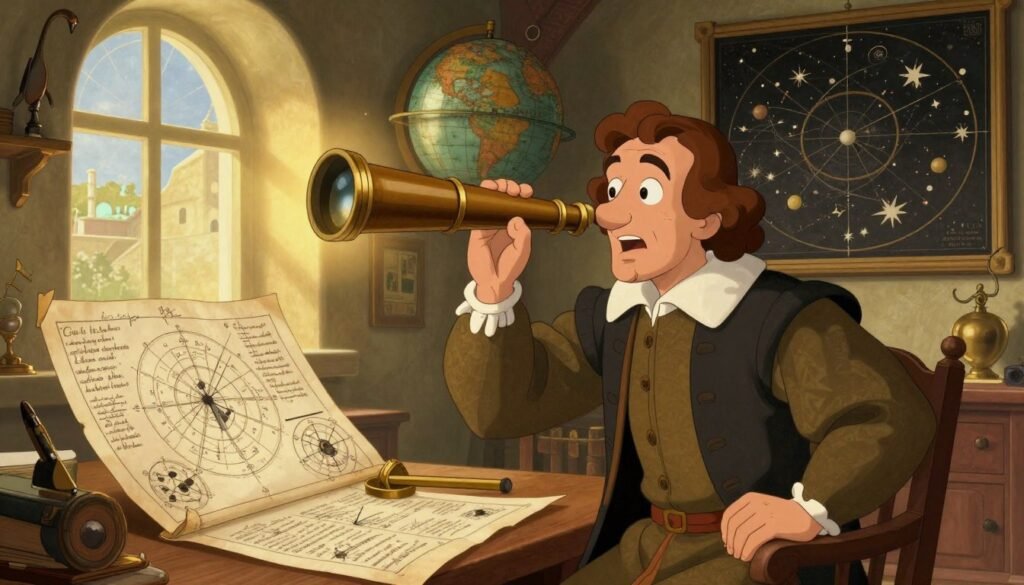
Imagine looking up at the sparkling night sky and feeling wonder. Have you ever wondered what it’s like to see stars through a lens for the first time? That’s how the world felt when a brilliant mind started in Pisa, Italy, in 1564.
We’re excited to share the life of this amazing astronomer and physicist with you! Born on February 15, he became a true pioneer who asked big questions. His Galileo discoveries showed us the moon has rocky mountains and Jupiter has its own moons!
Reading a Galileo biography shows how he used his telescope to challenge old beliefs. He proved our Earth moves around the sun, making him a science hero. Discovery is an adventure for curious minds like yours!
You can start your own adventure today with our team! Try Debsie Gamified Courses at https://debsie.com/courses to learn about space in a fun way. Let’s grow together as we explore our amazing universe’s secrets!
Key Takeaways
- Galileo was born in Pisa, Italy, on February 15, 1564.
- He significantly improved the telescope to study the stars and planets.
- His observations proved that the Moon has craters and a rough surface.
- He discovered the four largest moons orbiting the planet Jupiter.
- Galileo supported the idea that the Earth revolves around the Sun.
- His work laid the foundation for modern physics and astronomy today.
The Early Life and Education of a Genius
Galileo Galilei was born in Pisa in 1564. He was meant for greatness, with a curiosity and love for discovery! His father, Vincenzo Galilei, was a famous musician and composer. His mother, Giulia Ammannati, was a loving parent.
Galileo grew up in a family that loved music and learning. He heard the sounds of the lute and talked about music with his dad.
A Childhood in Pisa
Galileo’s early years were filled with music, curiosity, and learning. When he was ten, his family moved to Florence. But Pisa was where his love for learning started.
Being the son of a musician, Galileo learned a lot about music theory. This helped him understand math and physics later on.

Academic Pursuits and Early Interests
Galileo started his studies at the University of Pisa. He first studied medicine. But soon, he fell in love with mathematics and physics.
He wanted to know the secrets of the universe. For more about Galileo, check out the Stanford Encyclopedia entry on Galileo.
Some important parts of his early studies were:
- Reading ancient Greek philosophers and mathematicians
- Exploring the study of motion and inertia
- Learning about new scientific methods
Switching from medicine to math was a big step for Galileo. It made him the father of modern science. His early interests and studies helped him make big discoveries in astronomy and physics.
A Comprehensive Galileo Biography
Let’s explore the life of Galileo Galilei. His story is one of passion and discovery. It changed history! He helped start the scientific revolution of the Renaissance.
Galileo was always curious and loved to learn. He was born in Pisa, Italy. His journey in learning started early. Let’s look at his important life moments.
Tracing the Path of the Father of Modern Science
Galileo started as a scientist by studying motion. He changed old ideas with new ones. His work helped Sir Isaac Newton later.
His big contributions include:
- Challenging Aristotelian Physics: Galileo questioned old beliefs. He started modern science.
- Introduction to Telescopic Astronomy: He made the telescope better. This let us see the sky more clearly.
- Observations and Discoveries: He found moons around Jupiter and saw Venus’ phases. This proved the sun is at the center.
Key Milestones in His Personal and Professional Life
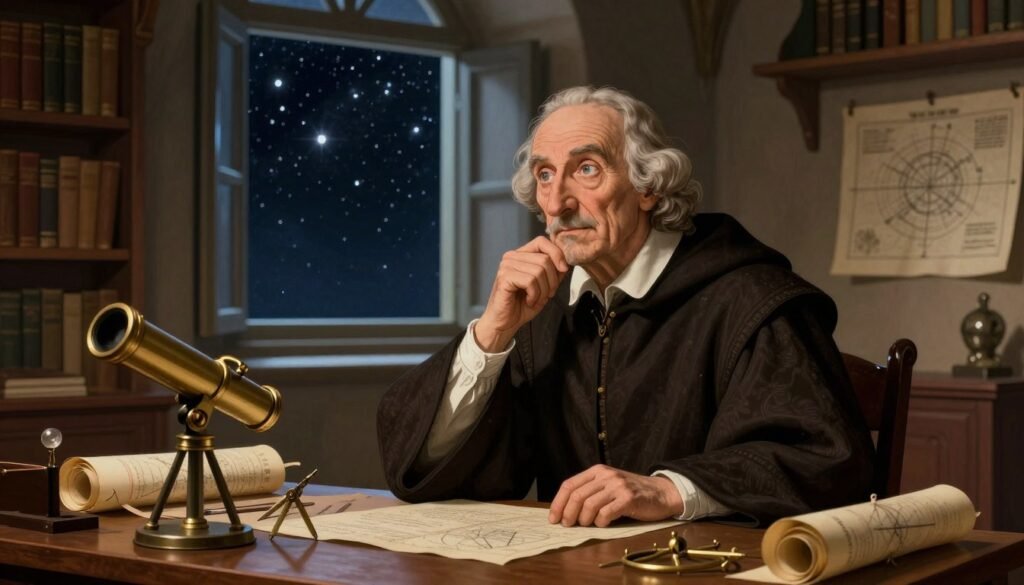
Galileo’s life had many important moments. These shaped his career and beliefs. Some key ones are:
- Early Academic Career: He started teaching math at the University of Pisa.
- Move to Padua: He went to the University of Padua. There, he could teach more freely and made big astronomy discoveries.
- Conflict with the Church: His support for the sun-centered universe caused trouble with the Church. This led to his trial and house arrest.
Galileo always wanted to know more about the world. His work still inspires scientists and astronomers today.
The Invention and Improvement of the Telescope
Galileo was excited when he heard about the ‘spyglass.’ He saw it as a chance to make something new. This device, called the telescope, could make far things seem closer.
Galileo wanted to make it better. He used his creativity to improve the Dutch design.
Refining Dutch Designs for Celestial Observation
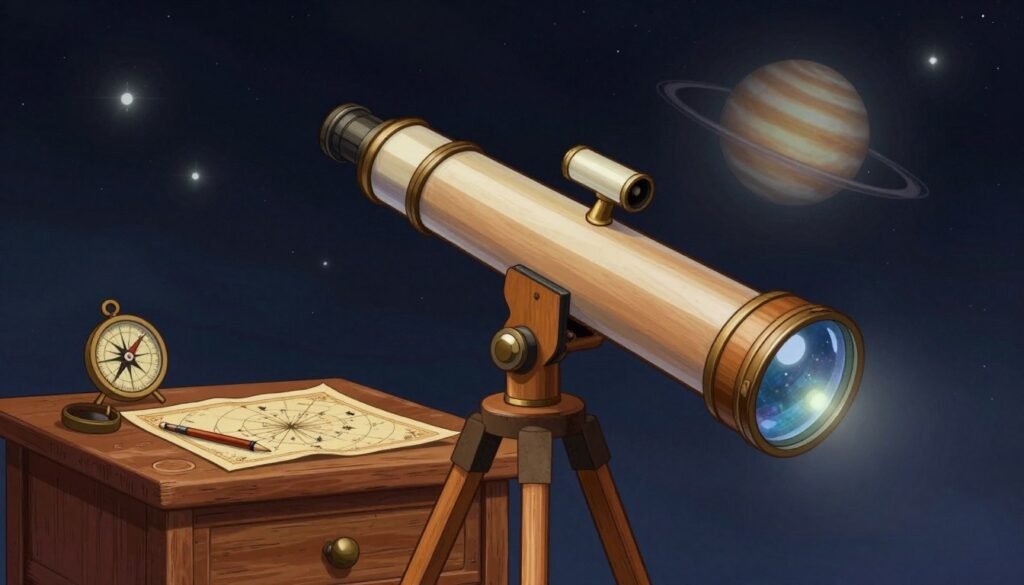
Galileo worked hard to make the telescope better. He wanted to see the night sky more clearly. He changed the lens and design to make things up to 30 times larger than before.
This made seeing stars and planets much clearer. It was a big step up from the Dutch designs.
The Impact of Optical Advancements on Astronomy
Galileo’s telescope changes were huge for astronomy. With his new telescope, he found many pioneering discoveries. These discoveries changed what people thought about the universe.
To learn more about Galileo Galilei’s life and work, click here. It shows how he changed science forever.
Discovering the Moons of Jupiter
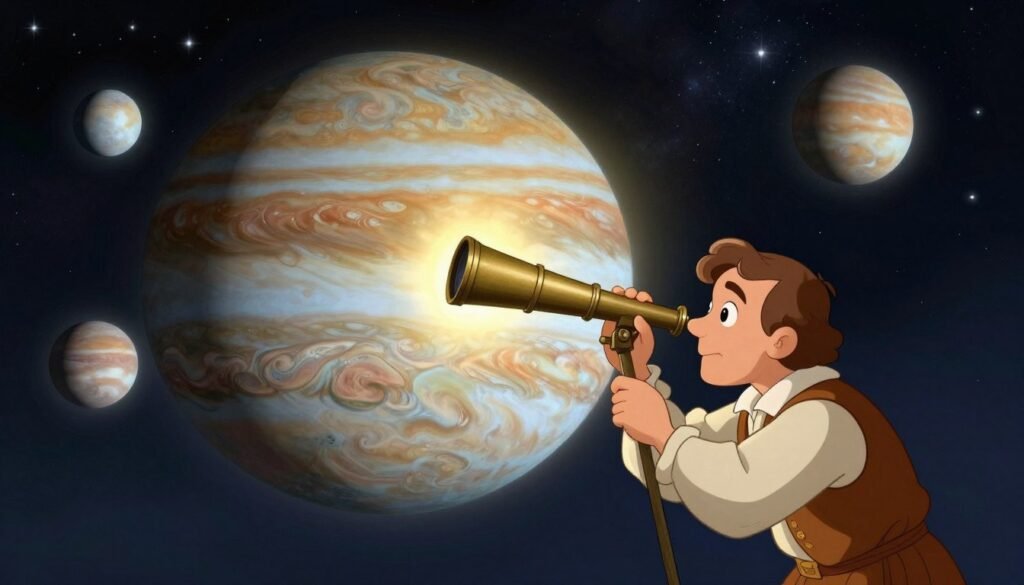
On a night in January 1610, Galileo Galilei made a big discovery. He used his telescope to see three ‘stars’ near Jupiter. But soon, he found out they were moons orbiting Jupiter.
The Medicean Stars and Their Significance
Galileo called these moons the Medicean Stars, honoring the Medici family. This was a big moment. It showed that other planets could have moons, not just Earth.
This discovery was a game-changer for our understanding of the solar system. It helped prove that the Sun, not Earth, is at the center.
Challenging the Geocentric Model of the Universe
By seeing Jupiter’s moons, Galileo showed that the geocentric model was wrong. This model said Earth was at the center. His discovery helped us move towards the heliocentric model.
Galileo’s discovery changed how we see the universe. It opened doors for more discoveries. He showed us the power of evidence in science.
Observing the Phases of Venus
Galileo made a big find by watching Venus’s phases. He used a telescope to see Venus change like the Moon. He saw it go from new to full and back again.
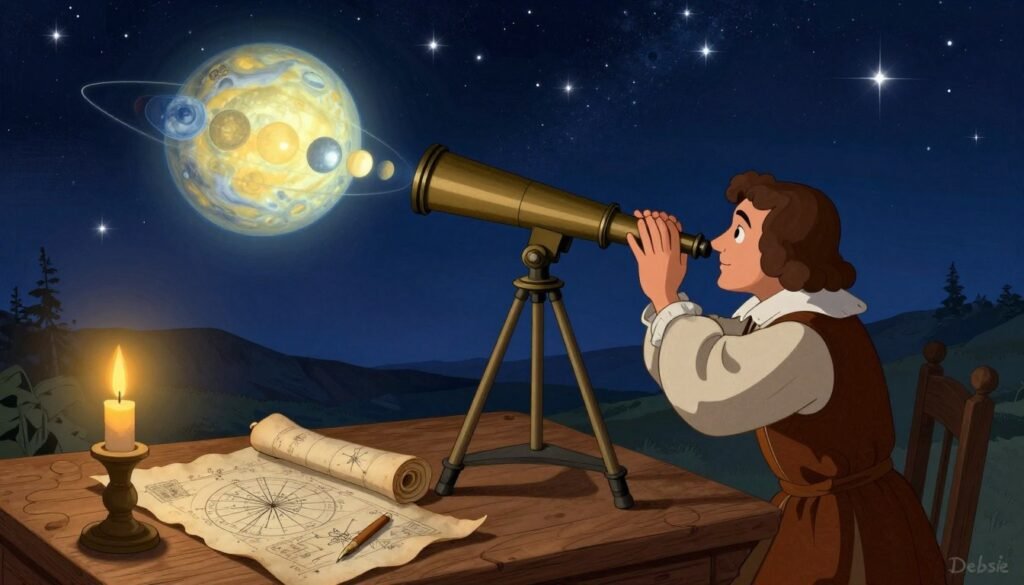
This was a game-changer. It showed Venus orbits the Sun, like the Moon orbits Earth. This supported the idea that the Sun is at the center of our solar system.
Evidence for the Heliocentric Theory
Seeing Venus’s phases was key in the debate about our solar system. Galileo said, “We have, in the phenomenon of Venus, a clear and certain proof that it revolves around the Sun.”
“We have, in the phenomenon of Venus, a clear and certain proof that it revolves around the Sun.”
Venus’s phases show it orbits the Sun, like Earth and other planets. This was a big challenge to the old idea that Earth is at the center of the universe.
| Phase | Description | Implication |
|---|---|---|
| New | Venus is between Earth and Sun | Supports heliocentric model |
| Full | Venus is on the opposite side of the Sun from Earth | Contradicts geocentric model |
| Crescent/Gibbous | Venus appears to be partially illuminated | Consistent with orbiting the Sun |
How Observations Shifted Scientific Paradigms
Galileo’s find of Venus’s phases was a big change in astronomy. It proved the heliocentric theory and challenged the old view.
This change was not just about science. It changed how people saw their place in the universe. Galileo’s work, including Venus, made him the father of modern science.
Galileo’s work challenged old beliefs and showed us new things. He helped us understand our universe better.
The Study of Sunspots and Lunar Topography
Galileo looked at the Sun and Moon and found new things! He saw sunspots and the Moon’s surface. These discoveries changed what people thought about the universe.
Galileo showed that the Sun, Moon, and other stars are not perfect. For a long time, everyone thought they were flawless. But Galileo’s work proved that’s not true.
Debunking the Perfection of Celestial Bodies
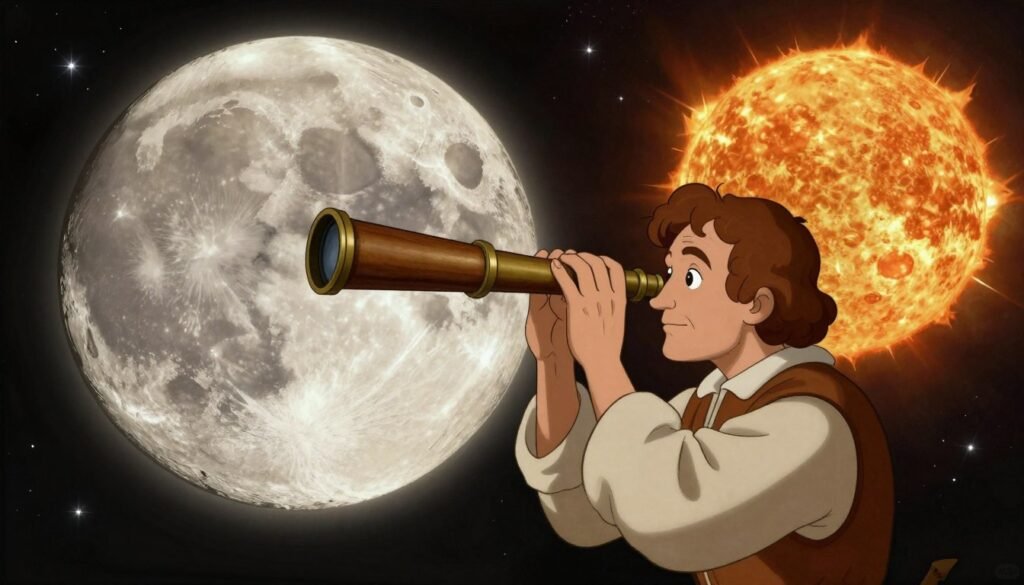
Galileo saw sunspots on the Sun. These dark spots showed the Sun was not always the same. It changed over time.
Mapping the Surface of the Moon
Galileo also looked at the Moon closely. He found mountains and craters on it. This was a big discovery.
By studying the Moon, Galileo showed it was not just a simple sphere. It was a rocky, dynamic place. This helped change how people saw the universe.
Galileo’s work was a big step forward in astronomy. He challenged old ideas and brought new evidence. This helped start modern astronomy.
Advancing the Laws of Motion and Mechanics
Galileo, known as the father of modern science, made a big impact. He worked hard on the laws of motion. His work helped us understand physics today.
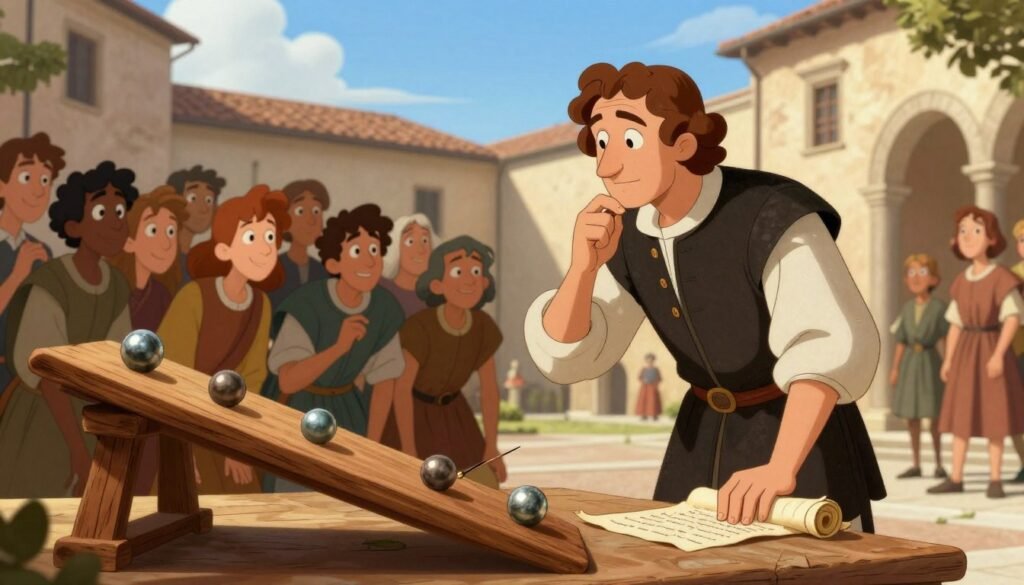
Galileo did cool experiments with falling bodies. He rolled balls down planes to see how they moved. He found that all objects fall the same, no matter their size. This was a big change from what Aristotle thought.
Experiments with Falling Bodies
Galileo used balls on planes to slow them down. He saw that how far they went was related to time. This showed that things fall at a steady speed.
The Foundation of Classical Physics
Galileo’s work on motion and mechanics helped start classical physics. He showed that Earth and sky follow the same rules. This was a big step towards seeing the universe as one.
Galileo’s discovery helped Sir Isaac Newton later. Newton used Galileo’s ideas to make his laws of motion. Together, they helped us understand the world better.
The Conflict with the Roman Catholic Church
Galileo loved the Copernican model. This made him clash with the Roman Catholic Church. The Church believed in a geocentric view. Galileo had evidence and observations to back his heliocentric model.
The Inquisition and the Defense of Copernicanism
The Church was upset by Galileo’s defense of Copernicanism. In 1616, they warned him to stop supporting the Copernican theory. But Galileo kept sharing his findings. This led to a big fight with the Church. You can learn more about this in Galileo’s conflict with the Catholic Church.
Galileo’s work, like studying Venus and Jupiter’s moons, proved the Copernican model. The Church saw this as a threat to its power and old views of the universe.
The Trial and House Arrest of Galileo
In 1633, Galileo went to Rome for the Inquisition. The Church wanted to stop his ideas. Galileo was found guilty and put under house arrest for life.
Even under house arrest, Galileo kept working. He made big contributions to physics and astronomy. His story shows the bravery needed to challenge old beliefs.
| Event | Year | Description |
|---|---|---|
| Warning from the Church | 1616 | The Church advises Galileo to abandon his support for Copernican theory. |
| Trial by the Inquisition | 1633 | Galileo is tried for heresy due to his support for the heliocentric model. |
| House Arrest | 1633 | Galileo is placed under house arrest for the remainder of his life. |
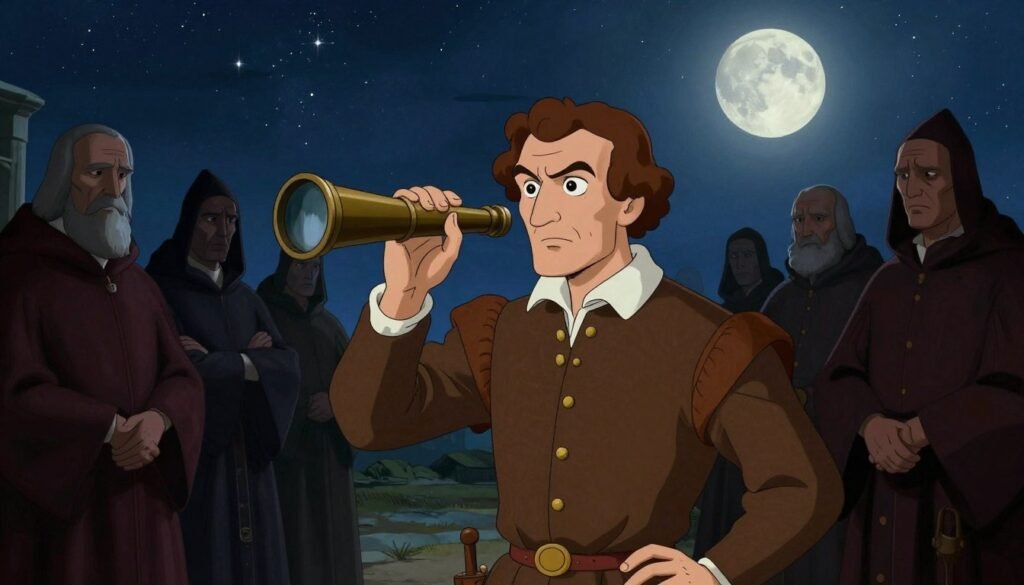
Mastering the Scientific Method
Galileo made a big change in science by focusing on watching and trying things. He is known as the father of modern science. His work changed how we do science today.
Galileo wanted to use empirical evidence more. He said we should base our ideas on what we see and measure. Not just on old beliefs or religion.
Empirical Evidence Over Philosophical Dogma
Galileo changed science by making experimentation and observation more important. He said we should test our ideas with experiments. Not just follow what others say.
- Observation: Carefully watching and recording phenomena
- Experimentation: Testing hypotheses through controlled experiments
- Evidence-based conclusions: Drawing conclusions based on empirical data
Galileo showed us that science can be more accurate. By using evidence, scientists can make real theories.
The Legacy of Rigorous Experimentation
Galileo’s work has inspired many scientists. His focus on rigorous experimentation has led to many discoveries.
“Measure what can be measured, and make measurable what cannot be measured.”
This quote shows Galileo’s spirit. He pushed science to new heights. His work has led to many scientific and technological advances.
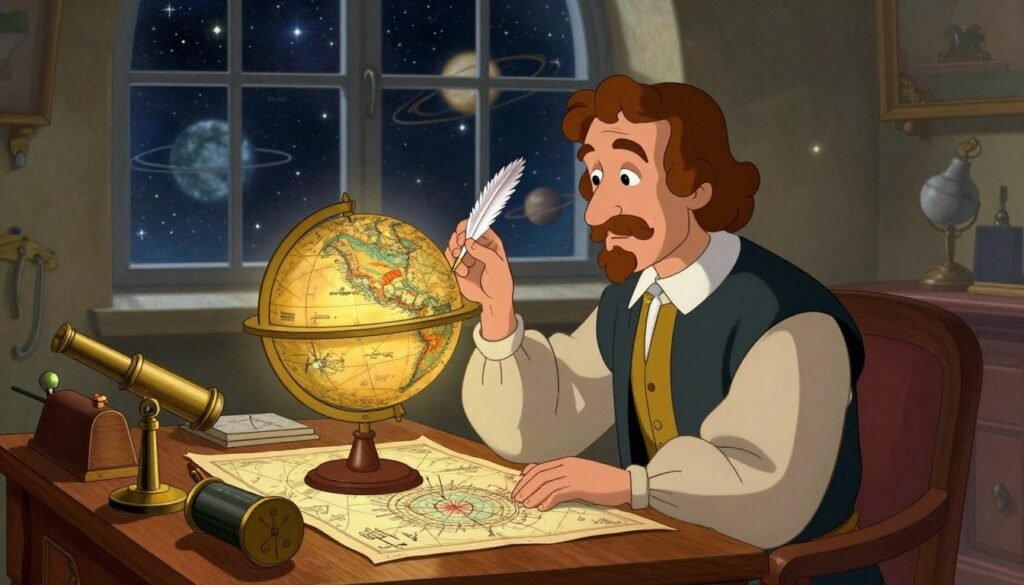
Today, we still use Galileo’s ideas in science. His focus on evidence and experimentation helps us discover new things. It guides scientists as they explore the world.
Galileo and the Development of the Pendulum Clock
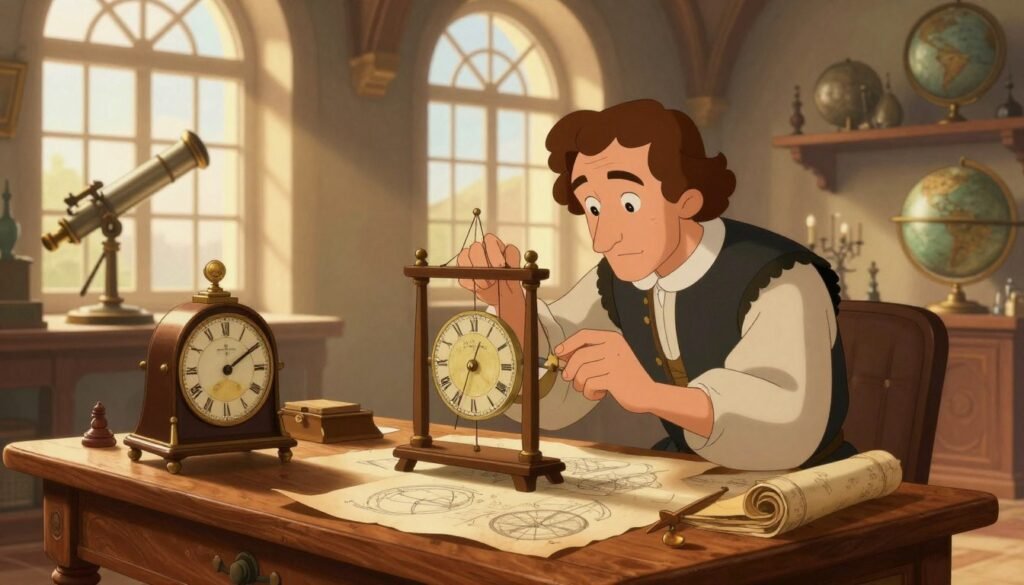
Galileo’s curiosity led to a groundbreaking discovery that changed timekeeping forever! His work on the pendulum’s properties laid the foundation for more accurate timekeeping devices.
The Isochronism of the Pendulum
Galileo discovered that pendulums have a unique property known as isochronism. This means they swing at a consistent rate. This discovery was pivotal! Learn more about Galileo’s work on the pendulum.
The isochronism of pendulums fascinated Galileo. His observations paved the way for later innovations in clockmaking.
Practical Applications in Timekeeping
The isochronism of the pendulum was later used in pendulum clocks. These clocks were much more accurate than before. This innovation had a big impact on science, navigation, and daily life!
The introduction of pendulum clocks marked a significant milestone in the quest for precise timekeeping.
| Clock Type | Accuracy |
|---|---|
| Mechanical Clocks | Within 15 minutes per day |
| Pendulum Clocks | Within 10 seconds per day |
Galileo’s work on the pendulum shows his innovative spirit. His discoveries have far-reaching consequences! His contributions to science continue to inspire and influence modern technology.
The Literary Contributions of a Scientist
Galileo wrote in a way that everyone could understand. This made his science known to more people. It helped start a big change in science.
Galileo chose to write in everyday language. This was a big change from using Latin. This choice helped more people learn about science, making it more open to everyone.
Writing in the Vernacular for Public Understanding
Galileo wrote in Italian to reach more people. His book “Dialogue Concerning the Two Chief World Systems” explained hard science in simple words.
Writing in a way everyone could understand was very important. It helped:
- Spread science to more people
- Make hard ideas easy to grasp
- Help more people understand science
Dialogue Concerning the Two Chief World Systems
“Dialogue Concerning the Two Chief World Systems” came out in 1632. It compared two big ideas about the universe.
| Work | Year Published | Key Contributions |
|---|---|---|
| Dialogue Concerning the Two Chief World Systems | 1632 | Presented arguments for the Copernican heliocentric model |
| Two New Sciences | 1638 | Outlined Galileo’s work on kinematics and materials science |
Galileo’s writing changed science forever. His work, like “Dialogue Concerning the Two Chief World Systems,” made science easier to understand. He opened doors for future scientists.
Learning Through Gamified Education
Let’s explore Galileo Galilei’s legacy. He was the father of modern science. His work made learning fun and interactive. Today, we use this idea in gamified education.
By adding games to learning, we make science fun for everyone. This method helps students understand and enjoy learning. It’s a great way to learn about the world.
Enhancing Scientific Literacy with Debsie Gamified Courses
Debsie Gamified Courses make learning fun. They use games to teach science and more. You can find them at https://debsie.com/courses.
Debsie is great for learning physics. It helps you grasp complex ideas. You can also find top physics tutors in Jamnagar, Gujarat.
Why Interactive Learning Matters for Modern Students
Interactive learning is key for today’s students. They love digital experiences. Gamification in education meets their needs.
Interactive learning boosts student engagement and retention. It makes learning more effective. See the table below for more details.
| Learning Method | Student Engagement | Retention Rate |
|---|---|---|
| Traditional Learning | 60% | 40% |
| Gamified Learning | 90% | 80% |

Let’s use gamified education to make learning better. Try Debsie Gamified Courses today. See the difference for yourself.
The Lasting Influence on Modern Astronomy
Galileo Galilei’s work still inspires today’s astronomers. He started a journey into space that we keep going. His discoveries help us learn more about the universe.
From Galileo to the James Webb Space Telescope
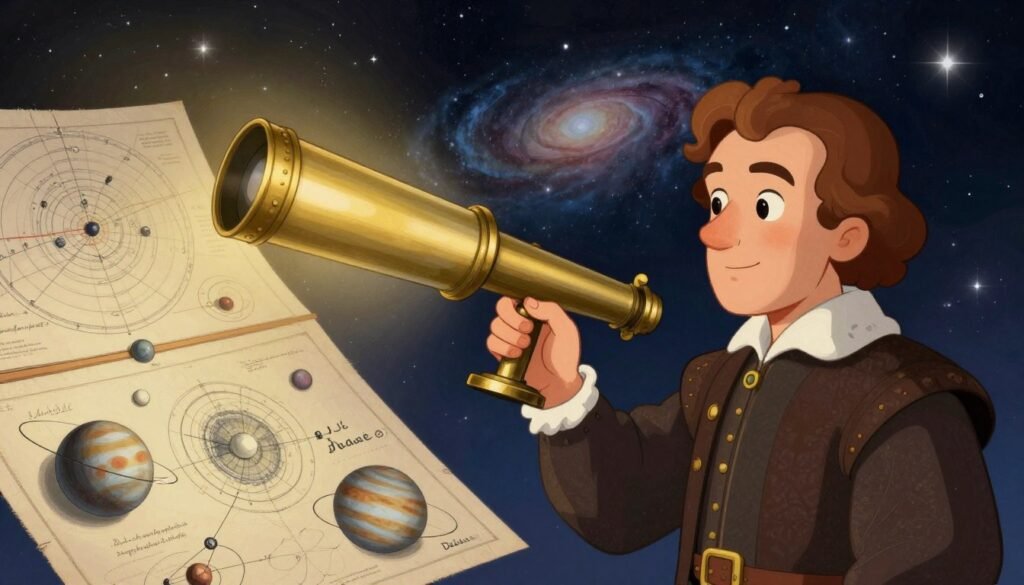
Galileo made the telescope better. He saw things that changed how we thought about the universe. Now, the James Webb Space Telescope lets us see even more. It keeps Galileo’s dream alive, exploring the cosmos and making new discoveries!
How His Discoveries Shape Current Space Exploration
Galileo showed us the universe is centered on the sun. This idea shapes how we explore space today. Here’s how his work still affects us:
| Galileo’s Discovery | Impact on Modern Astronomy |
|---|---|
| Observation of Jupiter’s Moons | Confirmed the existence of celestial bodies beyond Earth |
| Phases of Venus | Provided evidence for the heliocentric model |
| Study of Sunspots and Lunar Topography | Challenged the geocentric view and provided insights into celestial bodies |
Galileo’s work still inspires us. His discoveries keep pushing us to explore more. He shows us the power of curiosity and discovery!
The Enduring Legacy of the Father of Modern Science
Galileo’s spirit and love for truth changed our world! His life shows how much he impacted our view of the universe.
Galileo Galilei is famous for his big discoveries and bravery. He showed us the power of seeking knowledge and truth.
Honoring a Life Dedicated to Truth
Galileo loved science and facts. His work helped many fields grow. He is a light for scientists everywhere.
“Measure what can be measured, and make measurable what cannot be measured.”
This quote shows Galileo’s science way. He believed in seeing and measuring things. His bravery for truth shows his strong character.
The Cultural Impact of Galileo Galilei
Galileo’s work touched more than science. He changed culture and society. He stood for free thinking and was a science leader.
| Aspect | Galileo’s Contribution | Impact |
|---|---|---|
| Astronomy | Improved telescope, discovered moons of Jupiter | Expanded understanding of the solar system |
| Physics | Laws of motion, studies on inertia | Foundation for classical mechanics |
| Culture | Promoted scientific method and critical thinking | Influenced Enlightenment and modern science |
As we explore more, Galileo’s legacy reminds us of the value of curiosity and honesty. He shows us the power of seeking knowledge.
By following Galileo’s example, we can keep learning and growing. We can understand more about our world and the universe.
Conclusion
As we end our look at Galileo Galilei, we remember his big discoveries. These changed how we see the universe. His work still inspires many today.
If you want to learn more about the universe, check out Debsie’s educational resources. They explain how light works, from rainbows to lasers.
To keep learning, visit Debsie’s gamified courses at https://debsie.com/courses. They make science fun and easy to understand.
By learning about Galileo, we appreciate science more. His discoveries help us today.