Imagine finding a secret code that makes all living things! We’re excited to share this amazing story with you today. It shows how curiosity can change our world!
A brilliant mind loves solving puzzles. Demis Hassabis is a leader who uses computers to help people. He thinks smart technology can unlock our bodies’ secrets!
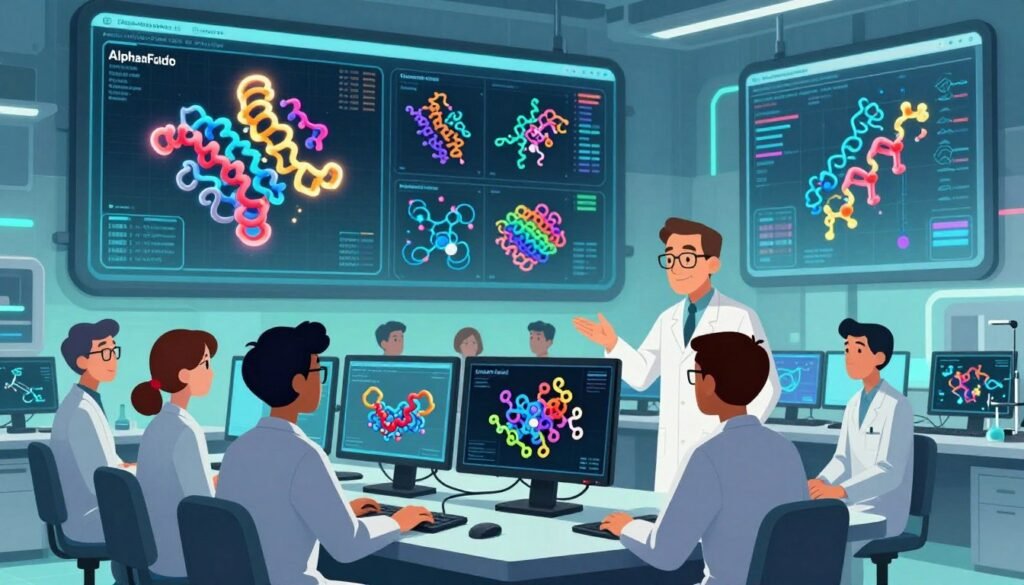
His famous creation, Demis Hassabis AlphaFold, is like a super-powered magnifying glass. It helps scientists find the shape of life. This helps us grow and stay healthy!
We want every child to feel the magic of learning these cool new things. You can try Debsie Gamified Courses at https://debsie.com/courses to start your adventure! Let’s dive in and see how protein structure prediction is making the future brighter for us all.
Key Takeaways
- Demis Hassabis is a world-renowned scientist using AI to solve major biological puzzles.
- AlphaFold is a revolutionary tool that predicts the complex shapes of proteins.
- This breakthrough helps doctors and researchers create new medicines much faster than before.
- Technology and science work together to help us understand the tiny building blocks of life.
- Gamified learning through Debsie allows children to explore these high-tech topics with joy!
The Early Life and Prodigious Beginnings of Demis Hassabis
Demis Hassabis started his journey to AI greatness early! He was born curious and loved complex games. These signs showed he was destined for greatness.
At four, Demis began playing chess. This game sharpened his strategic mind. It also set the stage for his AI career.
Chess Mastery and Early Cognitive Development
By 13, Demis was a chess master. This showed his amazing brain and hard work. Chess was more than a game to him.
His early years were filled with:
- Exceptional memory and concentration!
- Strategic thinking and problem-solving skills!
- A keen interest in complex systems!
The Transition from Gaming to Artificial Intelligence
As Demis got older, he wanted to understand game mechanics. This curiosity led him to AI. He could use his game knowledge to create smart systems.
Demis moved from gaming to AI naturally. His drive to innovate led him to AI. His work, like AlphaFold, has changed AI forever!

Demis Hassabis proves that talent, hard work, and curiosity can lead to AI success. His story is inspiring!
Founding DeepMind and the Vision for Artificial General Intelligence
Demis Hassabis co-founded DeepMind with a big dream. He wanted to make artificial general intelligence a reality. This dream was not just about starting a tech company. It was about changing what we thought AI could do.
DeepMind started with a big goal. They wanted to change AI by making algorithms that could learn and adapt. Demis believed AI could solve big world problems.
Building a Research Hub in London
London became DeepMind’s research center. It drew in the best minds from everywhere. They worked on AI systems that could learn from data, unlike old rule-based systems.
The London hub was key for innovation and teamwork. It helped DeepMind grow fast in AI research. This place was all about trying new things and being creative.
The Acquisition by Google and Scaling AI Research
When Google bought DeepMind in 2014, it was a big moment. It gave DeepMind the chance to grow its AI research. They could take on harder challenges.
With Google’s help, DeepMind kept exploring AI. They worked on protein structure prediction and more. Their work helped biology and medicine a lot, opening new doors for research.
Demis Hassabis and the Breakthrough of AlphaFold
Demis Hassabis and his team at DeepMind made a huge breakthrough with AlphaFold. They changed the game in protein structure prediction! This achievement is a big deal and shows how AI is changing biology.
Solving the Grand Challenge of Protein Structure Prediction
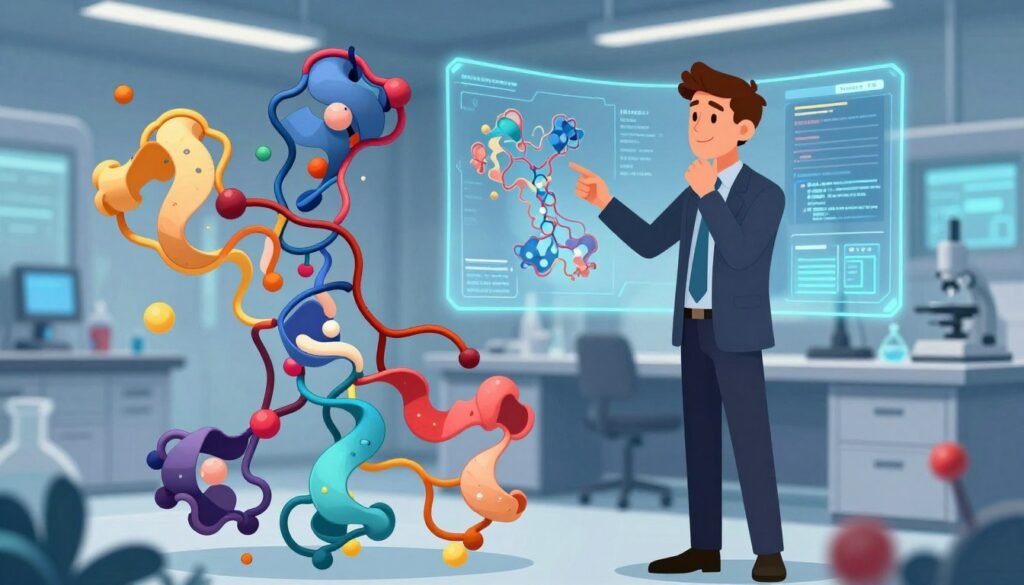
Predicting protein structures has been a tough problem in biology for a long time. AlphaFold’s success in this area is groundbreaking. It gives scientists a powerful tool to understand how proteins work.
By predicting protein structures well, AlphaFold has opened new doors. It helps us understand biological processes at a molecular level.
The Nobel Prize press release says AlphaFold’s impact is huge. It shows how it can speed up scientific discoveries!
How AlphaFold Changed the Landscape of Biology
AlphaFold has given biology a new view of protein structures. This is big news for drug discovery and personalized medicine. Scientists can now design better treatments and therapies.
Being able to predict protein structures well has speeded up research in many areas. It helps us understand diseases and develop new biotechnologies. AlphaFold is more than a tool; it’s a spark for innovation in biology!
The Scientific Impact of AlphaFold on Drug Discovery
Demis Hassabis’ AlphaFold has changed the game in science, mainly in drug discovery. It solves the tough problem of predicting protein structures! AlphaFold helps us understand how proteins work and find new treatments.
AlphaFold’s big win means big changes for drug research. It can guess protein shapes very well. This helps scientists find new drug targets fast. It makes making new medicines quicker.
Accelerating Pharmaceutical Research Pipelines
AlphaFold makes drug research go faster! It gives accurate protein structure guesses. This helps scientists:
- Find drug targets quicker
- Make new medicines that work better and are safer
- Make the whole drug-making process cheaper and faster
The DeepMind blog on AlphaFold’s five years shows its big promise. It helps solve tough biological questions. This leads to new treatments for hard-to-reach diseases.
Mapping the Proteome for Future Medical Breakthroughs
AlphaFold does more than speed up research. It helps map the proteome. This could lead to big medical wins! By guessing protein structures all over, scientists learn more about how proteins work together.
This knowledge helps create new treatments. It also deepens our understanding of diseases. As we keep using AlphaFold, we’ll see big steps forward in medicine. This will make people’s lives better and healthier.
Key Milestones in the Career of Demis Hassabis
Demis Hassabis has reached many big milestones in his career. He has made huge steps in AI research! His work has also inspired many scientists and researchers.
Demis Hassabis has always been a leader in AI. He has mastered complex games and improved reinforcement learning. His work has been very important.
Mastering Complex Games with AlphaGo
Demis Hassabis and his team at DeepMind made history with AlphaGo. They beat a world champion in Go. This was a big achievement that showed AI’s power in making decisions.
Advancing Reinforcement Learning Beyond Board Games
Hassabis has also helped improve reinforcement learning. This is a key part of AI that lets machines learn from their surroundings. It has big effects in areas like robotics and healthcare.
One big part of Demis Hassabis’ career is using AI in different areas. Here are some of his main achievements:
| Year | Achievement | Impact |
|---|---|---|
| 2016 | AlphaGo defeats Go world champion | Demonstrated AI’s capability in complex decision-making |
| 2020 | AlphaFold solves protein structure prediction | Revolutionized biology and drug discovery |
| 2014 | DeepMind acquired by Google | Scaled AI research and development |
To learn more about Demis Hassabis’ background and achievements, you can visit his Wikipedia page.
Demis Hassabis’ career shows the power of innovation and hard work. His work keeps inspiring and shaping the future of AI research.
The Intersection of Neuroscience and Artificial Intelligence
Demis Hassabis has been a leader in mixing neuroscience and AI. He uses insights from the human brain to make AI better! This mix is key to AI’s future.
Drawing Inspiration from the Human Brain
The human brain is amazing. It can handle lots of info and learn from it. Demis Hassabis and his team at DeepMind use the brain’s ideas for AI. For example, AI’s neural networks come from the brain’s neural links.
Applying Biological Principles to Neural Network Architectures
Using brain ideas in AI makes algorithms better and more flexible. This has led to big wins, like in protein structure prediction. AlphaFold has changed the game. To learn more, check out AI and Neuroscience.
| Characteristics | Traditional AI | Neuroscience-Inspired AI |
|---|---|---|
| Learning Mechanism | Primarily based on statistical models | Inspired by synaptic plasticity and neural connections |
| Adaptability | Limited by predefined rules | More adaptive due to neural network architectures |
| Efficiency | Can be computationally intensive | Potentially more efficient with biologically inspired algorithms |
Educational Initiatives and Gamified Learning
Demis Hassabis’ work on AI has sparked a new wave of interest in educational initiatives. These focus on skill acquisition and gamified learning! As we explore AI and protein structure prediction, it’s crucial to consider how the next generation of scientists is being nurtured.
One of the key areas of focus is the development of skills necessary for AI research and development. Skill acquisition is a critical component of AI development, as it enables researchers to tackle complex problems and push the boundaries of what’s possible.
The Importance of Skill Acquisition in AI Development
Acquiring the right skills is essential for aspiring AI scientists. This includes not only technical skills like programming and data analysis but also soft skills like collaboration and communication. Gamified learning platforms are making it easier for students to acquire these skills in an engaging and interactive way.
- Develops problem-solving skills through interactive challenges
- Enhances collaboration and teamwork through multiplayer games
- Provides real-time feedback and assessment
By leveraging gamification, educational initiatives can make learning more enjoyable and effective. This approach is beneficial for complex subjects like AI, where hands-on experience is invaluable.
Exploring Debsie Gamified Courses for Aspiring Scientists
Debsie offers a range of gamified courses designed to engage and inspire aspiring scientists. Their platform uses interactive games and challenges to teach complex concepts in an accessible way. You can try out these courses at https://debsie.com/courses and discover the excitement of learning through gamification!
For more information on how gamification is being used in AI education, you can visit https://rayuzwyshyn.net/EducAIteGamification/educaitegames.html to explore the latest developments in this field.
By combining engaging gameplay with rigorous educational content, Debsie is helping to shape the next generation of AI researchers and scientists. The future of AI research depends on innovative educational tools like these, which can inspire and empower students to pursue careers in this exciting field.
The Role of AlphaFold in Modern Protein Prediction
AlphaFold has changed how we predict protein structures. It gives us new insights into how proteins work! This technology has improved our knowledge of proteins and opened up new research areas.
Understanding the Mechanics of Protein Folding
Proteins are key in all living things. Their shape is linked to their function. Knowing how proteins fold helps us understand their roles in the cell.
AlphaFold uses smart machine learning to guess protein shapes from their sequences. This is better than old methods that take a lot of time and money.
A study in Nature found AlphaFold is very good at predicting protein shapes. It beats other methods in accuracy. This helps us understand proteins better and find new treatments.
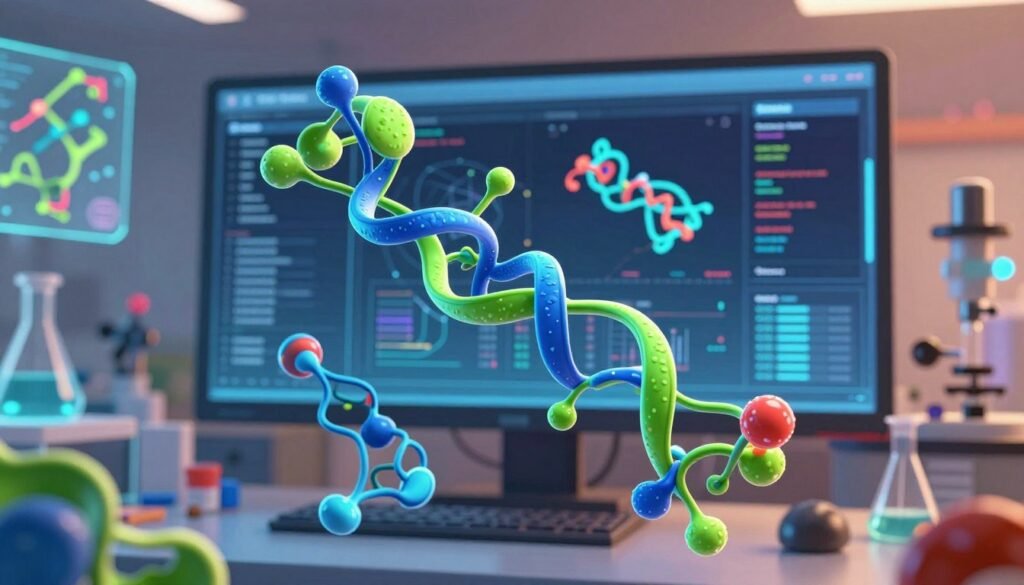
Overcoming the Limitations of Traditional Experimental Methods
Old ways to study protein structures have big problems. They take a lot of work, need a lot of protein, and don’t always work well. Some proteins are hard to study because they are big, complex, or unstable.
AlphaFold fixes these issues by being fast and accurate. It lets researchers study many protein structures they couldn’t before. This speeds up their work and lets them test new ideas quickly.
With AlphaFold, scientists can learn more about life and find new medicines. Knowing protein shapes well is a big help in understanding and changing life’s systems.
Ethical Considerations in the Age of Advanced AI
AI is changing fast, and we need to think about its ethics. As AI gets better, we must think about what it means.
Demis Hassabis says we need to be careful. We should be creative but also safe and responsible.
Balancing Innovation with Safety and Responsibility
AI is getting smarter, but we must be careful. AI systems like AlphaFold are making big discoveries.
We need to make sure AI is used right. We must have rules to keep it safe and prevent harm.
The Global Debate on AI Governance and Oversight
AI is a worldwide issue. We need to work together to make rules. Experts are talking about how to do this.
Demis Hassabis and others say we should work together. This way, we can make sure AI is used well.
We must think about AI’s future. By being careful and working together, we can make AI good for everyone.
Collaborations and the Open Science Philosophy
Demis Hassabis believes in open science. This means working together with many scientists. His team at DeepMind shares research and tools. This helps everyone move forward faster.
Sharing Data with the Global Scientific Community
Sharing data is key in open science. Demis Hassabis and his team share important data. This lets scientists all over the world use their work.
For example, AlphaFold’s data is now public. This lets scientists explore new things in biology.
This way of working has led to more projects together. Some good things come from this:
- Accelerated Discovery: Sharing data means less repeating work. This lets scientists try new things.
- Global Participation: People from all over can help and learn. This makes research more open.
- Innovative Solutions: Open data leads to new ideas. Different fields bring new views to the table.
The Impact of Open-Source Tools on Collaborative Research
Demis Hassabis and DeepMind also share tools. These tools help with AI and protein structure prediction. They are very useful for the community.
Here’s how these tools help:
- Enhanced Accessibility: Open tools let more people use AI. Even those without the means to make their own.
- Community Engagement: Open tools invite everyone to help. This makes the tools better over time.
- Rapid Advancements: Working together means faster progress. Everyone can build on each other’s work.
Demis Hassabis and DeepMind follow open science. This speeds up AI and protein prediction. It also creates a culture of teamwork and openness in science.
The Future Trajectory of DeepMind and AI Research
DeepMind is making big steps in AI research. Demis Hassabis leads the way. He’s pushing for new and exciting things.
Moving Toward Multimodal AI Systems
DeepMind is working on AI that can handle many types of data. This includes text, images, and sounds. It’s a big step towards making AI smarter.
Demis Hassabis says,
“The future of AI lies in its ability to understand and interact with the world in a more human-like way.”
Read more about Demis Hassabis’vision for.
Multimodal AI could change many fields. In healthcare, it could help doctors by looking at images and patient data. This could lead to better health care.
Addressing Complex Global Challenges Beyond Biology
DeepMind is also working on big global problems. They want to help with climate change and make energy use better. They’re using AI to make a difference.
AI can help in many ways. It can make data centers use less energy. It can also help predict and prepare for natural disasters. And it can help farmers use resources better.
Key areas of focus for DeepMind include:
- Developing more efficient AI algorithms
- Exploring new applications for AI in science and society
- Collaborating with global partners to drive positive change
Recognitions and Awards for Contributions to Science
Demis Hassabis has won many awards for his work in science! His AI work at DeepMind and AlphaFold changed protein prediction and more.
Academic Honors and Industry Accolades
He has gotten many honors for his work. He is a Fellow of the Royal Society and won the Breakthrough Prize in Life Sciences.
| Award | Year | Description |
|---|---|---|
| Breakthrough Prize in Life Sciences | 2023 | For his work on AlphaFold, revolutionizing protein structure prediction |
| Mullard Award | 2017 | Recognizing his outstanding contributions to science and technology |
| Royal Society Fellowship | 2018 | Elected for his significant contributions to AI and science |
The Legacy of Demis Hassabis in the Scientific Canon
Demis Hassabis’ work is celebrated with awards and a lasting legacy. His AI work opened doors for new discoveries and inspires scientists today.
He made AI easier to use and solved tough problems like protein folding. His work shows the strength of teamwork and different fields coming together.
Conclusion
Demis Hassabis’s work on AlphaFold has changed how we predict protein structures. This has opened new doors for medical research. His work in AI will keep changing science and more.
This article should have made you excited about AI’s progress. You can learn more with Debsie’s fun courses. They cover AI and science in a fun way. Visit Debsie’s courses to start learning today!
Demis Hassabis’s AI work is making new things possible. His AlphaFold project shows the power of new ideas and working together. We can’t wait to see what AI will bring next.