
🔄 Recap of Lesson 1
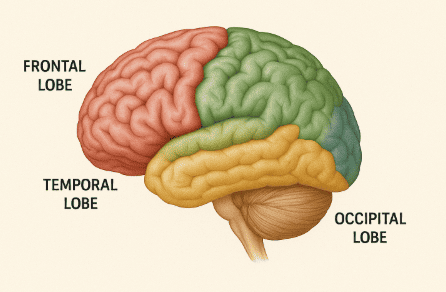
Last time, we zoomed out to see the big picture of the brain. We discovered its four lobes:
-
Frontal lobe = planner, boss, and decision-maker.
-
Parietal lobe = map reader, touch, and space manager.
-
Temporal lobe = listener, memory keeper.
-
Occipital lobe = visual artist.
We also learned that lobes are like departments in a company, each with its own job but all working together.
Today, we’re going to compare two very different sides of the brain: the thinking brain and the survival brain.
🏛️ Step 1: The Thinking Brain (Cerebrum)
The cerebrum is the largest part of your brain. It’s the wrinkly outer part you usually picture when you imagine a brain.
Jobs of the cerebrum:
-
Thinking and reasoning 🧩
-
Making decisions ⚖️
-
Speaking and understanding language 🗣️
-
Remembering and imagining 📚
-
Moving your muscles when you want to 🏃♀️
The cerebrum makes you you. It’s why humans can paint art, write books, and invent rockets.
🌱 Step 2: The Survival Brain (Brainstem)
Underneath the cerebrum, at the base of your brain, is the brainstem.
It looks small compared to the cerebrum, but it does life-saving work:
-
Controls breathing 🌬️
-
Keeps your heart beating ❤️
-
Controls blood pressure 🩸
-
Handles swallowing and digestion 🍲
-
Manages reflexes like coughing and sneezing 🤧
The brainstem is like the autopilot system on an airplane. Even if the pilot (the cerebrum) is resting, autopilot keeps the plane flying safely.
🎭 Step 3: A Simple Analogy
Think of your brain as a company:
-
The cerebrum is the CEO 👔, making big plans, solving problems, and creating ideas.
-
The brainstem is the building’s security system and utilities 🔒⚡. It keeps the lights on, the water running, and the air flowing—without which no one could even work.
You can survive with just the brainstem (like some animals), but without the cerebrum, you wouldn’t be “you.”
🗺️ Step 4: Parts of the Brainstem
The brainstem has three main parts:
-
Midbrain – controls eye movements, hearing, and alertness.
-
Pons – connects different parts of the brain and helps with sleep and breathing.
-
Medulla Oblongata – controls heartbeat, breathing, sneezing, and digestion.
If the brainstem stops working, life stops immediately. That’s why it’s called the survival brain.
🧩 Step 5: Working Together
Your cerebrum (thinking brain) and brainstem (survival brain) are always in partnership.
Example:
-
You decide (cerebrum) to run a race 🏃.
-
The brainstem speeds up your heartbeat and breathing automatically to give you more oxygen.
Without the brainstem, the cerebrum’s plans would fail. Without the cerebrum, the brainstem would just keep you alive but without higher thought.
🌌 Step 6: When the Thinking and Survival Brains Disagree
Sometimes the two brains send different messages.
Example:
-
You want to speak in front of a big audience (cerebrum decision).
-
But your brainstem triggers a survival reaction: sweaty palms, fast heartbeat, shaky voice (fight-or-flight response).
That’s why people sometimes feel nervous even though they decide to be calm.
🧠 Fun Fact
A chicken can survive for a short while without its head (😲) because the brainstem is still intact at the base of the neck, keeping basic functions like breathing going. But without the cerebrum, the chicken has no awareness.
📝 Recap of Lesson 2
-
The cerebrum (thinking brain) handles decision-making, reasoning, speech, imagination, and voluntary movement.
-
The brainstem (survival brain) keeps you alive by controlling heartbeat, breathing, and reflexes.
-
The cerebrum = CEO 👔; the brainstem = security and utilities 🔒⚡.
-
Both must work together: one keeps you alive, the other makes you human.