
🔄 Recap of Lesson 2
In Lesson 2, we learned about the thinking brain (cerebrum) and the survival brain (brainstem).
-
The cerebrum handles thinking, problem-solving, imagination, and conscious movement.
-
The brainstem keeps you alive, controlling heartbeat, breathing, and reflexes.
-
The cerebrum is like the CEO 👔 of the company (big plans).
-
The brainstem is like the security and utilities system 🔒⚡ (life support).
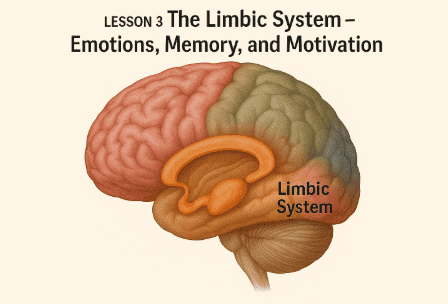
Now, between these two layers lies a very special set of structures: the limbic system. This is sometimes called the “emotional brain.”
🌍 Step 1: What is the Limbic System?
The limbic system is a group of structures deep inside the brain. It is older (in evolutionary terms) than the cerebrum and is found in many animals, not just humans.
Its main jobs:
-
Control emotions (fear, joy, anger, love) 💓
-
Form memories 📝
-
Motivate behavior (hunger, thirst, desire, drive) 🍎💧
-
Connect feelings to actions
If the cerebrum is the thinking brain and the brainstem is the survival brain, then the limbic system is the feeling brain ❤️.
🗺️ Step 2: Main Parts of the Limbic System
The limbic system is not just one part, but a team of parts working together. Let’s meet them:
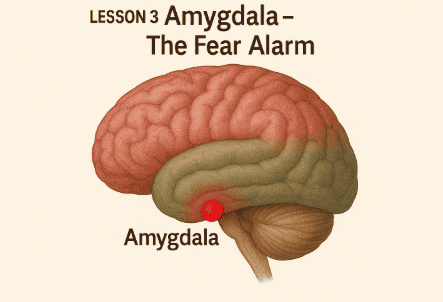
1. Amygdala – The Fear Alarm 🚨
-
Small almond-shaped structure (amygdala actually means “almond” in Greek).
-
Detects danger and controls fear and aggression.
-
Example: If you see a snake, the amygdala fires instantly: “Watch out! Danger!”
-
Also helps store emotional memories (that’s why you remember scary or exciting events clearly).
2. Hippocampus – The Memory Maker 📚
-
Shaped like a seahorse 🐎 (hippocampus means “seahorse” in Greek).
-
Main job: turn short-term experiences into long-term memories.
-
Example: If you study for an exam, the hippocampus helps you move facts into permanent memory.
-
Damage to the hippocampus makes it hard to form new memories.
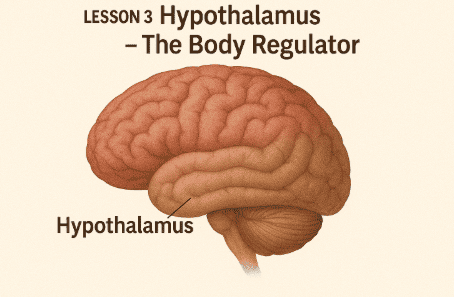
3. Hypothalamus – The Body’s Thermostat 🌡️
-
A tiny structure, but extremely powerful.
-
Controls hunger, thirst, body temperature, sleep, and hormones.
-
Example: If your body gets too hot, the hypothalamus makes you sweat. If you’re hungry, it signals you to eat.
4. Thalamus – The Relay Station 📡
-
Receives sensory information (except smell) and sends it to the right lobe of the cerebrum.
-
Example: When you touch something, the thalamus passes that signal to the parietal lobe.
Together, these structures help you feel, remember, and react.
🎭 Step 3: Everyday Examples of the Limbic System
Let’s imagine some daily situations:
-
You hear a sudden loud bang 💥 → your amygdala triggers fear and prepares your body to react.
-
You smell cookies baking 🍪 and remember your grandma’s kitchen → your hippocampus connects smell with memory.
-
You feel thirsty 🥤 → your hypothalamus tells you to drink water.
-
You look at a beautiful painting 🎨 and feel joy → your limbic system is lighting up.
Without the limbic system, life would feel flat and meaningless. It gives color and emotional depth to human experience.
⚖️ Step 4: Emotion vs. Logic
The limbic system and cerebrum often work together, but sometimes they disagree.
Example:
-
Your limbic system says: “Eat that whole cake—it looks so good!” 🎂
-
Your frontal lobe (cerebrum) says: “Better not. Too much sugar will make you sick.”
That’s why controlling impulses (self-control) is often hard—because your emotional brain is strong and quick, while your logical brain is not that strong, slower and more careful.
🧩 Step 5: The Limbic System in Animals
Humans are not the only creatures with a limbic system. Most mammals have it too.
-
A dog’s joy when it sees you 🐶,
-
A cat’s fear when it hears thunder 🐱⚡,
-
A rat learning a maze 🐭…
All of these involve their limbic systems. This shows that emotions and basic memories are not uniquely human – they’re shared across animals.
🌌 Step 6: When the Limbic System is Out of Balance
Problems in the limbic system can lead to disorders:
-
Overactive amygdala → anxiety, constant fear, panic attacks.
-
Damaged hippocampus → memory loss, like in Alzheimer’s disease.
-
Dysfunction in hypothalamus → problems with hunger, weight, or sleep.
-
Issues with thalamus → sensory processing difficulties.
This is why scientists study the limbic system so carefully – it is key to mental health.
🧠 Fun Fact
When you smell something, the signal goes directly to the limbic system without passing through the thalamus. That’s why smells trigger powerful memories and emotions instantly.
📝 Recap of Lesson 3
-
The limbic system is the emotional brain—it controls emotions, memory, and motivation.
-
Amygdala = fear and aggression.
-
Hippocampus = memory making.
-
Hypothalamus = hunger, thirst, body control.
-
Thalamus = relay station for senses.
-
It works closely with the cerebrum and brainstem but often focuses on feelings and drives.
-
Problems in the limbic system can cause anxiety, memory loss, or emotional imbalance.