
Quick Recap of the Last Lesson 🧠👀👂👃👅✋
In our previous lesson, we explored the five classical senses—sight, hearing, smell, taste, and touch. We learned that:
-
Eyes 👀 act like cameras that capture light.
-
Ears 👂 are like microphones that turn sound waves into signals.
-
Nose 👃 is a chemical detector that helps us smell tiny particles.
-
Tongue 👅 tastes different flavors using taste buds.
-
Skin ✋ feels pressure, vibration, and texture.
All of these senses send their information to the nervous system, which then interprets what is happening around us.
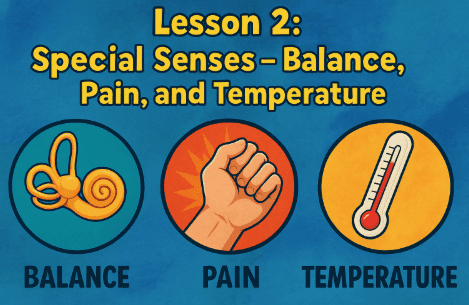
But here’s the surprise: we humans actually have more than just 5 senses. Some scientists say we have at least 9 or even more! Today, we’ll dive into three very special ones that don’t always get the spotlight:
-
Balance (equilibrium) ⚖️
-
Pain (nociception) 🔥
-
Temperature (thermoception) ❄️
Part 1: Balance – The Sense That Keeps Us Upright ⚖️
Imagine trying to walk on a tightrope 🎪. You would wobble, your arms would stretch out for support, and you would desperately try not to fall. The reason you can even attempt such a thing is because your body has an amazing sense called balance, also known as equilibrium.
Where Does Balance Come From?
You might think balance is controlled by your legs or eyes, but surprisingly, it is mostly managed by your inner ear—a hidden structure deep inside your head. Inside the inner ear is a system called the vestibular system, which is like a high-tech level machine (like a carpenter’s spirit level).
It has two main parts:
-
Semicircular canals – three tiny tubes shaped like hoops, filled with fluid. They detect rotational movement. For example: spinning, turning your head, or rolling sideways.
-
Otolith organs (utricle and saccule) – flat structures with tiny crystals (yes, actual microscopic crystals of calcium carbonate 💎!). They detect linear movement like moving forward in a car 🚗 or up in an elevator 🛗.
When you move, the fluid inside shifts, bending tiny hair cells (special nerve endings). These bending hairs send electrical signals to your brain: “You’re spinning left!” or “You’re falling forward!”
Teamwork with Eyes and Muscles 👀💪
Balance doesn’t work alone. Your brain combines information from three sources:
-
Inner ear (vestibular system) – tells you about movement and position.
-
Eyes – tell you what you see, whether the world is moving or stable.
-
Muscles and joints – contain sensors (proprioceptors) that report body position, like whether your knees are bent or your feet are flat.
Your brain blends all this to create a smooth sense of where you are in space.
Fun Examples of Balance in Action
-
Spinning dizziness 🎢: When you twirl, the fluid in your semicircular canals swirls. Even after you stop, the fluid keeps moving for a moment, making you feel like the world is still spinning.
-
Riding a bike 🚴: Your balance system helps you adjust tiny shifts in weight to stay upright.
-
Astronauts 👩🚀 in space: In zero gravity, the crystals in the inner ear don’t pull down, so astronauts often feel disoriented until their brains adjust.
👉 Mini Recap: Balance lives in the inner ear, uses fluid and crystals, and works with eyes and muscles to keep us steady.
Part 2: Pain – The Body’s Alarm System 🔔🔥
Now let’s talk about something everyone knows but nobody enjoys: pain.
Why Do We Feel Pain?
Pain is not just something annoying—it is your body’s alarm system 🚨. Without it, you wouldn’t know if something was harming you.
Imagine touching a hot stove 🔥. The nerves in your skin detect the extreme heat and immediately send a warning signal to your brain: “Danger! Pull away!” This saves you from burning your whole hand.
How Does Pain Work?
Pain is sensed by special nerve endings called nociceptors. The word comes from “noci-” meaning harm, and “ceptor” meaning receiver.
There are different types of nociceptors:
-
Mechanical nociceptors detect cuts, pressure, or injuries.
-
Thermal nociceptors detect burning heat or freezing cold.
-
Chemical nociceptors detect harmful chemicals (like from chili peppers 🌶️, which contain capsaicin that fools your nerves into thinking they’re burning).
These nociceptors send electrical signals up the spinal cord to the brain, where they are interpreted as pain.
When Pain Goes Wrong
Sometimes pain can become chronic (lasting for months or years), even when no actual damage is happening. This is like a fire alarm that keeps ringing even after the fire is gone.
-
Chronic pain: Pain lasts for months even when the injury has healed.
-
Phantom limb pain: People who lose a leg or arm can still feel pain in the missing part. This happens because the brain’s “map” of the body still includes the lost limb.
👉 Mini Recap: Pain is your body’s alarm system, detected by nociceptors. It protects you but can sometimes misfire.
Part 3: Temperature – The Thermometer Inside Us ❄️🔥
The third special sense is temperature, or thermoception.
How Do We Sense Temperature?
Your skin is filled with tiny sensors called thermoreceptors. These can detect:
-
Heat (warm receptors activate when things get hotter 🌞)
-
Cold (cold receptors activate when things get cooler ❄️)
Interestingly, cold receptors are more numerous, which is why we usually notice cold more quickly than heat. That’s why you notice a cold breeze quickly, but may not realize how hot it is outside until you start sweating.
Why Is This Important?
Sensing temperature is vital for survival:
-
It tells you not to touch a burning pan.
-
It makes you shiver 🥶 when it’s too cold, reminding you to find warmth.
-
It makes you sweat 😓 when it’s too hot, helping your body cool down.
Your brain carefully regulates your body temperature, keeping it around 37°C (98.6°F) most of the time. If your temperature goes too high (fever) or too low (hypothermia), it can be dangerous.
Fun Facts About Thermoception
-
Eating menthol (like in mint 🍃) makes your cold sensors fire, which is why mint feels “cool.”
-
Eating chili peppers 🌶️ makes your heat sensors fire, which is why they feel “hot,” even though the food is not actually warm.
👉 Mini Recap: Temperature sense comes from thermoreceptors in the skin, keeping us safe and regulating body heat.
Part 4: How Balance, Pain, and Temperature Work Together 🧩
Even though we studied them separately, these senses team up in daily life.
For example:
-
If you slip on ice ❄️, your balance tells you that you’re falling, your pain tells you if you land badly, and your temperature sense told you it was cold to begin with!
-
When you exercise 🏃, your balance keeps you steady, your pain warns you not to push too hard, and your temperature makes you sweat to cool down.
Your brain is constantly combining these signals into one smooth experience of reality.