
🔄 Quick Recap
So far, in Topic 1, we learned that:
-
The nervous system is the control network of the body.
-
Neurons are the tiny messengers that carry information.
-
Neurons send signals using electricity (action potentials) and chemicals (neurotransmitters).
-
Messages travel across gaps (synapses) so neurons can talk to each other.
Now, let’s zoom out from single neurons and look at the biggest boss of them all: the brain.
🌍 Step 1: The Brain as a Supercomputer
Your brain is about the size of two fists put together ✊✊, soft like jelly, and weighs around 1.3 to 1.5 kilograms (about three pounds).
Yet, inside it are about 86 billion neurons connected by trillions of synapses. That’s more connections than all the stars in our galaxy ✨.
If your brain were a computer, it would be far more powerful than any supercomputer humans have ever built. But unlike machines, your brain is alive—it can feel, imagine, love, and dream.
🏢 Step 2: The Brain Has Departments
Think of your brain as a giant company 🏢. Each department has a different job:
-
One department handles movement.
-
Another handles touch, taste, and smell.
-
Another handles vision.
-
Another makes plans and decisions.
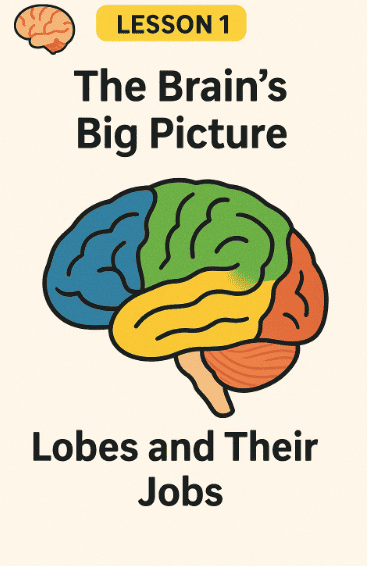
These “departments” are called lobes. The brain has four lobes, each on both the left and right sides.
🗺️ Step 3: The Four Lobes of the Brain
The brain’s outer layer is called the cerebrum. It looks wrinkly, like a walnut, but that’s because folding gives it more space to pack in neurons.
The cerebrum is divided into four lobes:
1. Frontal Lobe – The Planner and Boss 👔
-
Located at the front of your brain (behind your forehead).
-
Jobs: decision-making, problem-solving, planning, speaking, controlling movement, and personality.
-
Example: When you choose what to eat for dinner, solve a math problem, or decide not to shout in class even though you want to, your frontal lobe is at work.
2. Parietal Lobe – The Map Reader 🗺️
-
Located near the top and back of the brain.
-
Jobs: processes touch, pressure, pain, and spatial awareness (knowing where your body is in space).
-
Example: When you feel the texture of sand, or when you close your eyes and still know where your hand is, your parietal lobe is working.
3. Temporal Lobe – The Listener and Memory Keeper 🎧
-
Located on the sides of the brain, near your ears.
-
Jobs: hearing, language, and memory storage.
-
Example: When you listen to music, understand a story, or remember your friend’s face, your temporal lobe is busy.
4. Occipital Lobe – The Visual Artist 🎨
-
Located at the very back of the brain.
-
Jobs: vision—turns what your eyes see into pictures in your mind.
-
Example: When you recognize a tree, a cat, or the words on this page, your occipital lobe is working.
🎮 Step 4: A Fun Analogy
Imagine playing a video game 🎮:
-
Frontal lobe = the player making strategies and pressing buttons.
-
Parietal lobe = the game’s map, telling you where you are.
-
Temporal lobe = the speakers and memory card, letting you hear sounds and remember the game’s story.
-
Occipital lobe = the graphics card, turning raw data into images.
Without one of these parts, the whole game wouldn’t make sense.
🎭 Step 5: Left Brain vs. Right Brain
Your brain has two halves, called hemispheres. They look similar but sometimes have slightly different roles:
-
Left hemisphere: often handles language, logic, and step-by-step thinking.
-
Right hemisphere: often handles creativity, art, and spatial skills.
But don’t be fooled—it’s not as simple as “left = logical, right = creative.” Both sides work together like teammates in every task you do.
🧩 Step 6: How Lobes Work Together
The brain’s lobes don’t work alone. They are like an orchestra 🎻🎺🥁, each section playing its part, but all coming together to make music.
For example: when you’re eating an apple 🍎:
-
The occipital lobe helps you see the apple.
-
The parietal lobe helps you feel its roundness and texture.
-
The temporal lobe helps you hear the crunch and remember eating apples before.
-
The frontal lobe helps you decide whether to eat more or save some for later.
That’s teamwork at its finest.
🔬 Step 7: When Lobes Get Hurt
Different injuries or diseases affect different lobes:
-
Damage to the frontal lobe → problems with planning, personality changes.
-
Damage to the parietal lobe → difficulty sensing touch or knowing body position.
-
Damage to the temporal lobe → memory problems or trouble understanding language.
-
Damage to the occipital lobe → blindness, even if the eyes are healthy.
This is how scientists learned what each lobe does – by studying patients with injuries.
🧠 Fun Fact
Your brain’s outer layer (the cerebral cortex) is only about 2–4 millimeters thick (as thin as a coin), but it holds billions of neurons. That thin layer is what makes human beings able to write music, build rockets, and ask questions like “Who am I?”
📝 Recap of Lesson 1
-
The brain is like a supercomputer with departments (lobes).
-
Frontal lobe = planning, movement, personality.
-
Parietal lobe = touch, body position, space.
-
Temporal lobe = hearing, memory, language.
-
Occipital lobe = vision.
-
The two hemispheres (left and right) share work, but both are always active together.
-
The lobes work as a team, like an orchestra playing in harmony.