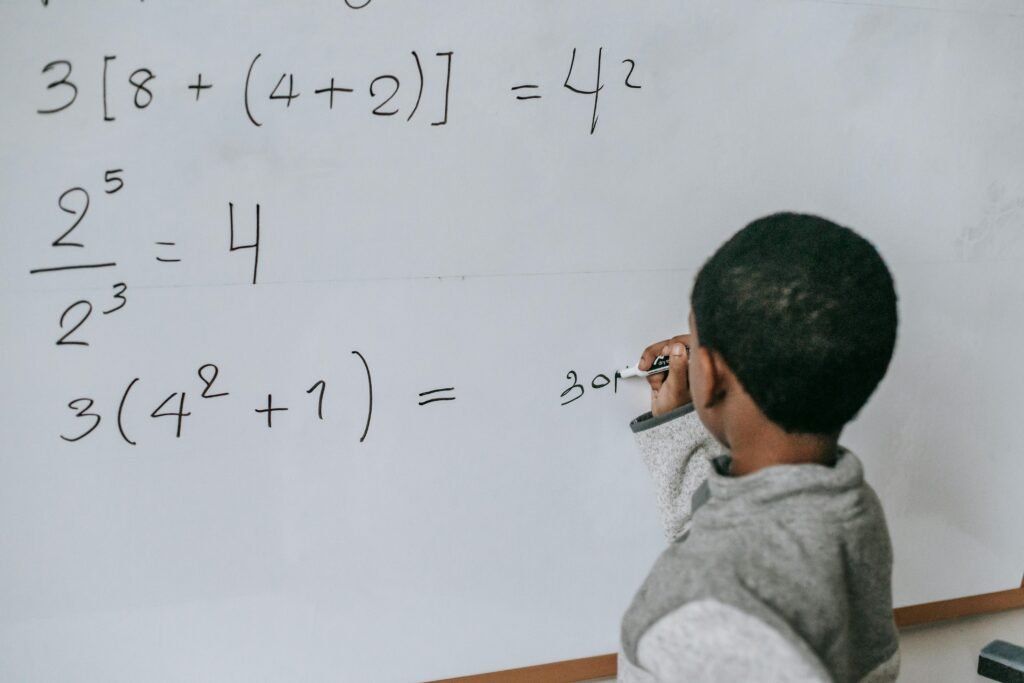
Have you ever looked at the night sky and wondered if you could change the world right now? It feels amazing to know that age is just a number when it comes to curiosity! Many famous thinkers started their journey while they were still just kids in school.
Imagine being like Blaise Pascal, who wrote a brilliant math paper at only sixteen years old! Even many famous figures made discoveries early in their lives. This shows that your big ideas matter right now, not just when you grow up.
These child prodigies showed the world that a brave heart and a sharp mind can rewrite science history forever. We are so excited to see how Lawrence Bragg or Subrahmanyan Chandrasekhar reached for the stars as teenagers. You have that same spark inside you!
To help you grow and explore, try out Debsie Gamified Courses at https://debsie.com/courses for a fun learning journey. We believe every child has the potential to do great things. Let’s dive into the stories of these young scientists and get inspired!
Key Takeaways
- Isaac Newton developed calculus and discovered gravity during his early twenties.
- Blaise Pascal created the first mechanical calculator when he was a teenager.
- Lawrence Bragg remains one of the youngest Nobel Prize winners in history at age 25.
- Subrahmanyan Chandrasekhar calculated the mass limits of stars at only 19 years old.
- Galileo Galilei improved the telescope to study the stars while he was still very youthful.
The Phenomenon of the Young Scientist
Child prodigies have always made big discoveries. Many famous scientists did their best work when they were young. For example,Einstein developed his theory of relativity at 26.
So, what makes these young achievers so great? Is it talent, hard work, or something else? Let’s look at some amazing stories and find out what made them special!

History is full of science prodigies who changed their fields. They are curious and love to learn. This makes them stand out.
To understand young scientists, we need to look at what helps them succeed. It might be early science lessons, a supportive family, or natural talent. Their achievements inspire others to love science and math!
Blaise Pascal and the Foundations of Geometry
Blaise Pascal’s story shows the power of curiosity and math talent! He started learning geometry at 12. He recreated Euclid’s work on his own. This early start showed his talent and set the stage for his future work.
Early Mathematical Intuition
Pascal had a natural feel for geometry. He understood complex math without help. His natural talent was the base for his later work.
- Independent Study: Pascal learned geometry by himself. This deepened his math knowledge.
- Creative Problem-Solving: He was creative and applied math to real life early on.
- Foundation for Future Work: His early intuition helped him later, like with the Pascaline.
The Development of the Pascaline
By 19, Pascal made the Pascaline, a first mechanical calculator. This was a big step in computer history. The Pascaline made math easier, like today’s computers.
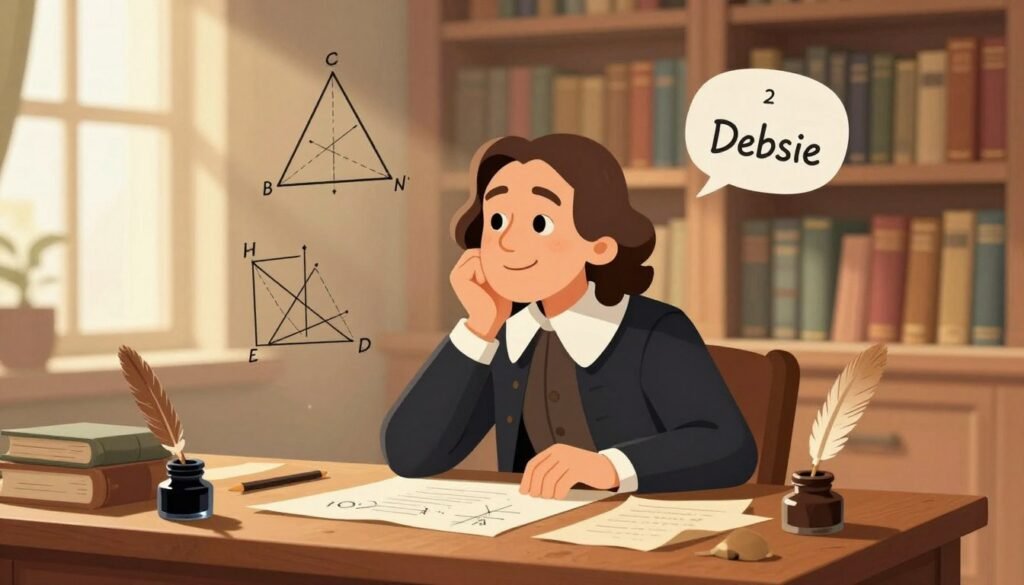
The Pascaline was for Pascal’s dad, a tax collector. It showed how Pascal’s math helped real life.
Key Features of the Pascaline:
- It was a mechanical calculator for basic math.
- Its design made hard math easy.
- It was a start for today’s computers.
Blaise Pascal’s work in geometry and the Pascaline show he was a great young scientist. His story inspires us to find our own talents and make discoveries.
Isaac Newton: The Miracle Year at Twenty-Three
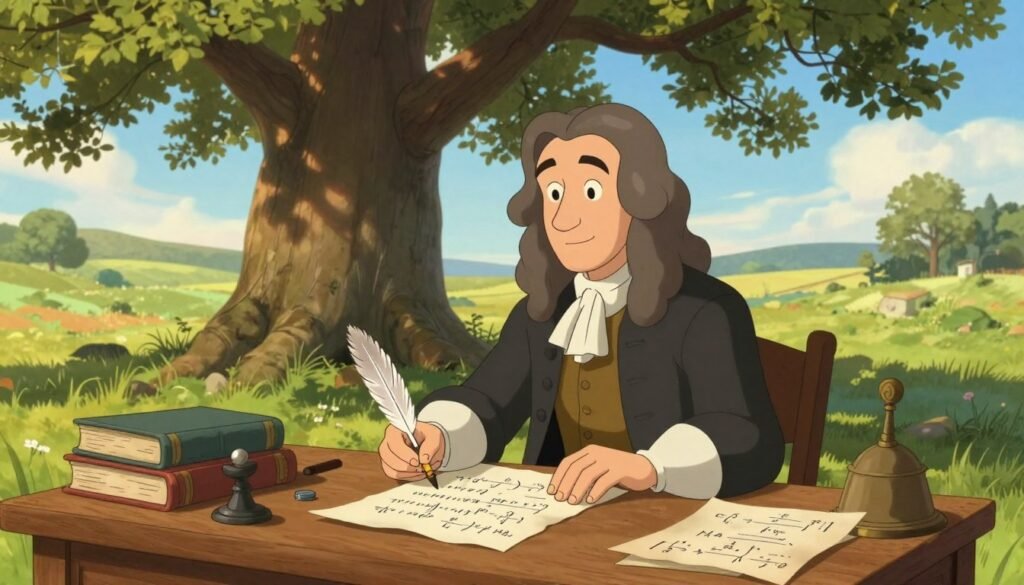
Isaac Newton was just 23 when he made huge discoveries. These discoveries changed science forever! In his “miracle year,” he started calculus and made his laws of motion. This changed how we see the world.
Calculus and the Laws of Motion
Newton’s work on calculus gave us a new way to understand complex things. You can learn more about this time in Newton’s life and its science impact by visiting this resource. His laws of motion are still key in physics today.
Newton’s laws of motion were a big deal. They tell us how forces move objects. To see how these laws work in our lives, check out this fun explanation for kids!
The Impact of the Plague Years on Scientific Discovery
The plague years were good for Newton’s work. With universities closed, he could focus on his research. This led to big steps in calculus and our understanding of the world.
Newton’s time during the plague shows the value of focused research. It shows how important it is for scientists to have time to work without distractions.
Carl Friedrich Gauss: The Prince of Mathematicians
Meet Carl Friedrich Gauss, known as the ‘Prince of Mathematicians.’ He showed early genius in math. This led to big steps forward in the field!
Early Schooling and Numerical Genius
Gauss was a math whiz from a young age! At three, he was already helping his dad with math. His love for numbers grew fast.
When Gauss was in school, he amazed his teacher. The teacher asked the class to add numbers from 1 to 100. Gauss solved it fast, showing his numerical genius!
Contributions to Number Theory Before Adulthood
Gauss made big moves in number theory before he was an adult. He worked on the fundamental theorem of arithmetic and found the law of quadratic reciprocity. These ideas helped other mathematicians a lot.
Gauss didn’t just work on number theory. He also made big steps in algebra and geometry. For more on Gauss, check out The Prince of Mathematics: Carl Friedrich.
Some of Gauss’s big contributions include:
- He developed the method of least squares!
- He worked on making regular polygons!
- He made big steps in astronomy!
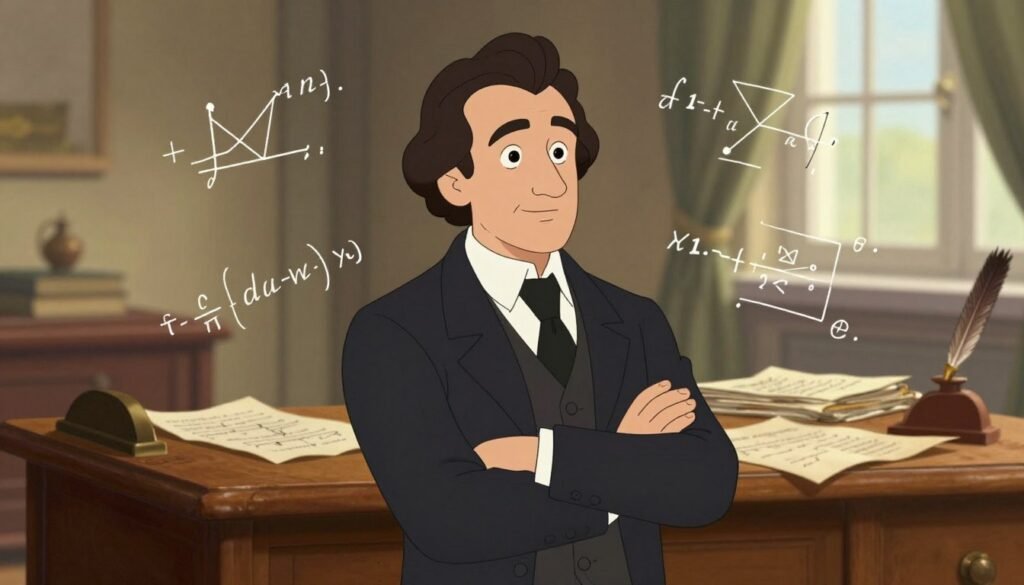
Gauss’s work still inspires today. It shows how early talent and hard work can change the world. His story proves that with the right support, young people can do amazing things!
Ada Lovelace and the First Computer Algorithm
Meet Ada Lovelace, the trailblazer who wrote the world’s first computer algorithm! She was the daughter of Lord Byron. Her journey into mathematics showed her genius and the support she got.
Ada Lovelace’s work on Charles Babbage’s Analytical Engine is famous. The Analytical Engine was a proposed mechanical computer. Ada’s insights were way ahead of her time.
Mathematical Education in the 19th Century
In the 19th century, Ada got a tough math education. This was rare for women back then. Her mom, Lady Byron, made sure Ada learned math and science.
Mathematics was not just a subject for Ada; it was a passion that drove her to explore and understand the world in a unique way. Her education helped her work on the Analytical Engine later.
| Year | Event | Significance |
|---|---|---|
| 1815 | Ada Lovelace was born | Birth of a future mathematical genius |
| 1833 | Ada met Charles Babbage | Introduction to the Analytical Engine |
| 1843 | Ada translated and expanded Luigi Menabrea’s notes on the Analytical Engine | Creation of the first computer algorithm |
Visionary Work on the Analytical Engine
Ada’s work on the Analytical Engine was not just about understanding its mechanics. She also saw its potential. She predicted its ability to manipulate symbols, like modern computing.
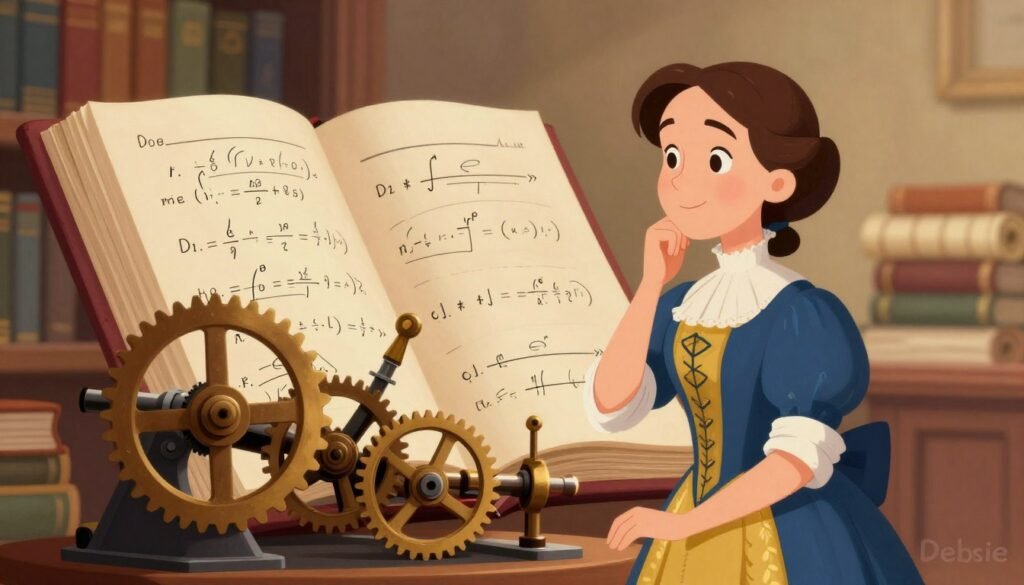
Ada Lovelace’s contribution to computer science is a shining example of how visionary thinking can lead to groundbreaking innovations. Her algorithm was the first computer program. This made her a pioneer in computer science.
Galois and the Tragic Brilliance of Group Theory
Évariste Galois was a shining star in math history. His work in group theory was groundbreaking! Though not known well when he was alive, his work helped algebra grow a lot.
Galois was a French math genius whose life was both brilliant and tragic. He made big steps in group theory before dying young. We’ll look at his fight for recognition and the lasting impact of his work.
The Struggle for Recognition
Galois had a hard time getting his math work seen by others. He sent it to the French Academy of Sciences many times. But they kept saying no or lost it.
It wasn’t just politics. His ideas were new and hard to understand back then.
Legacy of Algebraic Breakthroughs
Galois’s work shows the power of his ideas. His work on group theory and solving equations has changed math a lot. Now, Galois theory is key in advanced math classes everywhere.
Let’s see what made Galois’s work so important:
| Concept | Description | Impact |
|---|---|---|
| Group Theory | Study of algebraic structures known as groups | Fundamental in understanding symmetry and solvability |
| Galois Theory | Connection between group theory and field theory | Resolves the solvability of polynomial equations |
| Algebraic Breakthroughs | New insights into the structure of equations | Advanced the field of abstract algebra |
Galois’s story shows that new ideas are often not seen at first. But his work still inspires today. It shows the lasting power of human curiosity and creativity!
Marie Curie: Early Intellectual Pursuits
Marie Curie started her journey to be a great scientist early. She was very determined and loved to learn! Women didn’t get to go to school much back then. But Marie wanted to learn so much that she found ways to keep going.
Marie Curie really wanted to learn from a young age. Women couldn’t go to many schools in Poland back then. So, she went to the Flying University. It was a secret school for women who wanted to learn more.
The Flying University
The Flying University was very important for Marie. It was where she met people who loved to learn like her. They all wanted to learn more, even when it was hard.
The Flying University was not like other schools. It was secret because the government didn’t want women to learn. It was a place where women could go to school, even if they weren’t allowed.
Foundations of Radioactivity Research
Marie Curie and her husband Pierre started studying radioactivity. They found new elements, radium and polonium. Their work helped us understand the world better and led to new medicines and energy.
The Curies worked very hard to learn about radioactivity. They faced many challenges but kept going. Their work was so good that they won the Nobel Prize.
| Year | Event | Significance |
|---|---|---|
| 1891 | Marie Curie moves to Paris | Access to higher education at the Sorbonne |
| 1894 | Meets Pierre Curie | Collaboration and marriage, beginning of joint research |
| 1898 | Discovery of Radium and Polonium | Pioneering work on radioactivity |
Looking at Marie Curie’s early life and work, we see her determination and genius. She inspires scientists and learners everywhere.
Wolfgang Amadeus Mozart of Science: William Rowan Hamilton
William Rowan Hamilton was like the “Wolfgang Amadeus Mozart of Science.” He was very talented in many areas from a young age. Born in Ireland, he was great at languages and math. He learned many languages before he was a teenager.
Linguistic and Mathematical Mastery
Hamilton was amazing with languages. By 13, he could speak several languages, like Latin and Greek. He also knew Hebrew and modern languages.
But his real talent was in math. He was not just solving problems. He wanted to understand the big ideas and find new theories.
The Discovery of Quaternions
Hamilton found something very important in math called quaternions. Quaternions are like complex numbers but in four dimensions.
This was a big deal. It changed math and physics, mainly in mechanics and geometry. His work on quaternions helped lead to more discoveries.
To learn more about Hamilton’s work, visit https://mathigon.org/timeline/hamilton.
- Extension of complex numbers to four dimensions
- Impact on mechanics and geometry
- Paving the way for future mathematical breakthroughs
In short, William Rowan Hamilton was a genius. His work in math and physics still helps us today. His discovery of quaternions shows his creative mind and mathematical genius. His story teaches us about the value of talent and new ideas.
Enrico Fermi: A Teenage Physics Prodigy
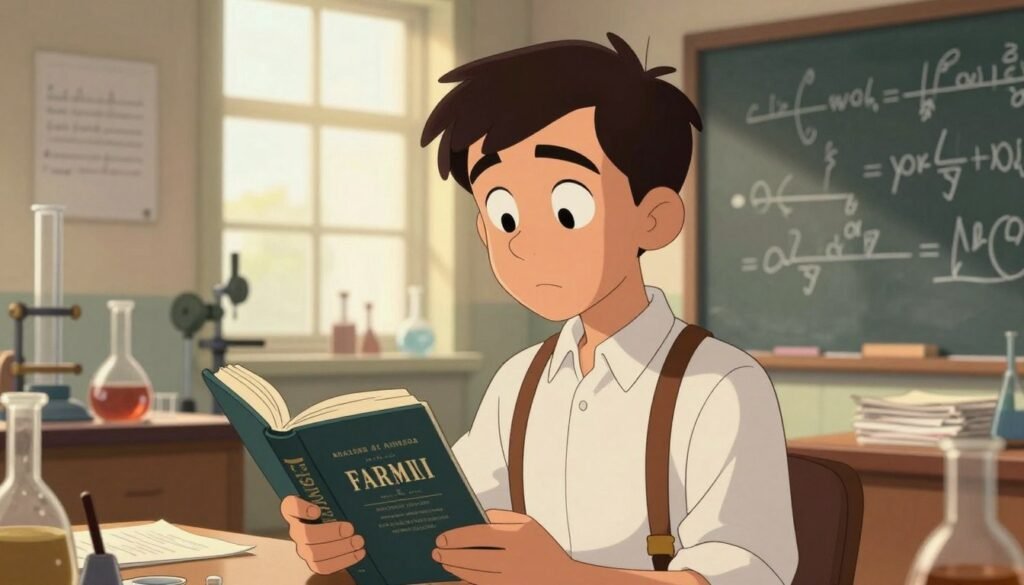
Enrico Fermi started his physics journey as a teenager. It was truly amazing! He showed a great talent for physics from a young age. He taught himself hard physics theories and principles.
Self-Taught Physics in Rome
Fermi loved physics a lot in Rome. He spent hours studying and doing experiments. He was self-taught in many physics areas.
His hard work and talent let him learn advanced ideas early. He was very interested in the works of top physicists of his time. Their ideas helped him make big contributions later.
Early Contributions to Quantum Theory
Fermi’s early work changed quantum theory a lot. This field was growing fast in the early 1900s. His work was seen as very important by scientists.
He could understand and use hard math and physics. This helped shape quantum mechanics’ future.
Fermi’s work on quantum theory was very important. It opened the door for new physics discoveries. His work still inspires scientists and researchers today!
The Modern Era of Young Scientists
Today, we see many young scientists making big discoveries! Technology and better access to learning have opened doors for them. These changes help young researchers overcome old obstacles.
Young scientists lead in finding new solutions. They use the latest tools and tech to solve big problems. They can work together from anywhere, thanks to the internet. This creates a worldwide group of young inventors.
Technological Advancements and Accessibility
Technology has made learning and research easier for everyone. Online classes, virtual labs, and free software let young scientists learn and do experiments easily. They don’t need expensive equipment anymore.
| Technological Advancements | Impact on Young Scientists |
|---|---|
| Online Educational Resources | Access to quality learning materials |
| Virtual Labs | Hands-on experimentation without physical infrastructure |
| Open-Source Software | Free access to powerful research tools |
The Rise of Youth-Led Research Initiatives
More young scientists are starting their own research projects. This is great for finding new ideas and making the world better.
We should keep supporting young talent. We will see even more amazing things from them in the future! 
Nurturing Potential with Debsie Gamified Courses
Make learning fun with Debsie’s engaging courses! We believe in making STEM education fun and easy for kids.
Our gamified courses spark a love for learning. They help kids become scientists and thinkers. We use games to make learning fun and help kids grow.
Integrating Gamification into STEM Education
Gamification makes learning fun and easy. At Debsie, we use games to make learning exciting. This helps kids learn and grow.
- Interactive Challenges: Our courses have fun challenges that help kids apply what they’ve learned.
- Personalized Learning: We offer learning paths that fit each child’s pace and style.
- Real-Time Feedback: Kids get feedback right away to help them learn from mistakes.

How to Get Started at https://debsie.com/courses
Starting with Debsie is easy! Just visit https://debsie.com/courses to see our courses for kids.
- Look through our courses to find the right one for your child.
- Try our free trial to see how our learning works.
- Start learning today and watch your child grow!
At Debsie, we create a safe and fun learning space. Join us and help your child love learning forever!
How Early Exposure Shapes Scientific Thinking
How we introduce science to kids shapes their future. Early science exposure boosts curiosity and love for learning.
Introducing science and math early gives kids a new view of the world. This early start can make them future scientists and thinkers.
The Role of Curiosity in Cognitive Development
Curiosity drives kids’ brain growth. Encouraging them to explore and ask questions helps them think critically. Nurturing curiosity is key to young scientists and thinkers!
Creating a curious environment helps kids develop scientific thinking. Hands-on experiments and activities spark their curiosity.

Building a Foundation for Lifelong Learning
Introducing complex ideas in fun ways inspires kids to keep learning. Early science and math exposure impacts their education and careers. It’s never too early to start!
As kids learn more, the science foundation they start with helps them grow. It’s a key step in raising innovators and thinkers.
Overcoming Challenges Faced by Youth in Academia
Young researchers face many challenges in academia. It’s not just about finding new knowledge. They also have to deal with obstacles.
Navigating Institutional Barriers
Institutional barriers can slow down young researchers. These can be things like too much red tape or not enough money. Getting the data or tools needed can be hard.
We need to make academia more welcoming and helpful. This way, young researchers can grow and succeed.
Let’s look at some common barriers young researchers face:
| Barrier | Description | Potential Solution |
|---|---|---|
| Limited Funding | Not enough money for research. | Look for grants, crowdfunding, or get help from institutions. |
| Bureaucratic Processes | Too many rules that slow things down. | Make things simpler, give clear rules, and offer help. |
| Lack of Resources | Not enough tools or data. | Work with other places, share, or find new ways. |
Finding Support Systems for Young Researchers
Support systems are key for young researchers. They include mentors, friends, and resources. These help them reach their goals.
For example, Debsie has tools that help young researchers. With these, they can get the support they need.
In conclusion, helping young researchers need a plan. We must tackle barriers and provide strong support. Together, we can help them grow and succeed.
The Impact of Mentorship on Young Scientists
Mentorship is very important for young scientists. It gives them the help they need to do well. It helps them make big contributions to their field.
Guiding Early Careers
Help in the early years is key. It keeps them from making mistakes and finds them chances. Experienced mentors share their wisdom and help in special ways.
By linking young scientists with experts, we help everyone. It makes learning and working together better. For example, programs that match mentors with mentees help a lot. You can learn more at Debsie’s early grades tutoring site!
Connecting Prodigies with Experts
Pairing young talents with experts is good for all. It helps young scientists and lets mentors share their knowledge. This can lead to new ideas and teamwork.
Here are some good things about mentorship for young scientists:
| Benefits | Description |
|---|---|
| Guidance | Experienced mentors provide valuable insights and support. |
| Networking Opportunities | Mentorship opens doors to new connections and collaborations. |
| Career Development | Mentorship helps young scientists navigate their early careers. |
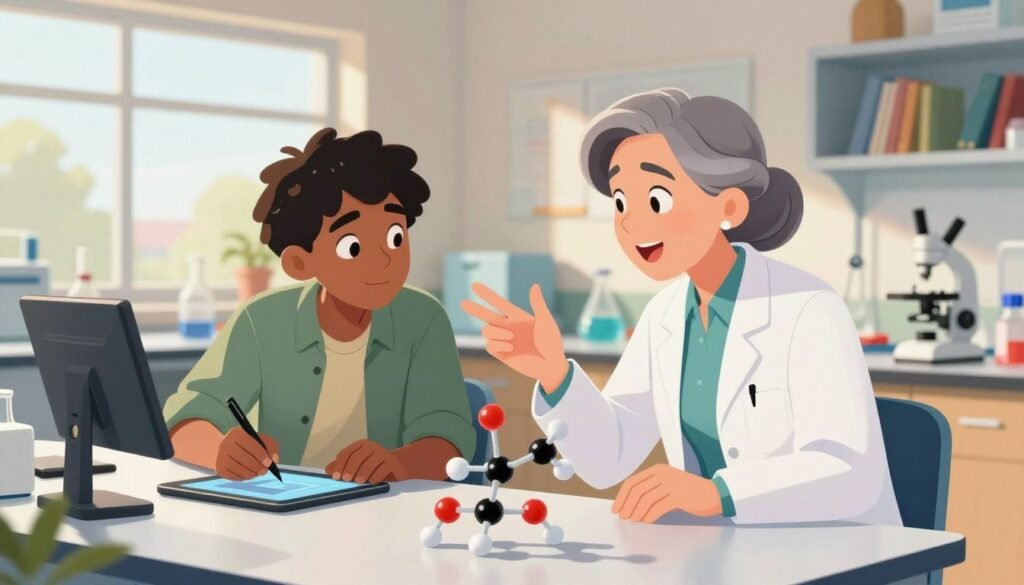
By focusing on mentorship, we help young scientists grow. Let’s celebrate how mentorship helps the next generation of researchers!
Conclusion
Young scientists throughout history show us the amazing things the next generation can do. We can help them grow by supporting their talents and curiosity. This way, they can change the world for the better.
Looking ahead, young scientists will be key in understanding our world and finding new ideas. With the right help, they can reach their full potential. This will make our future brighter for everyone.
The stories of these young scientists inspire us. They show us how important curiosity and creativity are. As we finish looking at their achievements, we know the future of science is bright. With support, the next generation will do amazing things!