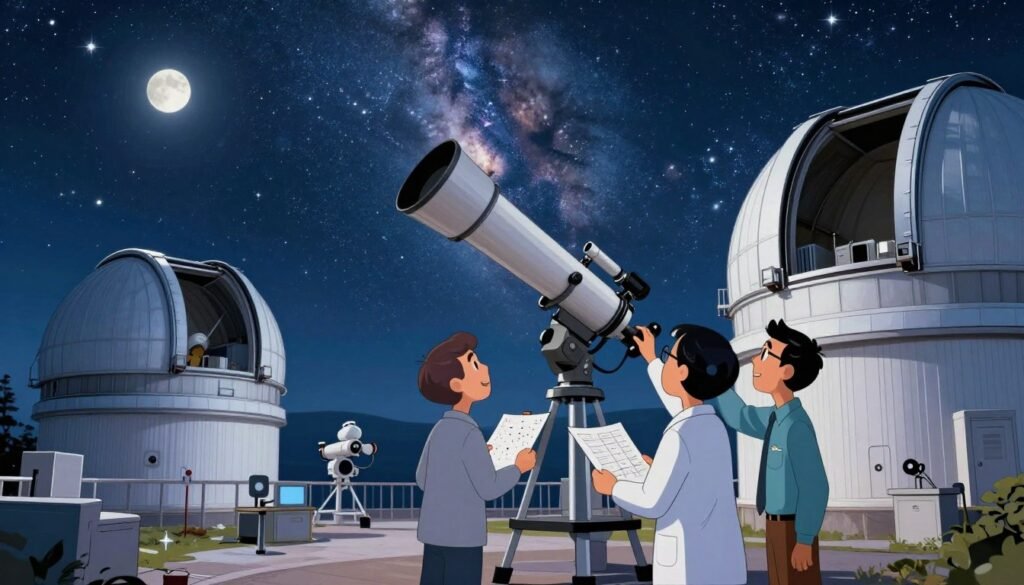
Imagine looking up at the twinkling night sky and feeling wonder! We all have an explorer inside us. From the start, people have tried to unlock the cosmos’ secrets.
Early astronomers used simple tools to track the moon and sun. They figured out our Solar System and how the sky changes. Now, we explore the warping of spacetime and the Universe’s expansion!
The best minds changed our world. Their bravery led to space exploration and modern travel! You can join this adventure and learn about the galaxy now.
Try out Debsie Gamified Courses at https://debsie.com/courses to start your mission! We’re excited to explore these legendary scientists with you. Let’s learn together!
Key Takeaways
- Early sky watchers helped us understand how the Solar System works.
- Groundbreaking discoveries mapped the chemistry of stars and black holes.
- Famous thinkers paved the way for modern rocket travel and discovery.
- The expansion of the Universe remains one of our biggest mysteries.
- Learning about the cosmos helps children grow their intellectual curiosity.
- Interactive courses make studying the stars fun and easy for everyone!
The Foundations of Celestial Mechanics
Pioneers laid the foundations of celestial mechanics. They dared to challenge old ideas! For centuries, knowing how stars and planets move was key to understanding the universe.
This journey changed how we see the cosmos. It opened doors for future astronomers.
Nicolaus Copernicus and the Heliocentric Revolution
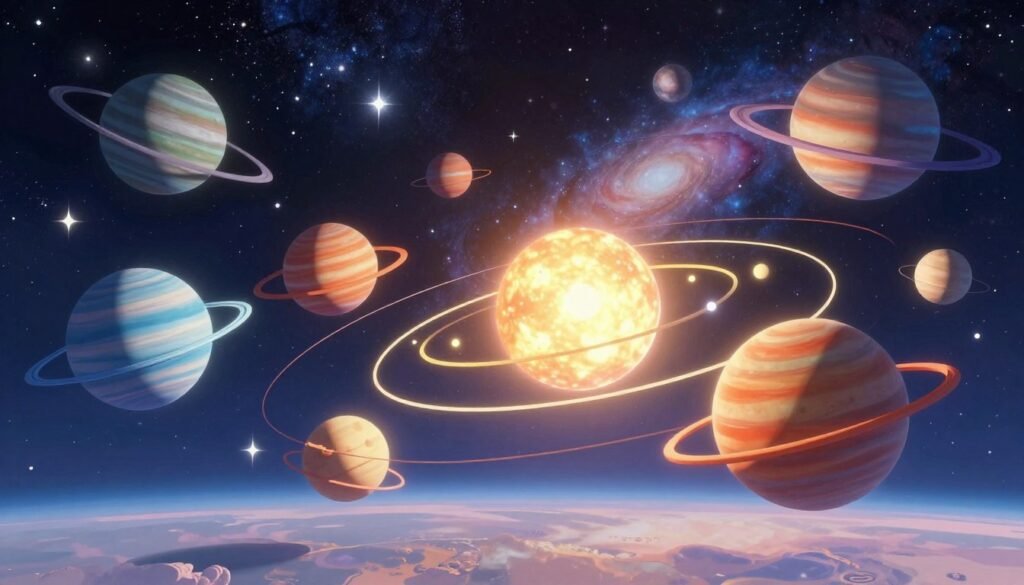
Nicolaus Copernicus changed the game with heliocentrism. He said the Sun, not Earth, is at the center of our solar system! This idea shook the old geocentric model and started a new way of thinking.
By putting the Sun at the center, Copernicus made it easier to understand how planets move. His work, De revolutionibus orbium coelestium, was a big step in astronomy. It made people see the universe in a new light and inspired others to explore.
Johannes Kepler and the Laws of Planetary Motion
Johannes Kepler built on Copernicus’s ideas. He found three key laws of planetary motion. These laws explained how planets orbit the Sun.
Kepler’s laws showed planets move in oval paths around the Sun. They also showed that the line from a planet to the Sun sweeps equal areas in equal times. His work was a big leap in understanding the universe.
Galileo Galilei: The Father of Observational Astronomy
Galileo Galilei used the telescope to show us new things in space. He changed how we see the universe. His work helped us explore space better.
Refining the Telescope for Space Exploration
Galileo made the telescope better. He saw things that helped prove the heliocentric model. He found four moons orbiting Jupiter, which was new and exciting.
Galileo kept looking and saw Venus change phases. This showed the universe is not centered on Earth. It was a big step in observational astronomy.
Challenging the Geocentric Dogma
Galileo’s work didn’t just add to our knowledge. It also changed how we think. He supported the heliocentric model, which was new.
“Measure what can be measured, and make measurable what cannot be measured.”
This quote shows how Galileo thought about science.
Galileo’s work helped future scientists a lot. He is very important in observational astronomy. His work still inspires scientists today!
Isaac Newton and the Universal Law of Gravitation
The universe is full of mysteries. Isaac Newton helped us understand a big part of it. His law of gravitation showed us how things move in space.
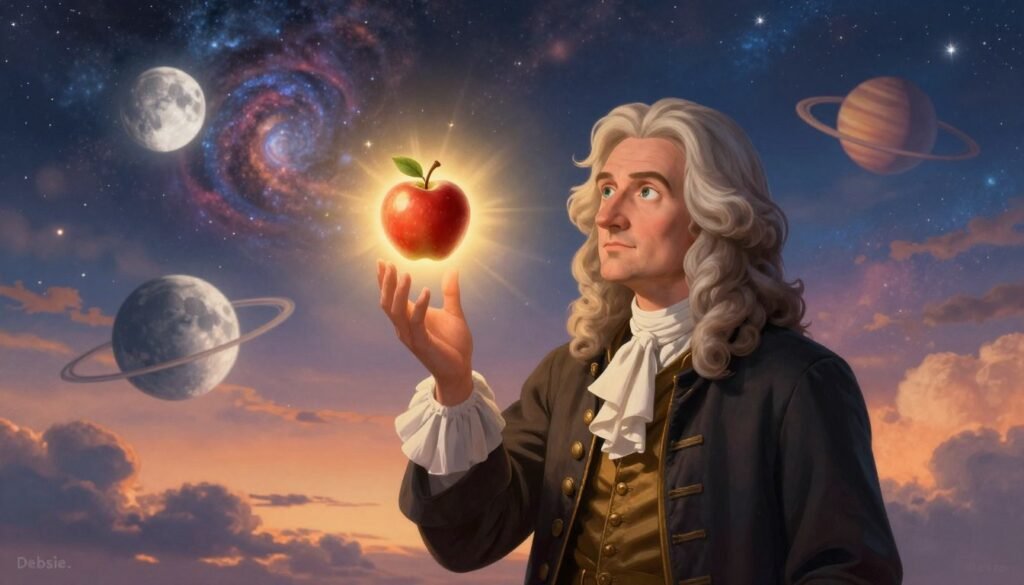
Newton figured out that the same force that makes apples fall is what keeps the Moon and planets in motion. This led to his universal law of gravitation. It says that every object pulls on every other object.
Defining the Physics of the Heavens
Newton’s law was a big change. It gave us a simple way to understand the universe. It helped us know how planets and comets move, and even the tides.
Before Newton, people thought the sky and Earth were different worlds. Newton showed they are the same. This changed how we see the universe.
The Mathematical Language of the Universe
Newton didn’t just explain the universe. He also gave us a way to talk about it mathematically. The calculus he created helped scientists understand physics better.
We still use Newton’s ideas today. His work helps us understand everything from falling objects to galaxies. Newton’s work shows how important curiosity and science are.
The Pioneers of Modern Astrophysics
Modern astrophysics is thanks to pioneers like Cecilia Payne-Gaposchkin and Subrahmanyan Chandrasekhar! Their work has greatly helped us understand the universe.
Cecilia Payne-Gaposchkin and Stellar Composition
Cecilia Payne-Gaposchkin was a pioneering astrophysicist. She found that stars are mostly hydrogen and helium. This was a big discovery for understanding stars.
Simply put, Payne-Gaposchkin showed the universe is mostly light elements. This changed old beliefs and helped start new research.
- She challenged old ideas about stars.
- Her work showed what stars are made of.
- Payne-Gaposchkin’s work helped others explore the universe more.
We keep learning from pioneers like Payne-Gaposchkin. For more on famous astrophysicists, visit this page.
Subrahmanyan Chandrasekhar and the Life Cycles of Stars
Subrahmanyan Chandrasekhar was also key in modern astrophysics. He studied how stars live and die. His work showed us the different stages of a star’s life.
Chandrasekhar’s big idea was the Chandrasekhar limit. It tells us the biggest size a white dwarf star can be. This idea helps us understand when a star dies.
- He came up with the Chandrasekhar limit, important for star study.
- Chandrasekhar’s work showed us how stars live and die.
- His ideas have helped many scientists for years.
The work of these pioneers is very important. They help us learn more about the universe every day.
Albert Einstein: Redefining Space and Time
Albert Einstein changed how we see the universe with his theory of general relativity. He showed that gravity is not a force. Instead, it’s how massive objects bend spacetime.
General relativity says mass and energy bend spacetime. Imagine a heavy ball on a trampoline. It warps the surface, changing how other objects move.
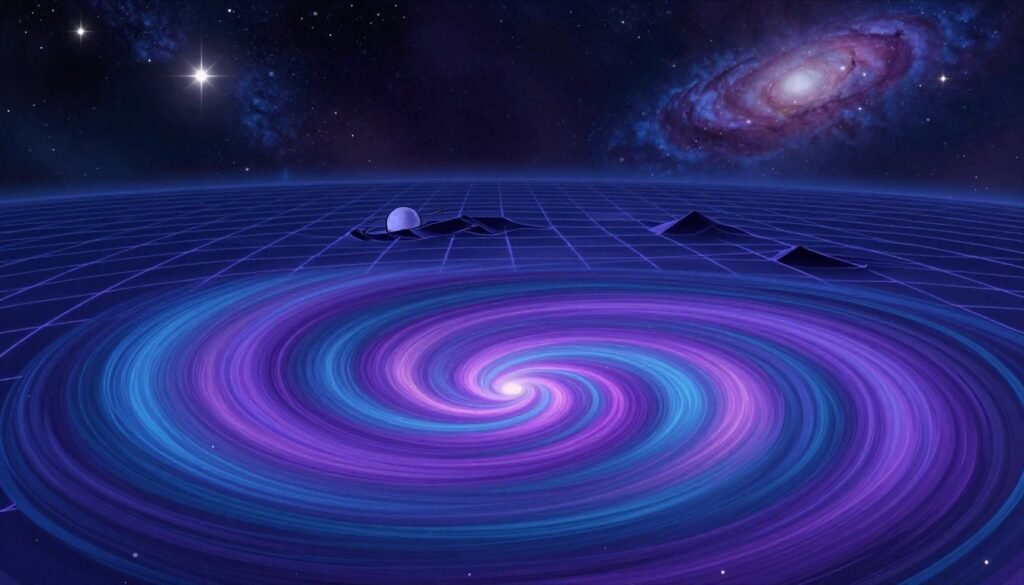
General Relativity and the Curvature of Spacetime
Einstein’s work was a big step forward in understanding gravity. His theory explained things like the bending of light around big objects. This was new and showed us more about the universe.
During a solar eclipse, we can see starlight bend around the Sun. This proves Einstein right. It shows how the Sun’s mass warps spacetime.
Predicting Black Holes and Gravitational Waves
Einstein also predicted black holes. These are areas where gravity is so strong, nothing escapes. At first, people doubted black holes. But now we know they exist.
General relativity also said about gravitational waves. These are ripples in spacetime from big objects moving fast. LIGO and VIRGO found these waves, opening new ways to study the universe.
Einstein’s work changed how we see space and time. His ideas are key to understanding the universe today. As we keep exploring, his ideas will keep guiding us.
Edwin Hubble: Expanding Our Cosmic Horizon
Edwin Hubble changed how we see the universe! He looked at the cosmos with new eyes. This made us see more of the universe.
The Discovery of Galaxies Beyond the Milky Way
Before Hubble, we thought the universe was just the Milky Way. But Hubble saw other galaxies. He found Cepheid variables in the Andromeda Nebula, proving it was a separate galaxy.
Hubble’s discovery was huge! It made us see the universe is bigger than we thought. It also led to more research on the universe’s structure and growth. Hubble said,
“The history of astronomy is a history of receding horizons.”
Measuring the Expansion of the Universe
Hubble also showed the universe is getting bigger. He saw that light from far-off galaxies is shifted. The farther away a galaxy is, the faster it is moving away!
This discovery was very important. It helped prove the Big Bang theory. It changed how we think about the universe’s start and growth. The universe’s expansion is key to modern astronomy.
Some important things about Hubble’s work are:
- Hubble’s observation of Cepheid variables proved the existence of galaxies beyond the Milky Way.
- The redshift of light from distant galaxies indicated the universe is expanding.
- Hubble’s work supported the Big Bang theory, revolutionizing our understanding of the universe’s origins.
The Legacy of the Best Space Scientists in History
Pioneering space scientists have a big impact on today’s space travel. Their discoveries and new ways of doing things help us now and will help us in the future.
These space science heroes are still important today. They helped us learn more about space. They also inspired many scientists and engineers to follow in their footsteps.
Shaping Modern Missions
Old discoveries help shape today’s space missions. For example, Nicolaus Copernicus and Johannes Kepler helped us understand how to move through space.
We keep using their ideas to explore more and see farther into space.
- The heliocentric model of the solar system
- The laws of planetary motion
- The understanding of gravitational forces
Evolution of Scientific Methodology
Today’s science is very different from the past. New technology and computers help us make more accurate observations and run complex simulations.
For instance, better telescopes and data tools let us see the universe in ways we never could before.
- Increased precision in observations and measurements
- Advances in computational power and data analysis
- Interdisciplinary collaboration among scientists and engineers
We keep improving our space knowledge and pushing the limits of space travel by using these new tools and ideas.
Carl Sagan: The Great Communicator of the Cosmos
Carl Sagan was a brilliant astronomer. He made the universe easy for everyone to understand! He inspired many scientists and fans of science.
Bridging the Gap Between Science and Society
Carl Sagan was great at explaining science to everyone. He made science fun and easy to get! His Cosmos series is a great example of this.
He wrote books that explained science in simple words. This made him loved by many. He wrote for both scientists and regular people.
The Search for Extraterrestrial Intelligence
Sagan also looked for life outside Earth. He thought it was a big human quest. He used radio telescopes to search for signals from other worlds.
The table below shows some key parts of Sagan’s work on SETI:
| Aspect | Description | Significance |
|---|---|---|
| Radio Telescopes | Used to detect signals from other civilizations | Potential for detecting extraterrestrial life |
| Arecibo Message | A radio signal sent into space to potentially contact extraterrestrial life | Symbolic attempt to communicate with the universe |
| SETI Research | Ongoing research into the possibility of extraterrestrial life | Continues to inspire new generations of scientists |
Carl Sagan’s work still inspires us today! His legacy teaches us about curiosity and knowledge. As we explore the universe, his work is very important.
Stephen Hawking: Unlocking the Secrets of Black Holes
Stephen Hawking changed how we see the universe, focusing on black holes! His work helped us understand these cosmic wonders better. It also inspired many scientists and thinkers.
Hawking’s study of black holes showed us more about them. He came up with Hawking radiation. This idea changed how we think about black holes and what happens to them.
Hawking Radiation and Quantum Gravity
The idea of Hawking radiation says black holes can release energy. This happens because of tiny quantum effects near their edge. Over time, this means black holes can shrink and eventually disappear.
A recent article on LIGO’s confirmation of Hawking’s theory shows his work’s impact. Hawking’s ideas have shaped our understanding of black holes.
Popularizing Complex Theoretical Physics
Hawking was great at making hard science easy to understand. His book, “A Brief History of Time,” is a great example. It shows how he could explain complex ideas simply.
Through his work and books, Hawking inspired many. He encouraged people all over the world to learn about the universe. His legacy keeps pushing new scientists to explore the cosmos.
Katherine Johnson and the Mathematics of Spaceflight
Katherine Johnson was a trailblazing mathematician. Her work was key to NASA’s Apollo missions! She was a human computer at NASA. Her mathematical calculations helped the spaceflights succeed.
Her work included calculating trajectories for the Apollo astronauts. This ensured they landed safely on the Moon and returned to Earth!
Calculating Trajectories for the Apollo Missions
Johnson’s work on orbital mechanics was vital for the Apollo missions. She worked with NASA engineers to make sure the flight paths were accurate. For example, her calculations helped the Apollo 11 astronauts reach the Moon’s surface and return!
Let’s look at some key aspects of her work:
| Aspect | Description | Importance |
|---|---|---|
| Orbital Velocity | Speed needed for a spacecraft to orbit the Earth or Moon | Key for achieving and keeping orbit |
| Trajectory Planning | The path the spacecraft follows from launch to landing | Important for reaching its destination |
| Launch Windows | Specific times for launch to achieve the desired trajectory | Crucial for matching with celestial bodies’ positions |
Breaking Barriers in Aerospace Engineering
Katherine Johnson’s achievements were more than just math. She was a trailblazer for women and minorities in STEM fields. Her story inspires many, showing that with hard work and talent, anyone can excel in their field!
To learn more about Katherine Johnson’s life and work, visit NASA’s tribute page!
Wernher von Braun and the Dawn of Rocketry
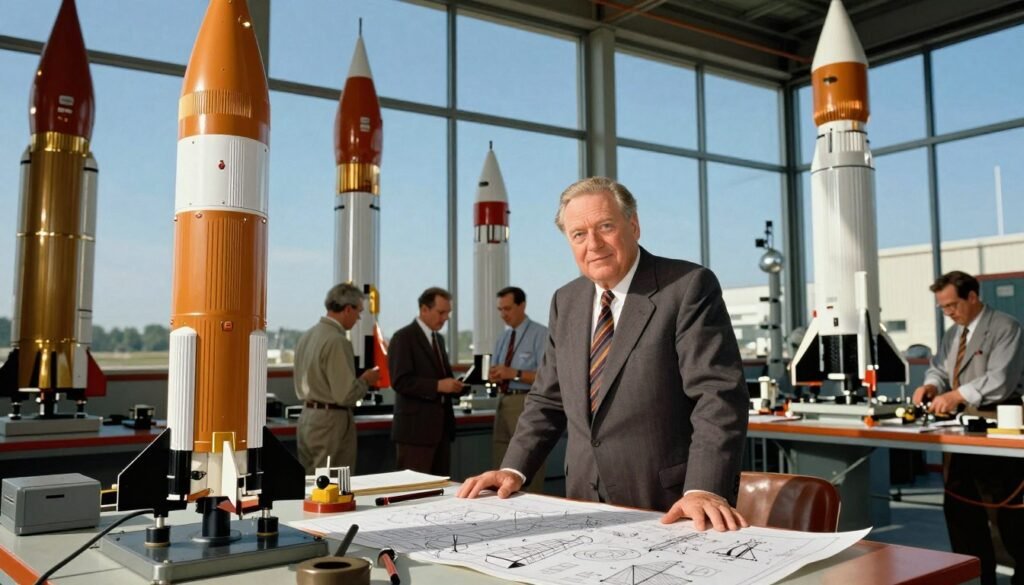
Wernher von Braun changed how we see space. He was a top rocket engineer. His work started modern space travel.
Von Braun helped make the Saturn V. This vehicle let astronauts land on the Moon. It also opened doors for more space travel.
Engineering the Saturn V Launch Vehicle
The Saturn V was huge, over 363 feet tall. It could take astronauts to the Moon. Von Braun’s team worked hard to make it.
| Feature | Description |
|---|---|
| Height | 363 feet |
| Payload Capacity | 262,000 pounds to Low Earth Orbit |
| Stages | 3 stages: S-IC, S-II, and S-IVB |
The Transition from Military to Civilian Space Exploration
Von Braun started with military rockets. But he helped move to civilian space use. His work on the Saturn V was a big step.
The Saturn V launch vehicle was key for the Apollo missions. It let astronauts land on the Moon. Von Braun’s work still inspires many today!
Vera Rubin and the Mystery of Dark Matter
Vera Rubin found dark matter by studying galaxy rotation. This changed astrophysics forever!
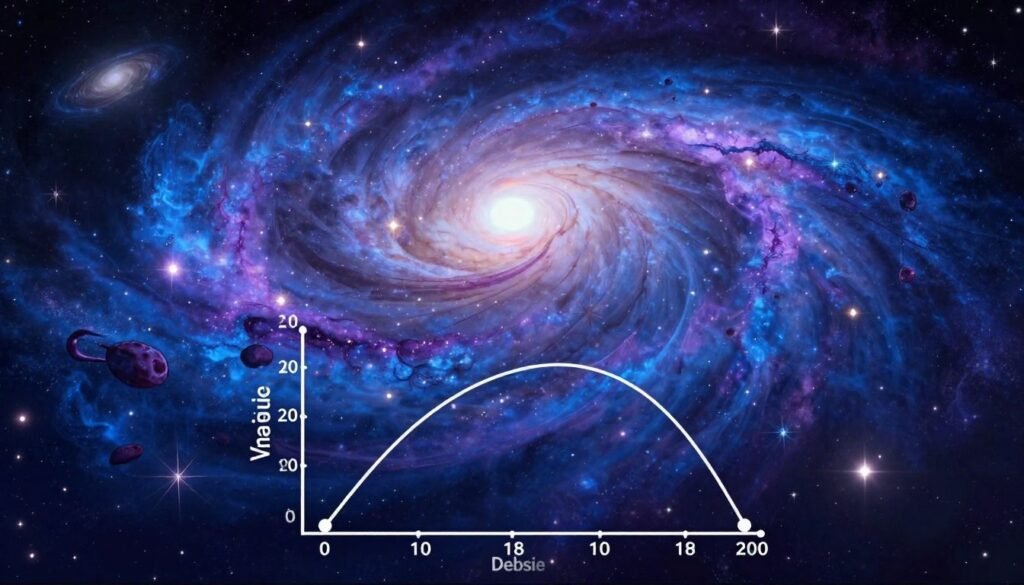
Galactic rotation curves show how star speeds change with distance. Vera Rubin’s observations revealed stars moving faster than expected. This meant there was more mass than we could see.
Observing Galactic Rotation Curves
Vera Rubin measured galaxy rotation curves. She found stars moving at a constant speed, far from the center. This was surprising because Newton’s laws said speed should slow down with distance.
The Invisible Influence Shaping the Universe
The gap between observed and expected rotation curves hinted at dark matter. Rubin’s work showed dark matter’s existence. It’s now known to make up 27% of the universe.
Today, we know dark matter’s key role in galaxy formation and growth. Vera Rubin’s work still inspires scientists today!
Learning from the Masters at Debsie Gamified Courses
At Debsie, we’re changing astronomy education with fun gamified courses. We want learning about space to be exciting for kids and parents!
Enhancing Your Scientific Knowledge Through Gamification
Gamification is more than a trend; it’s a way to make hard topics easy and fun. We use game ideas in our astronomy classes. This helps people learn and have fun at the same time.
Our gamified courses make learning fun and challenging. They help you understand space better. It’s a fun way to learn.
Why Interactive Learning Matters for Aspiring Astronomers
Interactive learning is key for those who want to be astronomers. It lets them learn in a fun, real-like way. They get to play with space data and learn a lot.
Our learning experiences spark curiosity and make you want to learn more. Debsie’s gamified courses are great for anyone who wants to learn astronomy in a fun way.
Explore the Curriculum at Debsie
Our astronomy lessons cover many topics, from the basics to the latest discoveries. Here’s what you can learn:
| Course Module | Description | Learning Outcomes |
|---|---|---|
| Introduction to Astronomy | Learn the basics of astronomy, like our solar system and beyond. | Know how the universe is set up and how things move in it. |
| Astrophysics Essentials | Learn the science behind space stuff. | Use science to understand space events and processes. |
| Cosmic Exploration | See the universe, from galaxies to stars. | Appreciate how big and complex the universe is. |
Ready to start your space journey? Try Debsie Gamified Courses today and explore the universe!
The Future of Space Science and Exploration
Space exploration is getting exciting! We’re about to discover new things in space. This includes secrets of dark matter and new worlds.
New technology and research will help us make big discoveries. These will help us understand the universe better.
Next-Generation Telescopes and Deep Space Imaging
New telescopes will let us see deeper into space. The James Webb Space Telescope is one example. It will help us study galaxies, stars, and planets in great detail.
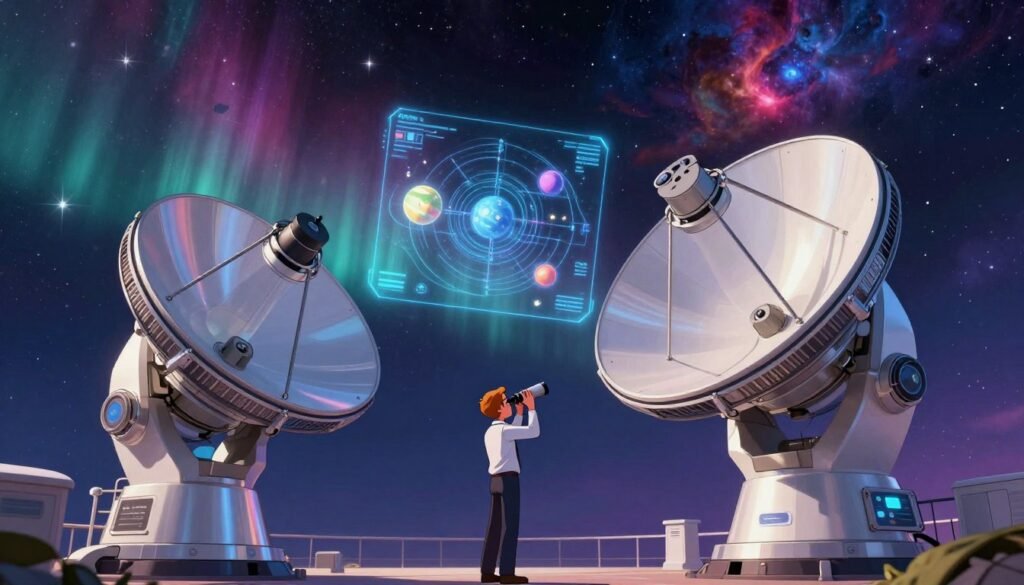
- Advanced optics for sharper images and more precise data.
- Increased sensitivity to find faint signals from far away.
- Improved data analysis software to handle lots of data.
The Role of Artificial Intelligence in Data Analysis
Artificial intelligence (AI) is changing space science. It helps analyze data from space missions. AI finds patterns and anomalies that humans might miss.
AI is used in many ways in space science:
- Data processing: AI quickly sorts through big datasets. This lets researchers focus on deeper analysis.
- Pattern recognition: AI finds patterns in data that could mean new discoveries.
- Predictive modeling: AI creates models to predict what we might see in the future.
The Impact of Collaborative Global Research
Collaborative global research is changing how we see the universe! Scientists from all over the world are working together. They are solving big challenges in space.
This teamwork brings many benefits. For example, international cooperation among space agencies has helped us learn more about space. Agencies like NASA, ESA, and Roscosmos are sharing their knowledge and resources.
International Cooperation in Space Agencies
Space agencies working together is key. They can do more together than alone. The International Space Station is a great example of international cooperation.
As a Harvard publication on a shared frontier says, working together is not just about sharing. It’s about finding new discoveries and breakthroughs.
Sharing Data to Solve Universal Mysteries
Data sharing is another important part of global research. By sharing data, scientists can find answers faster. They can learn more about the universe.
For example, data from space telescopes like Hubble and Kepler has helped us discover new things. This data sharing has let scientists study things we didn’t know before.
By keeping up the teamwork and sharing data, we can find more secrets of the universe. We can learn even more about the world around us!
Conclusion
We’ve looked at the amazing work of top space scientists. They’ve helped us understand the universe. People like Nicolaus Copernicus and Johannes Kepler started it all.
Today, scientists keep making new discoveries. They show us how vast and amazing the universe is. Their work inspires kids to love science and math.
At Debsie, we support this love for learning. We offer fun, personalized learning. This helps kids grow and love the universe’s wonders. The future of space science is exciting, and we can’t wait to see what’s next!