Have you ever looked up at the stars and felt amazed? We think every kid has a little explorer inside. This curiosity led to amazing discoveries by famous scientists who changed our view of the world.
These leaders didn’t just look at facts; they dreamed big and worked hard. They found secrets about energy, medicine, and our universe. Their work shows that asking “why” can change everything!
Want to start your own adventure? You can grow your brain and have fun! Try Debsie Gamified Courses at https://debsie.com/courses to start your journey today!
Learning about 20th century scientists inspires us to aim high. Their hard work and passion help us understand today’s world better every day!
Key Takeaways
- Discover how great minds changed world history forever.
- Explore links between human curiosity and scientific progress.
- Learn about major breakthroughs in physics and biology.
- See why these geniuses inspire students to dream big.
- Join fun learning adventures with interactive gamified courses.
- Understand how past discoveries shape our high-tech future.
The Dawn of Theoretical Physics and Albert Einstein
The 20th century saw a big change in how we see the universe. This was thanks to Albert Einstein. He was a theoretical physicist who changed physics a lot!
Einstein’s theory of relativity changed everything! It made us see space and time in a new way. Let’s see how his work changed physics!
Redefining Space and Time with Relativity
The theory of relativity changed how we see the world. Special relativity showed that mass and energy are the same thing. This was a big change in how we think about space and time.
General relativity said gravity is when space bends because of mass and energy. This was a huge change in how we see the universe. It changed how we see light and the universe growing!
The Photoelectric Effect and Quantum Foundations
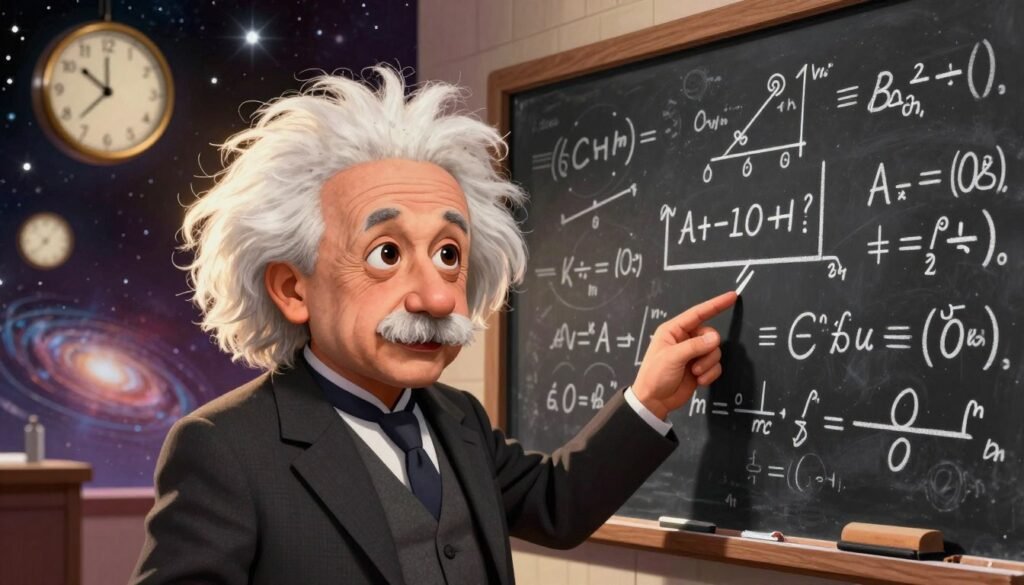
Einstein also worked on the photoelectric effect. He found that light can act like particles, called photons. The energy of these photons depends on their frequency. This was a big step for quantum theory!
His work on the photoelectric effect won him the Nobel Prize in 1921. It showed that light can act like waves and particles. This was a big idea at the time!
By looking at Einstein’s work, we learn about modern physics. His creative thinking and challenges to old ideas helped us discover new things!
Marie Curie and the Pioneering World of Radioactivity
Marie Curie changed how we see the world with her radioactivity work. She was a true leader, breaking new ground in chemistry and physics.
Breaking Barriers in Chemistry and Physics
Marie Curie worked hard to reach her goals. She was the first woman to win a Nobel Prize. She also won in two different sciences!
Her discoveries led to finding polonium and radium. You can find out more about her on the Nobel Prize website.
The Legacy of Mobile X-Ray Units in Wartime
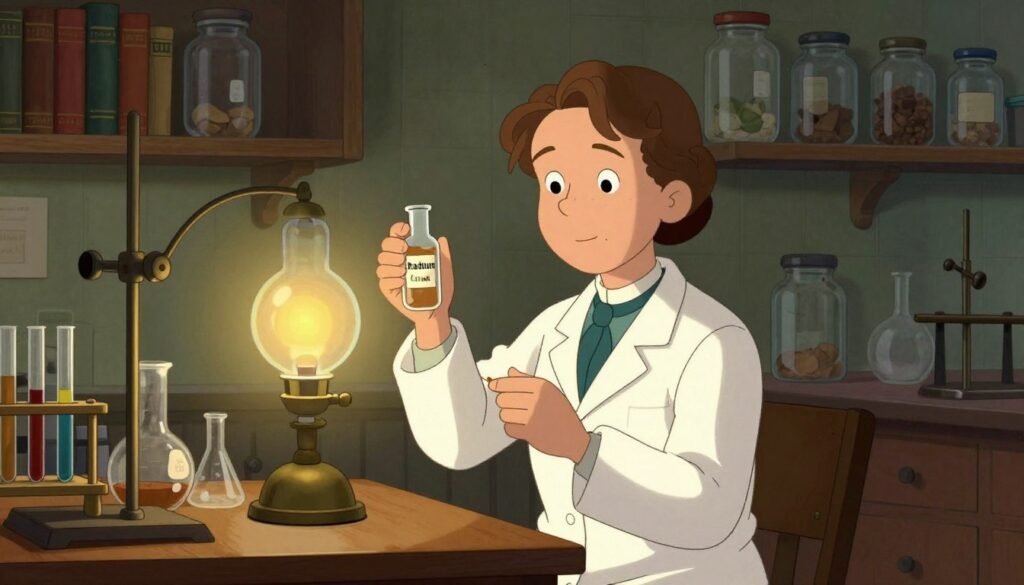
In World War I, Marie Curie helped create mobile X-ray units. This improved care for soldiers. Her work saved many lives and helped future medicine.
Alan Turing and the Birth of Computer Science
Imagine a world without computers or artificial intelligence. Alan Turing made our tech possible! He was a British mathematician and logician.
Turing helped start computer science and artificial intelligence.
Cracking the Enigma Code
During World War II, Turing helped crack the Enigma Code. It was a secret code used by the Nazis. His work at Bletchley Park was key.
He used the Bombe machine to help understand enemy messages. This shortened the war and saved many lives!
The Enigma Code was a tough puzzle. Turing’s solution showed his smart thinking. It also helped start computer science.
Defining Artificial Intelligence and the Turing Test
Turing did more than just codebreaking. He came up with the Turing Test. It’s a way to see if a machine can think like a human.
“We can only see a short distance ahead, but we can see plenty there that needs to be done.” – Alan Turing
The Turing Test checks if a machine can act smart like a human. It’s still important in AI today.
| Year | Event | Significance |
|---|---|---|
| 1936 | Turing publishes “On Computable Numbers” | Lays the foundation for modern computer science |
| 1941 | Turing’s work at Bletchley Park | Cracks the Enigma Code, aiding the Allied war effort |
| 1950 | Turing proposes the Turing Test | Defines a criterion for artificial intelligence |

The Genetic Revolution Led by Rosalind Franklin
Rosalind Franklin changed the game with X-ray crystallography. Her work helped us understand genetics and biotechnology.
At King’s College London, Franklin studied DNA with X-ray crystallography techniques. Her famous Photo 51 showed DNA’s double helix structure.
Capturing the Double Helix Structure of DNA
The double helix discovery was huge. Franklin’s Photo 51 was key to James Watson and Francis Crick’s model. You can read more about Franklin’s role on History.com.
Getting the double helix right was tough. Franklin’s work showed DNA’s molecular structure. This changed how we see genetic inheritance.

Advancing X-Ray Crystallography Techniques
Franklin was a master of X-ray crystallography. She improved methods to study molecule structures.
Her work helped structural biology grow. Today, X-ray crystallography is key for studying biological molecules.
Niels Bohr and the Architecture of the Atom
Imagine a world without knowing the atom’s secrets. Niels Bohr changed that forever! His work on atomic structure and quantum mechanics was key.
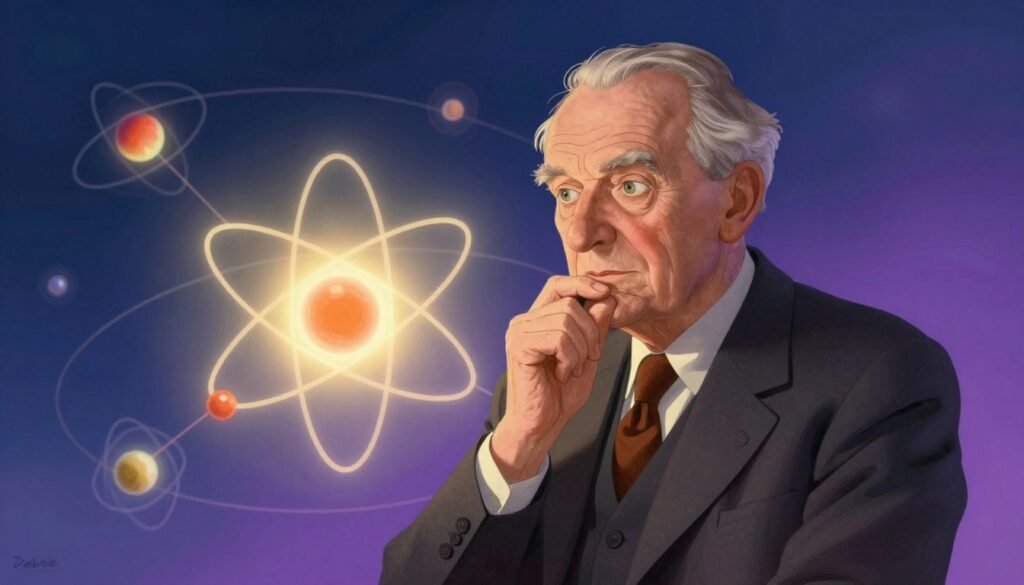
Niels Bohr introduced the Bohr model of the atom. It showed the atom as a small, positive nucleus with electrons in circles. This model was a big step in understanding the atom!
The Bohr Model and Quantum Mechanics
The Bohr model was more than a simple picture. It was a big step towards quantum mechanics. It showed how atoms use energy.
The Bohr model’s big deal was predicting hydrogen’s spectral lines. This was something classical physics couldn’t do. It opened doors to more quantum research!
| Key Features of the Bohr Model | Description |
|---|---|
| Electron Orbits | Electrons travel in circular orbits around the nucleus. |
| Energy Levels | Electrons occupy specific energy levels or shells. |
| Energy Emission/Absorption | Energy is emitted or absorbed when electrons jump between energy levels. |
Fostering Global Scientific Collaboration
Niels Bohr was a genius physicist and a big supporter of global science work. He helped bring scientists together, even in hard times.
Bohr’s work in science talks and teamwork has made a big impact. His legacy inspires scientists worldwide to work together!
Barbara McClintock and the Discovery of Jumping Genes
Meet Barbara McClintock, a trailblazing geneticist. She found “jumping genes” and changed genetics forever! McClintock was a pioneering geneticist who changed how we see genetics.
Her study on maize showed us special genes that move around. This was a big find for understanding how genes work and how they change over time!
Unlocking the Secrets of Genetic Transposition
McClintock found out that some genes can move around in a genome. This is called genetic transposition. It helps us understand how life changes and grows!
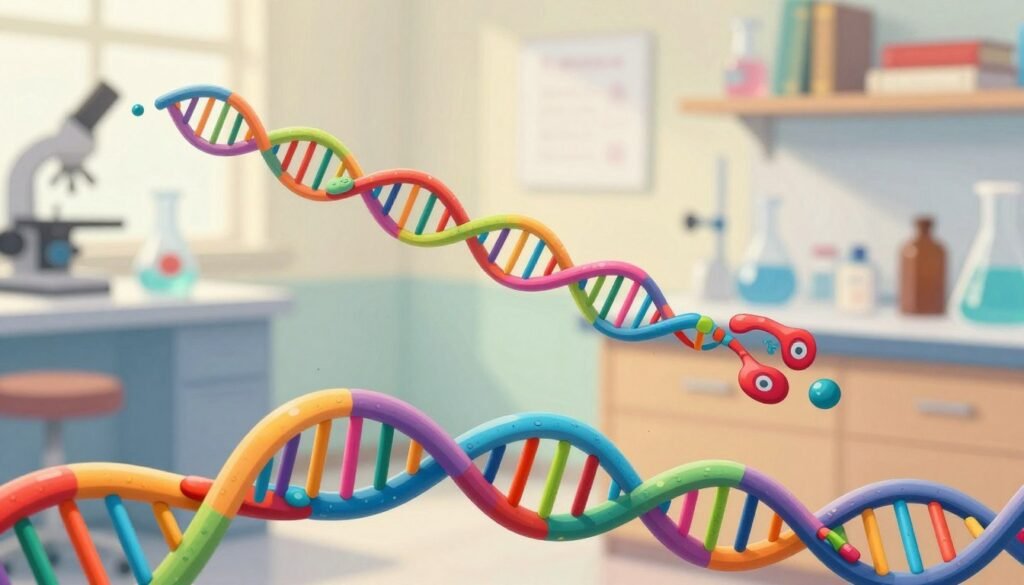
Her discovery of these moving genes helped us learn more about how genes work. It also led to new ways to study genetics and biotechnology!
| Key Aspects | Description |
|---|---|
| Transposable Elements | Genetic elements that can change their position within a genome |
| Genetic Transposition | The process by which genes “jump” from one location to another |
| Impact on Genetics | Advancements in understanding genetic regulation and genome evolution |
Persistence in the Face of Scientific Skepticism
Barbara McClintock faced a lot of doubt when she shared her “jumping genes” findings. But she kept going, driven by her love for discovery!
Her hard work helped us understand genetic transposition better. McClintock’s story inspires scientists everywhere!
Enrico Fermi and the Nuclear Age
Enrico Fermi was a trailblazer in nuclear physics. He led to a groundbreaking achievement that changed history! As a pioneering physicist, Fermi’s work deeply impacted our understanding of the atomic nucleus.
Fermi’s most notable achievement was leading the team that achieved the first controlled nuclear chain reaction! This milestone marked the beginning of the nuclear age. It opened up new avenues for energy production and scientific research.
The First Controlled Nuclear Chain Reaction
On December 2, 1942, Fermi’s team successfully initiated a controlled nuclear chain reaction at the University of Chicago. This experiment, known as Chicago Pile-1, showed the feasibility of nuclear reactors. It paved the way for further nuclear research.
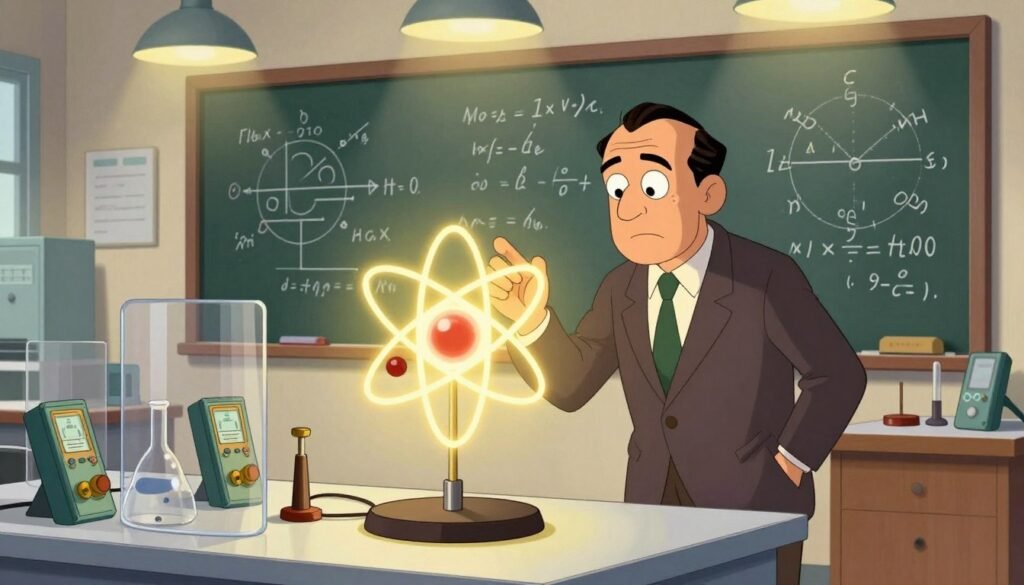
The achievement of the first controlled nuclear chain reaction was a significant milestone in nuclear physics. You can learn more about Enrico Fermi’s life and work to understand the context and impact of this achievement.
Contributions to Particle Physics and Statistics
Fermi’s contributions extended beyond nuclear physics to particle physics and statistical mechanics. His work on the Fermi-Dirac statistics provided a fundamental understanding of the behavior of particles at the atomic and subatomic level.
Fermi’s legacy continues to influence contemporary physics, with his theories and models remaining cornerstone principles in the field. His ability to simplify complex concepts has made his work accessible to new generations of physicists and researchers.
The Best Scientists of the 20th Century and Their Impact on Modern Education
The top scientists of the 20th century changed education forever! Their discoveries opened new ways to learn. This has made education more fun and interesting.
Bridging the Gap Between Discovery and Learning
Scientists like Albert Einstein and Rosalind Franklin showed us science’s power. They taught us that science is about learning and teaching too. This helps us get better at science and inspires new scientists!
Interactive learning is key. Gamified learning makes hard topics fun for everyone.
Enhancing Scientific Literacy Through Debsie Gamified Courses
Debsie leads the way with Debsie Gamified Courses. They use games to make science fun. Their courses fit everyone’s learning style.
Interactive Learning at https://debsie.com/courses
Check out https://debsie.com/courses for cool science games. These courses are fun and teach a lot. They make you curious about science.
- Engage with interactive simulations and games!
- Learn at your own pace with personalized feedback!
- Join a community of learners and compete in a friendly leaderboard!
Why Gamification Matters in Science Education
Gamification is a big deal in science teaching. It makes science fun and easy to get. This way, learning science is exciting and fun.

The work of the 20th century’s top scientists will keep changing education. With gamified learning, we’ll prepare the next generation. They’ll build on past discoveries and explore new science!
Linus Pauling and the Chemistry of Life
Linus Pauling changed science a lot. He worked hard on molecular biology and peace. His work still helps us learn new things.
Pauling was key in molecular biology. He figured out a lot about chemical bonding. His research helped us understand molecules better.
The Foundations of Molecular Biology
Pauling’s work helped us know more about living things. He showed us how chemical bonds work. This helped us understand molecules better.
He used quantum mechanics to study chemical bonds. This was a new way to look at molecules.
| Year | Contribution | Impact |
|---|---|---|
| 1931 | Publication of “The Nature of the Chemical Bond” | Revolutionized understanding of chemical bonding |
| 1951 | Discovery of the alpha helix structure of proteins | Advanced the field of molecular biology |
| 1962 | Awarded the Nobel Peace Prize | Recognized for peace advocacy |
Advocacy for Peace and Scientific Ethics
Pauling also cared a lot about peace and ethics. He worried about nuclear tests and weapons.
His work made people aware and changed laws. He won the Nobel Peace Prize in 1962 for stopping nuclear tests.
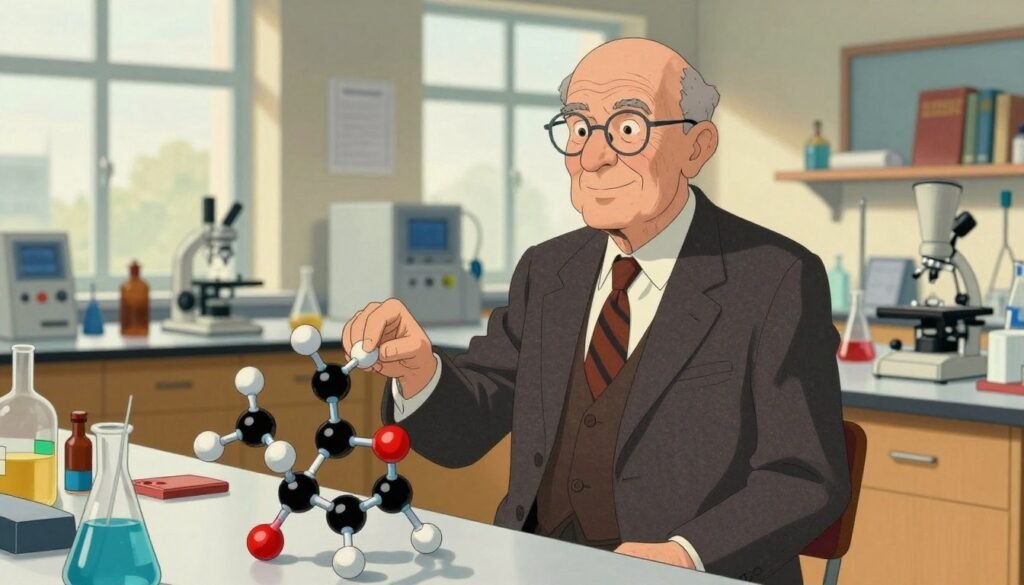
Pauling mixed science with peace and ethics. He left a big mark that still inspires today.
Richard Feynman and the Language of Physics
Richard Feynman was a true pioneer in physics. His work still inspires scientists and learners today.
He made big contributions to physics, but one key area was quantum electrodynamics (QED). QED explains how light and matter interact. Feynman’s work in this field was groundbreaking!
Quantum Electrodynamics and Feynman Diagrams
Feynman’s Feynman diagrams changed particle physics. These diagrams make complex math easier to understand. They help predict how tiny particles behave.
For example, Feynman diagrams show how electrons and photons interact. They turn complex interactions into simple pictures. This makes them a key tool in research.
| Feynman Diagram Component | Description |
|---|---|
| Lines | Represent particles such as electrons and photons |
| Vertices | Indicate interactions between particles |
| Loops | Represent virtual particles that are exchanged during interactions |
Making Complex Science Accessible to the Public
Feynman was not just a brilliant physicist. He was also a great communicator. He made science easy for everyone to understand. Through books and lectures, he shared his love for physics with many.
For those wanting to learn more about physics, top physics tutors and classes can help.
Feynman made science fun and easy to get. His work inspires teachers and students everywhere. His legacy lives on!
Rachel Carson and the Rise of Environmental Science
Rachel Carson’s “Silent Spring” in 1962 was a big moment for environmental science! This book showed the dangers of pesticides and started a big talk about protecting the environment.
Carson was a marine biologist and environmentalist. She talked about the bad effects of pesticides on animals and nature. Her work helped people see why we need to save nature and use resources wisely.
Silent Spring and the Pesticide Debate
“Silent Spring” was more than a book; it was a call to action. It talked about the bad side of pesticides, like DDT. Carson showed how these chemicals hurt animals and people.
This book started a big fight between those who make chemicals and those who want to protect the environment. Some said Carson was too worried, but her facts won many people over. For more on Rachel Carson, visit the Rachel Carson Homestead website.

Founding the Modern Environmental Movement
Rachel Carson’s work helped start the modern environmental movement. “Silent Spring” made many people want to help the environment. It led to big changes, like banning DDT in the U.S.
Carson’s work had a big impact in many ways:
| Area of Impact | Description |
|---|---|
| Environmental Policy | Helped make the U.S. Environmental Protection Agency (EPA) and laws like Clean Air and Clean Water Acts. |
| Public Awareness | Made people understand why we need to save the environment and fight pollution. |
| Scientific Research | Got more people to study how chemicals affect the environment. |
Today, Rachel Carson is seen as a leader in environmental science. Her work still inspires many to protect our planet. Her legacy reminds us to take care of Earth for the future.
Jonas Salk and the Eradication of Polio
Jonas Salk made a big step in 1955 with the first polio vaccine! This was a big win in the fight against polio. It was a disease that scared and hurt many people.
Creating the polio vaccine was a huge challenge. Jonas Salk and his team worked hard to make it safe and work well. Their hard work saved many lives and opened doors for more medical discoveries.
Developing the Vaccine
Several important things helped make the polio vaccine a success. These include careful testing and making it available to everyone.
- Extensive Research: Years of research went into developing the vaccine.
- Safety First: Ensuring the vaccine was safe for widespread use was a top priority.
The Ethics of Public Health
Salk made a big choice by not patenting the vaccine. This showed his dedication to public health, not just making money. This choice helped the vaccine reach more people fast.
Some key aspects of Salk’s approach include:
- Patent-Free Vaccine: By not patenting the vaccine, Salk enabled widespread distribution.
- Public Health Focus: Salk’s work prioritized the greater good, showing science’s power to make a difference.
- Global Impact: The vaccine has been key in almost wiping out polio worldwide.
Jonas Salk’s work still inspires scientists and health workers today. His contributions to medicine and his dedication to making discoveries available to all have had a big impact on health worldwide.
Conclusion
The best scientists of the 20th century changed how we see the world. They made big steps in physics, chemistry, computer science, and more. Their work is still important today.
They inspired many to study science and technology. Their stories show us the value of being curious and creative. To learn more about science, check out Debsie and their fun courses.
We can make the future brighter by following their example. Let’s keep learning and exploring science together!