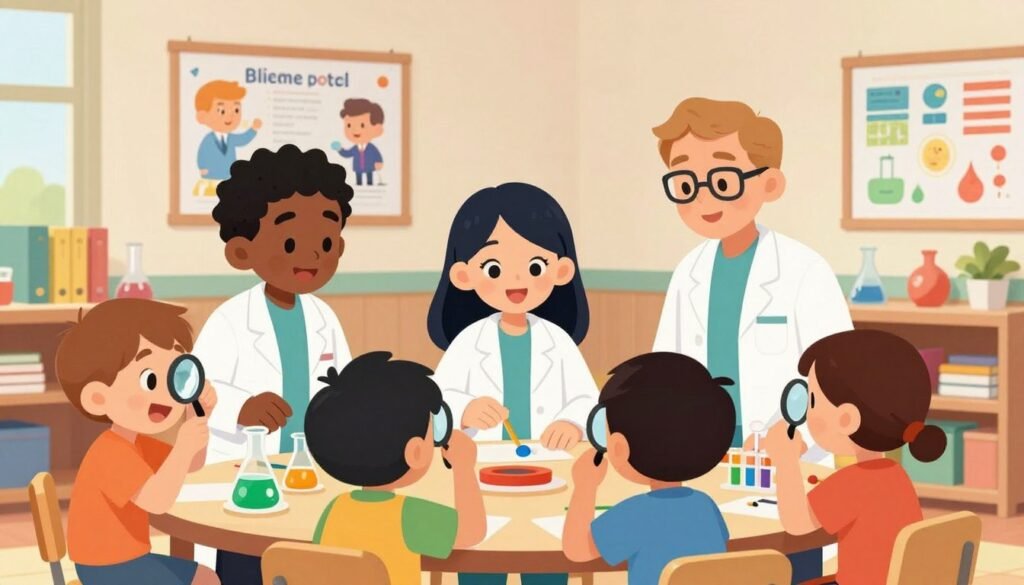
Do you remember looking up at the stars and feeling wonder? We want to keep that curiosity alive! Learning about great pioneers makes hard ideas easy and fun to remember.
Introducing young minds to the world of discovery through stories of famous experts can spark a lifelong passion. Renowned pioneers’ biographies are very valuable in teaching. They make learning an AMAZING ADVENTURE!
By exploring the lives of these trailblazers, youth gain a deep understanding of principles. We believe that science education aiding children should be fun and welcoming. It’s all about inspiration and growth!
Our platform, Debsie, offers gamified courses that make learning fun. You can start the learning journey today by visiting https://debsie.com/courses! Let’s play and grow together in this exciting world of learning!
Key Takeaways
- Biographies make complex concepts much easier to remember.
- Stories of trailblazers inspire a love of discovery.
- Interactive tools help young people grasp difficult principles.
- Gamified lessons turn education into an exciting game.
- Debsie provides personalized experiences to help youth thrive.
- Connecting with historical figures builds confidence in young learners.
Why Early Exposure to Science History Matters
Learning about scientists who changed the world can spark a love for learning in kids. It helps them understand science better and see the human side of discovery.
Biographies in science education make learning fun and relatable. Books like “Microbe Hunters” and “Crucibles: The Story of Chemistry” inspire young minds. These stories show the struggles and triumphs of scientists, making science fun and easy to grasp.
Sharing stories of famous scientists helps kids see science as a human journey. It encourages a love for learning and exploration. For example, you can try safe and fun chemistry experiments at home to make learning interactive!
The Benefits of Learning Science History
| Benefit | Description |
|---|---|
| Makes Science Relatable | By sharing the personal stories of scientists, science becomes more human and accessible. |
| Encourages Curiosity | Learning about the discoveries and challenges faced by scientists can inspire kids to ask questions and seek answers. |
| Fosters Appreciation | Understanding the history behind scientific concepts can foster a deeper appreciation for the subject. |
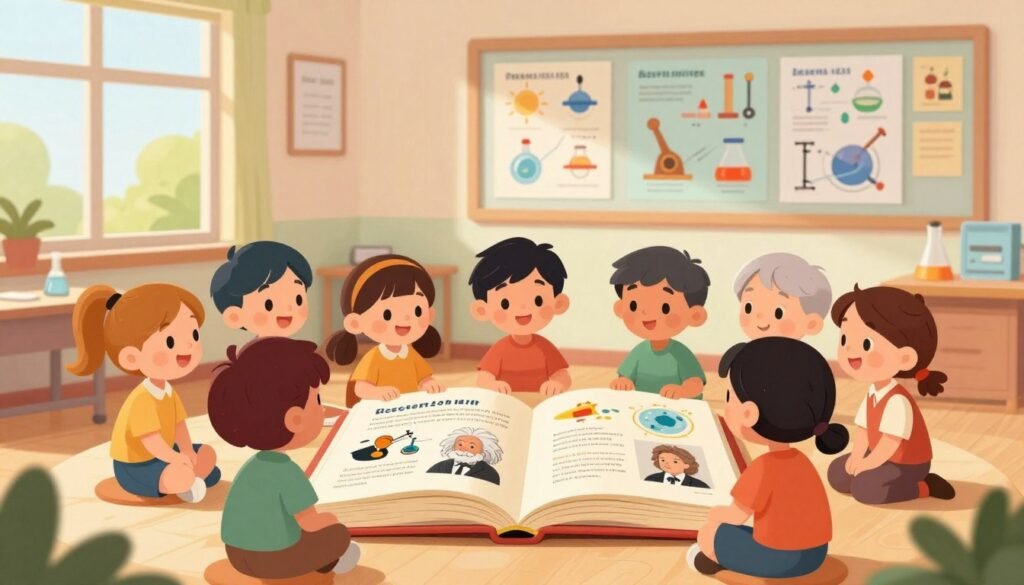
Adding science history to early education can deeply impact kids’ views of the world. It makes science fun and helps them understand it better.
The Best Scientists for Kids to Learn About First
To spark a love for science in kids, we share the amazing work of science heroes! By introducing them to key scientists, we inspire them to discover the scientific world. At Debsie, we make science fun and easy for young minds.
Choosing the right scientists for kids can be tough. But starting with big names like Albert Einstein, Marie Curie, and Isaac Newton is great. These leaders have changed our view of the world and opened doors for future scientists.
Books like “The Boy Who Loved Math: The Improbably Life of Paul Erdos” and “On a Beam of Light: A Story of Albert Einstein” are perfect. They’re kid-friendly science biographies that make science fun. They tell stories in a way that’s easy for kids to understand.
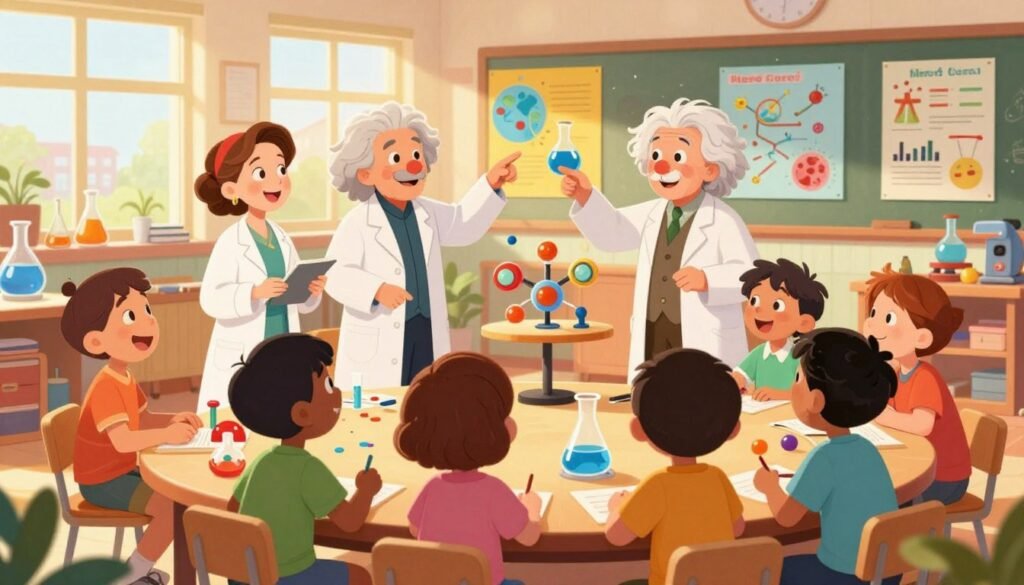
At Debsie, we make sure our content is both fun and educational. By focusing on famous scientists, we help kids learn about different sciences. This not only teaches them but also sparks their curiosity in science.
“The important thing is not to stop questioning. Curiosity has its own reason for existence.” – Albert Einstein
Einstein’s words capture the essence of scientific curiosity. By learning about great scientists, kids develop a love for science. They see how science shapes our world.
Albert Einstein and the Power of Imagination
Albert Einstein is known for his genius. His story mixes science and imagination. It inspires kids to think creatively and explore the universe.
Einstein’s work changed science and how we see the world. His theory of relativity showed us time and space are not fixed. They can change based on how fast we move and where we are.
Changing Our View of the Universe
Einstein’s theory changed how we see the universe. It showed that time and space can change. This depends on our speed and location in the universe!
Let’s use a simple example to understand this. Imagine you’re on a train and throw a ball straight up. To you, the ball goes straight up and down. But to someone watching, the ball also moves forward because the train is moving!
| Perspective | What Happens to the Ball |
|---|---|
| On the Train | The ball goes straight up and down. |
| On the Platform | The ball moves in a curve because the train is moving. |
Fun Experiments to Explain Relativity for Kids
Teaching relativity to kids can be fun with the right experiments! Here are a few ideas:
- Demonstrate time dilation using a simple clock or a timer.
- Use a flashlight and a mirror to show how the speed of light is always constant.
- Create a model of the solar system to discuss how gravity affects time and space.
For more interactive lessons, check out Debsie. It offers gamified courses that make learning fun and engaging!
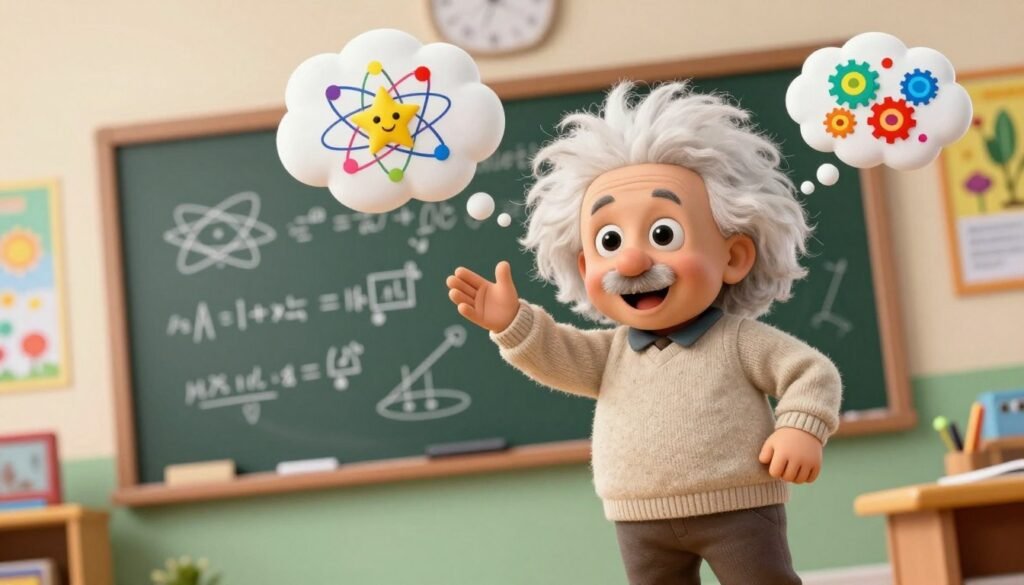
Reading “On a Beam of Light: A Story of Albert Einstein” by Jennifer Berne can also be helpful. It teaches kids about Einstein’s life and theories in an interesting way.
Marie Curie and the Spirit of Persistence
Meet Marie Curie, a trailblazing scientist who changed the world with her groundbreaking discoveries! Marie Curie’s journey is a powerful example of how persistence and hard work can lead to achieving great things, even in the face of challenges.
Marie Curie’s work in chemistry and physics was pioneering. She was the first woman to win a Nobel Prize and the first person to win two Nobel Prizes in different fields (physics and chemistry)! Her research on radioactivity paved the way for many scientific advancements.
Breaking Barriers in Chemistry and Physics
Marie Curie faced many obstacles in her career. At a time when women were not commonly accepted in science, she persevered and made significant contributions. Some of her achievements include:
- Discovering two new elements: polonium and radium.
- Pioneering the use of X-rays in medicine.
- Developing mobile X-ray units during World War I to treat soldiers.
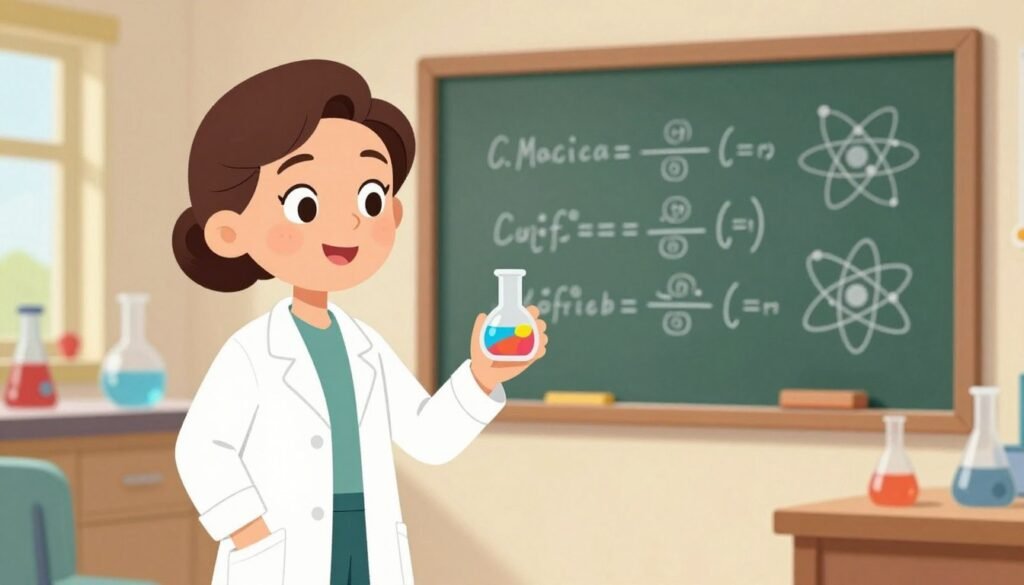
Lessons on Resilience and Scientific Discovery
Marie Curie’s story teaches us valuable lessons about resilience and the importance of following our passions. Here are some key takeaways:
- Perseverance is key: Marie Curie faced many rejections and challenges but continued her work.
- Be open to new ideas: She was not afraid to explore new areas of science.
- Collaboration matters: Her work with her husband, Pierre Curie, was instrumental in her discoveries.
Books like “Who Says Women Can’t be Doctors: The Story of Elizabeth Blackwell” and “Women in Science: 50 Fearless Pioneers Who Changed the World” are great resources to learn about more women who made significant contributions to science.
Isaac Newton and the Laws of Motion
Let’s explore the world of physics with Isaac Newton as our guide! He was a genius scientist from the 17th century. He is famous for his three laws of motion.
Newton’s laws tell us how things move and react to forces. A famous story about him is the apple that fell from a tree. This inspired his theory of gravity.
Gravity and the Apple Legend
The apple legend is a classic tale that makes physics easy to understand. It says Newton was sitting under an apple tree when an apple fell on his head. This made him think about the force that pulled the apple towards the ground.
“What we know is a drop, what we don’t know is an ocean.” – Isaac Newton
Simple Physics Demonstrations for Young Learners
We can show Newton’s laws with simple experiments. For example, we can see how an object stays still or keeps moving unless something else pushes it.
| Newton’s Law | Description | Simple Experiment |
|---|---|---|
| First Law | An object at rest stays at rest, and an object in motion stays in motion. | Pulling a tablecloth out from under dishes without disturbing them. |
| Second Law | Force equals mass times acceleration. | Pushing a heavy box versus a light box. |
| Third Law | For every action, there is an equal and opposite reaction. | Blowing up a balloon and releasing it. |
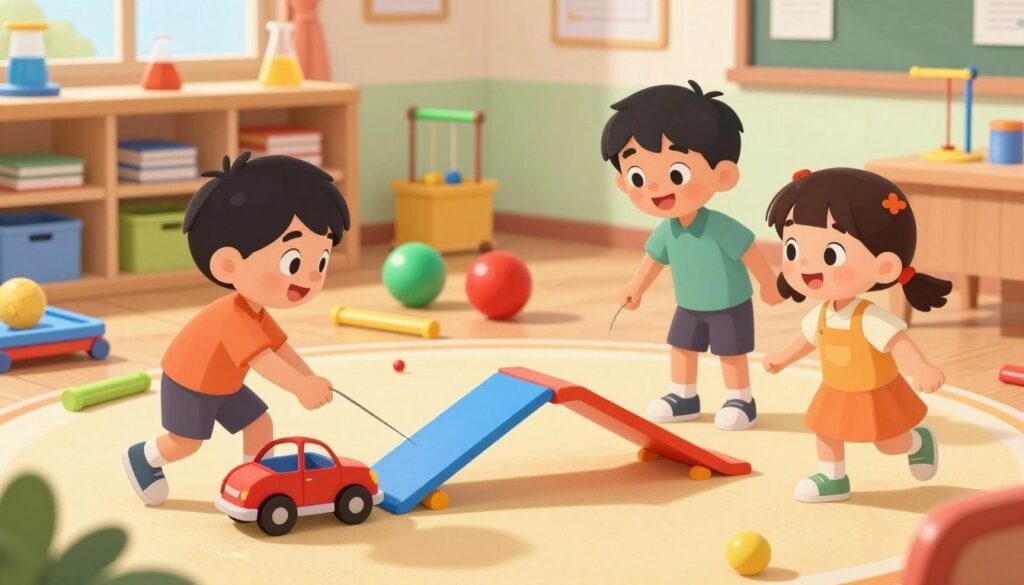
For more details on Newton’s laws and teaching them to kids, visit Debsie’s resource on the science of.
Jane Goodall and the Importance of Conservation
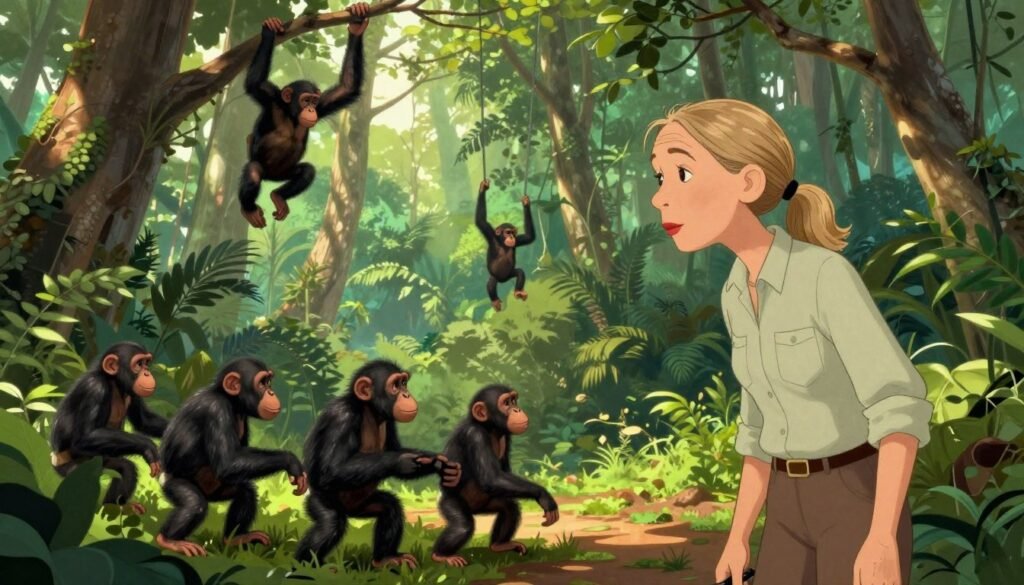
Jane Goodall’s story is full of passion and love for nature. It inspires many young people to care about the planet! Her work with chimpanzees shows us why we must protect our world’s diversity.
Her story teaches kids to care more about animals and nature. Goodall’s research, as seen in her biography, shows how one person can help save the planet.
Studying Chimpanzees in the Wild
Jane Goodall’s research on chimpanzees in Tanzania changed how we see them. She found out they are smart, social, and emotional. This made us rethink what makes us different from animals.
Teaching Kids Empathy for Animals and Nature
Goodall’s work shows us why teaching kids about nature is key. By learning about animals and ecosystems, kids grow to love nature more. Here are ways to teach empathy through science:
- Encourage children to observe and learn about local wildlife.
- Use stories and documentaries about conservation efforts.
- Engage kids in hands-on activities like planting trees or cleaning up parks.
| Conservation Actions | Impact |
|---|---|
| Reducing waste and recycling | Less landfill waste, conserved resources |
| Protecting natural habitats | Preserves biodiversity, supports ecosystem services |
| Supporting conservation organizations | Funds projects that protect endangered species and habitats |
Teaching kids about conservation and empathy prepares them to protect the planet. Jane Goodall’s work reminds us that we all can make a difference!
Nikola Tesla and the Future of Electricity
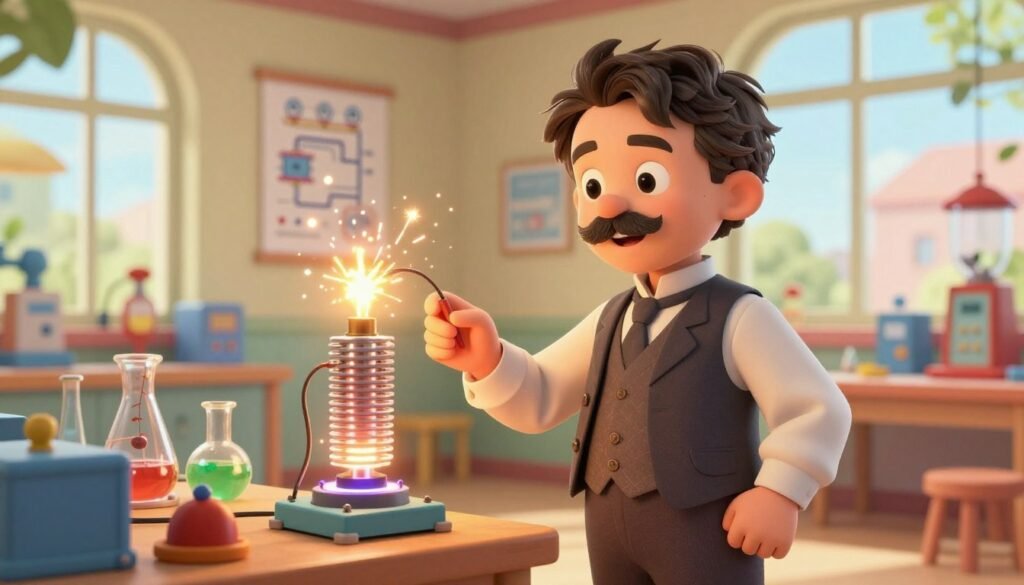
Let’s explore the amazing life of Nikola Tesla, a true pioneer in electricity! His work on alternating current (AC) changed our lives. Kids can learn about his achievements and the “War of Currents” to understand innovation and perseverance.
“Electrical Wizard: How Nikola Tesla Lit up the World” by Elizabeth Rusch is a great biography. It dives into Tesla’s role in electrical engineering.
The War of Currents and Modern Innovation
The “War of Currents” was a battle between Tesla and Thomas Edison over direct current (DC). Tesla’s AC won because it could send power far and wide. This led to electricity being everywhere.
We use AC electricity today, thanks to Tesla. Knowing its history can inspire kids to value innovation and hard work.
| Key Players | Their Contributions | Impact on Electricity |
|---|---|---|
| Nikola Tesla | Developed Alternating Current (AC) | Enabled efficient long-distance transmission |
| Thomas Edison | Advocated for Direct Current (DC) | Limited to short-distance transmission |
Safe Electrical Projects for Home Learning
Doing simple, safe electrical projects at home can teach kids about electricity. It can also make them curious about its uses. Here are some ideas:
- Create a homemade battery using a lemon or potato!
- Build a simple circuit using a battery, wires, and a small light bulb.
- Make a DIY electromagnet using a nail, wire, and a battery.
These projects teach kids about electricity basics. They also encourage creative thinking about electricity’s uses.
Ada Lovelace and the Birth of Computer Programming
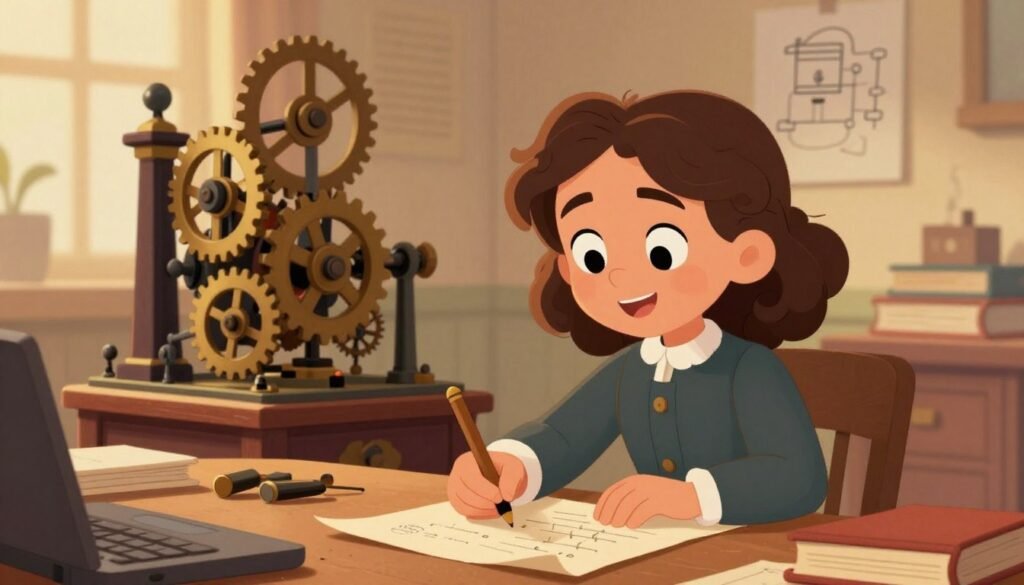
Ada Lovelace is a big name in computer science. She worked on Charles Babbage’s Analytical Engine. She is known as the first computer programmer.
Her story is inspiring. It shows the endless possibilities of computer programming!
The Visionary Behind the Analytical Engine
Ada Lovelace’s work was visionary. She saw the Analytical Engine’s true power. She knew it could do more than just calculate.
She said, “The Analytical Engine has no pretensions whatever to originate anything. It can do whatever we know how to order it to perform.”
“The more I study, the more insatiable do I feel my genius for it to be.” – Ada Lovelace
Her notes on the engine are historic. They show her as a pioneer in computer science. Learn more about her on National Geographic Kids.
Encouraging Computational Thinking in Children
Telling kids about Ada Lovelace can spark their interest in programming. Computational thinking is key in today’s world. It helps solve complex problems.
By teaching kids to program, we help them become creators. Not just users of technology.
- Start with simple coding games and puzzles that introduce programming concepts in a fun way!
- Use visual programming tools like Scratch to help kids understand how code can be used to create interactive stories and games.
- Encourage kids to think creatively about how technology can solve real-world problems.
By teaching kids to love programming, we shape the next generation of innovators!
George Washington Carver and Agricultural Innovation
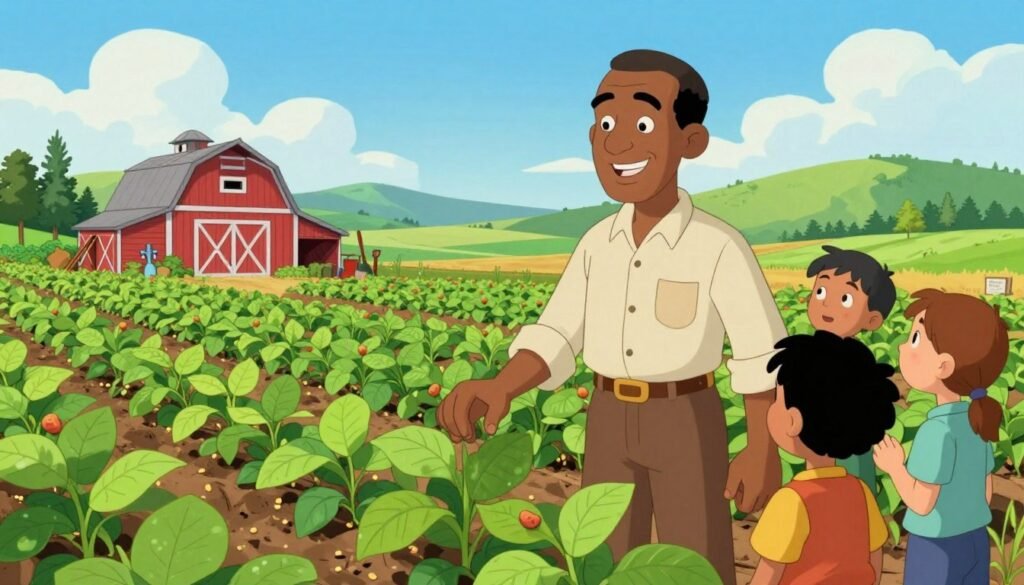
Imagine a scientist who changed farming and the environment. That’s George Washington Carver! He was a true pioneer in agricultural innovation. His work still inspires new generations.
Carver’s work shows us how to make a difference. By learning about him, kids can understand the value of sustainable farming and caring for our planet.
Crop Rotation and Sustainable Farming Practices
Carver’s big contribution was crop rotation and sustainable farming. He showed rotating crops improves soil health and boosts yields. This helps farmers and protects the environment.
Let’s see how Carver’s ideas help today:
| Crop Rotation Benefits | Environmental Impact | Farmers’ Benefits |
|---|---|---|
| Improved soil health | Reduced soil erosion | Increased crop yields |
| Reduced pests and diseases | Less need for chemical pesticides | Improved farm productivity |
| Increased biodiversity | Enhanced ecosystem services | More resilient farming systems |
Carver also worked with peanuts. He found over 300 uses for them. This shows the power of creativity in agriculture.
Teaching Kids About Environmental Stewardship
Learning about Carver teaches kids about caring for the environment. We can teach them simple ways to help, like reducing waste and planting trees.
Let’s inspire kids to care for our planet. Share Carver’s story and get them involved in sustainable activities!
Galileo Galilei and the Wonders of the Night Sky
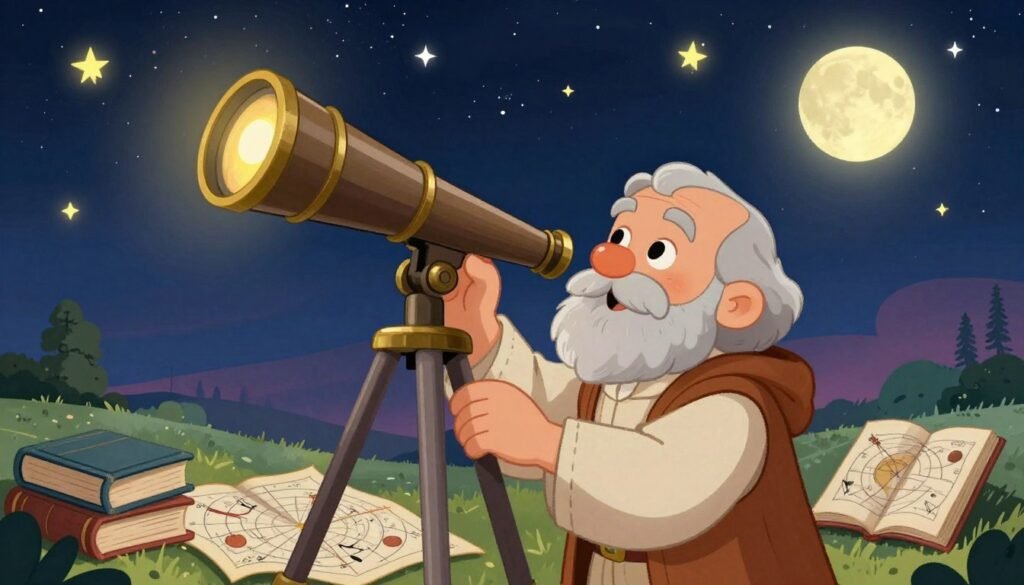
Let’s explore the world of astronomy together. We’ll learn about Galileo Galilei’s amazing work. He was a pioneer in understanding the universe. His discoveries inspired many to look up at the stars.
The Telescope and the Heliocentric Model
Galileo made the telescope better. He could see the night sky clearly. He found four moons around Jupiter and saw Venus change phases. This proved the heliocentric model is true. This model says the Sun is at the center, not Earth.
To learn more, visit NASA’s page on Galileo’s Observations. His work helped us understand the universe better.
Stargazing Activities for Aspiring Astronomers
Doing stargazing activities can spark a love for astronomy. Simple things like watching the moon or finding constellations are fun. You can use a telescope or binoculars to see more.
- Observe the moon and note its phases over a month.
- Identify constellations using a star chart or app.
- Watch a meteor shower and record your observations.
For kids wanting to learn about Galileo, “Along Came Galileo” by Jeanne Bendick is great. It introduces his life and work in an exciting way.
Rosalind Franklin and the Secrets of DNA
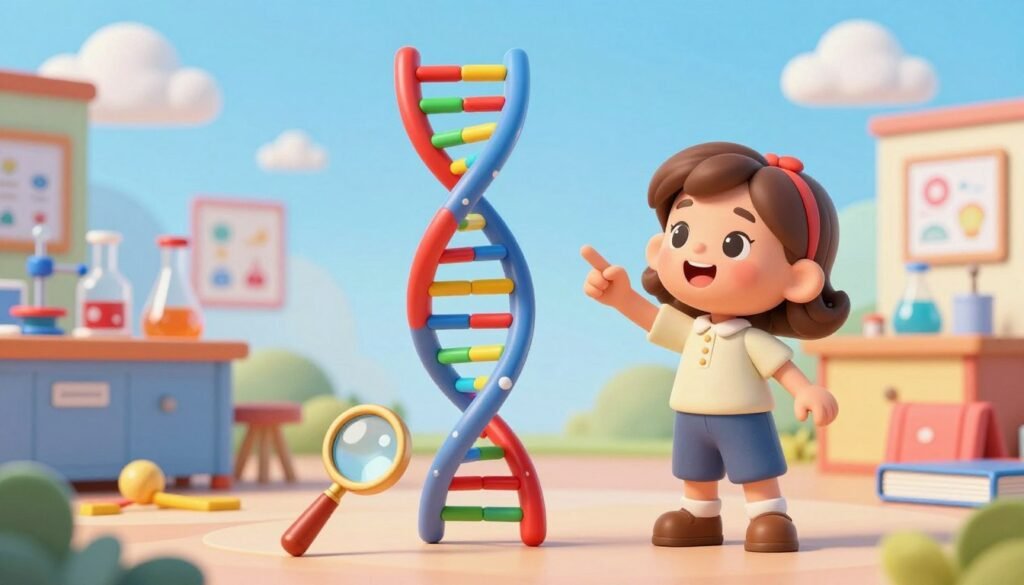
Meet Rosalind Franklin, a hero in science. She helped us understand DNA. She was a British scientist who worked hard to learn about DNA’s structure.
Her work helped find DNA’s shape. She took X-ray pictures of DNA. These pictures helped James Watson and Francis Crick create the double helix model. We can teach kids about genetics with fun activities!
The Hidden Hero of Molecular Biology
Rosalind Franklin faced many challenges. She was a woman in a man’s world. She worked hard with X-ray crystallography. Her story teaches us about determination and love for science!
Did you know? Her work on DNA was more than just pictures. It involved math and chemistry. Her data helped Watson and Crick win the Nobel Prize!
Explaining Genetics Through Hands-on Crafts
Teaching genetics to kids can be fun. Making DNA models is a great way to explain it. You can use pipe cleaners, beads, or playdough to make a DNA model. This helps kids see how DNA works.
Try this! Make a DNA model with pipe cleaners and beads. Use different colors for the four DNA bases: A, T, C, and G. Twist the pipe cleaners together and add the beads in the right order.
Louis Pasteur and the Fight Against Germs
Meet Louis Pasteur, the scientist who helped us understand the importance of hygiene and vaccination! Louis Pasteur was a French scientist from the 19th century. He is famous for his work on germ theory, vaccination, and pasteurization.
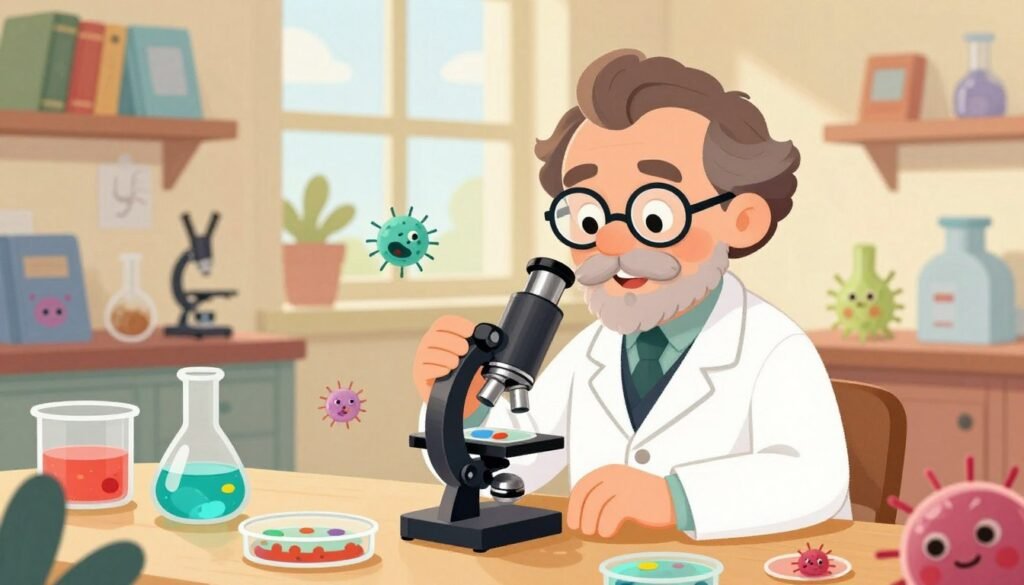
Pasteur’s work changed how we think about health and disease. Before him, many didn’t know how diseases spread. He proved that germs cause many illnesses. His findings led to big steps forward in public health.
The Discovery of Pasteurization and Vaccines
Pasteur created the process of pasteurization. It heats liquids to kill bad bacteria. This method is still used today in milk and other foods to make them safer.
He also helped a lot with vaccine development. His work on rabies and anthrax vaccines saved many lives. It also helped start modern vaccine research.
Teaching Hygiene Through Science Experiments
Teaching kids about hygiene can be fun with science experiments! For example, you can show how important handwashing is by:
- Using glitter or powder to represent germs on hands
- Showing how soap and water can remove these “germs”
- Talking about how regular handwashing stops illnesses from spreading
Such experiments teach hygiene and make learning science fun and interactive.
Gamifying Science Education with Debsie Courses
Imagine a world where science is fun, not boring. Welcome to Debsie’s gamified courses! We think learning should be exciting, not a chore. That’s why we’ve added game elements to our science courses.
Enhancing Learning through Gamification
Debsie’s courses make learning fun and engaging. We use quizzes, challenges, and rewards to keep kids interested. This makes science fun and easy to learn.
Gamification in education boosts engagement and motivation. It’s a great way to teach science. Our approach keeps kids curious and eager to learn.
Keeping Kids Engaged with Interactive Lessons
Interactive lessons are key in Debsie’s courses. We make science exciting with real-world examples and hands-on activities. This makes learning fun and relevant.
Here’s how our lessons help young learners:
| Benefit | Description |
|---|---|
| Enhanced Engagement | Interactive elements keep kids motivated and interested in learning. |
| Improved Understanding | Hands-on activities and real-world examples help clarify complex concepts. |
| Develops Problem-Solving Skills | Challenges and quizzes encourage critical thinking and problem-solving. |
Curious about Debsie? Check out our curriculum and start your child’s learning journey today. Visit https://debsie.com/courses to explore. Our platform is easy to use, helping you find the right course for your child.
Join the Debsie community today and watch your child’s love for science grow!
Encouraging Curiosity Through Scientific Biographies
Reading about famous scientists can spark kids’ curiosity. It makes them wonder about the world and science. This can lead to a lifelong love for learning.
Biographies for kids about scientists are great for this. They tell stories of amazing discoveries and the people who made them. This makes science seem exciting and real.
These stories also show kids that science is for everyone. They see how different people have made big contributions. This encourages them to explore and learn more.
By reading about scientists, kids can see the impact of science on our lives. They learn about new ideas and how they change things. This makes them think about how they can make a difference too.
So, reading about scientists is a great way to spark curiosity in kids. It opens their minds to the wonders of science and the world.
Overcoming Challenges in Science Education
Making science fun for kids is more than just making it simple. It’s about sparking their love for discovery!
Science teaching can be tough, but it’s doable. We can make it fun by using cool biographies and interactive lessons. We also make it relevant to their daily lives.
Making Complex Concepts Accessible
One big challenge is making hard science ideas easy for kids. We can use examples they can relate to and hands-on activities to help.
For example, showing how gravity works by dropping different objects can really help kids understand.
- Use everyday examples to explain complex theories!
- Encourage hands-on experiments to make learning fun!
- Utilize visual aids like diagrams and videos to support understanding!
Resources for Parents and Teachers
Having the right tools is key for parents and teachers to help with science. Sites like Debsie have cool lessons and biographies that make science exciting.
Some great resources include:
| Resource | Description | Benefit |
|---|---|---|
| Debsie Courses | Gamified learning experiences | Makes science fun and interactive |
| Science Biographies | Stories of famous scientists | Inspires kids through real-life examples |
| Hands-on Experiment Kits | Practical science experiments | Enhances understanding through practical application |
As Albert Einstein once said,
“Imagination is more important than knowledge. Knowledge is limited. Imagination encircles the world.”
Conclusion
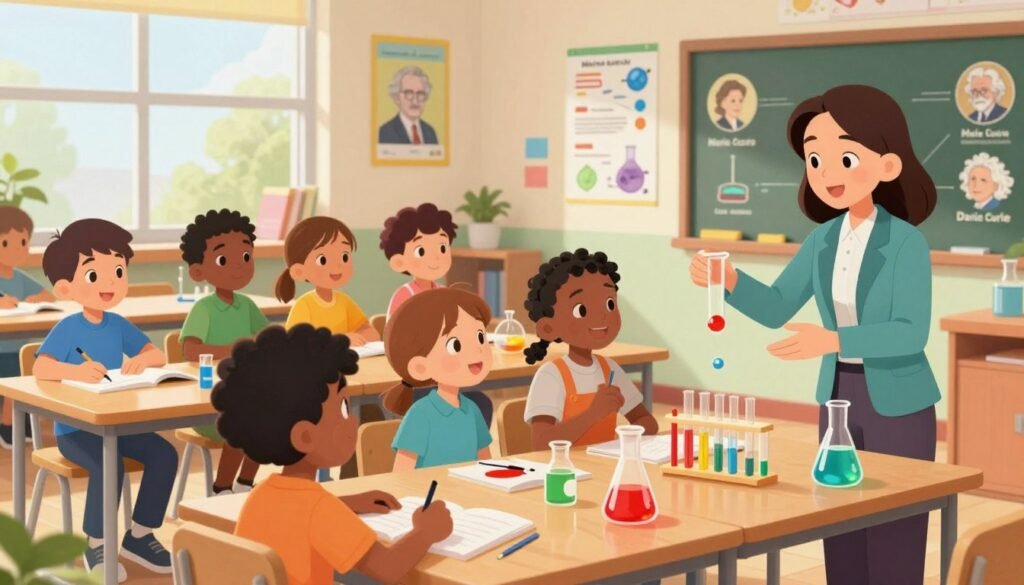
It’s very important to inspire young scientists for a better future. Science education for kids helps shape their minds. By telling them about famous scientists, we spark their curiosity.
At Debsie, we make science fun for kids. Our games and lessons inspire young scientists. Join us to give your child a fun learning experience.
Let’s inspire the next generation of scientists together. With Debsie, your child will love learning forever. It’s an exciting time to inspire young scientists!