Have you ever looked up at the night sky and wondered who helped us understand it? It’s amazing how one idea can change the world for everyone! Every child has a potential inventor inside, waiting to explore our world.
The scientists of Japan we honor today gave us life-saving medicine and robotics. Their hard work shows that curiosity is a superpower. These brave people changed our lives with their passion and dedication.
It’s time to celebrate the Japanese legacy of excellence and wonder. We want to help you play, learn, and grow as you find your path. Exploring these stories is like opening a treasure chest of knowledge for everyone.
Are you ready to start your own adventure in discovery? Try Debsie Gamified Courses at https://debsie.com/courses to grow your skills! STAY CURIOUS as you learn about those who dared to dream big.
Let’s explore these legendary stories together. You can get inspired to create something new! Learning is a grand adventure, and we’re happy to be on this journey with you. GROW YOUR MIND and see where your imagination takes you next!
Key Takeaways
- Discover how legendary innovators changed global technology and health.
- Learn how persistent curiosity leads to world-changing breakthroughs.
- Explore the unique contributions of Japan to modern robotics.
- Find inspiration to start your own scientific learning adventure.
- Understand the vital role of medicine in saving lives worldwide.
- See how personal passion turns into global success for everyone.
The Legacy of Scientific Innovation in Japan
The story of Japan’s scientific innovation is one of curiosity and genius. It’s shaped by innovative Japanese minds. Japan’s history is filled with famous Japanese researchers who made big contributions to science.
Japan values education and innovation a lot. This has led to many important discoveries. For example, Japanese scientists have made big strides in science and tech.
| Field | Notable Achievements | Impact |
|---|---|---|
| Physics | Advancements in particle physics and the discovery of neutrinos | Deepened our understanding of the universe |
| Biology | Research on autophagy and regenerative medicine | Opened new avenues for medical treatments and therapies |
| Technology | Development of lithium-ion batteries and carbon nanotubes | Revolutionized energy storage and material science |
Japan keeps inspiring new scientists and researchers. It values curiosity and hard work. This keeps Japan leading in scientific discoveries.
Defining the Best Japanese Scientists in History
Finding the top Japanese scientists in history is a deep dive into their groundbreaking contributions!
These trailblazers in science have moved their fields forward. They have also inspired many for generations!
To see why they are so special, let’s look at their achievements. Their work has had a big impact. You can learn more about Japanese scientists on Wikipedia’s list of Japanese Nobel laureates and.
| Scientist | Field | Notable Achievement |
|---|---|---|
| Hideyo Noguchi | Bacteriology | Identified the syphilis spirochete |
| Shinya Yamanaka | Regenerative Medicine | Developed induced pluripotent stem cells |
| Kitasato Shibasaburo | Medicine | Co-discovered the tetanus bacillus |
The table shows a few of the many influential Japanese scientists who have made big contributions!
These people are at the top because of their groundbreaking work. Their discoveries have changed science and the world!
Hideyo Noguchi: The Pioneer of Bacteriology
Hideyo Noguchi was a big name in bacteriology. He made huge changes in medicine! Born in Japan in 1876, he worked hard to understand diseases.
Noguchi found the syphilis bug, Treponema pallidum, in the 1900s. His work helped a lot in fighting diseases. He found the syphilis bug in sick people’s brains.
He also made a skin test for syphilis, called the Luetin test. Even though it’s not used now, it was a big step in finding the disease.
“The greatest happiness is to know the cause of the disease and to find the remedy.”
This quote shows his love for fighting diseases.
Impact on Modern Medicine
Noguchi’s work changed medicine a lot. His findings helped others study diseases and find new ways to test for them.
| Disease | Causative Agent | Diagnostic Method |
|---|---|---|
| Syphilis | Treponema pallidum | Luetin test (historical) |
| Rabies | Rabies virus | Fluorescent antibody test |
| Oroya Fever | Bartonella bacilliformis | Blood culture, serology |
Noguchi’s work is still important today. He inspired many scientists. His work in bacteriology is still very useful.
Learning about Hideyo Noguchi helps us see how far medicine has come. His story shows us the value of hard work and new ideas in science.
Shinya Yamanaka: Revolutionizing Regenerative Medicine
Imagine a world where damaged tissues and organs can be fixed or replaced. Shinya Yamanaka’s work is making this dream come true! He is a leader in Japanese science, changing how we see cells and their uses.
Yamanaka found a way to turn adult cells into stem cells. This is a big deal for medicine and research. This breakthrough could change regenerative medicine forever!
He took adult cells, like skin or blood, and made them into many types of cells. This means fixing heart tissue or making insulin for diabetes could be possible.
Let’s look at Yamanaka’s impact in this table:
| Year | Milestone | Significance |
|---|---|---|
| 2006 | Discovery of iPSCs | Revolutionized regenerative medicine by enabling the reprogramming of adult cells |
| 2012 | Nobel Prize in Physiology or Medicine | Awarded to Shinya Yamanaka for his groundbreaking work on iPSCs |
| Present | Ongoing Research and Applications | Continuous advancements in using iPSCs for disease modeling, drug discovery, and potential therapeutic applications |
Yamanaka’s work is a big win for science and hope for patients. As research grows, iPSCs could change healthcare a lot!
In short, Yamanaka’s work shows the power of new research. It shows how it can help people. We must keep supporting science for the good of all.
Kitasato Shibasaburo: The Father of Modern Japanese Medicine
Kitasato Shibasaburo is known as the Father of Modern Japanese Medicine. He made big discoveries that changed medicine in Japan and everywhere else.
Key Achievements:
- Isolation of the tetanus bacillus
- Discovery of the bubonic plague bacillus
- Development of the tetanus antitoxin
His work saved many lives. It also made Japan known more in science. Kitasato made Japanese medicine modern and up-to-date.
Kitasato Shibasaburo did more than just science. He taught and inspired many Japanese scientists. He encouraged them to study medicine and bacteriology.
Impact on Modern Medicine:
His work helped start new medical research and health projects in Japan. Today, Kitasato Shibasaburo is seen as a key scientist. His work is still celebrated all over the world!
Hantaro Nagaoka: Proposing the Saturnian Model of the Atom
The Saturnian model of the atom was a big step in physics by Hantaro Nagaoka.
Hantaro Nagaoka was a famous scientist from Japan. He came up with this model in the early 1900s. His idea helped grow the atomic theory.
Nagaoka thought the atom had a big center and electrons moving around it, like Saturn’s rings. This idea was very important.
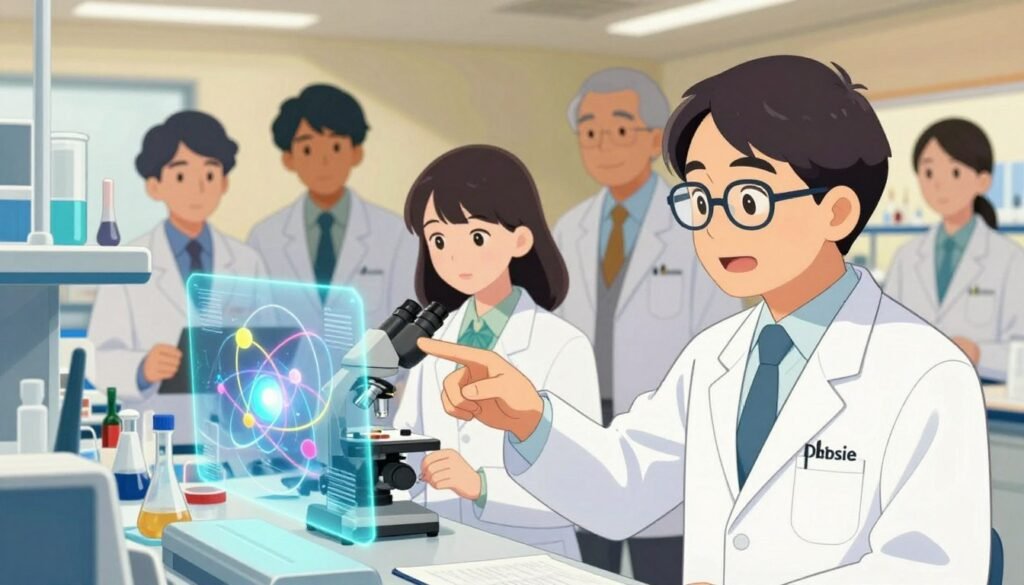
Nagaoka’s work on the Saturnian model shows how Japanese scientists changed our view of atoms. His ideas helped others make new discoveries in physics.
Learning about Hantaro Nagaoka and other Japanese scientists helps us see science is a global effort. Their findings not only grew our knowledge but also motivated scientists everywhere.
Yoshinori Ohsumi: Unlocking the Secrets of Autophagy
Yoshinori Ohsumi changed how we see cells. He found out how cells clean themselves. This is called autophagy.
Ohsumi found important genes for autophagy. He showed how cells control this cleaning. His work helps us understand diseases better.
To learn more, visit Tokyo Tech’s page on Yoshinori Ohsumi. It shows his big impact on science.
Key Findings of Ohsumi’s Research:
- Identification of autophagy-related genes
- Understanding the regulation of autophagy
- Implications for disease research and treatment
| Year | Discovery | Impact |
|---|---|---|
| 1990s | Identification of autophagy-related genes | Fundamental understanding of autophagy mechanisms |
| 2012 | Clarification of autophagy regulation | Advancements in disease research |
| 2016 | Nobel Prize in Physiology or Medicine | Global recognition of autophagy research |
Ohsumi’s work changed science a lot. It helped us find new ways to help people. His work shows how important basic science is for new medicines!
Chieko Asakawa: Breaking Barriers in Accessibility Technology
In the world of innovative Japanese minds, Chieko Asakawa is a shining star. She has changed the game in accessibility technology!
Chieko Asakawa is an IBM Fellow and a trailblazer. She has spent her life making tech better for people with disabilities. Her work has opened doors for many to use technology in new ways!

Her biggest hit is the IBM Home Page Reader. It made the internet easier for blind people to use. This shows her skill and her wish for everyone to be included.
Asakawa has also been a strong voice for making tech accessible. She has inspired many to make their work more inclusive. You can read more about her on IBM’s history page.
Her hard work shows how innovative Japanese minds are making the world a better place for all!
Ryoji Noyori: Advancing the Field of Asymmetric Catalysis
Ryoji Noyori has made big steps in science. His work helps us understand chemical reactions better. It also opens doors for new uses in medicines and materials.
He worked hard on making better catalysts for making complex molecules. His work lets us make pure compounds needed for drugs and more.
“The possibilities of science are infinite,” Ryoji Noyori said in an interview. This belief has guided his career, exploring new areas in science.
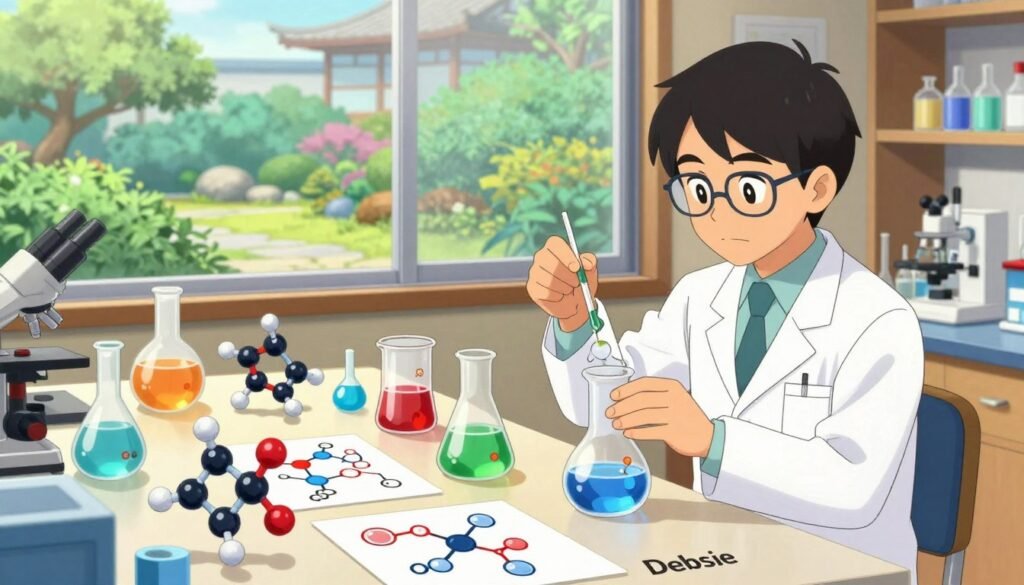
Noyori’s work is known worldwide, winning him the Nobel Prize in Chemistry in 2001. His efforts inspire many scientists today. They show how important hard work and new ideas are.
Midori Goto and the Intersection of Science and Education
Midori Goto’s work is a great mix of science and teaching. It inspires many young learners! We see how education helps grow future scientists.
Midori Goto shows us how important new teaching methods are in science. One great method is gamification. It’s used by places like Debsie.
Enhancing Learning Through Debsie Gamified Courses
Debsie’s courses make learning science fun and exciting! They use games to help students learn complex ideas in a fun way.
Why Gamification Matters in Scientific Education
Gamification in school is more than just fun. It makes learning feel real and helps students remember better. It makes students want to learn more, feel proud of what they do, and solve problems!
- Increases learner engagement
- Improves knowledge retention
- Develops critical thinking skills
Exploring the Debsie Platform at https://debsie.com/courses
Debsie has many gamified courses for different learners. Check out their courses at https://debsie.com/courses and see the future of learning science!

Akira Yoshino: Powering the Modern World with Lithium-Ion Batteries
Lithium-ion batteries power many devices today. They owe it to Japanese scientist Akira Yoshino. His work in the 1980s made the first lithium-ion battery possible.
Akira Yoshino started by trying different materials for a better battery. He used lithium cobalt oxide and carbon. This was a big step forward!
Lithium-ion batteries have changed our lives a lot. They make portable electronics like smartphones and laptops work. They also power electric vehicles!
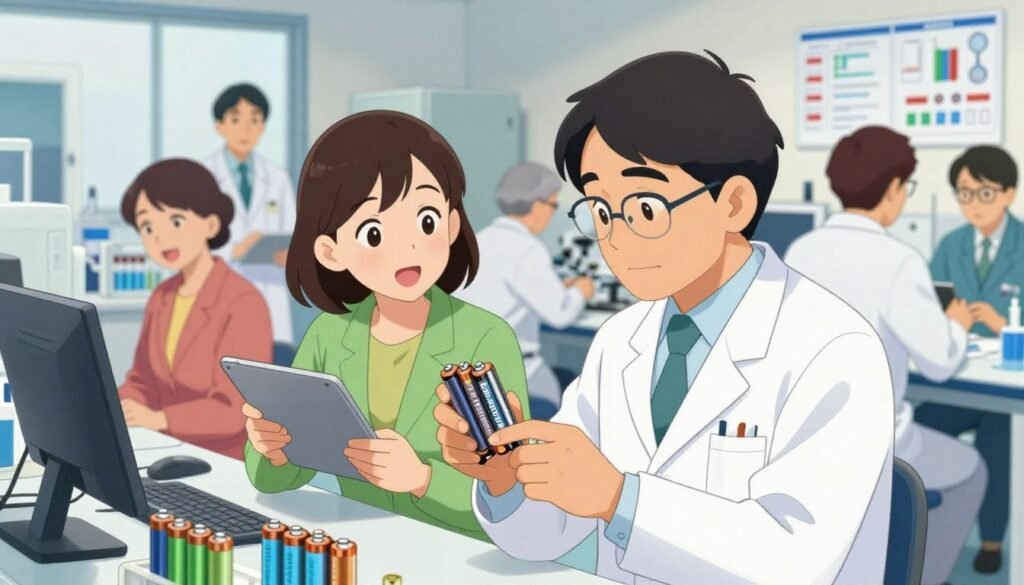
| Feature | Description | Advantage |
|---|---|---|
| High Energy Density | Lithium-ion batteries pack a lot of power relative to their size. | Enables the creation of smaller, lighter devices! |
| Long Cycle Life | These batteries can be charged and discharged many times. | Makes them cost-effective and convenient! |
| Low Self-Discharge | Lithium-ion batteries lose their charge relatively slowly. | Ideal for devices that are not used frequently! |
Akira Yoshino’s work on lithium-ion batteries is famous worldwide. He won the Nobel Prize in Chemistry in 2019!
Today, we keep improving technology. Akira Yoshino’s work reminds us of the power of innovation. It shows how it changes our lives every day!
Masatoshi Koshiba: Observing the Invisible Neutrinos
Masatoshi Koshiba changed how we see the universe with his neutrino research. He is a famous Japanese scientist. His work is key in neutrino astronomy.
Neutrinos are hard to find. Koshiba found new ways to see them. His work gave us new knowledge about these particles.
Significance of Neutrino Research
His work with the Kamiokande detector was a big deal. He saw neutrinos from Supernova 1987A. This was a huge moment in science!
Key Contributions
- Detection of Neutrinos from Supernova 1987A: This was a big find. It proved theories about supernovae and neutrinos.
- Advancements in Detector Technology: Koshiba made detectors better. This helped future research.
Seeing neutrinos helps us understand the universe. It confirms how stars work and explode. A study in Nature says it’s key for cosmic studies.
Koshiba’s work inspired many scientists. He showed us new ways to study the universe. His work opened doors for more research.
Takaaki Kajita: Proving Neutrino Mass
Let’s explore the world of neutrinos and Takaaki Kajita’s groundbreaking research. Neutrinos are very mysterious. They have puzzled scientists for a long time.
Takaaki Kajita is a famous Japanese physicist. He worked at the Super-Kamiokande observatory in Japan. His research showed that neutrinos have mass. This was a big discovery because scientists thought neutrinos were massless for a long time.The Experiment That Changed Everything!
The Super-Kamiokande experiment was key. It detected neutrinos from cosmic rays hitting the Earth’s atmosphere. Kajita and his team found that the number of neutrinos changed based on their direction. This showed that neutrinos can change types, or “flavors,” during their journey. This change, called neutrino oscillation, happens only if neutrinos have mass.
Kajita’s findings are very important. They show that neutrinos have mass, which challenges the Standard Model of particle physics. This discovery opens new doors for research into matter and the universe.
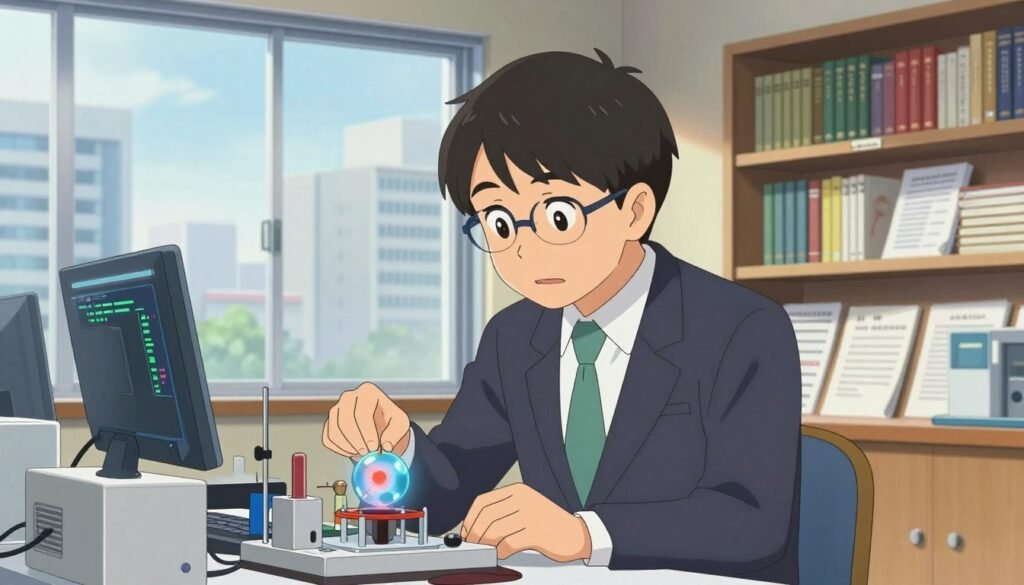
Here is a summary of the key points related to Takaaki Kajita’s research:
| Aspect | Description | Impact |
|---|---|---|
| Neutrino Mass | Proved that neutrinos have mass through the observation of neutrino oscillations. | Challenged the Standard Model of particle physics. |
| Super-Kamiokande Experiment | Detected neutrinos produced by cosmic rays and observed neutrino oscillations. | Provided evidence for neutrino mass. |
| Implications | Opened new research avenues into the fundamental nature of matter and the universe. | Advanced our understanding of particle physics. |
Takaaki Kajita’s work shows the power of human curiosity. His research has helped us understand the universe better. It has also inspired many scientists and researchers.
Sumio Iijima: The Discovery of Carbon Nanotubes
Sumio Iijima is a big name in innovative Japanese minds. He found carbon nanotubes. This discovery helped science and technology a lot.
In 1991, Sumio Iijima saw carbon nanotubes with an electron microscope. This was not just luck. It was hard work and understanding the tiny world!
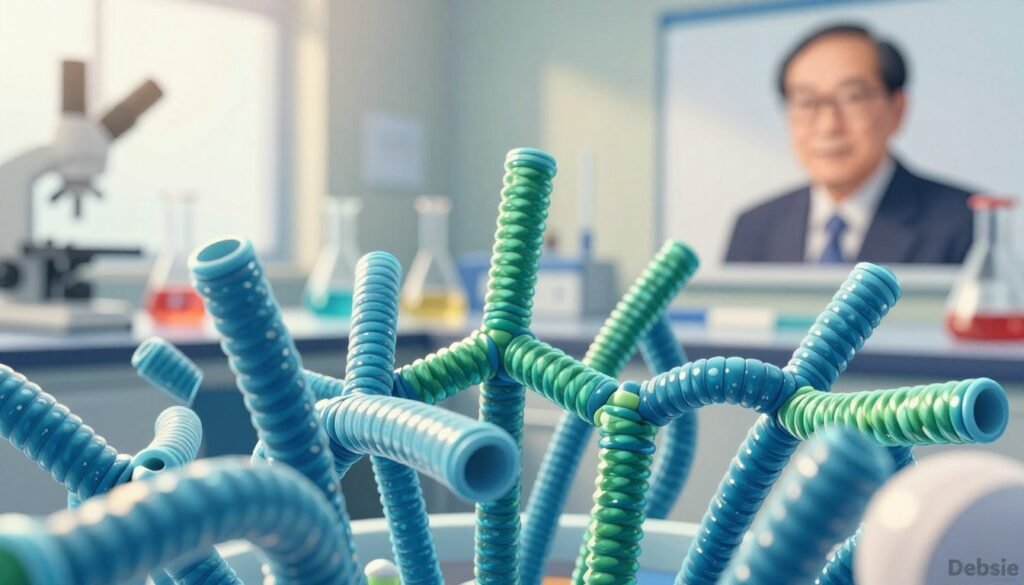
Carbon nanotubes are very special. They are strong, good at electricity, and keep heat well. They can be used in many things, like electronics and medicine! People all over are finding new ways to use them!
Iijima’s work shows how innovative Japanese minds help science. His discovery will keep inspiring scientists and engineers for years to come!
The Future of Japanese Scientific Research
The future of Japanese science looks bright. Many scientists in Japan are leading the way. They have made big contributions to different fields.
Japan is set to make a big impact in the future. It will keep being great in technology and engineering.
Japanese scientists are experts in robotics and electronics. They will make new things possible in these areas. For example, they might improve healthcare and manufacturing with new tech.
Factors Driving Progress
Several things will help Japanese science grow. Government support is key. It gives money for research and helps teams work together.
Japan’s education system is also strong. It focuses on science, technology, engineering, and math. This means there are always new, smart researchers coming along.
Interdisciplinary research is becoming more common. It lets scientists solve big problems from different angles.
Dr. Takaaki Kajita, a Nobel winner in physics, said,
“The future of science lies in the intersection of different fields.”
With its history, education, and government help, Japan will keep leading in science. The future looks bright thanks to these trailblazers in science.
Conclusion
Japan has led in science, thanks to its pioneers. They have changed the world. Hideyo Noguchi and Shinya Yamanaka are examples.
These people have made big impacts in their fields. Kitasato Shibasaburo and Yoshinori Ohsumi are also important. Their work has helped science grow worldwide.
Looking ahead, these pioneers will keep inspiring others. You can join this journey. Check out Debsie’s fun science courses at https://debsie.com/courses. It’s a great way to learn about science!