
Have you ever looked at the night sky and wondered how the stars move? That spark of curiosity is what drives the most brilliant minds to change our world! We are so excited to explore the legacy of people who dreamed big and worked hard.
Imagine a world without the number zero or the knowledge of modern medicine. It is quite hard to picture, right? Groundbreaking scientific contributions from history show us that a single idea can help every person on Earth.
We invite you to learn about famous Indian scientists who solved the biggest mysteries of nature. These pioneers paved a path for future generations to explore technology and extraordinary discoveries. Their passion is something we can all feel today!
You can even try out Debsie Gamified Courses at https://debsie.com/courses to learn more. It is a wonderful way to grow intellectually through interactive lessons and fun challenges! Let us begin this amazing journey of discovery together!
Key Takeaways
- Celebrate the legacy of brilliant minds who changed history.
- Discover how major breakthroughs in math and physics help us today.
- Understand the global impact of these extraordinary thinkers.
- Inspire the next generation to ask big questions and seek answers.
- Explore fun ways to learn and grow with Debsie.
The Legacy of Scientific Inquiry in India
India’s story of science is full of innovation and discovery. It goes back thousands of years! From ancient math and astronomy to modern physics and biology, India’s Indian science history is inspiring.
Ancient Indian scholars made big contributions to science. They helped set the stage for future scientists. For example, they came up with the idea of zero, changing math and more.
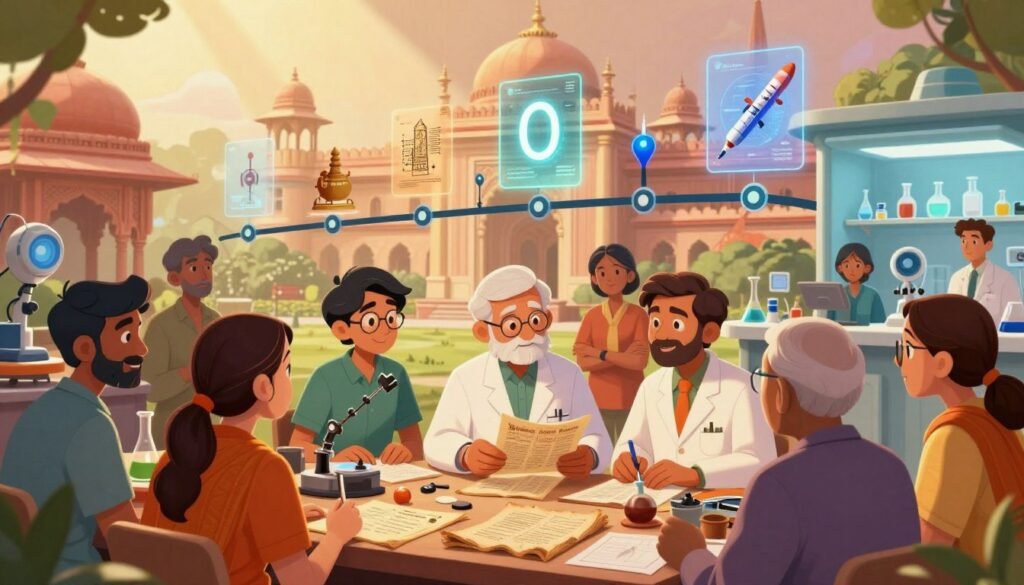
In recent times, scientific inquiry in India has grown even more. Scientists like Jagadish Chandra Bose and C.V. Raman made big discoveries. Their work helped us understand the world better and opened doors for other Indian scientists.
The legacy of Indian scientists is about more than just their work. It’s about how they’ve changed science worldwide. To learn more about their impact, read this article on the legacy of Indian scientists!
We keep celebrating and growing this legacy today. We encourage young people to explore, discover, and innovate. By learning from the past and facing future challenges, India’s science will keep growing!
Sir C.V. Raman: The Man Who Explained the Blue Sky
Sir C.V. Raman found the Raman Effect. He won the Nobel Prize in Physics. This made India known worldwide in science!
C.V. Raman was born in 1888. He loved learning about the world. He became a famous scientist in India.
He studied light and found something new. This changed how we see light forever!
So, what is the Raman Effect? It’s when light goes through something and changes. This change is important in science.
Raman did more than just find something new. He opened doors for others. He was the first Asian to win the Nobel Prize in Physics in 1930.
Here are some key things about C.V. Raman:
- He found the Raman Effect, changing how we see light.
- He was the first Asian to win the Nobel Prize in Physics in 1930.
- His work inspired many scientists and researchers.
C.V. Raman’s story shows us the power of curiosity and hard work. His legacy keeps inspiring scientists and learners everywhere!
Homi J. Bhabha: The Architect of India’s Nuclear Program
Homi J. Bhabha was key in starting India’s nuclear program. He helped build India’s nuclear setup. This set the stage for the country’s nuclear energy plans.
Homi J. Bhabha made big steps in nuclear physics. He wanted to use nuclear energy for good. His goal was to help science grow in India, not just make energy.
Bhabha was against making atomic bombs. He thought nuclear tech should help people, not harm them. This made India known for its smart use of nuclear power.
Bhabha’s work still helps India today. He started a path that India follows in nuclear energy. Now, India is a big name in nuclear science and energy.
Homi J. Bhabha’s work inspires many scientists. His dream of peaceful nuclear use still guides India’s science world.
Srinivasa Ramanujan: The Mathematical Genius Who Defied Logic
Meet Srinivasa Ramanujan, amathematical genius who amazed the world! He was born in a small town in India. From a young age, he showed a great talent for math.
Despite many challenges, he made big contributions tomathematical analysis,number theory, and infinite series.
Srinivasa Ramanujan’s work changed math forever. His mind was amazing, able to find complex math without learning it. You can learn more about his life and achievements from various sources, including this article.
Ramanujan’s work innumber theory is very important. He found new formulas and theorems that changed how we see math. His work on infinite series and continued fractions is also famous.
| Contribution | Description | Impact |
|---|---|---|
| Ramanujan Prime | A prime number that satisfies a certain condition related to the distribution of prime numbers. | Advanced number theory research. |
| Ramanujan Theta Function | A function that plays a crucial role in number theory, particularl in the study of modular forms. | Enhanced understanding of modular forms. |
| Infinite Series | Ramanujan derived numerous formulas for infinite series, many of which were previously unknown. | Expanded the field of mathematical analysis. |
Srinivasa Ramanujan’s legacy inspires many. His story shows that with hard work and passion, you can achieve great things. We celebrate his work and remember to support math talent and innovation.
Jagadish Chandra Bose: The Pioneer of Wireless Communication
Jagadish Chandra Bose was a big name in science. He was an Indian scientist who worked in the late 1800s and early 1900s. His work helped start modern wireless tech.
Bose showed the world how to talk without wires using radio waves. This was before Marconi’s inventions. His smart ideas helped make new tech possible!
Bose was the first Asian to get a US patent. This showed how important his work was. He studied radio waves and how to use them for talking.

Bose’s work changed tech a lot. His ideas helped make radio, TV, and phones possible. His work was very important.
Key Contributions of Jagadish Chandra Bose:
- Pioneered wireless communication through radio waves
- First Asian to be awarded a US patent
- Laid the foundation for modern wireless technologies
| Year | Contribution |
|---|---|
| 1895 | Demonstrated wireless communication |
| 1904 | Awarded US patent for his work on radio waves |
Vikram Sarabhai: The Visionary Behind the Indian Space Program
Vikram Sarabhai is known as the Father of India’s space program. His vision still inspires many today! He worked hard to get the government to start a space program for the country’s growth.
Vikram Sarabhai’s Vision for India
Sarabhai wanted to use space technology to help people’s lives. He thought it could improve things like communication, weather forecasts, and seeing things from far away.

He led the creation of the Indian Space Research Organisation (ISRO) in 1969. ISRO has been key in India’s space journey. They’ve launched many satellites and gone to the Moon and Mars.
“The Indian space program has come a long way since its inception, and it is a testament to the vision of pioneers like Vikram Sarabhai that we continue to push the boundaries of space exploration.”
Key Contributions
| Year | Contribution |
|---|---|
| 1962 | Establishment of the Indian National Committee for Space Research (INCOSPAR) |
| 1969 | Formation of ISRO |
| 1975 | Launch of India’s first satellite, Aryabhata |
Vikram Sarabhai’s work did more than just advance science. He saw how space tech could change society. His efforts are still helping India explore space, as seen on his Wikipedia page.
Subrahmanyan Chandrasekhar: Unlocking the Secrets of Stellar Evolution
Subrahmanyan Chandrasekhar changed astrophysics with his Nobel Prize-winning research on massive stars. His work on star evolution helped us understand the universe better!
How did an Indian scientist make such a big impact on space? Chandrasekhar was curious about the universe. He loved learning about stars and their life cycles.
Chandrasekhar’s work led to a big discovery instellar evolution. He found that big stars can turn into black holes. This idea changed astrophysics forever.
Let’s look at Chandrasekhar’s key findings and how they changed our view of the universe:
| Discovery | Impact on Astrophysics |
|---|---|
| Chandrasekhar Limit | Defined the maximum mass of a white dwarf star, beyond which it collapses into a more dense object. |
| Black Hole Formation | Provided insights into the formation of black holes from massive stars. |
| Stellar Evolution | Advanced our understanding of the life cycles of stars and their eventual fate. |
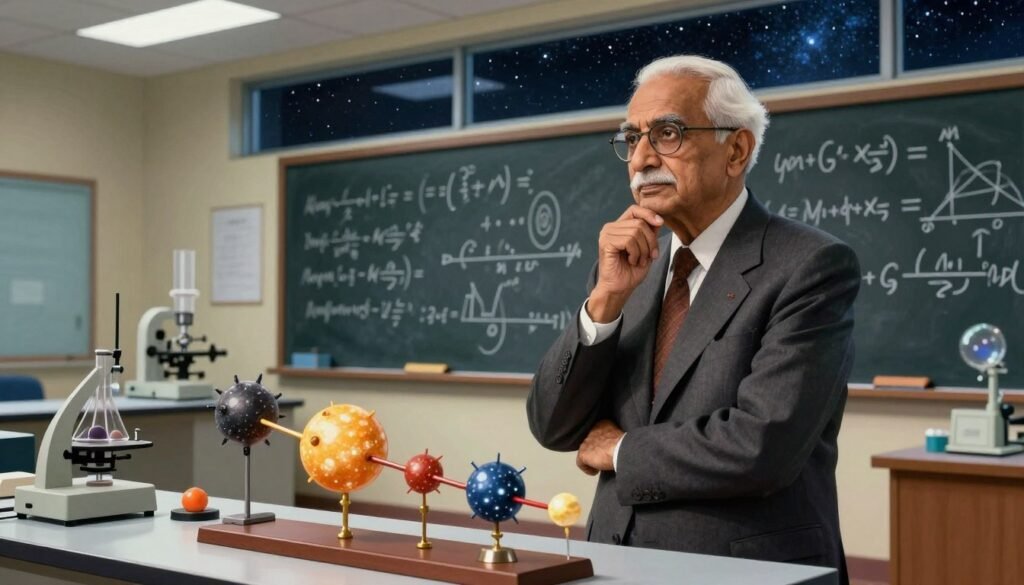
Chandrasekhar’s work didn’t just stop at theory. It has had a lasting effect on science. The University of Chicago says his “legendary discovery” still guides scientists today, in thestudy of black holes.
Learning about pioneers like Chandrasekhar helps us appreciate the universe more. His work inspires scientists and astrophysicists today!
A.P.J. Abdul Kalam: The People’s President and Missile Man
A.P.J. Abdul Kalam was known as the “Missile Man.” He played a big role in India’s missile and nuclear programs. He was a famous scientist and leader, leaving a big mark on India’s science world.
A Visionary Leader
A.P.J. Abdul Kalam worked on the Integrated Guided Missile Development Program (IGMDP). This made India important in missile technology. He helped make key missiles like Agni and Prithvi.
As India’s 11th President, he was called the “People’s President.” He was simple and kind. He made education and innovation important, inspiring many young Indians to study science and tech.
A.P.J. Abdul Kalam’s legacy goes beyond science. He was a hope and inspiration for many Indians, mostly the young. His life and work still motivate people to do their best and help society.
A.P.J. Abdul Kalam’s work shows his vision and hard work. Celebrating his achievements reminds us of the value of innovation, hard work, and leadership. These are key for a better future for our nation.
Har Gobind Khorana: Decoding the Language of Life
Har Gobind Khorana changed genetics with his work on the genetic code. He won the Nobel Prize in Physiology or Medicine for it! His research helped us understand how genes control proteins and led to big steps in genetics and biotech.
His Nobel Prize-winning work in 1968 was a big deal. He showed how DNA and RNA sequences tell our bodies how to make proteins. Proteins are key for many life processes.
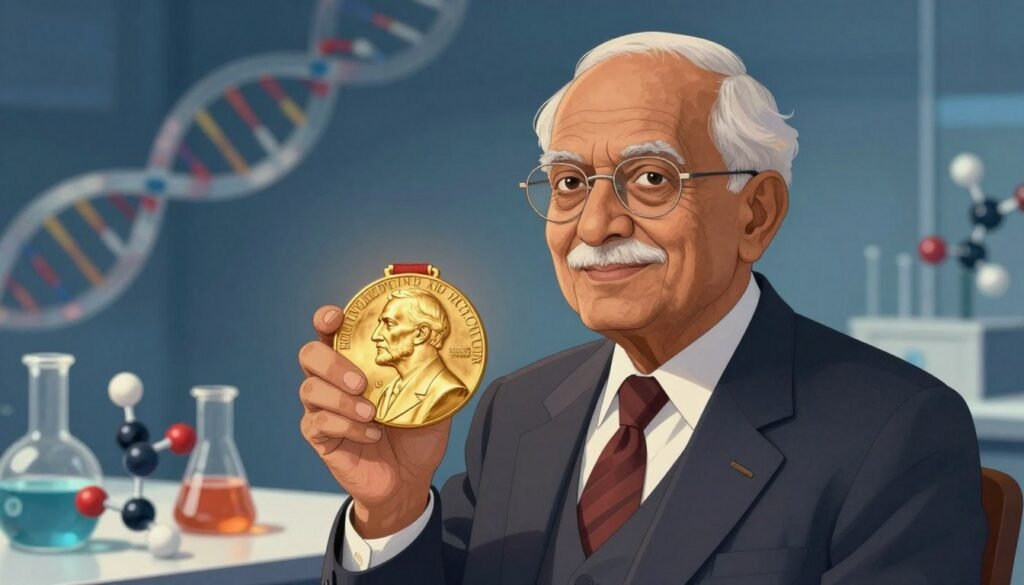
Khorana’s research was amazing. He made RNA molecules with certain sequences. This helped him figure out how different DNA sequences match up with amino acids. It was a huge challenge that needed new methods and a lot of knowledge of biology.
Khorana’s work did more than just win a Nobel Prize. It has helped many areas, like genetic engineering and biotech. Knowing the genetic code lets scientists find new ways to treat diseases and make better crops.
Looking at Har Gobind Khorana’s work, we see how it keeps inspiring scientists today. His work shows the value of curiosity and basic research.
Janaki Ammal: The Botanical Trailblazer
Meet Janaki Ammal, a pioneering botanist. Her work in plant genetics and cytogenetics left a lasting legacy! Her research advanced our understanding of plant biology and paved the way for future botanists.
Janaki Ammal’s contributions to botany were significant. She studied the genetic makeup of plants and how chromosomes behave. This research helped develop new crop varieties and improve farming.
One of her most notable achievements was her work on plant cytogenetics. She examined plant chromosomes to understand their evolutionary relationships. This helped classify plants more accurately.

Janaki Ammal’s research has had a lasting impact on botanical research. Her findings still influence today’s studies in plant breeding and genetic engineering. By understanding plant genetics, scientists can create crops that are more resilient and better suited for different conditions.
We celebrate Janaki Ammal’s achievements today. Her work reminds us of the importance of botany in improving our world. Her legacy inspires those interested in botany and its applications.
Celebrating the Best Indian Scientists Through Modern Learning
We can learn from India’s top scientists today. Modern tools make science fun and engaging. Gamified learning is a big part of this change.
Enhancing Scientific Literacy with Debsie Gamified Courses
Debsie Gamified Courses make learning fun and interactive. Kids learn science through games that are both fun and educational. This way, they enjoy learning and remember more.
Imagine your child grasping complex concepts with ease and excitement!
Why Gamification Matters in STEM Education
Gamification in STEM education is powerful. It makes learning fun and challenging. Debsie uses games to help kids understand science better.

| Learning Aspect | Traditional Learning | Gamified Learning |
|---|---|---|
| Engagement | Often passive, with less interaction | Highly interactive and engaging |
| Retention | Can be lower due to lack of engagement | Higher due to experiential learning |
| Understanding | May be limited by teaching methods | Enhanced through practical application |
Try Debsie Gamified Courses for a new learning experience. Visit https://debsie.com/courses to learn more!
The Global Impact of Indian Scientific Contributions
Indian scientists have made big marks in space and medicine. Their work has made India known worldwide. It has also led to new ideas everywhere.
They have worked in many areas. For example, Srinivasa Ramanujan’s work on number theory changed math. Homi J. Bhabha’s work in nuclear physics started India’s nuclear program. Dr. A.P.J. Abdul Kalam’s work on missiles made him famous and inspired many.
Here are some key areas where Indian scientists have made a big difference:
- Space Exploration: ISRO’s space missions are cheap and set a high standard.
- Medical Research: Indian scientists have helped a lot with vaccines and disease studies.
- Information Technology: Indian IT experts have helped shape the tech world.
As Ronald Ross, a British-Indian scientist, once said,
“The world is one great puzzle, and it’s a puzzle that we’re all trying to solve.”
Indian scientists have been leading the way. They have helped solve big problems in health, tech, and more.
| Scientist | Contribution | Global Impact |
|---|---|---|
| Sir C.V. Raman | Raman Effect | Revolutionized physics, helping us understand light better. |
| Homi J. Bhabha | Nuclear Physics | Started India’s nuclear program, influencing research worldwide. |
| Srinivasa Ramanujan | Number Theory | Helped grow modern math. |

We celebrate Indian scientists’ achievements. We also see how learning platforms help future scientists. By making science fun and easy, we can get more kids interested in science and tech!
Conclusion
The journey of India’s best scientists is truly inspiring. They have made big discoveries and changed the world. Their work helps us understand the universe and life itself.
These scientists show us that hard work and curiosity are key. They remind us that progress comes from learning and trying. You can learn more about them on the DPS Gurgaon website.
Want to learn more and have fun doing it? Try Debsie’s Gamified Courses. By following in their footsteps, we can keep exploring and innovating.