Ever felt that spark of wonder when you solve a hard puzzle? It’s like magic when a simple idea changes everything we know! We are so excited to explore the brilliant minds that sparked these big changes.
These pioneers showed us that curiosity has no limits! You can start your own adventure by checking out Debsie Gamified Courses at https://debsie.com/courses. It is time for us to learn and grow together!
Many famous german scientists did not just study old books. They looked at the world with fresh eyes and found new truths! We want to help you discover their amazing stories today.
Science is a big playground for your mind! Let us dive into this journey and see how they changed the whole world. Anyone can be an explorer if they just keep asking why!
Key Takeaways
- Discover the lives of thinkers who reshaped our world.
- Learn how big ideas spark major scientific breakthroughs.
- Explore the connection between curiosity and global innovation.
- Find inspiration for your very own learning adventure.
- Understand the lasting impact of these historical pioneers.
The Legacy of German Scientific Innovation
German scientific innovation has a rich history. It’s filled with groundbreaking discoveries and pioneers. These scientists have changed how we see the world. They’ve made big impacts in physics, chemistry, math, and biology.
Key Contributions
- Physics and Mathematics: German scientists have greatly helped us understand the physical world.
- Chemistry and Biology: Their work has led to big health breakthroughs and new knowledge of nature.
German scientific innovation has brought about many changes. It has shaped our modern science. Let’s look at some of these changes:
- The development of the laws of thermodynamics!
- The discovery of X-rays!
- Advancements in mathematics and physics!

These achievements show how much German scientists’ work has helped the world. Their discoveries keep inspiring new scientists and researchers today.
Johannes Kepler and the Laws of Planetary Motion
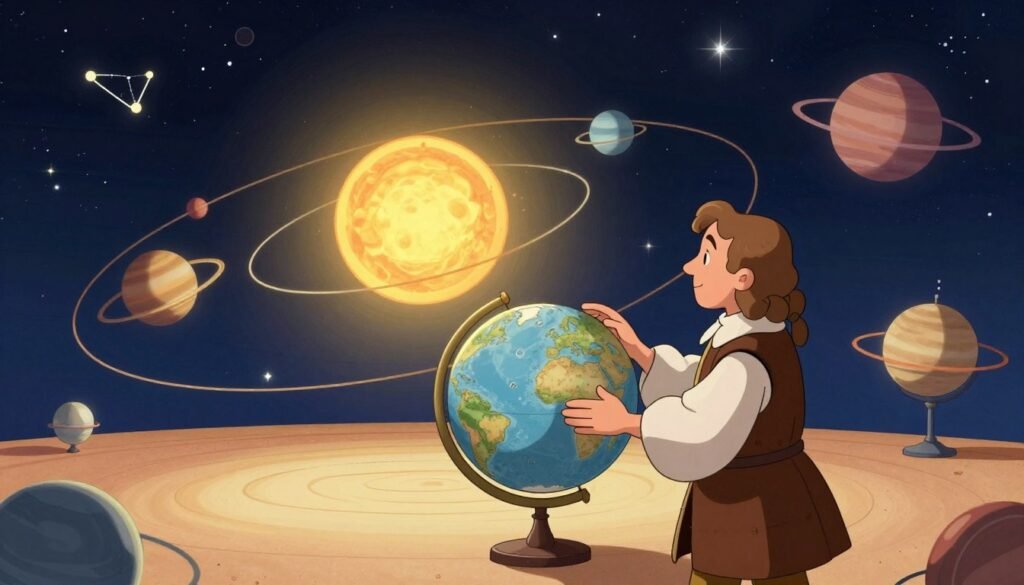
Let’s explore the world of astronomy with Johannes Kepler. He changed how we see the solar system! Kepler was a German mathematician and astronomer. He is famous for his three laws of planetary motion.
Kepler was influenced by the Copernican Shift. This idea put the Sun at the center of our solar system. Nicolaus Copernicus first suggested this, helping Kepler’s work.
The Copernican Shift
The Copernican Shift was a big change in astronomy. It said the Earth and planets orbit the Sun. This idea was new and challenged old views.
Kepler used this idea to create his laws of planetary motion.
“Astronomy is the daughter of mathematics, and mathematics is the language of nature.”
Kepler’s Three Laws
Kepler’s laws were a big step forward. They explain how planets move around the Sun. Here’s a quick look at each law:
| Law | Description |
|---|---|
| The Law of Ellipses | The orbits of the planets are elliptical in shape, with the Sun at one of the two foci. |
| The Law of Equal Areas | The line connecting the planet to the Sun sweeps equal areas in equal times. |
| The Law of Harmonies | The square of the orbital period of a planet is proportional to the cube of the semi-major axis of its orbit. |
Kepler’s laws helped us understand the solar system better. You can learn more about Kepler’s laws of planetary motion and their impact on modern astronomy.
Kepler’s work helped us learn more about the universe. It also prepared the way for scientists like Isaac Newton. His discoveries still inspire scientists today!
Gottfried Wilhelm Leibniz and the Foundations of Calculus
Let’s explore the amazing world of Gottfried Wilhelm Leibniz. He was a German thinker and math expert. He helped start calculus, a key part of math that helps us understand the world.
Leibniz was very smart in many areas. He worked in math, philosophy, and science. His biggest help was in creating calculus. This has changed many fields like physics and economics.
The Binary System
Leibniz also created the binary system. It uses only 0 and 1. This makes it perfect for computers. Today, it’s key for making computers work.

Calculus and Philosophical Contributions
Leibniz’s work on calculus was very important. He made the symbols we use today. His work helped science and engineering grow.
Leibniz was also very good at philosophy. He wrote a lot about big ideas like reality and how we know things. His ideas are still important today.
| Field | Contribution |
|---|---|
| Mathematics | Development of Calculus, Binary System |
| Philosophy | Metaphysics, Epistemology, Monadology |
| Computer Science | Foundation for Modern Computing through Binary System |
To learn more about Gottfried Wilhelm Leibniz, you can visit Wikipedia. It has a lot of info about his life and work.
Alexander von Humboldt and the Birth of Modern Ecology
Let’s explore the amazing journey of Alexander von Humboldt. He was a German explorer who changed how we see the natural world. His work helped start modern ecology.
Humboldt traveled a lot in the Americas. He collected lots of data on plants and geography. His ideas about nature being connected were new and important.
Exploration of the Americas
Humboldt’s trip to the Americas was key to his career. He studied the area’s geology, plants, and cultures. His detailed work gave us a lot of information for ecology.

Humboldt saw how humans harm the environment. He talked about deforestation and mining’s effects. His views were early and showed the need to think about nature’s future.
The Concept of Nature as a Web of Life
Humboldt thought of nature as a web of life. He saw that ecosystems are connected. This idea was new and is still important today.
We still use Humboldt’s ideas in ecology today. His work reminds us to explore and protect nature. His views on nature’s connections are still important for our planet.
Carl Friedrich Gauss: The Prince of Mathematicians
Let’s look at the life and work of Carl Friedrich Gauss. He had a big impact on number theory, geodesy, and magnetism! Gauss is called the “Prince of Mathematicians” for his big contributions to math and science.
Contributions to Number Theory
Gauss changed number theory a lot. This is a part of math that studies numbers. He worked on the Fundamental Theorem of Arithmetic and the theory of congruences. These works are the base of today’s number theory!
He found the law of quadratic reciprocity. This law is very important in many math areas. Gauss’s work helped us understand numbers better.
Advancements in Geodesy and Magnetism
Gauss also helped geodesy and magnetism a lot. Geodesy is about measuring the Earth’s shape and size. Gauss created new math and tools for this field!
In magnetism, Gauss worked with Wilhelm Weber. They learned more about the Earth’s magnetic field. They started the first magnetic observatory in Göttingen, Germany. This was a big step in studying the Earth’s magnetism.
By looking at Gauss’s work, we see how wide his impact was. His work still inspires many today!
Robert Koch and the Germ Theory of Disease
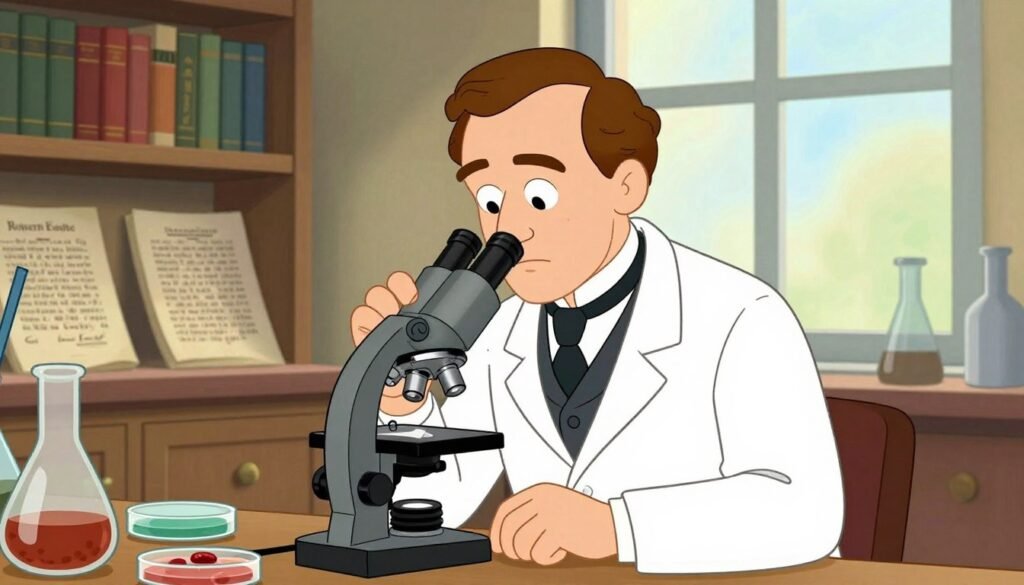
Robert Koch was a pioneering German physician and microbiologist. His work changed how we see diseases! His work on the germ theory of disease helped a lot with public health.
Koch made big steps in finding disease causes. He found ways to study pathogens better.
Identifying Pathogens
Koch wanted to know how microorganisms cause diseases. He was really into bacteria and how they make us sick. He made new ways to grow bacteria, helping find disease causes.
He found the bacteria for tuberculosis and anthrax. This helped us understand these diseases better. It also helped make treatments and vaccines.
The Koch Postulates
Koch also made Koch’s postulates. These rules help prove a disease cause. They are still important in science today.
The postulates are:
- The microorganism must be found in all sick organisms, but not in healthy ones.
- The microorganism must be taken from sick organisms and grown alone.
- The grown microorganism should make the disease in a healthy organism.
- The microorganism must be taken back from the sick organism and be the same as the first one.
Max Planck and the Quantum Revolution
Max Planck changed how we see energy and matter. He was a German physicist. His work started the quantum revolution.
So, what’s the quantum revolution? It’s a big change in how we understand tiny things. Max Planck was key in this change.
The Discovery of the Quantum
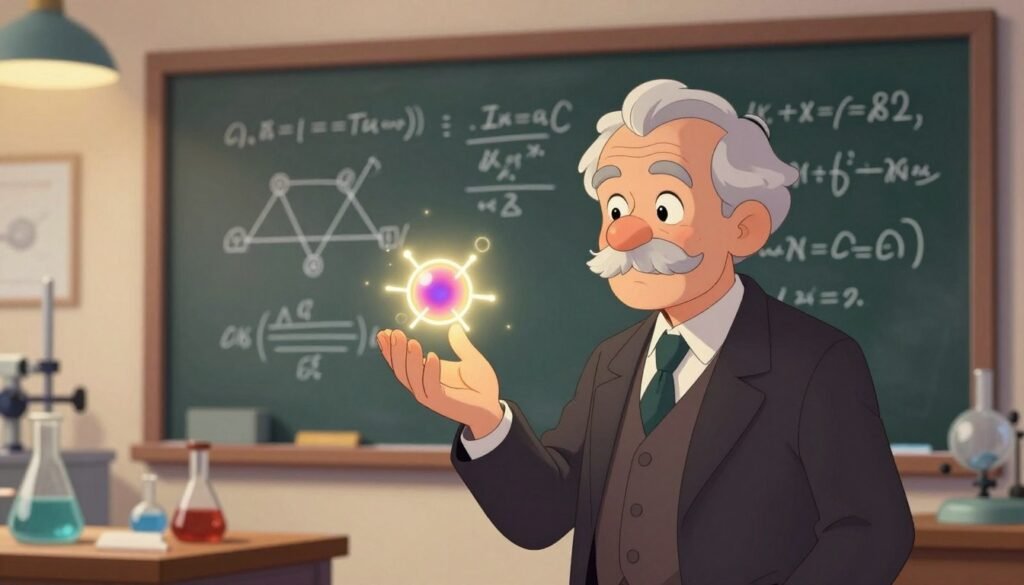
Planck found that energy comes in small packets, or quanta. This was a big change. It opened a new world in physics.
Impact on Modern Physics
Planck’s work changed physics a lot. His idea of quanta has helped many areas of physics.
Here are some ways Planck’s work has helped:
| Area of Physics | Impact of Planck’s Work |
|---|---|
| Quantum Mechanics | Fundamental principles of quantum mechanics rely on Planck’s concept of quanta. |
| Quantum Field Theory | Planck’s work laid the groundwork for understanding particle interactions. |
| Nuclear Physics | Understanding nuclear reactions and stability is rooted in quantum theory. |
Max Planck’s work still inspires scientists today. His legacy keeps pushing physics forward!
Albert Einstein: Redefining the Universe
Albert Einstein was a German physicist. He made big changes in science! He is seen as one of the top scientists of the 20th century.
Einstein changed how we see the universe. He made two big discoveries: the theory of relativity and mass-energy equivalence.
The Theory of Relativity
Einstein’s theory of relativity changed how we see space and time! It has two parts: special relativity and general relativity.
Special relativity says the laws of physics are the same for everyone moving at the same speed. General relativity adds gravity. It says gravity bends space and time because of mass and energy.
Mass-Energy Equivalence
Einstein’s famous equation is E=mc². It shows mass-energy equivalence. It means mass and energy can change into each other.
This idea has helped a lot in nuclear physics and more! It has led to new ways of understanding the universe and new technologies.
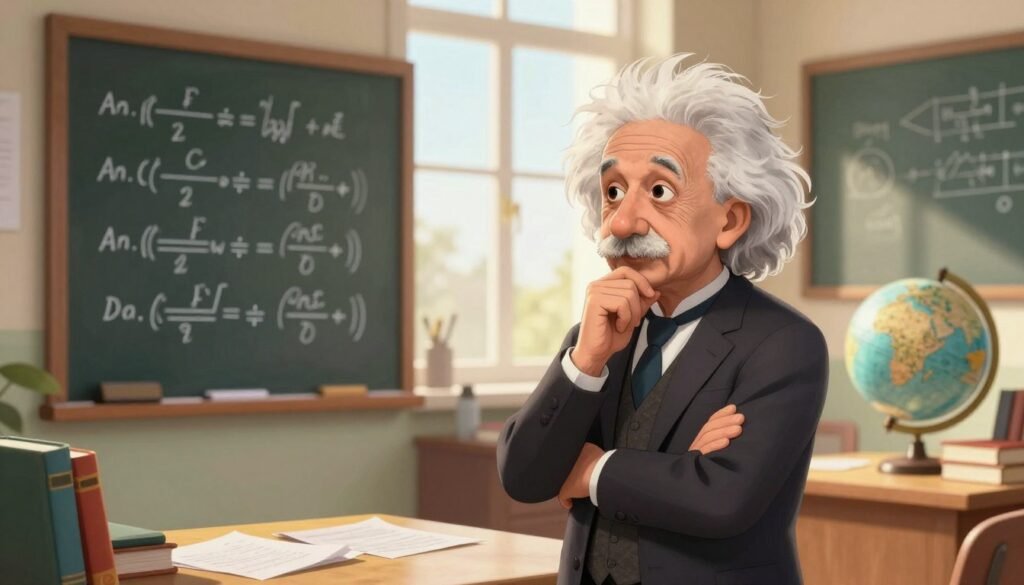
Einstein’s work still affects science and society today! His work shows the power of curiosity and innovation.
Werner Heisenberg and the Uncertainty Principle
Werner Heisenberg changed how we see the tiny world of atoms! He was a German physicist. He came up with the uncertainty principle.
This idea changed how we think about tiny particles. It says we can’t know some things at the same time! This idea is big for understanding our world.
Quantum Mechanics Foundations
The uncertainty principle is key to quantum mechanics. Quantum mechanics is about waves, particles, and chance. Heisenberg helped us understand these ideas better.
Let’s see how the uncertainty principle works:
| Property | Description | Implication |
|---|---|---|
| Position | The location of a particle in space | Cannot be precisely known with momentum |
| Momentum | The product of a particle’s mass and velocity | Cannot be precisely known with position |
| Energy | The ability of a particle to do work | Related to the uncertainty principle through the energy-time uncertainty relation |
The Philosophical Implications of Uncertainty
The uncertainty principle makes us think differently. It makes us wonder about knowing things and how we see the world!
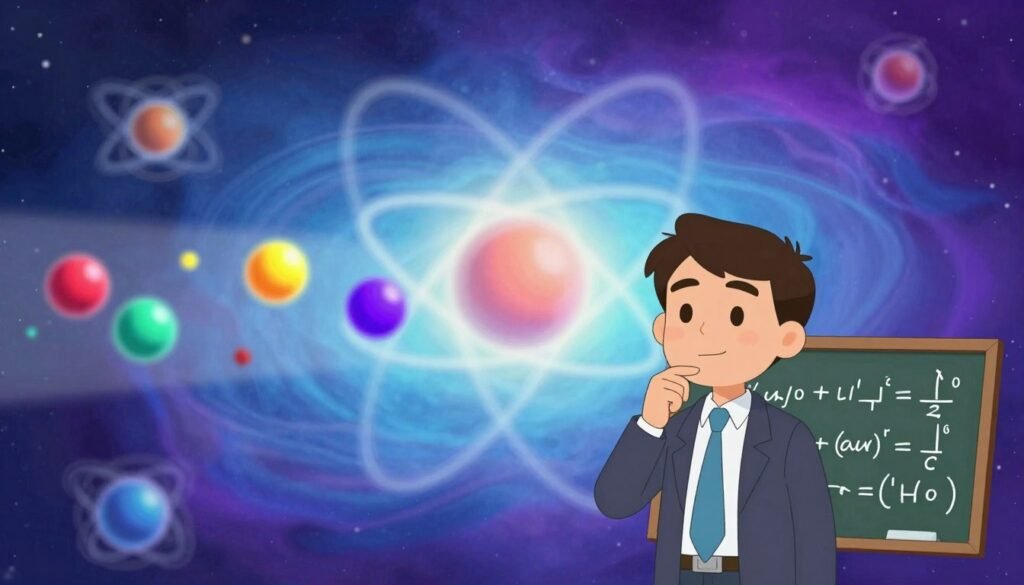
By accepting the uncertainty principle, we learn more about the tiny world. It’s really cool!
Otto Hahn and the Discovery of Nuclear Fission
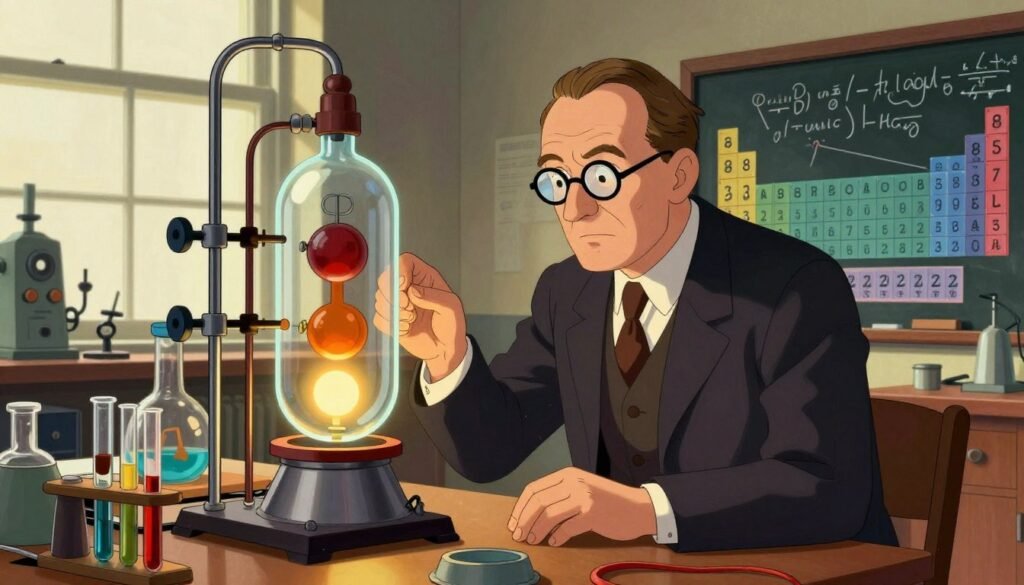
Otto Hahn found nuclear fission. This changed how we see atomic energy. He was a German chemist who worked in radiochemistry.
His work on nuclear fission was a big step. Nuclear fission is when atoms split. This releases a lot of energy.
The Radiochemistry Breakthrough
In 1938, Hahn made a big discovery. It led to big steps in nuclear energy and physics. His work changed science and the world.
Ethical Considerations of Nuclear Energy
Nuclear fission made us think about ethics. We must think about using nuclear energy wisely. How can we use it well?
| Aspect | Nuclear Fission | Nuclear Fusion |
|---|---|---|
| Process | Splitting of atomic nuclei | Combining of atomic nuclei |
| Energy Release | High energy release | Higher energy potential |
| Application | Nuclear power plants, atomic bombs | Potential future energy source |
Thinking about Otto Hahn’s discovery is important. It shows the need for careful innovation. By understanding nuclear fission, we can use energy safely and well.
Emmy Noether and the Symmetry of Physics
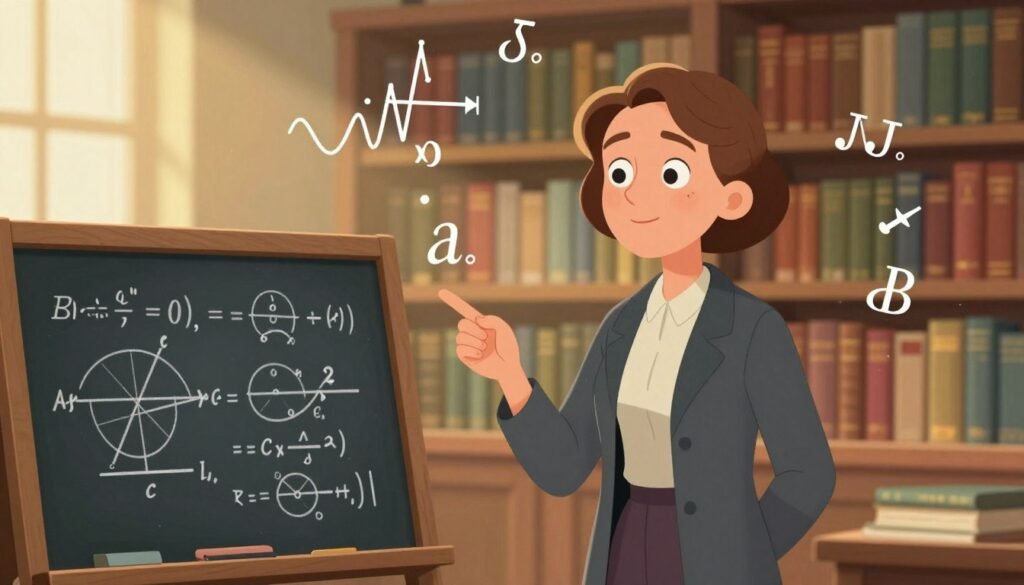
Let’s explore Emmy Noether’s amazing story. She was a mathematician who changed physics forever! Emmy Noether was a German mathematician. She helped us understand symmetry in physics better.
Her work has had a big impact. We’re excited to share her achievements with you! Noether’s work shows her genius and hard work.
The Power of Noether’s Theorem
Noether’s Theorem is key in physics. It links a system’s symmetries to its laws. This theorem has shaped our view of the universe.
Noether’s Theorem says every symmetry has a law. For example, time symmetry means energy is conserved. This idea helps us understand the world.
Breaking Down Barriers in Academia
Emmy Noether faced many challenges. She faced sexism and bias. But she didn’t give up.
Noether’s hard work and love for math inspired many. Her legacy keeps motivating women and others in STEM today. We celebrate her achievements and her impact on science!
A Curated Selection of the Best German Scientists
German scientists have made big impacts in many areas. They’ve changed how we see and do science. Their work is all over the world.
What makes a German scientist stand out? It’s their innovation, hard work, and love for finding new things. As Max Planck said,
“An important scientific innovation rarely makes its way by gradually winning over and converting its opponents.”
They often take big risks to discover new things.
German scientists are great because of their tough training. They also learn from many fields. This makes them very good at their jobs.

The Impact of German Universities on Global Research
German universities are key in global research. They are known for academic excellence and new ideas. Scholars from everywhere come to learn here.
These schools lead in science discoveries. They have the best tools and work together well. This helps science grow.
German universities help grow new talent. They push for new discoveries. This makes them very important in science worldwide.
Enhancing Your Scientific Knowledge with Debsie Gamified Courses
Take your scientific knowledge to new heights with Debsie’s gamified courses. They make learning fun and engaging! Debsie offers personalized, gamified learning experiences. They help children all over the world grow intellectually through many subjects and flexible teaching methods.
Debsie makes science and other subjects fun for everyone. They use game design elements in their courses. This creates an interactive environment that motivates learners to explore and understand complex concepts more deeply.
Why Gamified Learning Works
Gamified learning is not just about making education fun. It’s also about enhancing engagement and retention. Debsie’s platform uses game mechanics like points, badges, and leaderboards. This encourages learners to take an active role in their educational journey. This approach has been shown to improve learning outcomes and increase learner satisfaction.
Key benefits of gamified learning include:
- Increased engagement and motivation
- Improved retention of complex concepts
- Enhanced problem-solving skills
- A more enjoyable learning experience
Exploring Science Through Debsie
Debsie’s gamified courses cover a wide range of scientific topics. From basic principles to advanced concepts, learners can explore science in a hands-on manner. This not only deepens their understanding but also fosters a curiosity-driven approach to learning.
Ready to experience the future of science education? Try out Debsie Gamified Courses at https://debsie.com/courses and discover a new way to learn science!

Conclusion
We’ve looked at Germany’s top scientists. They changed how we see the world. Johannes Kepler and Albert Einstein are big names.
These scientists made big discoveries. They helped others learn and grow. You can learn more with Debsie’s fun courses.
Try Debsie Gamified Courses at https://debsie.com/courses. It’s fun and teaches you a lot. Join Debsie today and learn in a new way!