Imagine holding a tiny piece of the universe in your hands! Everything around us has a secret story. These stories are from the best chemists of all time!
These scientists were like wizards. They used logic and experiments to solve mysteries. They saw puzzles everywhere and wanted to solve them.
We owe our modern world to their hard work and boundless curiosity!
Learning about famous chemists shows us we can make big discoveries too. By exploring the history of chemistry, we see how simple questions lead to life-saving inventions. It’s exciting to see how these heroes shaped our lives today!
You can start your own scientific adventure right now! Try out Debsie Gamified Courses at https://debsie.com/courses to grow your brain and have fun. Let’s dive in and see how science makes the impossible possible!
Key Takeaways
- Discover how brilliant minds unlocked the secrets of atoms and molecules.
- Learn about the inventions that changed medicine and technology forever.
- Understand the connection between ancient experiments and modern science.
- Explore how curiosity leads to world-changing discoveries in every lab.
- Find fun ways to start your own learning journey with gamified tools.
- See why understanding matter is the key to a brighter future.
The Dawn of Modern Chemistry and Antoine Lavoisier
Antoine Lavoisier changed chemistry a lot. His work helped science grow for many years. He did careful experiments and made new ways to study chemistry.
The Father of Modern Chemistry
Antoine Lavoisier is called the “Father of Modern Chemistry”. He found oxygen and made a new way to name chemicals. His work brought new precision to science.
He helped scientists talk better and learn from each other. For more about Lavoisier, check out Project Gutenberg.
The Law of Conservation of Mass
Lavoisier also found the Law of Conservation of Mass. It says matter can’t be made or lost in a chemical reaction. This big idea changed how scientists understand chemistry.
His work shows the value of careful science. His ideas still help scientists today. They show how important his work is.
Dmitri Mendeleev and the Architecture of the Periodic Table
Imagine a world without knowing what new elements would be like. That’s when Dmitri Mendeleev came along with the Periodic Table. He sorted elements in a way that let him guess what new ones would be like. This big change helped us understand elements better.
The Periodic Table is more than a chart. It’s a guide through the world of elements. Mendeleev’s work helped scientists find new elements. He even guessed about gallium and germanium, and they turned out just as he thought!
Predicting the Unknown Elements
Mendeleev was great at finding patterns in elements. This skill let him guess about new elements and what they would be like. This was a big win for chemistry because it gave a roadmap for finding new elements. You can learn more about the Periodic Table at Debsie’s explanation for beginners.
Mendeleev’s guesses were not just guesses. They were based on deep knowledge of elements. He left spots in his table for elements he knew were coming. And when they were found, his guesses were right!
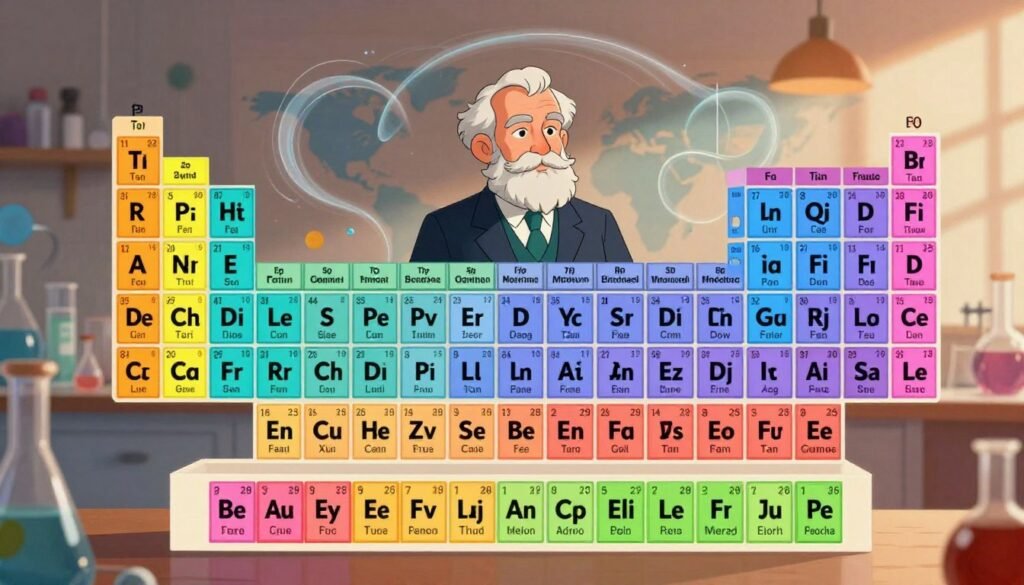
The Legacy of the Periodic Law
The Periodic Law changed chemistry forever. It says that elements’ properties come back in a cycle when arranged by atomic weight. This idea has helped many chemists and is still key today. The Periodic Table shows Mendeleev’s lasting impact, not just in chemistry but in science and education too.
Today, we still use Mendeleev’s work. The Periodic Table is a key tool in chemistry. It helps us understand how elements relate and guess what new ones will be like. Mendeleev’s work shows how science can change our view of the world!
Marie Curie and the Pioneering World of Radioactivity
Marie Curie changed how we see elements with her radioactivity research. Her work found new elements and helped future scientists. We still use her discoveries today!
Discovering Polonium and Radium
Marie Curie found two new elements: polonium and radium. Polonium was named after Poland, her homeland. She also found radium, which glows in the dark.
It took her years to find these elements. She worked hard, processing lots of uranium ore.
Marie Curie once said,
“One never notices what has been done; one can only see what remains to be done.”
This shows her drive for knowledge and her big impact on science.
Breaking Barriers for Women in Science
Marie Curie did more than just find elements. She was the first woman to win a Nobel Prize. She won two Nobel Prizes, in physics and chemistry!
Her work inspires women to study science, technology, engineering, and mathematics (STEM).
To learn more about Marie Curie, visit the Nobel Prize website. It tells her story and how she changed science.
Marie Curie’s big achievements include:
- Discovery of the elements polonium and radium
- First woman to win a Nobel Prize
- First person to win two Nobel Prizes in different fields
- Pioneering work on radioactivity
The Quantum Revolution of Linus Pauling
Linus Pauling mixed quantum mechanics with chemistry. This opened new ways for science to grow! His work on chemical bonds was a big leap. It showed us how molecules are built and how they react.
The Nature of the Chemical Bond
Pauling’s biggest win was his study on chemical bonds. He used quantum mechanics to figure out how atoms share electrons. This knowledge helped many areas, like making new materials and finding new medicines.
Advocacy and Scientific Integrity
Linus Pauling was also a big voice for scientific integrity. He thought science should help make the world better. He fought for peace and showed the importance of ethics in science.
| Aspect | Description | Impact |
|---|---|---|
| Chemical Bond Theory | Explained how atoms share electrons | Advanced materials science and pharmacology |
| Quantum Mechanics Application | Applied quantum principles to chemistry | Enhanced understanding of molecular structures |
| Scientific Advocacy | Promoted scientific integrity and ethics | Raised awareness on responsible science use |
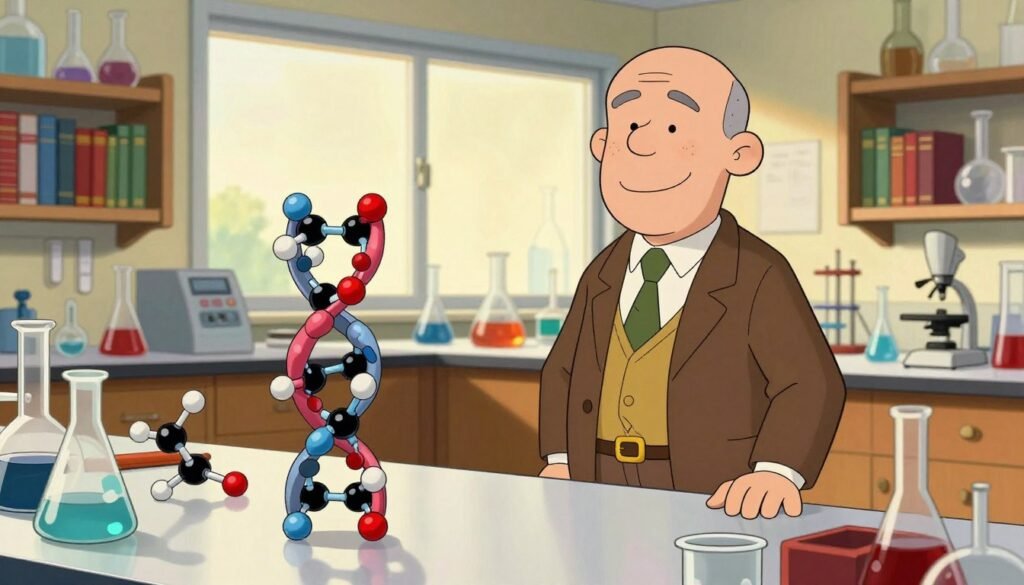
Robert Boyle and the Transition from Alchemy to Science
Robert Boyle was a key figure in chemistry. He helped make science different from alchemy. His work in the 1600s set the stage for today’s chemistry.
Boyle changed how we study chemistry. He focused on doing experiments and watching closely. This made chemistry its own science.
Boyle did many important things in chemistry. But one big thing he did was study gases. His work on gases helped us understand them better.
Boyle’s Law and Gas Dynamics
Boyle’s Law says that gas pressure and volume are related. This was a big discovery. It helped us learn more about gases.
The implications of Boyle’s Law were huge. It changed many fields, not just chemistry. It helped physics and engineering too.
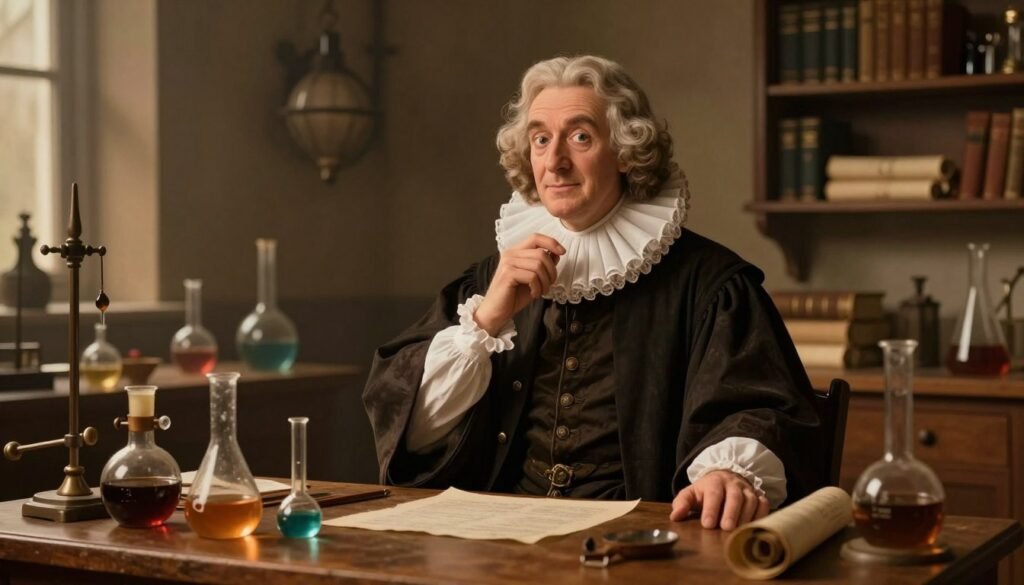
The Skeptical Chymist
“The Skeptical Chymist” was Boyle’s most important book. It changed how we think about chemistry. Boyle questioned old ideas and wanted a new way to understand matter.
The Skeptical Chymist is a key book in chemistry. It moved us away from alchemy and towards science.
John Dalton and the Atomic Theory
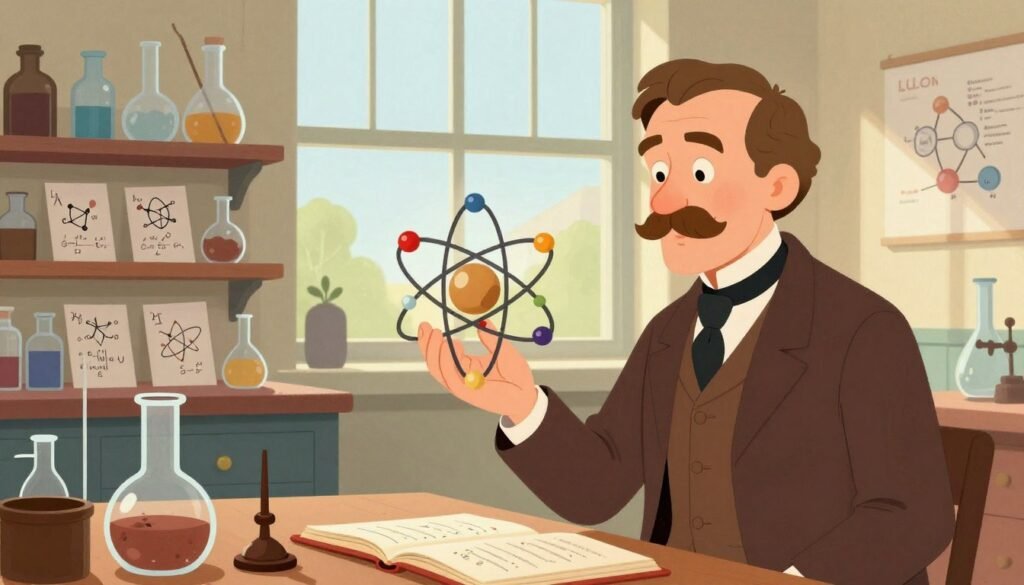
John Dalton changed how we see matter with his atomic theory. In the early 1800s, he said elements are made of tiny, indivisible particles called atoms. This idea started the modern study of chemistry.
Dalton’s theory had three main points. He said elements are made of atoms, all atoms of the same element are the same, and different elements have different atoms. This idea helped us understand how elements are made and how they react.
Defining the Atomic Weight
Dalton also figured out how to measure the weight of atoms. He found out how heavy different atoms are. This helped scientists understand how much of each substance is needed in chemical reactions.
The Impact on Chemical Notation
Dalton’s work also changed how we write about chemistry. He created symbols for elements and compounds. This made it easier for scientists to talk about chemistry.
His simple symbols made chemistry easier to understand. This made chemistry more open to everyone.
The Analytical Brilliance of Dorothy Hodgkin
Dorothy Hodgkin was a trailblazer in chemistry. She was known for her work on X-ray crystallography. This method helped her figure out the 3D shape of molecules.
Her work changed how scientists understood complex molecules. Hodgkin said,
“The fact that I was a woman made no difference to me; I was just as interested as a man would have been in the same circumstances.”
This shows her deep love for her work.
X-ray Crystallography Breakthroughs
Hodgkin was great at X-ray crystallography. She used X-rays to find out how atoms were arranged in crystals. This helped her understand complex molecules.
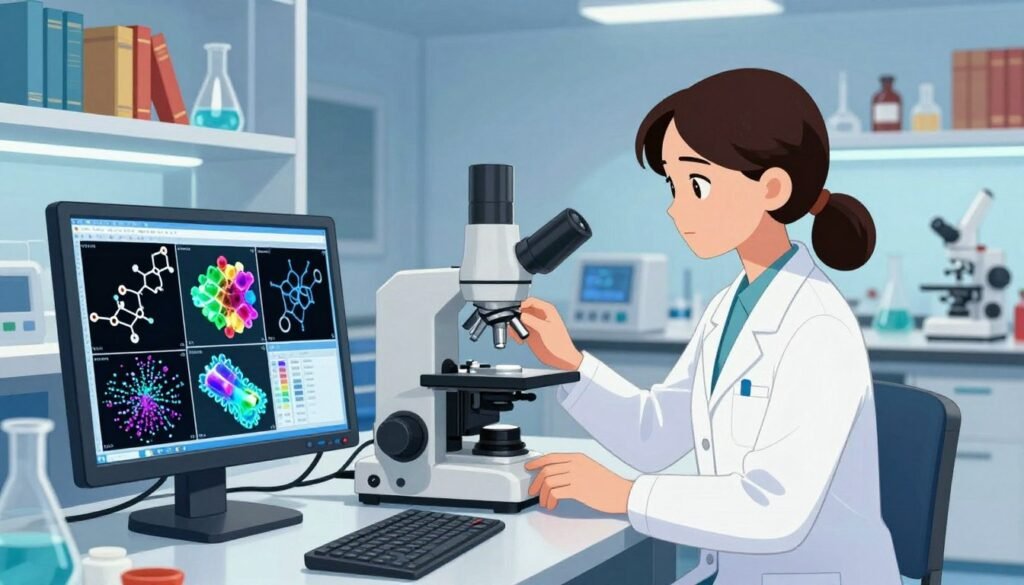
Mapping the Structure of Penicillin and Insulin
Hodgkin found out the shapes of penicillin and insulin. Her work on penicillin helped make new antibiotics. Her discovery of insulin’s shape helped treat diabetes.
Hodgkin’s work inspired many scientists. Her legacy shows the power of hard work and dedication in science.
Amedeo Avogadro and the Molecular Hypothesis
Amedeo Avogadro changed how we see matter. In the early 1800s, he came up with a big idea. It showed the difference between atoms and molecules, starting modern chemistry.
Avogadro said that gases of the same size, at the same temperature and pressure, have the same number of molecules. This idea was very important for understanding what things are made of. It led to big steps forward in science.
Distinguishing Atoms from Molecules
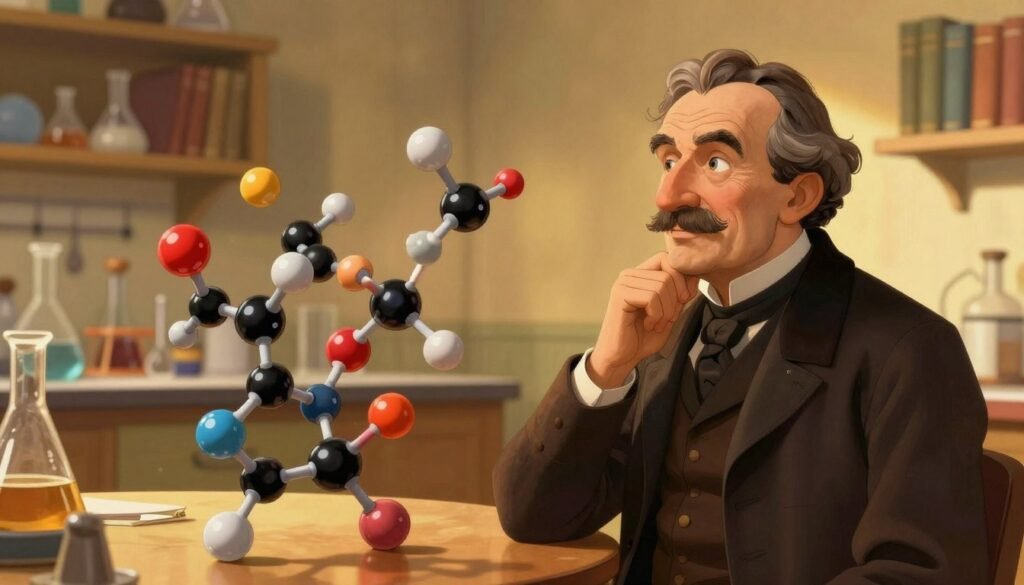
Avogadro was key in telling atoms and molecules apart. Atoms are the tiny parts of everything. Molecules are when atoms stick together. Knowing this helps us get how things react and what they are like.
His work showed that gases are made of molecules. This means that how a thing acts depends on its molecules, not just its atoms.
The Significance of Avogadro’s Number
Avogadro’s Number is 6.022 x 10^23. It shows how many units (atoms or molecules) are in one mole of something. This number is very important for chemistry. It lets scientists figure out how much of a substance is needed for a reaction.
Knowing Avogadro’s Number helps us connect the tiny world of atoms and molecules to the big world we see. It helps us figure out how much of a substance is needed for a reaction or made in one. It’s a key part of chemistry.
Avogadro’s work has greatly influenced chemistry. It changed how we see and work with matter at its most basic level.
Gilbert N. Lewis and the Electron Pair Theory
Gilbert N. Lewis changed how we see chemical bonding with his electron pair theory. This idea helped us understand how atoms work together. It also led to big steps forward in chemistry.
Lewis Structures and Covalent Bonding
Gilbert N. Lewis created Lewis structures. These pictures show how electrons are in molecules. Lewis structures use dots for electrons, making covalent bonding clear. This is when atoms share electrons to form molecules.
This idea helps us get how molecules act and how they interact.
Redefining Acids and Bases
Lewis didn’t just explain covalent bonding. He also changed what we know about acids and bases. He said acids can take an electron pair, and bases can give one.
This new view of acids and bases helped us understand chemical reactions better. It gave us a deeper look into chemistry.
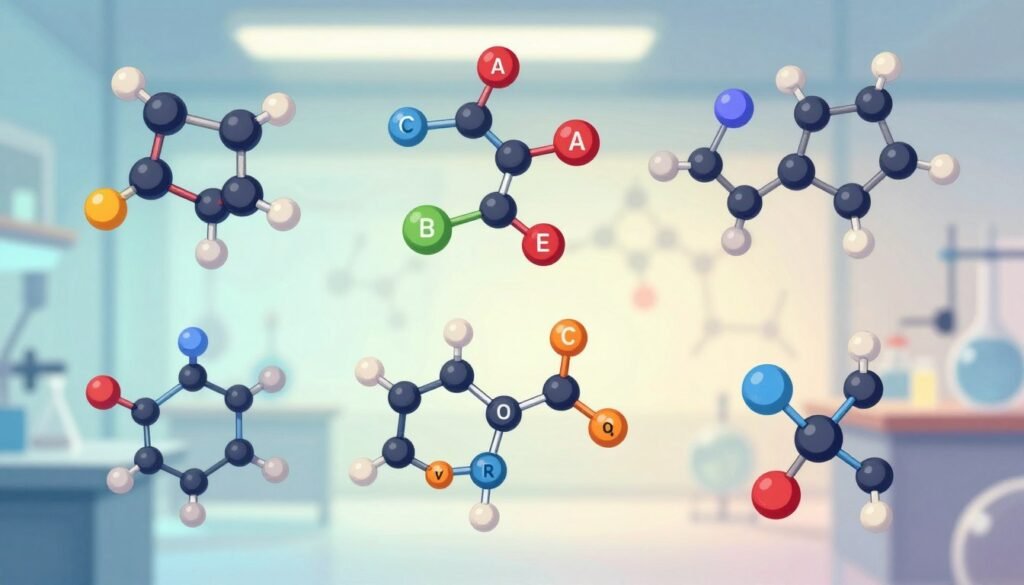
Gilbert N. Lewis’s work on the electron pair theory and Lewis structures has shaped chemistry. His ideas still guide us today, making his work key in chemistry.
The Synthetic Mastery of Robert Burns Woodward
Robert Burns Woodward was a master of making complex molecules. He changed the field of chemistry forever. His work allowed scientists to make complex molecules with great precision.
Woodward was famous for making total synthesis of complex organic molecules. He made cholesterol, cortisone, and vitamin B12. His skills and achievements opened doors for more discoveries in chemistry.
Total Synthesis of Complex Organic Molecules
Creating complex molecules is a big challenge. Woodward knew a lot about chemical reactions. He was very careful and creative in his work.
He once said, “The structure known, but not yet accessible by synthesis, is to the chemist what the unclimbed mountain is to the mountaineer.” His work on vitamin B12 showed his amazing skills.
The Woodward-Hoffmann Rules
Woodward also helped us understand chemical reactions. He created the Woodward-Hoffmann Rules. These rules help predict the results of certain reactions.
The Woodward-Hoffmann Rules changed organic chemistry a lot. They help chemists design better ways to make molecules. This has been very helpful.
“The Woodward-Hoffmann Rules have been instrumental in shaping our understanding of pericyclic reactions and have had a lasting impact on the field of organic chemistry.”
Alfred Nobel and the Chemistry of Explosives
Alfred Nobel was a Swedish inventor and chemist. He changed the world with his work on explosives. His work helped start the Nobel Prizes.
Nobel started working with nitroglycerin, a very explosive substance. He wanted to make it safer. This led to his famous invention, dynamite!
The Invention of Dynamite
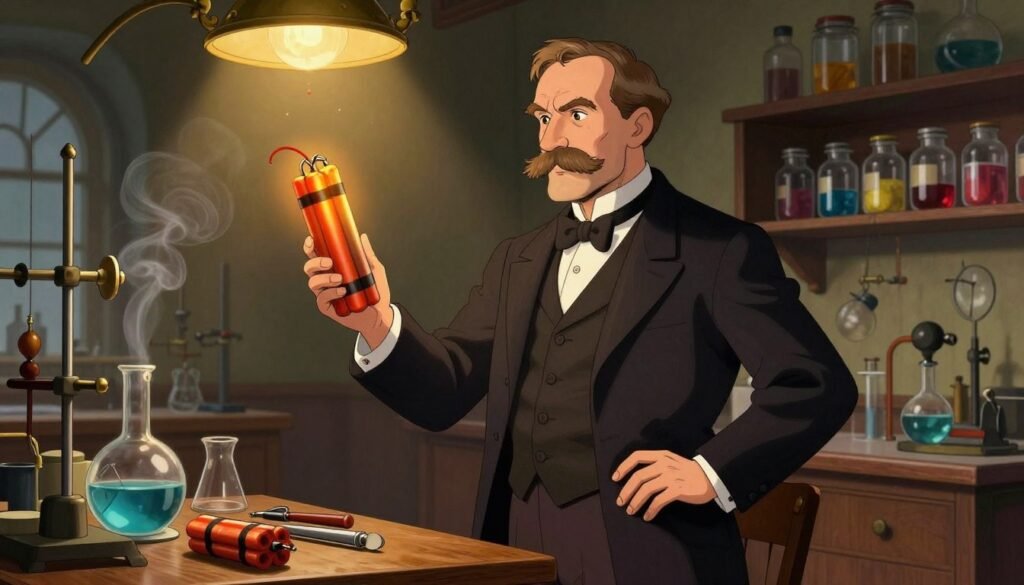
In 1866, Nobel mixed nitroglycerin with diatomaceous earth. This made a paste that could be shaped into sticks. These sticks were safer and easier to use. He called this invention dynamite.
- Dynamite made mining safer and more efficient.
- It helped build tunnels, canals, and big projects.
- Nobel’s invention was also used in the military.
Establishing the Nobel Prize Legacy
Nobel was a peace lover, despite his work on explosives. He wanted to leave a legacy that promoted peace. So, he started the Nobel Prizes in 1901.
To learn more about Alfred Nobel, visit https://www.sciencehistory.org/education/scientific-biographies/alfred-nobel/.
The Nobel Prizes are a symbol of excellence. They honor achievements in Physics, Chemistry, Medicine, Literature, Peace, and Economics. They inspire scientists and thinkers to be their best!
The Best Chemists Who Shaped Our Modern Understanding
Many top chemists have changed how we see the world of chemistry. Their work has helped us make big discoveries. It also shapes what we learn today.
Synthesizing Diverse Chemical Disciplines
The best chemists mix different areas of chemistry to find new things. They blend different fields to learn more about how chemicals work together.
For example, Marie Curie found out about radioactivity. This discovery helped both physics and chemistry. It led to new discoveries in medicine and materials science.
- Advancements in understanding chemical bonding!
- Development of new materials with unique properties!
- Breakthroughs in nuclear chemistry and physics!
How Historical Discoveries Influence Today’s Research
Old discoveries in chemistry still help today’s scientists. The work of early chemists helps today’s researchers.
The periodic table by Dmitri Mendeleev is still very important. It helps scientists guess what elements will be like. This is useful for making new materials and medicines.
Historical discoveries still shape today’s research in many ways. For example:
- New medicines are made thanks to understanding chemical structures.
- Work on the environment is driven by the need for green practices.
- New materials are made by understanding chemical bonds and properties.
Advancing Your Knowledge Through Gamified Learning
Find a new way to learn chemistry with fun games! Old learning ways can be boring. But gamified learning makes learning chemistry exciting.
We think learning should be fun. That’s why interactive education is key for us. We use games and fun activities to make chemistry easy and fun.
Why Interactive Education Matters in Chemistry
Chemistry can be tough, but it’s also rewarding. Interactive education helps because it lets you learn by doing. This way, you understand and remember better.
With quizzes, puzzles, and games, gamified learning makes chemistry fun for everyone. It’s great for kids because it taps into their curiosity and love for play.
Explore Debsie Gamified Courses at https://debsie.com/courses
At Debsie, we offer personalized, gamified learning experiences for kids worldwide. Our courses are fun and flexible, fitting different learning styles.
Visit https://debsie.com/courses to see our gamified courses. Join us and see how Debsie makes learning chemistry fun and engaging!

The Role of Chemistry in Solving Global Challenges
Chemistry is at the forefront of solving some of the world’s most pressing issues!
Chemists are working hard to make our world better. They use green chemistry to reduce harm to the environment. This means making products and processes that are kinder to our planet.
Green Chemistry and Sustainability
Green chemistry is key to making our world sustainable. It helps create products and processes that are safe for our planet. For example, biodegradable plastics and better renewable energy are thanks to green chemistry.
You can learn more about green chemistry and its uses on https://www.osti.gov/servlets/purl/2440714.
Some important green chemistry ideas include:
- Preventing waste
- Using every atom
- Making safer chemicals
- Starting with renewable materials
Medicine and Material Science Innovations
Chemistry is also vital for medicine and material science. It helps us understand diseases and create new treatments. For instance, new materials are being made for medical devices.
| Innovation | Application | Impact |
|---|---|---|
| Biodegradable Plastics | Packaging, Disposable Cutlery | Reduces Environmental Pollution |
| Advanced Medicines | Treatment of Diseases | Improves Human Health |
| Innovative Materials | Medical Devices, Implants | Enhances Medical Care |
Chemistry is crucial for solving global problems. By being creative and using green chemistry, we can make our future better.
The Future of Chemical Discovery
New technologies are changing how we do chemical research. The future of chemistry looks bright. New ideas will change how we use chemical knowledge.
Let’s explore some key areas that are changing chemical discovery!
Artificial Intelligence in Molecular Modeling
Artificial intelligence (AI) is changing molecular modeling. It lets scientists simulate complex chemical reactions. They can predict how molecules will behave with great accuracy!
AI can look at lots of data, find patterns, and make predictions fast. This is great for finding new medicines. AI can help find drugs that work well!
The Next Generation of Chemical Pioneers
The future of chemistry also depends on the people. The next generation of chemists is being trained in fun ways. Debsie’s gamified courses are helping them learn.
Here are some new technologies and how they might change chemical discovery:
| Technology | Application in Chemistry | Potential Impact |
|---|---|---|
| Artificial Intelligence | Molecular modeling and simulation | Accelerated drug discovery and materials science |
| Molecular Modeling Software | Predicting chemical reactions and properties | Enhanced understanding of chemical processes |
| Gamified Learning Platforms | Education and training for the next generation | Increased engagement and understanding of chemistry |
Looking ahead, technology and chemistry will lead to big discoveries. By using new tech and training the next chemists, we can solve big problems!
Conclusion
The journey through the lives of the best chemists shows us human curiosity and innovation. Lavoisier found the Law of Conservation of Mass. Marie Curie worked on radioactivity.
These people changed how we see the world. Their work still guides today’s research and inspires scientists. Their legacy is in their discoveries and the doors they opened for others.
To learn more about chemistry, try interactive learning. Debsie’s gamified courses at https://debsie.com/courses make learning fun. They help you understand chemistry better.
By learning from the best chemists, we can find new ways to solve problems. This helps us face today’s big challenges.