Have you ever felt that magic spark when you ask “why” and find the answer? We think every child has a little explorer inside, waiting to discover something new!
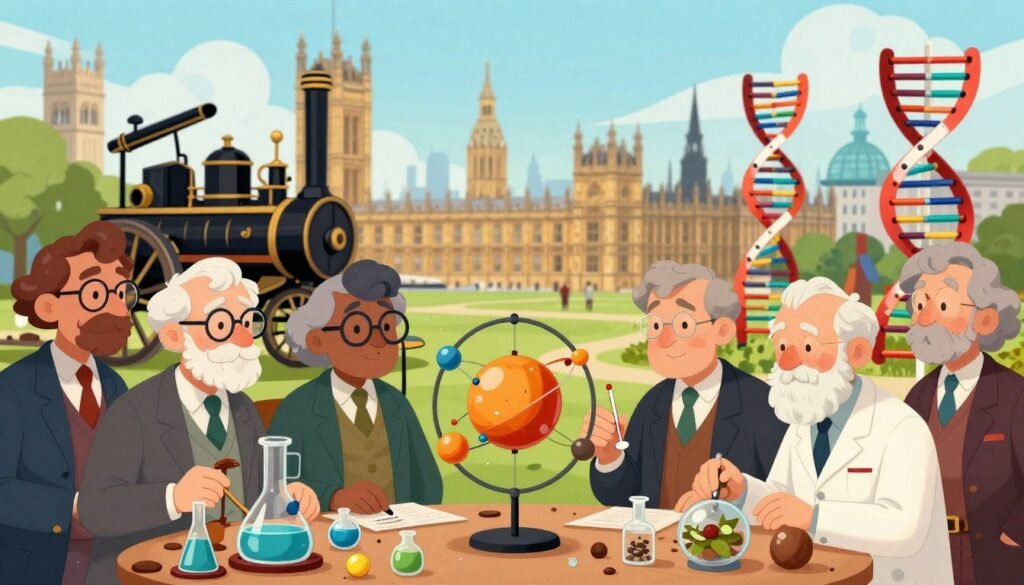
Britain has been home to brilliant minds for hundreds of years. These innovators made a global impact. They solved mysteries of our universe and life’s building blocks.
Welcome to our journey of famous british scientists and their amazing stories! Their hard work and passion show us that anything is possible when we stay curious.
You can grow your own mind and reach for the stars today. Try Debsie Gamified Courses at https://debsie.com/courses for fun and interactive learning!
From Sir Isaac Newton to Stephen Hawking, their stories are a great guide for your future. Let’s see how their work inspires us to dream big today!
Key Takeaways
- Innovation in the UK has transformed global STEM for many centuries.
- Breakthroughs in computer science and DNA changed our lives forever.
- Legends like Isaac Newton provide inspiration for all future explorers.
- Curiosity and grit are vital for making a lasting global impact.
- Debsie Gamified Courses help kids grow their unique scientific intellect.
- Learning about these pioneers helps children dream of their own success.
The Foundation of Modern Physics: Sir Isaac Newton
Let’s dive into the amazing story of Sir Isaac Newton. He was a British scientist who changed physics forever. His work on motion and gravity helped us understand the world.
Newton’s big book, Principia Mathematica, came out in 1687. It’s a key science book. In it, Newton shared his laws of motion and gravity. He showed how the same rules work on Earth and in space.
Principia Mathematica and the Laws of Motion
Principia Mathematica explains Newton’s three laws of motion. These laws tell us how things move and react to forces. The first law says things stay still or keep moving unless something else pushes them.
The second law links an object’s motion to the force on it and its mass. It’s F = ma, where F is the force, m is mass, and a is acceleration. The third law says every action has an equal opposite reaction.
| Newton’s Law | Description | Formula |
|---|---|---|
| First Law (Inertia) | An object remains at rest or in uniform motion unless acted upon by an external force. | – |
| Second Law (Force and Acceleration) | The force applied to an object is equal to its mass times its acceleration. | F = ma |
| Third Law (Action and Reaction) | For every action, there is an equal and opposite reaction. | – |
The Legacy of Universal Gravitation
Newton’s idea of universal gravitation changed how we see the universe. He said every mass pulls on every other mass. This pull is based on their masses and how far apart they are.
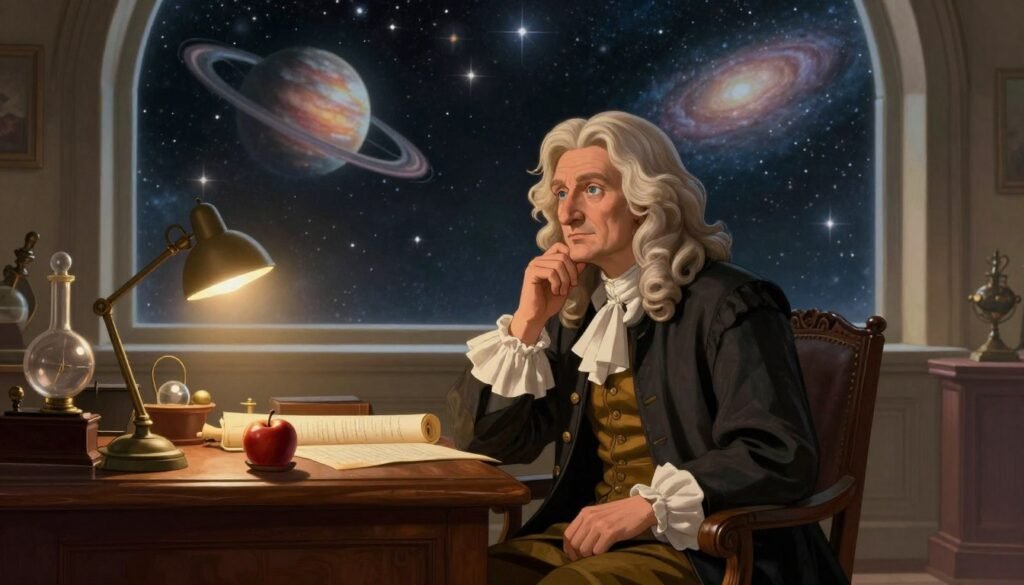
Newton’s work on gravity was huge. It explained why things fall, why planets orbit, and how comets move. His law of gravity was key for centuries until Einstein came along.
The Architect of Evolution: Charles Darwin
Charles Darwin changed how we see life on Earth! His idea of natural selection is key to biology today. Let’s look at his journey and discoveries that made him famous!
The Voyage of the HMS Beagle
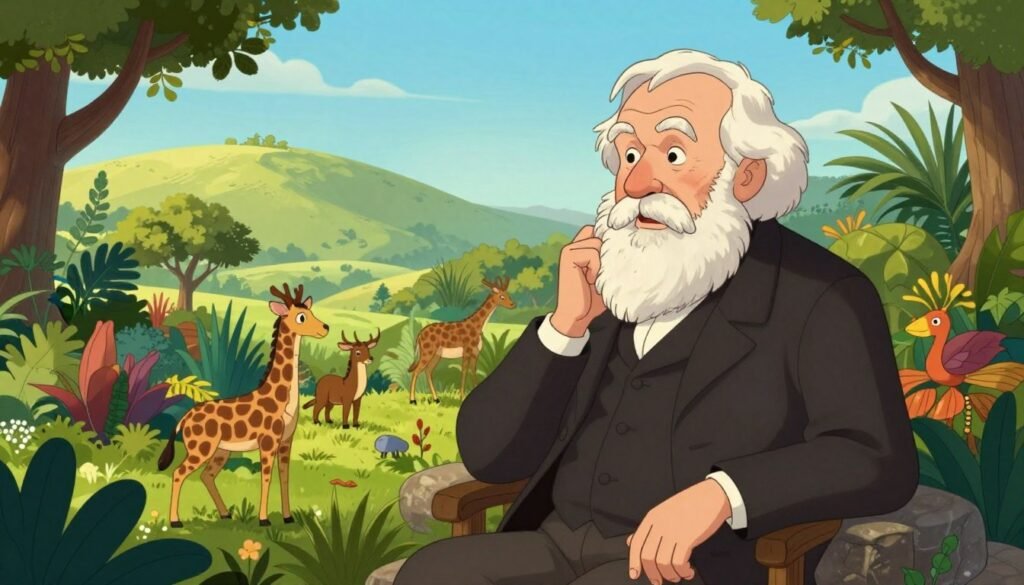
In 1831, Charles Darwin went on a big journey on the HMS Beagle. He traveled to many places, including the Galapagos Islands. There, he found many animals that helped him understand evolution.
He saw many different animals and places. This helped him see how species can change. Some important things he noticed were:
- The variety of finches on the Galapagos Islands, each with distinct beak shapes and sizes.
- The presence of similar species in different geographical locations, which hinted at adaptation.
- Fossils of extinct species that shared characteristics with living organisms.
Natural Selection and On the Origin of Species
Darwin’s journey on the HMS Beagle helped him come up with natural selection. He saw that species change over time. This happens because those with good traits live and have babies more.
In 1859, he published On the Origin of Species. This book explained how species adapt and evolve. It changed how we see life on Earth.
Darwin’s ideas were very important. They changed how we see ourselves in nature. They have helped biology, ecology, and conservation a lot.
The Pioneer of Computing: Alan Turing
Alan Turing is a name that resonates with innovation and genius in the world of computing!
We recognize Turing for his pivotal role in breaking the German Enigma code during World War II at Bletchley Park. His work not only shortened the war but also laid foundational principles for modern computer science.
Breaking the Enigma Code at Bletchley Park
At Bletchley Park, Turing’s contributions were instrumental in deciphering the Enigma code. He developed the Bombe machine, an electromechanical device that helped crack the code, significantly impacting the war’s outcome.
Turing’s work at Bletchley Park is a testament to his ingenious problem-solving skills and his ability to think outside the box. The success of the Enigma project is a great example of how teamwork and innovation can lead to groundbreaking achievements.
| Year | Event | Significance |
|---|---|---|
| 1939 | Turing joins Bletchley Park | Began working on Enigma code |
| 1941 | Successful cracking of Enigma | Significantly shortened the war |
| 1945 | End of World War II | Turing’s work recognized |
The Turing Test and Artificial Intelligence
Turing’s work didn’t stop at codebreaking. He is also known for proposing the Turing Test, a measure of a machine’s ability to exhibit intelligent behavior equivalent to, or indistinguishable from, that of a human.
The Turing Test has become a cornerstone in the field of artificial intelligence, sparking debates and inspiring research into creating machines that can think and learn like humans.
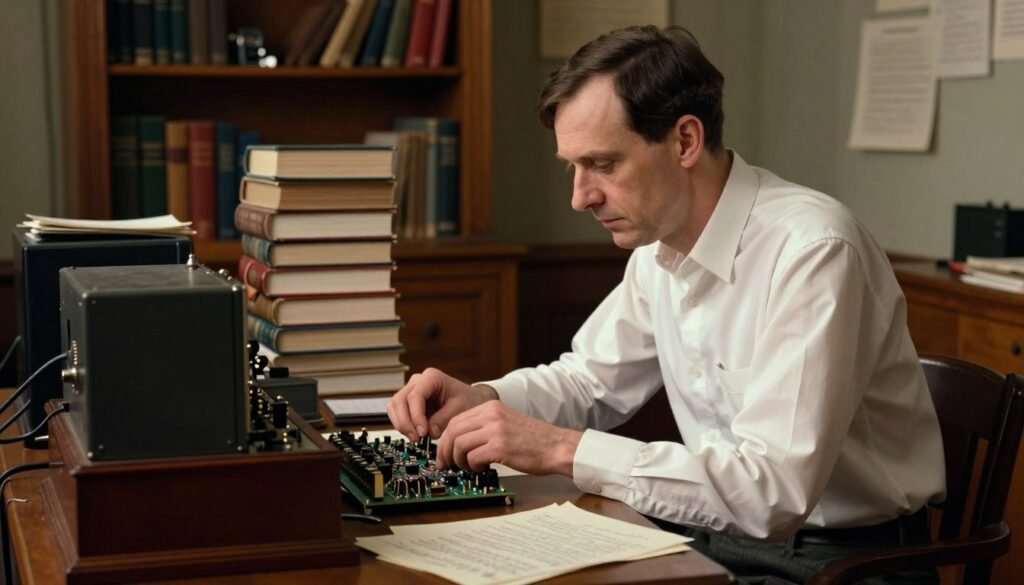
As we continue to advance in the field of computing and artificial intelligence, Turing’s legacy serves as a reminder of the power of human ingenuity and the importance of pushing the boundaries of what is possible.
The Theoretical Visionary: Stephen Hawking
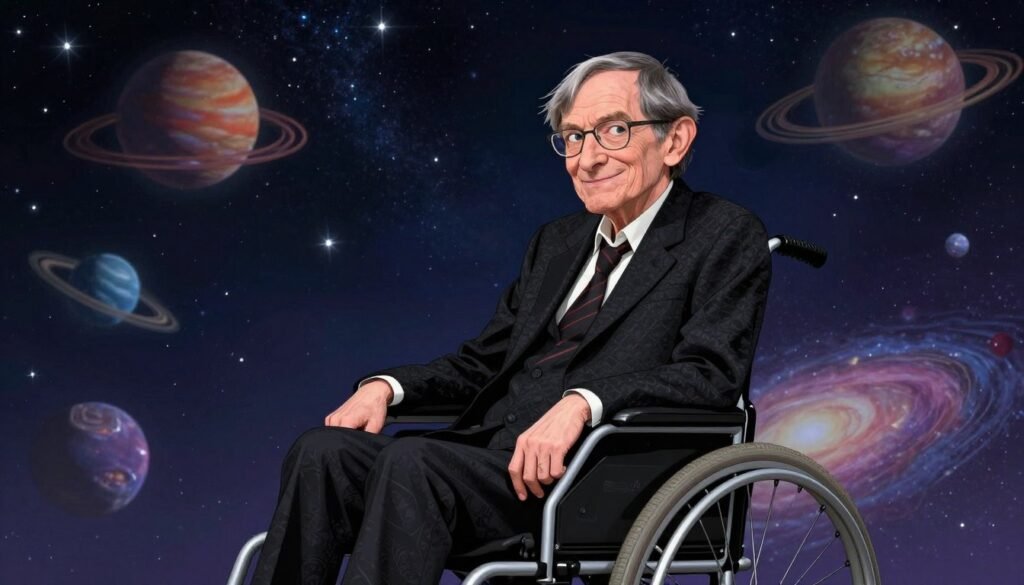
Stephen Hawking’s life is a story of overcoming odds. He was diagnosed with a motor neuron disease at 21. Doctors said he had just a few years left. But he lived over 50 years, inspiring many with his strength and will.
Hawking’s work changed how we see the universe. His studies on black holes and the universe’s start were key. Let’s look at his big contributions!
Black Holes and Hawking Radiation
Stephen Hawking changed how we see black holes. In the 1970s, he said black holes give off radiation, called Hawking radiation. This idea changed our view of black holes, showing they can disappear over time.
The idea of Hawking radiation was a big step in physics. It showed black holes have a temperature and can evaporate. This idea changed how we see the universe and physics.
| Key Concepts | Description |
|---|---|
| Black Holes | Regions in space where gravity is so strong that nothing, not even light, can escape. |
| Hawking Radiation | Theoretical prediction that black holes emit radiation due to quantum effects. |
A Brief History of Time and Public Science
In 1988, Hawking wrote A Brief History of Time. This book made science easy for everyone. It became a hit, making Hawking famous. He said,
“Intelligence is the ability to adapt to change.”
His way of explaining hard ideas shows his smartness and love for sharing knowledge.
Hawking’s work still inspires scientists and science fans today. You can learn more about him on PBS NewsHour.
The Father of Electromagnetism: Michael Faraday
Michael Faraday is a top scientist in history. His work on electromagnetism changed our world! He discovered many things that helped us make new tech.
Faraday worked in many areas, like chemistry and physics. But, his biggest impact was in electromagnetism. You can find out more about him on Wikipedia.
Discovering Electromagnetic Induction
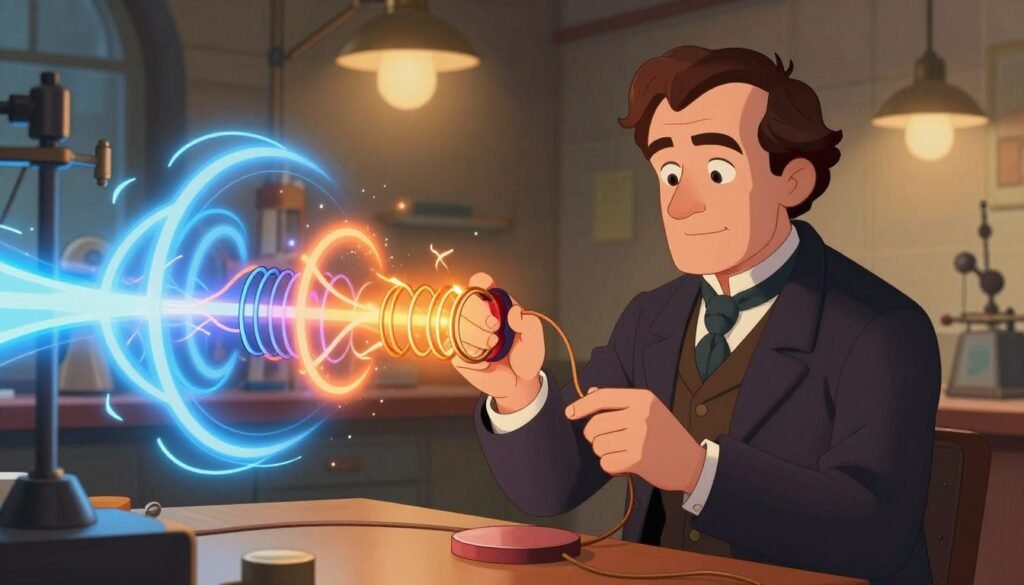
Faraday found the key to electromagnetic induction. This idea shows how to make electricity by changing a magnetic field. His discovery helped make many modern things, like generators and motors.
He worked hard and saw the big deal in his findings. His work changed physics and engineering forever.
The Development of the Electric Motor
Faraday’s work also led to the electric motor. This motor turns electricity into movement. It’s used in many things today, like appliances and machines.
The electric motor was a big step in tech history. It changed how we live and work. Now, electric motors are everywhere, helping us every day.
| Year | Discovery/Invention | Impact |
|---|---|---|
| 1831 | Electromagnetic Induction | Led to the development of generators, motors, and transformers |
| 1821 | Electric Motor | Converted electrical energy into mechanical energy, revolutionizing industry and daily life |
The DNA Double Helix: Rosalind Franklin
Rosalind Franklin’s work on DNA was key. Her famousPhoto 51 helped us understand genetics better!
She usedX-ray diffraction to study DNA fibers. This method scatters X-rays to show DNA’s structure. Her Photo 51 was crucial for the DNA double helix discovery.
X-ray Diffraction and Photo 51
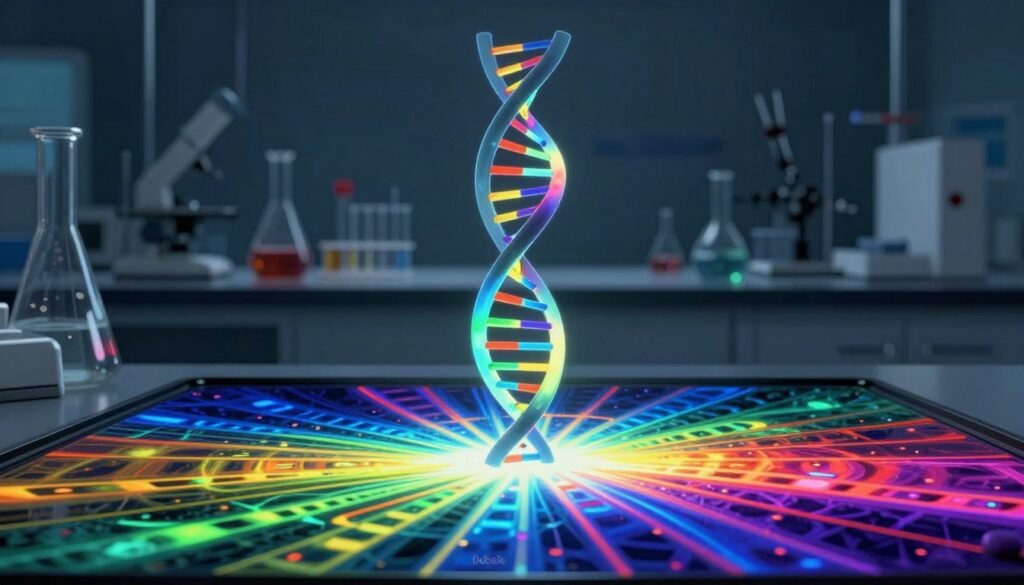 Photo 51 was a top-quality image. It helped James Watson and Francis Crick confirm their model.
To learn more about Franklin’s impact, check out Nature.
Contributions to Virology and Molecular Biology
Franklin did more than just DNA. She also worked on viruses. Her study of viruses like tobacco mosaic virus was groundbreaking.
Her work shows the power of science. It inspires scientists today!
The Penicillin Revolution: Alexander Fleming
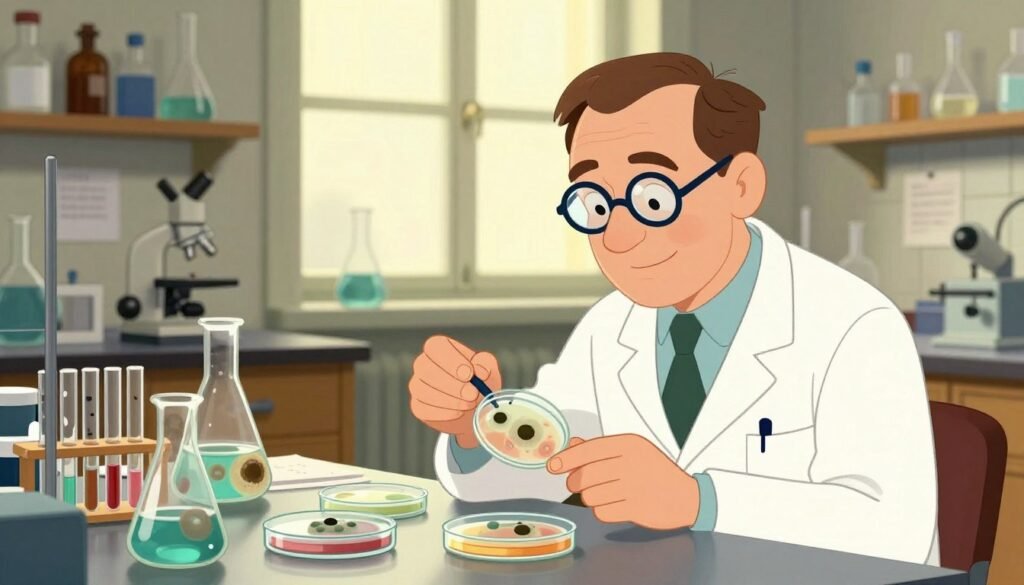
A Scottish scientist named Alexander Fleming made a big discovery in 1928. He found that a mold, Penicillium notatum, killed bacteria in his lab. This was a huge surprise.
The Accidental Discovery of Antibiotics
Fleming’s find was by accident, but it changed medicine a lot. He found a substance that killed bacteria and called it penicillin. His work showed how powerful penicillin was.
A PBS article talks about Fleming’s big find.
“Fleming’s discovery of penicillin was a major breakthrough in the fight against bacterial infections, and it paved the way for the development of modern antibiotics.”
Learn more about the first antibiotichere.
Transforming Modern Medicine and Healthcare
Fleming’s discovery changed medicine a lot. Penicillin saved many lives and changed how we treat infections. Now, antibiotics are key in healthcare.
Penicillin led to more research on antibiotics. Now, we have many ways to fight infections. Research keeps finding new ways to fight bacteria.
The Quantum Pioneer: Paul Dirac
Meet Paul Dirac, a scientist who changed how we see the quantum world! His work in physics is huge. It still guides scientists today.
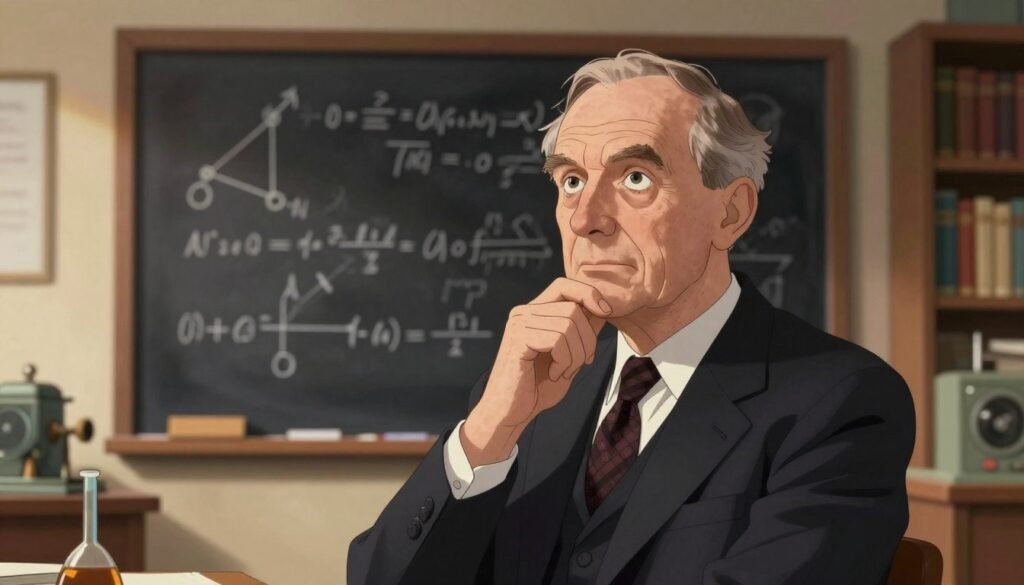
Dirac’s big win was the Dirac equation. It’s key in quantum mechanics. It shows how fermions act. This equation also showed that antimatter exists and helped us understand electron spin.
The Dirac Equation and Antimatter
The Dirac equation was a big deal in physics! It brought a new level of understanding to quantum mechanics by:
- Predicting the existence of antimatter, which was later confirmed experimentally!
- Explaining the spin of electrons and their magnetic properties.
- Providing a relativistic quantum mechanics framework that merged quantum theory and special relativity.
Foundations of Quantum Electrodynamics
Dirac’s work helped start quantum electrodynamics (QED). QED is about how light and matter interact. It’s a quantum field theory that works well. It predicts things like:
- The Lamb shift, a small change in hydrogen atom energy levels.
- The anomalous magnetic moment of the electron, a precise measurement that confirms QED’s accuracy.
Dirac’s work still inspires scientists today. It helps us understand the universe at its most basic level!
The Master of Genetics: Francis Crick
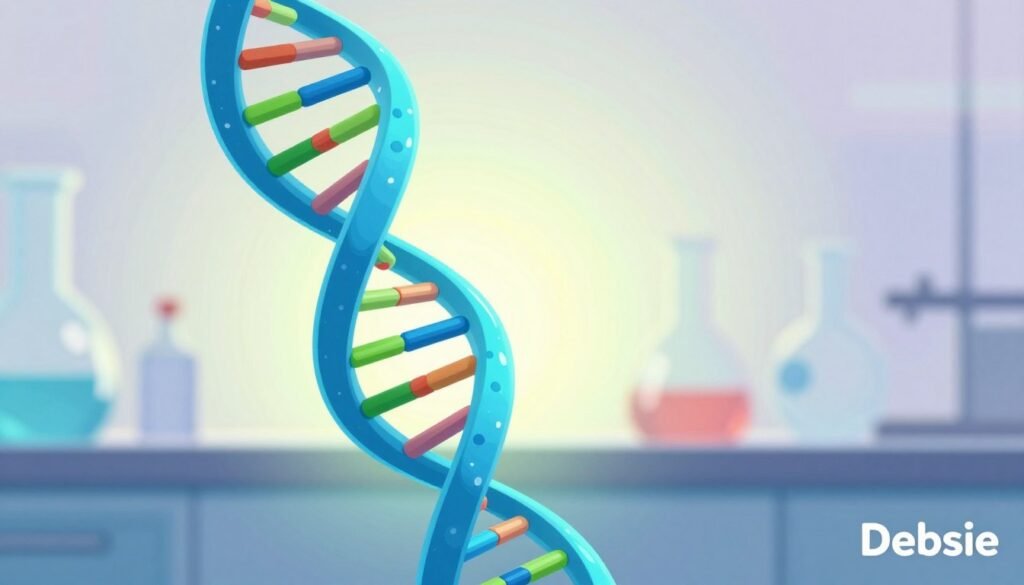
Let’s explore the world of genetics with Francis Crick. His work on DNA changed biology forever! He, along with James Watson, found DNA’s double helix structure. This was a big breakthrough in molecular biology.
Unraveling the Structure of DNA
The discovery of DNA’s structure was huge in science history. Crick and Watson worked at Cambridge University. They used data from Rosalind Franklin and Maurice Wilkins.
This double helix model was revolutionary. It showed how genetic info is stored and passed on.
The Central Dogma of Molecular Biology
Crick didn’t just stop at DNA’s structure. He also helped create the central dogma of molecular biology. This explains how genetic info flows in a biological system.
It shows how DNA turns into RNA and then into proteins. Proteins do lots of important work in cells.
| Concept | Description |
|---|---|
| DNA | Contains genetic instructions used in the development and function of all living organisms. |
| RNA | Acts as a messenger between DNA and the protein synthesis machinery. |
| Proteins | Perform a vast array of functions, including catalyzing metabolic reactions and replicating DNA. |
Francis Crick’s work in genetics and molecular biology has made a big impact. His discoveries still inspire scientists today.
The Analytical Engine: Ada Lovelace
Meet Ada Lovelace, a trailblazer in computer science! She worked on Charles Babbage’s Analytical Engine. This machine could do math and store data.
Ada Lovelace worked closely with Charles Babbage. She knew the Analytical Engine’s power. She also saw its future beyond just math.
Collaborating with Charles Babbage
Ada Lovelace translated an article by Italian mathematician Luigi Menabrea. Her notes were longer than the article itself!
Her notes showed she understood the Engine well. She thought it could make music and pictures too.
The First Computer Programmer
Ada Lovelace is seen as the first computer programmer. She wrote the first algorithm for a machine. This made her a pioneer in computer science.
- Her vision for the Analytical Engine was way ahead of its time.
- She saw the machine’s potential in many fields, not just math.
- Her notes on the Analytical Engine are the first computer program.
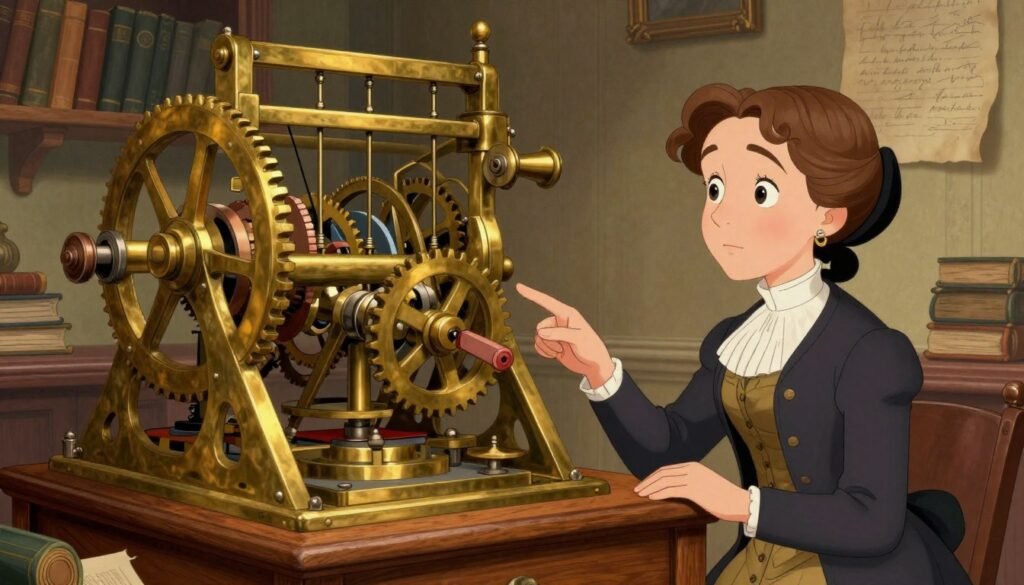
Ada Lovelace’s work in computer science shows her creativity and curiosity. She showed machines could do more than math. This opened the door to modern computing.
The Best British Scientists and the Evolution of Scientific Thought
The legacy of British scientists shapes our world! Their work has deeply influenced scientific thought.
British innovation has led global research. It has shaped science and shows why learning is key.
How British Innovation Shaped Global Research
British scientists have made big contributions. They’ve pushed progress and expanded our knowledge.
| Scientist | Contribution | Impact |
|---|---|---|
| Isaac Newton | Laws of Motion and Universal Gravitation | Fundamental principles of physics |
| Charles Darwin | Theory of Evolution through Natural Selection | Revolutionized biology and our understanding of species |
| Alan Turing | Computing and Artificial Intelligence | Shaped modern computing and AI research |
The Importance of Lifelong Learning and Skill Development
Scientific discoveries keep changing our view of the world. Lifelong learning is vital. It helps us stay current and grow our skills.
Learning for life boosts our knowledge and innovation. It’s key for future scientists and researchers.
Enhancing Your Scientific Knowledge with Debsie Gamified Courses
Debsie offers gamified courses for fun learning. These courses make science interactive and fun.
Ready to level up your learning? Visit Debsie at https://debsie.com/courses. Start exploring science today!
The Architect of the Periodic Table: John Dalton
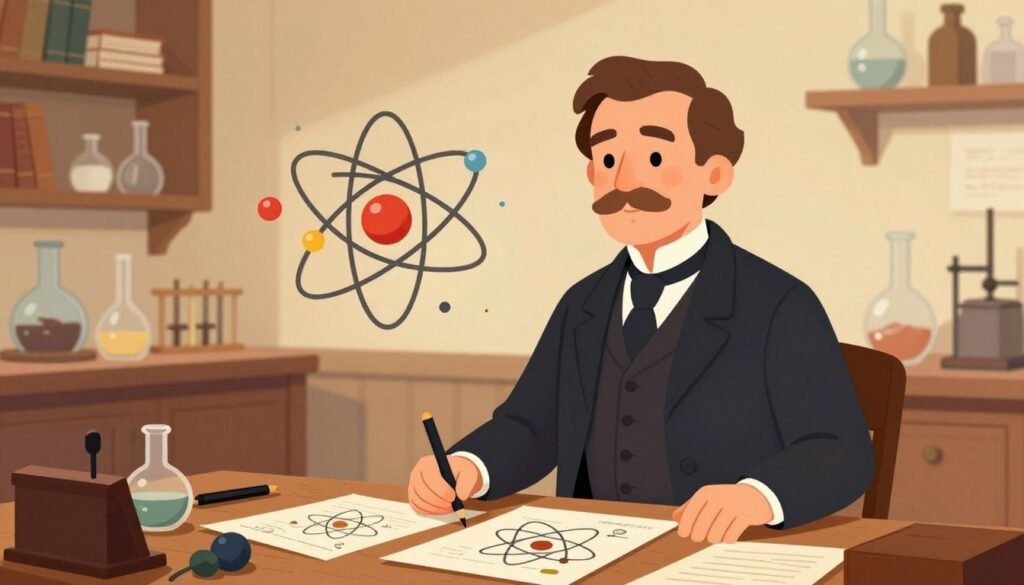
Meet John Dalton, the British scientist who changed chemistry forever!
Dalton’s work on atomic theory was a big change. He said elements are made of tiny, unbreakable atoms. He also said compounds form when atoms of different elements mix in certain ratios. This idea was new and helped start modern chemistry!
Atomic Theory and Chemical Symbols
Dalton’s ideas changed how chemists write about elements and compounds. He created a system of chemical symbols that was a big step towards today’s way of writing. Dalton’s symbols were circles with marks for different elements.
The Study of Color Blindness
Dalton also helped us understand color blindness. He studied it because he had it himself. His work made people know more about it and it’s sometimes called “Daltonism” in his honor.
Dalton’s work shows us the power of curiosity and never giving up. His ideas still inspire scientists and students today. They remind us that with hard work and passion, we can understand and grow from even the toughest ideas!
The Pioneer of Immunology: Edward Jenner
Let’s look at Edward Jenner’s amazing work. He started the idea of vaccination and saved many lives! His smallpox vaccine was a big step in immunology and health.
Jenner’s work saved many lives. It also helped start how we vaccinate today. Vaccination is key in keeping us healthy, fighting off many diseases.
The Smallpox Vaccine and Public Health
In 1796, Edward Jenner did something big. He noticed milkmaids who got cowpox were safe from smallpox. This led to the first vaccine.
- The smallpox vaccine was the first to work.
- It helped get rid of smallpox worldwide.
- Jenner showed how vaccines work, leading to more.
The Birth of Modern Vaccination
Jenner’s work on the smallpox vaccine started modern immunology. Now, vaccines are key in health plans everywhere, fighting many diseases.
Jenner’s discovery led to many vaccines. From polio and measles to flu and COVID-19 vaccines.
- Vaccines have saved millions of lives.
- They help control and stop diseases.
- Research keeps making vaccines better.
Conclusion
We’ve looked at the lives and achievements of Britain’s greatest scientists. Their work has changed the world a lot. The contributions of British scientists are unforgettable.
They have helped us understand the universe better. They’ve also made our lives better. Their work is still helping us today.
Scientists like Sir Isaac Newton and Alexander Fleming have changed our world. They’ve inspired many to keep exploring and learning. Their work shows us the power of human creativity.
We’re excited to see what the future holds. We know their legacy will keep inspiring us. Their work shows us the importance of never stopping to learn and discover.