
Imagine looking up at the night sky or using a GPS map. You might feel a rush of wonder! Behind every great discovery is a person with a dream and a curious mind.
These pioneers showed us that no hurdle is too high. They wanted to change the world!
Today, we celebrate the legacy of African American scientists. Their stories are about courage and heart. They cured diseases and helped us reach the moon.
Their work makes our lives better and safer!
You can start your own adventure today. Explore Debsie Gamified Courses! It’s fun and grows your brain.
We believe every child can be a great Black scientist.
Learning about these heroes shows us diversity makes the future brighter. Many leaders, like those in this list of 8 amazing scientists and how they changed, proved brilliance knows no bounds. Let’s dive into their amazing lives together!
Key Takeaways
- Discover the lives of pioneers who changed the world through innovation.
- Understand how diversity leads to better scientific breakthroughs for everyone.
- Learn about famous figures like Katherine Johnson and George Washington Carver.
- Explore how historical achievements inspire modern gamified learning experiences.
- See the impact of inventions like the blood bank and GPS on your daily life.
- Encourage a love for discovery and STEM in children and parents alike.
The Legacy of Black Scientists in Global Innovation
Black scientists have made a big impact on the world. They faced many challenges but kept going. They worked hard to get degrees and be recognized.
They have made big changes in medicine, agriculture, and technology. These leaders have broken down barriers for others.
They have made new discoveries and treatments in medicine. They also improved farming and crops.
Their achievements are a source of inspiration for many! They show that hard work and talent can change the world.
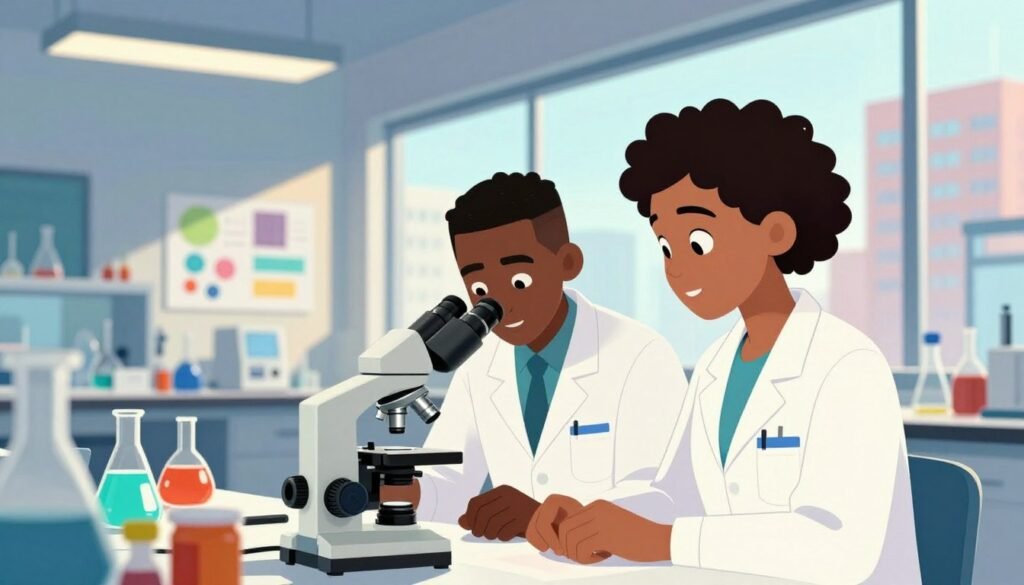
Black scientists have changed the world for the better. Their work inspires others to innovate and make a difference.
Benjamin Banneker and the Foundations of Early American Science
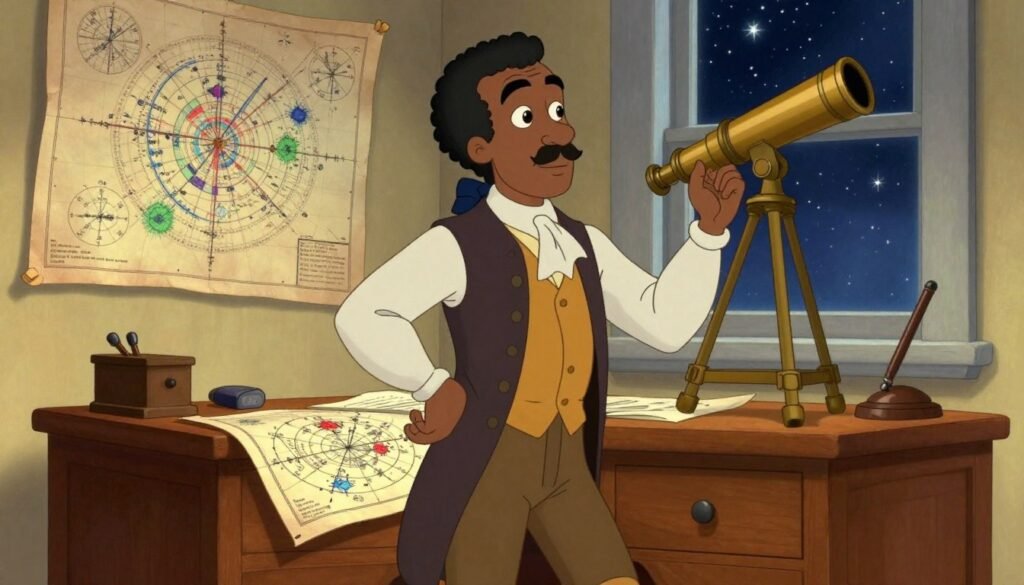
Meet Benjamin Banneker, a trailblazer in American science! He was born in 1731. Banneker was a self-taught astronomer and mathematician.
Banneker predicted a solar eclipse in 1789. This showed his deep knowledge in astronomy and math. His work showed the value of learning and education.
Banneker also helped survey Washington, D.C. He worked with famous surveyors. His skills were key for this big project.
“The very attempt to stem the torrent of opposition generally proves the ruin of weak minds; but we have seen that the more it rages, the more determined we are to act with firmness.”
This quote shows Banneker’s determination. His legacy inspires scientists and mathematicians, even those from underrepresented groups.
| Year | Achievement |
|---|---|
| 1789 | Accurately predicted a solar eclipse |
| 1791 | Participated in the surveying of Washington, D.C. |
Banneker’s work in early American science is important. It shows the diverse talent in the country’s history. By celebrating his achievements, we honor his legacy and the contributions of Black scientists.
George Washington Carver and the Agricultural Revolution
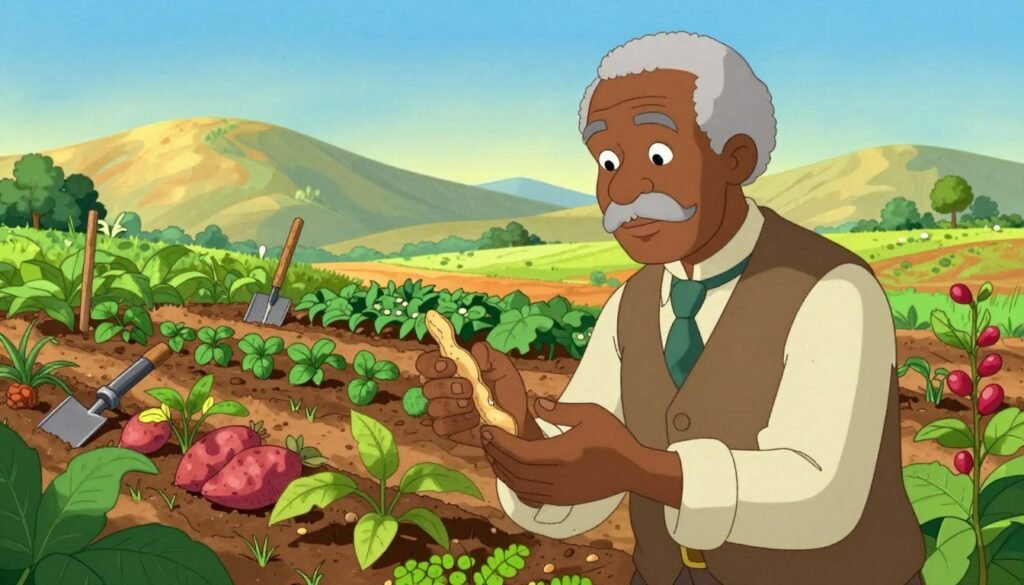
George Washington Carver changed farming forever! He was a top scientist in agricultural science. He came up with new ways to farm, like crop rotation.
This made farming better and helped farmers in the U.S. a lot.
At the Tuskegee Institute, Carver taught and researched a lot. He worked on peanuts, soybeans, and sweet potatoes. He found many uses for them, helping farmers make more money.
Carver was big on crop rotation. It keeps the soil healthy, fights pests, and makes farming better. This idea is still used today to help farmers all over.
| Innovation | Description | Impact |
|---|---|---|
| Crop Rotation | Rotating crops to maintain soil health | Improved soil fertility and reduced pests and diseases |
| Peanut Research | Discovering multiple uses for peanuts | Provided farmers with new products to market |
| Sustainable Practices | Promoting environmentally friendly farming techniques | Enhanced sustainability in agriculture |
To learn more about George Washington Carver, visit https://www.history.com/articles/george-washington-carver. It has lots of info on his work in agricultural science.
Dr. Charles Drew and the Life-Saving Science of Blood Plasma
Imagine a world without safe blood transfusions. Dr. Charles Drew made this world better! He was a famous surgeon who started blood banks and found new ways to store blood plasma. His work saved many lives during World War II.
Dr. Drew worked hard on blood plasma storage and transport. He found that separating blood into plasma and cells helped it last longer. This made it easy to send blood far without it going bad.
Key Achievements of Dr. Charles Drew:
- Developed the concept of blood banks.
- Improved the storage techniques for blood plasma.
- His work significantly contributed to saving lives during World War II.
Dr. Drew said,
“We have a tremendous amount of work to do, and I think that the key to it all is the proper use of blood.”
This shows his big dream to make blood transfusions safer and more available.
| Year | Achievement | Impact |
|---|---|---|
| 1940 | Developed blood bank concept | Revolutionized blood storage and transportation |
| 1941 | Improved blood plasma storage | Enabled long-distance transportation of blood |
| 1942-1945 | Contributions during World War II | Saved countless lives through blood transfusions |
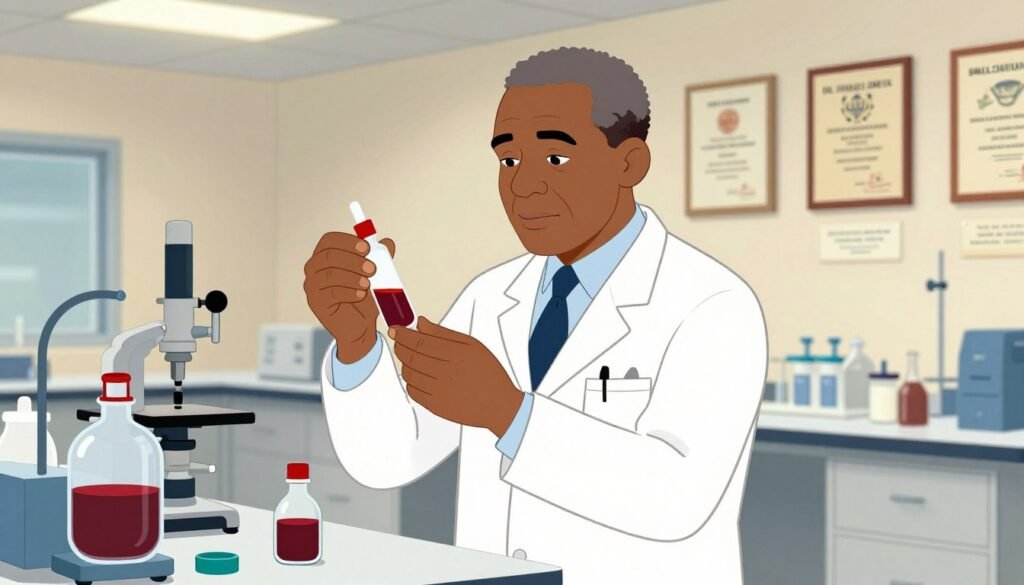
Dr. Charles Drew’s work still inspires doctors today. His work on blood plasma and blood banks changed healthcare. Now, blood transfusions are safe and save lives.
Katherine Johnson and the Mathematics of Space Exploration
Katherine Johnson was a key player in NASA’s early space missions. She worked as a mathematician at NASA. Her job was to calculate the paths for space missions, keeping astronauts safe.
Johnson was a trailblazer for women and minorities in STEM fields. Her hard work and skills won her respect and admiration. As NASA says, she did more than just math. She broke barriers for others to follow.
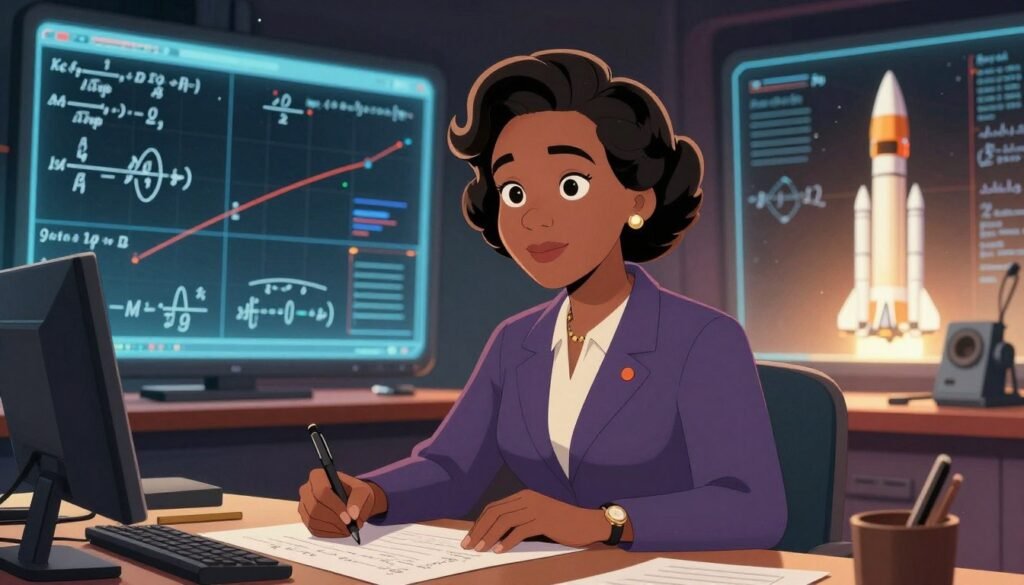
“The real glory is being part of something bigger than yourself,” Katherine Johnson once said. Her words show her spirit and the impact of her work. She inspires young people, girls and minorities, to go into science, technology, engineering, and mathematics.
Katherine Johnson’s story shows the power of determination and talent. Her work at NASA helped space exploration succeed. It also left a lasting legacy that inspires and educates people worldwide.
Dr. Percy Julian and the Synthesis of Medicinal Steroids
Meet Dr. Percy Julian, a pioneering chemist. He made groundbreaking contributions to the synthesis of cortisone and other vital steroids! His work had a profound impact on the medical community.
Dr. Julian’s journey to becoming a renowned chemist was not without its challenges. Despite facing racial barriers, he persevered and earned his Ph.D. in organic chemistry. His research focused on the synthesis of complex compounds from natural products, like soybeans and yams.
One of Dr. Julian’s most significant achievements was the synthesis of cortisone. This steroid is used to treat a range of medical conditions, including arthritis and skin allergies. Before his work, cortisone was very expensive and hard to produce. Dr. Julian’s innovative method made it more accessible and affordable, revolutionizing the treatment of various health issues.Key Contributions of Dr. Percy Julian:
- Synthesis of cortisone from natural products
- Development of new methods for producing medicinal steroids
- Pioneering work in the field of organic chemistry
Let’s take a closer look at Dr. Julian’s achievements in a comparative context:
| Compound | Previous Synthesis Method | Dr. Julian’s Synthesis Method |
|---|---|---|
| Cortisone | Complex, multi-step process from animal sources | Simplified process using soybeans and yams |
| Steroids | Limited availability, high cost | More accessible, reduced cost |
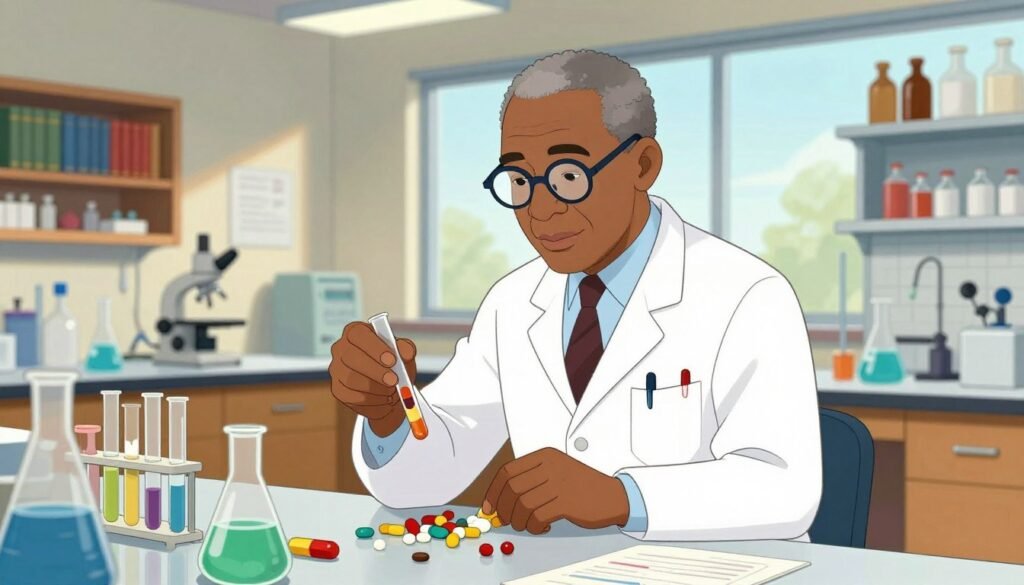
Dr. Percy Julian’s legacy extends beyond his scientific achievements. He inspired future generations of scientists. His work continues to impact the medical field. His story serves as a powerful reminder of the difference one individual can make through dedication and innovation.
Dr. Mae Jemison and the Intersection of Medicine and Space
Dr. Mae Jemison is a true pioneer. She was the first African American woman in space in 1992. She flew on the Space Shuttle Endeavour.
Her journey to NASA was not easy. She first worked as a doctor. Then, she served in the Peace Corps in Liberia and Sierra Leone.
Her time in the Peace Corps changed her view on health worldwide. Her medical background helped her in space medicine. She knew how to keep astronauts safe on long missions.
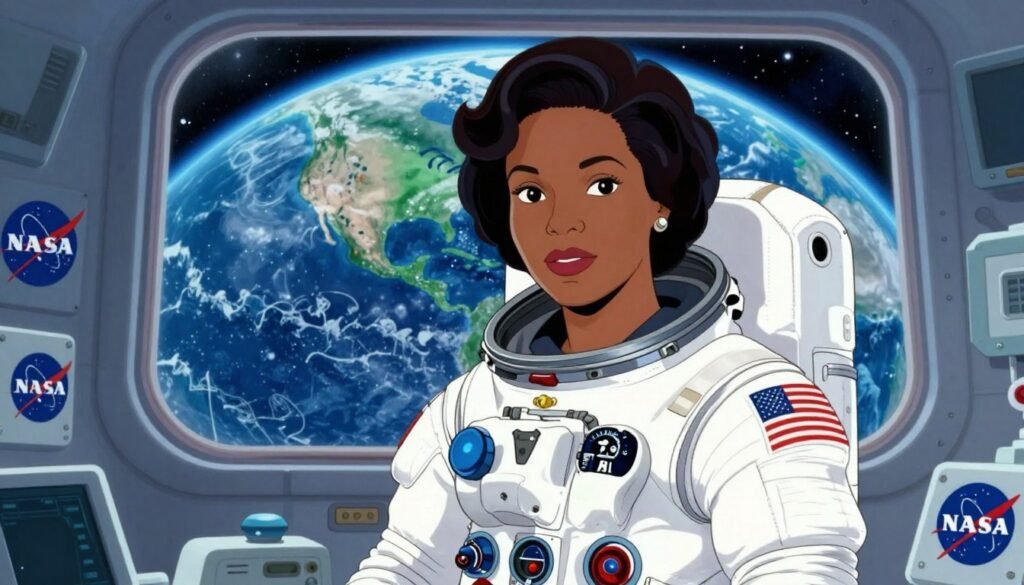
Dr. Jemison worked on Stanford University’s Health and Space Medicine Research. She also helped get more girls and minorities into STEM fields.
Her legacy goes beyond space. She has inspired many to chase their dreams, no matter the challenges. Her story shows the power of hard work and diversity in STEM.
Now, Dr. Jemison keeps working on STEM education and diversity in tech. Her efforts remind us that learning and innovation have no limits!
Dr. Gladys West and the Development of Global Positioning Systems
Meet Dr. Gladys West, the mathematician who helped create GPS. Her work made GPS a big part of our lives. It changed how we navigate and more.
Dr. Gladys West worked on the Global Positioning System (GPS). She did complex math and data work. Imagine a world without GPS – no Google Maps, no ride-sharing, and no precise navigation for planes and ships!

Dr. West helped GPS in many ways. She worked on using satellite data to make accurate Earth models. This is key for GPS to give exact locations and times.
| Contribution | Impact |
|---|---|
| Data Processing for GPS Satellites | Enabled accurate location and time information |
| Modeling the Earth’s Shape | Improved GPS accuracy for global users |
| Advancements in Geodetic Research | Supported various scientific and military applications |
Dr. Gladys West’s work on GPS changed our world. Her legacy inspires future scientists and mathematicians!
Dr. Shirley Jackson and the Advancements in Telecommunications
Dr. Shirley Jackson has made big steps in telecommunications. She is a physicist who helped shape today’s tech.
Dr. Jackson is a leader in physics. Her work has changed many fields, like telecommunications and energy. You can find out more about her on https://www.black-inventor.com/dr-shirley-jackson.
Key Contributions: Dr. Jackson’s research has brought many new ideas to telecommunications. Some of her big contributions are:
- Advancements in telecommunications technology
- Research on the behavior of subatomic particles
- Innovations in energy production and conservation
Impact on Telecommunications: Dr. Jackson’s work has made telecommunications better. Her research helped create faster and more reliable systems. This has led to better mobile tech, internet, and more!

Notable Achievements: Here are Dr. Shirley Jackson’s big wins in telecommunications and other areas:
| Achievement | Year | Impact |
|---|---|---|
| Received Ph.D. in Physics from MIT | 1973 | First African American woman to earn a Ph.D. in Physics from MIT |
| Research on subatomic particles | 1970s-1980s | Contributed to understanding of particle physics |
| Chairman of the U.S. Nuclear Regulatory Commission | 1995-1999 | First African American woman to hold the position |
Dr. Ernest Everett Just and the Study of Cell Biology
Dr. Ernest Everett Just was a trailblazer in cell biology. He made big discoveries about fertilization and marine animal development. His work helped us understand these processes better.
Dr. Just studied how eggs get fertilized. He found out how this affects the growth of embryos. His findings are very important.

He also discovered the egg’s surface is key in fertilization. This finding changed how we see cell biology.
Dr. Just said,
“The study of the egg is not merely a study of a cell; it is a study of the very beginnings of life itself.”
This shows his deep interest in fertilization and development.
His work still inspires scientists today. It’s a big part of developmental biology. By looking at his work, we see how amazing and complex life is.
Dr. Alice Ball and the Breakthrough Treatment for Leprosy
Meet Dr. Alice Ball, the chemist who changed leprosy treatment forever! She was a very smart chemist who helped a lot in medicine.
She found a new way to treat leprosy. This disease had been a big problem for a long time. Dr. Ball worked at the University of Hawaii.
She made a effective treatment for leprosy, called the “Ball Method.” It used special parts from chaulmoogra oil. This oil was used before but was hard to use because it was toxic.
Dr. Ball made it into an injectable form. This made it safer and easier for people to use.
Her work helped a lot with leprosy treatment. It also helped start more research on the disease. Dr. Ball’s work gave hope to many people with leprosy.
Today, we still remember Dr. Ball’s work in public health. Her legacy keeps inspiring scientists and researchers.
Modern Pioneers and the Future of STEM Education
Modern pioneers are changing STEM education in exciting ways! They are making science more accessible to everyone. This helps create a diverse and welcoming scientific community.
These pioneers do many things. They make new learning plans, create fun learning experiences, and push for more diversity in science. For example, Debsie is changing how kids learn with fun games.
Enhancing Learning Through Debsie Gamified Courses
Debsie’s courses at https://debsie.com/courses use games to teach STEM. This makes learning fun and easy for kids. It also gets them excited to learn more about STEM.
Debsie’s courses use cool features like AI-driven adaptive learning paths and leaderboards. These help kids learn at their own pace. It doesn’t matter how they learn best.
| Feature | Benefit |
|---|---|
| Gamified Learning | Increases engagement and motivation |
| AI-driven Adaptive Paths | Personalizes learning for each child |
| Leaderboards | Fosters healthy competition and encourages progress |
The Importance of Representation in Scientific Fields
Seeing people like you in STEM is very important. It helps kids dream of being scientists or engineers. This is very important for African American kids, who are often not seen in STEM.
By sharing stories of African American scientists, we can inspire many. For example, 10 Black Innovators Who Have Made an Impact in Science.

Let’s keep celebrating diverse scientists and educators. This will make STEM education better for everyone!
Overcoming Systemic Barriers in the Scientific Community
African American scientists have faced big challenges. But they have kept going and inspired others. They have had less access to resources, unfair funding, and fewer leadership roles. Still, they have made big impacts in their fields.
To beat these barriers, we need more diversity and inclusion in science. We can do this with mentorship, fair hiring, and support for all groups. A recent article on fighting systemic racism in science says change is key for fairness.
“The future of science depends on our ability to foster a diverse and inclusive environment where everyone has the opportunity to contribute and succeed.”
Socioeconomic factors also matter a lot. They affect how we think and our chances in school. Understanding this, as Debsie’s article explains, helps us help more people in science.
To tackle these barriers, we should:
- Make sure African American scientists are seen and heard!
- Help everyone get good education and research chances!
- Make science places welcoming and respectful!
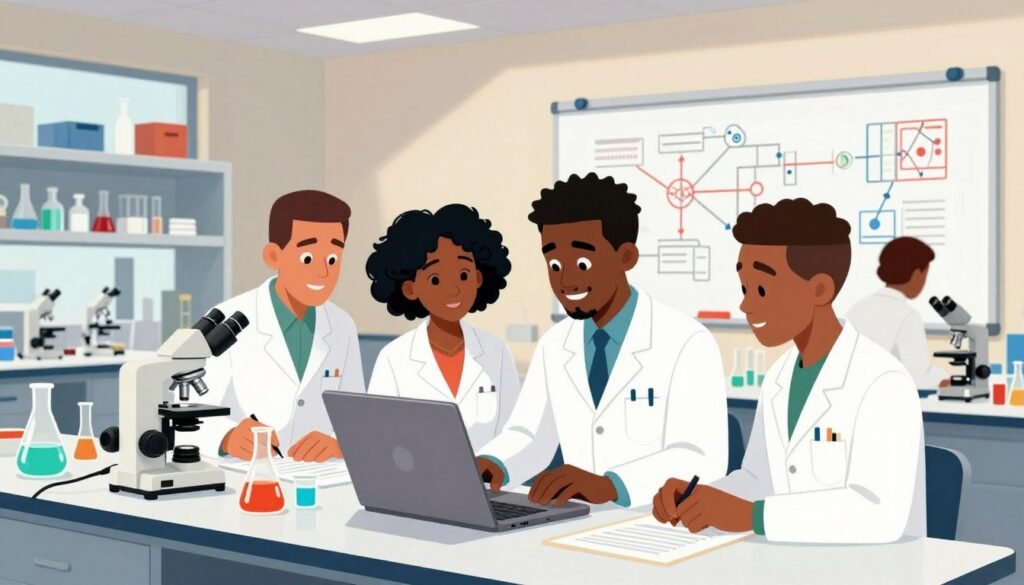
Together, we can make science better and more diverse. Let’s honor African American scientists and help the next ones!
Conclusion
Black scientists show us the power of new ideas and never giving up. We remember pioneers like Benjamin Banneker, Dr. Charles Drew, and Katherine Johnson. They changed how we see the world.
But, Black scientists face big challenges. They get less support and funding, as shown in the article on COVID-19 research. We need to keep helping and valuing their work.
Let’s celebrate Black scientists and make STEM fields more diverse. This way, we can build a fair and open scientific world. Learn more about Black scientists and fun educational games at Debsie’s gamified courses!