Artificial Intelligence is now part of school life. Many students use AI writing tools to finish homework, write essays, and fix grammar. Some teachers support it. Some worry about it. Parents are confused. Is AI helping children learn better? Or is it making them depend on machines?
1) Roughly 30%–60% of students say they have used an AI writing tool at least once for schoolwork
What This Really Means for Schools and Families
This number tells us one very clear thing. AI is not coming. It is already here. When up to sixty percent of students have tried an AI writing tool, it means this is no longer a small trend. It is part of daily student life.
Some students use AI out of curiosity. They want to see what it can do. Others use it because they feel stuck. Many use it because they feel pressure to perform well. And some use it simply because their friends are using it.
This does not automatically mean students are cheating. It means students are experimenting with new tools.
For parents, the smartest move is not fear. It is awareness. Instead of saying, “Do not use AI,” try asking, “How are you using it?” This question opens a healthy conversation. When children feel trusted, they become more responsible.

For teachers and schools, this stat shows that ignoring AI will not work. Clear policies are better than silence. Students need examples. They need to see the difference between using AI to brainstorm ideas and using AI to replace their own thinking.
At Debsie, we teach children that tools are like calculators. A calculator helps with speed, but it does not replace understanding. AI should work the same way. It should help students think better, not stop thinking.
When you guide children early, they learn balance. And balance is the real skill of the future.
2) About 15%–35% of students say they use AI writing tools weekly or more
When Use Turns Into Habit
Using AI once is curiosity. Using it every week is habit. This stat shows that a large group of students are not just testing AI. They are depending on it regularly.
When a student uses AI weekly, it becomes part of their writing routine. That can be good or bad. It depends on how it is used.
If a child uses AI to check grammar after writing their own draft, that builds skill. If they use AI to generate the full essay before even thinking, that weakens skill over time.
Habits shape the brain. Writing is not just about finishing homework. Writing trains thinking. It teaches structure, clarity, and logic. When AI replaces that process too often, the brain does less work.
Parents should gently observe patterns. Is your child opening AI before even reading the question? Or are they using it at the end for feedback? The order matters.
Teachers can design assignments that require visible thinking steps. Asking students to submit outlines, rough drafts, and short reflections about how they used AI creates accountability without fear.
At Debsie, we encourage children to build strong core skills first. Tools should come after effort, not before it. When students learn to struggle a little, they grow stronger.
Weekly use is not the problem. Unthinking use is the problem.
The goal is not to remove AI. The goal is to build independent thinkers who can use AI wisely.
3) Around 50%–70% of students report they generate ideas faster when AI is allowed for brainstorming
Speed Is Helpful, But Depth Matters More
Many students say AI helps them start faster. This is not surprising. Facing a blank page can feel scary. AI gives instant ideas, and that reduces stress.
For students who struggle to begin, this can be powerful. A simple prompt can create three or four topic ideas in seconds. That saves time and builds momentum.
But speed has a hidden risk. When ideas come too easily, students may not think deeply. They may accept the first idea instead of exploring better ones.
The brain grows when it works. When students brainstorm on their own, they stretch imagination. They connect ideas. They build creative muscles.
The solution is not banning AI brainstorming. The solution is improving it.
Parents can guide children to first think alone for five minutes before using AI. Write down three ideas. Then compare them with AI suggestions. This builds judgment skills.

Teachers can ask students to explain why they chose one idea over another. This forces thinking beyond copying.
At Debsie, we teach children how to think first and use tools second. Brainstorming should feel like a workout. AI can be a spotter, but the student must lift the weight.
Fast ideas are helpful. Thoughtful ideas are powerful.
4) Students often report saving about 10–30 minutes per essay when using AI for outlining
Saving Time Is Good, But What Happens to Learning?
Ten to thirty minutes saved per essay sounds amazing. For busy students, that feels like a gift. But we must ask an important question. What are they giving up in exchange?
Outlining teaches structure. It trains students to organize thoughts. It builds logical flow. When AI creates the outline, the student may follow it without truly understanding why it works.
If students skip this thinking step too often, they may struggle later when AI is not available.
Time saved should be reinvested wisely. If AI helps with outlining, students should use the extra time to improve arguments, add real examples, or refine clarity. The saved minutes should strengthen depth, not reduce effort.
Parents can encourage children to review AI outlines carefully. Ask them to rearrange sections. Ask them to explain each paragraph in their own words before writing.
Teachers can require students to slightly modify AI-generated outlines. Even small changes increase ownership.
At Debsie, we teach children that time is a tool. If AI saves time, use that time to grow stronger skills. Do not use it to rush to the next distraction.
Efficiency is powerful. But growth is more important.
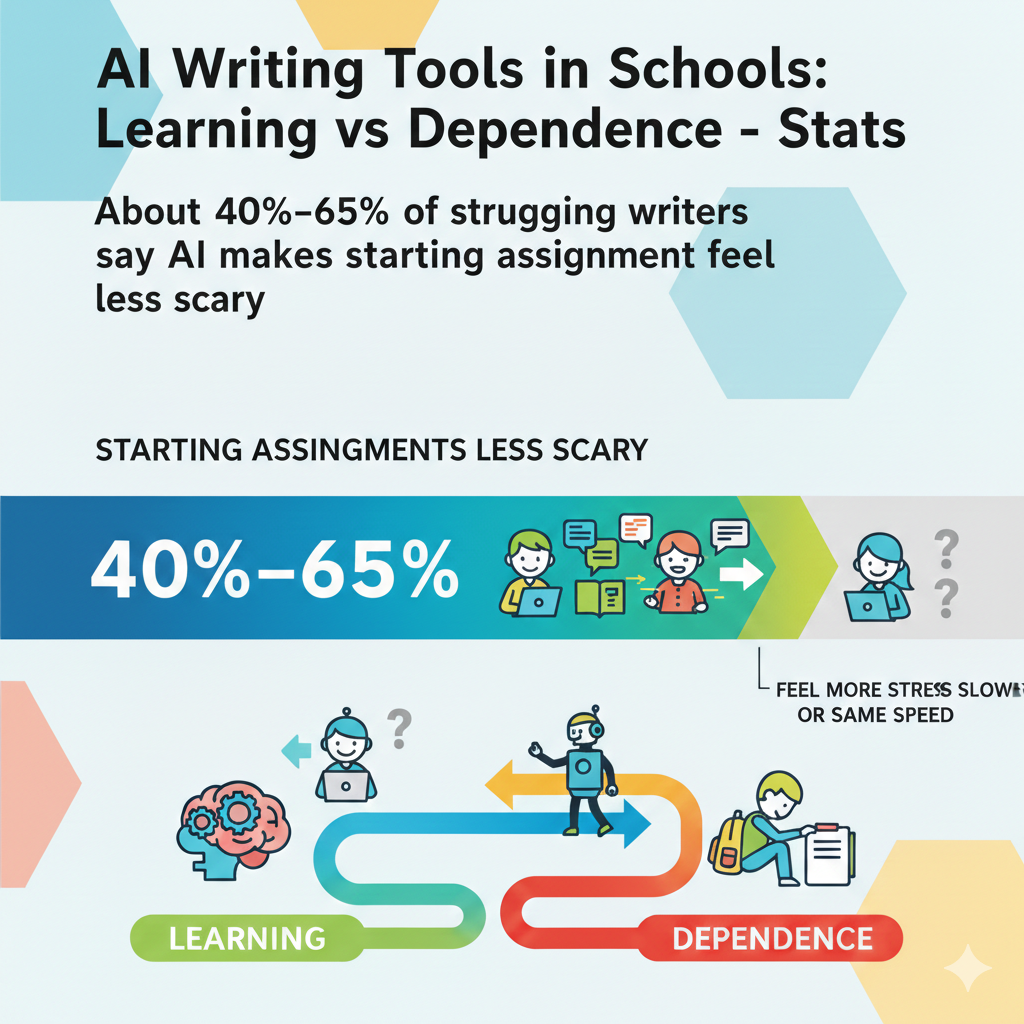
5) About 40%–65% of struggling writers say AI makes starting assignments feel less scary
Reducing Fear Can Unlock Growth
For many children, writing is emotional. It is not just academic. They fear being wrong. They fear judgment. They fear low grades.
When AI helps them start, it reduces that fear. That is important. Confidence is the door to learning.
If a child feels less anxious, they are more likely to try. And trying is the first step toward improvement.
But comfort must not become dependence. If a student believes they cannot start without AI, that belief limits growth.
Parents can build courage slowly. Encourage your child to write one paragraph alone before checking AI. Celebrate effort, not perfection.
Teachers can create low-pressure writing exercises. Short daily writing tasks build confidence without high stakes.
At Debsie, we believe confidence grows from small wins. AI can provide support, but children must experience success from their own thinking.
Fear reduction is powerful. But skill development must follow.
If AI removes fear and builds effort, it is helpful. If AI removes effort entirely, it becomes harmful.
The goal is simple. Confident students who can write on their own.
We have now covered the first five stats in depth.
6) Roughly 45%–75% of English language learners say AI helps them fix grammar and word choice
AI as a Language Support Tool
For students who are learning English, writing can feel twice as hard. They may understand the topic well, but struggle to express their ideas clearly. Grammar mistakes can lower grades even when their thinking is strong.
This is where AI can truly help.
When almost three out of four English language learners say AI improves grammar and vocabulary, it shows real value. AI can act like a patient editor. It corrects sentence structure. It suggests better words. It explains mistakes instantly.
This support builds confidence. A child who once felt embarrassed about errors may now feel brave enough to share ideas.
But here is the key. AI should correct, not replace.
If a student writes their own paragraph and then uses AI to refine grammar, learning happens. They can compare their original version with the improved one. Over time, patterns become clear. They start noticing their common mistakes. That is growth.
However, if a student types a short idea and lets AI expand it into a full essay, the language practice disappears.
Parents can encourage children to write first in simple English. Then ask AI to explain corrections clearly. Not just fix them, but explain why.
Teachers can allow AI for grammar support while still grading idea quality separately.
At Debsie, we believe language should empower children, not limit them. AI can be a bridge for global learners. But the child must still walk across it.
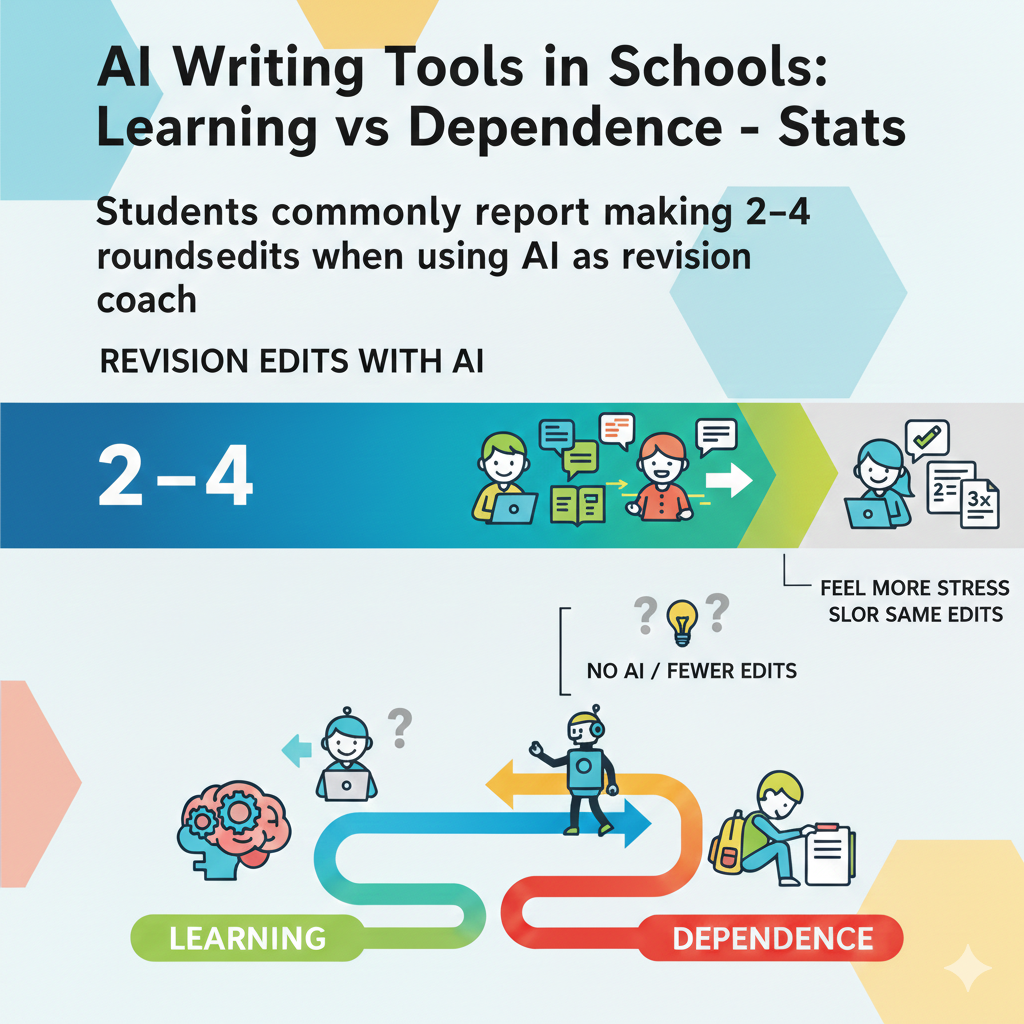
7) Students commonly report making 2–4 rounds of edits when using AI as a revision coach
More Editing Can Mean More Learning
Revision is where real writing improves. Sadly, many students used to submit first drafts without reviewing them. Now, with AI feedback, students often revise multiple times.
That is a positive shift.
When students edit two to four times, they see how writing improves step by step. They notice clarity, sentence flow, and argument strength.
But the way they edit matters.
If they simply accept every AI suggestion without thinking, they are not learning. They are outsourcing judgment. True revision requires comparison and decision-making.
Parents can guide children to review AI suggestions carefully. Ask them, “Do you agree with this change?” This builds critical thinking.
Teachers can require students to highlight changes and explain why they accepted or rejected certain suggestions.
At Debsie, we teach that revision is like polishing a gem. The tool can help polish, but the owner must inspect the shine.
Editing multiple times is powerful. Blind editing is not.
The goal is thoughtful improvement.
8) AI-assisted drafts often show 20%–50% fewer grammar and spelling errors
Surface Improvements Are Easy Wins
This stat explains why AI is so attractive. Grammar and spelling errors can drop by almost half. That is a big visible improvement.
Teachers see cleaner papers. Students receive better marks for technical accuracy. Parents feel proud.
But grammar is only one layer of writing. It is the surface. Deep writing involves logic, argument strength, evidence, and creativity.
If AI fixes grammar, students must focus their energy on deeper skills.
Parents should praise clean writing, but also ask about ideas. Ask your child what their main argument is. Ask why they believe it.
Teachers can separate grades. One part for grammar. Another part for reasoning.
At Debsie, we train students to understand structure and clarity first. When grammar tools clean the surface, students can invest time into deeper thinking.
Clean writing is important. Clear thinking is essential.
Use AI to polish. Do not let it replace thought.
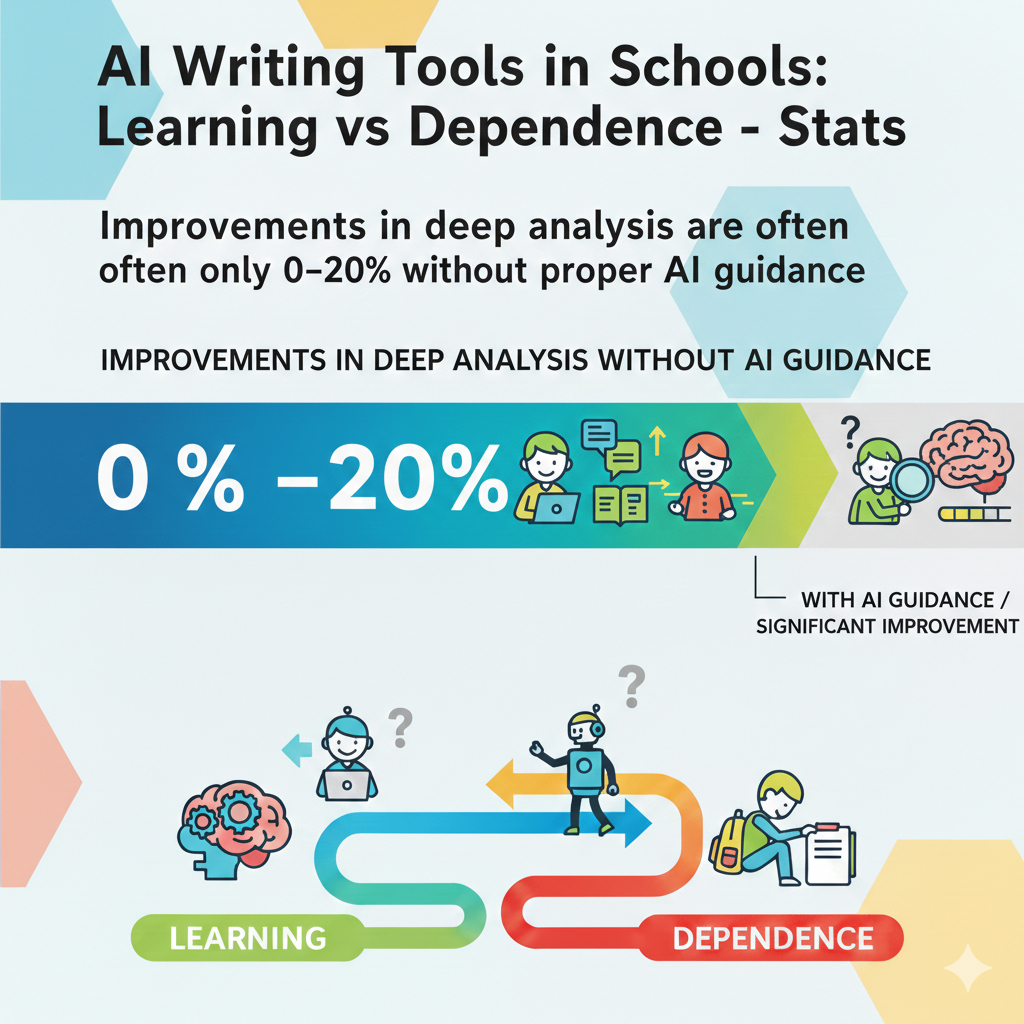
9) Improvements in deep analysis are often only 0%–20% without proper AI guidance
Thinking Skills Do Not Grow Automatically
This stat is powerful. While grammar may improve greatly, deep thinking does not automatically improve.
If students simply generate essays with AI, they may sound smart without actually understanding the topic.
Analysis requires questioning. It requires comparing ideas, forming opinions, and backing them with reasons. AI cannot grow that skill for the student.
Guided use makes the difference.
Parents can ask children to explain AI-generated arguments in their own words. If they cannot explain it simply, they may not truly understand it.
Teachers can design assignments that require personal examples, class discussions, or real-life connections. This forces genuine thought.
At Debsie, we focus heavily on reasoning skills. We teach children to break problems into steps, question assumptions, and defend their answers.
AI is a support tool. Thinking is a human skill.
Without guidance, AI may improve appearance. With guidance, it can strengthen understanding.
10) Around 25%–45% of students admit they have copied AI text directly at least once
The Copy-Paste Risk
This number is serious. When nearly half of students admit to copying AI text directly, it shows a growing ethical challenge.
Many students do this because they feel pressure. Deadlines, grades, and comparison create stress.
But copying weakens confidence. It creates a habit of avoidance. Over time, students may doubt their own ability.
Parents must approach this carefully. If a child admits copying, do not react with anger. Focus on why it happened. Was it time pressure? Fear of failure?
Teachers can reduce copy-paste behavior by requiring drafts, outlines, and process explanations.
At Debsie, we teach children that shortcuts steal growth. When students struggle through writing, their brain becomes stronger. That strength lasts for life.
AI should help children think better. It should never replace their voice.
Integrity is more valuable than speed.
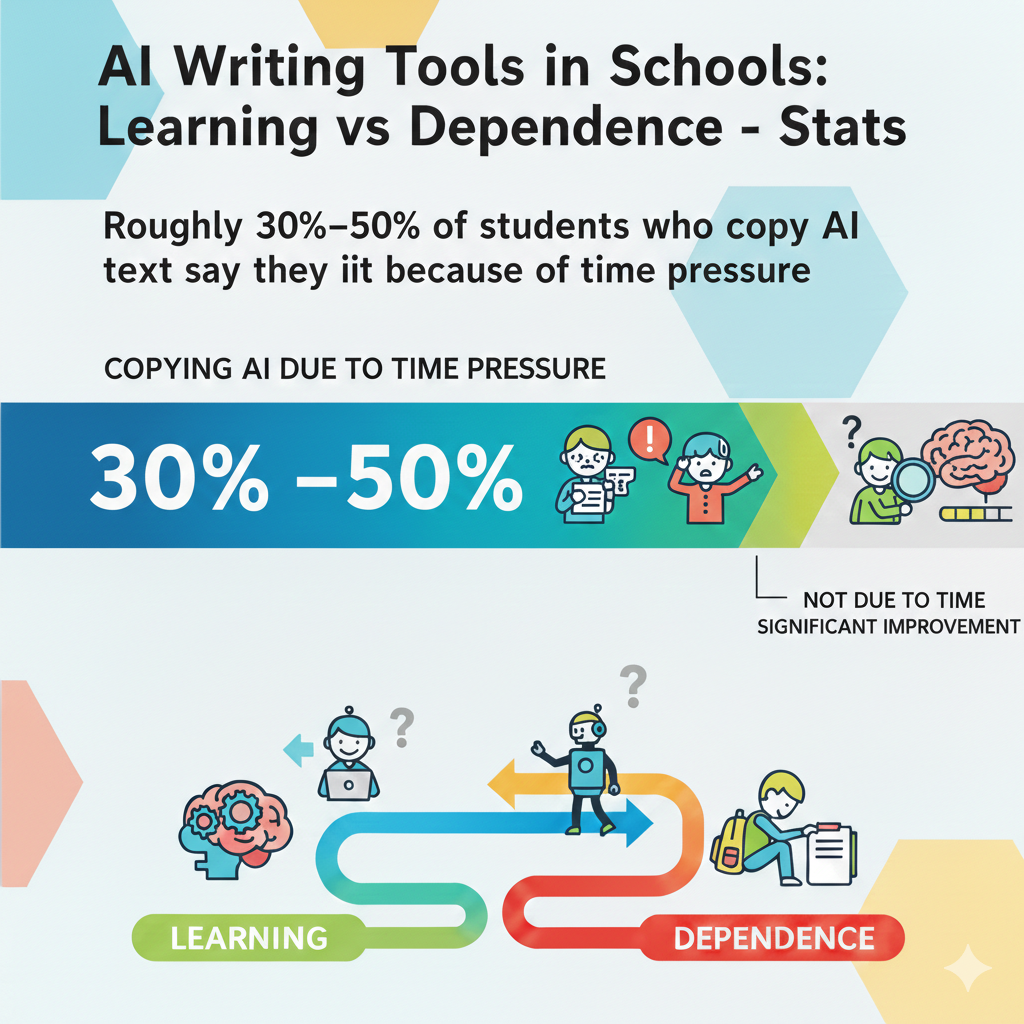
11) Roughly 30%–50% of students who copy AI text say they did it because of time pressure
Pressure Is the Real Problem
When students say they copied AI text because they were short on time, we must pause. The issue is not only technology. It is pressure.
Many students juggle homework, tests, activities, and social life. When deadlines pile up, AI feels like an easy escape. It promises fast answers. It removes the stress of starting from scratch.
But copying to save time creates a long-term cost. Students may finish faster today, but tomorrow they may struggle to write without help. Skills grow slowly. Shortcuts stop that growth.
Parents should look at schedules honestly. Is your child overloaded? Are expectations realistic? Sometimes reducing pressure is more powerful than banning AI.
Teach children time planning. Encourage them to start assignments earlier. Even starting ten minutes a day before the deadline reduces panic.
Teachers can space out deadlines when possible. They can also create smaller checkpoints instead of one large final submission. Smaller steps reduce last-minute rush.
At Debsie, we teach students how to manage time, not just solve problems. Smart planning builds confidence. When children feel in control of their schedule, they are less likely to depend on shortcuts.
The solution to copying is not fear. It is better planning and stronger habits.
12) In schools without clear AI rules, students are 2–3 times more likely to use AI for full writing tasks
Silence Creates Confusion
When schools do not clearly explain what is allowed and what is not, students guess. And guessing often leads to overuse.
If rules are unclear, students may assume full AI writing is acceptable. Or they may believe everyone else is doing it. That belief spreads quickly.
Clear guidelines reduce misuse. When students know AI can be used for brainstorming but not final drafts, they understand limits.
Parents should also create simple home rules. For example, AI can help check grammar, but the first draft must be written alone. Clear expectations create healthy boundaries.
Teachers can include AI policy statements in assignment instructions. Even a short explanation builds awareness.
At Debsie, we believe clarity builds responsibility. Children respect rules when they understand the reason behind them.
Technology without guidance leads to confusion. Technology with structure leads to growth.
Rules are not restrictions. They are support systems.
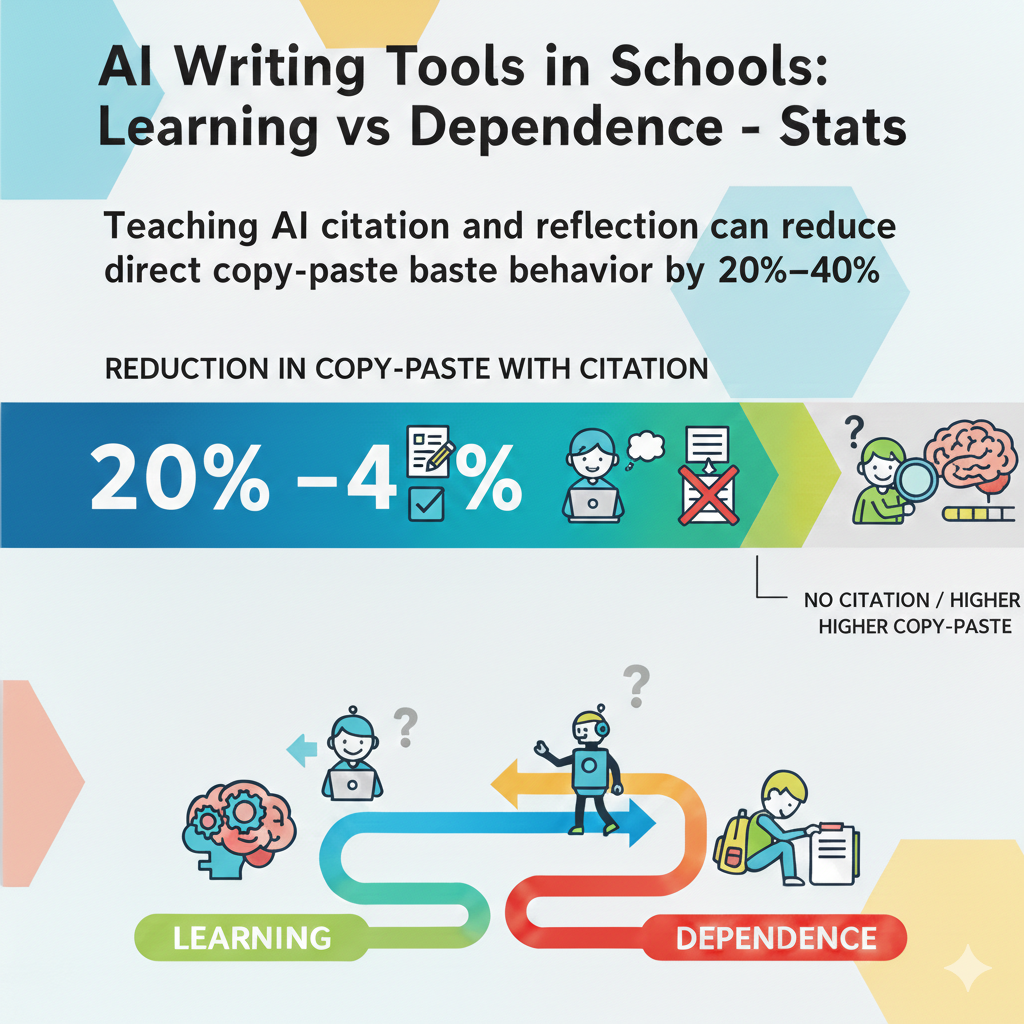
13) Teaching AI citation and reflection can reduce direct copy-paste behavior by 20%–40%
Education Is More Powerful Than Punishment
When students are taught how to cite AI use and reflect on how they used it, misuse drops significantly. This is important.
When children know they must explain how AI helped them, they become more thoughtful. Reflection forces awareness.
Instead of hiding AI use, students learn to document it. This builds honesty and accountability.
Parents can encourage children to keep a simple writing journal. Ask them to note when they used AI and how it helped. This habit builds transparency.
Teachers can require a short reflection paragraph at the end of assignments. Questions like, “How did AI support your thinking?” encourage responsible use.
At Debsie, reflection is a key learning tool. When students think about how they learn, they improve faster.
Punishment creates fear. Education creates maturity.
If we want children to use AI wisely, we must teach them how.
14) About 35%–55% of students say they are unsure what counts as cheating with AI
Confusion Creates Risk
When half of students do not clearly understand what cheating means with AI, problems are bound to happen.
Is rewording cheating? Is using AI to summarize notes allowed? What about fixing grammar?
Without clarity, students may cross lines unknowingly.
Parents should talk openly about academic honesty. Explain the difference between help and replacement. A good question to ask is, “Did you still do the thinking yourself?”
Schools should define examples clearly. Showing both acceptable and unacceptable uses removes confusion.
At Debsie, we teach ethical technology use from a young age. Children should understand that tools are helpers, not substitutes for effort.
Clarity protects students. When they understand boundaries, they can act with confidence.
15) Around 20%–40% of students use AI mainly to make their writing “sound smarter”
Sounding Smart Is Not the Same as Being Smart
Many students admit they use AI to make sentences more complex or impressive. They want their work to sound advanced.
This reveals something deeper. Students often equate complicated language with intelligence.
But true intelligence is clarity. The best writing is simple and strong.
When AI adds big words and long sentences, students may not fully understand what they are submitting. This weakens ownership.

Parents can encourage children to value clear writing. Ask them to explain their essay verbally. If they cannot explain it simply, the writing may not truly be theirs.
Teachers can reward clarity over complexity. Short, precise sentences should earn high marks.
At Debsie, we teach children that smart thinking is not about big words. It is about strong logic and honest expression.
AI can refine language. But it should not hide understanding.
Confidence comes from knowing what you wrote and why you wrote it.
16) In writing-heavy grades, many teachers estimate 10%–30% of submitted essays include AI-generated passages when no guardrails exist
When Guardrails Are Missing, Misuse Grows
In classes where writing is frequent and rules about AI are unclear, teachers often suspect that between one out of ten and one out of three essays contain AI-generated sections. This does not always mean full essays are written by AI.
Often, it is a paragraph here or a rewritten section there. But even partial dependence can slowly reduce skill growth.
This stat shows that structure matters. When there are no guardrails, students experiment freely. Some do it out of curiosity. Others do it because they see classmates doing the same. Over time, it becomes normal.
Guardrails do not mean banning technology. They mean building smart systems. For example, teachers can require handwritten brainstorming in class before the final typed draft. They can ask students to submit version history from shared documents.
They can include short in-class writing tasks that reflect the same topic as the take-home essay. These steps make learning visible.
Parents can support guardrails at home. Encourage your child to explain their argument before typing it. Ask them to outline ideas on paper first. When children talk through their ideas, it strengthens understanding.
At Debsie, we believe structure builds independence. Children thrive when expectations are clear. When students know they must show their thinking process, they focus more on learning and less on shortcuts.
The lesson here is simple. When adults create thoughtful systems, students rise to the challenge. Without guidance, dependence quietly grows.
17) When assignments are highly personal or based on unique class discussions, AI use drops by about 15%–35%
Personal Learning Reduces Dependence
AI works best on general topics. It can easily write about climate change, historical events, or broad themes. But when assignments become personal or tied to specific classroom conversations, AI becomes less useful.
Teachers report that when essays require students to reflect on their own experiences, connect to a class debate, or reference a unique activity, AI misuse decreases significantly. That is because AI cannot fully replicate a child’s lived experience or classroom memory.
This is a powerful insight. The more personal the task, the more authentic the learning.
Parents can encourage this approach at home too. If your child uses AI for help, ask them to include a personal example in every assignment. Real stories build ownership.

Teachers can design prompts that ask students to connect lessons to their lives. Questions like, “How did this topic change your opinion?” or “What did you learn from our class experiment?” require real thinking.
At Debsie, we use project-based learning for this reason. When children build, create, and reflect, their work becomes unique. It cannot be easily copied.
The more education feels personal, the less students depend on machines. Authentic tasks protect original thinking.
18) Assignments requiring process logs or draft reflections can reduce reported AI misuse by 20%–50%
When Process Matters More Than Product
One major reason students misuse AI is because only the final product is graded. If only the finished essay matters, students may focus on perfection rather than learning.
When teachers require process logs, draft submissions, or short reflections about how the work was created, misuse drops sharply. This is because students must show their thinking journey, not just the result.
A process log might include early ideas, outline changes, and reasons for revisions. Reflection questions might ask what was difficult and how it was solved. These small additions shift focus from appearance to growth.
Parents can apply this at home by asking about the steps behind the homework. Instead of asking, “Did you finish?” ask, “What part was hardest?” This encourages awareness of effort.
At Debsie, we emphasize learning journeys. We reward persistence, not just final answers. When children see that effort is valued, they invest more honestly.
Technology becomes less of a shortcut when the journey counts. Students begin to see that real learning happens during the struggle, not just at submission time.
19) About 15%–30% of heavy AI users say they feel less confident writing without it
The Confidence Gap
This stat reveals a hidden danger. Some students who frequently rely on AI begin to doubt their own ability. When asked to write without assistance, they feel nervous or stuck.
This is called skill drift. When a tool handles too much of the work, natural skill weakens. The brain adapts to the easier path.
Confidence in writing comes from practice. When students face challenges and solve them independently, belief grows. But when AI constantly fills gaps, students may question their capability.
Parents should occasionally encourage device-free writing time. Simple journal entries written by hand can rebuild self-trust. Praise effort, not polish.

Teachers can schedule timed in-class writing sessions without AI. These moments help students measure their real ability.
At Debsie, we build strong foundations first. We teach children to solve problems step by step. Once they trust their thinking, tools become enhancements, not replacements.
True confidence comes from knowing, “I can do this on my own.” AI should support that belief, not replace it.
20) In no-AI timed essays, some teachers report a gap of 1–2 grade levels between AI-assisted and independent writing
The Skill Gap Becomes Visible
When students write at home with AI help, their essays may appear advanced. But during timed, in-class writing without tools, performance sometimes drops noticeably. Teachers often describe a gap equal to one or even two grade levels.
This difference highlights dependence. If a student’s independent writing is much weaker than their AI-assisted work, learning may not be fully happening.
The goal of education is skill growth, not polished appearances.
Parents can compare different writing samples. Look at homework essays and in-class work. If there is a large gap, discuss how AI is being used.
Teachers can balance assessments. Some tasks may allow AI with clear guidelines. Others should measure independent ability.
At Debsie, we focus on mastery. Children should be able to explain concepts clearly without relying on tools. Once mastery is strong, technology becomes an accelerator, not a crutch.
A gap between assisted and independent work is a signal. It is not a reason for punishment. It is a sign that guidance is needed.
Students deserve to feel capable with or without technology.
21) Teachers commonly report that 20%–40% of AI-heavy work sounds confident but contains shallow thinking
When Writing Sounds Smart but Lacks Depth
Many teachers notice something interesting. Essays written with heavy AI support often sound polished and confident. The sentences flow well. The vocabulary seems advanced. The structure looks clean. But when teachers look closely, the ideas are often basic.
This happens because AI is very good at producing smooth language. It can organize paragraphs and create strong topic sentences. But it does not truly think. It predicts patterns. So the result may sound impressive while lacking real depth.
Shallow thinking shows up in simple arguments, weak examples, and missing evidence. The essay may repeat common ideas instead of presenting unique insights.
Parents can test depth easily. After your child finishes writing, ask them to explain their main point without reading from the screen. Ask follow-up questions like, “Why do you believe that?” or “Can you give a real example?” If they struggle, the writing may not fully reflect their own thinking.

Teachers can design rubrics that reward original examples, personal reasoning, and critical comparison. When grading focuses more on thinking quality than fancy language, students adjust their effort.
At Debsie, we train students to think deeply before writing. We teach them to question ideas and build arguments step by step. Clear thinking creates strong writing naturally.
Confidence in tone is not the same as confidence in understanding. Depth must always come before decoration.
22) AI-generated drafts can include at least one incorrect claim in about 10%–30% of cases unless students verify facts
The Risk of Hidden Mistakes
AI tools sometimes create information that sounds accurate but is not. These mistakes may include wrong dates, incorrect statistics, or made-up references. Students may not notice because the writing feels smooth and believable.
If up to thirty percent of AI-generated drafts contain at least one incorrect fact, that is serious. In academic settings, accuracy matters deeply.
Students must learn that AI is not a perfect source. It is a starting point, not a final authority.
Parents can encourage children to verify important claims. A simple habit helps. After writing, ask your child to check at least two key facts using reliable sources like textbooks or trusted websites.
Teachers can require citations for statistics and specific claims. When students know they must provide sources, they become more careful.
At Debsie, we emphasize research skills. We teach children how to cross-check information and question what they read. This builds strong judgment.
Blind trust in AI can lead to errors. Careful verification builds credibility.
The lesson is simple. Just because something sounds correct does not mean it is correct. Smart students double-check.
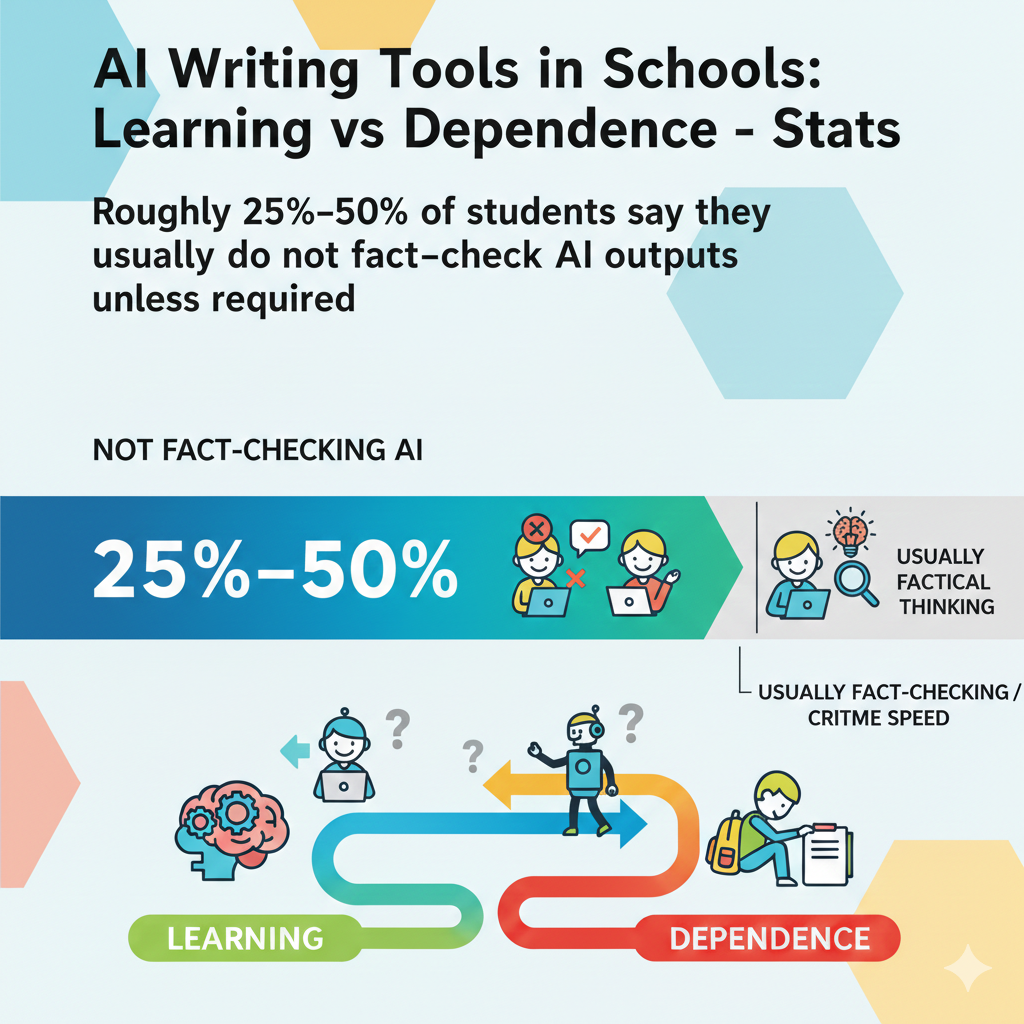
23) Roughly 25%–50% of students say they usually do not fact-check AI outputs unless required
Convenience Can Reduce Curiosity
Many students admit they rarely fact-check AI responses unless the teacher specifically asks for sources. This shows how convenience affects behavior.
AI provides quick answers. When students are in a rush, they may assume the information is accurate. Over time, this habit weakens research skills.
Fact-checking builds critical thinking. It forces students to compare sources and evaluate reliability. Without this practice, judgment skills decline.
Parents can model curiosity at home. If your child shares an AI-generated fact, ask, “Where did that come from?” Turn it into a small research activity.
Teachers can design assignments that require source comparison. Asking students to verify one AI-generated claim using two external references builds awareness.
At Debsie, we train students to question information respectfully. Curiosity is a powerful life skill. It protects against misinformation and builds independence.
AI should never replace verification. The strongest learners are those who ask, “How do I know this is true?”
Convenience is helpful. Curiosity is essential.
24) When students must submit sources and explain reasoning, fact-checking rates rise by about 20%–40%
Accountability Changes Behavior
This stat shows something hopeful. When teachers require students to explain their reasoning and provide sources, fact-checking improves significantly.
Students respond to expectations. When accountability is built into assignments, responsible behavior increases naturally.
Requiring reasoning explanations also strengthens learning. When students explain why they included certain facts, they process information more deeply.
Parents can encourage this habit by asking their child to justify opinions during conversations. Questions like, “What makes you think that?” build reasoning skills daily.
Teachers can add short reflection sections at the end of essays. Even two or three sentences explaining research choices can improve responsibility.
At Debsie, we believe accountability builds maturity. Children rise when expectations are clear and fair.
When students know their thinking process will be visible, they invest more effort. AI becomes a support tool instead of a shortcut.
Clear expectations shape strong habits.
25) AI detectors can wrongly flag human writing, with false positives often reported between 1%–10%
The Limits of Detection Tools
Many schools use AI detection software to identify possible misuse. However, these tools are not perfect. Sometimes they mistakenly flag human-written essays as AI-generated.
False positives create stress. A student who worked honestly may feel accused unfairly. Trust can be damaged if schools rely only on software.
Detection tools analyze writing patterns, but advanced or very structured student writing may resemble AI output. This makes errors possible.
Parents should teach children to keep drafts and notes. Saving writing steps can protect students if questions arise.
Teachers should use detection tools as one indicator, not final proof. Conversations with students are more powerful than automated judgments.
At Debsie, we emphasize trust and transparency. Technology should support fairness, not replace human judgment.
AI detection can help identify patterns, but it must be used wisely. Relationships and open communication matter more than software alerts.
Students learn best in environments where they feel trusted and guided.
26) AI detectors can miss AI-written work, with false negatives often reported at 10%–40% or higher for polished AI text
Detection Is Not a Perfect Shield
While some AI detectors wrongly flag human writing, they can also miss AI-generated content. In many classroom reports, teachers say detection tools fail to identify polished AI-assisted essays anywhere from ten percent to even forty percent of the time. This is called a false negative. It means AI-written work slips through unnoticed.
This creates a false sense of security. Schools may believe technology alone can solve the misuse problem. But detection tools are constantly playing catch-up. As AI writing improves, detection becomes harder.
Students also learn how to edit AI text to avoid detection. They may change wording, adjust sentence length, or combine AI output with their own writing. The more polished the result, the harder it becomes to detect.
The real lesson here is important. Prevention is stronger than policing.
Parents should focus on building internal values instead of relying on software. Talk about honesty, growth, and effort. When children understand that learning matters more than grades, they are less likely to misuse tools.
Teachers can design assignments that naturally reduce misuse. Oral presentations, in-class writing, personal reflections, and project-based tasks make it harder to fully outsource thinking.
At Debsie, we believe education should build skill, not fear. Detection tools may assist schools, but they cannot replace mentorship. The strongest protection against misuse is a culture of responsibility.
Technology alone cannot guard learning. Strong habits, clear expectations, and meaningful tasks do that far better.
When students value their own growth, they do not look for ways to bypass it.
27) In schools that provide teacher training on AI, educators are 2–4 times more likely to design thinking-based assignments
Training Teachers Changes the System
When teachers receive proper training on AI tools, classroom design changes significantly. Educators become two to four times more likely to create assignments that measure reasoning, creativity, and process rather than just final output.
This matters because the structure of assignments influences student behavior. If an assignment only asks for a polished essay, students may be tempted to use AI heavily. But if the task includes drafts, discussions, reflections, and in-class components, students must engage more deeply.
Teacher training empowers educators to understand both the benefits and risks of AI. Instead of fearing technology, they learn how to integrate it thoughtfully. They discover ways to use AI as a brainstorming partner while still protecting independent thinking.
Parents should support schools that invest in teacher development. When educators understand AI, they can guide students more effectively.
Schools can also host workshops for families. When parents and teachers share the same understanding, children receive consistent messages.
At Debsie, we believe great teaching shapes great learners. Our instructors focus on developing thinking skills first. Technology is introduced as a support layer, not the foundation.
When teachers evolve, classrooms evolve. And when classrooms evolve, students grow stronger.
The future of AI in schools depends not only on student behavior, but also on adult leadership.
28) Students with better devices and internet access can be 1.5–3 times more likely to use AI tools regularly
The Equity Challenge
Access matters. Students who have personal laptops, fast internet, and private study spaces are much more likely to use AI tools frequently. In some cases, they are up to three times more likely to use these technologies compared to peers with limited access.
This creates a new kind of learning gap. It is no longer only about textbooks or tutoring. It is also about digital tools.
On one hand, access to AI can provide support for brainstorming, grammar correction, and research help. On the other hand, unequal access may create differences in writing quality and speed.
Schools must be mindful of this gap. If AI is allowed for assignments, all students should have equal opportunity to use it responsibly.
Parents can also consider digital balance. Access should come with guidance. A powerful device without boundaries can increase dependence.
At Debsie, we focus on skill development that does not depend on expensive tools. Logical thinking, structured writing, and problem-solving can be practiced anywhere. Technology should enhance learning, not define it.
Equity means more than giving access. It means teaching responsible use.
When technology becomes part of education, fairness must remain a priority. Every child deserves equal opportunity to grow.
29) In classrooms where AI is openly discussed and taught as a tool, students are 20%–40% more likely to see it as a learning helper rather than a shortcut
Open Conversation Changes Mindsets
When teachers talk openly about AI instead of avoiding it, student attitudes shift. In such classrooms, students are significantly more likely to view AI as a helper for learning rather than a way to finish work faster.
This mindset difference is powerful. When AI is framed as a thinking assistant, students use it to clarify ideas, test arguments, and improve drafts. When it is seen as a shortcut, misuse increases.
Open discussion removes mystery. Students understand both strengths and weaknesses. They learn when to use AI and when to rely on their own thinking.
Parents can create similar openness at home. Instead of banning AI, discuss its pros and cons. Encourage balanced use.
Teachers can demonstrate live examples. Show how AI can brainstorm ideas, then show how students must refine and personalize them.
At Debsie, we treat technology as a tool, not a replacement for intelligence. Children learn that mastery comes from practice.
The way adults frame AI shapes how children use it. Transparency builds maturity. Silence builds confusion.
When students understand the purpose of a tool, they use it wisely.
30) Surface improvements from AI are often 2–5 times greater than improvements in deep reasoning unless critical thinking is explicitly taught
The Final and Most Important Insight
AI excels at surface-level writing tasks. Grammar, sentence flow, and structure can improve dramatically. In many cases, these improvements are two to five times greater than gains in deep reasoning skills.
This means essays may look much better without the student actually thinking more deeply.
Deep reasoning requires practice. It involves questioning assumptions, evaluating evidence, comparing perspectives, and forming independent conclusions. AI can suggest ideas, but it cannot replace the mental effort required to truly understand.
If schools focus only on polished results, students may appear to improve while real thinking remains unchanged.
Parents should prioritize conversations over perfection. Ask children what they learned, not just what grade they received.
Teachers should design tasks that reward reasoning, not decoration. Debates, presentations, and problem-solving exercises strengthen deep thinking.
At Debsie, we place thinking at the center of learning. Our programs train children to analyze, reflect, and solve problems step by step. Technology supports this journey, but it never replaces it.
The most important question is not whether AI makes writing better. The question is whether it makes students smarter.
When critical thinking is taught clearly and consistently, AI becomes a powerful ally. Without that foundation, it becomes a crutch.
Learning must always come before convenience.
Conclusion
AI writing tools are not going away. The numbers make that very clear. Students are using them. Some are benefiting. Some are becoming dependent. The difference is not the tool. The difference is guidance.
The stats show a clear pattern.
AI improves grammar quickly. It saves time. It reduces fear. It helps language learners feel more confident. These are real advantages.