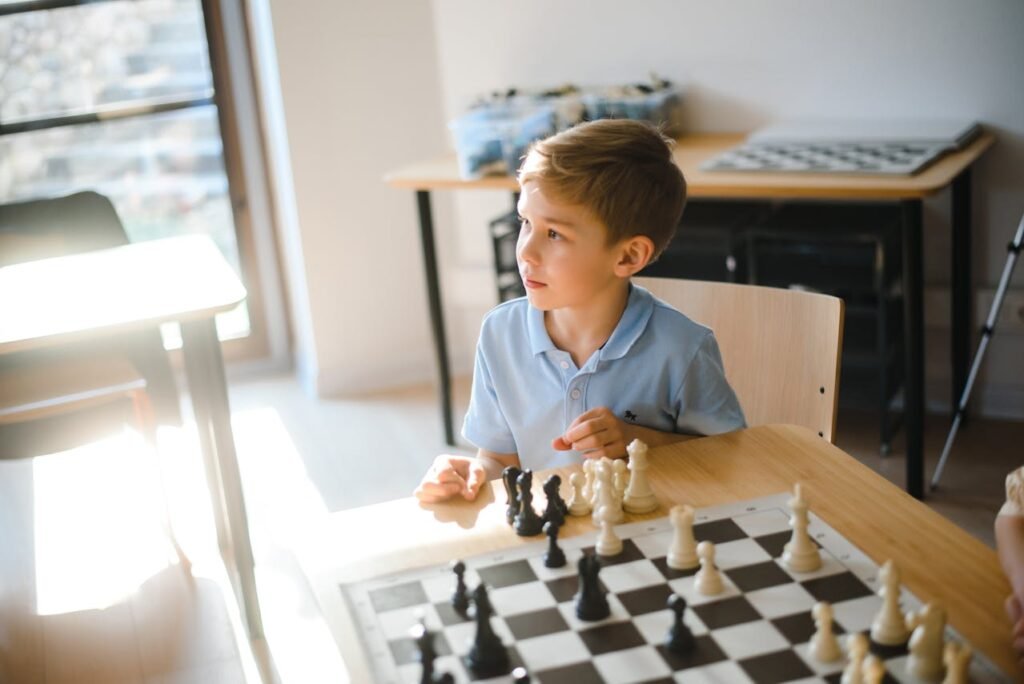
Before the first pawn moves, before the first check, and long before a brilliant checkmate appears on the board, every chess game begins with one simple but important step: setting up the chess board correctly.
For beginners, arranging the chess pieces can feel confusing at first. Where does the queen go? Which side should the white square be on? Why do knights sit next to rooks? And what exactly is a “rank”?
The good news is that chess board setup is easy once you understand the pattern. Every piece has a specific place, and once you learn the logic behind the arrangement, setting up a chessboard becomes second nature.
In this beginner-friendly guide, you’ll learn exactly how to set up a chess board, where each chess piece belongs, and how each piece moves. By the end, you’ll not only know how to arrange the board correctly—you’ll understand why the setup matters.
How to Set Up a Chess Board in 7 Simple Steps
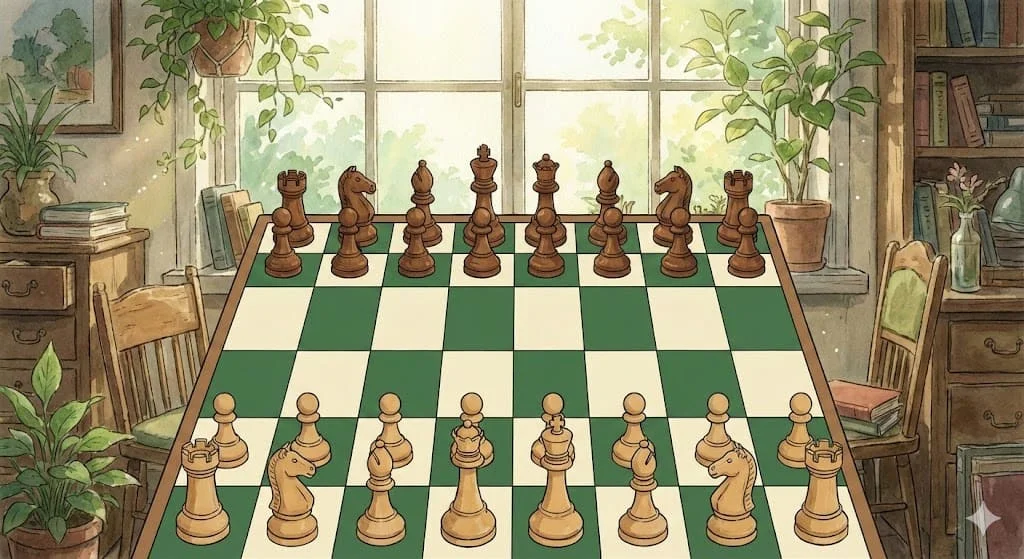
Step 1: Place the Chess Board the Right Way
The most common beginner mistake happens before any piece is placed on the board: the chessboard is turned the wrong way.
Here’s the golden rule:
White square on the right.
When you sit in front of the board, the bottom-right corner square should be a light-colored square.
An easy way to remember this is:
“White on right.”
This rule applies to both players. If the board is placed correctly, each player will have a light square in the bottom-right corner from their own perspective.
If Your Board Has Coordinates
Many chess boards include letters and numbers along the edges. These are called coordinates, and they help players record and understand moves.
When the board is facing White:
- The letters a to h should run from left to right.
- The numbers 1 to 8 should rise from White’s side toward Black’s side.
- White’s pieces begin on ranks 1 and 2.
- Black’s pieces begin on ranks 7 and 8.
This setup matters because chess notation depends on correct board orientation. If the board is turned the wrong way, learning openings, reading chess books, and following lessons becomes much harder.
Step 2: Place the Pawns on the Second Row

Once the board is facing the right direction, start with the pawns.
Each player has eight pawns.
For White, place the pawns on the second rank.
For Black, place the pawns on the seventh rank.
This creates a full row of pawns in front of the major and minor pieces.
Why Pawns Matter
Pawns may look small, but they are extremely important. They form the first line of defense and often determine the shape of the entire game.
Pawns can:
- Move forward one square.
- Move forward two squares on their first move.
- Capture diagonally.
- Promote into another piece if they reach the opposite end of the board.
Many beginners underestimate pawns, but experienced players know that pawn structure can decide the game. A strong pawn setup can protect your king, control the center, and create winning chances later.
Step 3: Place the Rooks in the Corners
Next, place the rooks.
Each player has two rooks. They go in the corners of the back row.
For White, the rooks go on a1 and h1.
For Black, the rooks go on a8 and h8.
Rooks are sometimes called castles because of their shape, but in chess, they are much more than decorative towers.
How Rooks Move
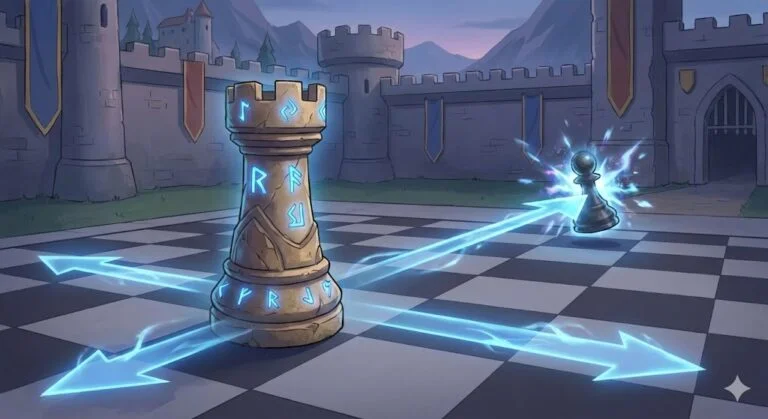
Rooks move in straight lines:
- Horizontally across rows.
- Vertically up and down files.
- As many squares as they want, as long as the path is clear.
Rooks are especially powerful on open files, which are columns without pawns. They often become stronger as the game progresses because pieces and pawns leave the board, giving rooks more space to move.
Beginner Tip
Do not leave your rooks trapped in the corners forever. Once the game opens up, try to connect your rooks and place them on active files where they can control important squares.
Step 4: Place the Knights Next to the Rooks
Now place the knights.
Each knight goes directly next to a rook.
For White, the knights go on b1 and g1.
For Black, the knights go on b8 and g8.
Knights are unique because they do not move like any other chess piece.
How Knights Move

Knights move in an “L” shape:
- Two squares in one direction.
- Then one square sideways.
Or:
- One square in one direction.
- Then two squares sideways.
The knight is also the only piece that can jump over other pieces.
This makes knights especially tricky and valuable in closed positions where other pieces may be blocked.
Why Knights Are Great for Beginners
Knights are excellent for surprise attacks. Because they jump, they can attack pieces that seem safe. They are also useful in the opening because they can quickly move toward the center.
A helpful beginner rule is:
Develop knights before bishops.
This is not always required, but it is a useful guide when learning how to start a chess game.
Want to Improve Faster?
Learning how to set up the chess board is the first step. Learning how to use the pieces with confidence is where real improvement begins.
Debsie is an AI-powered chess platform designed to help players understand their strengths, track progress, and receive personalized training recommendations. Whether you are learning the basics or preparing for competitive play, Debsie can help you measure your growth and focus on what matters most.
Step 5: Place the Bishops Next to the Knights
After the knights, place the bishops.
Each player has two bishops. They go next to the knights.
For White, the bishops go on c1 and f1.
For Black, the bishops go on c8 and f8.
How Bishops Move
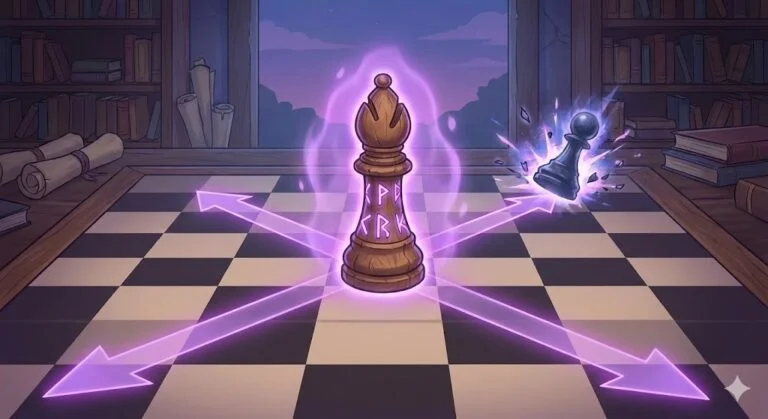
Bishops move diagonally. They can travel across the board in one move if no pieces block their path.
Each bishop stays on the same color square for the entire game:
- One bishop moves only on light squares.
- One bishop moves only on dark squares.
This is why bishops often work best as a pair. Together, they can control diagonals of both colors.
Beginner Tip
Try not to block your bishops with your own pawns. In the opening, moving central pawns often helps your bishops become active.
For example, moving the king’s pawn or queen’s pawn can open lines for your bishops and help you develop faster.
Step 6: Place the Queen on Her Own Color
Now it’s time to place the queen.
This is another part of chess setup that beginners often mix up.
Here’s the simple rule:
Queen goes on her own color.
That means:
- The White queen goes on a white square.
- The Black queen goes on a black square.
For White, the queen goes on d1.
For Black, the queen goes on d8.
How the Queen Moves
The queen is the most powerful piece on the chessboard. She can move:
- Horizontally.
- Vertically.
- Diagonally.
- As many squares as she wants, as long as the path is clear.
Because she combines the movement of both the rook and bishop, the queen is incredibly valuable in attack and defense.
Beginner Warning
Do not bring your queen out too early without a clear reason.
Many beginners move the queen quickly because she is powerful, but this can backfire. Your opponent may attack the queen with smaller pieces, forcing you to waste moves while they develop their position.
A better beginner strategy is to develop your knights and bishops first, protect your king, and bring the queen into action when the time is right.
Step 7: Place the King on the Remaining Square
Finally, place the king.
The king goes on the last empty square beside the queen.
For White, the king goes on e1.
For Black, the king goes on e8.
The king is the most important piece in chess. You do not “capture” the king in a real game. Instead, the game ends when the king is in checkmate, meaning it is under attack and has no legal escape.
How the King Moves
The king moves one square in any direction:
- Forward.
- Backward.
- Sideways.
- Diagonally.
Although the king moves slowly, protecting it is the main goal of the game.
Why Castling Matters
One of the most important beginner strategies is castling. Castling is a special move that allows you to move your king to safety and bring a rook closer to the center.
Most beginners should try to castle early, usually within the first 10 moves, as long as the position allows it.
Castling helps you:
- Protect your king.
- Connect your rooks.
- Prepare for a safer middlegame.
Complete Chess Board Setup: Quick Reference
Here is the full setup from left to right on the back row:
White’s Back Row
Rook – Knight – Bishop – Queen – King – Bishop – Knight – Rook
Squares:
a1, b1, c1, d1, e1, f1, g1, h1
Black’s Back Row
Rook – Knight – Bishop – Queen – King – Bishop – Knight – Rook
Squares:
a8, b8, c8, d8, e8, f8, g8, h8
Pawn Rows
White pawns go on:
a2, b2, c2, d2, e2, f2, g2, h2
Black pawns go on:
a7, b7, c7, d7, e7, f7, g7, h7
Easy Memory Tricks for Chess Setup
Chess setup becomes much easier when you use simple memory rules.
1. White on Right
Always make sure the bottom-right square is white.
2. Queen on Her Color
White queen on white. Black queen on black.
3. Corners Belong to Rooks
Rooks always start in the corners.
4. Knights Stand Beside Rooks
Knights go next to the rooks.
5. Bishops Stand Beside Knights
Bishops go next to the knights.
6. King Takes the Last Square
Once the queen is placed correctly, the king goes on the remaining central square.
Common Chess Setup Mistakes Beginners Should Avoid
Even experienced players sometimes spot incorrectly arranged boards in casual games. Here are the most common mistakes to avoid.
Mistake 1: Board Facing the Wrong Way
If the bottom-right square is dark, the board is wrong. Rotate it before placing the pieces.
Mistake 2: Queen and King Reversed
This is the most common piece placement mistake. Remember: queen on her own color.
Mistake 3: Pawns on the Wrong Rank
Pawns should be placed directly in front of the other pieces, not on the back row.
Mistake 4: Knights and Bishops Swapped
From the corner inward, the order should be:
Rook, Knight, Bishop.
Mistake 5: Forgetting That Both Sides Mirror Each Other
White and Black have the same arrangement, but from opposite sides of the board.
Why Correct Chess Board Setup Matters
Setting up the chessboard correctly is not just about following rules. It affects how the game works.
A correct setup ensures:
- Both players start fairly.
- Legal chess moves make sense.
- Openings can be played properly.
- Chess notation is accurate.
- Beginners build good habits from the start.
When the board is set up incorrectly, the game may feel confusing, especially when learning openings or following lessons from a coach, book, or online platform.
A correct setup gives every game a clean, balanced beginning.
What to Do After Setting Up the Board
Once the board is ready, White always moves first.
A good beginner opening plan is:
- Control the center.
- Develop knights and bishops.
- Castle early.
- Avoid moving the same piece too many times.
- Do not bring the queen out too soon.
- Look for threats before every move.
The four central squares—e4, d4, e5, and d5—are especially important. Controlling the center gives your pieces more freedom and makes it easier to attack or defend.
Beginner-Friendly Chess Setup Checklist
Before starting your game, check these points:
- Is the white square on the right?
- Are all pawns on the second row from each player’s side?
- Are the rooks in the corners?
- Are the knights next to the rooks?
- Are the bishops next to the knights?
- Is the queen on her own color?
- Is the king beside the queen?
- Is White ready to move first?
If the answer is yes to all of these, your chess board is ready.
Learn Chess with Better Guidance
Knowing how to set up a chess board is an essential first step. But chess becomes even more exciting when you understand strategy, tactics, openings, and how to think during a game.
That’s where Debsie can help.
Debsie offers a complete learning path with live classes, world-class Grandmaster coaches, peer learning, practice sessions, assignments, and tournaments. The program is designed to help students build strong foundations and grow with structure, confidence, and expert guidance.
Whether you are a beginner learning your first moves or a competitive player aiming to improve, Debsie gives you a clear path forward.
Frequently Asked Questions About Chess Board Setup
1. Which way should a chess board face?
A chess board should always be placed so that each player has a white square in the bottom-right corner. Remember the phrase: white on right.
2. Where does the queen go in chess setup?
The queen always goes on her own color. The White queen starts on a white square, and the Black queen starts on a black square.
3. Where does the king go on a chess board?
The king goes beside the queen on the remaining central square. White’s king starts on e1, and Black’s king starts on e8.
4. Where do the pawns go?
Each player’s eight pawns go on the row directly in front of the main pieces. White pawns start on the second rank, and Black pawns start on the seventh rank.
5. What piece goes in the corner of a chess board?
The rooks go in the four corners of the chessboard.
6. Does White always move first?
Yes. In chess, White always makes the first move.
7. What is the easiest way to remember chess setup?
Use this order from the corner inward:
Rook, Knight, Bishop, Queen, King, Bishop, Knight, Rook.
Also remember:
White on right. Queen on color.
Final Thoughts: Set the Board, Start the Battle
Chess begins with order. Every piece has a home, every square has a purpose, and every game starts with the same balanced setup.
Once you know how to set up a chess board correctly, you can focus on what makes chess truly exciting: planning attacks, spotting tactics, protecting your king, and outsmarting your opponent one move at a time.
So place the board with the white square on the right, put the queen on her color, line up your pieces, and enjoy the game.
Your first move is waiting.

Adhip Ray is the founder of Debsie, an online learning platform focused on chess and skill-based learning for children. His work at Debsie brings together chess education, structured thinking, problem-solving, and interactive learning for young students.
Adhip has an academic background in law, statistics, analytics, and technology. He is from Amity Law School and the Indian Statistical Institute, Kolkata, with formal training that connects legal reasoning, data analytics, quantitative thinking, and structured problem-solving. This interdisciplinary background is reflected in Debsie’s focus on building sharper thinking skills in children through chess and related learning programs.
Adhip is also a FIDE-rated chess player from India. He holds FIDE ID 5055954 and has a standard FIDE rating of 1832. His FIDE profile records him as an Indian player with a long rating history in standard chess, including rated games from his competitive playing years. His chess background gives Debsie a founder-led connection to the game, not only as an educational activity but also as a competitive discipline that develops concentration, calculation, planning, and decision-making.
In addition to chess, Adhip has a strong interest in coding, data, and technical problem-solving.
Adhip’s profile combines chess, law, data analytics, and programming. At Debsie, this background supports the creation of learning experiences that are logical, structured, and skill-oriented. The platform’s chess-focused programs are connected to broader cognitive skills such as pattern recognition, patience, strategic planning, focus, and problem-solving.
As founder of Debsie, Adhip brings together experience from multiple fields: formal legal education from Amity Law School, analytical training from the Indian Statistical Institute, Kolkata, competitive chess experience through his FIDE-rated profile, and coding practice through LeetCode. This combination gives Debsie a distinct foundation in strategy, reasoning, analytics, and child-focused learning.
Through Debsie, Adhip is associated with building chess and learning content for children that goes beyond basic instruction. The platform connects chess with thinking skills, helping students approach challenges with more structure, clarity, and confidence. His own background in chess and analytical problem-solving gives the platform a direct link to the skills it aims to develop in young learners.
Adhip is also a member of Forbes Business Council.