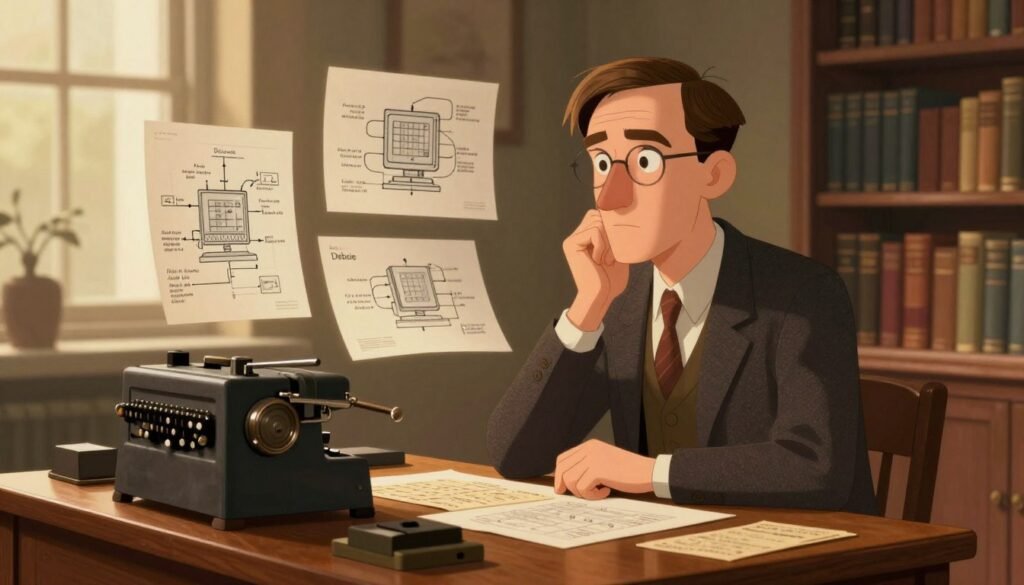
Ever thought about who dreamed of a thinking machine? Imagine a world without video games or smart gadgets. It’s hard to think about, but someone started it all!
We have our digital world today thanks to a very smart man. Alan Turing, born on June 23, 1912, was a math whiz. He loved solving puzzles and creating new ideas.
His groundbreaking work started the first computers and changed history. He thought machines could learn like us. This idea led to the world of artificial intelligence we love today.
Now, we keep exploring by finding fun ways to learn. Try Debsie Gamified Courses at https://debsie.com/courses for a tech adventure. This legend didn’t just make machines; he showed us to dream big.
Key Takeaways
- This famous mathematician is known as the father of modern computer science.
- He was born in 1912 and became a legendary codebreaker during wartime.
- His “universal machine” concept led to the laptops and phones we use now.
- He created a special test to see if a machine could mimic human thought.
- His incredible inventions helped save millions of lives by solving secret codes.
- Debsie offers interactive learning to help kids explore these exciting science topics.
The Early Life and Academic Brilliance of Alan Turing
Alan Turing was born in Maida Vale, London. He showed great curiosity and talent from a young age! He was the second child of Julius and Ethel Turing. His older brother, John Ferrier Turing, played a big role in his early life.
Formative Years and Intellectual Curiosity
Turing started school at St Michael’s. The headmistress saw his genius right away! He was very smart from a young age.
At Hazelhurst Preparatory School and Sherborne School, Turing loved mathematics and science. His time at Sherborne was very important. It helped him start his academic journey.
Teachers at Sherborne encouraged Turing’s curiosity. He enjoyed solving hard math problems.

Mathematical Foundations at Cambridge
Turing went to King’s College, Cambridge. He got first-class honors in mathematics there. This was a key time for him.
At Cambridge, Turing met many smart people. He was inspired by Alan Turing’s work. He started to think about math logic and computers.
Some important things happened at Cambridge for Turing:
- He studied with famous mathematicians!
- He learned a lot about math logic!
- He started thinking about computers!
Turing’s time at Cambridge was very important. It prepared him for his future work.
The Concept of the Universal Turing Machine
Alan Turing introduced the Universal Turing Machine in 1936. This idea changed computer science forever! His paper “On Computable Numbers” showed us what makes a problem solvable. It’s a big deal because it helped create today’s computers.
Defining Computability and Logic
Turing’s work on the Universal Turing Machine was key. He created a simple machine that reads and writes on an endless tape. It can solve any problem that can be solved, which is very important in computer science.The beauty of Turing’s machine lies in its simplicity and universality!Here’s how it works:
- Reading symbols from the tape
- Writing symbols to the tape
- Moving the tape left or right according to the instructions
- Halting when the computation is complete
This idea might seem simple, but it’s very important for what we can do with computers.
The Theoretical Blueprint for Modern Computers
The Universal Turing Machine was a blueprint for today’s computers. It showed that one machine can do any job, with enough time and memory. This idea is key in how computers are made today.Today’s computers, despite their complexity, operate on principles laid out by Turing’s theoretical work!Let’s compare Turing’s ideas with today’s computers:
| Concept | Turing’s Theoretical Model | Modern Computing Equivalent |
|---|---|---|
| Memory | Infinite Tape | RAM and Storage Devices |
| Processing | Reading/Writing Symbols | CPU Operations |
| Instructions | State Machine | Program Instructions |
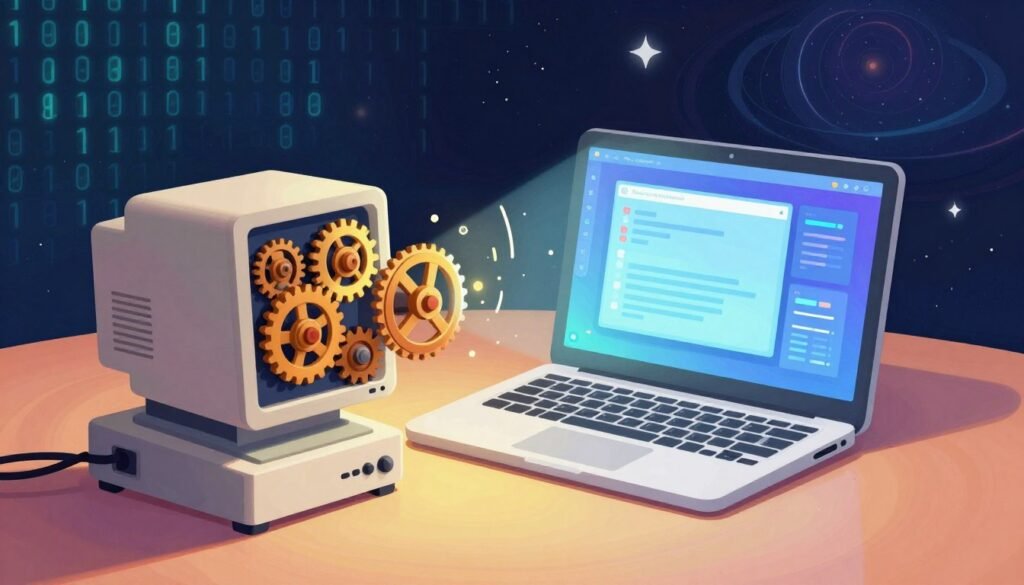
Understanding Turing’s work helps us see the basics of today’s computers.
Breaking the Enigma Code at Bletchley Park
Alan Turing’s work at Bletchley Park was a big win for the war against Nazi Germany! During World War II, Turing worked at the Government Code and Cypher School at Bletchley Park. He was key in cracking the German Enigma cipher.
The Secret War Against Nazi Communications
Turing’s work was super important for the war effort. He found ways to quickly break German ciphers. Codebreaking was very hard, but Turing’s ideas helped a lot.
The Enigma machine was very smart. Turing and his team worked hard to figure it out. They wanted to read the secret messages.
Engineering the Bombe Machine
Turing made the Bombe machine. It was a big help in cracking Enigma messages. This invention was a big deal for codebreaking.
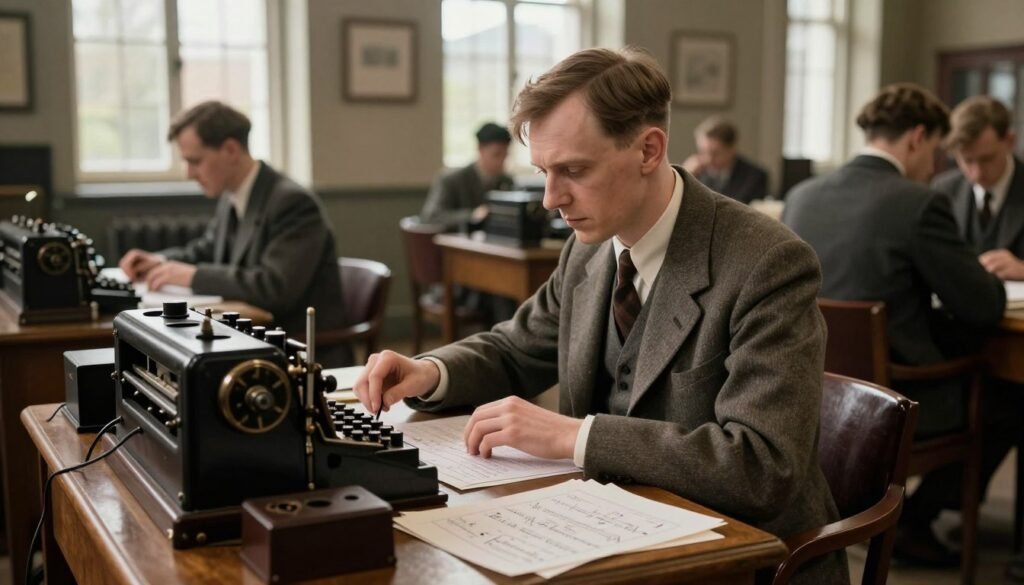
The Bombe machine was very important. It helped a lot in the Allied victory. Turing’s work at Bletchley Park was a huge achievement.
By cracking the Enigma code, Turing and his team gave the Allies a big advantage. This helped defeat Nazi Germany. Turing’s work during this time was amazing. It showed his great contributions to computer science and the war.
The Birth of Artificial Intelligence
Alan Turing’s work was key in starting artificial intelligence. In 1950, he wrote a paper called “Computing Machinery and Intelligence.” He asked, “Can machines think?” This led to the Turing Test, a way to see if a machine can act smart like a human.
Defining Machine Intelligence
Turing’s ideas were very new and exciting. He wanted to make machines that could think like us. The Turing Test is a simple test. A person talks to a human and a machine, without knowing which is which. If they can’t tell, the machine passes the test.
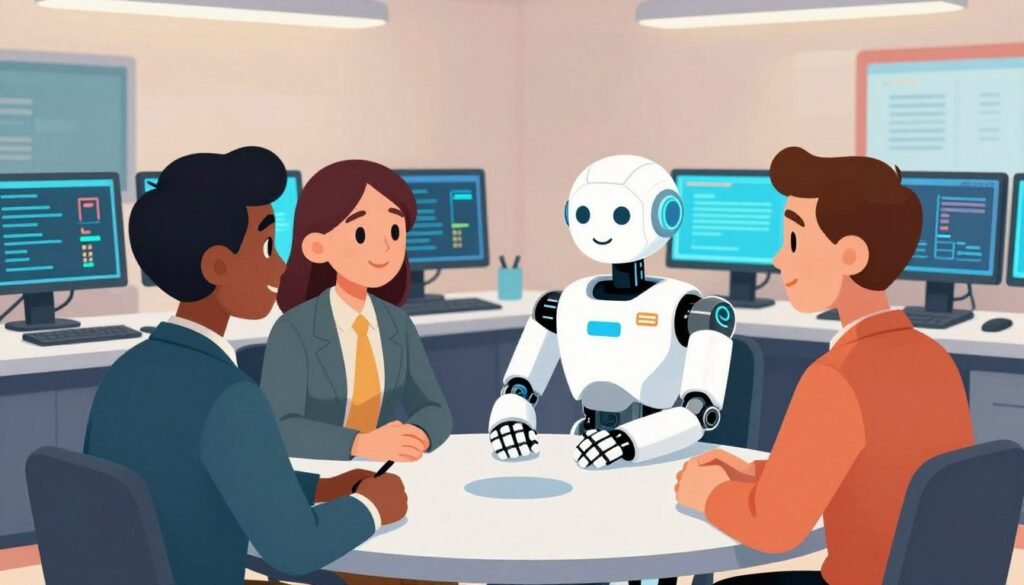
Turing’s work changed everything. A look back at the start of AI research shows his big impact. His ideas on computers and machines helped start computer science as we know it today.
The Turing Test and Its Enduring Legacy
The Turing Test is still important in AI today. It has sparked many debates. Some say it’s not perfect, but it has helped AI get better at talking and learning.
| Aspect | Description | Impact |
|---|---|---|
| Nature of the Test | Evaluates a machine’s ability to exhibit intelligent behavior equivalent to, or indistinguishable from, that of a human. | Driven advancements in AI research and development. |
| Methodology | Involves a human evaluator conversing with both a human and a machine without knowing which is which. | Simple yet effective in assessing machine intelligence. |
| Legacy | Continues to be a benchmark for measuring machine intelligence. | Influenced numerous AI systems and research directions. |
Turing’s ideas keep pushing AI forward. They inspire new discoveries and ideas.
Alan Turing and the Development of Early Computing Hardware
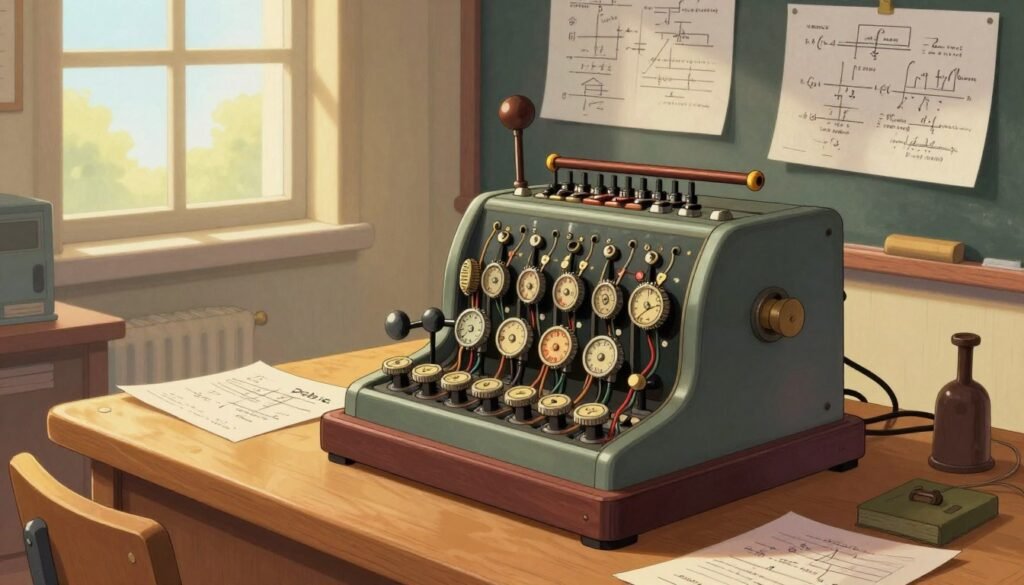
Alan Turing’s work on early computing was very important! After the war, he worked at the National Physical Laboratory. There, he designed the Automatic Computing Engine (ACE), one of the first stored-program computers. This was a big step towards the computers we use today.
The Automatic Computing Engine Project
The ACE project was very big. Turing wanted to make a machine that could do calculations fast. His design for ACE was groundbreaking. It used a stored-program computer idea, where both the program and data are in memory. This idea is still key in computer design today!
Turing’s work on ACE showed his deep knowledge and practical skills. Even though the ACE wasn’t built exactly as he planned, his ideas helped make future computers better. You can learn more about Turing’s work by visiting this article on the NIST website.
Contributions to the Manchester Mark 1
Turing also helped with the Manchester Mark 1. This computer ran its first program in 1949. The Manchester Mark 1 was a big step in computer technology. Turing’s work on this project made him a true pioneer in computer science.
Turing’s work helped start the modern computer era! Today, we see his impact in our digital lives. As we keep improving in computer science and AI, Turing’s work is still very important. You can learn more about computing and find fun courses at Debsie to grow your skills!
Mathematical Biology and Morphogenesis
Turing was curious about mathematical biology. He wanted to know how living things grow their shapes and patterns.
He wrote a key paper on morphogenesis. He said oscillating chemical reactions are key. These reactions help us understand nature’s patterns, like leopard spots or zebra stripes.
Patterns in Nature and Chemical Reactions
His work showed that chemicals can make stable patterns. Later research proved Turing right. It showed how chemical reactions help in morphogenesis.
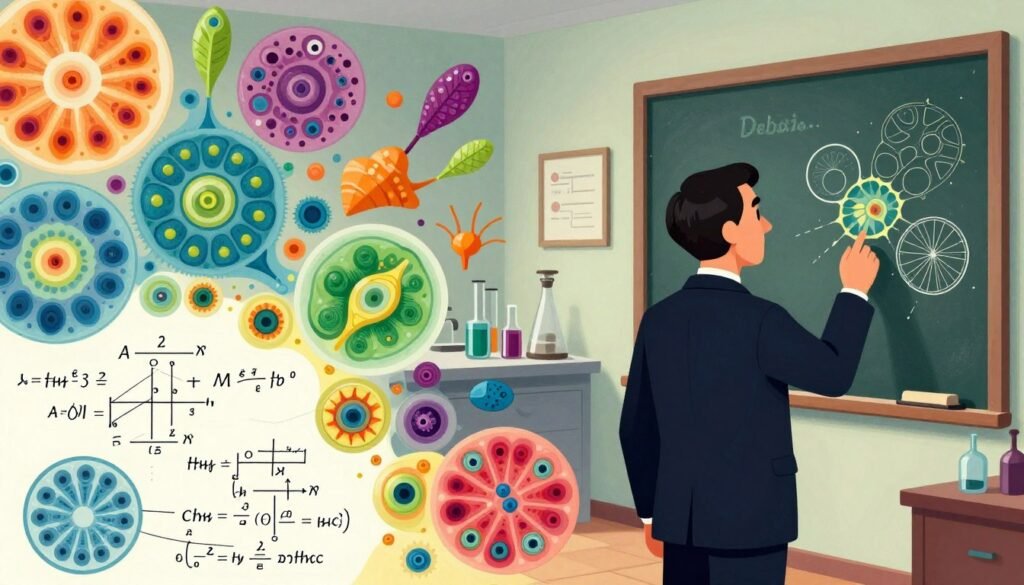
For example, animal coats’ patterns can be explained by Turing’s work. Here’s a simple look at how different patterns are made:
| Pattern Type | Description | Example |
|---|---|---|
| Stripes | Alternating bands of color or texture | Zebra stripes |
| Spots | Isolated patches of color or texture | Leopard spots |
| Mottling | Mixed or blended patterns | Some fish scales |
The Lasting Impact on Biological Modeling
Turing’s work changed how we model biology. It helped in developmental biology and pattern studies. A researcher said,
“Turing’s work on morphogenesis has been foundational in understanding how complex patterns arise in biological systems.”
Today, scientists use Turing’s ideas to study nature’s patterns. They create new models to explain these patterns.
The Tragic Persecution and Legal Struggles
Alan Turing’s life changed in 1952. He was prosecuted for being gay, which was illegal in the UK! This was a hard time for Turing because people were very mean to those who were gay.

Impact of Post-War Social Attitudes
In the years after the war, social attitudes were very strict. Turing’s actions, seen as private today, were seen as wrong back then. This made Turing’s legal problems worse.
The laws and social views of the time really hurt Turing. His prosecution came from these strict views.
The Conviction and Its Consequences
Turing had to choose: jail or chemical castration through hormones. He chose the latter, which changed his life a lot. This treatment hurt him physically and emotionally.
The conviction and treatment hurt Turing a lot. It also hurt his job. He lost his security clearance and couldn’t work with the British government anymore.
Learning about Turing’s story shows us why we need social tolerance and legal changes. It reminds us of the progress we’ve made and the work still to do.
The Legacy of Alan Turing in Modern Technology
Alan Turing’s work changed technology a lot! He helped create the software we use today. His ideas about computers are still important.
Now, Turing’s work is in many things like search engines and money transactions. His ideas made computers better. This changed many industries and how we live and work.
Powering Today’s Software
Turing’s ideas helped make programming languages and software engineering better. The Universal Turing Machine idea is key. It shows one machine can do any task with enough time and memory.
For example, compilers and interpreters were made possible by Turing. His work led to more advanced software. This software can solve hard problems and mimic real life.
The Evolution of AI from Turing’s Vision
The Turing Test is a big deal in AI. It checks if a machine can act like a human. This idea has pushed AI to new heights.
AI keeps getting better, thanks to Turing. Today’s AI can learn and change. Turing’s work keeps inspiring AI research.
Turing’s discoveries will keep shaping our technology. His work is key to modern computing and AI. His impact will last for many years!
Learning Computational Skills Through Gamified Platforms
We can learn computational skills in a fun way now. This is thanks to Alan Turing’s work. Modern tools make learning about technology easy for everyone.
Gamified learning platforms are a big step forward. They turn hard ideas into fun games. This makes learning both enjoyable and effective!
The Importance of Accessible Tech Education
It’s key to make tech education easy for all. This lets more people help shape the tech future. It shows Turing’s dream of tech for everyone.
Gamified learning makes hard topics easy. It helps people solve problems, think creatively, and feel confident.

Exploring Debsie Gamified Courses
Debsie leads in educational change. They offer personalized, gamified learning experiences. You can find these at https://debsie.com/courses.
These courses teach more than just coding. They help understand technology and solve problems. Learning with Debsie keeps Turing’s spirit alive.
So, try out Debsie Gamified Courses today. It’s a fun and effective way to learn. Debsie is great for parents and anyone wanting to learn more about tech.
The Global Recognition of Turing’s Contributions
Alan Turing’s work is known all over the world. His ideas in computer science and artificial intelligence changed technology forever.
His work has reached across borders and time. Posthumous pardons and public honors show how much he’s valued.
Posthumous Pardons and Public Honors
In 2013, Turing got a pardon from the British government. This was for being wrongly punished for being gay.
- A public apology was given by the government for how Turing was treated.
- Many public honors and celebrations have honored Turing’s legacy.
Turing’s Image on Currency and Cultural Icons
These honors show Turing’s big impact on our world. His legacy will keep shaping technology and more!
The Philosophical Implications of Machine Consciousness
Turing’s work made us wonder if machines can really think. This question leads to deep thoughts about the difference between human minds and artificial ones.
Machine consciousness is more than just doing tasks. It’s about knowing if machines can feel and think like us. Can machines really feel, or are they just pretending to be smart? Experts and thinkers have been arguing about this for a long time.
Can Machines Truly Think?
The Turing Test is a way to see if machines are as smart as people. “Computing machinery and intelligence” by Turing started this idea. But, it only looks at what machines do, not what they feel inside.
Some say passing the Turing Test doesn’t mean a machine really thinks. They think true thinking needs feelings and knowing oneself. As AI gets better, we must think about the right thing to do.
The Debate Between Logic and Intuition
The fight over machine consciousness often talks about logic versus intuition.
“We can only see a short distance ahead, but we can see plenty there that needs to be done.”
Turing’s words show how hard it is to guess what AI will be like. Logic helps us understand machines, but intuition is key for humans.
We need to mix logic with understanding human feelings and creativity. This mix is key to making AI that’s not just smart but also helpful to us.
The Influence of Turing on Cryptography and Cybersecurity
Alan Turing’s work changed history and started modern cryptography and cybersecurity. His work on the Enigma code during World War II was key. It showed how important it is to keep information safe.
Turing worked at Bletchley Park. He used logic and math to crack codes. His work on the Bombe machine helped break the Enigma code. This showed the power of systematic methods in codebreaking.
From Enigma to Modern Encryption Standards
Turing’s work on cryptography has shaped modern encryption. His ideas about secure communication are still used today. Modern encryption, like public-key cryptography, owes a lot to Turing.
Encryption has grown a lot since Turing’s time. From simple codes to today’s complex algorithms, Turing’s work is behind it all. His work on the Enigma code showed how crucial encryption is for safe communication.
The Role of Logic in Protecting Digital Privacy
Logic is key in keeping our digital info safe, thanks to Turing. His work showed that using logic and math is vital for secure encryption. Logical principles help make strong security protocols for online safety.
Today, Turing’s ideas help keep our online world safe. As we deal with the digital world, Turing’s work reminds us to protect our online privacy. Strong encryption and cybersecurity are crucial for this.
The Intersection of Science and Human Rights
Alan Turing’s story shows us how vital human rights are in science. His life teaches us that seeking knowledge must go hand in hand with justice and respect for all.
Turing’s journey, full of highs and lows, teaches us about the need for a welcoming science world. We can make STEM fields better by learning from his story.
Reflecting on the Treatment of Scientific Pioneers
Alan Turing faced harsh treatment because of who he was. This hurt him and might have slowed science’s progress. We must learn from this to make science welcoming for everyone.
Advocacy for Diversity in STEM Fields
Turing’s life shows why we must fight for diversity in science. A diverse science world is more creative and innovative. We must support all kinds of people in STEM.
Here are some numbers that show why diversity matters in science:
| Field | Percentage of Women | Percentage of Underrepresented Groups |
|---|---|---|
| Computer Science | 25% | 15% |
| Engineering | 15% | 10% |
| Mathematics | 30% | 12% |
Together, we can make STEM fields better and brighter. Let’s keep Turing’s dream alive by fighting for a fair science world!
Conclusion
Alan Turing’s life and work have changed the world. His work in computer science and artificial intelligence is still inspiring today. You can learn more about him on the Wikipedia page dedicated to Alan Turing.
Debsie Gamified Courses make learning tech fun. They use interactive lessons to help you grow. This way, you can keep up with new tech trends.
Let’s honor Turing’s work by exploring tech’s possibilities. Check out Debsie Gamified Courses at https://debsie.com/courses. Start your learning journey today!