Have you ever looked at the deep blue ocean and wondered about its color? A young boy in India was curious about this too. He loved to learn and explore the world.
This famous scientist was very smart. He finished his degree at 16! He used a special tool to study light and found something amazing.
His discovery changed physics forever. It’s called the Raman Effect. He worked hard and won a Nobel Prize in 1930. His journey shows us that asking big questions can lead to findings that help the whole world!
Learning about science is like a grand adventure where you are the hero! You can start your own quest for knowledge today. Try the Debsie Gamified Courses. We make learning fun like your favorite game!
He showed us that even the ocean’s color is a secret. You can read more about his work at this link. Let’s keep exploring and learning together!
Key Takeaways
- He was a brilliant child prodigy from India.
- His work explained why the ocean looks so blue.
- He won a Nobel Prize for studying light scattering.
- He built his own tools to make scientific breakthroughs.
- His discovery is a vital part of modern quantum theory.
The Early Life and Academic Brilliance of Chandrasekhara Venkata Raman
Raman was born into a family that loved learning. He was the second of eight kids. His dad, a teacher, helped spark his love for learning.
A Prodigy in the Making
Raman went to St Aloysius’ Anglo-Indian High School in Visakhapatnam. There, his love for physics grew. His parents supported him every step of the way.
As he grew, Raman became more curious about the world. This curiosity set him up for big things in science.
The Influence of Indian Scientific Institutions
The Indian Association for the Cultivation of Science (IACS) was key for Raman. It helped him explore and make big contributions to science. Places like IACS encouraged new ideas and discoveries in India back then.
For more on C. V. Raman’s life and work, check out different sources.
“The important thing in science is not so much to obtain new facts as to discover new ways of thinking about them.” – William Lawrence Bragg
| Institution | Role in Raman’s Life |
|---|---|
| St Aloysius’ Anglo-Indian High School | Early education and foundational learning |
| Indian Association for the Cultivation of Science (IACS) | Platform for scientific exploration and research |

The Discovery of the Raman Effect
C.V. Raman found the Raman Effect. It changed how we see light and matter! This big find happened on February 28, 1928.
This discovery was huge. It showed how light and matter interact. Let’s learn more about it.
The Physics of Inelastic Light Scattering
When light goes through a clear material, most scatters the same way. But a little bit scatters differently. This is the Raman Effect! It tells us about the tiny parts of materials.

The Raman Effect is very useful. It helps in chemistry, biology, and more. Scientists use it to know what a substance is made of.
The Moment of Scientific Breakthrough
February 28, 1928, is National Science Day in India. C.V. Raman and K.S. Krishnan made a big find. They used light and a special tool to see how materials scatter light.
| Material | Wavelength Shift Observed | Significance |
|---|---|---|
| Liquid | Yes | Indicated molecular vibrations |
| Gas | Yes | Showed rotational and vibrational modes |
| Solid | Yes | Revealed phonon interactions |
The Raman Effect showed us the power of science. It helped us understand light and matter better. It also led to new technologies.
Key CV Raman Discoveries That Changed Physics
Raman’s work changed how we see the world. He helped us understand molecules and light better. His discovery, the Raman Effect, opened new paths in physics.
Advancements in Molecular Spectroscopy
The Raman Effect was a big step in studying molecules. It let scientists look at how molecules move and change. This method is key in chemistry and physics, helping us learn about molecules and how they interact.
Raman’s work affects many areas. For example, it helps in studying materials and biological tissues. Raman spectroscopy is used in many fields.
| Field | Application of Raman Spectroscopy | Benefits |
|---|---|---|
| Materials Science | Analysis of material composition and structure | Understanding material properties for technological advancements |
| Biomedical Research | Study of biological tissues and cells | Insights into disease mechanisms and diagnosis |
| Chemistry | Identification of molecular species | Advancements in chemical analysis and synthesis |
Understanding the Quantum Nature of Light
Raman’s discovery showed light’s quantum nature. The Raman Effect showed light can change its frequency when it meets matter. This proved quantum mechanics was real, even when it was new.
Raman’s work changed science a lot. It helped us understand light and matter better. His discovery still guides science today.
The Nobel Prize in Physics and Global Recognition
Raman’s discovery of the Raman Effect was recognized worldwide. He won the Nobel Prize in Physics in 1930! This honor showed the world what Indian science could do.
“The Nobel Prize is a recognition not just of my work, but of the potential of Indian scientists to contribute significantly to the global scientific community,” Raman said, reflecting on his achievement.
Award Ceremony Highlights
The 1930 Nobel Prize in Physics award ceremony was big. Many famous scientists were there. Raman’s win was celebrated everywhere, starting a new chapter in science.
Global Impact on the Scientific Community
Raman’s win changed the world of science. It made young scientists, including those from India, want to do great research. Raman’s work still inspires scientists today.
The Raman Effect changed how we understand light and matter. It led to big steps in physics and chemistry.
Now, Raman’s work is seen in many areas. From materials science to health research, his legacy lives on. It shows the power of science and new ideas.
Raman’s Research on the Scattering of Light
C.V. Raman changed how we see light. His work helped us understand light better. It also led to big steps in science.
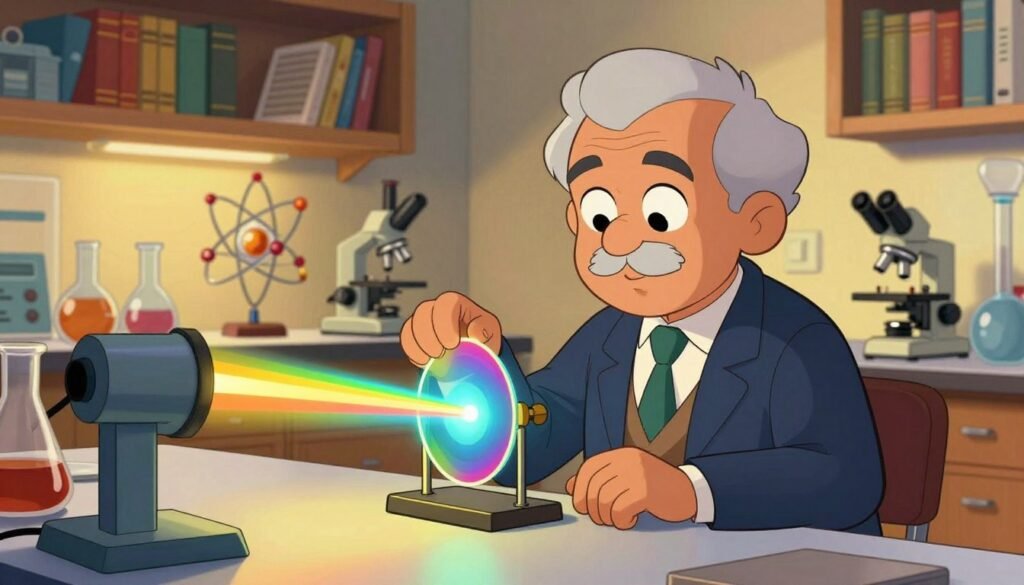
In 1923, Raman found new light rays. He used violet glass and special liquids to see them. This was a big moment in physics!
Experimental Methodology and Instrumentation
Raman was very careful in his experiments. He used special tools to study light. This included monochromatic light and special equipment.
He designed his experiments well. This let him measure light scattering precisely. His hard work and careful science were key to his success!
Theoretical Implications for Modern Optics
Raman’s work on light scattering was very important. It helped us understand light and matter better. This changed modern optics a lot!
The Raman Effect helped scientists study molecules. It opened doors in chemistry, biology, and materials science. This was a big step forward.
The impact of Raman’s research continues to be felt today. It helps in spectroscopy, laser tech, and optical communication. His work shows the power of science!
The Physics of Musical Instruments and Acoustics
C.V. Raman loved the science of music. He studied how Indian drums and stringed instruments make sound.
Music isn’t just for listening. It’s also about the physics of sound. Raman used physics to understand music.
Vibrations of Indian Drums
Raman looked at how Indian drums like the tabla and mridangam work. He found that their sound comes from the vibrations of their membranes.
Drums don’t just make one sound. They make many sounds because of different vibrations. The drum’s shape, size, and material also affect its sound.

“The vibrations of the drumhead are not simple harmonic motions, but rather complex motions that involve multiple frequencies.”
This makes Indian drums sound unique. You can learn more about sound on Debsie’s website.
Science Behind Stringed Instruments
Raman also studied stringed instruments like violins and the veena. He found that their sound comes from vibrating strings.
The sound quality depends on string tension, material, and instrument shape.
Raman’s work showed music is both art and science. He explained how drums and stringed instruments work through physics.
Studies on the Optics of Colloids and Crystals
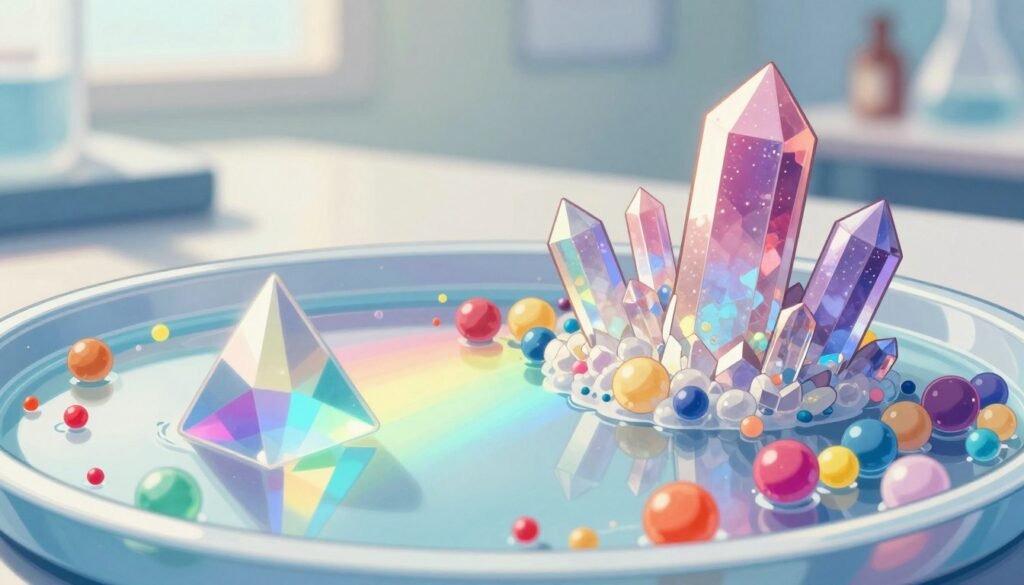
C. V. Raman’s work on optics of colloids and crystals was groundbreaking. It showed how light interacts with matter. His research helped us learn more about different materials.
Raman looked at how light moves through or bounces off colloids and crystals. His findings helped us understand these materials better. This is important for materials science and solid-state physics.
Light Interaction with Matter
When light hits matter, it can get absorbed, go through, or bounce back. Raman studied how light scatters, mainly in colloids and crystals. He found that scattered light tells us about the material’s molecular structure and what it’s made of.
The way light and matter interact is complex. It depends on the light’s wavelength and the material’s properties. Raman’s work helped us understand these interactions better. This led to new uses in spectroscopy and materials testing.
Contributions to Solid State Physics
Raman’s work in solid-state physics was key. He helped us understand crystals’ optical properties. His research showed how atoms in a crystal affect its light behavior.
| Material | Optical Property | Relevance to Solid State Physics |
|---|---|---|
| Crystals | Scattering of Light | Understanding crystal structure and defects |
| Colloids | Light Absorption and Transmission | Studying particle size and distribution |
| Solids | Reflectivity and Refraction | Analyzing material properties |
Raman’s work on colloids and crystals has greatly influenced our understanding of the world. He showed us how light and matter interact. His work has inspired many physicists and materials scientists.
The Raman Research Institute and Legacy
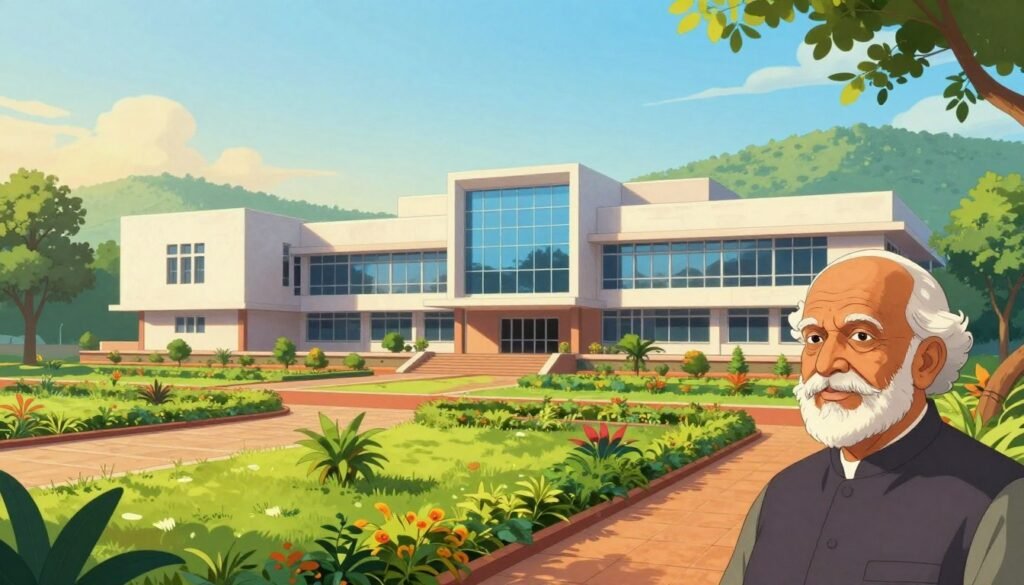
C. V. Raman loved science so much. He started the Raman Research Institute. It’s a place that still makes people excited about new ideas!
The Raman Research Institute began in 1948. It showed Raman’s commitment to scientific greatness. He worked hard there until he passed away in 1970. His work still guides scientists today.
Founding a Hub for Scientific Inquiry
The institute was more than a lab. It was where curiosity and discovery grew. Raman wanted a place where scientists could explore and learn new things.
By starting the Raman Research Institute, Raman created a space for deep research. He also inspired many scientists to come. The institute became a center for science, attracting smart people and helping them work together.
Continuing the Tradition of Excellence
Today, the Raman Research Institute is still important in India’s science world. It keeps doing top-notch research, just like Raman wanted.
Looking ahead, we see how important places like the Raman Research Institute are. You can follow Raman’s path by exploring science with Debsie Gamified Courses!
By using the resources available, you join a group that loves science. Let’s keep C. V. Raman’s spirit alive by loving science too!
Educational Philosophy and Mentorship
C. V. Raman loved to see students ask questions and explore. He wanted students to think like scientists. This helps them stay curious and keep asking questions.
Developing a Scientific Mindset
Raman helped many young scientists grow. He taught them to think deeply and find new things.
“The important thing in science is not so much to obtain new facts as to discover new ways of thinking about them.”
This way of thinking helps students become creative and solve problems.
Learning Through Gamified Approaches at Debsie
At Debsie, we make science fun and easy to understand. Our games help students learn science in a fun way.
Enhancing Scientific Literacy with Debsie Gamified Courses
Our games help students learn science better. They cover many topics in an easy way. Try our courses today at https://debsie.com/courses and see how fun learning can be!
| Feature | Description | Benefit |
|---|---|---|
| Interactive Modules | Engaging lessons that use game design elements | Makes learning fun and interactive |
| Personalized Learning | AI-driven approach to tailor learning experiences | Enhances student engagement and understanding |
| Leaderboards | Competitive element to encourage learning | Fosters a sense of achievement and motivation |

Learn more about science and young minds at this article on C. V. Raman’s legacy.
The Cultural Impact of Raman in India
C. V. Raman’s work has touched many lives in India. It has inspired a nation and sparked a love for discovery. His legacy shows the power of curiosity and innovation.
Inspiring Generations of Indian Scientists
Raman’s achievements have inspired many Indian scientists. His work in physics has encouraged others to follow in his footsteps. You can learn more about him in this article on The Hindu.
The Raman Effect discovery has inspired young minds. It shows that with hard work and passion, Indians can make big contributions to science.
National Science Day and Its Significance
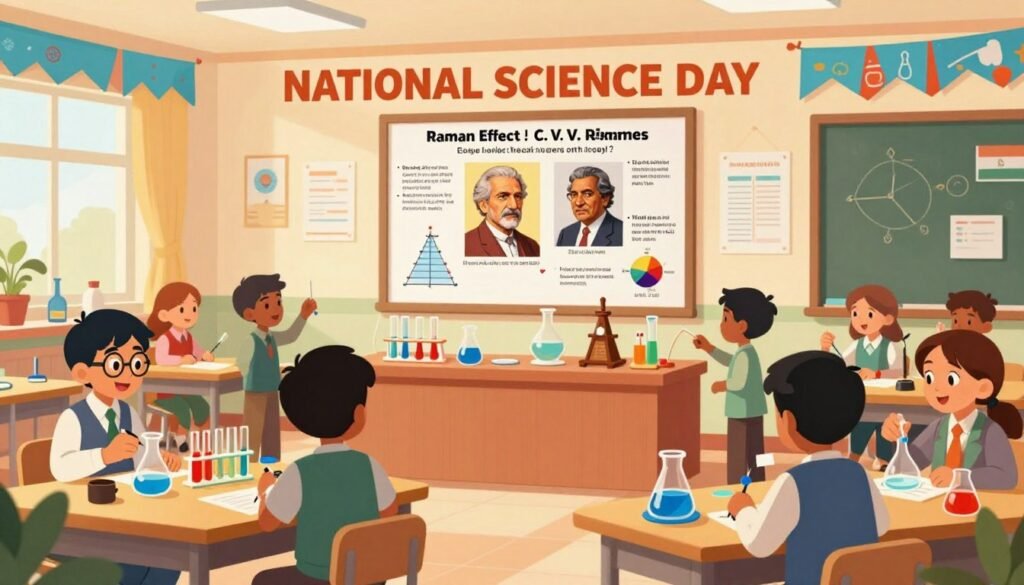
February 28th is National Science Day in India. It celebrates the Raman Effect discovery. This day honors Raman’s spirit of scientific inquiry.
On this day, many events are held to promote science and technology. It’s a time to see how science affects our lives. It also encourages the next generation of scientists.
| Year | Event | Location |
|---|---|---|
| 2023 | National Science Day Lecture | New Delhi |
| 2022 | Science Exhibition | Mumbai |
| 2021 | Science Fair | Bangalore |
National Science Day celebrates Raman’s lasting impact. It shows his influence on Indian scientists and the culture.
Raman’s Contributions to the Study of Diamonds
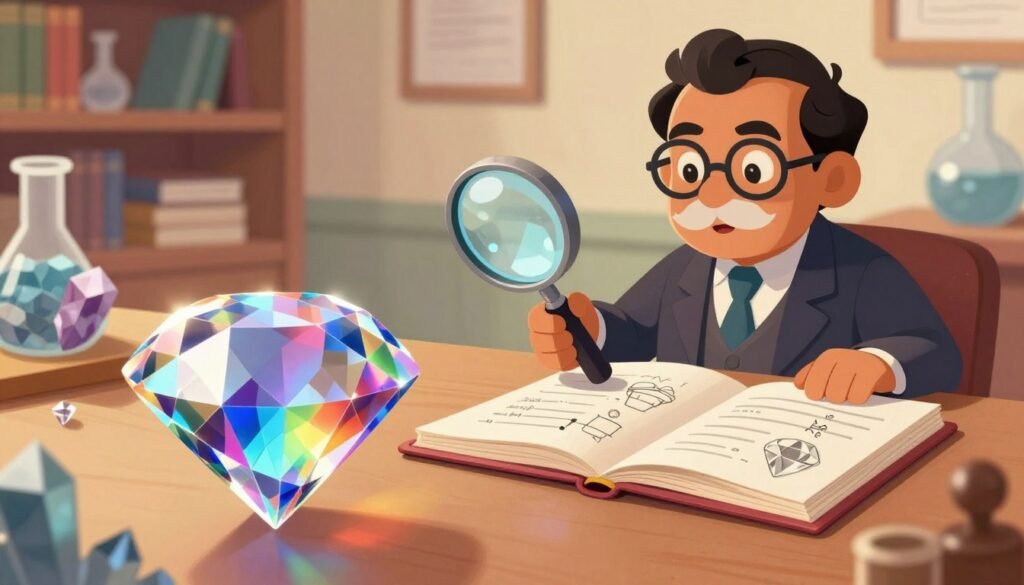
C. V. Raman found new things about diamonds. He learned about their light and structure. His work showed the science behind their shine.
We will see how Raman changed our view of diamonds. Raman’s research on diamonds looked closely at their light behavior.
Optical Properties and Structural Analysis
Raman studied how diamonds handle light. He found out how they absorb, reflect, and send light. This helped us understand diamonds better.
The sparkle of diamonds comes from their light trickery. Raman explained why diamonds shine so brightly.
The Brilliance of Gemstones Explained
Diamonds sparkle because of their inside and light. Raman’s study gave us a science reason for this sparkle.
| Property | Description | Significance |
|---|---|---|
| Optical Properties | How diamonds interact with light | Explains their brilliance and sparkle |
| Structural Analysis | Understanding the internal structure | Reveals the uniqueness of diamonds |
| Refractive Index | Measures how much light bends | Affects the diamond’s brilliance |
Raman’s work on diamonds has made a big difference. His discoveries still inspire scientists and gem lovers today.
The Enduring Relevance of Raman Spectroscopy Today
Raman spectroscopy is a big deal today. It was first used by C.V. Raman. It helps in many scientific areas.
This tool lets scientists look at how molecules move. It shows what materials are made of. It’s good because it doesn’t hurt the sample much.
Applications in Chemistry and Biology
In chemistry, it helps find and study molecules. It’s great for complex biological systems too. It shows how different parts of living things work together.
In biology, it’s key for studying cells and tissues. It lets scientists check the chemical makeup of living things without harming them.

Modern Technological Advancements
New tech has made Raman spectroscopy better. Today’s tools are more sensitive and flexible. They get data faster and with better detail.
Using Raman with other methods like microscopy and chromatography is exciting. It helps scientists learn more about complex things. This is good for research in materials and medicine.
As tech keeps getting better, Raman spectroscopy will keep leading the way. It will help us find new things and understand our world better!
Conclusion
C. V. Raman’s life shows us the power of being curious. His discovery of the Raman Effect won him the Nobel Prize. It changed how we see light and matter.
Raman’s work reminds us to keep learning. His findings still inspire scientists today. You can follow his path with Debsie Gamified Courses.
Debsie makes science fun and easy to learn. It helps you grow and understand the world better. By being curious like Raman, we can discover more.
Join Debsie today and start exploring science at Debsie Gamified Courses!