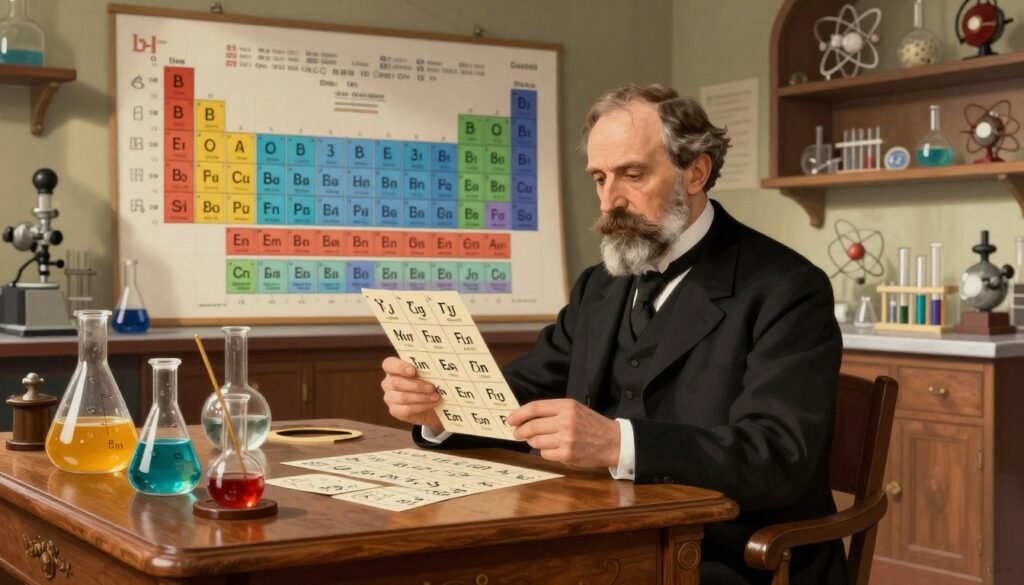
Imagine working on a thousand-piece puzzle and seeing the whole picture first. That feeling is what makes learning so wonderful. We often look at the world and wonder how everything fits together so perfectly.
A long time ago, a brilliant Russian chemist wanted to solve the ultimate puzzle of nature. He became the periodic table inventor by finding the secret rhythm of the elements! His vision changed how we understand the very building blocks of life.
We are so excited to dive into the story of Dmitri Mendeleev and his amazing work! He simplified science for everyone and even predicted elements that had not been found yet. His legacy helps us grow and see the beauty in logic every single day.
Are you ready to start your own adventure in science? You can explore new worlds and play while you learn! Try out Debsie Gamified Courses at https://debsie.com/courses to spark your curiosity and unlock your potential!
Key Takeaways
- Discover how a Russian chemist organized the building blocks of nature.
- Understand the role of the periodic table inventor in modern science.
- Learn how predicting the future helped find new chemical elements.
- Explore how patterns make complex subjects easy and fun to learn.
- See how Debsie provides interactive ways to master chemistry.
Early Life and Formative Years in Siberia
Dmitri Mendeleev was born in Tobolsk, Siberia. He was the youngest of 17 siblings. Born in 1834, his family faced many challenges.
His father lost his job and his mother’s glass factory was destroyed. Yet, Mendeleev’s early life showed his strength and will to succeed.
A Childhood Shaped by Hardship
Young Mendeleev grew up in tough Siberia. The cold and family troubles could have stopped him. But they made him more determined.
His early life was filled with big challenges. But these challenges helped him grow strong for the future.
The Influence of the Tobolsk Gymnasium
Mendeleev went to the Gymnasium in Tobolsk. There, he started to love science. The education he got there helped shape his future.
He became very interested in chemistry and other sciences. This was the start of his journey in science.
Moving to Saint Petersburg for Higher Education
Mendeleev’s family moved to Saint Petersburg for better schools. This big move was key for his education. It helped him to study more and make a big impact in chemistry.

| Event | Year | Location |
|---|---|---|
| Born | 1834 | Tobolsk, Siberia |
| Attended Gymnasium | Early 1840s | Tobolsk |
| Moved to Saint Petersburg | Late 1840s | Saint Petersburg |
The Academic Journey of Dmitri Mendeleev
Dmitri Mendeleev’s academic journey was a big change. It helped shape his future in chemistry!
Mendeleev faced many challenges. He studied hard at the Main Pedagogical Institute in Saint Petersburg. Then, he got sick with tuberculosis and moved to the Crimean Peninsula to get better.
Struggles and Triumphs at the University of Saint Petersburg
Mendeleev had tough times at the University of Saint Petersburg. But he didn’t give up. He worked hard and graduated. His time there was key to his scientific growth!
- Completing his education at the Main Pedagogical Institute
- Overcoming health challenges, including tuberculosis
- Engaging in research that would later influence his work on the periodic table
Researching Abroad in Heidelberg
Mendeleev’s research changed when he went to Heidelberg. There, he did experiments on liquids and used the spectroscope. These experiences abroad made him a better chemist!
In Heidelberg, Mendeleev made big discoveries. He worked with famous scientists. This helped him a lot in his later work.
The State of Chemistry Before the Periodic Table
Before Mendeleev’s work, chemistry was very confusing. Many elements were found, but no one knew how they worked together. It was like trying to read a book with pages all mixed up.
Scientists had trouble finding patterns in elements. This made it hard to understand matter. The need for a systematic approach was clear!
The Chaos of Disorganized Chemical Knowledge
Chemistry was a mess, with many elements but no clear understanding. Scientists were like puzzle solvers without a picture. New elements were found fast, but organizing them was tough.

Early Attempts at Classification by Predecessors
John Newlands and Lothar Meyer tried to sort elements early on. Their work helped Mendeleev create the periodic table. Newlands found that elements followed a pattern, like the “Law of Octaves.”
These early tries showed scientists were close to finding order. Mendeleev used this to make his famous table.
The Eureka Moment: Dreaming the Periodic Table
Dmitri Mendeleev had a dream about the periodic table. He had studied elements and their weights for years. He wanted to find a way to organize them.
The Famous Legend of the Dream
Mendeleev said he dreamed of the elements’ arrangement. This eureka moment came after lots of hard work. In the dream, elements were sorted by weight and properties.
This dream story is famous in science. It shows how hard work and intuition can lead to big discoveries. It’s a story of perseverance in scientific discovery.
Organizing Elements by Atomic Weight and Properties
Mendeleev sorted elements by atomic weight and properties. This was a big breakthrough. It not only organized known elements but also predicted new ones.
Here’s what Mendeleev did:
- He listed all known elements and their properties.
- He arranged them by atomic weight.
- He found patterns and relationships between elements.
- He predicted new elements to fill gaps in the table.
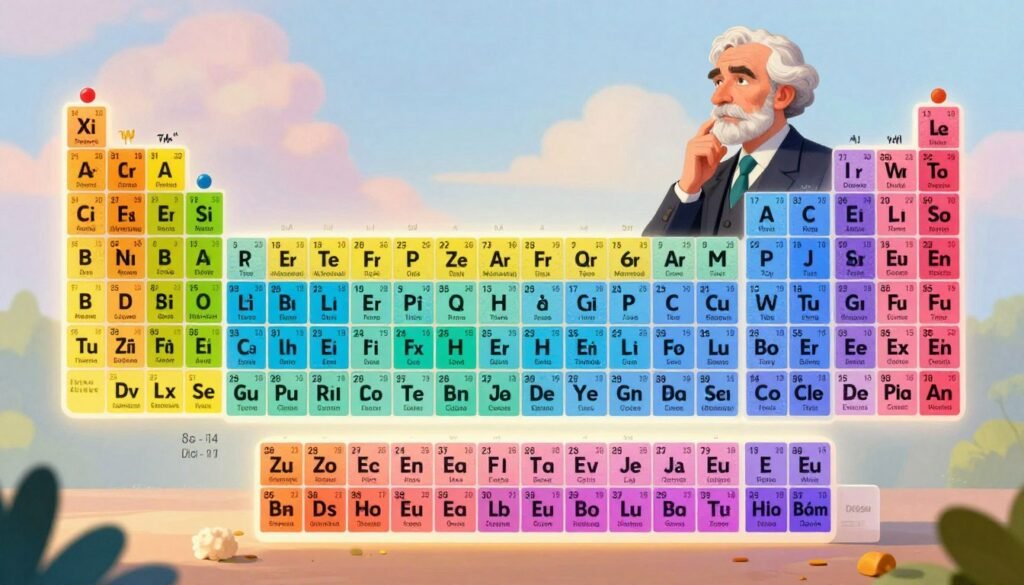
Mendeleev’s work on the periodic table shows the power of scientific inquiry and creativity. His method has changed chemistry forever. It’s now a key tool for scientists everywhere.
Dmitri Mendeleev as the Periodic Table Inventor
Dmitri Mendeleev made the periodic table. It organized elements and showed where new ones would be! His work, “The Principles of Chemistry,” listed all known elements and their traits.
Publishing the Principles of Chemistry
Mendeleev wrote “The Principles of Chemistry” from 1868 to 1870. It was more than just a book of facts. It was a new way to look at chemistry, filled with Mendeleev’s ideas.
He saw a pattern in elements’ properties and weights. Many chemists tried to sort elements before him. But Mendeleev was different. He predicted new elements to fill his table’s gaps.
The First Draft of the Periodic System
Mendeleev’s first table was a big step. He sorted elements by weight and chemical traits. This was a new way to see elements, not just list them.
He left spots for elements not yet found. He guessed their properties, like eka-aluminum and eka-silicon. Later, gallium, scandium, and germanium were found, proving him right. You can read more about Mendeleev on Wikipedia.
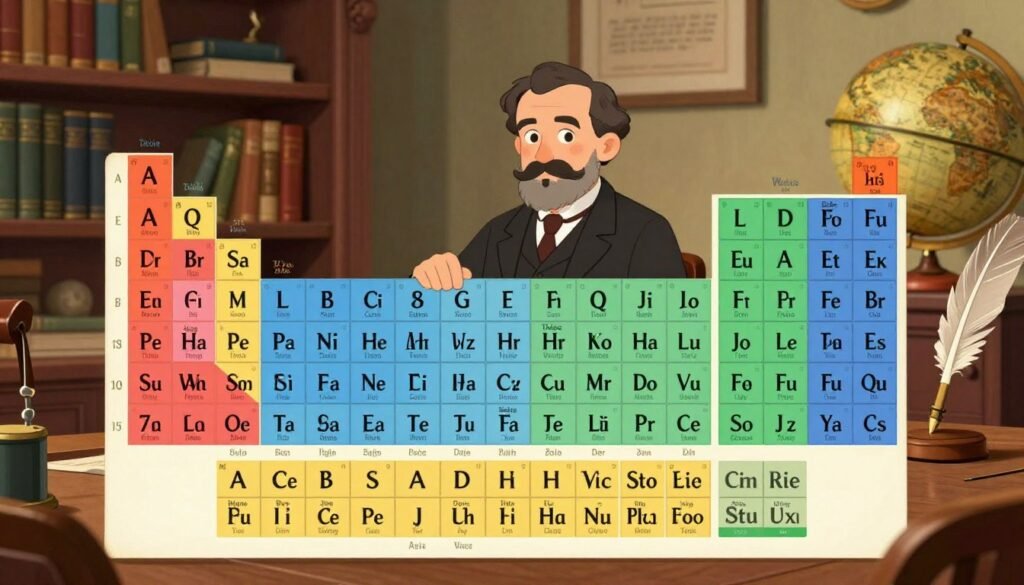
Mendeleev’s work on the periodic table shows his creativity and hard work. His ideas helped us understand chemistry better and led to new discoveries!
Predicting the Undiscovered Elements
Mendeleev’s periodic table was more than just a list. It was a tool for predicting new elements. He used known elements’ properties and weights to guess what was yet to be found.
Mendeleev left empty spots in his periodic table for these new elements. He was sure his table was right. He named them with Sanskrit words like “eka” for now.
The Genius Behind the Gaps
Mendeleev’s decision to leave gaps was a sign of his genius. He was not just listing known elements. He was also looking forward, expecting new discoveries.
Eka-Aluminum, Eka-Boron, and Eka-Silicon
Mendeleev guessed the traits of elements like eka-aluminum, eka-boron, and eka-silicon. His guesses were spot on. Later, finding gallium, scandium, and germanium proved him right.
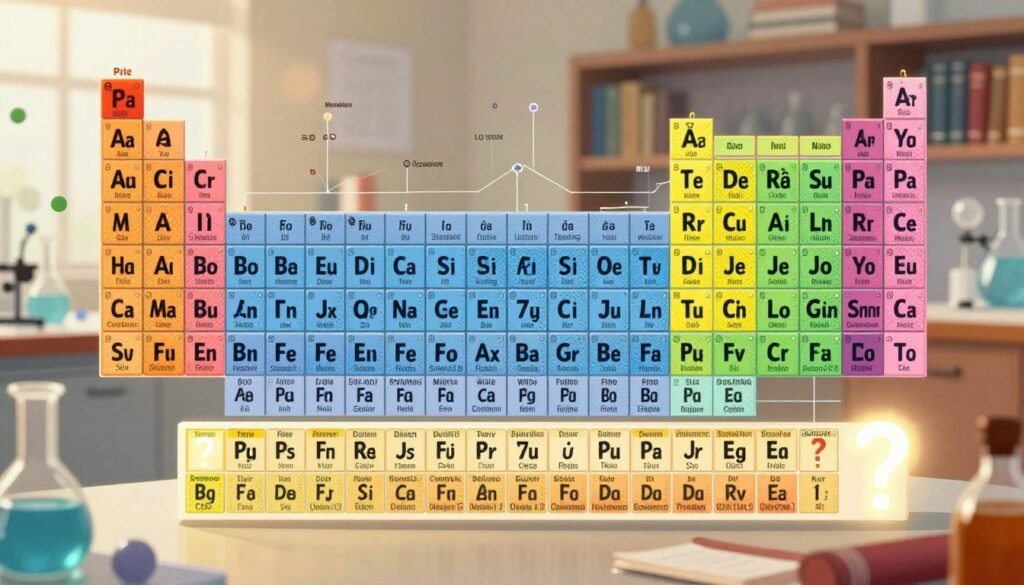
Mendeleev’s guesses showed his genius and the periodic table‘s strength. His work changed chemistry. It gave a way to understand new discoveries and element relationships.
The Validation of Mendeleev’s Predictions
Mendeleev’s predictions changed chemistry forever! It was more than just a table. It was a new way to see elements. His work showed the way for new discoveries.
His predictions were proven right by his genius. The finding of some elements was key. Let’s look at how these elements proved Mendeleev right.
The Discovery of Gallium
In 1875, gallium was found. It was one of Mendeleev’s guesses. French chemist Paul-Émile Lecoq de Boisbaudran found it in sphalerite. Gallium’s traits matched what Mendeleev said about eka-aluminum.
“Gallium’s discovery was a big win for Mendeleev’s table,” it showed his predictions were strong. You can read more about Mendeleev’s guesses on Wikipedia.
The Confirmation of Scandium and Germanium
In 1879, scandium was found, and in 1886, germanium was discovered. Scandium was like eka-boron as predicted by Mendeleev. Germanium was like eka-silicon. These finds filled gaps in the table and proved Mendeleev right.
These discoveries were big for chemistry. They showed the table was more than a list. It was a guide for science.
Beyond the Table: Mendeleev’s Contributions to Science
Dmitri Mendeleev did more than just create the periodic table. He was a scientist who helped many fields. His work is still important today.
Research on the Elasticity of Gases
Mendeleev studied how gases act under different conditions. His research helped start new studies in physics and chemistry.
The elasticity of gases is a key property. It affects many natural and industrial processes!
Studies on Petroleum and Industrial Chemistry
Mendeleev also worked on petroleum. He helped start the first oil refinery in Russia. His work showed how science can solve real-world problems.
Key Contributions to Petroleum Studies:
- Analyzing the composition of petroleum
- Developing methods for refining petroleum
- Improving the efficiency of petroleum-based industrial processes
Here are some important facts about Mendeleev’s work on petroleum:
| Year | Contribution | Impact |
|---|---|---|
| 1860s | Research on petroleum composition | Understanding of petroleum properties |
| 1870s | Development of refining methods | Improved efficiency in petroleum refining |
| 1880s | Establishment of Russia’s first oil refinery | Advancements in industrial chemistry |
Mendeleev was a scientist with many interests. His work still inspires scientists today!
The Personal Life and Character of a Scientific Giant
Dmitri Mendeleev’s life was full of science, strong beliefs, and many interests! His character was as fascinating as his scientific work.
A Complex Personality and Social Views
Mendeleev had a complex personality and strong social views! He dared to speak out against the old ways, pushing for change in Russia. His bold words sometimes clashed with the government, but he won respect from his friends.
His life was filled with important moments, like his marriages and being a dad. Mendeleev’s family life mixed old values with new dreams, showing his forward-thinking in science and society.
His Passion for Meteorology and Aeronautics
Mendeleev loved meteorology and aeronautics too! He believed science could make our lives better. He was excited about studying weather and how things fly.
His work in meteorology was groundbreaking, helping us understand weather better. His work in aeronautics was also ahead of its time, showing his creative mind.
Looking at Mendeleev’s many interests, we see how he changed science and our world. His legacy shows the value of curiosity and exploring new things.
The Global Recognition of His Work
Mendeleev’s work was loved all over the world. His discovery of the periodic table changed chemistry a lot. He got many big awards for it.
Awards and International Acclaim
Mendeleev got many accolades for his science work. He got awards from many places. He also got titles from famous places.
- Awards from various scientific communities
- Honorary titles from prestigious institutions
- The Copley Medal from the Royal Society
The Legacy of the Copley Medal
The Copley Medal was given to Mendeleev for his great work. It shows how much his peers respected him. This medal is given every year by the Royal Society for big science wins.
| Award/Honor | Year | Awarding Body |
|---|---|---|
| Copley Medal | 1905 | Royal Society |
| Other notable awards | Various | Various scientific bodies |

Mendeleev’s work is still celebrated today. It shows how much he changed science. His work inspires scientists all over the world.
Learning Chemistry Through Modern Methods
Chemistry education has changed a lot. Now, we use fun ways like gamification! Old teaching methods are now mixed with new ones that make learning chemistry fun and engaging.
Chemical Education Evolution
How we teach chemistry has changed a lot. No more just reading books and listening to lectures. Now, we use fun and interactive ways to learn.
Technology is a big reason for this change. Online tools let students explore chemistry in a virtual world. This makes learning more fun and helps them understand better.
Enhancing Your Knowledge with Debsie Gamified Courses
Debsie leads this change with fun chemistry courses. They use game design to make learning exciting. This makes hard concepts easier to get.
Why Gamification Works for Science
Gamification is great because it makes learning feel like a game. Debsie’s platform makes students want to learn and remember more.
It also makes learning interactive. Students do quizzes and puzzles that help them apply what they’ve learned. This makes chemistry stick in their minds.
Exploring the Offerings at Debsie
Debsie’s courses cover many chemistry topics. Their platform is easy to use, so students can learn at their own pace.
Debsie also has physics classes with the same fun approach.
Here’s a comparison of old learning methods and gamified learning:
| Aspect | Traditional Learning | Gamified Learning |
|---|---|---|
| Engagement | Often passive | Highly interactive |
| Retention | Variable | Improved through repetition and challenge |
| Accessibility | Limited by location and resources | Accessible online from anywhere |
As Richard Feynman said, “Learning is not just a spectator sport.” Debsie’s way of learning chemistry is fun and engaging.
“The art of teaching is the art of assisting discovery.”
Debsie is changing how we learn chemistry with new methods and technology. Their approach is not only improving understanding but also inspiring future scientists.

The Periodic Table in the Modern Era
The periodic table is still very important today! It has changed a lot since it was first made. Now, it helps us understand the elements better.
Now, we use atomic numbers to sort elements. This makes the table more accurate and easier to use.
Refinements and the Modern Atomic Number
Using atomic numbers was a big change. Scientists like Henry Moseley showed it was better than using atomic weights. You can find more about this on the Royal Society of Chemistry’s website.
This change helps us know more about elements. The table now shows elements in order of their atomic number. This number tells us how many protons are in an atom’s center.
| Element | Atomic Number | Atomic Weight |
|---|---|---|
| Hydrogen | 1 | 1.00794 |
| Helium | 2 | 4.002602 |
| Oxygen | 8 | 15.9994 |
The Inclusion of Synthetic Elements
Now, we also include synthetic elements. These are made in labs, not found in nature.
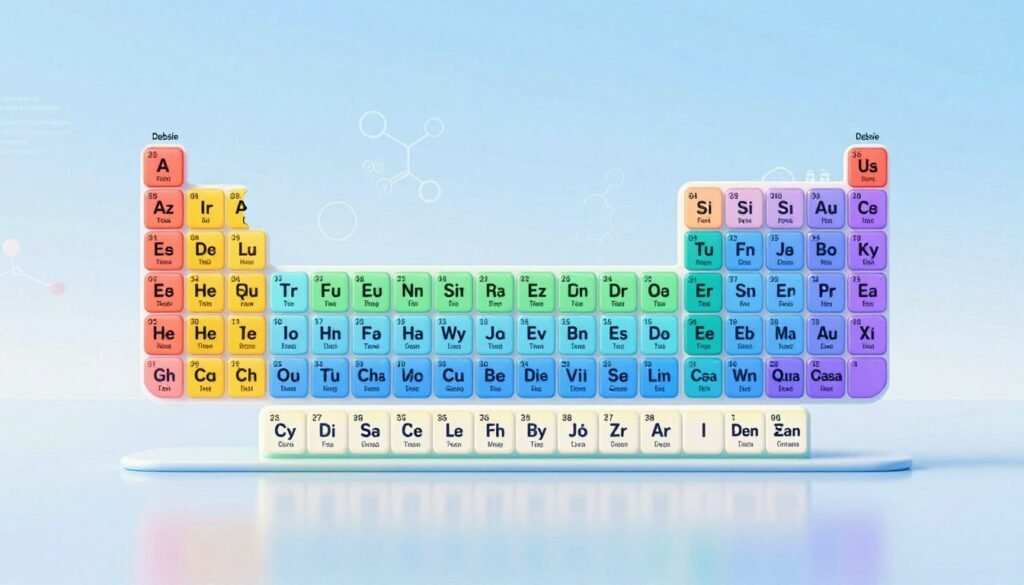
The periodic table keeps getting better. It shows us how chemistry and physics are always changing. It’s a key tool for understanding our world.
The Lasting Impact on Modern Science
Mendeleev’s work still shapes our science today. His periodic table is key to chemistry and physics. It has led to many discoveries and big steps forward.
Shaping Modern Physics and Chemistry
Mendeleev’s table has changed physics and chemistry a lot. It helps scientists predict what elements can do. This has led to new discoveries and big research breakthroughs.
Let’s look at some areas where Mendeleev’s work has made a big difference:
| Field | Impact | Examples |
|---|---|---|
| Chemistry | Understanding chemical properties and reactions | Predicting element properties, understanding chemical bonding |
| Physics | Understanding atomic structure and relationships | Studying atomic weights, understanding periodic trends |
| Materials Science | Discovery of new materials and elements | Synthetic elements, new compounds |
The Periodic Table as a Universal Language
The periodic table is more than a tool for chemists. It’s a universal language for physics and chemistry. Scientists all over use it to share complex ideas. To learn more about chemical symbols, visit Debsie’s page on chemical symbols!

Understanding the periodic table helps us learn about elements. Mendeleev’s work shows the power of science and discovery!
Conclusion
Dmitri Mendeleev changed science forever. His work still inspires many today. He showed us how to organize elements in a smart way.
The periodic table is a big part of chemistry now. You can learn more at Debsie.com. There, you’ll find fun courses to help you grow.
Visit Science History to learn more about Mendeleev. His story is amazing.
Let’s keep exploring and learning together. Mendeleev’s spirit of discovery is still with us.