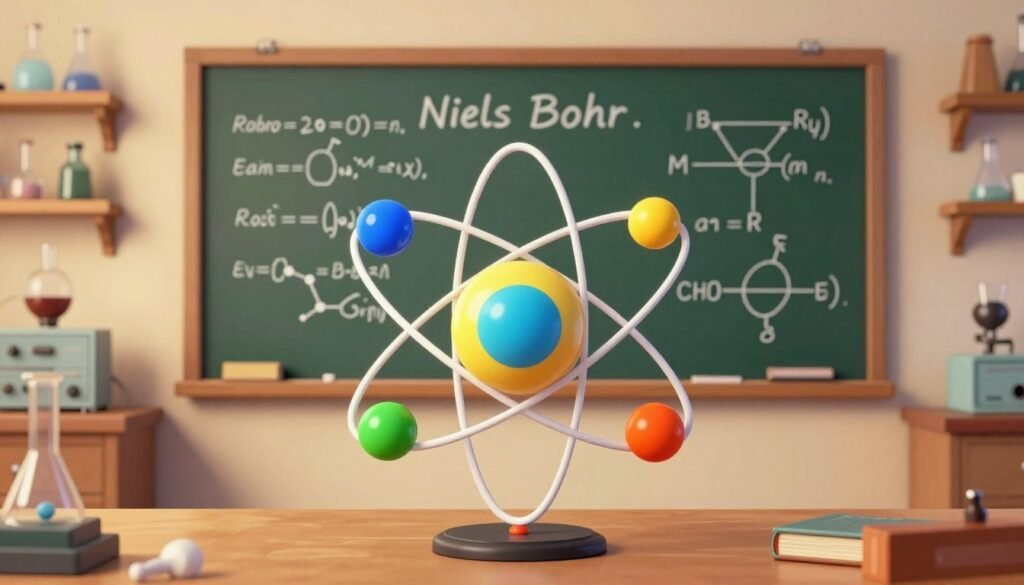
Have you ever looked at a tiny grain of sand and wondered what lies inside? It’s amazing to think that everything we touch is made of tiny pieces we can’t see! We’re excited to share the story of a man who looked closer than anyone else.
Born in Copenhagen, Denmark, on October 7, 1885, he was a brilliant pioneer. Niels Bohr spent his days thinking about the small parts of our world. His work led to a 1922 Nobel Prize and changed physics for everyone!
You can dive into the world of physics too! Try out Debsie Gamified Courses at https://debsie.com/courses for a fun way to learn. We love helping young explorers grow through interactive discovery and playful missions.
Let’s learn about the Niels Bohr discoveries that helped us map the secrets of the atom. His contributions make it possible for us to understand the complex energy that powers our modern lives. Are you ready to explore the microscopic world that makes up our massive universe?
Key Takeaways
- Born in 1885 in Copenhagen, Denmark, he became a science legend.
- He won the Nobel Prize in Physics in 1922 for his atomic research.
- His work explained how atomic structure and quantum theory function.
- Bohr helped us understand how atoms emit light and energy.
- Debsie offers gamified courses to make these complex topics fun.
- His legacy continues to inspire young scientists around the globe.
The Early Life and Academic Foundations of Niels Bohr
Niels Bohr was born into a family that loved learning. His dad, Christian Bohr, was a professor of physiology. His mom, Ellen Adler, came from a rich Jewish family in Danish banking and politics.
A Childhood in Copenhagen
Bohr grew up in Copenhagen. It was a place full of learning and curiosity. Here’s what made his childhood special:
- He came from a family that loved learning.
- His dad’s work in physiology was a big influence.
- His mom’s background added to the cultural and intellectual vibe.

Academic Pursuits at the University of Copenhagen
Bohr went to the University of Copenhagen to study. He learned physics from Christian Christiansen. This was key for his future Niels Bohr discoveries.
Some important parts of his studies were:
- He studied physics at the University of Copenhagen.
- He worked with Christian Christiansen.
- He built a strong base in theoretical physics.
At Debsie, we support young minds with personalized, gamified learning experiences! Check out our courses at https://debsie.com/courses and help your child grow!
The Revolutionary Bohr Atomic Model
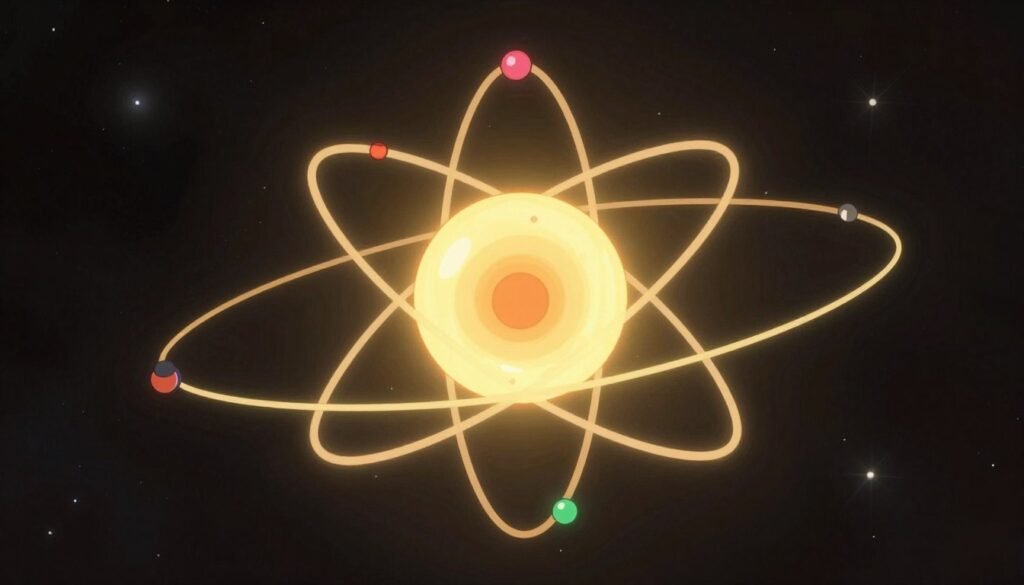
Niels Bohr changed how we see the atom. In 1913, he came up with a new idea. He said electrons move in set paths and change energy when they jump.

Challenging the Classical Physics Paradigm
Bohr’s idea was different from old physics. He said electrons have set energy levels. Old physics thought they would keep losing energy and fall into the nucleus.
This was a big step. Bohr showed a new way to see the atom. He used quantum theory to explain things old physics couldn’t.
The Concept of Quantized Electron Orbits
The Bohr model talks about quantized electron orbits. Electrons can only be in certain places around the nucleus. When they move, they release or take in energy, showing light of a certain color.
This idea made atoms stable and explained why elements have unique light colors. Learn more about these ideas with Debsie Gamified Courses!
Key Niels Bohr Discoveries in Quantum Mechanics
Niels Bohr changed how we see the atomic world. His work shaped physics and sparked big talks about reality.
Bohr came up with the correspondence principle. It says quantum theory matches classical physics when quantum numbers get big. This link was key.
The Correspondence Principle
The correspondence principle was a big step. It showed how quantum and classical mechanics are connected. It proved quantum mechanics is more than just a new idea.
Let’s look at a table that shows how quantum and classical mechanics differ:
| Phenomenon | Quantum Mechanics Prediction | Classical Mechanics Prediction |
|---|---|---|
| Energy Levels | Quantized | Continuous |
| Large Quantum Numbers | Approaches Classical Predictions | N/A |
| Particle Behavior | Wave-Particle Duality | Definite Position and Trajectory |
Complementarity as a Philosophical Framework
Bohr also talked about complementarity. He said particles can be waves and particles at the same time. This idea made us think differently about reality.
“The opposite of a correct statement is a false statement. But the opposite of a profound truth may well be another profound truth.” – Niels Bohr
This idea affects more than just physics. It changes how we think in philosophy, biology, and more.
At Debsie, we want to share cool ideas like these with everyone! Check out our fun courses at https://debsie.com/courses to learn about quantum mechanics and more!
The Copenhagen Interpretation of Quantum Theory
At the heart of quantum theory lies the Copenhagen interpretation. This idea, championed by Bohr, still fascinates physicists today! It says quantum mechanics is complete and measurement affects the outcome.

Defining the Nature of Reality
The Copenhagen interpretation asks big questions about reality. It says, at the quantum level, reality isn’t fixed until we look at it. This idea goes against old ideas of a fixed reality.
Want to learn more? Check out Debsie Gamified Courses. They make hard physics topics fun and easy to understand!
The Role of the Observer in Quantum Systems
A big part of the Copenhagen interpretation is the observer’s role. It says the act of measuring is not just watching. It’s actually changing the outcome of a quantum event. This has led to many debates about how much the observer affects reality.
For more on this, see the Wikipedia article on the Copenhagen interpretation. It gives a detailed look at the topic.
The Copenhagen interpretation is key to understanding quantum mechanics! It’s not just for physics. It makes us think about how observation and measurement work in many areas.
Niels Bohr and the Solvay Conferences
Imagine being part of a meeting where physics’ future was being shaped. This was real for Niels Bohr at the Solvay Conferences! These meetings were where top physicists talked about quantum theory’s latest.
Niels Bohr’s role in these meetings was big. He had deep talks with other great minds, like Albert Einstein. They talked about quantum mechanics and what reality really is.
Debates with Albert Einstein
The talks between Bohr and Einstein were very interesting. Einstein didn’t believe in quantum mechanics’ randomness. Bohr stood up for quantum theory, saying it fully explained the atomic world.
These debates were key to understanding quantum mechanics. Bohr and Einstein’s arguments helped us learn more about it.
Shaping the Future of Theoretical Physics
The Solvay Conferences, with Bohr’s help, were very important for physics. The talks and debates helped start new research in quantum mechanics.
Bohr’s work and talks with other scientists showed how teamwork and debate help science grow. By exploring new ideas and questioning old ones, scientists like Bohr expanded our knowledge.
At Debsie, we encourage kids to be curious and ask questions. Our fun courses at https://debsie.com/courses make learning about physics exciting. Kids can learn to love science by exploring it in a fun way.
The Institute for Theoretical Physics
In Copenhagen, Niels Bohr started the Institute for Theoretical Physics. It was a big change for quantum mechanics! This place drew top physicists from everywhere, making a community that pushed quantum mechanics forward.
Creating a Hub for Global Scientific Minds
The Institute for Theoretical Physics, led by Bohr, drew famous physicists. They wanted to learn about the atomic world. Here, the Bohr atomic model and Niels Bohr discoveries were talked about and improved.
Bohr brought together different minds. This made theoretical physics grow. Learn more about interactive learning in physics at Debsie Gamified Courses!

Mentoring the Next Generation of Physicists
Bohr was not just a great physicist but also a great teacher. He helped many young scientists grow. His teaching was key to quantum mechanics’ growth. For more on learning, check out Debsie’s educational chances!
| Key Aspects | Description |
|---|---|
| Global Hub | Attracted physicists worldwide, fostering collaboration |
| Mentorship | Bohr guided young physicists, shaping future scientists |
| Innovation | Environment encouraged new ideas and discoveries |
To learn more about the Niels Bohr Institute and its history, visit Wikipedia’s page on the Niels Bohr. The legacy of the Institute for Theoretical Physics still inspires physicists today!
Niels Bohr and the Manhattan Project
Niels Bohr’s work on the Manhattan Project was a big change for him. He was a famous physicist. His Niels Bohr discoveries helped a lot with atomic theory.
He was part of a big and tricky project. Bohr worked with other smart scientists. They made the atomic bomb, which changed history.
The Ethical Dilemmas of Nuclear Energy
Bohr saw the bad side of nuclear weapons. He thought a lot about the ethical implications of science.
He wanted science to be used wisely. Bohr thought science should help people, not harm them.
Advocating for International Scientific Cooperation
Bohr wanted scientists to work together. He thought this could make science safer for everyone.
Learn more about Niels Bohr’s life and work. Bohr showed us how important it is to think about science’s impact.
At Debsie, we teach kids to be curious and responsible. Check out our fun physics courses at https://debsie.com/courses!
The Nobel Prize and Global Recognition
Niels Bohr won the Nobel Prize in Physics in 1922. This prize was for his work on the atomic structure. It showed his big impact on science worldwide.
After winning the Nobel Prize, Bohr kept inspiring scientists. Let’s look at his Nobel Prize and his lasting impact.
The 1922 Nobel Prize in Physics
Niels Bohr got the Nobel Prize in Physics in 1922. He was honored for his work on atoms and the radiation they give off. This prize was for his Bohr atomic model, which changed how we see atoms.
Legacy of Scientific Excellence
Bohr’s impact goes beyond his Nobel Prize. He taught many physicists and helped science work together worldwide. His atomic model led to big steps in physics and chemistry.
Some key parts of Bohr’s legacy are:
- He inspired many scientists to come.
- He helped us understand atoms better.
- He made science work together globally.
Bohr’s work shows the power of science and new ideas. You can help your child be great with Debsie’s learning plans! Check out Debsie Gamified Courses at https://debsie.com/courses.
Expanding Knowledge Through Debsie Gamified Courses
Debsie’s gamified courses make learning about Niels Bohr exciting. They use fun, interactive ways to teach complex physics. This helps kids understand tough topics better.

Learning Complex Physics Concepts Through Gamification
Learning quantum mechanics can be hard. But Debsie’s gamified approach makes it fun. They use games to teach kids about Niels Bohr’s work in a fun way.
For example, their Niels Bohr’s atomic model courses are both fun and educational. Kids can do quizzes and simulations. This helps them learn important concepts.
Explore Educational Opportunities at Debsie Courses
Debsie has many courses for different needs. You can see them at https://debsie.com/courses. This helps find the right course for your child.
Experts say gamification boosts learning. Debsie uses this to make learning fun and effective for kids everywhere.
“The more you know, the more you realize you don’t know. But with Debsie, learning becomes a fun adventure!”
Debsie’s courses are great for learning physics and more. You can also find top physics tutors and classes for extra help.
The Philosophical Impact of Bohr’s Work
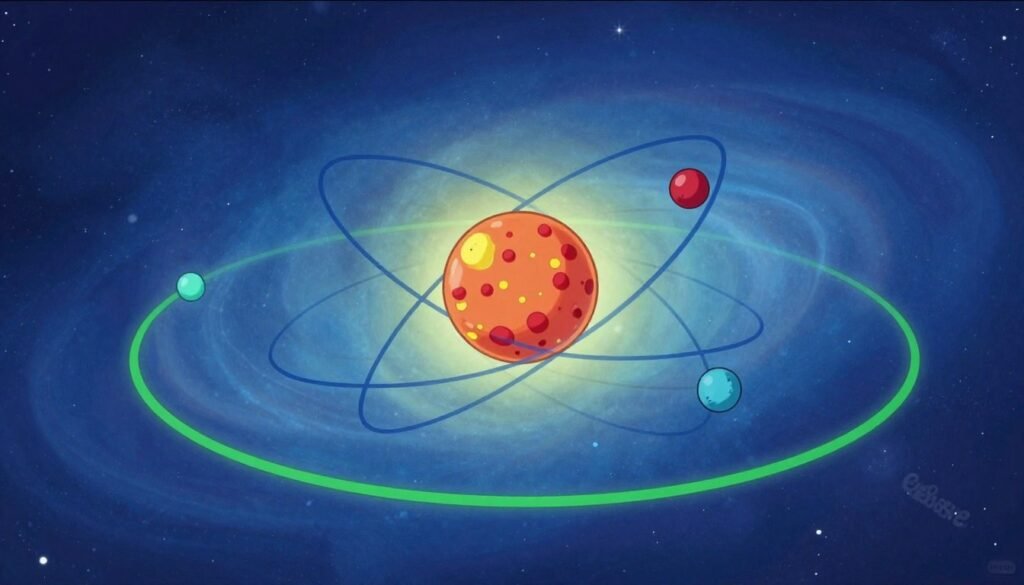
Bohr’s idea of complementarity changed how we see reality. It affected physics and philosophy! His Bohr atomic model showed that some things can’t be seen or measured at the same time. This challenged old ideas about what is real.
Bohr said different ways of measuring can show different things. This idea helped connect science and how we understand the world. It showed us that knowing things has limits and possibilities.
Bridging Science and Human Understanding
Bohr’s work also changed philosophy. His ideas made people think more about reality and knowledge. He showed that watching something can change what it is.
This idea made us see the world in a new way. It showed how the person watching and what is being watched are connected. Bohr’s work helped start big talks in philosophy about what we can know and what is real.
The Influence of Complementarity Beyond Physics
Complementarity is not just for physics. It has also changed thinking in biology, psychology, and philosophy. It makes us think that different ways of seeing things can be good together, not against each other.
This idea helps us understand the world better. It shows that different views can help each other. This is good for learning, where many ideas can help us understand more.
At Debsie, we want to make learning fun and interactive. You can find our courses at https://debsie.com/courses. We help kids see how science, philosophy, and the world are all connected!
Niels Bohr and the Development of Nuclear Fission
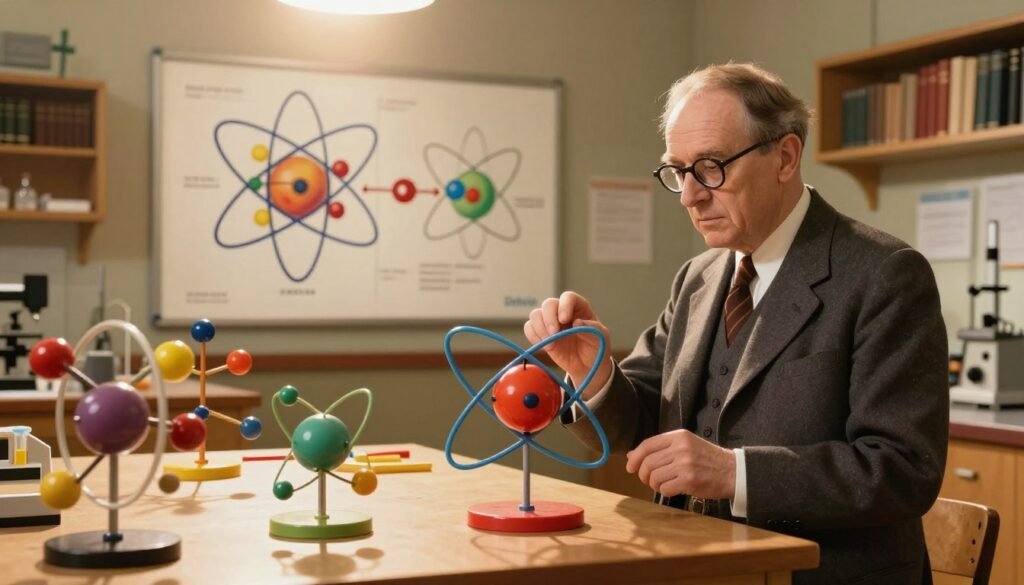
Niels Bohr worked with John Wheeler on the liquid drop model. This was key for understanding nuclear fission. It was a big step in nuclear physics, showing how atomic nuclei act under certain conditions.
The liquid drop model came out in the late 1930s. It sees the nucleus as a fluid droplet. This idea helps us understand nuclear stability and how it leads to fission. The model shows how nuclei can split, releasing a lot of energy.
Liquid Drop Model Insights
The model views the nucleus as a liquid drop with surface tension. This idea helps explain how some nuclei can split. It also shows how nuclear binding energy keeps a nucleus stable.
Collaborations and Impact
Bohr and Wheeler’s work together was a big scientific achievement. It showed how science is global. Their work helped us understand nuclear processes better. It also had big effects on energy and global security.
To learn more about complex physics like nuclear fission, check out Debsie Gamified Courses at https://debsie.com/courses! These courses offer interactive learning. They help you understand Niels Bohr’s discoveries and their role in science today.
| Key Aspects | Description | Impact |
|---|---|---|
| Liquid Drop Model | Treats the nucleus as a droplet of incompressible fluid | Explains nuclear stability and fission processes |
| Collaboration with John Wheeler | Joint work on understanding nuclear fission | Advanced nuclear physics and energy applications |
| Nuclear Fission Understanding | Insights into nucleus splitting and energy release | Significant for energy production and security |
The Enduring Legacy of the Bohr Model
The Bohr atomic model is key to understanding atoms! It’s simple and helps students grasp atomic physics. It’s still used today, even though newer models exist.
Modern Applications in Chemistry and Spectroscopy
The Bohr model is still important in chemistry and physics. It’s used in spectroscopy and other areas. It explains how atoms take in and give out energy.
- Understanding atomic energy levels
- Explaining spectral lines
- Foundation for more advanced quantum mechanics
To learn more about quantum physics, visit this link!
Why Bohr Remains a Pillar of Modern Science
The Bohr model’s impact goes beyond teaching. It helped lead to many scientific discoveries. Debsie’s educational content can help your child learn science well. Try Debsie Gamified Courses at https://debsie.com/courses for fun learning!

Conclusion
Niels Bohr’s work changed physics forever! His discoveries about atoms led to big steps in quantum mechanics.
The Bohr atomic model is key in physics today. It shows us the power of curiosity and keeps scientists excited.
Make your child curious with Debsie Gamified Courses at https://debsie.com/courses. These fun courses make learning easy and fun. They help kids learn and understand the world better.
Let’s keep exploring like Bohr did. Start your child’s learning journey today with Debsie. Watch them grow and learn!