Imagine looking up at the stars and feeling excited. Ever wonder why things work the way they do? That curiosity is where Richard Feynman discoveries started!
This famous American physicist won the 1965 Nobel Prize. He showed that science is more than old books. It’s a fun adventure with puzzles for all to enjoy!
We think learning should be exciting. Start your journey today with Debsie Gamified Courses at https://debsie.com/courses! Our lessons make hard topics fun.
He loved to explain hard things simply. He said, if you can’t explain it to a kid, you don’t get it. We use this spirit of wonder to help you learn new things every day!
Key Takeaways
- He shared the 1965 Nobel Prize in Physics for his work on how light and matter interact.
- He transformed complex scientific theories into fun and engaging lessons for students.
- His unique methods turned difficult problems into interactive puzzles.
- He showed that curiosity and asking questions are the most important tools for any explorer.
- Debsie provides gamified tools to help children learn through adventure and play.
- His legacy encourages every student to keep discovering the beauty of the world.
The Early Life and Intellectual Curiosity of Richard Feynman
Richard Feynman was born on May 11, 1918, in New York City. His early life showed the power of curiosity and inquiry! He grew up in Far Rockaway, Queens, New York, where he was encouraged to explore and ask questions.

Childhood Experiments in Far Rockaway
Feynman’s childhood was full of experiments and activities that sparked his curiosity! He loved to fix radios and learn about mechanical devices. This hands-on learning made him love solving problems.
These early experiments helped Feynman think deeply. He learned by doing and observing the world around him.
The Influence of His Father on Scientific Thinking
His father, Melville Feynman, had a big impact on Richard. He taught Richard to ask questions and think deeply. Melville would talk to Richard about big ideas, helping him think more deeply.
This helped Feynman a lot in his studies. It taught him to always question and explore, preparing him for his future.
The Academic Journey at MIT and Princeton
Richard Feynman’s journey in school was very important. He went to MIT and then Princeton. There, he did some of his best work!
At MIT, Feynman learned a lot. He was very curious and loved to try new things in physics. His studies at MIT helped him get ready for Princeton.
Developing the Path Integral Formulation
Feynman worked on the path integral formulation at Princeton. This was a big step for him. It gave a new way to see quantum mechanics.
This new way helped Feynman understand how particles move. It was a big change in physics. It showed his creative thinking and helped others too.
| Key Contributions | Description | Impact on Physics |
|---|---|---|
| Path Integral Formulation | A new approach to quantum mechanics focusing on the sum of probabilities of all possible paths a particle can take. | Revolutionized understanding of particle behavior and interactions. |
| Interactions with Physics Giants | Engagements with influential physicists like Albert Einstein and John von Neumann. | Shaped Feynman’s theories and provided insights into the workings of the greatest minds in physics. |
Early Encounters with Theoretical Physics Giants
At Princeton, Feynman met famous physicists. He met Albert Einstein and John von Neumann. These meetings helped him a lot.
Meeting these great minds helped Feynman grow. He learned a lot from them. This helped him become a better physicist.
Richard Feynman and the Manhattan Project
Feynman joined the Manhattan Project at Los Alamos when he was very young. This project was a big effort during World War II. It aimed to make the atomic bomb.
Feynman’s work was not just about helping make a big scientific breakthrough. It was also about dealing with the tough questions about making such a powerful weapon.
The Youngest Group Leader at Los Alamos
Feynman became a group leader at Los Alamos. He was one of the youngest leaders there. This job needed technical skills, leadership, and teamwork.
As a leader, Feynman worked on many parts of the project. He did theoretical work and solved practical problems. His young ideas helped the team a lot.
Balancing Ethical Dilemmas with Scientific Progress
Feynman had to think about the ethics of making the atomic bomb. He had to mix his love for science with the moral questions of his work.
This experience changed Feynman a lot. It made him think deeply about science, ethics, and responsibility. He learned the importance of thinking about the big picture of science.
| Aspect | Feynman’s Role | Impact |
|---|---|---|
| Leadership | Youngest Group Leader | Demonstrated exceptional leadership skills |
| Scientific Contribution | Theoretical Work and Problem-Solving | Significant contributions to the Manhattan Project |
| Ethical Considerations | Grappling with Moral Implications | Shaped his views on science and ethics |
The Development of Quantum Electrodynamics
Richard Feynman’s work on quantum electrodynamics was a big step forward. It changed how we see light and matter. His work showed his genius and moved physics forward a lot.
Visualizing Interactions with Feynman Diagrams
Feynman made Feynman diagrams to show how particles interact. These diagrams help physicists understand and figure out the chances of different things happening. They are very important in physics today!
- Simplified complex calculations!
- Enhanced understanding of particle interactions!
- Facilitated predictions and discoveries in physics!
Winning the Nobel Prize in Physics
Feynman’s work on quantum electrodynamics earned him the 1965 Nobel Prize in Physics. He shared it with Julian Schwinger and Shin’ichirō Tomonaga. This award showed how important their work was in understanding light and matter.
The Nobel Prize win showed Feynman’s creative thinking. It shows his work still inspires many scientists today!
The Feynman Lectures on Physics: A Pedagogical Revolution
Richard Feynman made hard physics easy for college students. His famous lectures show his unique teaching way. It still motivates students and teachers today.
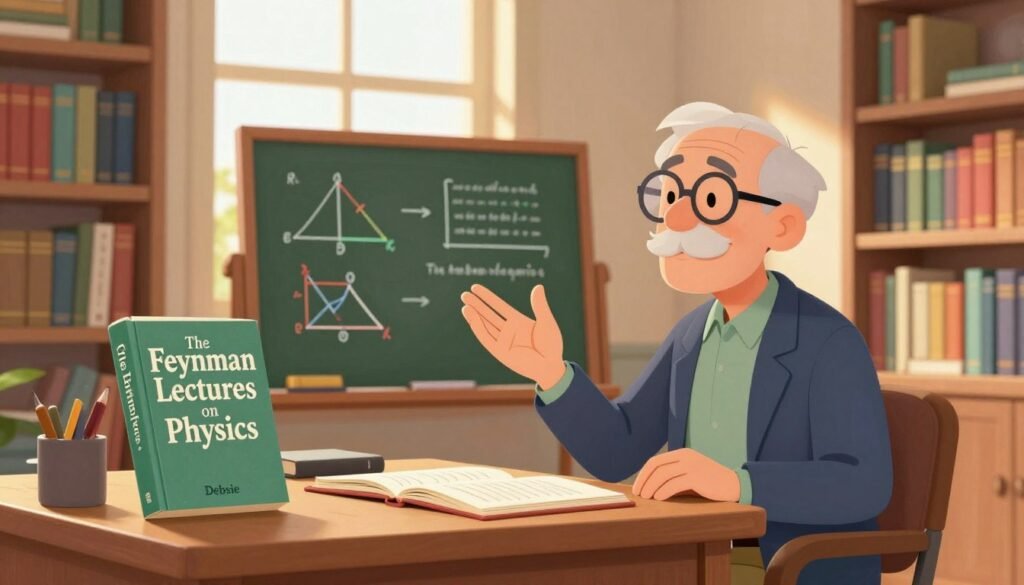
Breaking Down Complex Concepts for Undergraduates
Feynman’s teaching was new because he made hard ideas simple. He used clear explanations and intuitive analogies. This made physics seem like an exciting story, not a hard task!
Some key things about his teaching style are:
- He used real-world examples to show complex ideas!
- He encouraged students to think creatively and question things!
- He made complex math simple and focused on the physics behind it!
Why His Teaching Style Remains the Gold Standard
Feynman’s teaching is still important today because it values understanding over memorization. He taught the principles behind the math. This helped his students really understand physics!
As Feynman’s approach to physics shows, his method builds a deep love for the subject.
The effect of Feynman’s lectures is clear in:
- His teaching methods are widely used in physics classes!
- “The Feynman Lectures on Physics” is still loved by many!
- He inspires teachers to try new ways of teaching!
Gamifying the Learning Experience
Richard Feynman’s teaching methods have inspired a new wave of gamified learning experiences! By turning complex concepts into engaging challenges, we can make learning science a thrilling adventure.
Feynman believed in making science accessible and fun. Today, his legacy lives on through innovative educational approaches that gamify the learning process.
Modern Approaches to Mastering Difficult Subjects
Gamified learning is changing how we learn hard subjects. By adding game design to educational content, we can keep students interested and motivated.
Key benefits of gamified learning include:
- Increased student engagement
- Improved understanding of complex concepts
- Enhanced retention rates
As Feynman once said,
“I think I can safely say that nobody understands quantum mechanics.”
But with gamified learning, we’re making it easier for everyone to understand these hard concepts.

Exploring Debsie Gamified Courses for Scientific Literacy
Debsie Gamified Courses offer an interactive way to learn scientific concepts, inspired by Feynman’s approach to teaching. You can try them out at https://debsie.com/courses!
These courses are designed to make science fun and easy to understand. They use gamification to help people learn science better. By using game design and interactive challenges, Debsie Gamified Courses offer a unique learning experience.
Join the Debsie community today and start your gamified learning journey!
The Art of Scientific Intuition
Feynman was great at solving problems in new ways! He loved to think outside the box. This made him very good at scientific intuition.

Thinking Outside the Traditional Physics Framework
Feynman thought differently than most. He found new ways to solve problems. This led to groundbreaking discoveries that others missed.
His work on the Manhattan Project and Quantum Electrodynamics showed his talent. He used new thinking to get amazing results.
The Importance of First Principles Thinking
Feynman believed in first principles thinking. This means breaking down problems to their simplest parts. It helps you understand things better and be more creative.
By knowing the basics, you can tackle harder stuff. It makes solving problems easier. To learn more, check out Debsie’s physics courses. They make learning fun and interactive.
Richard Feynman and the Challenger Disaster Investigation
Richard Feynman’s work was key in the Space Shuttle Challenger disaster. In 1986, he joined the Presidential Commission to find out what happened. His science skills helped a lot in the investigation.
The Famous O-Ring Demonstration
Feynman’s most famous act was his O-ring test. He used ice water and an O-ring sample to show how cold affected it. This simple test was a big moment in the inquiry.
Holding Bureaucracy Accountable Through Science
Feynman’s work showed the value of scientific integrity and accountability. He said the failure was not just a tech issue. It was also because of bad management.
- The O-ring design was not good for cold weather.
- There was poor talk between managers and engineers.
- Pushing for a launch date ignored safety rules.
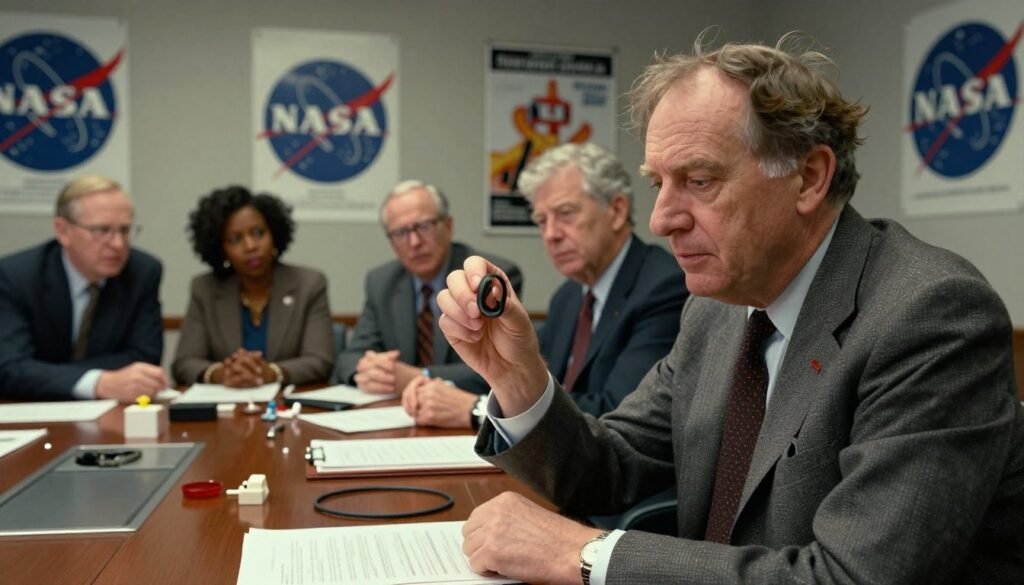
Feynman’s work and the O-ring test show science’s power. They help find the truth and push for honesty and responsibility.
The Eccentric Personality Behind the Genius
Richard Feynman had a mind full of genius and a personality full of fun! His life showed us that being smart and playful can go hand in hand. This mix of traits sparks creativity and new ideas.
Feynman loved many things, not just physics. His curiosity and love for life made him very interesting. He was always eager to learn and explore.
Bongo Player and Artist
Feynman loved music, and playing the bongo drums was his favorite. He was great at it and played at parties. He was also good at drawing and sketching, showing his creative side.
For Feynman, art was more than a hobby. It was a big part of who he was. It helped him see the world in a special way. An article on Right Attitudes talks about how his creativity helped him in science and life.
Love for Pranks and Intellectual Mischief
Feynman enjoyed playing pranks and solving puzzles. He was great at cracking safes and codes, skills he used during the Manhattan Project. His fun and playful side made him very popular.
Feynman showed us that being smart doesn’t mean being serious all the time. His fun personality and love for learning still inspire us today. He taught us that learning and creativity should be fun!
Key Richard Feynman Discoveries That Changed the World
Richard Feynman made big changes in physics! His work still inspires scientists everywhere. His discoveries show his creative mind and love for learning!
He made a big impact on superfluidity. His study of liquid helium helped us understand it better. He showed how it acts at very cold temperatures.
Superfluidity and Liquid Helium Research
Feynman’s work on superfluidity was very important. He found that liquid helium can flow without any resistance at very cold temperatures. This changed how we see the world.
Contributions to Quantum Computing Theory
Feynman was also a leader in quantum computing. He saw how quantum mechanics could change computers. His ideas have encouraged many to explore quantum computing.
As Richard Feynman’s Wikipedia page says, his work in quantum electrodynamics and path integral formulation helped shape modern physics. You can learn more about his work and its effects on science today!
The Feynman Technique for Rapid Learning
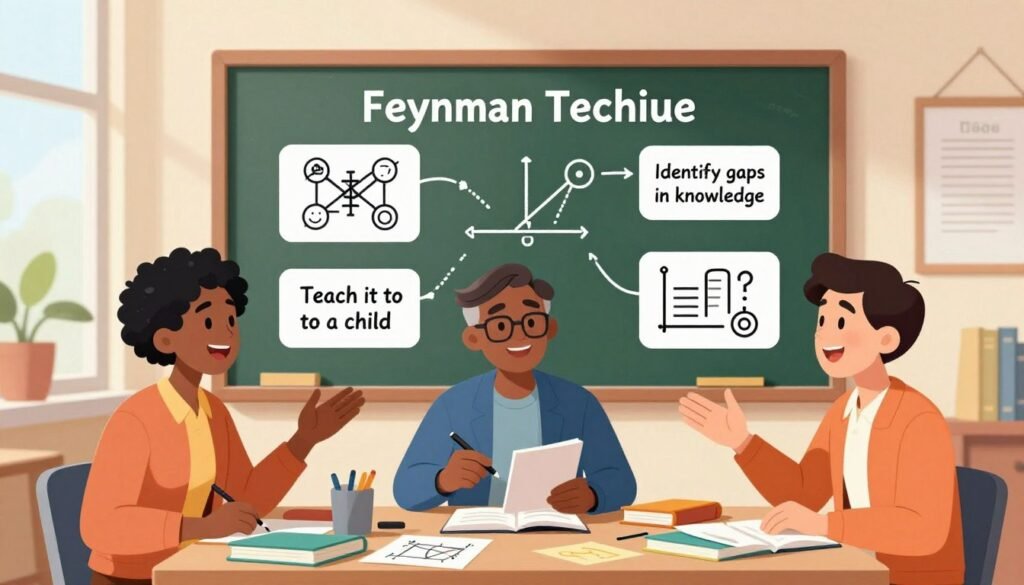
Learning complex concepts is now easier with the Feynman Technique! This method, inspired by Richard Feynman, helps you learn new skills fast.
The Feynman Technique makes hard subjects simple. It helps you understand better by breaking things down. This way, you can learn and remember more easily.
Simplifying Concepts to Identify Knowledge Gaps
Start with a concept you want to learn. Write down what you know about it. Then, find out what you don’t know.
For example, learning quantum mechanics? Write down its main ideas. You might find you need to learn more about wave-particle duality. Knowing what you don’t know helps you focus your learning.
Applying the Technique to Any Field of Study
The Feynman Technique works for any subject. It’s not just for physics, like Richard Feynman used it for. It’s good for biology, economics, or learning a new language too.
Here’s a table showing how it works across different fields:
| Field of Study | Complex Concept | Simplified Explanation |
|---|---|---|
| Physics | Quantum Entanglement | Particles connected across distances, affecting each other instantly |
| Biology | CRISPR Gene Editing | A tool for precisely editing genes, like a molecular scissors |
| Economics | Opportunity Cost | The value of the next best alternative given up when making a decision |
Using the Feynman Technique makes hard ideas easy to understand. For more learning tips, including physics, visit Debsie’s top physics tutors and classes.
Travels and Adventures in Brazil and Beyond
Richard Feynman went on exciting trips, including to Brazil. He loved diving into the local culture! His travels were about seeing new places and learning from different ways of life.
Cultural Immersion and Scientific Exchange
In Brazil, Feynman taught physics and learned to play the drums. This mix of culture and science was special to him. He thought knowing a culture well could help understand science better.
“The culture of Brazil has a very distinctive, very beautiful, and very lively quality to it.”
He loved the energy of Brazil. This energy showed in his science and teaching.
Feynman talked with local scientists in Brazil. This helped him see how science is seen and taught worldwide. He was curious about the differences and similarities between Brazil and the US.
The Challenges of Academic Systems Abroad
Feynman saw the tough parts of academic systems in Brazil. He noticed big differences in teaching science compared to the US. This made him want to help science education everywhere.
He thought science education should include doing experiments. Not just reading books. This idea shaped his work on making education better.
Let’s compare the academic systems Feynman saw:
| Aspect | Brazilian System | US System |
|---|---|---|
| Teaching Method | Primarily theoretical | Balanced theoretical and practical |
| Student Engagement | Limited hands-on activities | Encouraged experimentation |

Feynman learned a lot from his travels. He saw how important it is to know different cultures. His adventures in Brazil and elsewhere made him a better scientist and educator.
The Legacy of a Scientific Icon
Richard Feynman’s legacy inspires many scientists and thinkers today! His work in physics and more shows his groundbreaking ideas and fresh science approach.
Inspiring Generations of Physicists
Feynman is famous for his work in quantum electrodynamics and his role in the Challenger disaster. He made hard ideas easy for everyone. This has inspired many scientists. Learn more about Feynman’s work on American Scientist.

The Enduring Popularity of His Autobiographical Works
Feynman’s books, like “Surely You’re Joking, Mr. Feynman!” and “What Do You Care What Other People Think?”, are loved by many. They mix humor, insight, and curiosity. These books show Feynman’s life, his love for science, and his unique problem-solving ways.
By sharing his stories, Feynman has inspired scientists and the public. He made science fun and easy for all.
Why Science Should Always Be Fun
Richard Feynman showed us that science is more than just formulas. It’s about sparking joy and curiosity in discovery! This way, we can change how we learn and see the world.
Feynman thought that keeping wonder alive is key to understanding science. This makes us want to explore, ask questions, and find answers. It helps us love learning for life.
Maintaining Wonder in the Face of Complexity
When we look at complex science with curiosity and awe, we discover new things. Feynman’s work on quantum electrodynamics shows this. By making hard ideas simple, we can get others excited about science.
For example, learning how physics works in our daily lives, like with roller coasters, makes science fun and real. It shows how science connects to our everyday world.

Encouraging Curiosity in the Next Generation
It’s important to encourage curiosity in kids. This helps grow a new generation of scientists and thinkers. By making science fun and interactive, we can spark their interest in the world.
Using new ways to teach science, like games, can deepen their love for it. At Debsie, we focus on keeping curiosity alive and promoting exploration.
By following Feynman’s lead and making science fun, we can prepare the next generation. They will see the world with wonder and awe. This will drive progress and innovation for the future.
Conclusion
Richard Feynman’s legacy inspires many scientists and learners today. His way of teaching science has changed how we learn. It makes complex ideas easier to understand.
Feynman showed us how important curiosity and creativity are in learning. You can still explore science in fun ways. For example, check out Feynman’s Nanotechnology Lecture online.
Want to learn more in a fun way? Try gamified learning. It makes hard subjects fun. Learn more at Debsie Gamified Courses. It’s a great place to start.