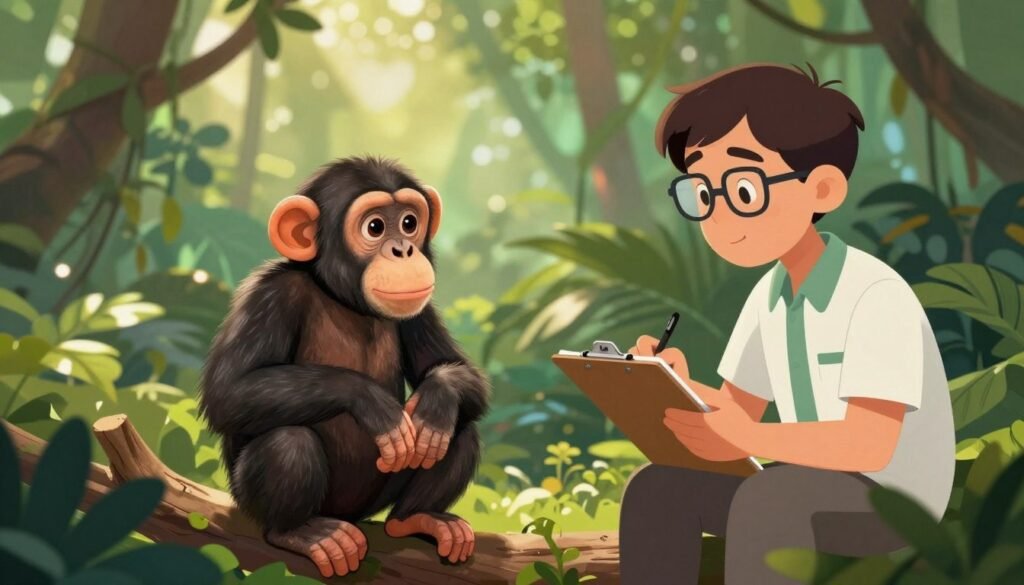
Ever dreamed of talking to animals? It’s like a fairy tale. But one scientist made it real! She showed us that nature is full of mystery if we just take the time to listen.
In June 1960, she arrived at Gombe Stream on Lake Tanganyika’s eastern shore. She started the first chimpanzee research in Tanzania’s forests. Her patience uncovered secrets no one else knew!
Now, you can explore the wild from home! Try Debsie Gamified Courses at https://debsie.com/courses. Interactive learning makes learning fun and helps kids grow!
Her work showed us that animals are smarter than we thought. These findings changed how we see the world and our role in it. Are you ready to become a bold explorer today?
Key Takeaways
- Pioneering work at Gombe Stream began in June 1960.
- The study transformed our views on animal intelligence and emotions.
- The research proved that wild animals use tools to survive.
- Patience and observation are vital for scientific discovery.
- Interactive courses help children learn about groundbreaking scientists.
- Her legacy encourages us to protect nature and all living creatures.
The Early Life and Curiosity of a Future Icon
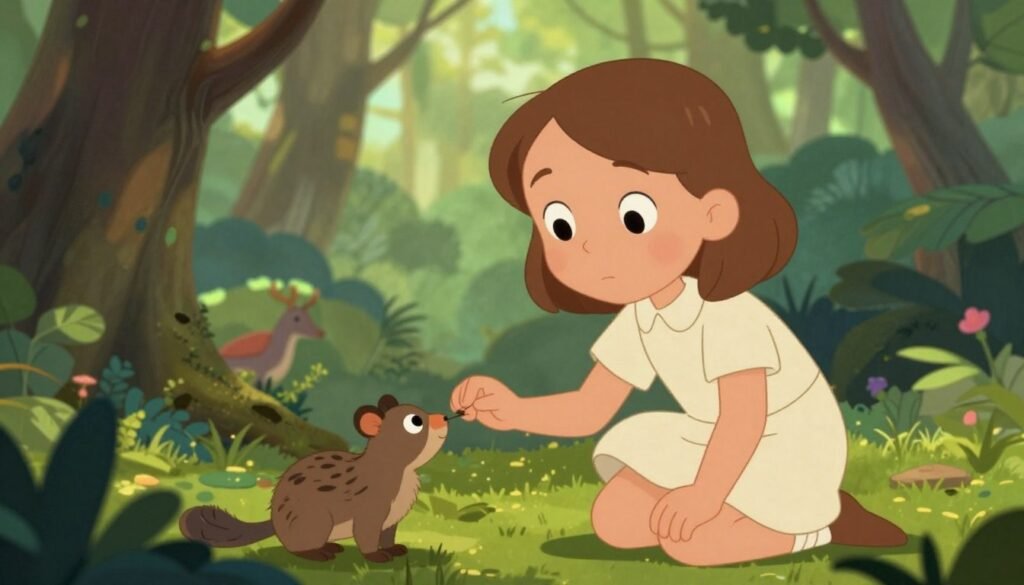
Jane Goodall loved the world as a kid. This love helped her change how we see animals. Her family supported her love for nature and animals.
Jane loved stories about animals and adventure. “Tarzan of the Apes” by Edgar Rice Burroughs was her favorite. It made her want to explore Africa.
A Childhood Defined by Nature
Jane Goodall loved animals and the outdoors. She spent hours watching wildlife. This helped her understand the world and sparked her curiosity.
Her parents were hesitant at first. But they supported her dreams. This support was key for Jane to follow her heart.
| Early Influences | Impact on Jane Goodall |
|---|---|
| Love for Nature and Animals | Instilled a deep respect and curiosity for wildlife |
| Stories of Adventure (e.g., Tarzan) | Sparked imagination and desire to explore Africa |
| Family Support | Enabled her to pursue unconventional ambitions |
The Influence of Dr. Louis Leakey
Dr. Louis Leakey was very important to Jane Goodall. He saw her potential and encouraged her to study chimpanzees in Tanzania. This chance helped her become a leading figure in primatology.
With Dr. Leakey’s help, Jane Goodall changed science. Her work showed us more about chimpanzees. It still inspires many today.
Jane Goodall and Her Pioneering Chimpanzee Research
The year 1960 was when Jane Goodall started her groundbreaking research on chimpanzees in Tanzania’s Gombe Stream National Park! Her work changed how we see chimpanzees and their ways of living.
Arrival at Gombe Stream National Park
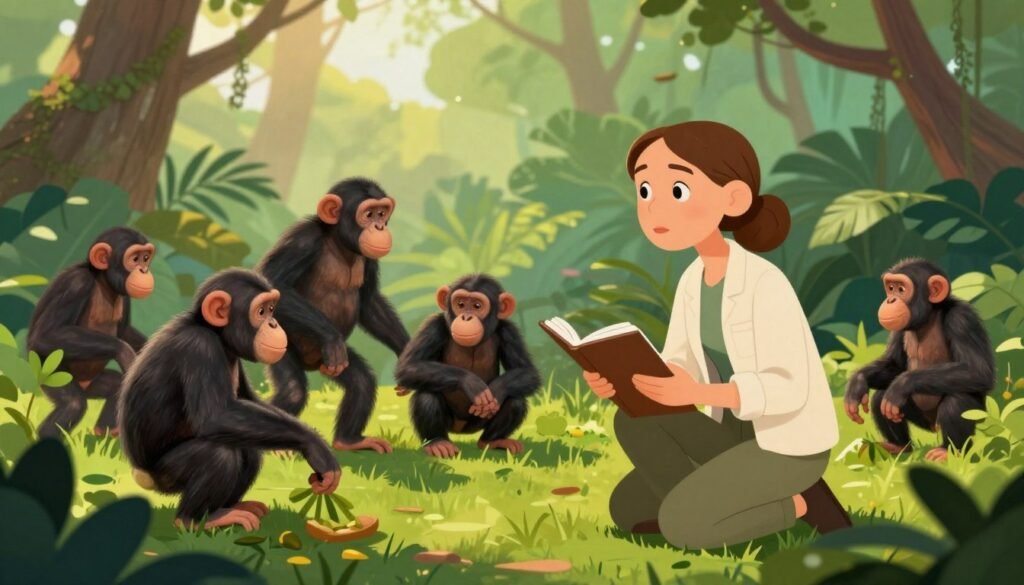
In June 1960, Goodall set up a camp at Gombe Stream to study wild chimpanzees for the long term. At first, the chimps were scared of her. But she won their trust by being patient and persistent! She took careful notes on their daily lives, how they interacted, and their home.
Breaking Traditional Scientific Barriers
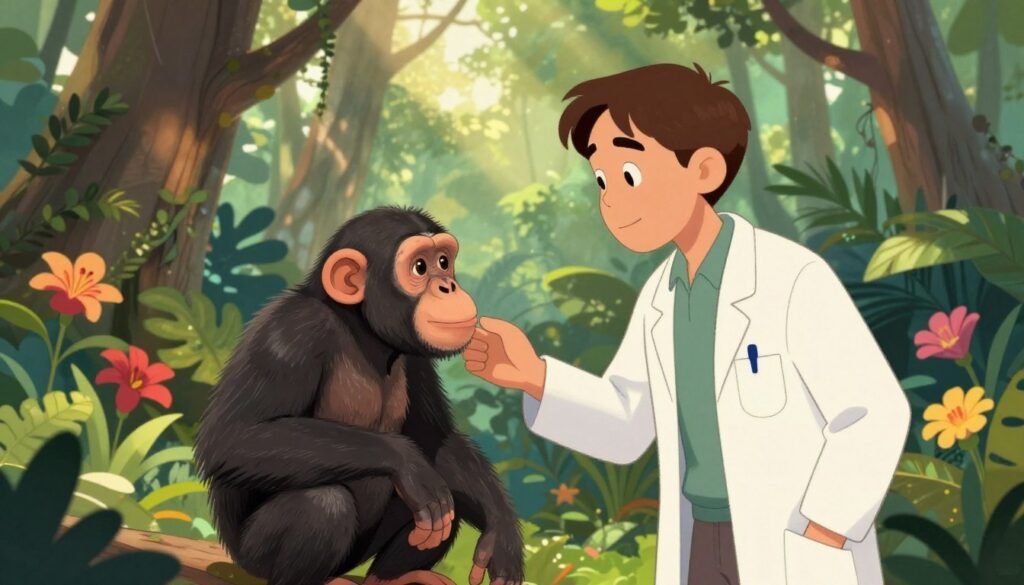
Goodall did something new by naming the chimpanzees instead of using numbers. She watched and wrote down their actions, showing they had complex social lives and were smart. This made us see them in a new light, showing they have feelings and social bonds.
| Behavior Observed | Description | Significance |
|---|---|---|
| Tool Use | Chimpanzees using sticks to fish for termites | Challenged the notion that humans are the only tool-using species |
| Complex Social Structures | Observation of hierarchies and alliances among chimpanzees | Revealed sophisticated social behaviors in chimpanzees |
| Emotional Depth | Documentation of grief, empathy, and mother-infant bonds | Highlighted the emotional complexity of chimpanzees |
The Discovery of Tool Use in Chimpanzees
Jane Goodall found out that chimpanzees use tools! This was a big surprise to scientists. It also made us think differently about what it means to be human.
Challenging the Definition of Humanity
Chimpanzees using tools was a big shock. People thought only humans could use tools. Goodall’s work made us rethink what makes us human.
Chimpanzees using tools showed they were smarter than we thought. This led to more research on their behavior and smarts.
The Famous Termite Fishing Observation
Termite fishing is a famous example of chimpanzee tool use. Goodall saw them use grass or twigs to get termites. It was a smart way to find food.
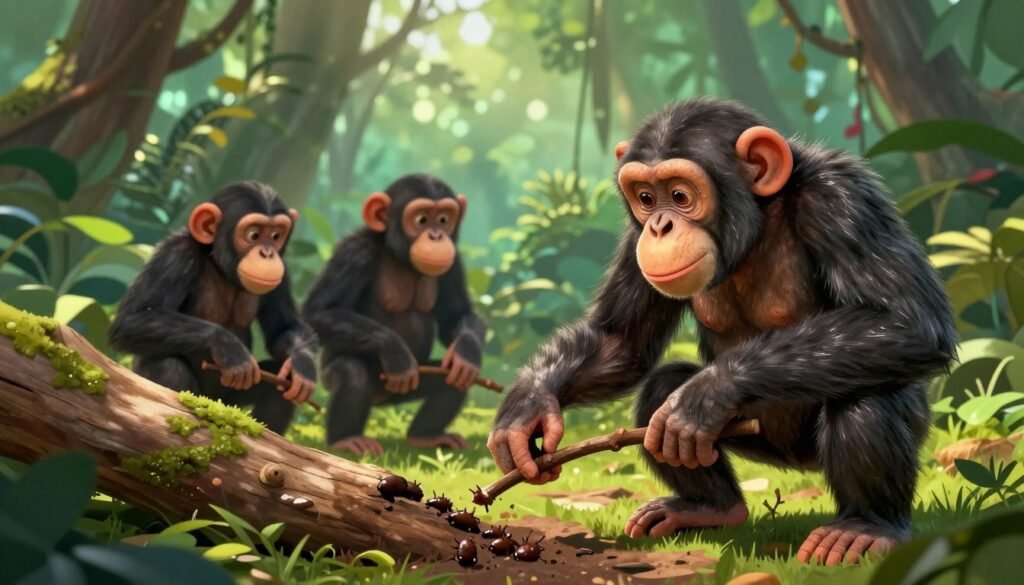
This observation was key. It showed chimpanzees could do complex things. It also helped us understand how they learn from each other.
| Tool Use Behavior | Description | Significance |
|---|---|---|
| Termite Fishing | Using sticks or grass to extract termites from mounds | Demonstrates problem-solving and adaptability |
| Stick Use | Using sticks to retrieve food or for other purposes | Shows cognitive and manipulative abilities |
| Rock Use | Using rocks to crack open nuts or other objects | Highlights physical strength and tool adaptation |
Goodall’s findings changed how we see chimpanzees. They inspired more research on their complex behaviors.
Observing Complex Social Structures
Exploring chimpanzees shows us their complex social lives. Jane Goodall’s work at Gombe Stream National Park showed us their societies. These societies have rules and behaviors that amaze us.
Goodall found that Gombe chimpanzees have a clear hierarchy. Dominant ones lead, and this changes over time. It changes as they grow, make friends, or change status.
The Hierarchy of the Gombe Chimpanzees
The Gombe chimpanzees have a strict hierarchy. Dominant chimpanzees get food and mating first. Subordinates follow their leaders.
Dominant males show off to keep their place. They might be aggressive or loud. Subordinates show they’re not in charge by pant-grunting or bowing.
| Behavior Type | Dominant Chimpanzees | Subordinate Chimpanzees |
|---|---|---|
| Aggression | Assert dominance through aggressive displays | Show submission to avoid conflict |
| Submission | Rarely display submissive behaviors | Frequently display submissive behaviors like pant-grunting |
| Social Bonding | Form alliances through grooming and shared activities | Strengthen bonds with other subordinates and sometimes with dominants |
Alliances and Political Maneuvering
Alliances are key in chimpanzee societies. They form bonds to gain power or stay safe. These bonds can last a long time and are built through grooming.
Goodall said the best leaders are kind and caring. They build strong relationships to keep their group stable. Learn more about this in this article on the Jane Goodall Institute’s website.
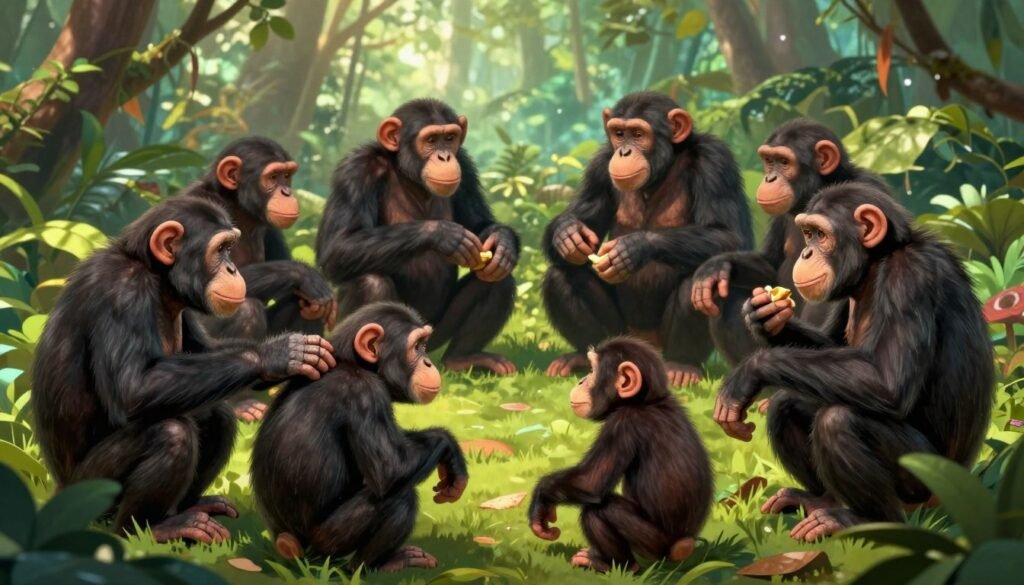
Studying chimpanzees helps us understand their minds and feelings. They show intelligence and deep emotions through their social lives.
The Emotional Depth of Primates
Goodall’s work with chimpanzees showed us their deep emotional world. They can feel empathy and grief! Her studies at Gombe Stream National Park showed us that animals are more than just instinct.
Documenting Grief and Empathy
Goodall saw many times when chimpanzees showed empathy towards each other. For example, they comforted each other after fights or losses. This shows how strong their social bonds are.
She also saw grief in chimpanzees. When a chimpanzee lost a family member, like a mother losing her baby, they would act like they were mourning. They would withdraw and do less of their usual activities. You can learn more about Goodall’s research and its impact on our understanding of animal emotions here.
The Importance of Mother-Infant Bonds
The bond between a mother and her baby is very important in chimpanzee society! Goodall’s work showed that these bonds help the baby survive and also affect the mother’s life and feelings.
A strong mother-infant bond is key for a young chimpanzee’s growth. It gives them food, social support, and emotional support. The table below shows some important points about mother-infant bonds Goodall found.
| Aspect | Description | Importance |
|---|---|---|
| Nourishment and Care | Mothers give food and protection to their babies. | Essential for baby’s survival and growth. |
| Social Learning | Babies learn by watching their mothers. | Important for fitting into chimpanzee society. |
| Emotional Support | Mothers comfort and reassure their babies. | Helps babies develop emotional strength. |
In conclusion, Goodall’s research showed us how complex chimpanzees are emotionally. They can feel many emotions, including empathy, grief, and strong mother-infant bonds. This changes how we see and treat non-human primates.
The Darker Side of Chimpanzee Behavior
Jane Goodall saw amazing and scary things in her research. She learned about their complex social lives. This helped her understand their fights.
Witnessing Aggression and Warfare
Goodall saw fights and wars among the chimpanzees! The Gombe Chimp War was a big example. It showed the bad side of their behavior.
In the Gombe Chimp War, Goodall saw groups attacking each other. This was new and changed what people thought about chimpanzees.
This war showed how smart and aggressive chimpanzees can be. It made scientists rethink what they knew about them.
Scientific Implications of Primate Violence
Seeing violence in chimpanzees changed how we see them. It shows that not just humans can be violent. Our closest relatives can be complex and sometimes mean.
| Behavior | Description | Implication |
|---|---|---|
| Aggression | Hostile behavior towards other chimpanzees | Challenges the view of chimpanzees as peaceful |
| Warfare | Coordinated attacks against rival groups | Indicates complex social organization |
| Territoriality | Defense of territory against other groups | Suggests a level of social complexity similar to humans |
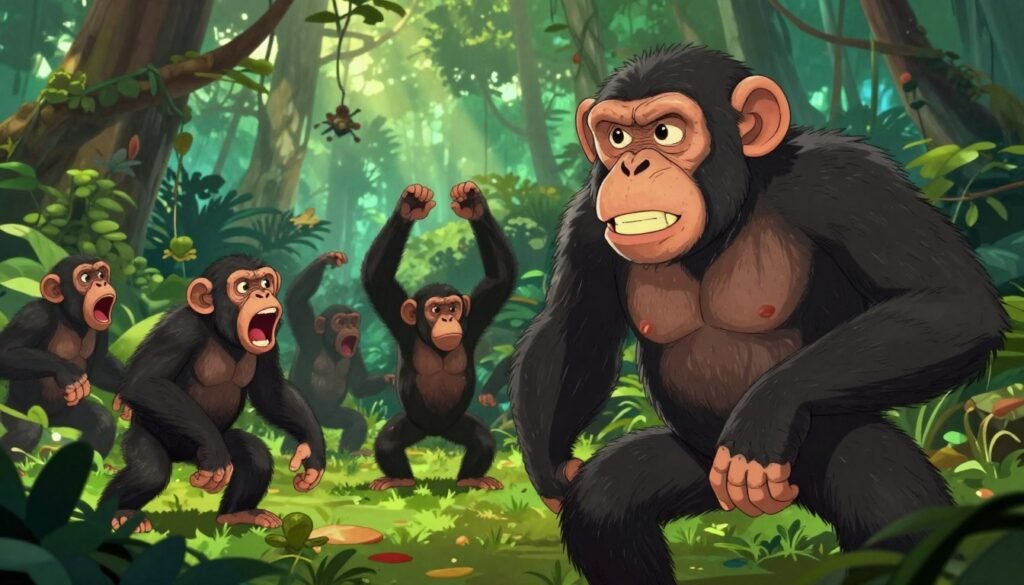
Goodall’s work opened new ways to study violence in animals. It helps us understand humans better too!
Advocating for Animal Welfare and Ethics
Jane Goodall changed her career to focus on animal welfare and ethics. Her famous research on chimpanzees made her see the need to protect all animals. She wanted to stop cruelty and exploitation.
Transitioning from Researcher to Activist
Goodall’s work became known worldwide. She used her fame to help animals. She wanted to use her knowledge to make their lives better.
You can learn more about her work on the Animal Advocacy Academy website.
The Fight Against Laboratory Testing
Goodall spoke out against animal testing in labs. She said it was wrong and often not needed. Her efforts helped change how animals are treated in research.
“The greatest danger to our future is apathy… The most frightening thing is the indifference of people to the problems of the environment, to the problems of animals.”
| Advocacy Area | Key Actions | Impact |
|---|---|---|
| Animal Welfare | Campaigns against animal cruelty, promoting conservation | Increased awareness and policy changes |
| Laboratory Testing | Advocating for alternative methods, raising awareness about animal suffering | Reduction in animal testing, improved treatment of research animals |
| Conservation Efforts | Supporting conservation projects, promoting sustainable practices | Protection of habitats, preservation of biodiversity |
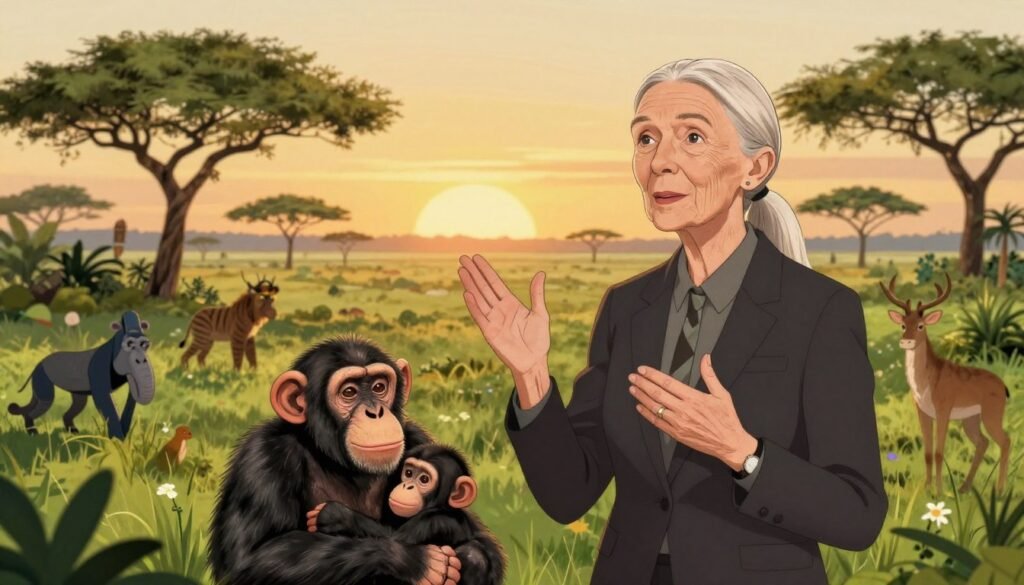
The Roots and Shoots Global Movement
The Jane Goodall Institute’s Roots & Shoots program is a beacon of hope. It empowers youth to lead in conservation efforts worldwide. It’s not just about teaching kids about the environment. It’s about giving them the power to act and make a difference in their communities!
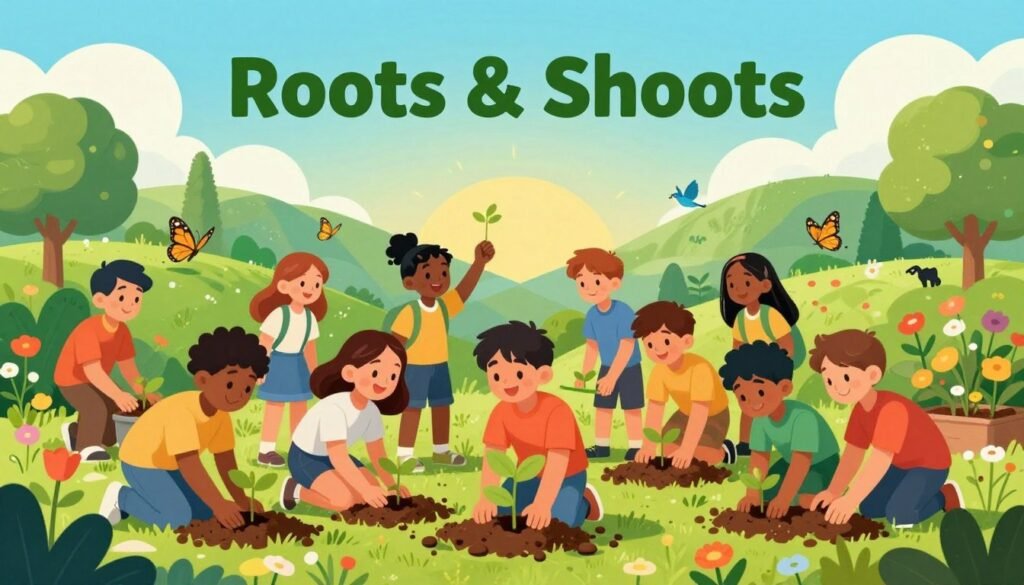
Empowering the Next Generation
Roots & Shoots is more than a program; it’s a movement. It empowers young people to be tomorrow’s leaders. Through hands-on projects, they learn leadership, teamwork, and problem-solving.
Jane Goodall once said,
“The greatest danger to our future is apathy… Change requires action.”
Roots & Shoots inspires young people to take action!
The program works in over 60 countries, making it global. It encourages young people to solve problems in their communities. This could be protecting wildlife, reducing waste, or promoting sustainability.
By doing this, it teaches them to be global citizens and feel responsible for the planet.
Global Impact of Youth-Led Conservation
The impact of Roots & Shoots is huge and far-reaching. It empowers young people to lead in conservation. This creates a ripple effect that goes beyond local areas to inspire change worldwide.
The youth in Roots & Shoots are not just learning about conservation. They are becoming agents of change in their own right.
Some key outcomes of Roots & Shoots include:
- Increased awareness and understanding of environmental issues among young people
- Development of leadership and project management skills through hands-on conservation projects
- Promotion of community engagement and social responsibility
These outcomes help the environment and grow the young participants personally.
The Jane Goodall Institute and Its Mission
The Jane Goodall Institute is a leader in saving our planet. It works hard to keep animals and plants safe. They focus on helping chimpanzees and their homes.
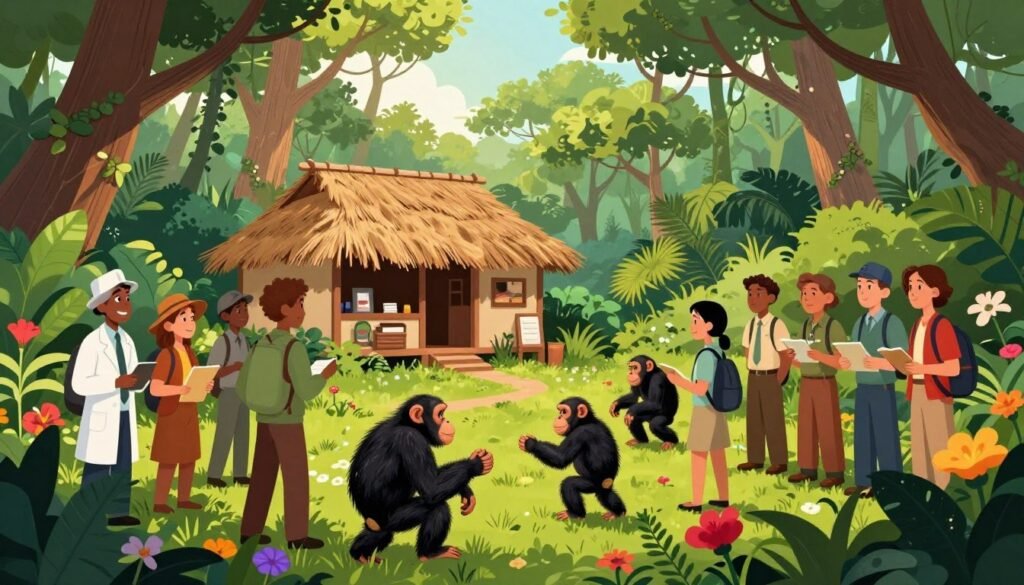
Protecting Habitats and Biodiversity
The Jane Goodall Institute wants to keep animals’ homes safe. They work with local people to help animals and people live together. This way, animals and people can both thrive.
They fix homes, do research, and teach people about animals. This helps everyone understand and love animals more. It makes the world a better place for all of us.
Community-Centered Conservation Strategies
The Jane Goodall Institute loves working with local people. They make plans that fit each area’s needs. This way, animals and people both win.
They show us how important it is to work together. To learn more, visit the Jane Goodall Institute’s Wikipedia page. We can all help save our planet by supporting these efforts.
Learning Through Gamified Education
Find out how gamified education is changing how we learn about science and conservation! It makes learning fun and interactive. This helps inspire a new group of scientists and conservationists.
Gamified education uses game design to improve learning. It makes hard science topics easy and fun. This boosts scientific literacy for everyone.
Enhancing Scientific Literacy with Debsie Gamified Courses
Debsie’s courses turn learning into an adventure! They use games to teach science and conservation. This makes learning fun and exciting.
- Interactive lessons that make complex concepts fun to learn!
- Real-world applications that show the relevance of science to everyday life!
- A supportive community that encourages learners to grow and achieve!
Check out Debsie’s courses at https://debsie.com/courses. See how they boost scientific literacy and spark a love for learning!

Why Interactive Learning Matters for Conservation
Interactive learning is key for conservation. It gets learners involved and encourages action. It makes conservation personal and relatable.
Interactive learning for conservation has many benefits:
- Increased empathy for the environment and its inhabitants!
- A better understanding of the impact of human actions on ecosystems!
- Empowerment to make a positive difference through informed choices and actions!
By using gamified education, we can build a more informed and active conservation community. Join us and start learning with Debsie today!
The Legacy of Scientific Objectivity
Jane Goodall changed how we see animals by living with chimpanzees. Her work changed how we see the world and our place in it.
Redefining the Relationship
Goodall named the chimpanzees instead of using numbers. She watched them in a way that felt personal. This shift in methodology helped us understand them better.
Her work showed us that empathy and compassion are key in science. They help us connect with what we study.
The Shift Toward Empathy
Goodall’s work changed biology too. She taught us to see animals as more than just subjects. We now think about their feelings and lives.
This change led to better treatment and protection of animals. It helps us live better with nature.
Goodall’s legacy teaches us that scientific objectivity and empathy go hand in hand. Together, they help us understand the world better.
Environmental Conservation and Climate Change
Jane Goodall’s work shows us forests and animals are linked. Environmental conservation is key against climate change!
Primates like chimpanzees need healthy forests to live. Deforestation harms them and worsens climate change. It releases carbon and messes with weather!
Connecting Primate Survival to Forest Health
Forests are full of life and keep our climate stable. Losing forests hurts biodiversity and climate. It affects local wildlife and global weather.
Jane Goodall’s work shows forests and primates are connected. Saving forests helps animals and fights climate change!
The Role of Reforestation in Global Stability
Reforestation helps forests and the planet. It absorbs carbon, fights climate change, and shelters wildlife.
Reforestation efforts have big impacts:
| Reforestation Effort | Carbon Sequestration | Biodiversity Impact |
|---|---|---|
| Replanting Native Species | High | Significant increase in local biodiversity |
| Sustainable Forest Management | Moderate | Maintains ecosystem balance |
| Urban Forestry Initiatives | Low to Moderate | Improves urban ecosystems |
Understanding our planet’s connections is vital. Supporting conservation and sustainable practices helps our environment. We can create a better world for all!
Learn more about ecosystems in our article on the food chain!
The Enduring Influence on Modern Primatology
Jane Goodall’s research has changed primatology forever. It has inspired many scientists. Her work helps us understand primates and their homes.
Goodall’s discoveries opened doors for new researchers. Now, studying primates is more detailed. It uses many different ways to learn.
Mentorship and the New Wave of Researchers
Goodall has helped many young scientists. She shares her knowledge to guide them. This helps them in their primate research.
“The greatest danger to our future is apathy…” – Goodall’s words motivate young scientists. They work hard in conservation and research.
These young researchers are now leaders. They carry on Goodall’s work. They help us learn more about primates and their homes.
Technological Advancements in Field Studies
New technology has changed primatology. Scientists use tools like camera traps and genetic analysis. This helps them study primates in the wild.
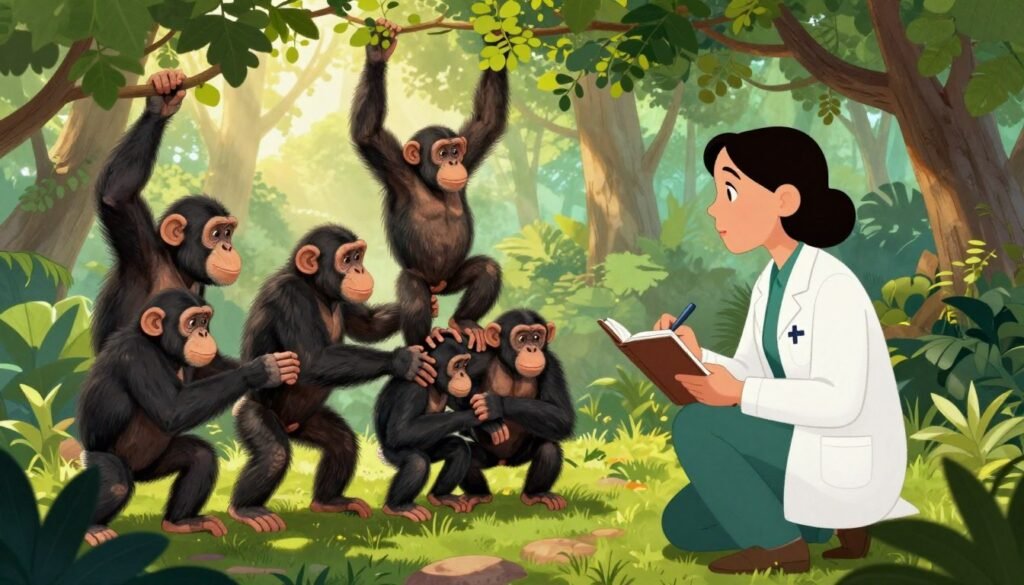
This technology gives scientists better data. They learn more about primate behavior and needs. This helps in protecting their homes.
Now, conservation efforts are more focused. They aim to save primate habitats. They also tackle the big problems these animals face.
Public Perception and the Human-Animal Connection
Jane Goodall’s work has changed how we see animals and nature! Her research has shown us that animals are smart and important. This has made us see the world in a new way.
Goodall’s findings have brought humans and animals closer together. She has made us appreciate the special bonds in the animal world. Her work has shown us the power of understanding animals better.
Changing How Society Views Non-Human Intelligence
Goodall showed us that animals, like chimpanzees, are smart and can solve problems. This has changed how we see animal smarts. Now, we know animals are more than just creatures.
Because of Goodall, we feel more for animals. We see they can feel, solve problems, and even learn from each other. This has led to more care for animals and the planet.
| Aspect | Pre-Goodall Perception | Post-Goodall Understanding |
|---|---|---|
| Tool Use | Exclusive to humans | Observed in chimpanzees and other animals |
| Social Complexity | Primarily human | Recognized in various animal species |
| Emotional Depth | Limited to humans | Acknowledged in animals, including empathy and grief |
The Power of Storytelling in Science
Goodall’s way of telling stories has made science fun and easy to understand. She shares stories of animals and their lives. This has helped many people learn and care about science.
Her storytelling has inspired many to become scientists and protect nature. Storytelling in science shows us how to connect with the world around us.
The Global Recognition of a Lifetime of Work
Jane Goodall has been widely praised for her groundbreaking research and advocacy. Her work has changed how we see animals. It has also sparked a global push for conservation and animal welfare.
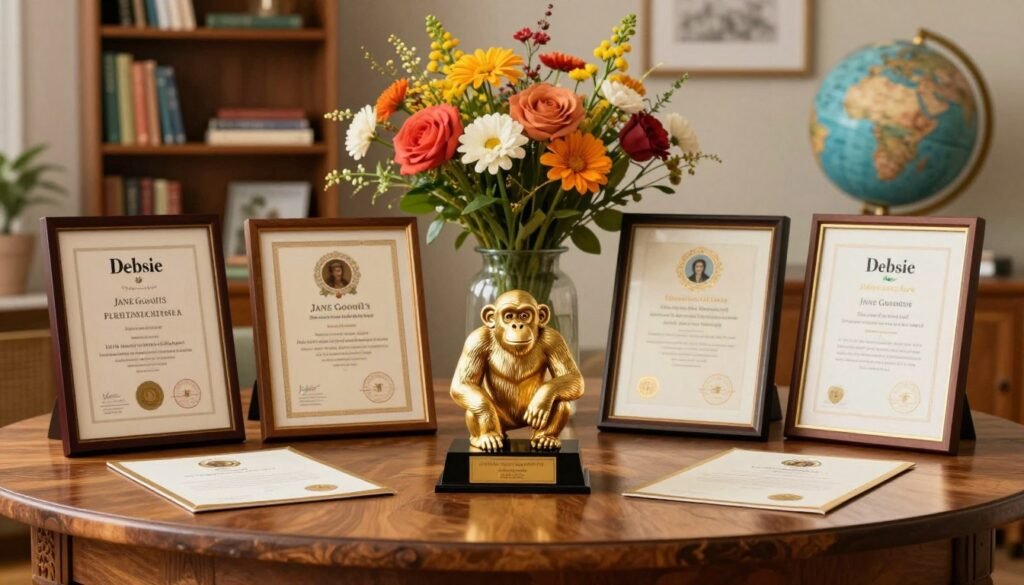
Awards, Honors, and Diplomatic Roles
Jane Goodall has won many important awards. She was named a United Nations Messenger of Peace. This shows her commitment to a kinder, greener world. She also got the Prince Rainier Award and the Benjamin Franklin Medal in Life Science.
These honors celebrate her science and her work for animals and the planet. Goodall has also had important roles in diplomacy. Her work has inspired people everywhere to help our planet.
Continuing the Work at Age Ninety
Even at ninety, Jane Goodall kept going strong. She traveled, spoke out, and inspired others to care for our planet. Her hard work shows us that we can all make a difference.
Goodall’s legacy is more than awards. It’s about the big change she brought to how we see the world. Her work teaches us about the value of kindness, saving the planet, and fighting for all living things.
Conclusion
Jane Goodall changed how we see animals and nature. Her work still inspires many today.
Her legacy teaches us to protect our planet and care for all living things. It shows us how one person can make a big difference.
To learn more about science and saving the planet, check out Debsie Gamified Courses at https://debsie.com/courses. It’s fun to learn and help save the world.
Start your journey of discovery and help make a difference in conservation!