Have you ever looked at the night sky and felt amazed? We all wonder about the universe and our place in it. This curiosity leads to amazing discoveries!
One man changed how we see the world. Many can’t name a living scientist, but everyone knows him. This biography tells the story of a life that changed our world.
His discoveries in physics and astronomy still shape our understanding of energy. He showed us that even a small bit of mass can create a lot of power. We’re excited to share his story with you!
You can start your own journey of discovery. Try Debsie Gamified Courses at https://debsie.com/courses. It’s time to play, learn, and grow together while exploring the stars.
Key Takeaways
- The scientist remains a global icon for his brilliant mind and curiosity.
- He changed physics forever with his unique views on space and time.
- His most famous formula explains the link between energy and mass.
- The world of astronomy grew because of his revolutionary ideas.
- He proved that light and energy follow amazing natural rules.
- Gamified learning helps children explore these big concepts with ease.
The Early Years and the Making of a Genius
Albert Einstein’s early life was full of wonder. It set the stage for his big contributions to science. Let’s see how his early years in Munich and key experiences shaped him.
Einstein was born in Ulm, Germany, in 1879. He came from a middle-class Jewish family in Munich. His parents, Hermann and Pauline, encouraged his curiosity and love for learning.
A Curious Childhood in Munich
Einstein’s childhood was full of wonder. His father, Hermann, was an engineer and salesman. His mother, Pauline, was a homemaker. They created a supportive environment for his curiosity.
When his father gave him a compass at five, it sparked his interest in science. This gift made him wonder about the world.
The Influence of the Compass and Geometry
The compass his father gave him was very important. It made him think about the forces behind the compass needle’s movement.
Geometry also caught his attention. It introduced him to math and proof-based reasoning. This fueled his curiosity even more.
| Influence | Description | Impact on Einstein |
|---|---|---|
| Compass | Given by his father at age 5 | Sparked interest in science and invisible forces |
| Geometry | Study of mathematical structures | Introduced to proof-based reasoning |
| Family Environment | Supportive parents | Nurtured curiosity and love for learning |
By looking at these influences, we understand how Einstein’s early years shaped him. They helped him become a famous scientist.
A Comprehensive Albert Einstein Biography
Einstein’s journey in school was tough but rewarding. He struggled at first but did well in Switzerland. There, he excelled in physics and math!
Academic Struggles and Early Employment
Einstein’s school days were hard. He got kicked out of school in Munich. But he didn’t give up.
In Switzerland, he found his place. He loved learning about physics there. It sparked his curiosity.
After school, finding a job was hard. But he got a job in Bern, Switzerland. It was as a patent clerk. This job helped him support himself while he worked on physics.
| Year | Event | Significance |
|---|---|---|
| 1894 | Expelled from Luitpold Gymnasium | Marked the end of his formal schooling in Munich |
| 1900 | Graduated from ETH Zurich | Completed his education in physics and mathematics |
| 1902 | Began work as a patent clerk | Supported himself while pursuing theoretical physics |
The Miracle Year of 1905
1905 was a big year for Einstein. It’s called his “miracle year.” He wrote four papers that changed how we see the world.
These papers introduced the special theory of relativity. They explained the photoelectric effect. And they gave a math explanation for Brownian motion!
These ideas made Einstein famous. They also helped create many new technologies. You can learn more about these ideas and how they changed the world!
Revolutionizing Our Understanding of Space and Time
Albert Einstein changed how we see the universe. His work on relativity was a big deal. He introduced time dilation and length contraction, changing our views.
Let’s explore his Special Theory of Relativity and its impact on physics.
The Special Theory of Relativity
In 1905, Einstein came up with the Special Theory of Relativity. It said physics works the same for everyone moving at the same speed. This idea was new because it talked about time dilation.
Time dilation means time moves slower for people moving fast. You can learn more about time on our page about understanding clocks, seasons, and speed.
Einstein also talked about length contraction. This means moving objects look shorter to people standing still. These ideas were very new and changed how we see the world.
Challenging Newtonian Physics
Einstein’s theory went against Newtonian physics, which was very old. Newtonian physics thought time and space were fixed. But Einstein said they are not.
This change helped us understand the universe better. It led to big steps forward in astrophysics and cosmology.
By learning about Einstein’s work, we see how amazing the universe is. His ideas still inspire scientists today. His legacy shows the power of human curiosity and smart thinking.
The General Theory of Relativity and Gravity
Albert Einstein changed how we see gravity and the universe. His work on special relativity led to a new idea. He said gravity is like a curve in space caused by mass and energy.
Einstein thought that mass and energy bend space. This idea changed how we see the world. It gave us a better understanding of gravity.
The Geometry of Spacetime
Einstein’s theory is all about space and time. He said gravity isn’t a force. Instead, it’s how space curves around big things like planets and stars.
Here’s a table that shows how Einstein changed our view of gravity:
| Aspect | Newtonian Understanding | Einstein’s General Relativity |
|---|---|---|
| Nature of Gravity | Force between masses | Curvature of spacetime |
| Cause of Gravity | Mass attracting mass | Mass and energy warping spacetime |
| Predictions | Limited to weak gravitational fields | Accurate for strong gravitational fields and cosmological phenomena |
The 1919 Solar Eclipse Confirmation
In 1919, a solar eclipse proved Einstein right. Scientists saw starlight bend around the Sun. This matched Einstein’s ideas. 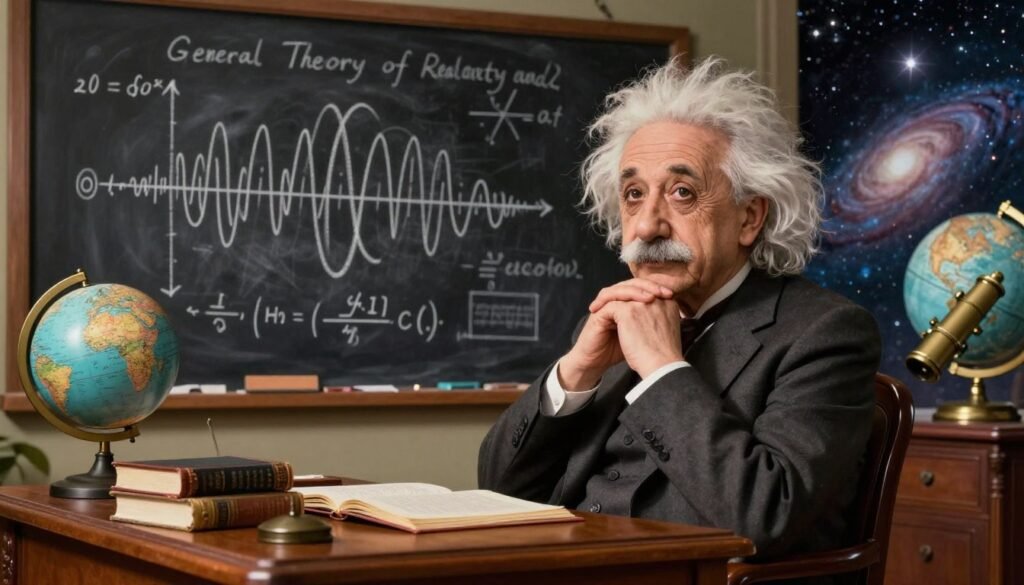
This proof made Einstein a big name in science. It was a big moment in physics history.
Albert Einstein Discoveries That Changed Modern Technology
Albert Einstein’s discoveries changed modern technology in amazing ways. His work helped us understand the universe better. It also led to many technologies we use every day.
Photoelectric Effect and Quantum Theory
Einstein’s work on the photoelectric effect was key to quantum theory. He showed how light can act like particles, called photons. This idea helped create solar cells and digital cameras.
Want to learn more about these ideas? Debsie’s courses make science fun and easy to understand.
From Lasers to GPS Systems
Einstein’s ideas helped create many technologies. Lasers work because of how Einstein explained light and matter. GPS systems use Einstein’s theory of general relativity to work well.
Here are some technologies influenced by Einstein:
| Technology | Description | Einstein’s Contribution |
|---|---|---|
| Lasers | Devices that emit light through a process of optical amplification | Understanding of stimulated emission |
| GPS Systems | Global Positioning Systems that provide location and time information | Theory of General Relativity for accurate spacetime calculations |
| Solar Cells | Devices that convert light into electrical energy | Explanation of the photoelectric effect |
Einstein’s work still inspires scientists and engineers today. By learning about his discoveries, we see the power of human curiosity. Let’s keep exploring and learning together!
The Iconic Image of the Eccentric Professor
Albert Einstein’s image is linked with genius and being a bit odd. His unique style and ways have made him a big deal around the world.
The Messy Hair and Lack of Socks
Einstein often looked a bit messy, with wild hair and no socks. He didn’t worry much about how he looked. He was too busy thinking about the universe!
His way of dressing was a big part of who he was. People knew him right away. He didn’t really think about clothes much. His mind was always on big ideas!
The Famous Tongue-Out Photograph
There’s a famous photo of Einstein with his tongue out. This famous tongue-out photograph was taken on March 14, 1951, by Arthur Sasse on Einstein’s 72nd birthday.
The photo shows Einstein’s fun and playful side. It shows that even smart people can be fun and light-hearted!
Einstein’s image still inspires many today. His mix of smartness, creativity, and being a bit odd has left a lasting mark.
Einstein as a Global Humanitarian and Pacifist
Einstein was more than a scientist. He fought for civil rights and peace. He thought science and humanity should work together for a better world.
Einstein stood up for civil rights. He supported the NAACP and worked with W.E.B. Du Bois to fight racial inequality.
Advocacy for Civil Rights and Social Justice
In the 1930s and 1940s, Einstein spoke out for African Americans. He opposed lynching, segregation, and racial injustice. He used his voice to help those who were silenced.
Some of his key actions were:
- Supporting the NAACP’s anti-lynching campaign
- Speaking out against segregation in education
- Advocating for equal rights for African Americans
Einstein didn’t just fight for civil rights. He also supported women’s rights, labor rights, and other social causes.
The Shift Toward Nuclear Disarmament
After seeing the atomic bomb’s damage, Einstein pushed for nuclear disarmament. He warned about the dangers of nuclear weapons and urged leaders to disarm.
Einstein’s warnings were right on time. The threat of nuclear war is still a big worry today. His call for peace is as important as ever.
| Year | Event | Einstein’s Role |
|---|---|---|
| 1930s-1940s | Civil Rights Movement | Supported NAACP, spoke out against racial injustice |
| 1945 | Atomic Bombings of Hiroshima and Nagasaki | Warned of the dangers of nuclear proliferation |
| 1940s-1950s | Nuclear Disarmament Movement | Advocated for nuclear disarmament, urged world leaders to work toward peace |
Einstein’s legacy as a humanitarian and pacifist still inspires us today. His work shows how one person can make a big difference.

The Man Behind the Science: Personal Life and Struggles
Einstein’s life was full of both happiness and hard times. His story shows us the ups and downs of his personal life.
Relationships and Family Dynamics
Einstein loved his family deeply, but work often took him away. His first wife, Mileva Marić, was smart and talented too. But, their marriage was tough because of Einstein’s fame and their different ways.
As Einstein became more famous, his family life got harder. His second wife, Elsa Löwenthal, was his cousin. They married for practical reasons. Still, his family was very important to him, shaping his views on love and loss.
The Challenges of Fame and Exile
Einstein’s fame brought many problems. He was seen as a genius, but this fame was hard to handle. People watched him closely, affecting his personal life and mind.
When the Nazis came to power, Einstein faced even more challenges. As a Jew, he was attacked for his beliefs. In 1933, he left Germany for the United States. There, he kept fighting for peace and justice.
“The important thing is not to stop questioning. Curiosity has its own reason for existence.”
Einstein’s life was deeply shaped by these times. His dedication to helping others and his strength in hard times still inspire us today!
Einstein and the Development of Gamified Learning
Albert Einstein’s work has reached into gamified learning. Here, curiosity meets innovation! Educators use Einstein’s ideas to make learning fun and effective.
Einstein loved to learn and question things. By thinking like him, we can make learning exciting! Gamified learning mixes fun games with real education.
Curiosity-Driven Learning
Einstein’s curiosity was key to his success. By making learning interactive, we can spark curiosity in students! Debsie’s courses use games to make learning fun and easy.
Enhancing Cognitive Skills
Gamified learning boosts more than just fun. It helps improve thinking, solving problems, and working together! These skills are what Einstein’s work showed us.
Why Gamification Works for Complex Subjects
Gamification makes hard subjects easy and fun. It’s a great way to learn about Einstein’s ideas, like relativity! Interactive learning helps us remember and understand better.
How to Start Your Learning Journey at Debsie
Want to try gamified learning? Start with Debsie’s courses and find a fun way to learn! Begin your journey at https://debsie.com/courses.
For more on new learning methods, read about the Professor Einstein Robot. It shows how tech meets education.
The Enduring Mystery of the Unified Field Theory
One of the biggest mysteries in physics is the unified field theory. Einstein worked on it until he died. This theory tries to mix all the basic forces of nature into one idea.
Quest for a Theory of Everything
Einstein wanted to make physics simpler and more united! He thought all forces, like gravity and electromagnetism, could come from one idea. But, he couldn’t finish the theory.
Einstein tried many ways to solve the unified field theory. He used his work on general relativity and tried to add electromagnetism to it.
Today, scientists still work on this problem. They use ideas like string theory and loop quantum gravity to try to solve it.
Why He Never Finished the Final Puzzle
Einstein had a hard time finishing the unified field theory. The problem was too complex, and he didn’t know enough about the forces back then.
| Challenge | Description |
|---|---|
| Limited Understanding of Nuclear Forces | During Einstein’s time, the strong and weak nuclear forces were not well understood, making it challenging to incorporate them into a unified theory. |
| Mathematical Complexity | The mathematical tools and techniques available to Einstein were not sufficient to tackle the complexity of the unified field theory. |
| Lack of Experimental Evidence | The lack of experimental evidence to support or guide the development of the unified field theory hindered Einstein’s progress. |
Einstein’s work on the unified field theory, though unfinished, has greatly influenced modern physics! His work still inspires scientists today as they search for a complete theory.
Einstein in Popular Culture and Media
Einstein’s impact on popular culture is vast and varied. His image and ideas have shown up in many places. This includes movies, books, art, and ads.
The Archetype of the Mad Scientist
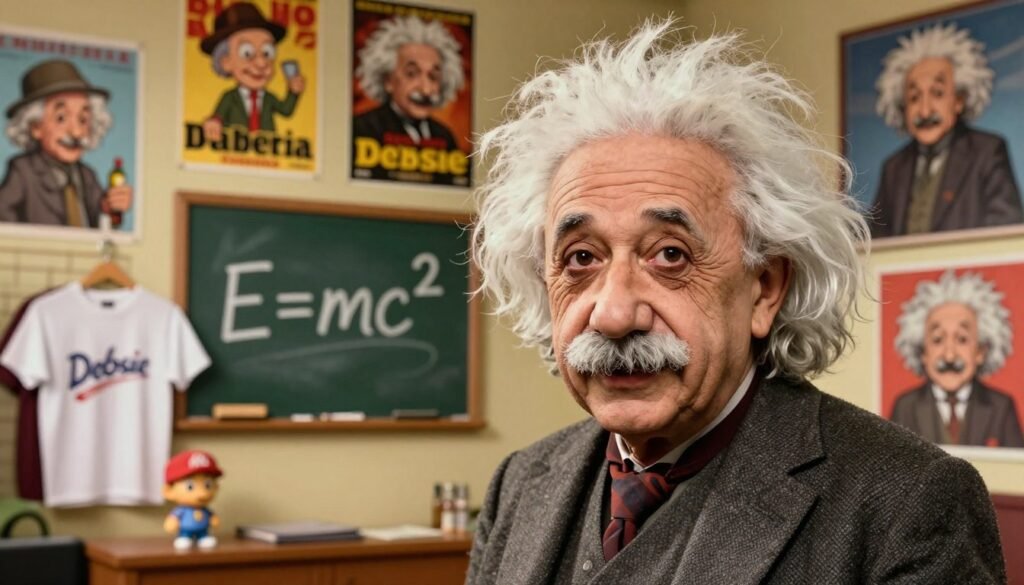
Einstein is often seen as the ultimate “mad scientist.” This image shows him with wild hair and acting strangely. The image of Einstein sticking out his tongue is a famous sign of this.
You might have seen this photo many times. It has been used and joked about a lot.
- Films like “Back to the Future” feature a character named Doc Brown, inspired by Einstein’s odd ways.
- TV shows like “The Big Bang Theory” often talk about Einstein’s smartness and quirky side.
- Ads and cartoons use Einstein’s face to show off smarts and creativity.
Einstein’s Legacy in Film and Literature
Einstein’s ideas have inspired many in movies and books. His theories are often talked about in documentaries and films. You can find more about Einstein in media on Wikipedia.
- “Einstein on the Beach,” an opera by Philip Glass, deals with Einstein’s work.
- “The Einstein Factor,” a TV game show, tests contestants’ smarts and problem-solving skills, like Einstein did.
Looking at Einstein’s role in popular culture shows how he still inspires us today.
The Lasting Impact on Scientific Education
Einstein’s work still inspires today’s learners. His problem-solving and discoveries changed science teaching and learning.
Einstein valued curiosity and critical thinking. His legacy continues to shape science education. It inspires new scientists to explore.
Inspiring Generations of Physicists
Einstein’s work inspires young scientists. His love for discovery and perseverance motivate many to study science.
At Debsie, we love teaching kids. We make physics fun with gamified courses! Our interactive methods inspire the next scientists.
The Role of Thought Experiments in Modern Research
Einstein used thought experiments to find new ideas. His imagination helped him challenge old theories.
Today, thought experiments are key in research. They help explore complex ideas and form new theories. We use them to teach critical thinking and creativity.
| Einstein’s Discovery | Impact on Science | Impact on Education |
|---|---|---|
| Theory of Relativity | Revolutionized our understanding of space and time | Inspires new approaches to teaching physics and astronomy |
| Photoelectric Effect | Led to the development of quantum theory | Illustrates the importance of experimentation and observation |
| Thought Experiments | Continues to influence scientific research and discovery | Encourages critical thinking and creativity in students |
Exploring Einstein’s work shows science education’s value. It shapes our world view.
Want to inspire future scientists? Check out Debsie’s courses at https://debsie.com/courses!
Conclusion
Albert Einstein’s life and work inspire people all over the world! His big discoveries and fight for justice and peace made him famous. By reading his Albert Einstein biography, we see the power of curiosity and creativity.
Einstein changed how we see space, time, and gravity. His work still helps us learn and grow. We can use his ideas to be curious and creative in our own lives.
To keep learning, try Debsie’s fun courses at https://debsie.com/courses! It’s exciting to learn and grow with Debsie’s interactive and fun lessons.