Michael Faraday: The Scientist Who Helped Build the Electric Age

Michael Faraday

Imagine a world without your favorite gadgets or lights at night. It’s hard to think about! We’re lucky because one brave explorer made the lights come on!

This brave soul was an English chemist and physicist who loved to learn. He worked hard with magnets and wires. He made the first electric motors and generators.

We think every child has a spark of genius inside! You can learn about Michael Faraday’s discoveries. It’s amazing how one person can change the world!

Do you want to be a science master too? Try Debsie Gamified Courses at https://debsie.com/courses. It’s fun! Exploring Michael Faraday’s life will make you dream big and play harder!

Key Takeaways

  • He was a brilliant scientist who studied how electricity and magnets work together.
  • His inventions led to the creation of the first electric motor and generator.
  • He discovered benzene and helped us understand chemistry much better.
  • This scientist popularized common words we use today like “electrode” and “ion.”
  • He showed that magnetism could actually affect rays of light!
  • His work laid the foundation for almost all the modern technology we use now.

The Humble Beginnings of a Scientific Genius

Michael Faraday started his journey to fame with simple beginnings! He was born on September 21, 1791, in Newington Butts, Surrey. His family always worked hard.

At 14, he became an apprentice to George Riebau, a bookbinder. He learned bookbinding and got interested in science books.

From Bookbinder’s Apprentice to Royal Institution

Faraday loved science books, including ones on electricity. He started simple experiments. These experiments were the start of his big discoveries.

  • Exposure to scientific literature
  • Conducting simple experiments
  • Attending lectures by prominent scientists

His big chance came when he heard Humphry Davy at the Royal Institution. He took detailed notes and sent them to Davy. Davy was impressed by his hard work.

The Influence of Humphry Davy

Davy helped Faraday a lot. He became Davy’s assistant at the Royal Institution. This was the start of his amazing scientific career.
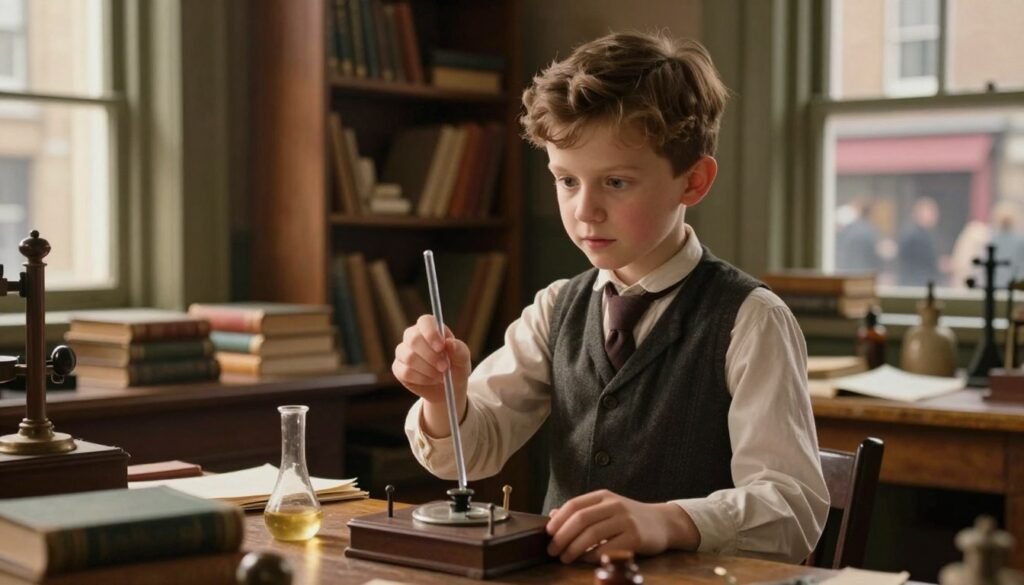
A young Michael Faraday, around 12 years old, stands in a modest 19th-century London workshop, surrounded by books and scientific instruments. He is dressed in simple, period-appropriate attire, with a look of curiosity and determination on his face. In the foreground, he is engaged in experimenting with static electricity, gently touching a glass rod. The middle ground features shelves lined with dusty books and materials, hinting at his self-education. Illuminated by warm, soft natural light filtering through a small window, the scene conveys an atmosphere of humble beginnings and intellectual curiosity. The background shows a bustling street outside, evoking the historical context of Victorian London. The overall mood is inspiring and hopeful, capturing the essence of a young genius in the making. Colors are rich and warm, instilling a friendly and inviting feel. Brand name: Debsie.

Exploring Faraday’s life shows how his early days shaped his discoveries. Learn more about science with fun courses at Debsie Gamified Courses!

The Discovery of Electromagnetic Rotation

In 1821, Faraday made a big discovery. He invented devices that could rotate using electricity. This was the start of modern electric motors!

His work was not by chance. It came from lots of experiments and understanding science well.

Faraday’s discovery was a big deal. It showed how electricity can turn into moving parts. This idea is key for many modern techs.

The First Electric Motor

Faraday made the first electric motor from his experiments. He built two simple devices that made a wire spin around a magnet! These early motors were basic but showed a big idea. They showed that electricity can make things move.

These motors worked because of a simple idea. An electric current makes a magnetic field. When this field meets another magnet, it makes a force. This force can make things spin. This idea is still used in electric motors today!
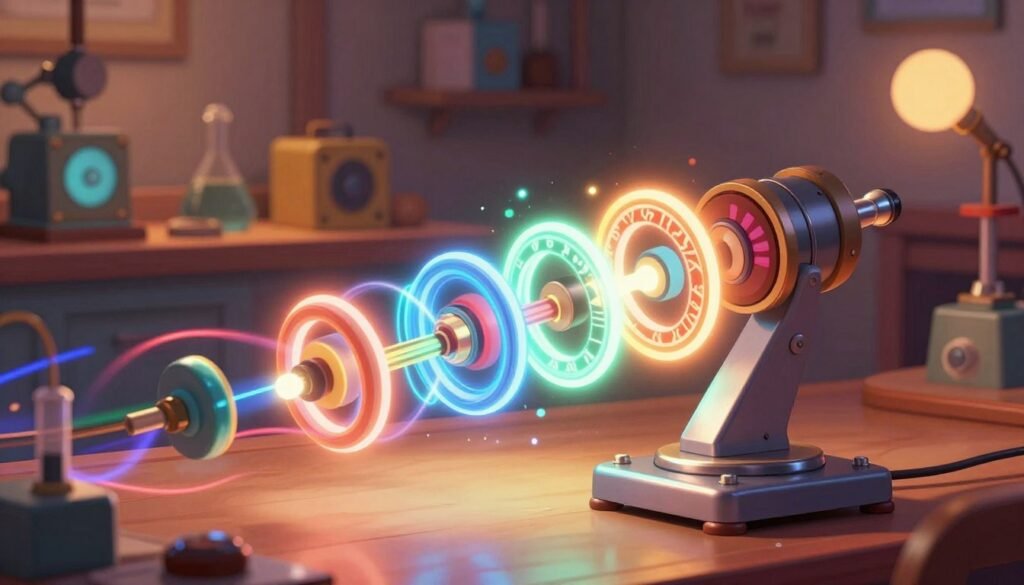
A vivid representation of electromagnetic rotation, showcasing an intricate apparatus inspired by Michael Faraday's experiments. In the foreground, a sleek, metallic device spins gracefully on a base, emitting colorful arcs of energy that trail off into the air. In the middle ground, a series of glowing coils and magnet patterns intertwine, symbolizing the interaction of electricity and magnetism. The background features a softly illuminated laboratory filled with vintage scientific instruments, bathed in warm, ambient light. A warm glow radiates from the device, casting delicate shadows and creating a sense of wonder. Capture this scene with a slightly tilted angle to emphasize the dynamic motion of rotation. The atmosphere should evoke innovation and excitement, with a friendly and inspiring mood. Branding subtly included: "Debsie".

Overcoming Scientific Skepticism

Even though Faraday found something important, some scientists didn’t believe him. They thought his discovery was not useful.

But Faraday didn’t give up. He kept showing his work and its value. Slowly, the scientific world started to see how important it was.

“Nothing is too wonderful to be true, if it be consistent with the laws of nature.”

Year Event Significance
1821 Faraday discovers electromagnetic rotation Lays the foundation for modern electric motors
1821 Development of the first electric motor Demonstrates the conversion of electrical energy into mechanical energy
Later Years Recognition of Faraday’s work Wins over scientific community with persistence and clear experiments

Michael Faraday and the Principles of Electromagnetic Induction

Faraday’s work on electromagnetic induction was key. It led to the electric generator. This idea is still important today.

Electromagnetic induction is when a changing magnetic field makes a current in a conductor. This is how many electrical devices work! Faraday’s discovery was a big step in physics and engineering.

The Famous Iron Ring Experiment

Faraday’s iron ring experiment was famous. He used an iron ring with two coils of wire. Passing current through one coil made a current in the other.

Here’s a simple look at Faraday’s iron ring experiment:

Component Description
Iron Ring The core around which the coils were wrapped
Primary Coil The coil connected to the power source
Secondary Coil The coil where the current was induced

Faraday said, “The power of electricity to induce a current in a nearby circuit was a discovery of immense significance.” This shows how big his findings were.

“The power of electricity to induce a current in a nearby circuit was a discovery of immense significance.”

Michael Faraday

The Birth of the Electric Generator

Faraday’s work led to the electric generator. It turns mechanical energy into electrical energy. This invention changed how we use electricity!

Today, electric generators are everywhere. They power everything from big plants to small devices. You can learn more about them on Debsie Gamified Courses!
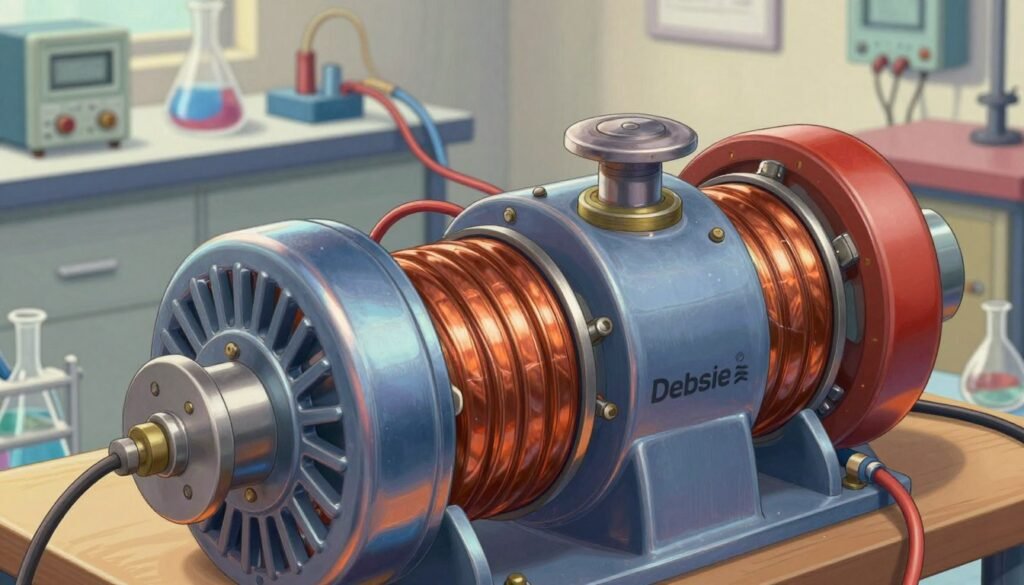
A detailed, realistic image of an electric generator, showcasing its intricate components like copper coils and the rotor. In the foreground, focus on the generator's shiny metal casing reflecting soft, warm lighting, symbolizing innovation. The middle ground features a network of wires and electrical instruments, meticulously arranged to highlight the principles of electromagnetic induction. In the background, a subtle blur of a scientific laboratory environment can be seen, filled with beakers and electrical devices, enhancing the atmosphere of experimentation and discovery. The scene should evoke a mood of curiosity and advancement in science. Use vibrant colors to bring the equipment to life, and capture the image from a slightly elevated angle to provide an engaging perspective. The brand name 'Debsie' should be incorporated seamlessly into the design without dominant prominence.

Understanding electromagnetic induction and the electric generator shows Faraday’s impact. His work lets us use electricity in many ways. It has changed our world!

Advancing the Field of Electrochemistry

Michael Faraday changed how we see chemical reactions and electrical processes. His work on electrolysis opened new doors in technology and industry.

Faraday didn’t just study science. He also named key terms we use today. Let’s explore some of these terms.

Defining Electrolysis and Ions

Electrolysis is when an electric current starts a chemical reaction. This happens in an electrolytic cell with two electrodes. Faraday named electrolysis, electrolyte, and ion to explain these ideas.

An ion is an atom or molecule with extra electrons. This gives it a charge.

Knowing about ions and electrolysis helps us understand batteries, metal purification, and some medical treatments.

Faraday’s Laws of Electrolysis

Faraday’s work led to two important laws about electrolysis. These laws connect the amount of substance changed at an electrode to the electric charge used.

Faraday’s Law Description
First Law The mass of a substance changed is directly related to the electric charge used.
Second Law The mass of different substances changed by the same electric charge is related to their weights.

These laws were a big deal. They gave us a way to measure and predict electrolysis accurately.
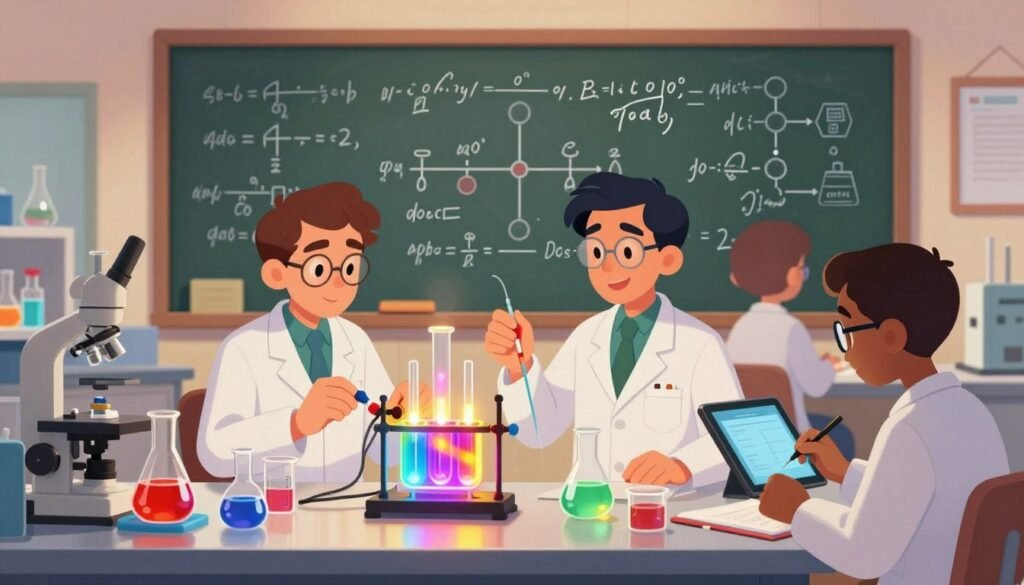
A vibrant electrochemistry laboratory scene set in the foreground, showcasing a diverse group of scientists in professional attire engaged in experiments. One scientist is focused on a colorful electrochemical cell with glowing electrodes, while another is taking notes from a digital tablet. In the middle ground, various glass beakers and apparatus filled with luminous liquids reflect the excitement of discovery. The background features a large chalkboard filled with complex equations and diagrams related to electrochemical reactions, illuminated by warm, ambient lighting. The overall mood is one of collaboration and innovation, emphasizing the transformative nature of Faraday's contributions to the field. This image should capture the essence of scientific advancement in electrochemistry, branded subtly with "Debsie".

Faraday’s work in electrochemistry has made a big difference. His ideas still shape science and technology today.

The Concept of the Electric Field

Imagine seeing invisible forces. That’s what Faraday did with his electric field idea! This idea changed how we see physics and helped make new tech.

Visualizing Invisible Forces

Faraday came up with the electric field idea. It shows the area around charged particles where electric forces are felt. He said every charged particle has an electric field that affects other charges.

He used lines of force to explain it better. These lines show the electric field’s direction and strength. They help us see how electric forces work, even though we can’t see them!
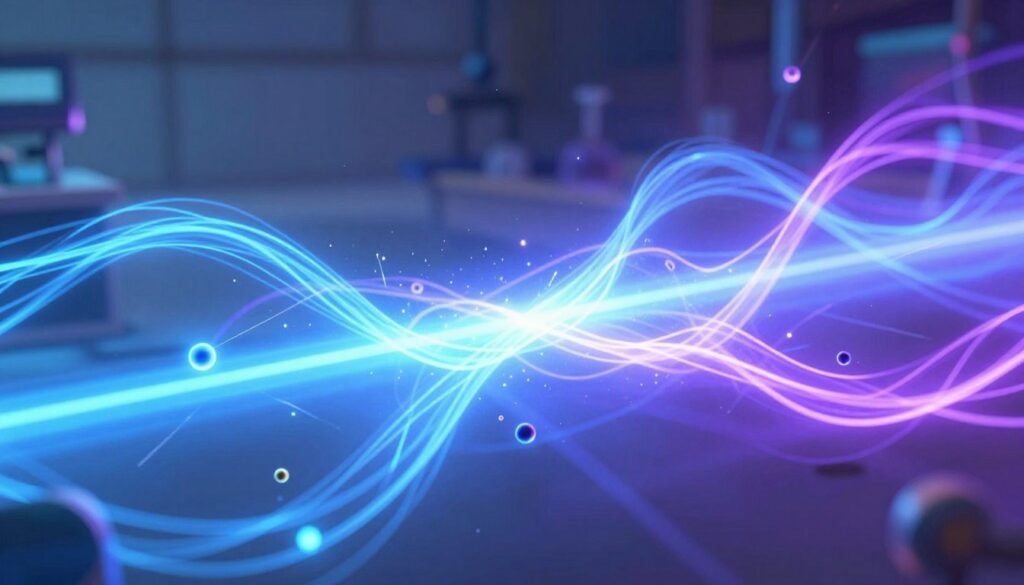
A captivating visualization of an electric field in action, showcasing vibrant, swirling electric lines and bursts of energy in a gradient of blue and purple hues. In the foreground, an abstract representation of charged particles, depicted as glowing spheres, is dispersed among the dynamic field lines. The middle ground features intersecting and oscillating waves of energy, illustrating the invisible forces at play. The background includes a subtle hint of a scientific laboratory setting with soft, diffused lighting, evoking a sense of discovery and innovation. The overall mood should feel electrifying yet informative, reflecting the monumental impact of the electric field in science, with a touch of artistic flair. Rendered in high resolution for clarity and detail, produced by Debsie.

Lines of Force and Their Impact on Physics

The idea of lines of force changed physics a lot. It helped scientists understand charged particles and electromagnetic waves better.

The table below shows what Faraday’s ideas mean:

Concept Description Impact
Electric Field Region around charged particles where electric forces can be detected Revolutionized understanding of charge interactions
Lines of Force Visual representation of the direction and strength of the electric field Facilitated understanding of electric forces and electromagnetic phenomena

Faraday’s work on the electric field and lines of force was key. It helped physics and engineering grow a lot. His ideas still inspire scientists and engineers today!

Want to dive into physics and see how electric fields are used today? Check out Debsie’s fun courses at https://debsie.com/courses!

The Invention of the Faraday Cage

Imagine a world where lightning can’t hurt you. This is thanks to Michael Faraday and his Faraday Cage. It’s a shield that spreads out electrical charges evenly. This cancels out the electromagnetic field, keeping what’s inside safe.

But how does it work? The Faraday Cage uses electrostatic shielding. When an electrical charge hits the cage, the metal’s electrons move. They cancel out the external field. So, the inside of the cage stays safe from electrical shocks!

Understanding Electrostatic Shielding

Electrostatic shielding is a key idea in physics. It has many uses. By using metal to cover a space, we can block out electromagnetic fields. This is important in many fields, like electronics and aerospace.

Let’s see how it works in different ways:

Application Description Benefit
Lightning Protection Faraday Cages protect buildings from lightning by spreading out the charge. Safety from electrical surges
Electronic Devices Faraday Bags or pouches keep devices safe from external electromagnetic pulses (EMPs). Protection of sensitive electronics
Scientific Research Faraday Cages shield sensitive equipment in labs from outside interference. Accurate experimental results

Modern Applications in Technology and Safety

The Faraday Cage has many uses today. It protects electronic devices during transport and from electromagnetic pulses (EMPs). For example, a car acts as a Faraday Cage during a lightning storm, keeping people inside safe.

As we keep inventing and using more technology, the Faraday Cage’s principles are key. By using electrostatic shielding, we make systems safer and more reliable for the future!
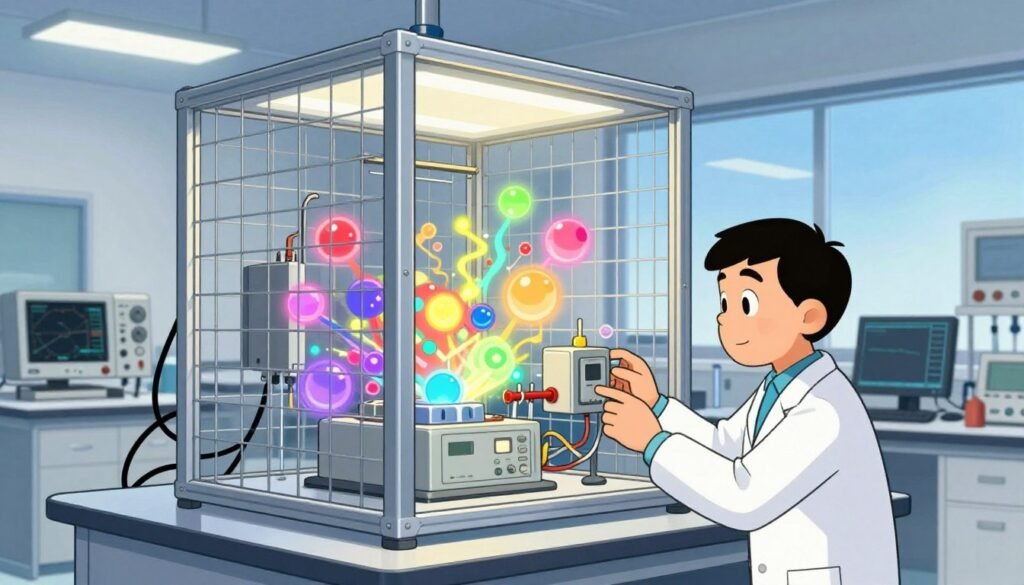
A detailed depiction of a Faraday Cage in a laboratory setting, showcasing the cage as a metallic mesh structure filled with vibrant energy particles, symbolizing electric shielding. In the foreground, a scientist in professional attire is conducting an experiment, intently observing devices within the cage that glow softly, illuminated by overhead fluorescent lighting. The middle ground features lab equipment like oscilloscopes and computers, creating a busy yet organized atmosphere. In the background, a large window reveals a clear blue sky, enhancing the sense of openness and innovation. The overall mood is one of discovery and scientific progress, with a friendly yet focused ambiance. The image is colorful, clean, and minimal, branded with the name "Debsie" subtly integrated into the scene.

James Clerk Maxwell, a famous physicist and friend of Faraday, said something important. “The scientific worth of Faraday’s work is in the ideas he suggested, not just the facts he found.” The Faraday Cage shows Faraday’s creative mind and his big impact on science and technology!

The Discovery of Diamagnetism

Faraday was always looking for new knowledge. He found diamagnetism, a big discovery that changed how we see magnets! This helped us learn more about magnetic properties of things.

Faraday’s work showed that some things push away magnets. This was new and exciting. It made us see how different things act with magnets. You can learn more cool science facts at https://debsie.com/courses!

Magnetic Properties of Matter

Faraday’s work helped us understand magnets better. He found that some things pull towards magnets (ferromagnetic) and others push away (diamagnetic).

A visually captivating illustration of diamagnetism depicting a central object, a glowing magnet suspended in the air, surrounded by swirling particles that represent opposing magnetic forces. In the foreground, a scientist in professional attire observes the phenomenon with curiosity, holding a notepad. The middle layer features a dynamic arrangement of various materials like bismuth and graphite, levitating slightly above a sleek, reflective surface. The background showcases a softly illuminated laboratory filled with scientific instruments, emphasizing a sense of discovery and innovation. Use warm, vibrant colors to create an inviting atmosphere, with beams of light highlighting the magnetic interactions. The scene should convey a mood of wonder and inspiration, reminiscent of Faraday’s groundbreaking discoveries. Created by Debsie.

Challenging Existing Magnetic Theories

Faraday’s discovery shook up old ideas about magnets. It made us think more about magnets and how they work. This led to more research on magnets.

Learning about diamagnetism helps us see how things interact with magnets. This knowledge is important in many areas of science and tech!

The Faraday Effect and the Interaction of Light and Magnetism

Michael Faraday found out about the Faraday Effect. It changed how we see light and magnetism working together. This discovery is key in physics and engineering.

Polarization of Light

Light changes when it goes through a clear material with a magnetic field. The light’s direction changes based on the magnetic field’s strength and how far it travels. The Faraday Effect helps us understand this.

The Foundation for Modern Optical Communication

The Faraday Effect is important for today’s optical communication. It helps make better optical isolators and circulators. These tools are key for clear signals in networks.
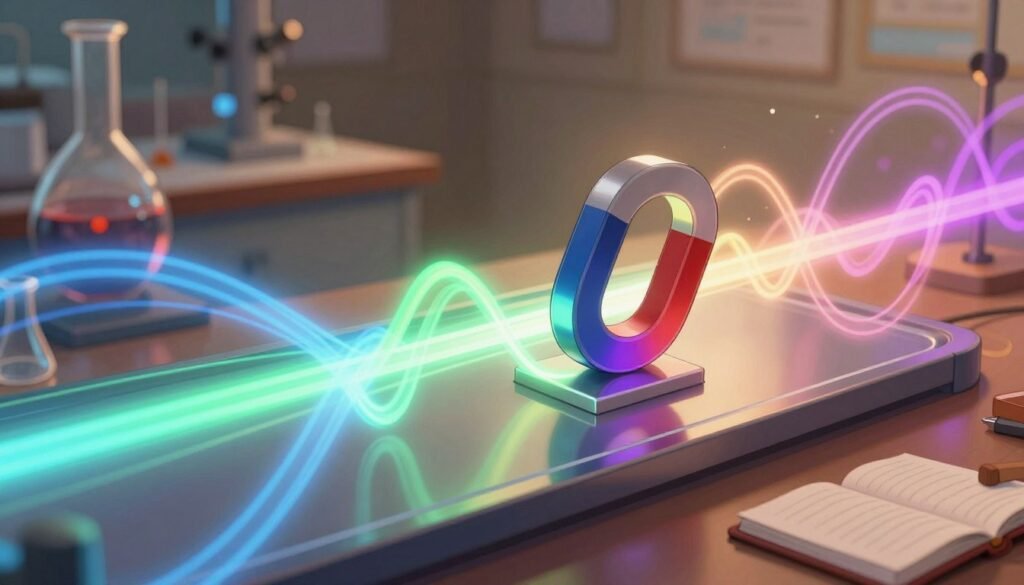
A mesmerizing depiction of the Faraday Effect, showcasing colorful light waves interacting with a magnetic field. In the foreground, swirling strands of light in vibrant hues of blue, green, and violet represent polarized light, gracefully bending as they pass through a transparent medium. The middle ground features a prominently displayed magnet surrounded by intricate, flowing lines that symbolize the magnetic field lines in dynamic motion. In the background, a softly blurred laboratory setting creates an atmosphere of scientific discovery, with faint outlines of glass apparatuses and notebooks. The scene is illuminated by warm, soft lighting, enhancing the mood of wonder and curiosity, reminiscent of a historic scientific breakthrough. This image represents the harmonious relationship between light and magnetism, designed by Debsie.

Property Description
Effect on Light Rotation of the plane of polarization
Influencing Factor Magnetic field strength
Application Optical isolators and circulators

The Faraday Effect is well-known and used in many technologies.

The Royal Institution and the Christmas Lectures

Michael Faraday started something special at the Royal Institution. He created the Christmas Lectures. These talks made science easy for everyone to understand.

Faraday wanted science to be for everyone. He worked hard to share it with the community. His efforts inspired many scientists and science teachers.

Making Science Accessible to the Public

Faraday’s Christmas Lectures were a hit. They drew big crowds and made people wonder. He explained hard ideas in simple words, making science fun.

You can learn more about the Christmas Lectures on the Royal Institution’s website! Faraday’s work inspired many to explore science.

The Chemical History of a Candle

Faraday’s famous talk was “The Chemical History of a Candle.” He showed how a simple candle can teach us a lot. He turned a common object into a science lesson.

Here are some key ideas from his lectures:

Concept Description
Chemical Reactions Faraday explained the chemical reactions that occur when a candle burns, including combustion and the release of heat and light.
Capillary Action He demonstrated how capillary action draws fuel to the wick, sustaining the flame.
Physics of Flames Faraday discussed the physics behind the flame, including the role of oxygen and the behavior of gases.

Faraday showed us that the world is full of wonder. You can keep exploring science with fun courses on Debsie!

A lively scene depicting a traditional Christmas Lecture at the Royal Institution, with a middle-aged male scientist passionately demonstrating an experiment, surrounded by a captivated audience of diverse attendees, including children and adults, all dressed in modest, professional attire. The foreground shows a wooden podium with scientific instruments and colorful chemical reactions in glassware. In the middle, the audience is engaged, their faces illuminated by warm, ambient light from elegant chandeliers hanging above. The background features the historic architecture of the Royal Institution, adorned with festive decorations. The mood is educational and festive, with a focus on curiosity and engagement in science, inviting viewers into this historical celebration of knowledge. The image embodies a friendly and vibrant atmosphere. Designed by Debsie.

The Practical Application of Faraday’s Discoveries

Faraday’s discoveries changed the game for the industrial revolution! His work on electricity helped us understand it better. It also helped create modern electrical systems.

Faraday found out how to make electricity efficiently. His discoveries let us use electricity on a big scale. This changed how we make things and work!

Powering the Industrial Revolution

The industrial revolution was a big change time. Faraday’s work was key to this change. Electricity helped make new machines and ways to make things.

Using electricity everywhere helped industries grow. This made the world better and changed life for everyone!
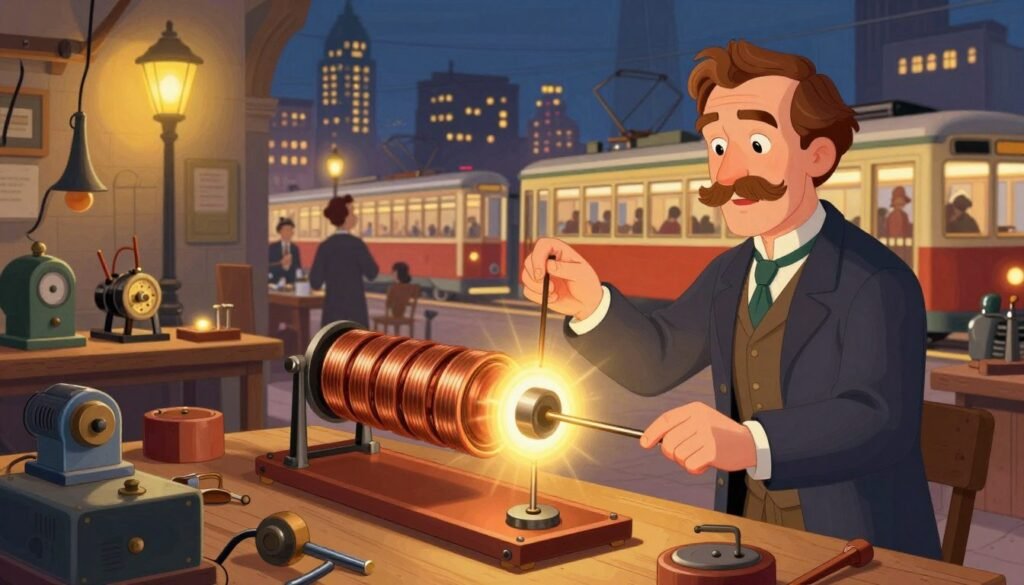
A vibrant and informative illustration showcasing the practical applications of Faraday's discoveries. In the foreground, an experienced scientist in professional attire demonstrates electromagnetic induction using a model of a dynamo, with copper coils and a spinning magnet. The middle ground features a busy 19th-century workshop, complete with tools and inventions inspired by Faraday's work, such as telegraphs and electric motors. The background displays an illuminated cityscape, symbolizing the dawn of the electric age with glowing streetlights and electric trams. Use bright, warm lighting to convey innovation and excitement, with a slightly tilted angle to emphasize the dynamic process. The atmosphere should feel inviting and educational, reflecting the impact of Faraday’s contributions. Include the brand name "Debsie" subtly integrated into the scene.

The Transition to Modern Electrical Grids

Faraday’s work also helped make modern electrical grids. We can now send electricity far and wide. This powers our world today.

Now, our electrical grids are very advanced. They use smart tech and green energy. Faraday’s work still helps us get electricity easily and safely!

Learning Science Through Gamification

Learning science is now fun thanks to gamification! It’s changing how we teach and learn science. Gamification helps everyone learn more about science.

Gamification uses game ideas in school to make learning fun. It adds points, badges, and leaderboards to science. This makes learning science fun and interactive.

Enhancing Scientific Literacy Today

Knowing science is key today. Gamification makes learning science fun and interactive. This helps us understand science better.

Some benefits of gamification in science learning are:

  • More people want to learn and stay interested.
  • They remember complex ideas better.
  • They learn to think and solve problems well.
  • They work better together and compete.

Exploring Debsie Gamified Courses

Debsie has fun science courses. They use gamification to make learning interactive. You can check out their courses at https://debsie.com/courses.

For example, a project on Learning Electromagnetism through a playful fair game shows gamification works. It helps learners understand electromagnetism better.
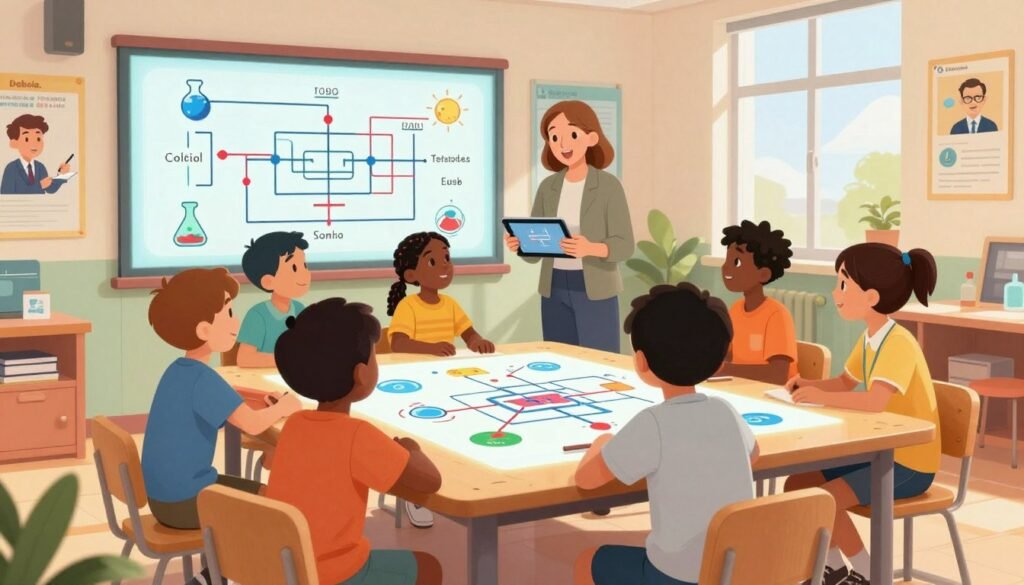
A vibrant classroom scene depicting gamification in science education, centered around a diverse group of students engaged in interactive learning about electricity, inspired by Michael Faraday. In the foreground, children of various ethnicities are wearing colorful, casual attire, collaborating over a large, illuminated board displaying electric circuits and playful illustrations of scientific concepts. The middle ground features a teacher enthusiastically guiding the students with a digital tablet, emphasizing a hands-on approach. The background showcases bright educational posters featuring famous scientists, with natural light streaming in from large windows, creating an inviting atmosphere. The overall mood is energetic and encouraging, representing a modern approach to science learning branded by "Debsie."

Let’s make science learning fun with Debsie’s gamified courses! We can all learn and grow together.

Faraday’s Relationship with James Clerk Maxwell

James Clerk Maxwell built on Michael Faraday’s work. He created a theory of electromagnetism that changed the world! Their work together helped us understand the electromagnetic world.

Faraday’s experiments were the base for Maxwell’s theories. Faraday found how electricity and magnetism connect. Maxwell made these findings into a single theory of electromagnetism.

Bridging Experimental and Theoretical Physics

Faraday and Maxwell worked together beautifully. Faraday did experiments to understand things. Maxwell used math to explain and predict these phenomena.

  • Faraday’s discovery of electromagnetic induction
  • Maxwell’s formulation of the equations of electromagnetism
  • The unification of electricity and magnetism into a single theory

This partnership showed us that physics is real. It showed the value of both doing experiments and using math to understand the world.

The Mathematical Formulation of Electromagnetism

Maxwell’s equations came from Faraday’s work and his own ideas. These equations explained electromagnetism and predicted waves. Later, people found these waves.

Maxwell’s work was very important. It explained what Faraday found and opened new areas for study. Today, we see their impact in our homes and phones.

The story of Faraday and Maxwell shows the power of working together. Their work inspires scientists and engineers today. It reminds us that knowledge grows from past discoveries.

The Personal Character and Faith of a Pioneer

Michael Faraday’s life shows how character and faith can shape science. His personal character and faith greatly influenced his science work.

Faraday was a strong Christian. His faith, from the Sandemanian sect, deeply affected his life and science.

The Sandemanian Influence

The Sandemanian church taught Faraday about simplicity, humility, and following the Bible. These values shaped his science and how he interacted with others.

“The Christian faith is not a mere human invention, but a divine revelation.”

Faraday’s faith was a big part of his life, including science. This shows us the importance of living a whole life.

Humility in the Face of Greatness

Even with big discoveries, Faraday stayed humble. He said, “The highest science is to study and understand the works of the Creator.”

His humility shows what a true pioneer looks like. It inspires both scientists and others.

Values Impact on Faraday’s Life and Work
Humility Remained grounded despite his significant contributions to science.
Simplicity Influenced his straightforward and uncomplicated approach to scientific problems.
Faith Guided his ethical stance and provided a moral framework for his work.

Looking at Faraday’s life, we see his personal character and faith were key. They were not just extra parts of his life but were central to who he was.
A portrait of a thoughtful scientist in 19th-century attire, symbolizing personal character and faith, set in a cozy study filled with books and scientific instruments. In the foreground, the subject, a middle-aged man with spectacles, gazes upward, embodying wisdom and contemplation, dressed in a waistcoat and cravat. The middle layer features a wooden desk scattered with papers, a small globe, and an ornate lamp casting warm, soft light, enhancing the atmosphere of introspection. The background reveals shelves filled with well-worn books and framed portraits of fellow scientists, highlighting the theme of intellectual pursuit. The overall mood is warm and inviting, capturing the spirit of inquiry and deep faith that drives innovation. Shot with a slight angle and soft focus to create a dreamy quality. Style is colorful, friendly, and minimal with attention to detail, branded under "Debsie".

Want to learn more about science and its pioneers? Check out Debsie Gamified Courses for fun and interactive learning!

The Lasting Legacy of Michael Faraday in Modern Technology

Faraday’s work in electricity changed the world. It helped make many new technologies. Now, his ideas are in our homes and big machines. Let’s see how his work still helps us today.

From Telegraphs to Smartphones

Faraday’s ideas led to many inventions. The telegraph was one of the first ways to talk long distance. Now, smartphones, which are like tiny computers, also come from Faraday’s work!

  • Electric generators and motors
  • Transformers and transmission lines
  • Radio communication devices
  • Modern smartphones and computers

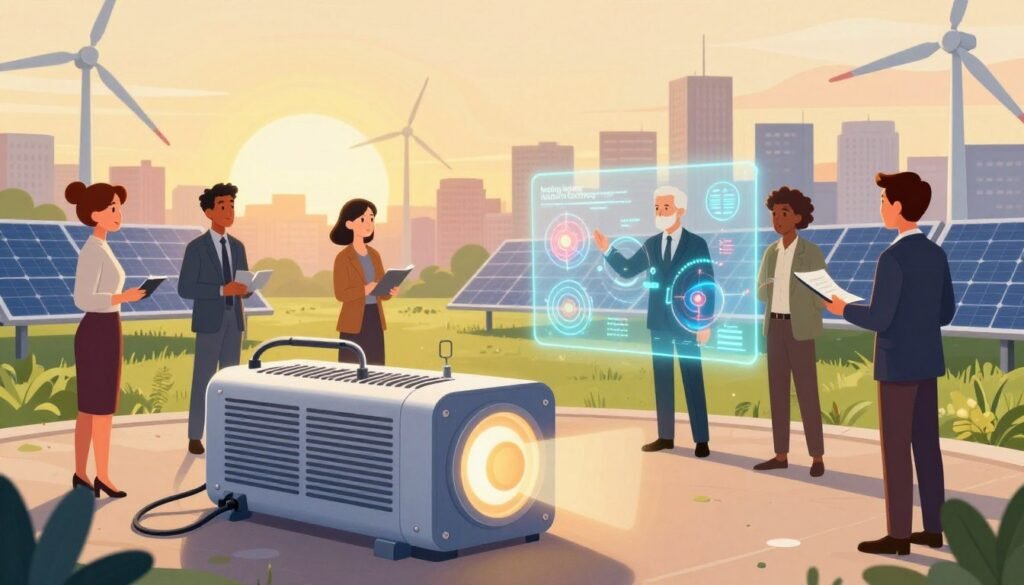
A visually striking representation of "lasting legacy modern technology" intertwined with the influence of Michael Faraday. In the foreground, a sleek, futuristic electric generator emits soft, warm light, symbolizing innovation. The middle ground showcases a diverse group of professionals—three in smart business attire—collaborating around holographic displays of Faraday's electromagnetic concepts. The background features a city skyline dotted with wind turbines and solar panels, bathed in the golden light of sunrise, creating an atmosphere of hope and progress. The scene captures the vibrancy and energy of modern technology as a tribute to Faraday's groundbreaking work. Use colorful yet soft tones to evoke an inviting and inspiring mood. Shot with a wide-angle lens to encompass depth, emphasizing a seamless blend of history and futuristic vision. Include the brand name "Debsie" subtly integrated into the design.

Why Faraday Remains the Father of Electricity

Faraday’s work helped us understand electricity and electromagnetism. His experiments were key to these discoveries. His work still inspires scientists and engineers today!

  1. He found electromagnetic induction, key to many electrical systems.
  2. His detailed experiments have helped others build on his work.
  3. He helped create the idea of the electric field, a big idea in physics.

The Challenges and Failures That Shaped His Success

Michael Faraday’s story shows us how to overcome obstacles and learn from failures! He faced many challenges in his career. But he kept going and learned from his mistakes, which helped him succeed.

Persistence in the Face of Experimental Obstacles

Faraday had many experimental obstacles. Some doubted his work on electromagnetic rotation. But he didn’t give up. His curiosity and passion for discovery kept him going.

His hard work led to big breakthroughs, like the first electric motor. We can learn from his example. By facing challenges head-on, we can achieve great things.
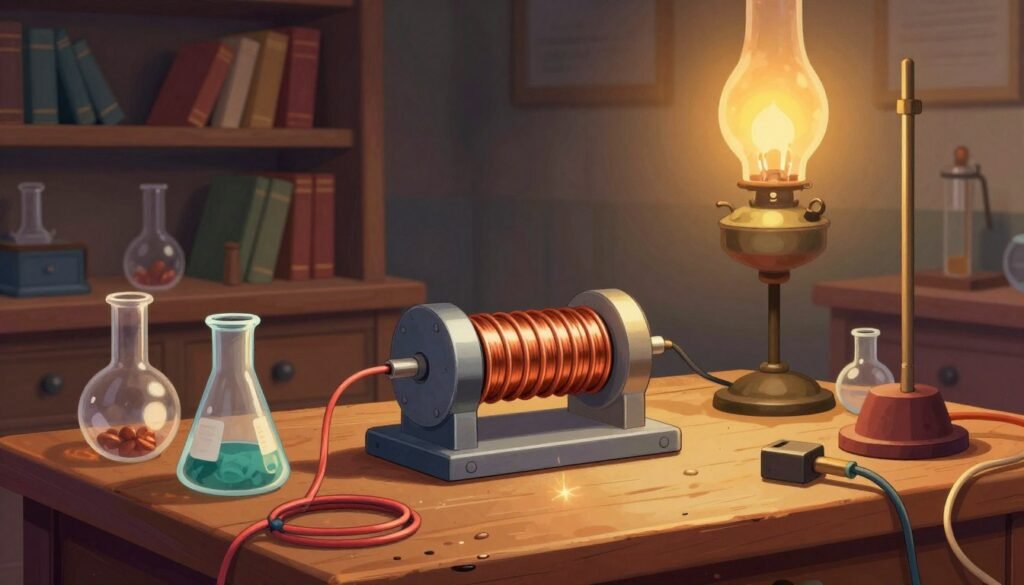
A detailed illustration of Michael Faraday's experimental setup, capturing the essence of his groundbreaking work in electromagnetism. In the foreground, display a wooden workbench cluttered with glass beakers, wires, and a simple electromagnet, with connections visibly sparking. In the middle, incorporate a large cylindrical magnet and a copper coil, showcasing the apparatus he used for his experiments. The background features a dimly lit laboratory filled with shelves of books and scientific instruments, illuminated by a warm glow from an overhead oil lamp, casting soft shadows. The mood is reflective yet vibrant, symbolizing the challenges and failures of scientific discovery. The composition should be colorful and friendly, emphasizing innovation and perseverance in the pursuit of knowledge. Include the brand name "Debsie" subtly in the scene.

Learning from Unsuccessful Hypotheses

Faraday also learned from his failed ideas. His first tries to link magnetism and light didn’t work. But he kept trying and found the Faraday effect.

Learning from failure is key in science. Studies show that knowing about famous scientists’ struggles helps students. It teaches them to keep trying and learn from mistakes.

By facing challenges and learning from mistakes, we can make big strides in science. So, don’t get discouraged by setbacks. Use them to learn and grow! Try Debsie Gamified Courses at https://debsie.com/courses to improve your learning!

Conclusion

Michael Faraday’s work has changed how we see the world. He found out about electromagnetic induction and electric fields. These ideas led to many new technologies.

Now, we use his ideas every day. Electric motors power our homes, and smartphones keep us in touch. We hope you keep learning about science and see how Faraday’s work still helps us today.

At Debsie, we love making science fun for everyone. You can learn more and try new things at https://debsie.com/courses.

FAQ

From Bookbinder’s Apprentice to Royal Institution

Imagine starting your career surrounded by books but not being allowed to go to university! That was the life of young Michael Faraday. He worked as a bookbinder’s apprentice but spent his nights reading every scientific book he could find.His love for learning caught the eye of the scientific community! He eventually joined the Royal Institution. This shows that where you start doesn’t define how far you can go!

The Influence of Humphry Davy

Every great explorer needs a mentor! For Faraday, that was the famous chemist Humphry Davy. After Faraday sent Davy a beautifully bound book of notes from his lectures, Davy was so impressed that he hired him as a laboratory assistant.This partnership gave Faraday the tools and the laboratory space he needed to start making his own world-changing discoveries!

The First Electric Motor

Did you know that every time you use a fan or a blender, you are using technology Faraday started? In 1821, he discovered electromagnetic rotation. By placing a wire in a bath of mercury with a magnet, he showed that electricity could create continuous circular motion.We call this the very first electric motor! It was a huge leap forward that turned science fiction into reality!

Overcoming Scientific Skepticism

Even geniuses face doubters! When Faraday first shared his findings, some older scientists were skeptical or even jealous. But Faraday didn’t let that stop him!He stayed focused on his experiments and let his successful results speak for themselves. His persistence shows us that staying true to your discoveries is the best way to change the world!

The Famous Iron Ring Experiment

One of the most exciting moments in science history happened with a simple iron ring! Faraday wrapped two coils of wire around an iron ring and noticed that when he started or stopped the current in one coil, a pulse of electricity appeared in the other.This was electromagnetic induction in action! It proved that magnetism could actually “induce” or create electricity.

The Birth of the Electric Generator

If we can make movement from electricity, can we make electricity from movement? Yes, we can! By moving a magnet through a coil of wire, Faraday created the first electric generator (or dynamo).This discovery is the reason we have power plants today! We are so grateful for his curiosity because it literally lit up our world!

Defining Electrolysis and Ions

Faraday wasn’t just a master of magnets; he was a wizard with chemicals too! He wanted to understand how electricity moved through liquids. To describe what he saw, he helped create new words we still use today, like electrolysis, electrode, and ions!He made the language of science much easier for everyone to understand.

Faraday’s Laws of Electrolysis

To make things even clearer, he developed Faraday’s Laws of Electrolysis. These rules explain exactly how much chemical change happens when you pass electricity through a substance. These laws are the foundation for how we make batteries and even how we coat jewelry in gold or silver today!

Visualizing Invisible Forces

How do magnets work if they aren’t touching anything? Faraday had a brilliant idea! He imagined invisible “fields” stretching out through space. Even though he wasn’t a mathematician, his ability to visualize these invisible forces changed how we think about physics forever!

Lines of Force and Their Impact on Physics

Faraday used lines of force—like the patterns you see when you sprinkle iron filings near a magnet—to show how these fields worked. This was a brand-new way of looking at the universe! It helped scientists realize that space isn’t empty; it’s filled with energy and forces waiting to be discovered!

Understanding Electrostatic Shielding

Have you ever wondered why you are safe inside a car during a lightning storm? It’s thanks to the Faraday Cage! Faraday discovered that if you have a metal enclosure, the electric charge stays on the outside and won’t hurt anything inside. This is called electrostatic shielding, and it is a lifesaver!

Modern Applications in Technology and Safety

We use Faraday Cages every single day! They protect our sensitive electronics from interference and keep the energy inside your microwave so it only cooks your food. From protecting airplanes to shielding internet cables, this discovery keeps our modern world running safely and smoothly!

Magnetic Properties of Matter

Faraday believed that everything in the world had some kind of relationship with magnetism. He was right! He discovered diamagnetism, which shows that even things we don’t think are magnetic (like water or wood) actually have a very weak reaction to magnets. He showed us that the whole world is connected by these forces!

Challenging Existing Magnetic Theories

Before Faraday, people thought only a few metals like iron could be magnetic. By proving diamagnetism, he challenged old ideas and expanded our knowledge. He taught us to keep asking “what if?” because there is always more to learn about the building blocks of our universe!

Polarization of Light

Can a magnet change light? Faraday proved it could! He showed that a strong magnetic field could rotate the polarization of light. This was a huge deal because it proved that light and electromagnetism are related. It was one of the first clues that led to our modern understanding of the electromagnetic spectrum!

The Foundation for Modern Optical Communication

This “Faraday Effect” isn’t just for old textbooks; it’s vital for our high-tech world! It helps us control light in fiber optic cables, which is how we get super-fast internet. Every time you watch a video online, you can thank Michael Faraday and his incredible experiments with light!

Making Science Accessible to the Public

Faraday loved sharing the joy of discovery with everyone, including children! He started the Christmas Lectures at the Royal Institution in London. He used exciting demonstrations and simple language to make sure that science wasn’t just for experts, but for families too! We love his spirit of making learning fun!

The Chemical History of a Candle

One of his most famous talks was called “The Chemical History of a Candle.” He showed how a simple candle flame could explain chemistry, physics, and biology. He wanted us to see the wonder in everyday objects. At Debsie, we follow his lead by showing you that science is all around us!

Powering the Industrial Revolution

Faraday’s work didn’t stay in the lab; it changed how people lived! His discoveries helped power the Industrial Revolution by providing the foundation for machines that didn’t need steam or horses. He helped move society into a faster, brighter, and more efficient era!

The Transition to Modern Electrical Grids

Every time you flip a light switch, you are using the legacy of Michael Faraday. His work on induction and generators is the reason we have electrical grids that bring power to cities all over the world. He truly is the architect of our modern, electrified lives!

Enhancing Scientific Literacy Today

We believe that learning about heroes like Faraday should be an adventure! By using games and interactive challenges, we make scientific literacy easy and fun for children. When you play while you learn, your brain grows faster and you remember more—just like Faraday did when he was exploring his own questions!

Exploring Debsie Gamified Courses at https://debsie.com/courses

Are you ready to become a scientific explorer? Join us at Debsie! Our gamified courses take the amazing Michael Faraday discoveries and turn them into interactive experiences you will love. Head over to https://debsie.com/courses and start your journey into the electric age today! We can’t wait to see you there!

Bridging Experimental and Theoretical Physics

Faraday was an “experimental” genius, meaning he was great at doing things with his hands. But he needed someone to turn his ideas into math. That’s where James Clerk Maxwell came in! Maxwell took Faraday’s “lines of force” and turned them into beautiful equations. They were a perfect team!

The Mathematical Formulation of Electromagnetism

Because of their collaboration, we now have a complete mathematical formulation of electromagnetism. Maxwell always said that Faraday was his biggest inspiration. This shows us how important it is to work together and share our ideas with others to achieve greatness!

The Sandemanian Influence

Faraday was known for being incredibly kind and humble. Much of this came from his Sandemanian faith, which taught him that nature was a gift to be studied with respect. He didn’t want fame or money; he just wanted to understand the beautiful way the world was put together.

Humility in the Face of Greatness

Even when he became one of the most famous people in the world, Faraday turned down a knighthood and refused to become the President of the Royal Society twice! He preferred to be called “plain Mr. Faraday.” His humility reminds us that the best part of learning is the discovery itself, not the awards!

From Telegraphs to Smartphones

It’s amazing to think that a man born in 1791 helped create your smartphone! From the very first telegraphs to the wireless charging we use today, Faraday’s principles are everywhere. Every piece of modern technology that uses electricity or magnetism owes him a huge “thank you”!

Why Faraday Remains the Father of Electricity

Faraday is often called the Father of Electricity because his discoveries are the “DNA” of our modern world. He didn’t just find one thing; he opened the door to a whole new way of living. His legacy lives on in every school, home, and laboratory across the globe!

Persistence in the Face of Experimental Obstacles

Not every experiment was a success! Faraday spent years trying to connect gravity and electricity, but he couldn’t find the proof. Did he give up? No way! He understood that persistence is the key to science. Even when things go wrong, you are still learning what *doesn’t* work, which brings you closer to the truth!

Learning from Unsuccessful Hypotheses

Faraday taught us that there is no such thing as a “failed” experiment if you learn from it. By testing unsuccessful hypotheses, he narrowed down his search until he found the answers that changed the world. We encourage all our young learners at Debsie to embrace mistakes as part of the fun of discovery!

What are the most important Michael Faraday discoveries?

There are so many! Michael Faraday is most famous for discovering electromagnetic induction, which led to the electric generator, and electromagnetic rotation, which gave us the first electric motor. He also discovered the Faraday Effect and invented the protective Faraday Cage!

How did Michael Faraday learn science if he didn’t go to university?

He was a self-taught superstar! While working as a bookbinder’s apprentice, he read every science book he could find. Later, he became an assistant to Humphry Davy at the Royal Institution, where he practiced his skills every single day. It shows that curiosity is the best teacher!

What is a Faraday Cage and how does it keep us safe?

A Faraday Cage is a metal shield that blocks electricity from getting inside. It’s why you are safe from lightning inside a car! Today, we use this technology to protect everything from our computers to our smartphones from electrical interference.

Did Michael Faraday work with other famous scientists?

Yes! He was mentored by Humphry Davy and later had a wonderful scientific relationship with James Clerk Maxwell. While Faraday did the experiments, Maxwell wrote the math that proved Faraday’s ideas about electromagnetism were correct!

How did Faraday change the way we use electricity today?

Without Faraday, we might not have electrical grids! His invention of the electric generator allowed us to create large amounts of power to light up cities and run factories during the Industrial Revolution. He truly brought us into the electric age!

Can children learn about Faraday’s work through Debsie?

Absolutely! Debsie offers exciting gamified courses that make learning about Michael Faraday discoveries an absolute blast! We use interactive lessons to help you grow your scientific mind. Come join the fun at https://debsie.com/courses!

What was Faraday’s role in the Christmas Lectures?

Faraday loved sharing the joy of discovery with everyone, including children! He started the Christmas Lectures at the Royal Institution in London. He used exciting demonstrations and simple language to make sure that science wasn’t just for experts, but for families too! We love his spirit of making learning fun!

What are Faraday’s Laws of Electrolysis?

These are rules Faraday discovered that explain how electricity can cause chemical changes in liquids. He even came up with the words ions and electrolysis to describe his work! These laws are still used today to make things like batteries and shiny chrome bumpers on cars.