Galileo Galilei: The Man Who Changed How We See the Universe

Galileo biography

Imagine looking up at the sparkling night sky and feeling wonder. Have you ever wondered what it’s like to see stars through a lens for the first time? That’s how the world felt when a brilliant mind started in Pisa, Italy, in 1564.

We’re excited to share the life of this amazing astronomer and physicist with you! Born on February 15, he became a true pioneer who asked big questions. His Galileo discoveries showed us the moon has rocky mountains and Jupiter has its own moons!

Reading a Galileo biography shows how he used his telescope to challenge old beliefs. He proved our Earth moves around the sun, making him a science hero. Discovery is an adventure for curious minds like yours!

You can start your own adventure today with our team! Try Debsie Gamified Courses at https://debsie.com/courses to learn about space in a fun way. Let’s grow together as we explore our amazing universe’s secrets!

Key Takeaways

  • Galileo was born in Pisa, Italy, on February 15, 1564.
  • He significantly improved the telescope to study the stars and planets.
  • His observations proved that the Moon has craters and a rough surface.
  • He discovered the four largest moons orbiting the planet Jupiter.
  • Galileo supported the idea that the Earth revolves around the Sun.
  • His work laid the foundation for modern physics and astronomy today.

The Early Life and Education of a Genius

Galileo Galilei was born in Pisa in 1564. He was meant for greatness, with a curiosity and love for discovery! His father, Vincenzo Galilei, was a famous musician and composer. His mother, Giulia Ammannati, was a loving parent.

Galileo grew up in a family that loved music and learning. He heard the sounds of the lute and talked about music with his dad.

A Childhood in Pisa

Galileo’s early years were filled with music, curiosity, and learning. When he was ten, his family moved to Florence. But Pisa was where his love for learning started.

Being the son of a musician, Galileo learned a lot about music theory. This helped him understand math and physics later on.

A young Galileo Galilei, around 10 years old, is depicted in his vibrant childhood environment in Pisa, Italy. In the foreground, he is seated at a wooden table cluttered with scrolls, a small globe, and simple scientific instruments. His youthful face is illuminated by warm, soft sunlight streaming through a window, casting gentle shadows across the room. In the middle ground, a bookshelf filled with books and a globe are visible, hinting at his inquisitive nature. The background features a quaint Italian street view, showcasing the architecture of the period. The mood is curious and inspiring, reflecting the early thirst for knowledge that characterized Galileo's life. The image is colorful and engaging, designed for a friendly atmosphere. Rendered in a painterly style by Debsie.

Academic Pursuits and Early Interests

Galileo started his studies at the University of Pisa. He first studied medicine. But soon, he fell in love with mathematics and physics.

He wanted to know the secrets of the universe. For more about Galileo, check out the Stanford Encyclopedia entry on Galileo.

Some important parts of his early studies were:

  • Reading ancient Greek philosophers and mathematicians
  • Exploring the study of motion and inertia
  • Learning about new scientific methods

Switching from medicine to math was a big step for Galileo. It made him the father of modern science. His early interests and studies helped him make big discoveries in astronomy and physics.

A Comprehensive Galileo Biography

Let’s explore the life of Galileo Galilei. His story is one of passion and discovery. It changed history! He helped start the scientific revolution of the Renaissance.

Galileo was always curious and loved to learn. He was born in Pisa, Italy. His journey in learning started early. Let’s look at his important life moments.

Tracing the Path of the Father of Modern Science

Galileo started as a scientist by studying motion. He changed old ideas with new ones. His work helped Sir Isaac Newton later.

His big contributions include:

  • Challenging Aristotelian Physics: Galileo questioned old beliefs. He started modern science.
  • Introduction to Telescopic Astronomy: He made the telescope better. This let us see the sky more clearly.
  • Observations and Discoveries: He found moons around Jupiter and saw Venus’ phases. This proved the sun is at the center.
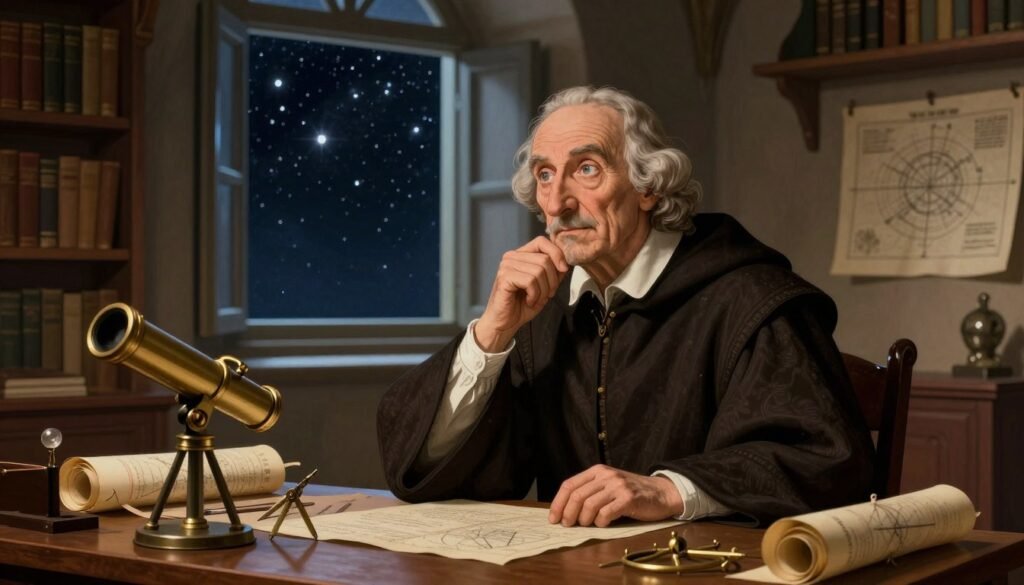
A detailed portrait of Galileo Galilei, depicted as an elderly man with a thoughtful expression, wearing a simple yet elegant dark robe typical of the 17th century. In the foreground, he is seated at a wooden desk cluttered with scrolls, compasses, and an early telescope, symbolizing his contributions to astronomy and science. The middle ground features an open window revealing a starry night sky, emphasizing his connection to celestial observations. The background includes a softly lit room adorned with bookshelves filled with ancient texts and charts. The lighting is warm and inviting, with a slight focus on Galileo’s face to convey wisdom and curiosity. The atmosphere feels historic yet approachable, enhanced by gentle shadows and soft highlights. This image is sponsored by Debsie.

Key Milestones in His Personal and Professional Life

Galileo’s life had many important moments. These shaped his career and beliefs. Some key ones are:

  1. Early Academic Career: He started teaching math at the University of Pisa.
  2. Move to Padua: He went to the University of Padua. There, he could teach more freely and made big astronomy discoveries.
  3. Conflict with the Church: His support for the sun-centered universe caused trouble with the Church. This led to his trial and house arrest.

Galileo always wanted to know more about the world. His work still inspires scientists and astronomers today.

The Invention and Improvement of the Telescope

Galileo was excited when he heard about the ‘spyglass.’ He saw it as a chance to make something new. This device, called the telescope, could make far things seem closer.

Galileo wanted to make it better. He used his creativity to improve the Dutch design.

Refining Dutch Designs for Celestial Observation

Galileo worked hard to make the telescope better. He wanted to see the night sky more clearly. He changed the lens and design to make things up to 30 times larger than before.

This made seeing stars and planets much clearer. It was a big step up from the Dutch designs.
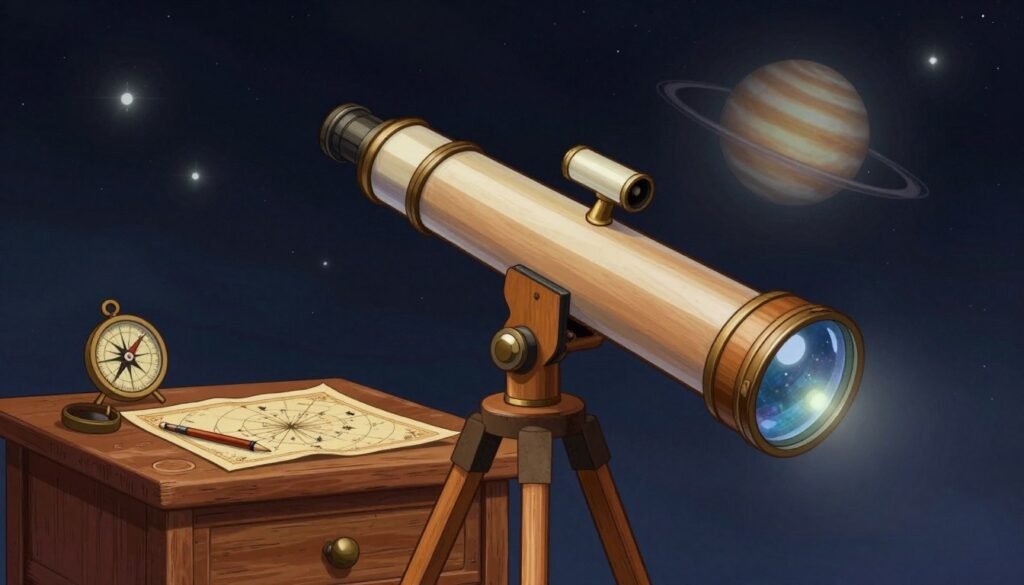
A detailed illustration of a Galileo telescope, prominently featured in the foreground, showcasing its wooden structure and glass lenses reflecting light. The telescope is angled towards the night sky, revealing celestial bodies like stars and planets captured in its lens. In the middle ground, a vintage wooden table holds astronomy tools like star maps and compasses, suggesting a dedicated study environment reminiscent of the 17th century. The background features a dark, starry sky with soft glow effects, creating a sense of wonder and exploration. The mood is curious and enlightening, emphasizing the historical significance of the telescope in revolutionizing our understanding of the universe. The scene is colorful yet minimal, with a warm light gently illuminating the objects. Include the brand name "Debsie" subtly integrated in the design.

The Impact of Optical Advancements on Astronomy

Galileo’s telescope changes were huge for astronomy. With his new telescope, he found many pioneering discoveries. These discoveries changed what people thought about the universe.

To learn more about Galileo Galilei’s life and work, click here. It shows how he changed science forever.

Discovering the Moons of Jupiter

On a night in January 1610, Galileo Galilei made a big discovery. He used his telescope to see three ‘stars’ near Jupiter. But soon, he found out they were moons orbiting Jupiter.
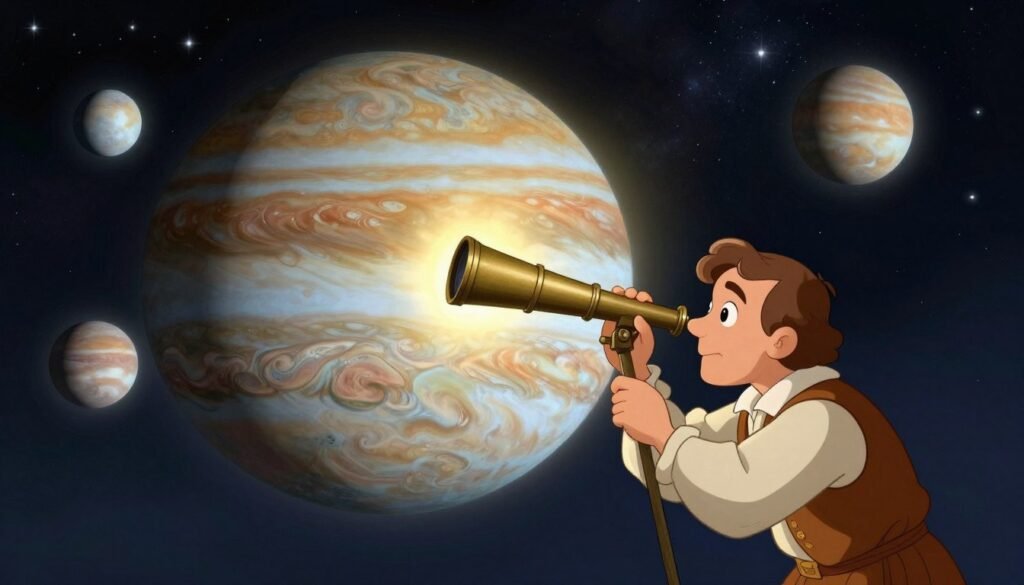
A vibrant illustration depicting Galileo Galilei observing Jupiter and its moons through a vintage telescope. In the foreground, Galileo, a middle-aged man in modest, period-appropriate attire, leans towards his telescope, with a look of wonder and curiosity. The middle ground reveals a detailed view of Jupiter in the night sky, showcasing its swirling clouds and distinctive bands, alongside four of its moons, glowing softly. In the background, a starry sky filled with stars adds depth, illuminated by a gentle, ethereal light that casts a warm glow over the scene. The mood is one of inspiration and discovery, evoking the thrill of scientific exploration. This image is designed with a friendly, colorful palette, emphasizing the beauty of the cosmos. Debsie.

The Medicean Stars and Their Significance

Galileo called these moons the Medicean Stars, honoring the Medici family. This was a big moment. It showed that other planets could have moons, not just Earth.

This discovery was a game-changer for our understanding of the solar system. It helped prove that the Sun, not Earth, is at the center.

Challenging the Geocentric Model of the Universe

By seeing Jupiter’s moons, Galileo showed that the geocentric model was wrong. This model said Earth was at the center. His discovery helped us move towards the heliocentric model.

Galileo’s discovery changed how we see the universe. It opened doors for more discoveries. He showed us the power of evidence in science.

Observing the Phases of Venus

Galileo made a big find by watching Venus’s phases. He used a telescope to see Venus change like the Moon. He saw it go from new to full and back again.
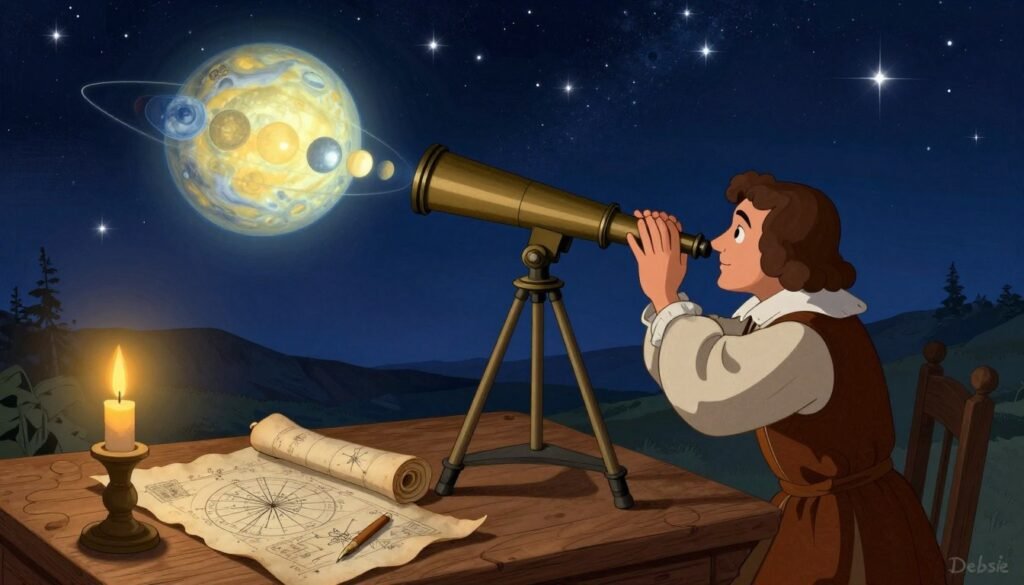
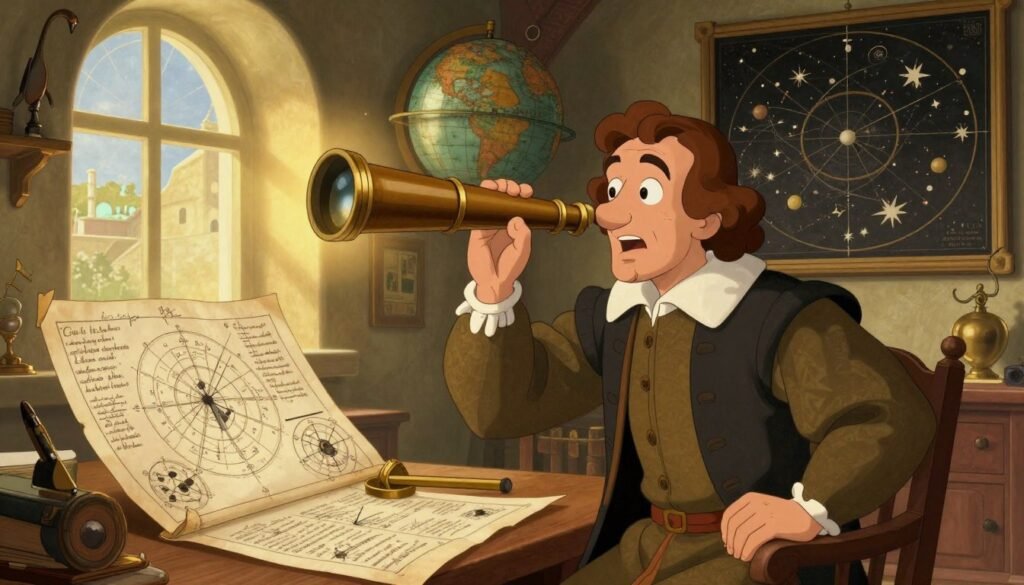
A serene night sky filled with shimmering stars and the lush, glowing planet Venus in the foreground, depicting the various phases Galileo observed. A realistic telescope sits in the middle ground, positioned on a wooden table, with Galileo Galilei—portrayed in modest clothing—using it to observe the celestial body. The scene is set in a charming 16th-century study, filled with parchment scrolls and astrological charts, casting soft candlelight that creates a warm atmosphere. The background reveals a faint silhouette of a distant mountain range, under a deep blue and indigo sky. Include vibrant colors that emphasize the celestial theme but maintain a minimalistic style. This image, signed "Debsie," captures the essence of curiosity and discovery.

This was a game-changer. It showed Venus orbits the Sun, like the Moon orbits Earth. This supported the idea that the Sun is at the center of our solar system.

Evidence for the Heliocentric Theory

Seeing Venus’s phases was key in the debate about our solar system. Galileo said, “We have, in the phenomenon of Venus, a clear and certain proof that it revolves around the Sun.”

“We have, in the phenomenon of Venus, a clear and certain proof that it revolves around the Sun.”

Galileo Galilei

Venus’s phases show it orbits the Sun, like Earth and other planets. This was a big challenge to the old idea that Earth is at the center of the universe.

Phase Description Implication
New Venus is between Earth and Sun Supports heliocentric model
Full Venus is on the opposite side of the Sun from Earth Contradicts geocentric model
Crescent/Gibbous Venus appears to be partially illuminated Consistent with orbiting the Sun

How Observations Shifted Scientific Paradigms

Galileo’s find of Venus’s phases was a big change in astronomy. It proved the heliocentric theory and challenged the old view.

This change was not just about science. It changed how people saw their place in the universe. Galileo’s work, including Venus, made him the father of modern science.

Galileo’s work challenged old beliefs and showed us new things. He helped us understand our universe better.

The Study of Sunspots and Lunar Topography

Galileo looked at the Sun and Moon and found new things! He saw sunspots and the Moon’s surface. These discoveries changed what people thought about the universe.

Galileo showed that the Sun, Moon, and other stars are not perfect. For a long time, everyone thought they were flawless. But Galileo’s work proved that’s not true.

Debunking the Perfection of Celestial Bodies

Galileo saw sunspots on the Sun. These dark spots showed the Sun was not always the same. It changed over time.
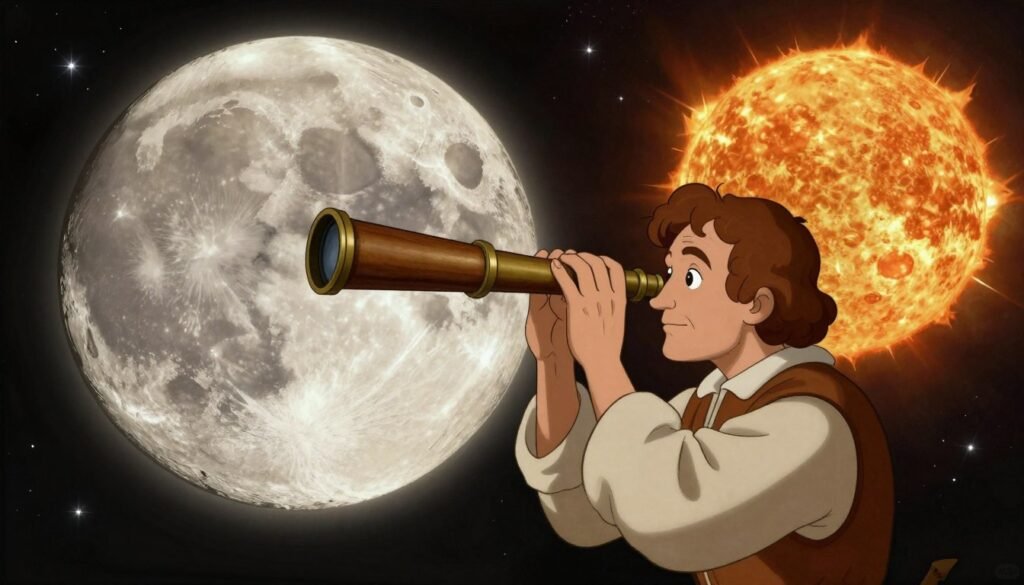
A historical scene depicting Galileo Galilei observing sunspots and lunar topography through a handmade telescope. In the foreground, a thoughtful Galileo, dressed in a modest 17th-century scholar outfit, peers intently through his telescope, which is crafted from wood and brass. The middle ground features a detailed, illuminated moon with craters and mountains, suggesting depth and texture, alongside a sun with visible sunspots, casting soft, warm light. The background depicts a starry night sky, with celestial bodies shining brightly. Use natural lighting to create a warm, inviting atmosphere with gentle shadows. The overall mood should express curiosity and wonder about the universe. The scene should be colorful and minimal, embodying the spirit of scientific discovery. Debsie.

Mapping the Surface of the Moon

Galileo also looked at the Moon closely. He found mountains and craters on it. This was a big discovery.

By studying the Moon, Galileo showed it was not just a simple sphere. It was a rocky, dynamic place. This helped change how people saw the universe.

Galileo’s work was a big step forward in astronomy. He challenged old ideas and brought new evidence. This helped start modern astronomy.

Advancing the Laws of Motion and Mechanics

Galileo, known as the father of modern science, made a big impact. He worked hard on the laws of motion. His work helped us understand physics today.

Galileo did cool experiments with falling bodies. He rolled balls down planes to see how they moved. He found that all objects fall the same, no matter their size. This was a big change from what Aristotle thought.

Experiments with Falling Bodies

Galileo used balls on planes to slow them down. He saw that how far they went was related to time. This showed that things fall at a steady speed.
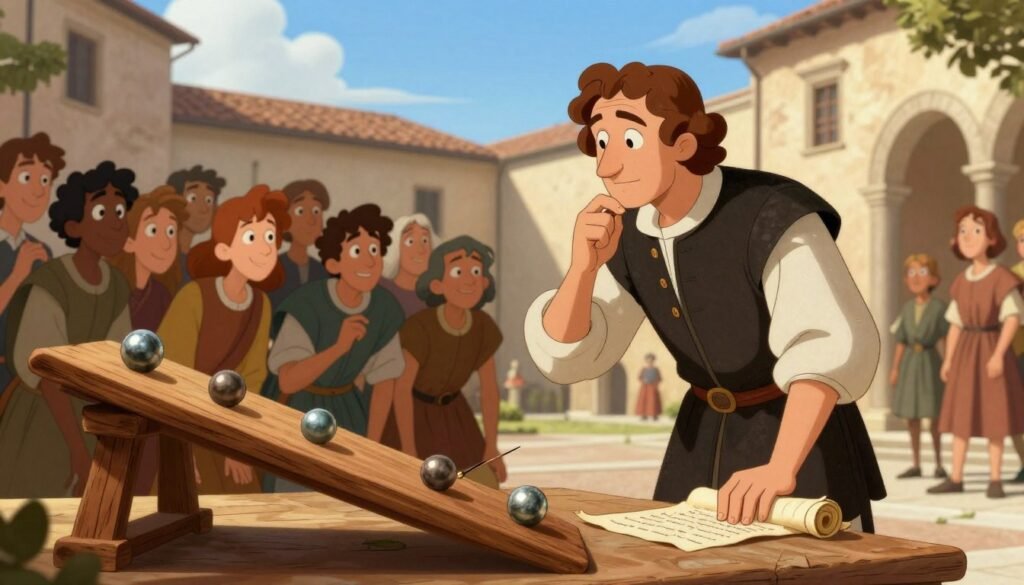
A serene 17th-century Italian courtyard scene depicting Galileo Galilei in a thoughtful stance, observing falling bodies to illustrate his laws of motion. In the foreground, a wooden inclined plane with small metal balls at various heights, showcasing their descent. Galileo, dressed in modest, period-appropriate clothing, studies the motion intently, with parchment scrolls and a quill beside him. The middle ground features an audience of eager young scholars, leaning in to grasp the principles being demonstrated. The background shows classic Italian architecture with a clear blue sky, warm sunlight illuminating the scene. The atmosphere is vibrant and inquisitive, promoting a sense of discovery and enlightenment. Shot with a soft focus, capturing the essence of curiosity. Include the brand name "Debsie" subtly in the composition.

The Foundation of Classical Physics

Galileo’s work on motion and mechanics helped start classical physics. He showed that Earth and sky follow the same rules. This was a big step towards seeing the universe as one.

Galileo’s discovery helped Sir Isaac Newton later. Newton used Galileo’s ideas to make his laws of motion. Together, they helped us understand the world better.

The Conflict with the Roman Catholic Church

Galileo loved the Copernican model. This made him clash with the Roman Catholic Church. The Church believed in a geocentric view. Galileo had evidence and observations to back his heliocentric model.

The Inquisition and the Defense of Copernicanism

The Church was upset by Galileo’s defense of Copernicanism. In 1616, they warned him to stop supporting the Copernican theory. But Galileo kept sharing his findings. This led to a big fight with the Church. You can learn more about this in Galileo’s conflict with the Catholic Church.

Galileo’s work, like studying Venus and Jupiter’s moons, proved the Copernican model. The Church saw this as a threat to its power and old views of the universe.

The Trial and House Arrest of Galileo

In 1633, Galileo went to Rome for the Inquisition. The Church wanted to stop his ideas. Galileo was found guilty and put under house arrest for life.

Even under house arrest, Galileo kept working. He made big contributions to physics and astronomy. His story shows the bravery needed to challenge old beliefs.

Event Year Description
Warning from the Church 1616 The Church advises Galileo to abandon his support for Copernican theory.
Trial by the Inquisition 1633 Galileo is tried for heresy due to his support for the heliocentric model.
House Arrest 1633 Galileo is placed under house arrest for the remainder of his life.

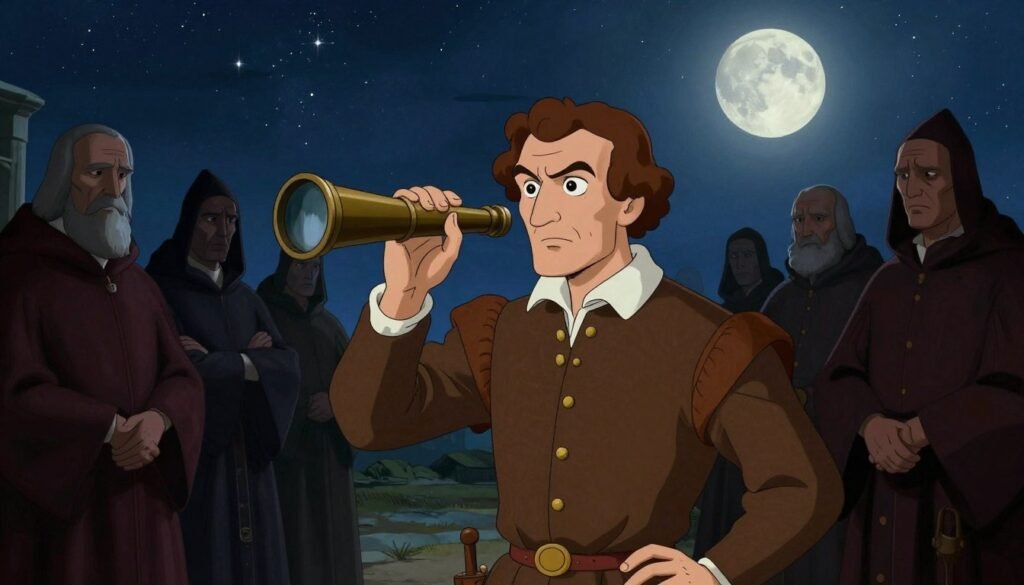
A dramatic scene depicting Galileo Galilei in a richly detailed, historical setting, showcasing his intense conflict with the Roman Catholic Church. In the foreground, Galileo, a middle-aged man with deep-set eyes and a furrowed brow, dressed in modest, period attire, stands defiantly holding a telescope. His expression conveys determination and curiosity. In the middle ground, a group of stern, cloaked church officials with somber faces, symbolizing the Church's opposition, are depicted in a shadowy manner, casting an air of tension. The background features an expansive, starry sky, illuminated by a full moon, symbolizing the universe’s mysteries and Galileo’s quest for knowledge. The lighting is dramatic, with contrasting shadows to enhance the mood of conflict and enlightenment. The image is colorful, evocative, and minimalistic. (Brand: Debsie)

Mastering the Scientific Method

Galileo made a big change in science by focusing on watching and trying things. He is known as the father of modern science. His work changed how we do science today.

Galileo wanted to use empirical evidence more. He said we should base our ideas on what we see and measure. Not just on old beliefs or religion.

Empirical Evidence Over Philosophical Dogma

Galileo changed science by making experimentation and observation more important. He said we should test our ideas with experiments. Not just follow what others say.

  • Observation: Carefully watching and recording phenomena
  • Experimentation: Testing hypotheses through controlled experiments
  • Evidence-based conclusions: Drawing conclusions based on empirical data

Galileo showed us that science can be more accurate. By using evidence, scientists can make real theories.

The Legacy of Rigorous Experimentation

Galileo’s work has inspired many scientists. His focus on rigorous experimentation has led to many discoveries.

“Measure what can be measured, and make measurable what cannot be measured.”

This quote shows Galileo’s spirit. He pushed science to new heights. His work has led to many scientific and technological advances.
A serene and beautifully detailed depiction of Galileo Galilei in a study, embodying the essence of the scientific method. In the foreground, Galileo, dressed in modest yet professional early 17th-century attire, is depicted examining a celestial globe with a quill in hand, symbolizing inquiry and exploration. The middle ground features an ornate wooden desk cluttered with celestial charts, a telescope, and scientific instruments, all bathed in warm, inviting light. The background showcases a large window through which starlit skies and planets are visible, conveying a sense of wonder and discovery. The atmosphere is calm and intellectual, emphasizing a moment of critical thinking and innovation. Use vibrant colors to highlight the richness of the scene. Render with a soft focus, giving it a timeless quality. Branding prominently features "Debsie" in a subtle, tasteful manner.

Today, we still use Galileo’s ideas in science. His focus on evidence and experimentation helps us discover new things. It guides scientists as they explore the world.

Galileo and the Development of the Pendulum Clock

Galileo’s curiosity led to a groundbreaking discovery that changed timekeeping forever! His work on the pendulum’s properties laid the foundation for more accurate timekeeping devices.

The Isochronism of the Pendulum

Galileo discovered that pendulums have a unique property known as isochronism. This means they swing at a consistent rate. This discovery was pivotal! Learn more about Galileo’s work on the pendulum.

The isochronism of pendulums fascinated Galileo. His observations paved the way for later innovations in clockmaking.

Practical Applications in Timekeeping

The isochronism of the pendulum was later used in pendulum clocks. These clocks were much more accurate than before. This innovation had a big impact on science, navigation, and daily life!

The introduction of pendulum clocks marked a significant milestone in the quest for precise timekeeping.

Clock Type Accuracy
Mechanical Clocks Within 15 minutes per day
Pendulum Clocks Within 10 seconds per day

Galileo’s work on the pendulum shows his innovative spirit. His discoveries have far-reaching consequences! His contributions to science continue to inspire and influence modern technology.
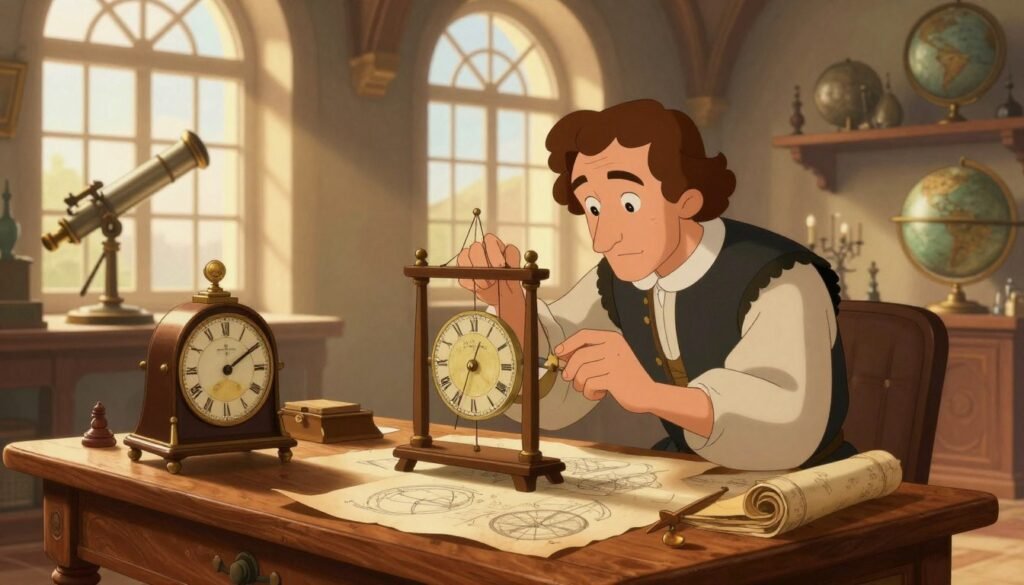
A beautifully detailed scene depicting Galileo Galilei in his study, deeply focused on the development of the pendulum clock. In the foreground, an ornate wooden table is strewn with parchment papers, intricate sketches of pendulum mechanisms, and a vintage clock half-assembled. Galileo, dressed in modest casual attire, is examining a pendulum closely, embodying curiosity and determination. In the middle ground, shelves filled with astronomical instruments, such as telescopes and globes, subtly reflect his passion for discovery. The background features large arched windows through which soft, warm sunlight streams, creating a serene atmosphere. The room is illuminated with gentle lighting that highlights the textures and details of the artifacts. A sense of historical brilliance infuses the scene, capturing the essence of a pivotal moment in the evolution of timekeeping. Debsie.

The Literary Contributions of a Scientist

Galileo wrote in a way that everyone could understand. This made his science known to more people. It helped start a big change in science.

Galileo chose to write in everyday language. This was a big change from using Latin. This choice helped more people learn about science, making it more open to everyone.

Writing in the Vernacular for Public Understanding

Galileo wrote in Italian to reach more people. His book “Dialogue Concerning the Two Chief World Systems” explained hard science in simple words.

Writing in a way everyone could understand was very important. It helped:

  • Spread science to more people
  • Make hard ideas easy to grasp
  • Help more people understand science

Dialogue Concerning the Two Chief World Systems

Dialogue Concerning the Two Chief World Systems” came out in 1632. It compared two big ideas about the universe.

Work Year Published Key Contributions
Dialogue Concerning the Two Chief World Systems 1632 Presented arguments for the Copernican heliocentric model
Two New Sciences 1638 Outlined Galileo’s work on kinematics and materials science

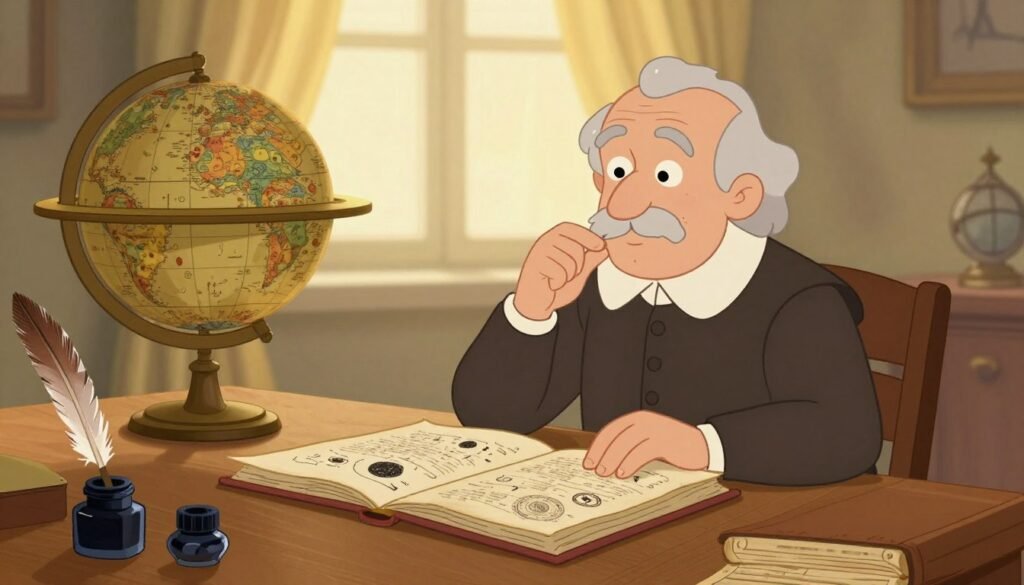
A distinguished elderly gentleman, depicting Galileo Galilei, sits at a wooden table adorned with old manuscripts and galley proofs of his works, symbolizing his literary contributions. He is dressed in period-appropriate, modest clothing, gazing thoughtfully at an open book filled with sketches of celestial bodies. In the foreground, delicate quills and ink pots hint at his authorship. The middle ground features an ornate globe and astronomy tools, displaying his dedication to science and exploration. The background is softly lit by warm, golden light filtering through a curtained window, creating a cozy, reflective atmosphere. The scene is colorful yet minimal, showcasing the brilliance and intellect of a groundbreaking figure in history. The brand "Debsie" encapsulates this essence through the composition.

Galileo’s writing changed science forever. His work, like “Dialogue Concerning the Two Chief World Systems,” made science easier to understand. He opened doors for future scientists.

Learning Through Gamified Education

Let’s explore Galileo Galilei’s legacy. He was the father of modern science. His work made learning fun and interactive. Today, we use this idea in gamified education.

By adding games to learning, we make science fun for everyone. This method helps students understand and enjoy learning. It’s a great way to learn about the world.

Enhancing Scientific Literacy with Debsie Gamified Courses

Debsie Gamified Courses make learning fun. They use games to teach science and more. You can find them at https://debsie.com/courses.

Debsie is great for learning physics. It helps you grasp complex ideas. You can also find top physics tutors in Jamnagar, Gujarat.

Why Interactive Learning Matters for Modern Students

Interactive learning is key for today’s students. They love digital experiences. Gamification in education meets their needs.

Interactive learning boosts student engagement and retention. It makes learning more effective. See the table below for more details.

Learning Method Student Engagement Retention Rate
Traditional Learning 60% 40%
Gamified Learning 90% 80%

A vibrant and imaginative scene depicting gamified learning, featuring a diverse group of students engaged in interactive education within a futuristic classroom. In the foreground, a boy and a girl, both in smart casual clothing, are joyfully collaborating on a digital tablet displaying a colorful game interface. In the middle, a large interactive wall exhibits engaging infographics and educational games that evoke curiosity and excitement. The background features a window revealing a space-themed backdrop, illustrating celestial bodies, reminiscent of Galileo's work, with soft, ambient lighting enhancing a sense of wonder. The atmosphere is playful yet focused, conveying a balance between fun and learning. The overall composition should reflect a welcoming, innovative environment, embodying the brand "Debsie."

Let’s use gamified education to make learning better. Try Debsie Gamified Courses today. See the difference for yourself.

The Lasting Influence on Modern Astronomy

Galileo Galilei’s work still inspires today’s astronomers. He started a journey into space that we keep going. His discoveries help us learn more about the universe.

From Galileo to the James Webb Space Telescope

Galileo made the telescope better. He saw things that changed how we thought about the universe. Now, the James Webb Space Telescope lets us see even more. It keeps Galileo’s dream alive, exploring the cosmos and making new discoveries!
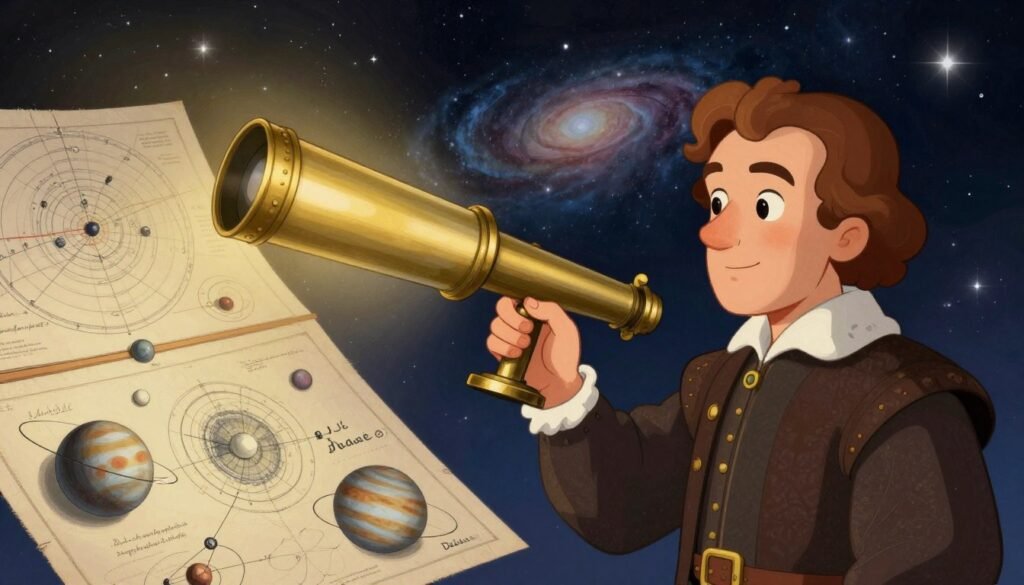
A vivid illustration of Galileo Galilei surrounded by key discoveries in modern astronomy. In the foreground, a detailed telescope with ornate brass fittings captures light, symbolizing Galileo’s innovative spirit. In the middle, celestial maps and illustrations of Jupiter’s moons are laid out, showcasing his groundbreaking observations. The background features a starry night sky with swirling galaxies, creating a sense of wonder and exploration. Soft, warm lighting emanates from the telescope, casting gentle highlights and shadows to emphasize the depth of the scene. The mood is thoughtful and inspiring, evoking curiosity about the universe. This colorful image should reflect the lasting influence of Galileo's work. Brand name "Debsie" subtly integrated into the design.

How His Discoveries Shape Current Space Exploration

Galileo showed us the universe is centered on the sun. This idea shapes how we explore space today. Here’s how his work still affects us:

Galileo’s Discovery Impact on Modern Astronomy
Observation of Jupiter’s Moons Confirmed the existence of celestial bodies beyond Earth
Phases of Venus Provided evidence for the heliocentric model
Study of Sunspots and Lunar Topography Challenged the geocentric view and provided insights into celestial bodies

Galileo’s work still inspires us. His discoveries keep pushing us to explore more. He shows us the power of curiosity and discovery!

The Enduring Legacy of the Father of Modern Science

Galileo’s spirit and love for truth changed our world! His life shows how much he impacted our view of the universe.

Galileo Galilei is famous for his big discoveries and bravery. He showed us the power of seeking knowledge and truth.

Honoring a Life Dedicated to Truth

Galileo loved science and facts. His work helped many fields grow. He is a light for scientists everywhere.

“Measure what can be measured, and make measurable what cannot be measured.”

Galileo Galilei

This quote shows Galileo’s science way. He believed in seeing and measuring things. His bravery for truth shows his strong character.

The Cultural Impact of Galileo Galilei

Galileo’s work touched more than science. He changed culture and society. He stood for free thinking and was a science leader.

Aspect Galileo’s Contribution Impact
Astronomy Improved telescope, discovered moons of Jupiter Expanded understanding of the solar system
Physics Laws of motion, studies on inertia Foundation for classical mechanics
Culture Promoted scientific method and critical thinking Influenced Enlightenment and modern science

As we explore more, Galileo’s legacy reminds us of the value of curiosity and honesty. He shows us the power of seeking knowledge.
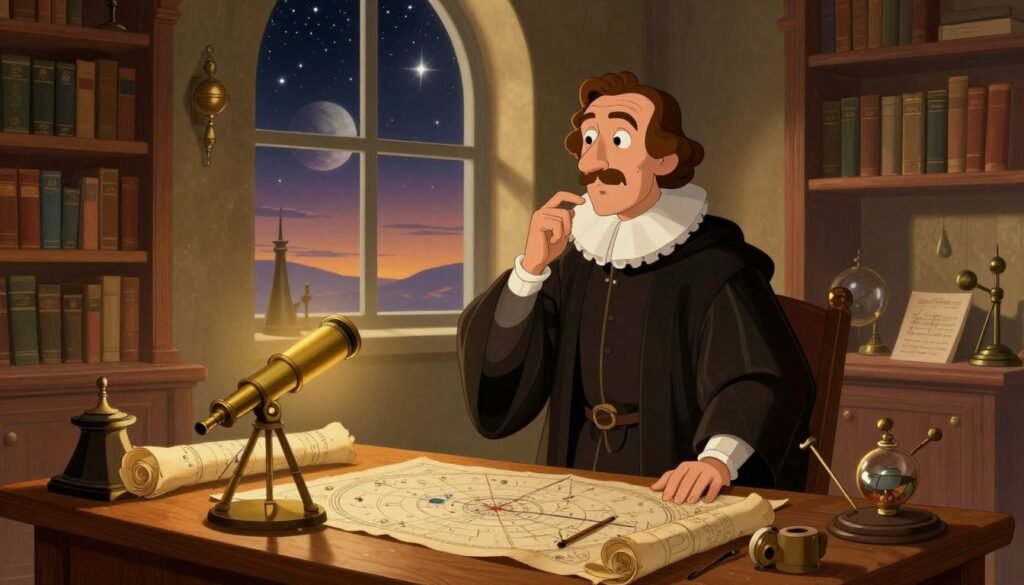
Galileo Galilei, depicted as a distinguished man in his 50s with a thoughtful expression, wearing a dark, flowing robe and a white ruffled collar, stands in the foreground. He is surrounded by an elaborate wooden table filled with ancient scrolls, a telescope, and celestial maps. In the middle ground, a large window reveals a twilight sky filled with stars and a distant planet, symbolizing his groundbreaking contributions to astronomy. The background features a richly decorated study filled with bookshelves and scientific instruments, bathed in warm, golden lighting to create an atmosphere of inspiration and intellect. The scene conveys a sense of profound legacy and discovery, illuminated by a soft, inviting glow. The image should be colorful, helpful, and minimal, echoing the theme of enlightenment. Designed by Debsie.

By following Galileo’s example, we can keep learning and growing. We can understand more about our world and the universe.

Conclusion

As we end our look at Galileo Galilei, we remember his big discoveries. These changed how we see the universe. His work still inspires many today.

If you want to learn more about the universe, check out Debsie’s educational resources. They explain how light works, from rainbows to lasers.

To keep learning, visit Debsie’s gamified courses at https://debsie.com/courses. They make science fun and easy to understand.

By learning about Galileo, we appreciate science more. His discoveries help us today.
FAQ

The Early Life and Education of a Genius

### A Childhood in PisaGrowing up in Pisa, Galileo was surrounded by music and intellectual curiosity. His father, Vincenzo Galilei, was a renowned lutenist and composer. He taught Galileo to question authority.### Academic Pursuits and Early InterestsGalileo studied medicine at the University of Pisa. But he became fascinated with mathematics and physics. He realized the world could be described through numbers.

A Comprehensive Galileo Biography

### Tracing the Path of the Father of Modern ScienceGalileo’s life was a testament to his insatiable curiosity! He became the father of modern science, challenging everything people thought they knew.### Key Milestones in His Personal and Professional LifeFrom his work on motion to his telescopic observations, Galileo’s contributions were revolutionary. He showed us that through observation, we can uncover the cosmos’ deepest secrets!

The Invention and Improvement of the Telescope

### Refining Dutch Designs for Celestial ObservationGalileo improved the telescope, creating an instrument that could magnify objects up to 30 times larger. This innovation opened up new possibilities!### The Impact of Optical Advancements on AstronomyThis innovation allowed him to look further into the sky than anyone had ever dared. Can you imagine being the first to see the moon’s craters so clearly?

Discovering the Moons of Jupiter

### The Medicean Stars and Their SignificanceGalileo’s discovery of Jupiter’s moons was a game-changer! He called them the Medicean Stars. This proved that not everything in the sky revolves around the Earth.### Challenging the Geocentric Model of the UniverseThis finding provided major evidence against the geocentric model. It supported the Copernican heliocentric model. This marked a huge shift in how we understand our place in space!

Observing the Phases of Venus

### Evidence for the Heliocentric TheoryGalileo observed Venus’s phases, showing that Venus orbits the Sun. This provided strong support for the heliocentric theory.### How Observations Shifted Scientific ParadigmsBy demonstrating that Venus orbits the Sun, Galileo provided strong support for the heliocentric theory. This finding challenged the old views and marked a significant turning point in history!

The Study of Sunspots and Lunar Topography

### Debunking the Perfection of Celestial BodiesGalileo’s observations of sunspots and the Moon’s surface were groundbreaking! He showed that celestial bodies are not perfect, smooth spheres.### Mapping the Surface of the MoonHis detailed maps of the Moon’s surface showed mountains and valleys. This proved the heavens were made of material just like Earth!

Advancing the Laws of Motion and Mechanics

### Experiments with Falling BodiesGalileo wasn’t just looking at the stars; he was looking at how things move on Earth! Through his experiments with falling bodies, he proved that objects fall at the same rate regardless of their weight.### The Foundation of Classical PhysicsHis findings established the foundation for classical physics. His work paved the way for future legends like Isaac Newton!

The Conflict with the Roman Catholic Church

### The Inquisition and the Defense of CopernicanismGalileo’s advocacy for the heliocentric model led to a big conflict with the Roman Catholic Church. He was brave and continued to defend the truth based on what he saw through his telescope.### The Trial and House Arrest of GalileoDespite the Church’s opposition, Galileo stood by his work. This led to a trial and eventual house arrest. This period highlights the challenges faced by scientists who challenge the status quo to seek the truth!

Mastering the Scientific Method

### Empirical Evidence Over Philosophical DogmaGalileo was a pioneer in the scientific method! He taught us that we should rely on empirical evidence—things we can see and measure—rather than just old ideas.### The Legacy of Rigorous ExperimentationBy emphasizing rigorous experimentation, Galileo helped establish a new standard for inquiry. We still use his methods in science classrooms today!

Galileo and the Development of the Pendulum Clock

### The Isochronism of the PendulumDid you know Galileo noticed a swinging lamp in a cathedral and discovered the isochronism of the pendulum? He realized that the time it takes for a pendulum to swing doesn’t depend on how wide the swing is!### Practical Applications in TimekeepingThis led to the development of much more accurate timekeeping devices. Galileo’s innovative spirit truly knew no bounds!

The Literary Contributions of a Scientist

### Writing in the Vernacular for Public UnderstandingGalileo was also a gifted writer! Instead of writing only in Latin (which only scholars knew), he often wrote in Italian.### Dialogue Concerning the Two Chief World SystemsHis famous book, “Dialogue Concerning the Two Chief World Systems,” made his ideas accessible to everyone. He wanted YOU to be able to understand the universe!

Learning Through Gamified Education

### Enhancing Scientific Literacy with Debsie Gamified CoursesAs we explore Galileo’s legacy, we see how important it is to make learning fun! Debsie Gamified Courses offer a fun and effective way to learn about science.### Why Interactive Learning Matters for Modern StudentsBy using game design and interactive learning, Debsie makes growing your brain feel like an adventure! Check out https://debsie.com/courses and start your journey today!

The Lasting Influence on Modern Astronomy

### From Galileo to the James Webb Space TelescopeGalileo’s influence is still felt! From his tiny telescope to the massive James Webb Space Telescope, we are still using his ideas to look deeper into the cosmos.### How His Discoveries Shape Current Space ExplorationAs we continue to explore Mars and beyond, we build upon the foundation laid by Galileo. He truly started our journey to the stars!

The Enduring Legacy of the Father of Modern Science

### Honoring a Life Dedicated to TruthGalileo’s legacy is a testament to the power of human curiosity. He showed us that seeking the truth is the most important mission of all!### The Cultural Impact of Galileo GalileiHis story continues to inspire new generations of thinkers and explorers. He is, and always will be, the father of modern science!As we conclude our journey, we are reminded of the profound impact Galileo Galilei had on our world. From the moons of Jupiter to the laws of motion, his work is all around us. We hope you’ve enjoyed this exploration! KEEP LEARNING and KEEP EXPLORING with Debsie!

Why is Galileo called the father of modern science?

He is known as the father of modern science because he pioneered the use of empirical evidence and the scientific method. He insisted that we should test theories through observation and experimentation!

What were the most famous Galileo discoveries?

Some of the most famous Galileo discoveries include the four largest moons of Jupiter, the phases of Venus, and the fact that the Moon’s surface is covered in mountains and craters rather than being perfectly smooth!

Did Galileo invent the telescope?

While he didn’t invent the very first one, he significantly improved the Dutch design! His version was much more powerful, allowing for a magnification of up to 30 times, which changed astronomy forever.

What is the heliocentric theory that Galileo supported?

This is the idea, originally proposed by Nicolaus Copernicus, that the Sun is at the center of our solar system and the planets, including Earth, orbit around it!

How did the pendulum discovery help people?

Galileo discovered the isochronism of the pendulum, which laid the groundwork for creating accurate pendulum clocks. This was a huge step forward for science and daily life!

Why did Galileo get in trouble with the Roman Catholic Church?

He faced conflict because his support for the Copernican heliocentric model challenged the Church’s view at the time that the Earth was the center of the universe. This led to a trial and his eventual house arrest.

How can kids learn about Galileo in a fun way?

You can dive into interactive learning through Debsie Gamified Courses! By visiting https://debsie.com/courses, children can explore science and history through games and challenges that make learning an adventure!