Have you ever looked at the stars and felt a sense of extraordinary wonder? We all start as curious kids, asking big questions about our world. This curiosity drove the greatest minds to solve the universe’s biggest mysteries!
Between 1901 and 2025, these honors were given 633 times to 1,026 brilliant people and groups. These Nobel Prize scientists didn’t just work in labs; they changed our lives and dreams!
Their stories invite us to explore, learn, and dream big every day. You can start your own journey of discovery now! Try Debsie Gamified Courses at https://debsie.com/courses and see where your curiosity leads.
We celebrate these leaders because they show us big ideas can change everything. Their journey proves that with determination and a love for learning, anyone can grow and make a big difference.
Key Takeaways
- Over 1,000 distinguished individuals and groups have received these honors since 1901.
- Famous researchers have made groundbreaking discoveries in physics, chemistry, and medicine.
- Their achievements continue to inspire new generations of children to pursue STEM careers.
- The awards recognize excellence in diverse fields including literature and global peace efforts.
- Debsie provides gamified learning experiences to help you explore these subjects through play.
- Personalized education tools can turn your curiosity into world-changing skills.
The Legacy of Nobel Prize Scientists
Nobel Prize scientists have changed our world in big ways! They helped us understand the universe better and found treatments that save lives. The Nobel Prizes were started by Alfred Nobel in 1895. They honor people who have made big changes.
Groundbreaking achievements in many areas have grown our knowledge. They have also inspired many scientists and thinkers. Learning about these people shows us how they have deeply affected our society.
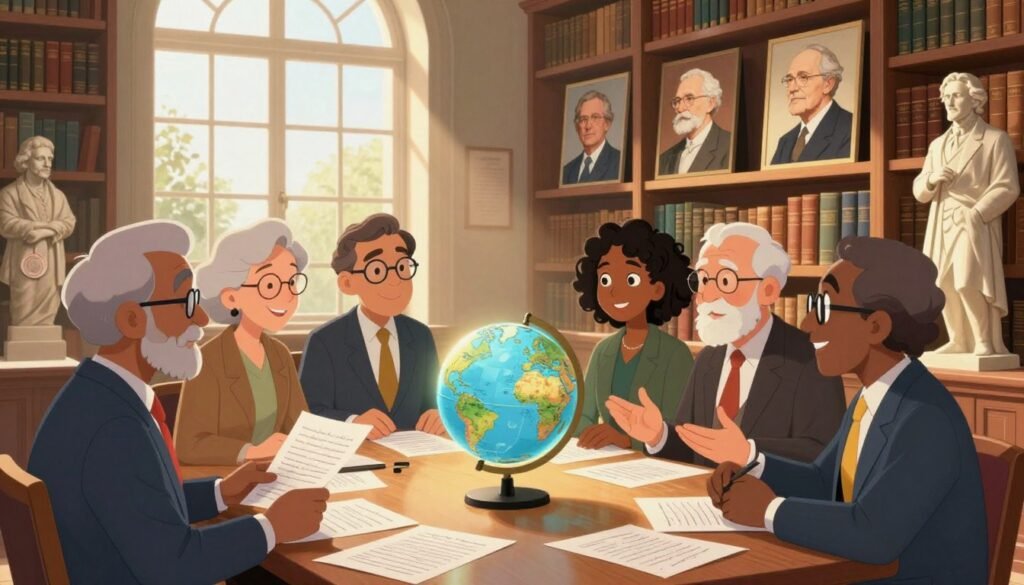
Their work shows us the power of curiosity and new ideas! We celebrate their wins to encourage more people to explore and think deeply. This way, we keep growing our knowledge.
Exploring the stories of Nobel Prize winners shows us how they’ve changed our world. Their work reminds us that science and discovery can make our future brighter for everyone!
Marie Curie: A Pioneer in Radioactivity
Marie Curie was the first woman to win a Nobel Prize. Her work in radioactivity opened doors for others. She was a true leader in science.
Marie Curie’s work on radioactivity was groundbreaking. She found polonium and radium with her husband Pierre. This helped us understand atoms better.
Breaking Barriers in Physics and Chemistry
Marie Curie worked in both physics and chemistry. She won Nobel Prizes in both fields. This shows her creativity and ability to mix disciplines.
Curie inspired many scientists with her work. She showed women they could work in STEM fields too.
The Lasting Impact of Radium Research
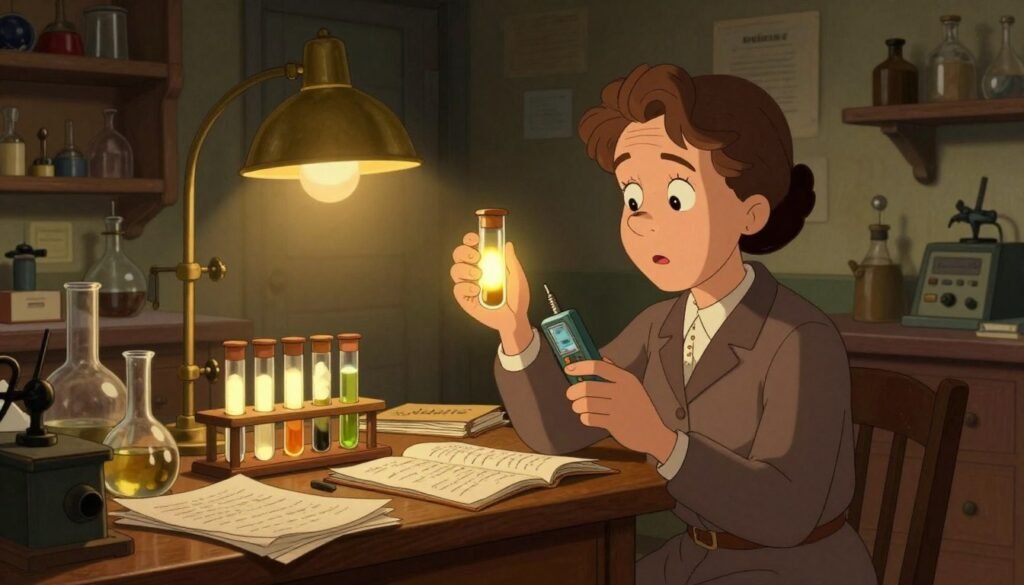
Marie Curie’s discovery of radium changed science and medicine. It led to new cancer treatments. It also helped us learn more about atoms.
We still use her discoveries today. Her work reminds us of the power of science. It inspires us to keep exploring and discovering!
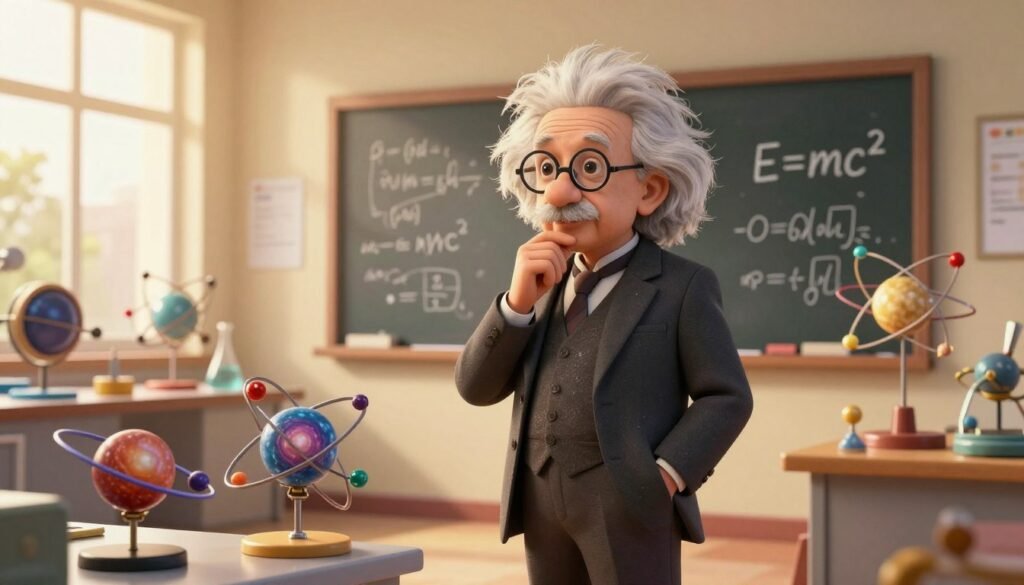
Albert Einstein: Revolutionizing Theoretical Physics
Albert Einstein changed how we see space and time. His work shows how important it is to keep asking questions. It shows the power of human curiosity.
Einstein’s work in theoretical physics helped us understand the universe better. He thought outside the box and made new discoveries. His ideas were very important.
The Miracle Year and the Photoelectric Effect
In 1905, Einstein had a special “miracle year”. He published four papers that changed physics. One paper explained the photoelectric effect.
This effect shows that light can act like particles. Einstein’s work on this topic won him the Nobel Prize in 1921. It helped start quantum mechanics.
General Relativity and the Modern Universe
Einstein’s biggest idea is general relativity, from 1915. It changed how we see gravity. He said gravity is not a force, but a bend in spacetime.
This idea has changed how we see the universe. It helps us understand black holes and how the universe grows. For more on time and the universe, check out Debsie’s exploration of time.
Einstein’s work still inspires people today. It shows the power of imagination and curiosity.
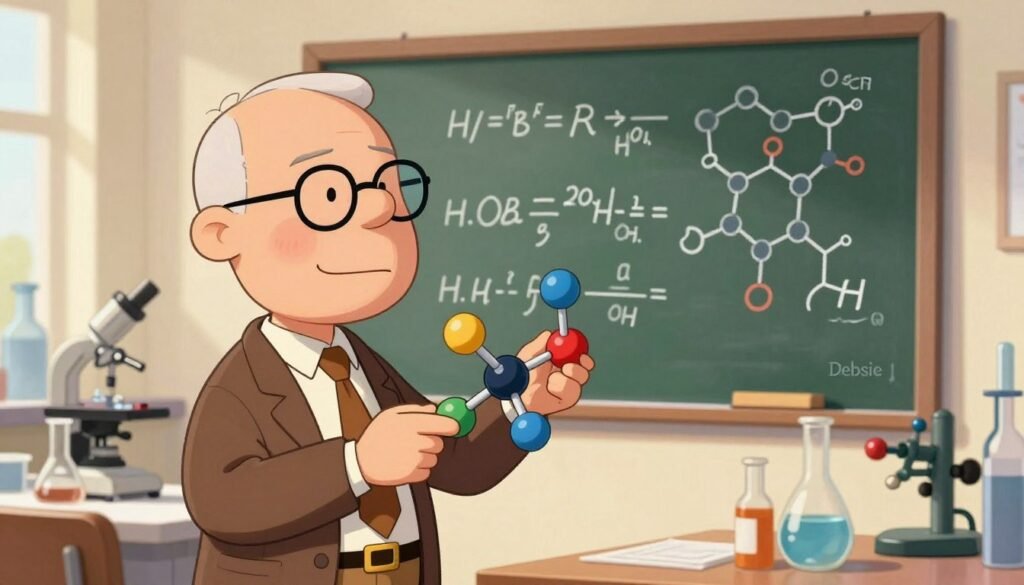
Linus Pauling: The Master of Chemical Bonding
Linus Pauling changed science a lot. He won two Nobel Prizes. His work helped us understand chemistry and peace better.
Defining the Nature of the Chemical Bond
Pauling changed chemistry with his work on chemical bonding. He figured out how molecules work. You can learn more about his discoveries.
He used quantum mechanics to understand molecules. This work won him the Nobel Prize in Chemistry in 1954!
Advocacy and the Nobel Peace Prize
Pauling was a great scientist and a strong peace advocate. He won the Nobel Peace Prize in 1962. You can find more about him on the Nobel Prize website.
He showed us how science can help society. His work teaches us about the power of science and activism for peace!
Barbara McClintock: Unlocking Genetic Transposition
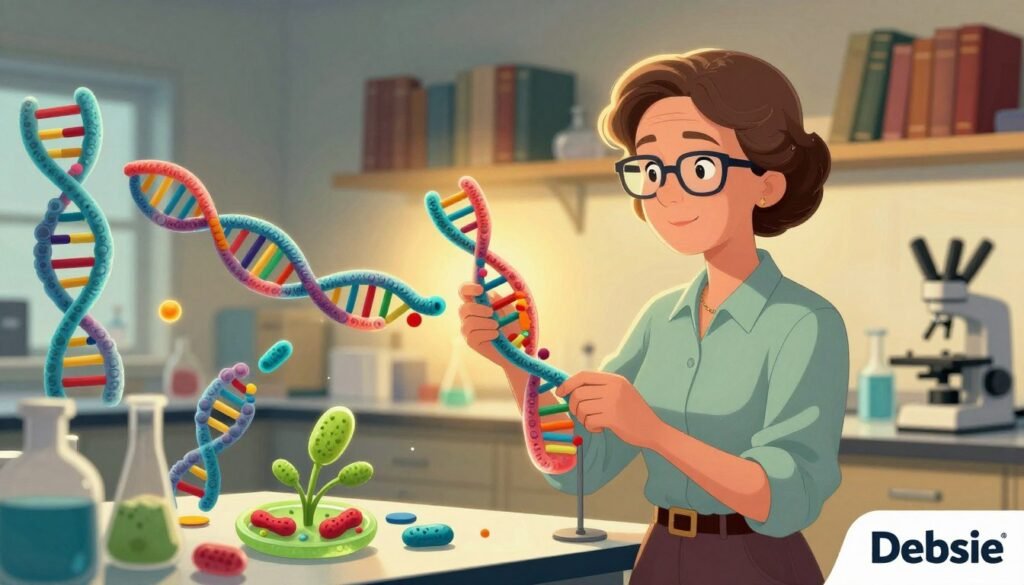
Barbara McClintock changed genetics and molecular biology with her work on transposons. She found “jumping genes.” This changed how we think about genes and opened new research paths.
The Discovery of Jumping Genes
McClintock studied maize genetics and found transposons. These are genes that move around in a genome. Her groundbreaking discovery was hard to believe at first but is now key in genetics.
Her work showed how transposons affect gene expression and add to genetic variety. Her findings have greatly changed our view of genetics. They also help in biotechnology and genetic engineering.
Persistence in the Face of Scientific Skepticism
Despite doubt, McClintock kept working, driven by her love for discovery. The Carnegie Science website calls her a true pioneer, ahead of her time.
Her hard work helped us understand genetic transposition better. McClintock’s story shows the power of creativity and determination in science. It inspires scientists everywhere.
Richard Feynman: Quantum Electrodynamics and Beyond
Richard Feynman changed how we see quantum electrodynamics. He won the Nobel Prize in Physics in 1965. His work made complex physics easier to understand.
Feynman made hard ideas simple. His work still shapes science today. You can learn more about Richard Feynman’s life and work to see his impact.
Visualizing Physics with Feynman Diagrams
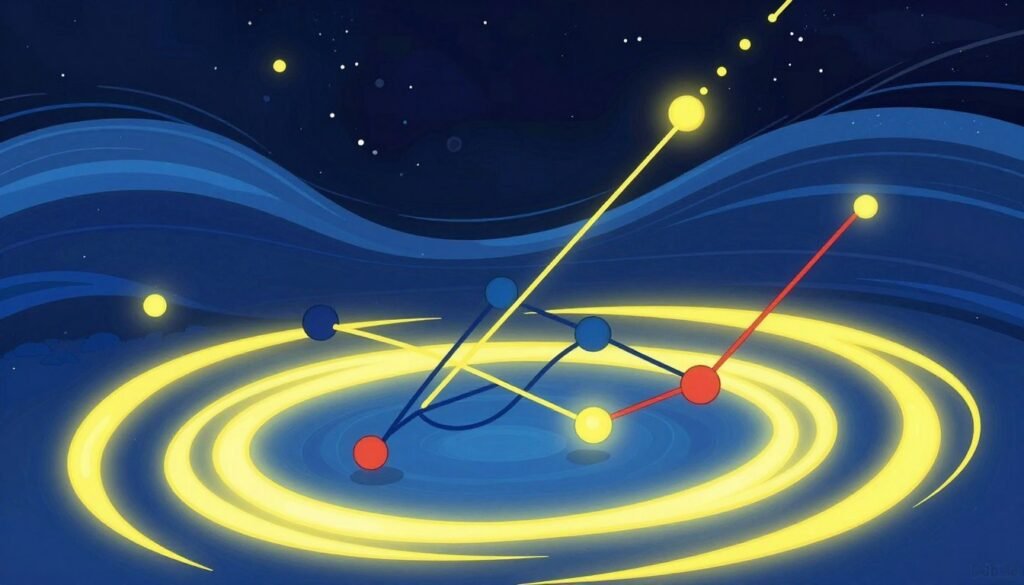
Feynman diagrams are a big part of his work. They are a way to show complex physics simply. These diagrams use lines and shapes to show how particles interact.
For example, they can show how an electron and a photon interact. This makes it easier to understand and calculate what happens. Feynman diagrams are key in particle physics.
The Feynman Lectures and Scientific Communication
Feynman was a great teacher. His lectures, “The Feynman Lectures on Physics,” are famous. They make science easy to understand for everyone.
“I think I can safely say that nobody understands quantum mechanics.” – Richard Feynman
Feynman’s quote shows how hard quantum mechanics is. But his work and teaching have helped many understand physics. He inspired many scientists and thinkers.
| Contribution | Impact |
|---|---|
| Feynman Diagrams | Simplified complex particle interactions, making calculations more manageable. |
| The Feynman Lectures | Made physics more accessible to students and the general public. |
| Quantum Electrodynamics | Revolutionized the understanding of particle physics and earned Feynman a Nobel Prize. |
Richard Feynman’s work is more than science. He showed us that science is about understanding the world in simple ways.
Dorothy Hodgkin: Mapping the Structures of Life
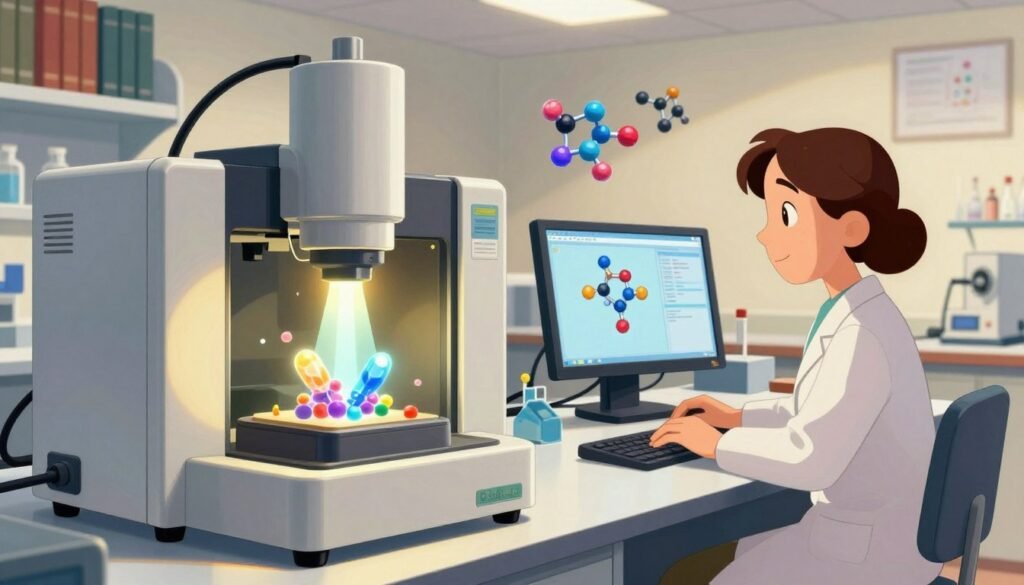
Meet Dorothy Hodgkin, a Nobel Prize winner. She used X-ray crystallography to map life’s structures. Her work helped us understand biomolecules and led to big medical wins.
Dorothy Hodgkin was a pioneer in X-ray crystallography. She figured out the shapes of important biomolecules like penicillin and insulin. This method uses X-rays to find out how atoms are arranged in a molecule.
X-ray Crystallography and Penicillin
Her work on penicillin was a big deal. Knowing its shape helped make new antibiotics. Hodgkin said in her Nobel lecture, “Finding penicillin’s shape was tough. But new methods and hard work helped us.” You can read more about her work in her Nobel lecture.
Advancing the Understanding of Insulin
Hodgkin also made big strides in insulin research. Figuring out insulin’s shape was hard because it’s big and complex. But her work helped us understand how insulin works in our bodies. It has made a big difference in diabetes research.
“The X-ray analysis of insulin was a long and difficult task, but it has given us a deeper understanding of the molecule’s structure and its biological activity.”
Hodgkin’s work has changed medicine and biochemistry a lot. Her legacy keeps inspiring scientists today!
Niels Bohr: Architect of the Atomic Model
Let’s explore the amazing story of Niels Bohr. He helped us understand the tiny building blocks of matter! His work on the atomic model and quantum mechanics won him the Nobel Prize in 1922. His ideas have changed how we see atoms and tiny particles.
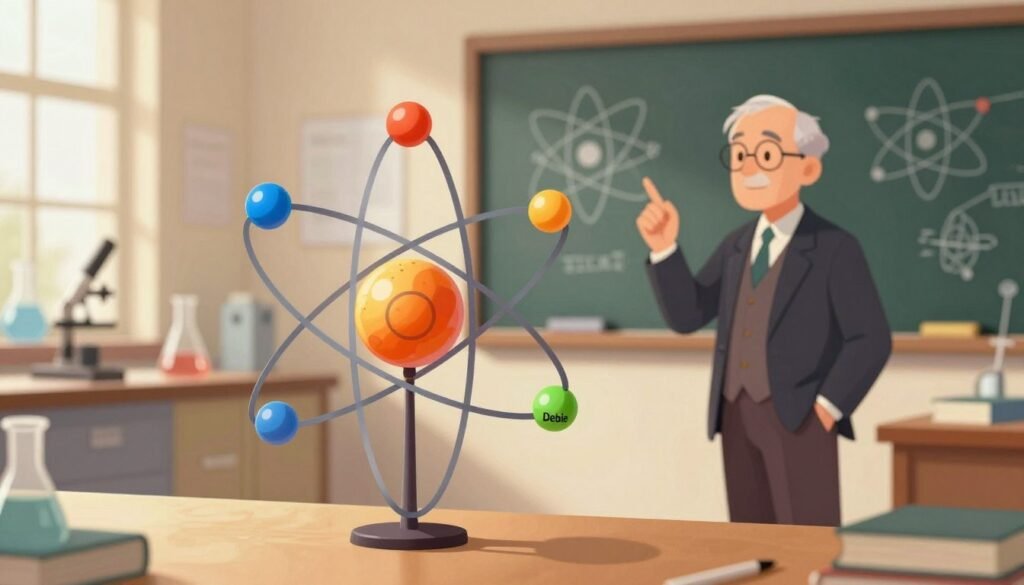
Bohr started by studying the secrets of the atomic structure. He came up with the Bohr Model of the Atom. This idea shows that atoms have a small, heavy center and electrons moving around it.
The Bohr Model of the Atom
The Bohr model was a big leap. It showed that electrons have specific places to be in an atom. This helped us understand how atoms take in and give out energy.
The key features of the Bohr model include:
| Feature | Description |
|---|---|
| Energy Levels | Electrons are arranged in specific energy levels or shells around the nucleus. |
| Electron Jump | Electrons jump from one energy level to another by emitting or absorbing energy. |
| Nuclear Stability | The model explains the stability of atoms based on the arrangement of electrons. |
The Copenhagen Interpretation of Quantum Mechanics
Bohr didn’t just work on the atomic model. He also helped create the Copenhagen Interpretation of Quantum Mechanics. This idea says that some things in the quantum world are just probabilities, not exact facts.
Bohr’s work has been very important. It has shaped our view of the atomic world. By looking at his work, we learn about the power of models and the role of interpretation in science.
Rosalind Franklin and the Nobel Controversy
Franklin’s data, known as Photo 51, helped find the double helix structure of DNA! She worked hard in X-ray crystallography to get this data.
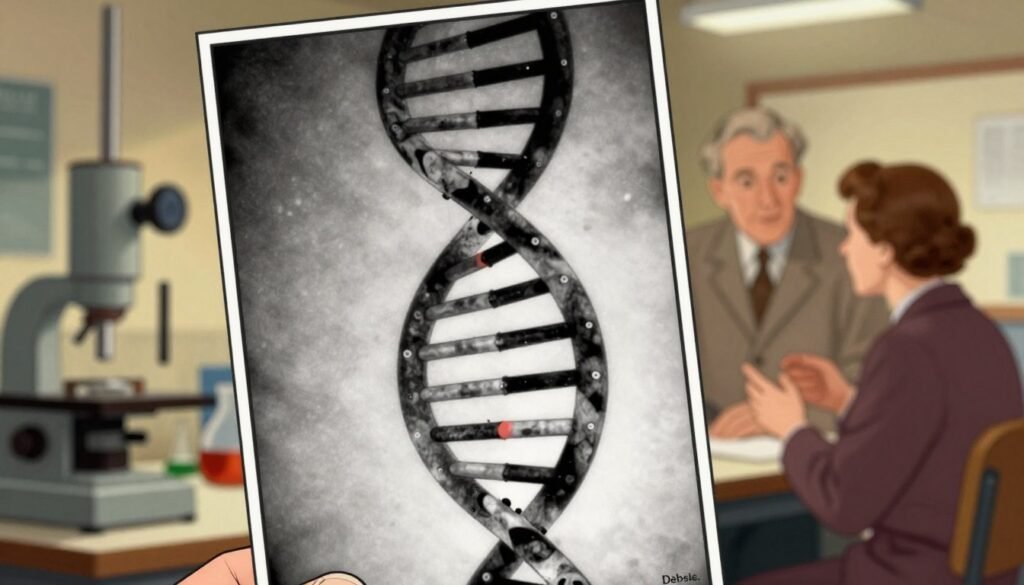
Photo 51 and the Double Helix
Rosalind Franklin worked at King’s College London. She took Photo 51, an X-ray image. This image showed the DNA’s double helix model.
James Watson and Francis Crick used this image. They made the famous DNA model. This was a big step in genetics and biology.
Learn more about Franklin’s story and how she might have been robbed of a Nobel. Check out this link to find out more.
Recognizing Contributions Beyond the Prize
Rosalind Franklin didn’t get a Nobel Prize for DNA. But her work is now seen as key to a big scientific find. We should honor all scientists, not just those who get awards.
Learning about Franklin’s life shows us the value of hard work and individual contributions. Start your science journey with Debsie’s fun courses!
Enrico Fermi: The Architect of the Nuclear Age
Enrico Fermi changed how we see nuclear physics. His work led to big steps in energy and understanding atoms.
Fermi did more than one thing. He changed nuclear and particle physics. He started the first controlled nuclear chain reaction with his team.
The First Controlled Nuclear Chain Reaction
On December 2, 1942, Fermi and his team did something big. They started the first controlled nuclear chain reaction. This was a huge step in nuclear science.
Fermi’s team worked hard to make this happen. They used graphite and uranium in a reactor. This success led to new ways to use nuclear energy.
| Year | Event | Significance |
|---|---|---|
| 1938 | Nobel Prize in Physics | Awarded for work on induced radioactivity |
| 1942 | First Controlled Nuclear Chain Reaction | Paved the way for nuclear energy |
| 1950s | Fermi’s Work on Particle Physics | Advanced understanding of subatomic particles |
Fermi Statistics and Particle Physics
Fermi did more than just nuclear reactions. Fermi statistics helped us understand particles. These particles are key to what makes up everything.
Fermi’s work in particle physics is still important today. It helps us in many fields, from materials to the universe itself. His work still inspires scientists.
Learning from the Greats with Debsie Gamified Courses
Discover the thrill of learning with Debsie’s Gamified Courses. Science comes alive here! We learn from Nobel Prize-winning scientists. This sparks a love for discovery in everyone.
At Debsie, we make science fun and easy to learn. Our courses inspire creativity and curiosity. They use fun ways to teach complex science ideas.

Applying Scientific Principles to Modern Education
We make learning exciting by using science’s best ideas. Our courses use real-life stories to teach science. This makes it easier to grasp and remember.
Interactive learning is our main focus. We think science should be fun. This way, more people can explore and understand our world.
How to Start Your Learning Journey at Debsie
Starting with Debsie is simple! Just visit our website at https://debsie.com/courses. We have courses for students, teachers, and science lovers.
Join our community today. Start your journey to understanding and loving science. Learning with Debsie is an adventure for the whole family!
Max Planck: The Father of Quantum Theory
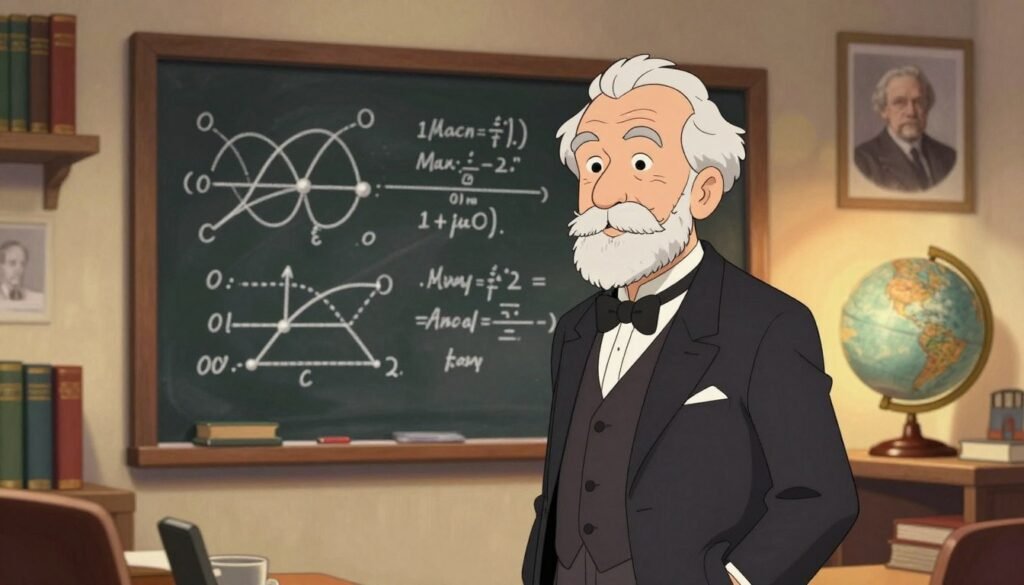
Let’s dive into Max Planck’s life and work. We’ll see how he started quantum theory. His work won him the Nobel Prize in Physics in 1918.
The Discovery of the Quantum of Action
Max Planck found the quantum of action. It’s a key part of modern physics. This was a big step in quantum theory.
Planck studied black-body radiation. He learned that energy comes in small packets, or quanta. This was new, unlike the old idea of energy as a wave.
Shifting the Paradigm of Classical Physics
Max Planck changed how we see physics. Albert Einstein said his work was a big challenge. It’s still a challenge today.
“All matter originates and exists only by virtue of a force which brings the particle of an atom to vibration and holds this most minute solar system of the atom together. We must assume behind this force the existence of a conscious and intelligent Mind. This Mind is the matrix of all matter.”
Planck’s work helped many scientists, like Einstein and Niels Bohr. His legacy keeps inspiring new scientists.
Elizabeth Blackburn: Telomeres and the Secret of Aging
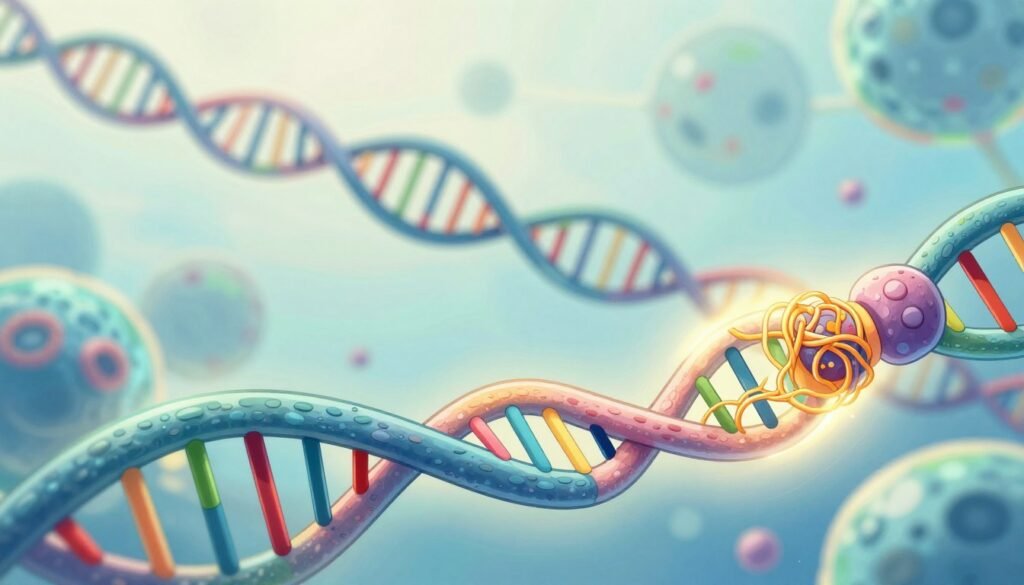
Elizabeth Blackburn changed how we see aging with her telomere research! Telomeres protect our chromosomes. Her work shows how they affect aging.
The Discovery of Telomerase
Blackburn found telomerase, a key enzyme. It helps rebuild telomeres. This is big for understanding aging and age-related diseases.
Let’s look at telomerase’s role:
| Aspect | Description | Implication |
|---|---|---|
| Telomerase Activity | Rebuilds telomeres, maintaining their length | Allows cells to divide more times |
| Presence in Cells | Active in stem cells and cancer cells | Impacts cellular aging and cancer development |
| Research Implications | Understanding telomerase’s role in aging and cancer | Potential therapeutic targets for age-related diseases |
Implications for Medicine and Longevity
Telomerase’s discovery is a big deal for aging and medicine! Scientists are studying it for new treatments. They hope to help people live longer and healthier.
Elizabeth Blackburn’s work is key in aging research. It guides us and inspires new discoveries!
Conclusion
Marie Curie, Albert Einstein, and Linus Pauling show us the power of curiosity and smart thinking. They have helped us understand the world better. They also inspired many to work in science, writing, and peace.
We should keep exploring and learning more. You can find out more about Nobel Prize winners and their work on the Nobel Prize website.
Their work inspires us to be innovators and thinkers. By celebrating their achievements, we want to encourage a new generation to explore and discover!