Have you ever looked at the bright stars and wondered how they stay in the sky? We often feel that same spark of wonder here at Debsie! It all starts with a single question that can change the whole world forever.
A long time ago, a brilliant English polymath asked those very same questions. This amazing thinker was a mathematician and an explorer of the universe who mastered the laws of nature. You can learn about this famous scientist to see how curiosity leads to greatness!
His incredible journey led to many Isaac Newton discoveries that still help us understand gravity today. You can even start your own adventure by trying out Debsie Gamified Courses to grow your brain and play while you learn! We love helping every child discover their inner genius through fun games.
Reading a scientific biography shows us that even a small boy from a farm can become a legend. He proved that the same simple laws move a tiny falling apple and the giant moon! Let’s explore the life of a man who truly changed everything we know about the physical world.
Key Takeaways
- Newton was a leading figure in the Scientific Revolution and Enlightenment.
- He developed the law of universal gravitation to explain how planets move.
- The scientist co-developed calculus, a powerful new type of mathematics.
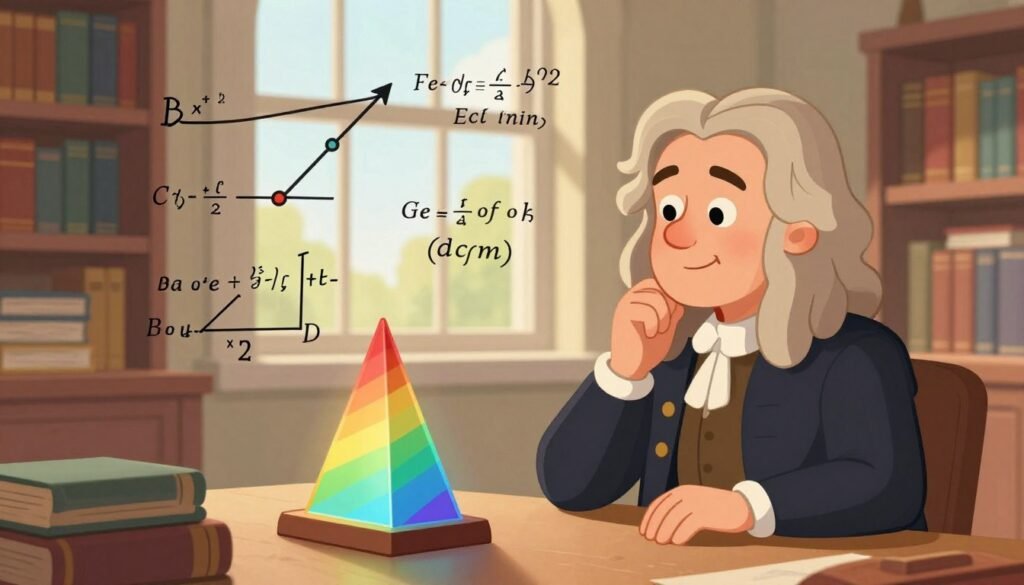
- His work with prisms proved that white light is made of many colors.
- He built the first reflecting telescope to study the stars more clearly.
- His three laws of motion are still the foundation for modern physics.
The Early Life and Formative Years of Isaac Newton
Isaac Newton was born in Woolsthorpe, Lincolnshire, England. He was born on January 4, 1643. His father died before he was born.
Newton’s mother remarried, leaving him with his grandmother. This time alone helped him start his love for learning. You can learn more about Newton’s personal life and how it influenced his work.
A Solitary Childhood in Woolsthorpe
Newton grew up in Woolsthorpe, feeling quite alone. His mother remarried and his father died before he was born. But, he was very curious about the world.
He started to like making simple machines and models. This showed his talent for understanding how things work.
| Aspect | Description | Impact on Newton |
|---|---|---|
| Family Background | Father died before birth; mother remarried | Raised by grandmother, leading to a solitary childhood |
| Early Interests | Mechanic inventions and natural phenomena | Developed curiosity and foundational knowledge for future scientific pursuits |
| Education | Initially local schooling | Layed the groundwork for further academic endeavors |
Academic Awakening at Trinity College
Newton’s education really took off at Trinity College, Cambridge. There, he met the works of famous scientists and mathematicians. This greatly influenced his learning.
At Trinity College, Newton learned a lot about math and science. This was the start of his amazing work. His time there was very important for his growth.
Newton’s early years were very important for his future. Being alone as a child and going to Trinity College helped him become a famous scientist.
The Comprehensive Isaac Newton Biography
Isaac Newton’s life was filled with hard work and a love for learning! His journey changed the way we see science today.
At Cambridge University, the Great Plague of London in 1665 changed everything. The university closed, and Newton went back to Woolsthorpe. This time, known as his ‘annus mirabilis’ or miracle year, was very important for Newton. He worked on calculus, optics, and his theory of universal gravitation.
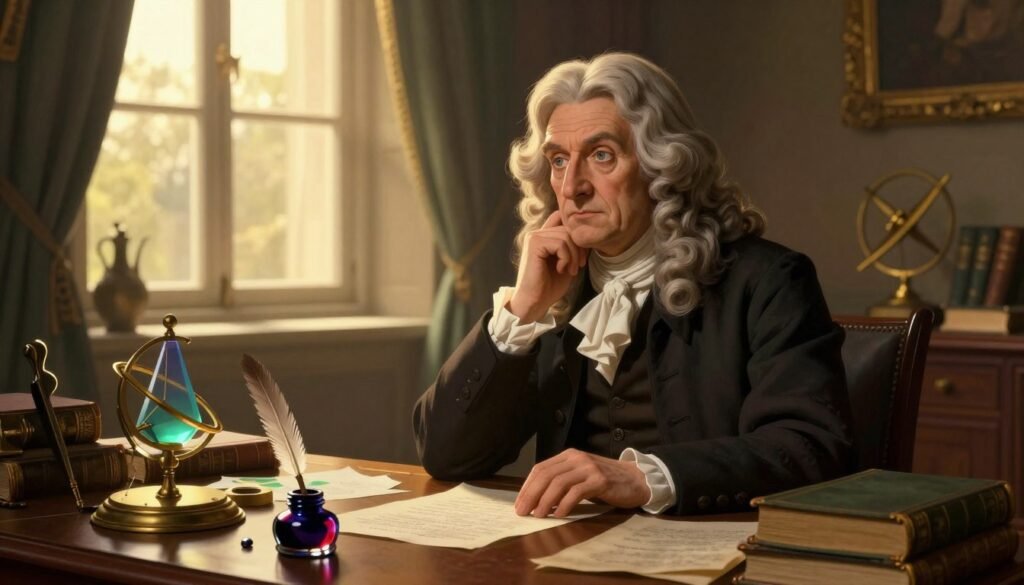
During the plague, Newton started working on calculus. He also studied light and color with prisms and lenses. His thoughts on the sky led to his law of universal gravitation.
Navigating the Plague Years
The plague years helped Newton focus on his work. He could solve math problems and do experiments without distractions. This time was key in shaping his scientific ideas.
Rise to the Lucasian Chair of Mathematics
In 1669, Newton became the Lucasian Professor of Mathematics at Cambridge University. This was a big honor for him as a mathematician and scientist. As a professor, he taught math and did research. His work made a big impact on math and physics.
The Revolutionary Principia Mathematica
Newton’sPhilosophiæ Naturalis Principia Mathematica changed physics and astronomy forever! It came out in 1687. This book started classical mechanics and how we see the universe.
It showed Newton’s laws of motion and gravity. This changed how we see the world.
Defining the Laws of Motion
Newton’s laws of motion are key. They tell us how objects move and react to forces.
– The first law says objects stay still or keep moving unless a force stops them.
– The second law links an object’s motion to the force on it and its mass, F=ma.
– The third law says every action has an equal opposite reaction.
These laws were big because they helped us understand and predict motion. They work on Earth and in space.
| Newton’s Law | Description | Formula |
|---|---|---|
| First Law | Law of Inertia | No net force, no change in motion |
| Second Law | Force and Acceleration | F = ma |
| Third Law | Action and Reaction | F₁ = -F₂ |
The Mathematical Foundation of the Universe
The Principia Mathematica introduced Newton’s laws and the math for the universe. Newton used calculus, even though it’s not in the book. His math and methods raised the bar for science.
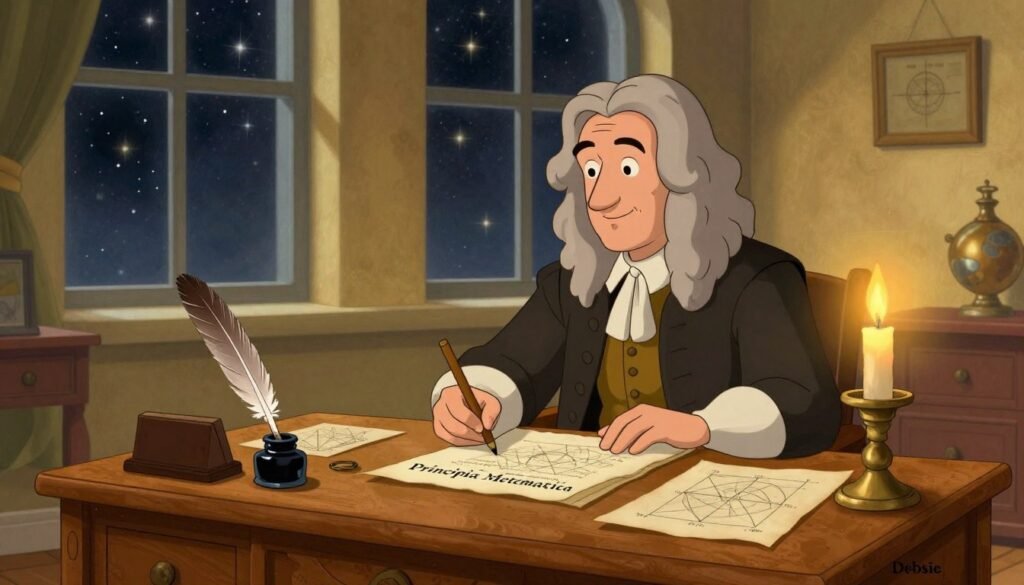
Newton mixed math with science to understand the world. His work has shaped physics and astronomy for centuries.
Unlocking the Secrets of Universal Gravitation
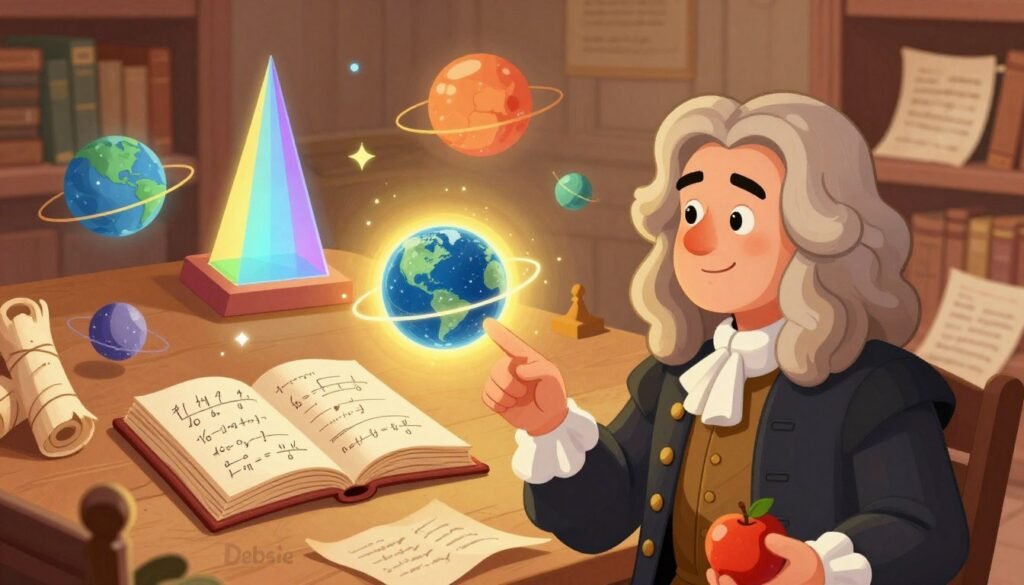
Newton’s theory of universal gravitation explained more than just an apple falling. It also showed how planets move. This idea changed how we see the universe. It showed how everything in the sky moves together under one big force.
The Apple Legend Versus Scientific Reality
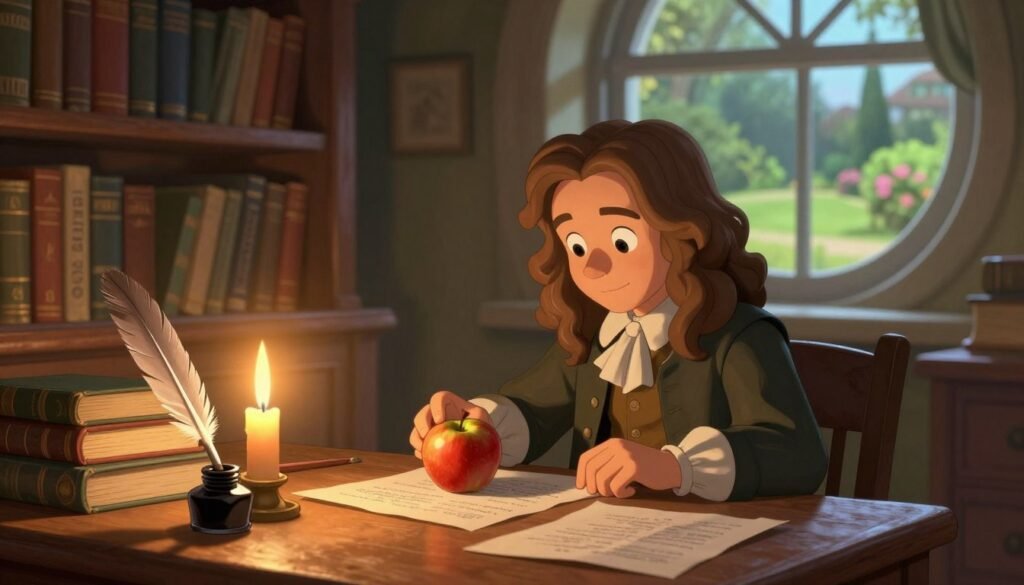
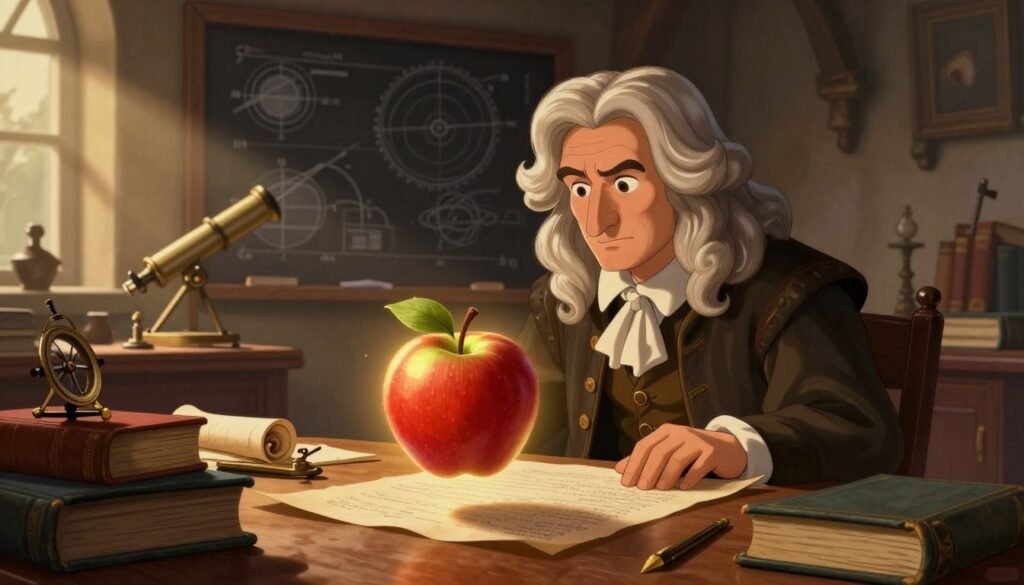
The story of Newton and the apple is famous. But what does it really tell us about gravity? The story might be more legend than truth. Yet, it shows when Newton started to understand gravity’s big role.
His wonder about the apple falling led him to study gravity more. We can learn more about Newton’s work and its effects on science fromESA’s article on Isaac Newtonand our XMM.
Calculating the Orbits of Planets
Newton’s work on gravity helped us understand planet orbits. He used his law of gravity to explain how planets move. This showed that the same force that pulls an apple down also moves planets.
This big step forward in physics proved the Copernican model right. It also started classical mechanics.
Newton’s work on gravity has changed how we see the universe. By studying gravity, we learn about planets, stars, and galaxies. His work still inspires scientists and engineers today!
Pioneering Work in the Field of Optics
Isaac Newton changed how we see light and its secrets. His work in optics was a big step for science.
Newton’s work in optics was huge. He used prisms and made the reflecting telescope. These show his creative mind!
The Nature of White Light and Prisms
Newton’s famous experiment used a prism and white light. It showed white light is made of many colors.
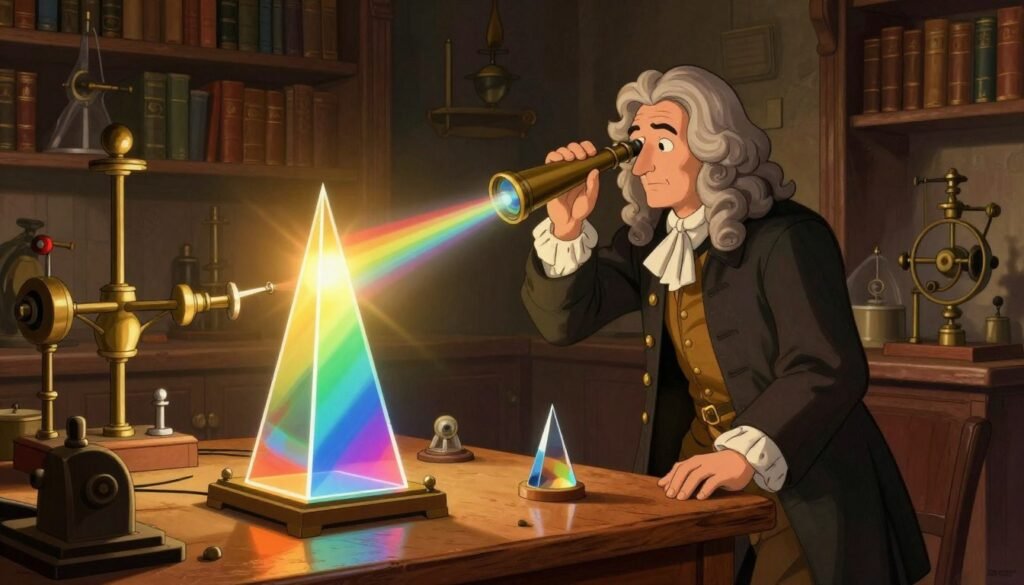
By using a prism, Newton split white light into colors. This was a big find. You can try it at home with a prism and light.
Invention of the Reflecting Telescope
Newton also helped astronomy with the reflecting telescope. It let people see the sky better, helping future astronomers.
The reflecting telescope uses a mirror to show images. Newton fixed a problem with old telescopes. This made seeing stars better and was a big tech step!
The Development of Calculus
Calculus started with Sir Isaac Newton and German mathematician Gottfried Wilhelm Leibniz. They worked on it around the same time. Newton focused on the study of rates of change and accumulation. He used the method of fluxions.
Leibniz, on the other hand, used the term “differentials” and “integrals.” He created the notation we use today. This notation makes calculus easier to understand and work with.
Both Newton and Leibniz made important contributions to calculus. Their work laid the foundation for many scientific and mathematical discoveries. It has greatly influenced fields like physics, engineering, and economics.
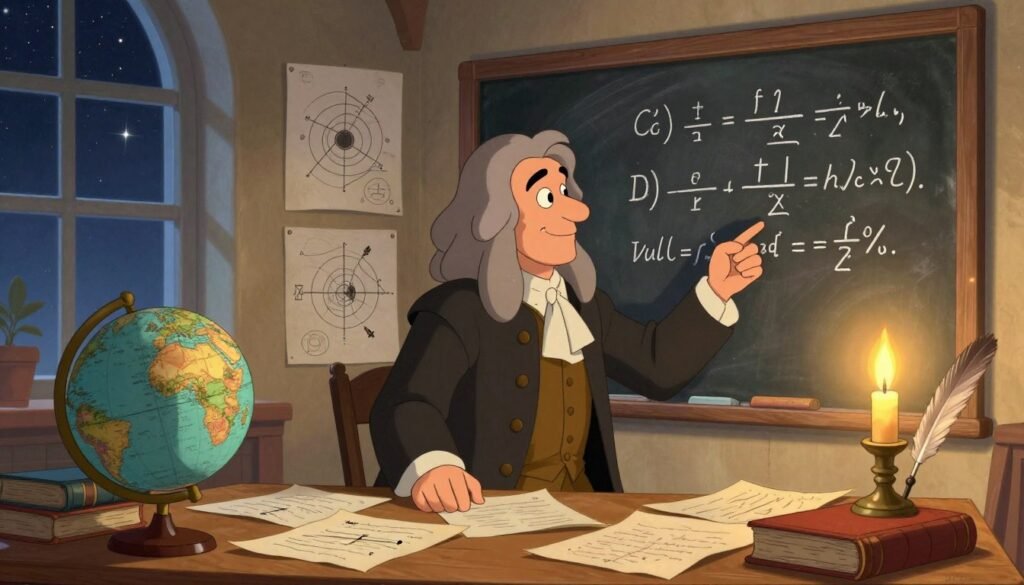
Calculus is a powerful tool that helps us solve problems in various areas. It allows us to analyze and model real-world phenomena. This makes it essential for scientific research and technological advancements.
Master of the Royal Mint
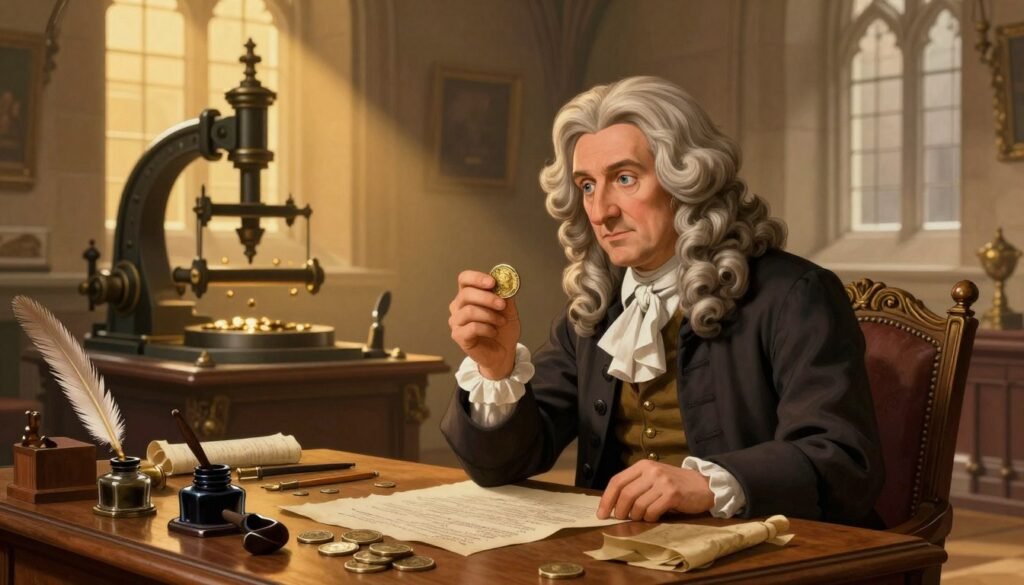
Isaac Newton became Master of the Royal Mint in 1699. This was a big change for him. He used his sharp mind and hard work in finance.
Newton’s job was to make coins and keep the money safe. He was very good at it.
Newton worked hard to stop fake money. He was very thorough and creative in his fight against it.
Combating Counterfeiting in London
London had a big problem with fake money. It hurt the economy and made people lose trust. Newton wanted to stop it.
He used science to find and catch the fake money makers. He worked very hard to do this.
Thanks to Newton, less fake money was made. He helped the economy and people’s trust in money.
Administrative Rigor and Public Service
Newton was very good at his job at the Royal Mint. He made the money-making process better and safer. He worked very hard and paid attention to details.
Newton was good at many things, not just science. He was passionate and skilled in finance too. His work at the Royal Mint shows how dedicated he was to helping others.
Newton’s work at the Royal Mint shows he was more than just a scientist. He made a big difference in many areas, including money.
Alchemy and the Esoteric Interests of Newton
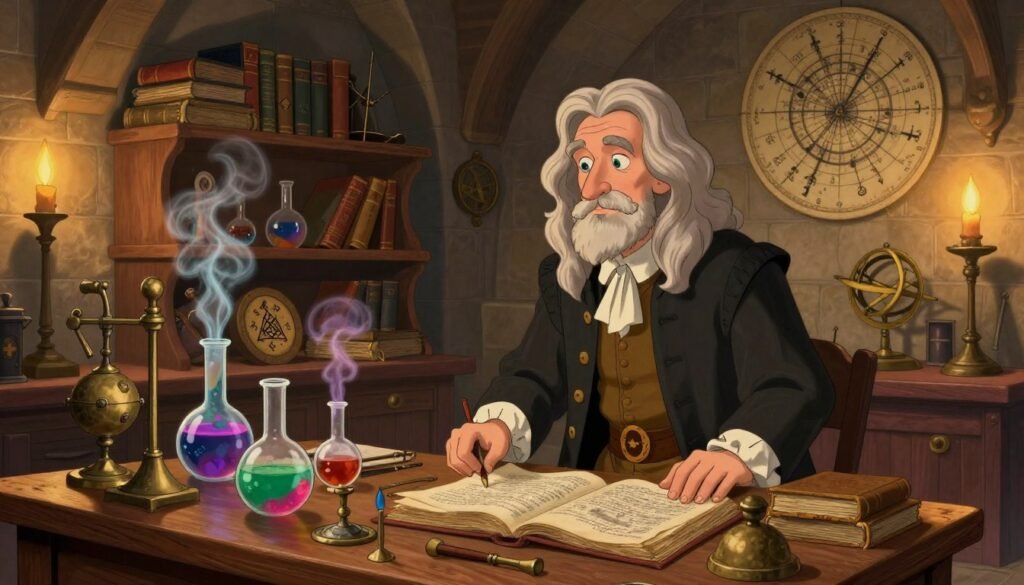
Isaac Newton loved alchemy, a secret part of his life. His work in alchemy shows how wide his interests were. It’s not as well-known as his work in physics and math.
Newton wrote a lot about alchemy. He left behind many papers about his experiments and ideas. His alchemy was not just a fun thing to do. It was a serious study that mixed science and mysticism.
The Search for the Philosopher’s Stone
Newton wanted to find the Philosopher’s Stone. This magical thing could turn simple metals into gold and give eternal life. His writings show he was really into alchemy.
He wasn’t just looking for gold. Newton wanted to understand the secrets of nature. His search shows his deep curiosity about the world.
Bridging Science and Mysticism
Newton’s alchemy connected science and mysticism. His famous work in physics and math helped start modern science. But his alchemy showed another side of him.
Looking at Newton’s alchemy helps us see his time better. It shows how scientists and thinkers thought back then. They mixed facts and ideas in their work.
Newton’s many interests show us that lines between fields are not always clear. Understanding this can make us see history and science in a new way.
The Royal Society and Scientific Leadership
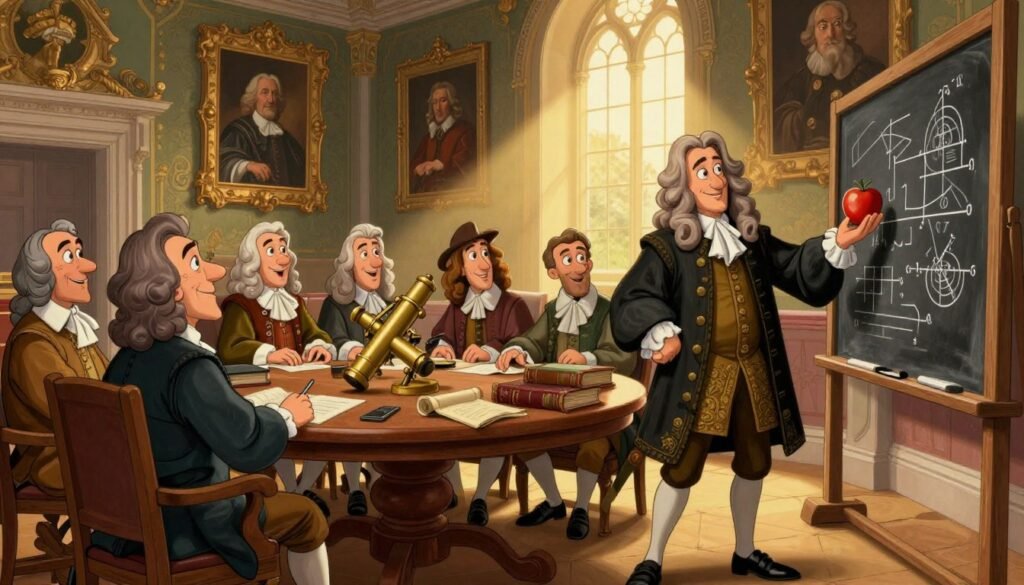
Isaac Newton was the president of the Royal Society. He helped make the Royal Society a place for new ideas. Newton’s work helped start many new scientific discoveries.
Establishing Scientific Standards
Newton became president of the Royal Society in 1703. He made science better by setting high standards. He pushed for careful methods and tests.
The Royal Society says Newton was key in shaping its history. He made sure science was done well.
Newton did many important things:
- He pushed for research based on facts!
- He encouraged scientists to work together!
- He set rules for publishing and checking each other’s work!
Newton made science better by focusing on facts. He said, “If I have seen further, it is by standing on the shoulders of giants.” This shows he valued learning from others.
“If I have seen further, it is by standing on the shoulders of giants.”
Newton’s Influence on Future Generations
Newton’s work has greatly influenced scientists for a long time. His work in physics and math helped start classical mechanics. This has helped many scientists for centuries.
| Scientist | Contribution | Influence by Newton |
|---|---|---|
| Albert Einstein | Theory of Relativity | Built upon Newton’s laws to develop modern physics! |
| Joseph-Louis Lagrange | Analytical Mechanics | Expanded on Newton’s work in mechanics! |
| William Herschel | Astronomical Discoveries | Used Newton’s principles to understand celestial mechanics! |
Newton’s work still inspires scientists today. His discoveries are key to understanding our universe. We keep learning because of giants like Newton!
Gamifying Your Learning Journey with Debsie
Learning is now more fun with Debsie’s gamified courses! We think education should be exciting, not boring. That’s why we make learning fun for everyone.
Interactive education really works. It makes learning fun and easy. Debsie uses games to help you understand hard topics. This is backed by research, like studies on gamifying the past.
Why Interactive Education Matters
Old ways of learning can be dull. Interactive education makes you part of the action. It’s about learning by doing and feeling the subject matter.
Debsie’s learning platforms fit different learning styles. So, every student finds a way that works for them. Whether you learn best by seeing, hearing, or doing, we’ve got you covered.

Explore Debsie Gamified Courses for Science Enthusiasts
Debsie has gamified courses for science lovers. Our courses cover physics and more. They’re designed to challenge and inspire you. Check out our courses at https://debsie.com/courses.
For physics fans, our top physics tutors and classes are a must-see. Our platform helps you learn complex ideas and stay motivated.
Join Debsie today for a better learning experience! We can’t wait to have you!
The Lasting Impact of Isaac Newton Discoveries
Isaac Newton’s discoveries have greatly changed modern science! His work helped start the Enlightenment and classical mechanics. His ideas still shape science today.
Shaping the Enlightenment Era
Newton’s science and math helped shape the Enlightenment. His work on universal gravitation and laws of motion changed how we see the world. This inspired scientists and thinkers.
The Enlightenment valued reason and curiosity. Newton’s focus on evidence and method set a new standard. His scientific approach influenced many.
Foundations for Classical Mechanics
Newton’s work started classical mechanics. This is the study of big objects moving under forces. His laws and gravitation gave us a way to understand physical systems.
Newton’s laws are used in many fields, like astronomy and engineering. His laws help us make accurate predictions about complex systems.
Today, Newton’s work is still important in science and tech. His discoveries are key to understanding our world. They help in designing machines and exploring space!
Newton’s Complex Personality and Rivalries
Isaac Newton was more than just a scientist. He had a complex personality that shaped his life and work. Let’s explore the interesting sides of his character and the rivalries he faced.
Newton was very focused on his work. He often forgot about his health and friends. This focus helped him make big discoveries but also made him hard to get along with.
Conflicts with Robert Hooke
Newton had a big fight with Robert Hooke. Hooke was a famous scientist who studied light and tiny things. They disagreed a lot, mainly about light and color.
“The scientific man does not aim at an immediate result. He does not expect that an advanced idea will be readily taken up. His work is like that of the planter — for the future. His duty is to lay the foundation for those who are to come, and point the way.”
This quote shows the spirit of science and the challenges faced by pioneers like Newton.
The fight between Newton and Hooke was not just about science. It was also about personal differences and jealousy. Hooke’s criticism of Newton’s work on light was a big issue between them.
| Aspect | Newton | Hooke |
|---|---|---|
| View on Light | Corpuscular theory | Wave theory |
| Contribution | Laws of motion, universal gravitation | Work on elasticity, microscopic observations |
| Personality | Solitary, intensely focused | Assertive, critical |
The Solitary Genius Behind the Science
Newton was a solitary person, deeply dedicated to his work. His ability to focus and keep going despite criticism was key to his success.
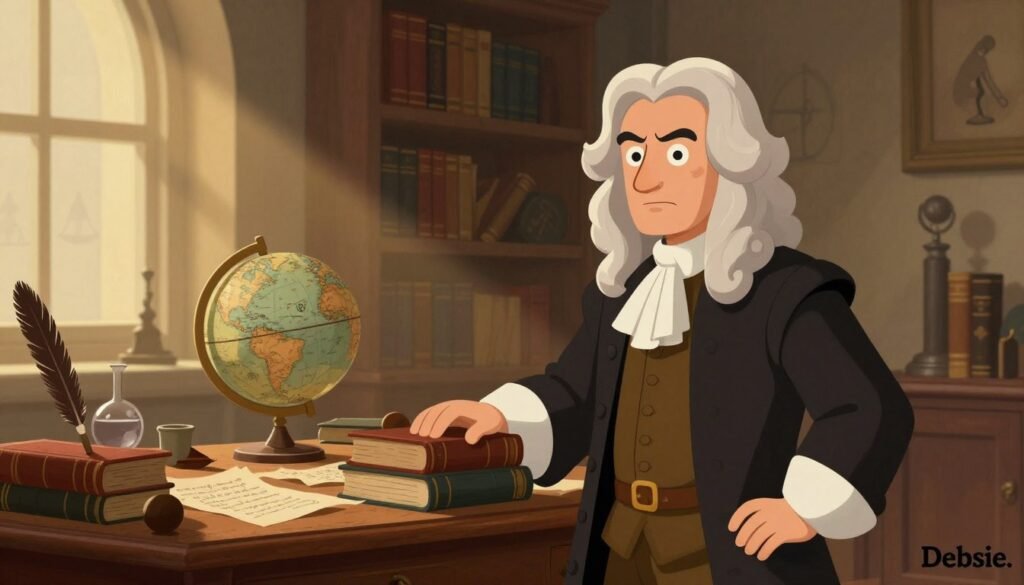
Newton’s focus and dedication led to huge scientific contributions. His legacy inspires scientists and learners everywhere!
The Legacy of Newtonian Physics in the Modern World
Isaac Newton’s discoveries still shape our world today! His work started classical mechanics. It has greatly influenced modern science.
From Space Exploration to Everyday Engineering
Newton’s laws help in space travel. Space agencies use them to plan paths and understand gravity. For example, NASA plots Mars trips with Newton’s laws.
Newton’s work also affects daily engineering. Roller coasters, bridges, and machines all use his principles.
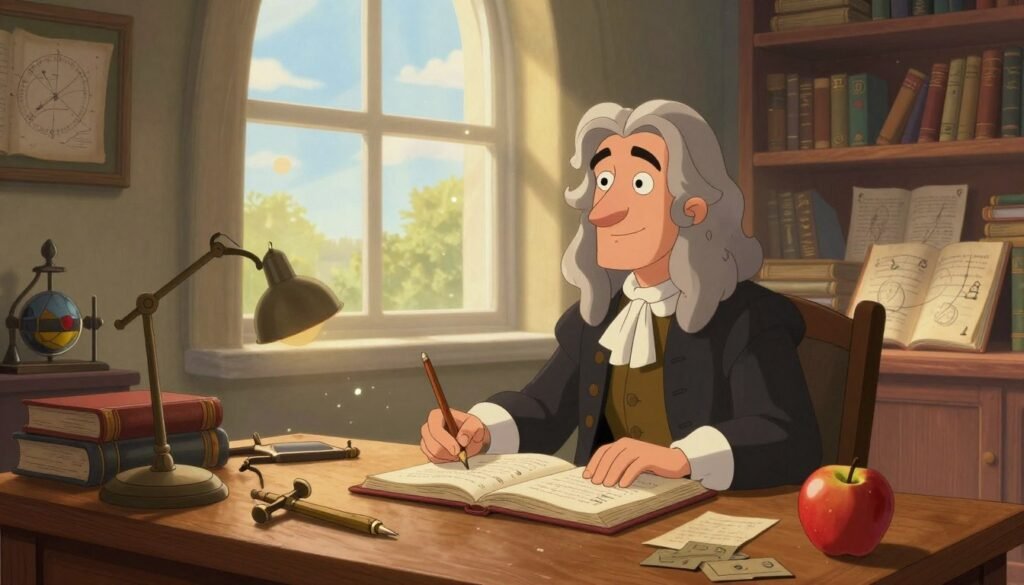
Why Newton Remains Relevant Today
Newton’s discoveries are still key as we grow technologically.
“Newton’s work is a testament to the power of human curiosity and the importance of foundational scientific research.”
His laws are taught everywhere. They help us understand the physical world.
Newton’s laws are simple yet powerful. They keep inspiring scientists and engineers.
Conclusion
Isaac Newton’s work still inspires people all over the world! His big discoveries in physics and math have changed how we see the universe.
Newton’s laws of motion and gravity helped start classical mechanics. His work in optics and calculus also helped shape science today.
We can keep exploring science with fun learning! Debsie’s games make learning exciting. Start your journey today at https://debsie.com/courses and see the fun of science!
The story of Isaac Newton shows us the power of being curious and dedicated. Newton’s work reminds us that science is always an adventure, full of new discoveries.