
Ever wonder how your tablet picks your favorite game? It’s not magic. It’s thanks to smart people working hard. We’re excited to introduce you to the pioneers of machine learning.
These scientists are changing our world. They make artificial intelligence possible for all. Names like Andrew Ng and Fei-Fei Li show us anything is possible with curiosity and heart.
Imagine your child becoming as influential as Geoffrey Hinton or Daphne Koller. Their stories inspire us to dream big. We believe every child can lead in technology and innovation.
We want your family to join this exciting journey. Try Debsie Gamified Courses at https://debsie.com/courses. Leaders like Yann LeCun and Demis Hassabis are shaping our future.
Key Takeaways
- Discover the brilliant minds like Andrej Karpathy and Ian Goodfellow who shape our world.
- Learn how modern technology helps us solve big problems and stay connected.
- Understand the basic ideas behind the tools we use every day at home.
- Find inspiration from leaders like Rana el Kaliouby and Ruslan Salakhutdinov.
- Explore how gamified learning makes complex subjects fun for children and parents.
- Get ready to start your own educational journey with the best resources available.
The Pioneers Who Defined the Foundations of Artificial Intelligence
The start of Artificial Intelligence was made by visionaries. Their work still shapes AI today! We find pioneers like Alan Turing and John McCarthy. They changed AI forever.
Alan Turing and the Birth of Computational Logic
Alan Turing is called the father of computer science. He worked on how computers think. His ideas, like the Turing Machine, are key to AI.
Turing’s work still guides AI today. You can learn more about his ideas and AI by checking out resources on computational theory!
John McCarthy and the Coining of Artificial Intelligence
John McCarthy coined the term “Artificial Intelligence”. He also started the 1956 Dartmouth Conference. This was the start of AI as we know it.
The Dartmouth Conference was a big deal. It brought together experts to talk about smart machines. McCarthy’s work helped AI grow.
Learning about these pioneers is your first step into AI. Keep exploring with Debsie’s fun AI courses at https://debsie.com/courses. See how you can help shape tech’s future!
Geoffrey Hinton and the Deep Learning Revolution
Geoffrey Hinton is called the ‘Godfather of Deep Learning.’ He has changed artificial intelligence a lot. His work lets machines learn and get better by themselves. This has led to big steps forward in AI.
The Backpropagation Breakthrough
Hinton made the backpropagation algorithm for deep neural networks. This algorithm helps networks learn from mistakes. They get better over time.
In an interview with MIT Technology Review, Hinton talked about his big win with backpropagation.
Impact on Modern Neural Networks
Hinton’s work has greatly changed neural networks today. Deep learning uses these networks in many areas. This includes things like recognizing images and understanding language.
Now, you can learn more about deep learning and neural networks. You can do it through fun and personal courses on Debsie.
Yann LeCun and the Evolution of Computer Vision
Yann LeCun’s work on convolutional neural networks has changed how machines see and understand pictures. His work has made computer vision better. Now, machines can recognize images and find objects.
LeCun’s ideas have made AI better. They have helped us learn more about computer vision. We need to know about the key technologies that have made this progress.
Convolutional Neural Networks Explained
Convolutional Neural Networks (CNNs) are special AI models for pictures. They are good at handling image data. CNNs learn from pictures by using special layers.
CNNs find patterns in pictures. They use these patterns to understand images better. This is why they are so good at computer vision tasks.

Contributions to Meta and Open Source AI
Yann LeCun has done more than just research. He has helped make AI open-source and advanced AI research at Meta. You can read about his work on the Meta AI blog.
LeCun has shared his work and helped others. This has made AI better and faster. His openness has helped AI grow.
To learn more about AI and computer vision, check out Debsie’s courses at https://debsie.com/courses. They make learning fun and interactive.
Yoshua Bengio and the Architecture of Language Models
Language models have gotten really smart. Yoshua Bengio’s work on probabilistic models and sequence learning has led the way. His research lets machines talk like us, opening up new AI uses.
Probabilistic Models and Sequence Learning
Yoshua Bengio’s work on probabilistic models has changed natural language processing. He made models that learn from data sequences. Now, AI can write and guess text really well.
Some key parts of his work are:
- Creating probabilistic models for complex data sequences.
- Improving sequence learning for AI to talk like us.
- Pushing deep learning forward with neural networks.
Advocacy for Ethical AI Development
Bengio is also big on ethical AI development. He says AI should be clear, fair, and good for everyone.
He pushes for ethical AI practices. This way, AI is made with care for human values and happiness.
Fei-Fei Li and the Democratization of AI Data
Fei-Fei Li is leading the way in making AI data available to everyone. Her work has made AI more open and fair for all.
Fei-Fei Li has changed the game with AI data. She helped create better image recognition systems.
The ImageNet Project and Its Legacy
The ImageNet project, led by Fei-Fei Li, was huge. It had millions of images for AI to learn from.

ImageNet’s impact is huge. It made AI data available to everyone. You can learn more about it at Fei-Fei Li’s AI discussion.
Human-Centered AI Initiatives
Fei-Fei Li also focuses on human-centered AI. She wants AI to respect human values and needs.
Her work ensures AI is used wisely. This way, AI helps everyone, not just a few. Fei-Fei Li is making AI better and fairer for the future.
Demis Hassabis and the Quest for Artificial General Intelligence
Demis Hassabis is leading the charge in artificial general intelligence. He’s pushing AI to new heights. His work is inspiring many in the field.
As DeepMind’s leader, Demis has led many important projects. He’s made big strides in AI. His work includes AlphaGo and AlphaFold.
DeepMind and AlphaGo Success
AlphaGo stunned the world in 2016. It beat a human Go champion. This was a big win for AI.
AlphaGo used new tech to win. It mixed neural networks with tree search. This let it play Go better than humans.
Solving Protein Folding with AlphaFold
AlphaFold is another big win for DeepMind. It predicts protein structures from amino acid sequences. This is key for drug discovery and disease understanding.
AlphaFold has changed the game. It’s a powerful tool for scientists. It helps find new ways to treat diseases.
| AI System | Application | Impact |
|---|---|---|
| AlphaGo | Playing Go | Demonstrated AI’s capability in complex strategy games |
| AlphaFold | Predicting Protein Structures | Revolutionized biomedicine and drug discovery |
Demis Hassabis keeps pushing AI forward. You can learn more about AI at Debsie Gamified Courses.
Andrew Ng and the Scaling of AI Education
Andrew Ng is making AI education available to everyone! He founded Coursera and DeepLearning.AI to share AI knowledge worldwide.
He co-founded Coursera, a big online learning site. It lets millions of people learn from top schools. Coursera has:
- Many courses from top universities
- Specializations in AI and machine learning
- Flexible learning options for everyone
Founding Coursera and DeepLearning.AI
Andrew Ng also started DeepLearning.AI. It focuses on deep learning and AI. It offers special courses for AI experts. This has helped a lot in:
- Improving deep learning
- Building an AI community
- Offering ongoing AI learning resources
Practical Applications of Machine Learning
Machine learning has many uses. It helps in healthcare and finance. Andrew Ng shows how AI can solve big problems and make things better. He wants more people to learn and use AI.
Some examples of machine learning uses are:
- Predictive maintenance in factories
- Personalized shopping tips online
- Helping doctors with diagnosis and treatment

Daphne Koller and the Intersection of Biology and AI
Daphne Koller has made AI and biology work together! She’s a top researcher. Her work has changed biology with advanced AI.
She created probabilistic graphical models. These models help AI understand complex biological data. Let’s explore this more!
Probabilistic Graphical Models
Probabilistic graphical models use graphs to show complex data. Daphne Koller’s work in this area is key. It helps researchers study biological systems better.
These models help in many ways in biology. They help understand how genes work and predict protein structures. They give insights into biological processes.
Insitro and Drug Discovery Innovations
Daphne Koller also co-founded Insitro. It uses AI and machine learning to change drug discovery. Insitro finds new drug targets and predicts how well they work.
This new way could make finding new drugs faster and cheaper. Insitro combines AI with biology to explore new drug possibilities.
| Company | Focus Area | Innovation |
|---|---|---|
| Insitro | Drug Discovery | AI-driven target identification |
| Insitro | Drug Development | Predictive modeling for efficacy |
| Insitro | Personalized Medicine | Tailored treatment strategies |
To learn more about AI in biology, check out Debsie Gamified Courses at https://debsie.com/courses. These courses let you practice AI and machine learning.
The Essential Role of AI Scientists in Modern Industry
AI scientists are changing the game in modern industry! Their work is pushing tech forward and changing how businesses work.
AI scientists are key in today’s industry. They help mix research with real-world use. They make businesses better, smarter, and more innovative.
Bridging Academic Research and Commercial Deployment
AI scientists are important in making research useful for businesses. They:
- Make AI models for different industries
- Work with leaders to find AI’s value
- Make sure AI works well and can grow
This helps many areas grow, like healthcare and finance.
How Industry Leaders Shape Global Policy
AI leaders are not just tech innovators. They also shape global rules. They:
- Push for rules that help AI grow
- Work with governments on AI ethics
- Make sure AI is open and fair

To learn more about AI scientists and how to get better at it, check out Debsie Gamified Courses at https://debsie.com/courses!
Learning from the Best: Upskilling in the Age of AI
AI is changing many industries fast. We need to keep learning and growing. This helps us stay good at our jobs.
Learning all the time is now a must. AI and machine learning are changing fast. We need to know the new skills needed by the industry. https://joshbersin.com/2026/02/new-research-how-ai-transforms-400-billion-of-corporate-learning/.
Why Continuous Education Matters
Learning all the time helps us keep up with job changes. It makes our careers better and helps our companies grow. Learning all the time is key. That’s where Debsie Gamified Courses help!
- Get better at AI and machine learning skills!
- Keep up with job changes!
- Help your company grow and be innovative!
Exploring Debsie Gamified Courses for Skill Mastery
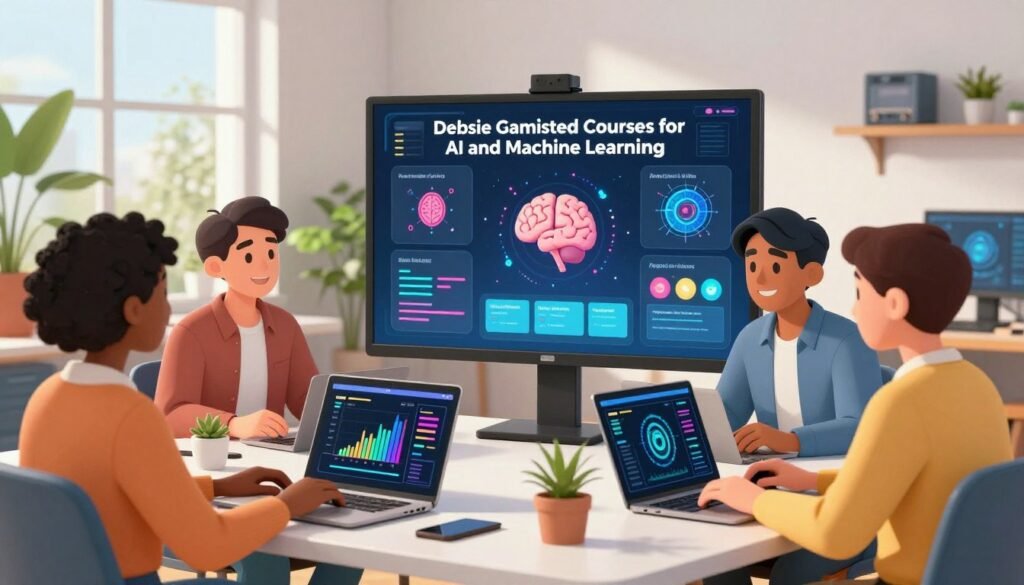
Debsie Gamified Courses make learning fun and easy. They use games to keep you interested and learning. Check out https://debsie.com/courses and start learning today!
The future is for those who learn and grow! By choosing Debsie, you’re on a journey of discovery. Join us and start learning with the best!
Timnit Gebru and the Critical Study of AI Ethics
Timnit Gebru’s work has made us think about fairness and clearness in AI. She is a top researcher in AI ethics. Her studies onalgorithmic bias and fairnesshelp make sure AI is made right.
Her work has shown us the problems and helped make AI better for everyone. Let’s look at her studies on bias and why different views are important in tech.
Algorithmic Bias and Fairness
Timnit Gebru fights againstalgorithmic bias, which makes AI unfair. She says AI must be fair and clear. You can learn more about AI ethics at Debsie Gamified Courses.
AI bias can cause big problems, like:
- Keeping old stereotypes alive!
- Being unfair in who gets hired!
- Causing unfair results in justice!
The Importance of Diverse Perspectives in Tech
Different views are very important in tech. Timnit Gebru wants AI to include many voices. This makes AI fair for everyone.
Diverse teams bring:
| Aspect | Homogeneous Team | Diverse Team |
|---|---|---|
| Problem-Solving | Limited viewpoints | Varied and innovative solutions |
| Product Development | May overlook certain user needs | More inclusive and user-friendly products |
| Ethical Considerations | Potential for bias and oversight | Greater awareness and mitigation of bias |
Timnit Gebru’s work shows diverse teams find and fix AI biases better. For more on her story, read Technology Review.

Ilya Sutskever and the Scaling Laws of Large Models
Ilya Sutskever is making big waves in AI. His work on large models is changing the game. He’s a top researcher in artificial intelligence.
He’s famous for creating GPT models. GPT models have changed how machines talk. They can write like humans, really well!
The Development of GPT Architectures
Ilya Sutskever’s team made GPT models. These models are great at understanding and writing text. They learn from huge amounts of data.
GPT models get better as they get bigger. This is thanks to Sutskever’s work. Bigger models can do more things.
Vision for Superintelligence and Safety
Ilya Sutskever wants AI to be smarter than us. He says we need to make sure AI is safe. It should do what we want it to do.
He’s thinking about the future of AI. His work helps make AI that’s strong and safe. It’s good for all of us.
Want to learn more about AI? Check out Debsie Gamified Courses at https://debsie.com/courses. These courses are a great way to learn about AI!
Kate Crawford and the Societal Impact of Machine Learning
Kate Crawford’s work shows us the big impact of machine learning. She’s a top researcher who helps us see how AI affects us all. She wants us to think deeply about the tech we use.
Her work says machine learning touches many parts of our lives. It’s not just tech. It’s about how tech meets society. She helps us see the unintended consequences of AI systems.

The Hidden Costs of AI Infrastructure
Crawford looks closely at the hidden costs of AI. This includes the harm to the environment and the energy needed for AI. She also talks about the unfair labor in making AI work.
Her research shows us the need for better AI practices. We must think about the impact on society and the planet. This is key as we use more AI.
“AI systems are not just technical systems, they are social systems, and they need to be designed and evaluated as such.”
Advocating for Accountability and Transparency
Crawford pushes for accountability and transparency in AI. She believes AI should be made with care for its impact. This way, those who make AI can be held accountable.
Being open about AI is also key. It lets us check and understand AI’s choices. Crawford’s goal is to make AI better for everyone.
To learn more about AI’s impact and how to help make AI better, check out Debsie’s courses at https://debsie.com/courses!
The Future Trajectory of AI Research
AI research is getting more exciting by the day! New discoveries are coming. AI will keep getting better and change our lives in many ways.
Emerging Trends in Multimodal Systems
Multimodal systems are key in AI now. They can handle text, images, and sounds. This helps us understand the world better. Multimodal AI could change virtual helpers, health checks, and self-driving cars.
Expect big steps in multimodal systems soon. For example, mixing images and text will make captions and answers better.
The Shift Toward Energy-Efficient Computing
AI is also moving toward using less energy. As AI gets more complex, it needs a lot of power. Now, scientists are working on making AI use less energy.
New ways like neuromorphic computing are being explored. This makes AI strong and green. It’s important for AI to be good for our planet.

To keep up with AI news, check out Debsie Gamified Courses at https://debsie.com/courses. These courses teach AI in fun and interactive ways.
How to Follow the Work of Leading AI Scientists
To keep up with AI’s latest, follow top AI scientists! They share their work through different channels.
Tracking Academic Publications and Conferences
AI scientists often publish in academic publications and at conferences. Look for new research on arXiv, ResearchGate, and Academia.edu. Also, check out NeurIPS, ICML, and IJCAI for the latest AI news.
Google Research shares its big wins on its blog. It gives a peek into the latest AI discoveries.
Engaging with Open Source Communities
Many AI scientists work in open source communities. They share their projects and work together. GitHub and GitLab have lots of AI projects. You can follow top scientists and even help with their work.
Debsie Gamified Courses at https://debsie.com/courses teach AI and machine learning in fun ways!

Conclusion
The world of AI and machine learning is changing fast. Pioneering scientists are making new things possible. They are changing how we live and work.
By learning from the best in AI, you can be ahead. You can find new chances in this exciting field. Keep exploring AI and machine learning. Start your learning journey with Debsie Gamified Courses at https://debsie.com/courses!
Join a community of learners and grow your skills. Learn with fun games and stay current with AI and machine learning news. The future is bright, and it’s waiting for you!