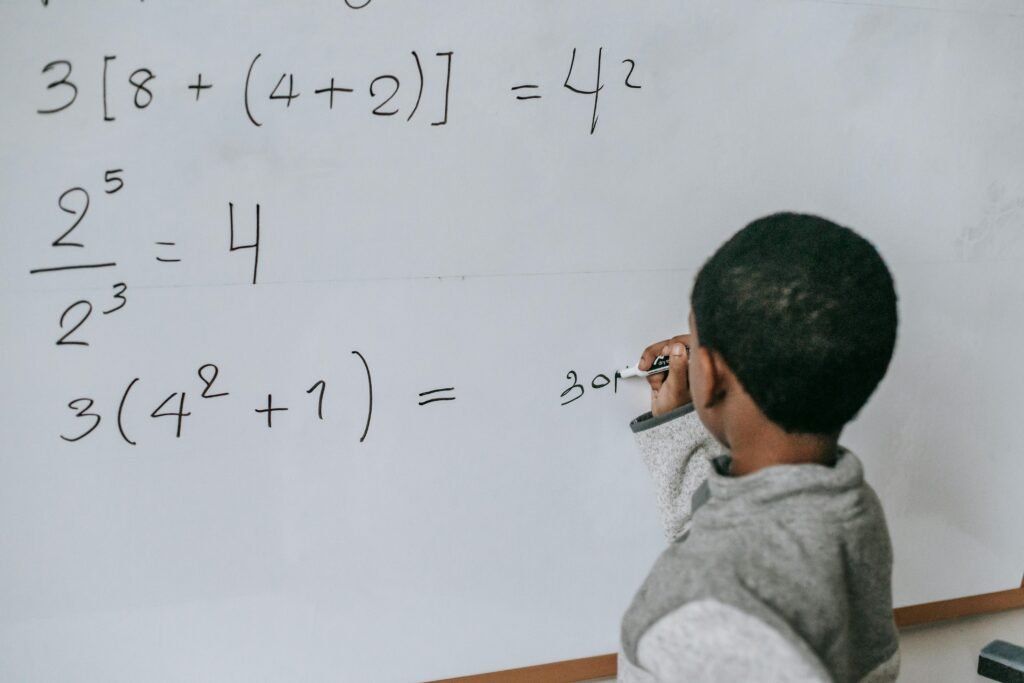
Have you ever looked up at the night sky and wondered about space? We all feel curious about how things work. It’s a journey that starts with just one question.
Many smart explorers have spent their lives answering big questions. These greatest physicists changed how we see everything, from tiny atoms to the whole universe! Their discoveries help us understand our amazing world.
You can start your own learning journey by studying M-theory and other secrets about our world. Discovering the best scientific stories is just the beginning. Let’s explore the lives of these amazing thinkers together.
Try Debsie Gamified Courses at https://debsie.com/courses to make learning science fun! We believe every child can become a genius with the right support. Let’s play, learn, and grow as we uncover nature’s secrets!
Key Takeaways
- Physics helps us explain the big mysteries of our universe.
- Famous scientists like Hawking and Einstein changed how we see reality.
- Curiosity is the most important tool for any young scientist.
- M-theory provides a unique look at how the world is put together.
- Gamified learning makes complex science fun and easy to understand.
- Every child has the potential to achieve great things through discovery.
The Foundations of Classical Mechanics: Isaac Newton
Isaac Newton’s work in classical mechanics shows our endless curiosity and creativity! His discoveries changed how we see the world. They still shape physics today.
Newton’s famous book, Principia Mathematica, shares his laws of motion and gravity. Let’s explore why this work is so important for classical mechanics!
Principia Mathematica and the Laws of Motion
In Principia Mathematica, Newton explained three key laws of motion. These laws are basic to physics!
- The first law says objects stay still or keep moving unless a force stops them.
- The second law links an object’s motion to the force on it and its mass, F=ma.
- The third law says every action has an equal opposite reaction.
These laws help us understand and predict how things move on Earth and in space!

The Development of Calculus and Universal Gravitation
Newton, along with Gottfried Wilhelm Leibniz, created calculus. This tool is key for solving complex physics problems!
Newton’s gravity theory says every mass pulls on every other mass. This idea explains why things fall and planets orbit the Sun!
“To myself I seem to have been only like a boy playing on the seashore… whilst the great ocean of truth lay all undiscovered before me.”
Newton’s work greatly influenced classical mechanics. Here’s a quick summary:
| Contribution | Description | Impact |
|---|---|---|
| Laws of Motion | Three principles describing how objects move and respond to forces. | Fundamental understanding of physics and engineering. |
| Universal Gravitation | Theory that every mass attracts every other mass. | Explained terrestrial and celestial phenomena. |
| Calculus | Mathematical tool for analyzing complex phenomena. | Enabled precise calculations in physics and other sciences. |
The Architect of Modern Physics: Albert Einstein
Albert Einstein changed how we see space and time with his ideas. His work made us rethink the universe. It opened new ways to understand it.
Einstein did many things for science. But his theory of relativity is his biggest achievement. We will look at that and his work on the photoelectric effect, which helped start quantum mechanics.
Special and General Relativity
In 1905, Einstein said that physics is the same for everyone moving the same way. He also showed that mass and energy are the same thing. This is in his famous equation E=mc^2.
In 1915, Einstein added to his earlier work with general relativity. He said gravity bends space and time because of mass and energy. He predicted things like gravitational waves and black holes, which we now know are real.
| Theory | Year Introduced | Key Concepts |
|---|---|---|
| Special Relativity | 1905 | Laws of physics are invariant for all observers in uniform motion; E=mc^2 |
| General Relativity | 1915 | Gravity as spacetime curvature; prediction of gravitational waves and black holes |
The Photoelectric Effect and Quantum Beginnings
Einstein showed that light can act like particles, now called photons. This helped start quantum mechanics. His work on the photoelectric effect was key.
This work helped quantum theory grow. It also got Einstein the Nobel Prize in Physics in 1921. His ideas still shape physics and technology today, like in solar cells and quantum computers.
The Quantum Pioneer: Niels Bohr
Niels Bohr was a pioneer in quantum mechanics. He changed how we see the atomic world! His work shaped physics and inspired many scientists. As Niels Bohr showed, the atom’s secrets are complex but fascinating!
Atomic Structure Insights
The Bohr model of the atom was a big step. It showed electrons have specific energy levels around the nucleus!
Let’s look at some key points of the Bohr model:
| Feature | Description |
|---|---|
| Energy Levels | Electrons are in specific energy levels or shells around the nucleus. |
| Electron Jump | Electrons can move from one energy level to another by using or losing energy. |
| Nuclear Stability | The nucleus is stable, with electrons orbiting around it. |
Copenhagen Interpretation and Its Impact
The Copenhagen interpretation was developed by Niels Bohr and Werner Heisenberg. It says a quantum particle’s properties are not set until it’s observed!
This idea has deeply changed how we see the quantum world. It shows how important observation is in quantum systems.
Niels Bohr’s work in quantum mechanics was very important. His ideas on the Bohr model and Copenhagen interpretation helped physics and chemistry grow!
The Master of Electromagnetism: James Clerk Maxwell
Maxwell’s work on electromagnetism is a big deal in physics. It helped us understand light and other waves!
James Clerk Maxwell mixed electric and magnetic forces into one. This big change helped us see the universe in a new way. As James Clerk Maxwell once said, his equations changed physics forever!
Maxwell’s Equations and the Nature of Light
Maxwell’s equations joined electricity and magnetism together. They also showed that light is a wave. This was a big idea back then.
“The whole history of the theory of electricity has been one of alternation between the one-fluid and the two-fluid theories; and it is now generally agreed that the phenomena can be explained by the conception of an electromagnetic field.”
The Kinetic Theory of Gases
Maxwell also worked on gas molecules. He came up with the Maxwell-Boltzmann distribution. It shows how fast gas molecules move.
The Quantum Mechanics Visionary: Werner Heisenberg
Imagine a scientist who changed classical physics. That’s Werner Heisenberg! He opened doors to the atomic world with quantum mechanics. Let’s see how his work affects us today!
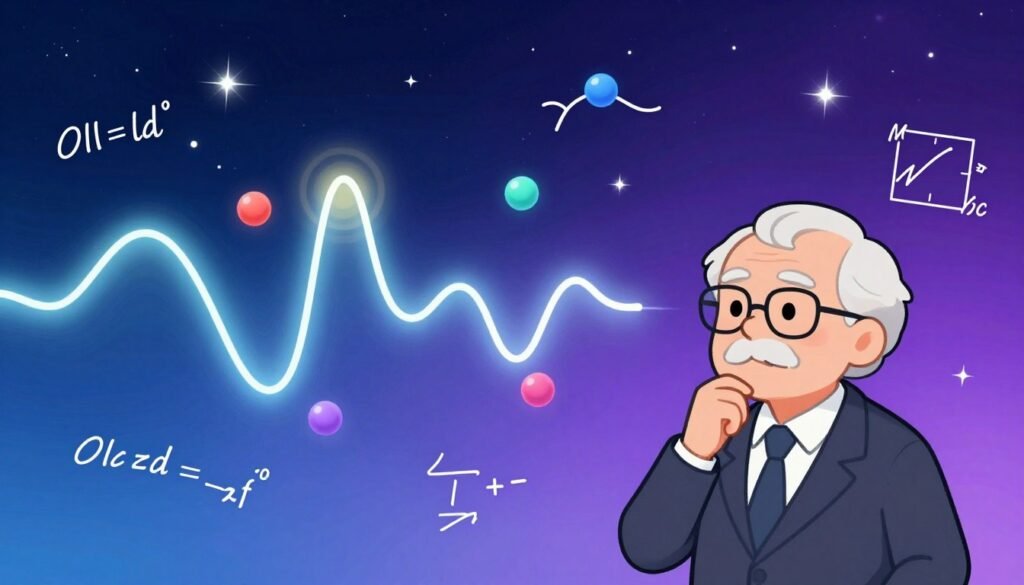
Heisenberg created the uncertainty principle. It says we can’t know some things at the same time. Heisenberg said,
“The more precisely the position is determined, the less precisely the momentum is known.”
This idea changed how we see the atomic world!
The Uncertainty Principle
The uncertainty principle is key in quantum mechanics. It shows we can’t know everything about an object. Heisenberg’s idea limits how much we can know at the atomic level.
This idea affects many fields, like physics and engineering. It’s used in understanding particle behavior and in quantum computing. Heisenberg’s work is still important today!
Matrix Mechanics and Atomic Structure
Heisenberg also made matrix mechanics. It uses matrices to understand atoms and molecules. This method is still used in quantum physics today!
With matrices, Heisenberg and others could predict atomic behavior better. Their work built on others, like Niels Bohr. Together, they helped us understand atoms better.
Heisenberg’s work in quantum mechanics has lasted a long time. It inspires new scientists and engineers. As we explore the universe, Heisenberg’s work is key.
The Greatest Physicists of All Time: Marie Curie
Marie Curie was a trailblazer in physics. Her work on radioactivity changed our view of the world. It led to many scientific discoveries.
Pioneering Research on Radioactivity
Marie Curie’s work on radioactivity was a big deal! She started by studying uranium rays found by Henri Becquerel. Her hard work and careful observations helped us understand radioactivity better.
Some key parts of her research were:
- Studying the properties of radioactive substances
- Creating ways to separate and clean radioactive isotopes
- Seeing how radioactivity helps us learn about atoms

Discoveries of Polonium and Radium
Marie Curie found two new elements: polonium and radium. These finds were key to understanding radioactive elements better.
Finding these elements was hard work. It involved:
- Processing lots of pitchblende to get the elements
- Using new methods to separate the elements
- Learning about the properties of polonium and radium
Her achievements showed her hard work and dedication. They also opened new paths in physics and chemistry. They inspired many to keep exploring and discovering.
The Theoretical Titan: Richard Feynman
Meet Richard Feynman, the Theoretical Titan who reshaped the landscape of modern physics with his pioneering work!
Feynman was an American physicist. He worked in quantum electrodynamics. He made complex ideas simple for everyone.
Quantum Electrodynamics and Feynman Diagrams
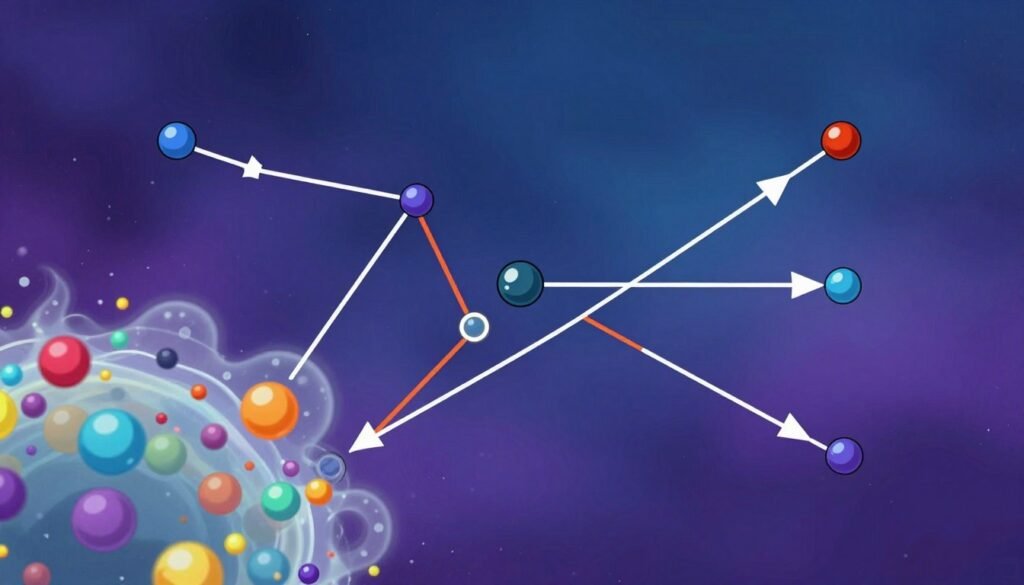
Feynman made a big impact with quantum electrodynamics (QED). It shows how light and matter work together. He also created Feynman diagrams.
- Feynman diagrams show how tiny particles interact. They help us understand and predict their behavior.
- These diagrams are key in particle physics. They help with calculations and understanding quantum field theories.
Contributions to Nanotechnology and Computing
Feynman saw the future in nanotechnology. He thought about changing matter at the atomic and molecular level. His ideas started new research and development.
Some important things he contributed include:
- The idea of tiny machines and their uses.
- The need for precision in engineering and making things at the nanoscale.
Feynman’s work still guides research in nanotechnology and more. It shows how his creative ideas keep making a difference.
The Relativistic Quantum Pioneer: Paul Dirac
Paul Dirac changed the game in relativistic quantum mechanics! He found antimatter and started quantum field theory. Let’s explore what he did!
Dirac made a big splash with the Dirac equation. It’s a key part of quantum mechanics. It mixes quantum and special relativity, giving us a deeper look at particles.
The Dirac Equation and Antimatter
The Dirac equation said there’s antimatter out there. It said every particle has a twin with the same mass but opposite charge. Then, we found the positron, the electron’s antiparticle.
- The Dirac equation merged quantum mechanics and special relativity!
- It predicted the existence of antimatter, which was a groundbreaking concept!
- The discovery of antimatter validated Dirac’s theory and opened new avenues in physics!
Quantum Field Theory Foundations
Dirac also helped start quantum field theory (QFT). QFT talks about how particles interact through fields in space and time. His work in QFT has shaped our understanding of particles and forces.
Some key things Dirac did for QFT include:
- Providing a relativistic framework for understanding particle interactions!
- Laying the groundwork for the development of quantum electrodynamics (QED)!
- Influencing the development of modern particle physics theories!
Dirac’s work still inspires physicists today. His ideas are a big part of modern physics!
The Master of Thermodynamics: Ludwig Boltzmann
Meet Ludwig Boltzmann, the mastermind behind statistical mechanics! His work changed how we see thermodynamics. It still shapes science today.
Ludwig Boltzmann was an Austrian physicist from the 19th century. He’s famous for his work in statistical mechanics and the kinetic theory of matter. His research is key to modern thermodynamics!
Statistical Mechanics and Entropy
Boltzmann’s biggest achievement was statistical mechanics. It shows how particles behave to understand materials. He also created the concept of entropy, which measures disorder or randomness.
The famous Boltzmann equation, S = k log W, links entropy (S) to possible microstates (W). This equation is on his tombstone, showing its importance!
The Kinetic Theory of Matter
Boltzmann also worked on the kinetic theory of matter. This theory explains gas behavior by looking at molecule motion. He teamed up with James Clerk Maxwell to develop it.
The kinetic theory of gases helps us understand how gases change with temperature and pressure. Boltzmann’s work proved the atomic theory of matter, a big debate at the time.
Key Contributions of Ludwig Boltzmann:
| Contribution | Description |
|---|---|
| Statistical Mechanics | Developed the field of statistical mechanics, explaining material properties through particle behavior. |
| Entropy Concept | Introduced the concept of entropy and its relation to the disorder of a system. |
| Kinetic Theory | Contributed to the kinetic theory of gases, explaining gas behavior through molecular motion. |
Understanding Boltzmann’s work helps us see the basics of matter and energy. His legacy inspires scientists and researchers today!
The Cosmic Explorer: Stephen Hawking
Stephen Hawking was a famous physicist. He changed how we see the universe. His work covered everything from tiny particles to huge spaces.
Stephen Hawking is famous for his work on black holes. He said black holes can even send out radiation. This was a big change from thinking nothing could get out.
Black Hole Radiation and Hawking Radiation
Hawking’s idea about black holes was a big step forward. He said black holes can get smaller and smaller until they disappear.
This idea changed how we see the universe. It made us think about black holes in a new way. They are not forever, but they can disappear in a burst of energy.
| Key Aspect | Description | Impact on Cosmology |
|---|---|---|
| Black Hole Radiation | Black holes emit radiation due to quantum effects near the event horizon. | Challenges the traditional view that nothing escapes a black hole. |
| Hawking Radiation Theory | Proposed by Stephen Hawking, it explains how black holes evaporate over time. | Suggests black holes have a finite lifetime. |
| Cosmological Implications | The theory impacts our understanding of the universe’s evolution. | Reshapes our knowledge of black holes’ role in the universe. |
The Nature of the Universe and Time
Hawking also looked into time and the universe. He thought the universe started as a tiny, hot point. This idea helps us understand how the universe began and grew.
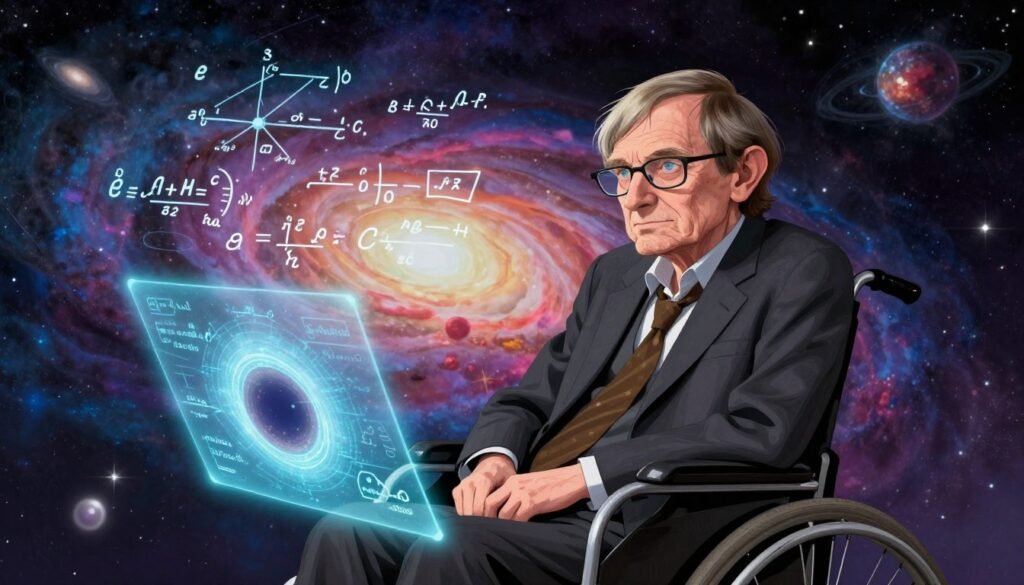
Studying black holes and the universe’s start is very exciting. Hawking’s work helped us learn more about space and time. His ideas keep scientists and the public curious.
The Experimental Genius: Michael Faraday
Michael Faraday changed physics a lot. His experiments helped make many new technologies!
His work on electricity and magnetism was very important. It helped start many modern technologies.
Electromagnetic Induction and Field Theory
Faraday found out about electromagnetic induction. This is how many electrical devices work.
This idea is still used today. It helps with power and wireless charging.

The Faraday Cage and Electrolysis
Faraday also made the Faraday cage. It spreads out electrical charges. This makes a safe place inside from outside electrical fields.
His work on electrolysis helped us understand chemical reactions better. He even found new elements.
| Faraday’s Key Contributions | Description | Impact |
|---|---|---|
| Electromagnetic Induction | Discovery of the principle behind electrical generators and transformers | Revolutionized power generation and distribution |
| Faraday Cage | Device that protects against electromagnetic fields | Used in lightning protection and electromagnetic shielding |
| Electrolysis | Research on the chemical effects of electric current | Led to the discovery of new elements and understanding of chemical reactions |
The Quantum Architect: Erwin Schrödinger
Imagine a world where things can be in many states at once. This is what Erwin Schrödinger brought to quantum mechanics!Erwin Schrödinger is a big name in physics, known for quantum mechanics.
Schrödinger changed how we see the quantum world. His work is both theoretical and practical, helping us today.
Wave Mechanics and the Schrödinger Equation
Schrödinger created the Schrödinger equation, a key part of quantum mechanics. It shows how quantum systems change over time. This helps us understand tiny particles.
To learn more about famous physicists, including those in quantum mechanics, visit this page.
The Thought Experiment of Schrödinger’s Cat
Schrödinger is also known for Schrödinger’s cat. This thought experiment shows the weird side of quantum mechanics. It’s about a cat that can be alive and dead at the same time.
The main points of Schrödinger’s work are:
- The Schrödinger equation, a key quantum mechanics equation.
- Wave mechanics, a way to describe quantum systems.
- Schrödinger’s cat, a thought experiment that shows quantum weirdness.
Schrödinger’s work has greatly helped physics. His discoveries keep helping us learn about the quantum world.
Enhancing Your Physics Knowledge with Debsie Gamified Courses
Learn physics in a fun way with Debsie’s gamified courses. We make hard topics easy and fun. Learning physics should be exciting, not boring.
Why Gamified Learning Works for Complex Science
Gamified learning makes science fun. It uses games to teach complex ideas. This way, you learn better and have fun.
Studies show gamified learning helps students do well. At Debsie, we use games to help you succeed in physics.
Exploring Physics Modules at Debsie
Our physics modules cover many topics. You can learn at your own pace. Our lessons fit your learning style.
Some topics include:
- Mechanics and motion
- Energy and thermodynamics
- Electromagnetism and optics
- Quantum mechanics and relativity

Starting with Debsie is easy. Visit https://debsie.com/courses to see our courses. Sign up and start learning.
We also offer special learning for certain areas. For example, in Chula Vista, you can find top physics tutors and classes. In Carlsbad, visit top physics tutors and classes.
Conclusion
We’ve looked at the amazing world of top physicists, from Isaac Newton to Stephen Hawking! They changed how we see the universe. They taught us about the laws of motion and black holes.
Their big discoveries and research led to many new things in science and tech. We keep learning from them and get excited to learn more!
At Debsie, we love making learning fun and easy. Our games and interactive lessons make physics fun. Join us and explore the universe’s wonders!
Find the fun in learning with Debsie. Discover the universe’s secrets, one discovery at a time!