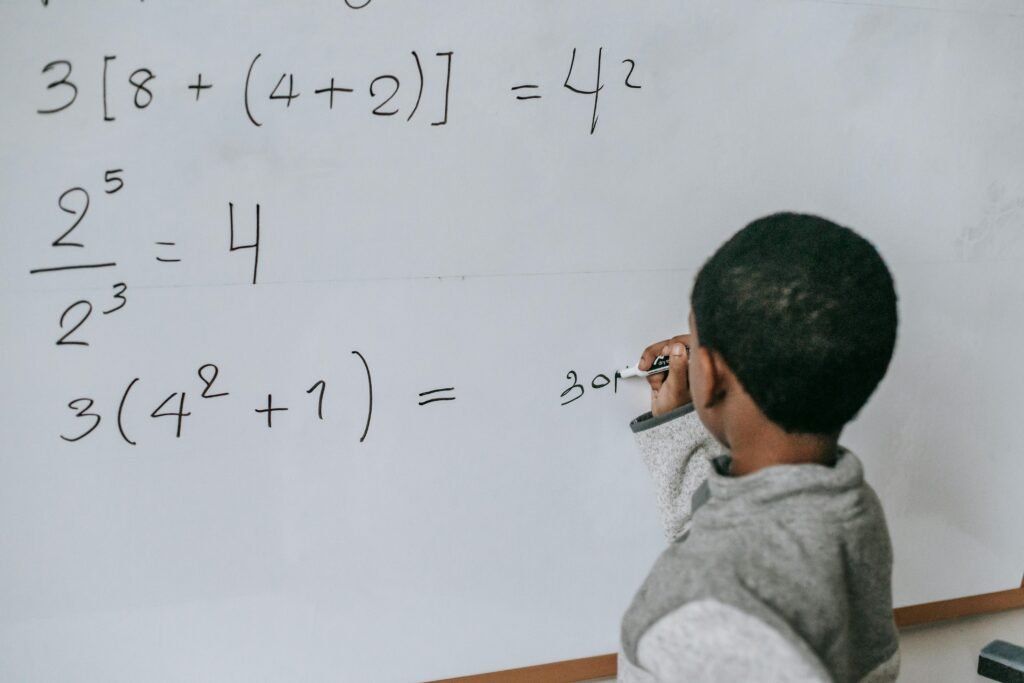
Ever argue with friends about the best basketball player? We all love a good GOAT debate! It’s always exciting, whether it’s Michael Jordan or LeBron James.
Imagine the same excitement in the history of science! It’s like sports, with stars who changed our view of the world. Exploring it together is thrilling!
We’re on a fun journey to find the greatest scientist! There are so many brilliant minds that changed our lives. They are like real-life superheroes!
Learning about these heroes is fun for you and your family! Try Debsie Gamified Courses at https://debsie.com/courses to discover more. Let’s explore their amazing achievements!
Key Takeaways
- Science has its own legendary figures similar to sports stars.
- The debate over the top spot is lively and very complex.
- Great discoveries often change how we understand the entire world.
- Brilliant minds have evolved our knowledge over many centuries.
- Gamified learning makes exploring these famous figures fun for kids.
- We look at paradigm-shifting theories and groundbreaking ideas.
Defining the Criteria for the Best Scientist in History
To figure out who is the best scientist, we need clear rules. Like in basketball, we look at stats and awards. For scientists, we check their discoveries’ impact, how long they last, and comparing across fields.
The Impact of Paradigm Shifts
One key thing is how much a scientist changes our view of the world. A big change is called a paradigm shift. Thomas Kuhn said,
“The transfer of allegiance from one paradigm to another is a conversion experience that cannot be forced.”
Scientists like Isaac Newton and Albert Einstein changed our view of the universe.
These big changes open new paths in science. For example, Einstein’s work changed how we see space and time. Newton’s laws started classical mechanics.
Longevity and Relevance of Discoveries
How long and useful a scientist’s work stays is also key. The best scientists’ work still helps us today. Their discoveries shape today’s science and tech. For example, DNA’s structure by Watson, Crick, and Franklin still guides genetics and biotech.
Here are some scientists and how long their work lasts:
| Scientist | Discovery | Year | Current Relevance |
|---|---|---|---|
| Isaac Newton | Laws of Motion | 1687 | Foundation for classical mechanics |
| Albert Einstein | Theory of Relativity | 1905, 1915 | Understanding of space and time |
| Marie Curie | Radioactive Elements | 1898 | Advancements in nuclear physics and medicine |
The Difficulty of Cross-Disciplinary Comparison
 A biologist’s work can’t be directly compared to a physicist’s. But we can look at their impact in their field and how it affects others.
By knowing these criteria, we can better decide who might be the best scientist in history. It’s a tough job that needs careful thought and many perspectives.
Isaac Newton: The Architect of Classical Physics
Isaac Newton changed how we see the world. His work in math, physics, and astronomy is still important today. He helped us understand the natural world better.
Newton worked hard on mathematical foundations and calculus. He created fluxions, now called calculus. This helped us study things like how things move and solve problems.
Mathematical Foundations and Calculus
Newton and Gottfried Wilhelm Leibniz made calculus. It helps us understand change and how things add up. This is key in physics, engineering, and economics.
Calculus lets us know how things move and react to forces. It helps us figure out where things will go. This is useful for many things, like predicting where planets will be.
The Laws of Motion and Universal Gravitation
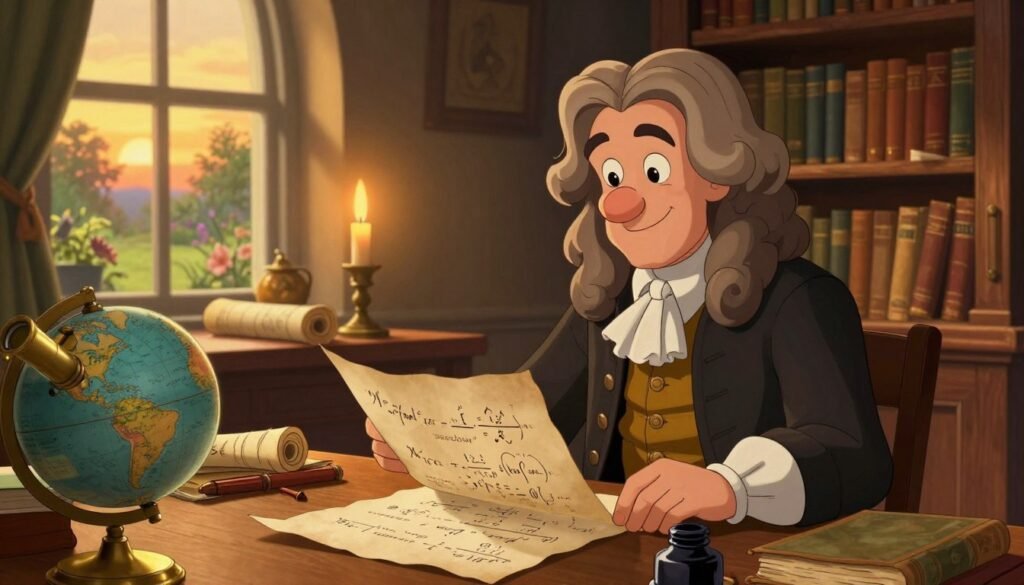
Newton’s laws of motion and universal gravitation are very important. His laws tell us how things move and react. The law of universal gravitation explains how things pull each other.
These ideas help us understand many things. Like why apples fall and how planets move. Newton showed that the same rules apply everywhere in the universe.
Learning about Newton helps us understand the universe better. His work still affects science and engineering today. He is one of the most important scientists ever.
Albert Einstein: Redefining Space and Time
Imagine a scientist who changed how we see space and time. He also helped start quantum mechanics. That scientist is Albert Einstein! His work in physics is huge, and we’re excited to share it with you.
Einstein’s work changed how we see the universe. His ideas have lasted a long time in physics and beyond. Let’s look at some of his biggest contributions.
The Theory of General and Special Relativity
Einstein’s theory of relativity changed how we see space and time. The special theory showed that E=mc². This means mass and energy are the same and can change into each other. The general theory explained gravity as the bending of space and time by mass and energy.
Time dilation and length contraction are weird ideas from special relativity. Many experiments and observations have proven them true.
| Theory | Key Concept | Impact |
|---|---|---|
| Special Relativity | E=mc² | Equivalence of mass and energy |
| General Relativity | Curvature of spacetime | Understanding gravity |
The Photoelectric Effect and Quantum Beginnings
Einstein’s work on the photoelectric effect was key to quantum theory. He showed that light can act like particles, now called photons. This was a big change from seeing light only as waves.
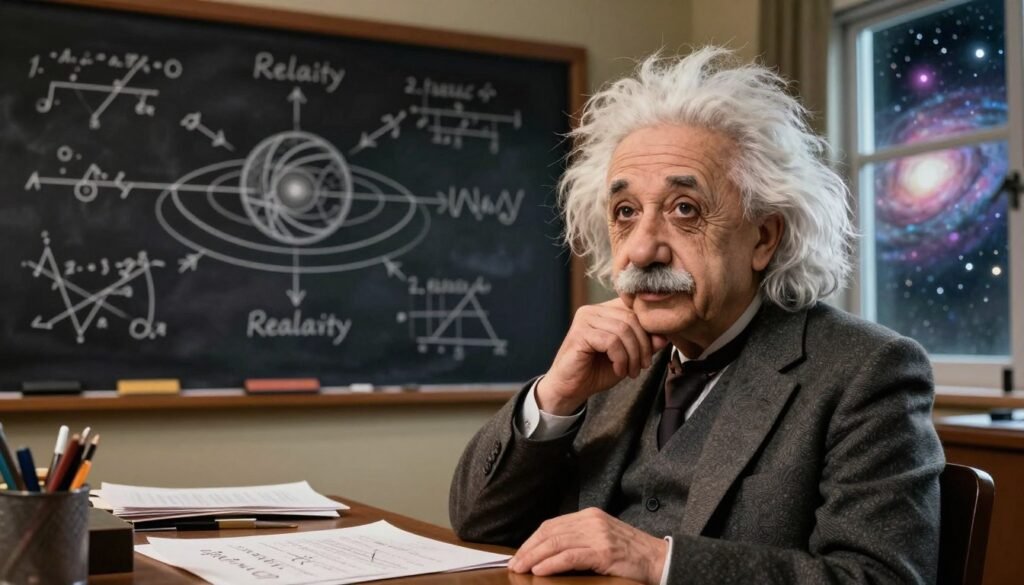
Einstein’s work shows how important curiosity and new ideas are. His work still inspires scientists and learners. It helps us understand the universe in deep ways.
Marie Curie: A Pioneer in Radioactivity
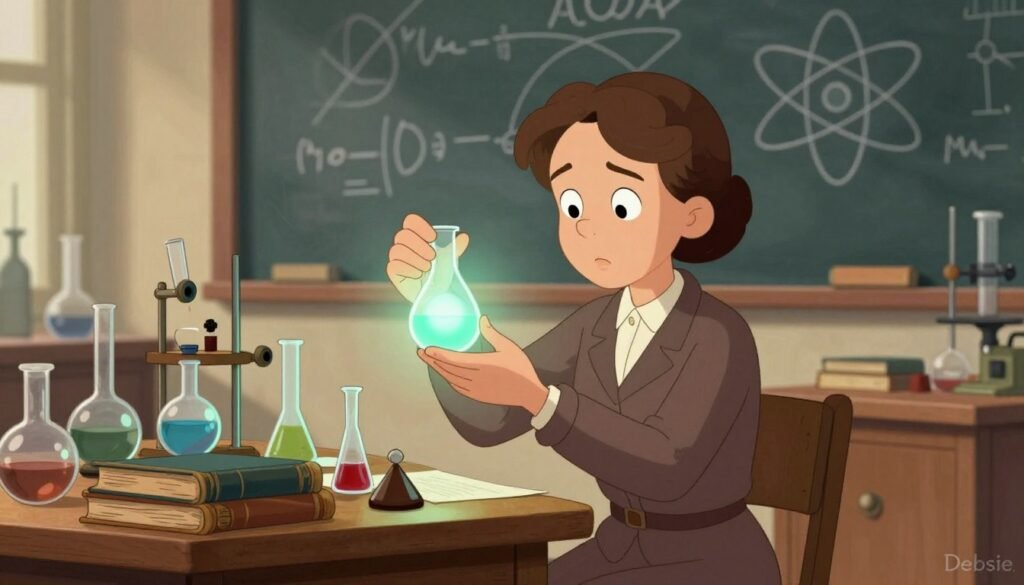
Marie Curie’s work in radioactivity changed science forever! She is famous for hergroundbreaking research on radioactive elements. Her discoveries helped us understand atoms better and led to big advances in medicine and energy.
Groundbreaking Research on Radioactive Elements
Marie Curie found two new elements:poloniumandradium. These finds were huge. They added to the periodic table and helped us understand radioactivity better.
Her research had many important moments:
- She discovered polonium, named after Poland.
- She isolated radium, a very radioactive element.
- She was a pioneer in working with radioactive isotopes.
Overcoming Barriers as a Woman in Science
Marie Curie faced many challenges as a woman in science. But she didn’t give up and achieved great things.
She overcame many barriers, including:
- Being the first woman to win a Nobel Prize.
- Being the first person to win two Nobel Prizes in different fields (physics and chemistry).
- Paving the way for future generations of women in science.
Marie Curie’s impact goes beyond her science. She inspired many people worldwide. She showed that with hard work and determination, anyone can achieve greatness.
Charles Darwin: The Architect of Evolutionary Biology
Charles Darwin changed how we see life on Earth. His work on evolution is key. It has shaped biology and our view of nature.
Natural Selection and The Origin of Species
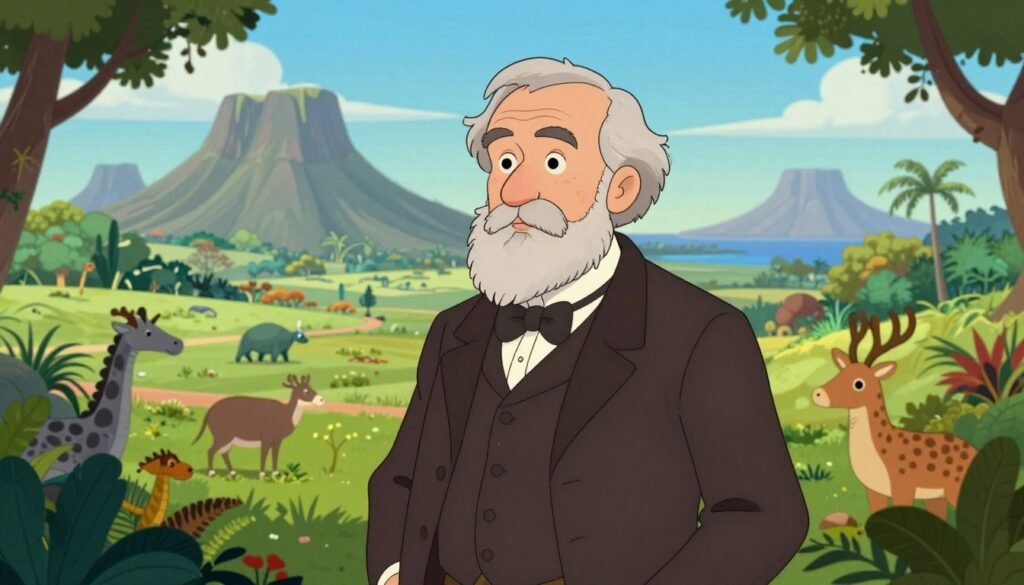
Darwin’s big idea is evolution through natural selection. He wrote about it in “On the Origin of Species.” This idea says that life changes over time. It happens because some traits help animals survive and have babies.
You can learn more about Darwin’s life and work on Charles Darwin’s contributions.
The Lasting Impact on Modern Genetics
Darwin’s theory has a big impact on genetics today. It helps us understand how different species are connected. Genetics and evolutionary biology keep growing. They help us learn more about life.
| Year | Event | Significance |
|---|---|---|
| 1831 | Darwin embarks on the HMS Beagle | Collected species samples that later supported his theory of evolution |
| 1859 | Publication of “On the Origin of Species” | Introduced the concept of natural selection to the scientific community |
| 1871 | Publication of “The Descent of Man” | Applied evolutionary theory to human evolution |
Darwin’s work still shapes science today. It affects genetics and conservation biology. His legacy shows how science can change our world.
Galileo Galilei: The Father of Observational Astronomy
Galileo Galilei is known as the “Father of Observational Astronomy”. He made big changes in the field! His work showed us new ways to see the universe.
Advocating for the Heliocentric Model
Galileo believed in the heliocentric model. This means the Earth and planets go around the Sun. He wasn’t alone in this idea, but it was new back then.
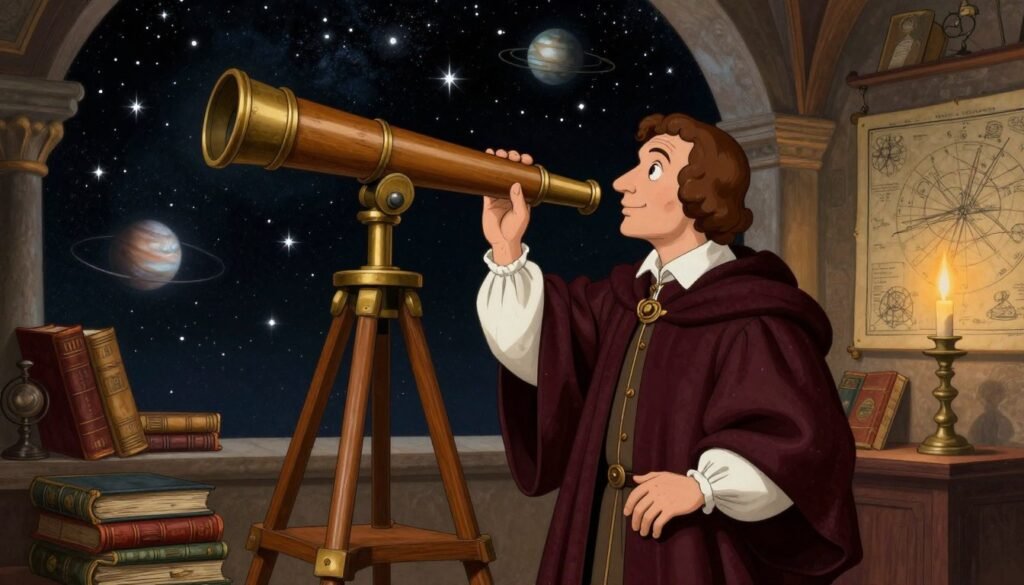
With his telescope, Galileo saw things that helped prove this model. He saw four moons around Jupiter and Venus’s phases like the Moon.
The Development of the Scientific Method
Galileo’s work changed astronomy and science. He showed the value of observing, experimenting, and making guesses based on what we see.
This was a big change from old ways that relied too much on authority.
Galileo’s work on the heliocentric model and the scientific method helped a lot. His ideas still inspire scientists and astronomers today!
Nikola Tesla: The Visionary of Modern Electricity
Imagine a world without electricity. We owe it to Nikola Tesla. His work changed how we live and work today.
Alternating Current and Power Distribution
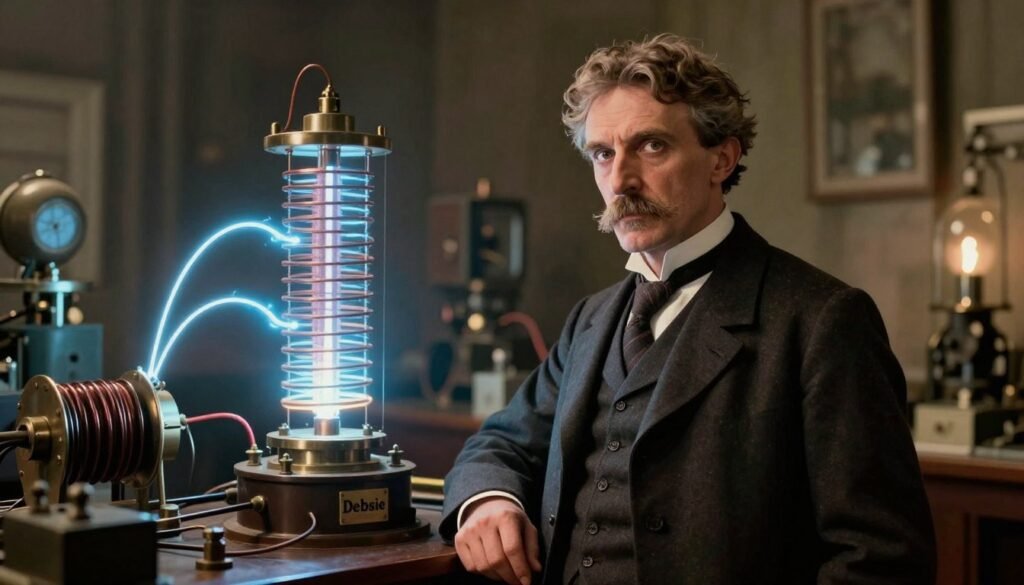
Tesla made alternating current (AC) systems. This changed how we send electricity. AC is better than direct current (DC) for long distances.
AC systems have big advantages. They can be changed to high voltage. This cuts down on energy loss during sending.
Contributions to Wireless Communication
Tesla also worked on wireless communication. His ideas helped start modern wireless tech. He dreamed of sending energy and info wirelessly.
Tesla’s work in wireless tech was ahead of its time. His ideas still shape today’s radio and wireless charging.
| Characteristics | Alternating Current (AC) | Direct Current (DC) |
|---|---|---|
| Transmission Efficiency | High efficiency over long distances | Limited efficiency over long distances |
| Scalability | Easily scalable for widespread distribution | Difficult to scale for large-scale distribution |
| Cost-Effectiveness | More cost-effective for large-scale transmission | Less cost-effective for widespread use |
James Clerk Maxwell: The Unifier of Electromagnetism
James Clerk Maxwell changed physics a lot. His work on electromagnetism helped us make many new technologies!
Maxwell made a big discovery. He put together electricity and magnetism into one idea called electromagnetism. This was a huge change in how we see the world!
Maxwell’s Equations and Light
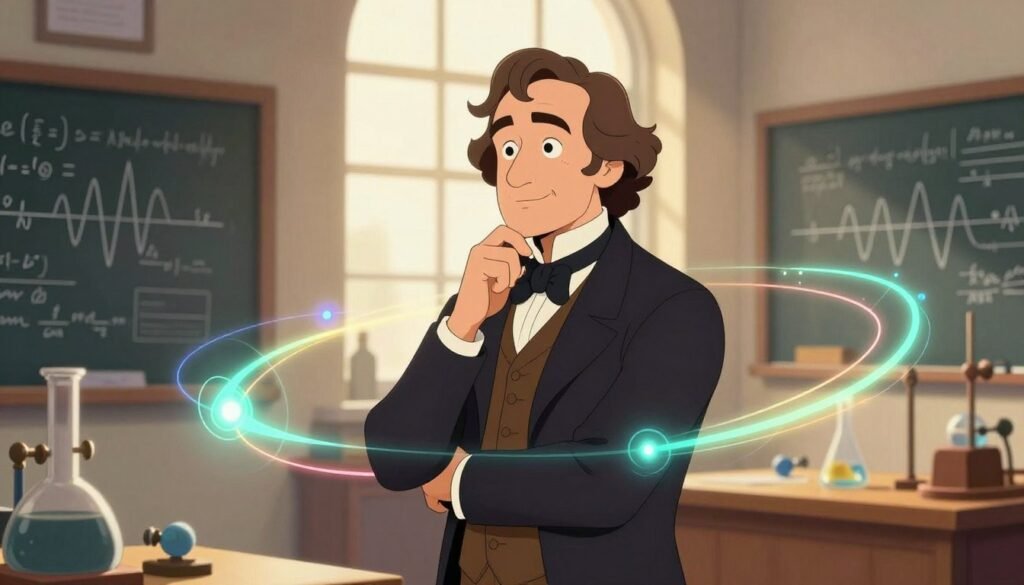
Maxwell’s work showed that light is part of electromagnetic waves. He found out that light moves at the same speed as these waves. This made him think that light is actually an electromagnetic wave!
Maxwell said, “Light and magnetism are the same thing. Light is an electromagnetic wave.” This shows how smart he was.
The Foundation for Modern Telecommunications
Maxwell’s work is very important for today’s tech. His ideas help us understand how to send signals through the air. This is key for radio, TV, and wireless tech.
| Technology | Impact of Maxwell’s Work |
|---|---|
| Radio Communication | Enabled the transmission of information over long distances through electromagnetic waves. |
| Wireless Technologies | Paved the way for the development of Wi-Fi, Bluetooth, and other wireless communication methods. |
| Televisions and Radar | Allowed for the creation of technologies that rely on the transmission and reception of electromagnetic waves. |
We still use Maxwell’s ideas today. We keep making new tech because of him. By using his ideas, we can make even more cool things!
Louis Pasteur: The Savior of Modern Medicine
Louis Pasteur is a hero in science. He changed medicine and health forever. His work saves lives every day.
Pasteur was a true pioneer. He changed old ideas with new ones. He helped start many medical advances.
Germ Theory and Vaccination
Pasteur showed us that germs cause diseases. This was a big change. He helped make vaccines for many diseases.
He made vaccines for anthrax and rabies. His work on Louis Pasteur helped many people.
- He made the first vaccine for anthrax.
- He also made the first rabies vaccine for humans.
- His germ theory work started microbiology.
As Pasteur said,
“Science knows no country, because knowledge belongs to humanity, and is the torch which illuminates the world.”
This shows his love for science and health.
Pasteurization and Food Safety
Pasteur also made pasteurization. It makes food safer. It kills bad bacteria in liquids.
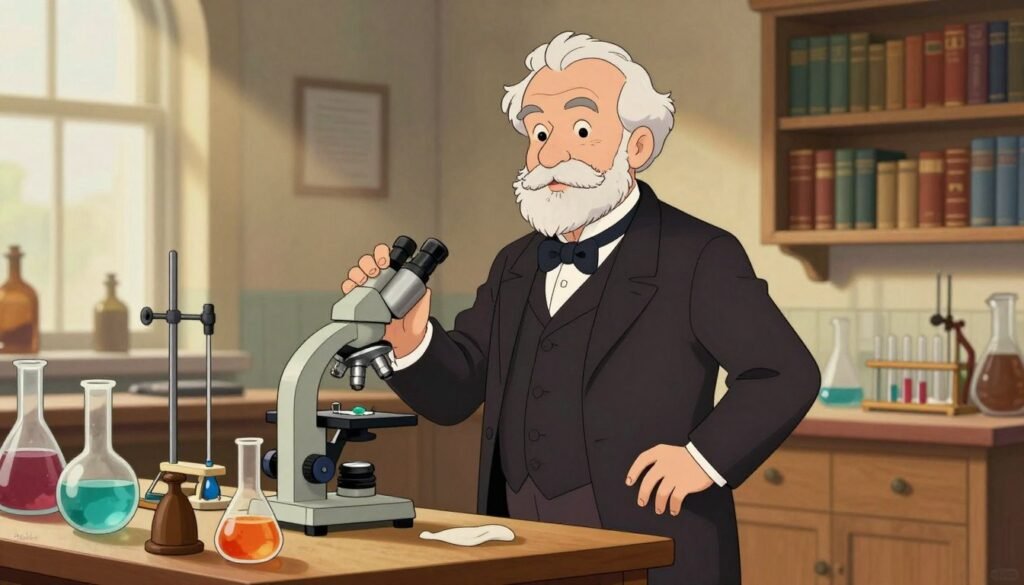
Pasteur’s work shows how science helps us. We can learn from him and make the world healthier.
Ada Lovelace: The First Computer Programmer
Ada Lovelace worked on Charles Babbage’s Analytical Engine. She is known as the first computer programmer. Her notes showed how to use the engine to calculate Bernoulli numbers.
Understanding the Analytical Engine’s Potential
Lovelace saw the engine’s power. She thought it could do more than just numbers. This was revolutionary for its time!
She knew the engine’s limits and its uses. This made her a true pioneer in computer science.
Translating Mathematical Concepts into Code
She turned math into machine code. This was a groundbreaking achievement. It started modern computer programming.
| Aspect | Before Ada Lovelace | After Ada Lovelace |
|---|---|---|
| Programming Concept | No formal programming concepts | Introduction of programming concepts |
| Analytical Engine’s Potential | Seen as a mere calculator | Recognized as a general-purpose computer |
| Mathematical Application | Limited to numerical calculations | Applied to various tasks through programming |
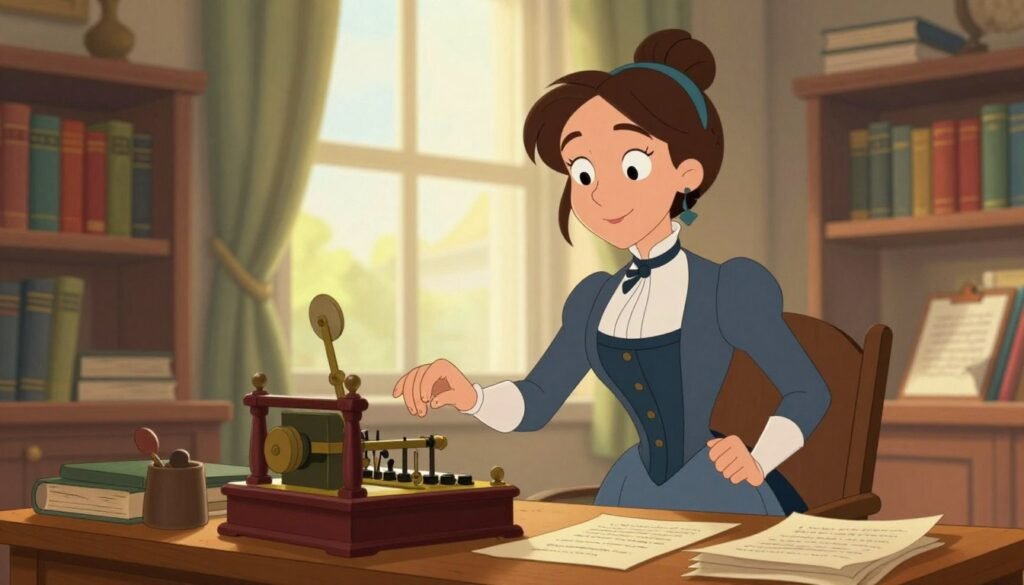
Ada Lovelace’s legacy inspires many today! Her work on the Analytical Engine and her vision are legendary in computing history.
Enhancing Your Scientific Literacy with Debsie Gamified Courses
Learn science in a fun way with Debsie’s gamified courses. We make hard topics easy and fun. Learning should be exciting, not boring.
Why Gamified Learning Works for Complex Topics
Gamified learning is great for tough science topics. It uses games and fun activities to teach. This makes learning fun and helps you understand science better.
Our courses use interactive simulations and real-world applications. This helps you get concepts. It also makes it easier to remember and use what you learn.
Exploring the Debsie Course Catalog
Our courses cover many topics, like physics and biology. They are both fun and informative. Check out our courses at https://debsie.com/courses to learn more.
For physics fans, check out our top physics tutors and classes. They offer extra help and support.
Albert Einstein said,
“The important thing is not to stop questioning. Curiosity has its own reason for existence.”
At Debsie, we love to explore and learn. We encourage you to do the same.
| Course | Description | Benefits |
|---|---|---|
| Physics Fundamentals | An introductory course covering the basics of physics. | Understand the principles of physics and their applications. |
| Biology Essentials | A course exploring the core concepts of biology. | Gain insights into the living world and its complexities. |
| Chemistry Basics | A foundational course on chemistry principles. | Learn about chemical reactions and their significance. |

Choosing Debsie’s courses means starting a fun learning journey. Join us today and see the difference for yourself!
The Subjectivity of Scientific Greatness
Who is the greatest scientist of all time? It’s not just about facts. Our culture plays a big role too! We look at scientists like Isaac Newton, Albert Einstein, and Marie Curie. We see their work through our cultural lens.
Just like in basketball, opinions on the greatest scientists vary. Our views change based on culture and personal beliefs. The recognition of scientists also changes across cultures and time.
Cultural Bias in Science
Cultural bias shapes our science heroes. How we teach science and tell stories about scientists is influenced by culture! For example, who we focus on in school reflects cultural values, not just science.
Here are some examples of cultural bias in science:
| Scientist | Cultural Impact | Reason for Recognition |
|---|---|---|
| Albert Einstein | Global Icon | Theory of Relativity |
| Marie Curie | Pioneer for Women in Science | Radioactivity Research |
| Nikola Tesla | Innovator in Electrical Engineering | Alternating Current |
The Evolution of Scientific Recognition
How we see scientists changes over time. New evidence and changing values can change how we view past scientists! For example, we now value diversity and inclusion in science more.
Exploring science history shows us greatness from many angles. As Maria Popova says, science is about wonder and human experience too.
Conclusion
As we finish our look at the most influential scientists, finding the best scientist in history is hard.
We’ve seen the amazing work of Albert Einstein, Marie Curie, Isaac Newton, and Charles Darwin.
These people have changed how we see the world. They’ve made big steps in physics, chemistry, biology, astronomy, and math.
Their work has changed our lives and how we see the world.
Let’s keep celebrating their work and how it has shaped our world!