Ever wonder how the first light bulb was made? We often think about how smart people came up with things we use every day. It’s the magic of science that makes our world better!
Learning about famous scientists can spark your creativity. They dared to dream big and made it happen. They changed how we talk and even see the stars!
Today, we want you to feel that spark of curiosity! Try Debsie Gamified Courses at https://debsie.com/courses to start your journey. Learning is fun, and everyone can win!
These American geniuses showed us that any problem can be solved. Their work is seen in everything from tiny atoms to the farthest stars. Let’s meet the legends who shaped our world.
Key Takeaways
- Discover the brilliant minds who changed our daily lives forever.
- Learn how classic inventions made the modern world possible.
- Explore the unique stories of legendary American pioneers.
- Find out how curiosity leads to massive global changes.
- See how gamified learning helps you master tough subjects.
The Foundation of American Scientific Inquiry
Visionaries in America were bold. They questioned old ideas and explored new ones. Their curiosity and drive for discovery set the stage for big changes.
American science thrives on innovation and trying new things. Pioneers in various fields have enriched American science history. They worked in physics, chemistry, biology, and more!

Learning about American science history is more than just knowing past achievements. It shows how these discoveries shape our lives today and tomorrow. For example, understanding DNA helps us grasp life’s basics.
| Field | Key Figures | Major Contributions |
|---|---|---|
| Physics | Benjamin Franklin | Study of electricity |
| Biology | George Washington Carver | Agricultural innovations |
| Chemistry | Various pioneers | Advancements in chemical science |
By looking into American scientific inquiry’s roots, we honor the scientists who paved the way. Their work is a bridge to today’s scientific wonders. It shows us the power of science in our world.
Benjamin Franklin and the Dawn of American Discovery
Benjamin Franklin is often seen as the start of American discovery. His endless curiosity and new ideas changed American science a lot!
Franklin was a leader in many areas like electricity, people studies, and weather. His work with electricity was very important. His kite experiment in 1752 showed lightning is electricity, opening doors for more research.
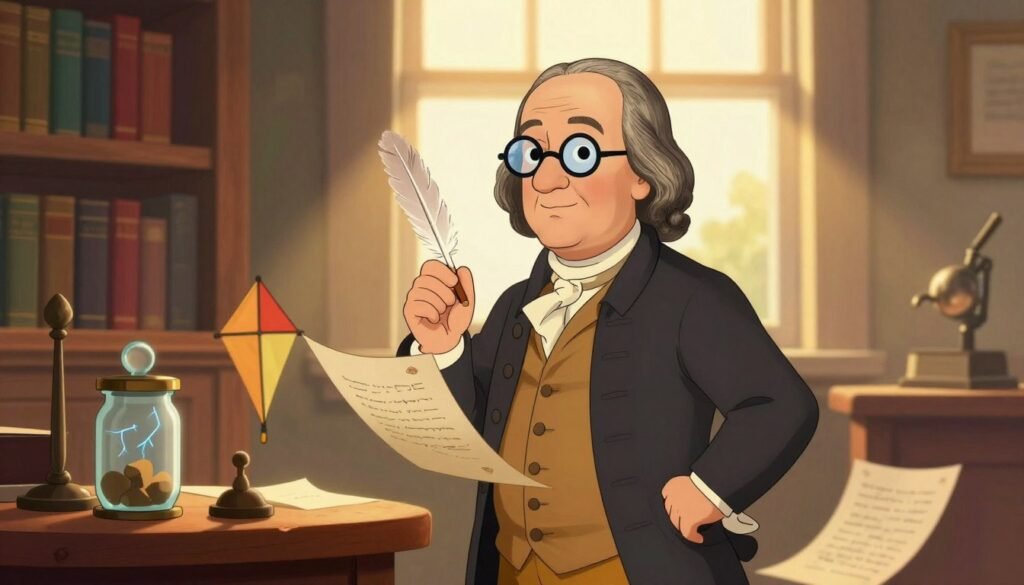
He didn’t just do the kite experiment. He also made the lightning rod to protect buildings. His studies on people helped start modern studies on populations. He also helped us understand weather better.
An article by Harvard Gazette talks about Benjamin Franklin’s experiments and politics. It shows how he used science to solve real problems.
| Field | Contribution | Impact |
|---|---|---|
| Electricity | Kite Experiment, Lightning Rod | Paved the way for future research in electricity and saved buildings from lightning strikes |
| Demography | Population Studies | Lay the foundation for modern demography |
| Meteorology | Weather Pattern Observations | Contributed to our understanding of weather |
Benjamin Franklin’s curiosity and new ideas helped American science grow. He inspired many scientists after him. His work is still celebrated today, making him a key figure in American history.
Thomas Edison and the Industrial Revolution
Thomas Edison changed the world with his inventions during the Industrial Revolution! He had over 1,093 patents. His work changed how people lived, worked, and talked to each other.
Edison made the light bulb, the phonograph, and the motion picture camera. These inventions made life better. They also helped industries grow.
Edison started the first industrial research lab, called Edison’s Laboratory. It was a place where Edison and his team made new tech.
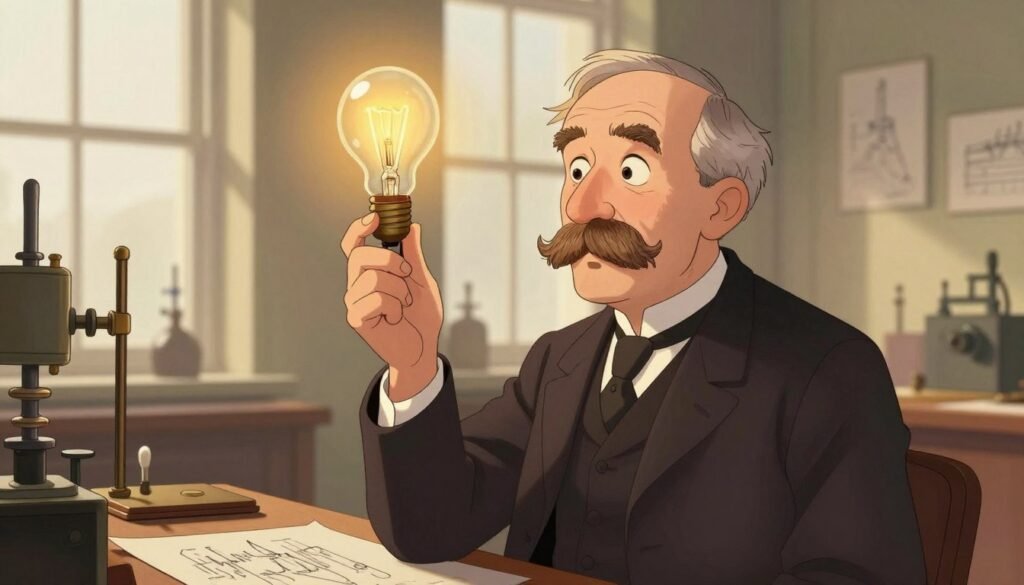
Edison’s work had a big impact on the Industrial Revolution. Here’s a table showing some of his key inventions and how they changed society:
| Invention | Year | Impact |
|---|---|---|
| Light Bulb | 1879 | Revolutionized indoor lighting, enabling people to work and socialize after dark! |
| Phonograph | 1877 | Allowed for the recording and playback of sound, transforming the music industry! |
| Motion Picture Camera | 1888 | Paved the way for the development of the film industry! |
Edison’s work during the Industrial Revolution changed many things. It made life better for people everywhere. His legacy still inspires new ideas and tech today!
Nikola Tesla and the Future of Electricity
Imagine a world where electricity is harnessed and distributed efficiently. This is thanks to Nikola Tesla! We explore his life and work, finding out how he changed electrical engineering.
Nikola Tesla was a true pioneer in electrical engineering. He worked on alternating current (AC) systems. This made it easy to send electricity far away, changing how we use power.
Tesla had big ideas, like sending electricity without wires. He did many experiments to make this happen. His ideas were new for his time but helped create many modern technologies.
As Tesla once said,
“The present is theirs; the future, for which I really worked, is mine.”
This quote shows his forward-thinking and love for innovation.
Tesla’s AC systems won the “War of Currents” against Edison’s DC. AC was better for sending power far. You can learn more about Nikola Tesla’s inventions and their impact on today’s tech.
| Achievement | Description | Year |
|---|---|---|
| Development of AC Motor | Tesla designed the AC motor, which is still widely used today. | 1888 |
| Patent for AC Transmission | Tesla was granted patents for his AC transmission system. | 1888 |
| Wireless Power Transmission Experiments | Tesla conducted experiments on wireless power transmission. | 1890s |
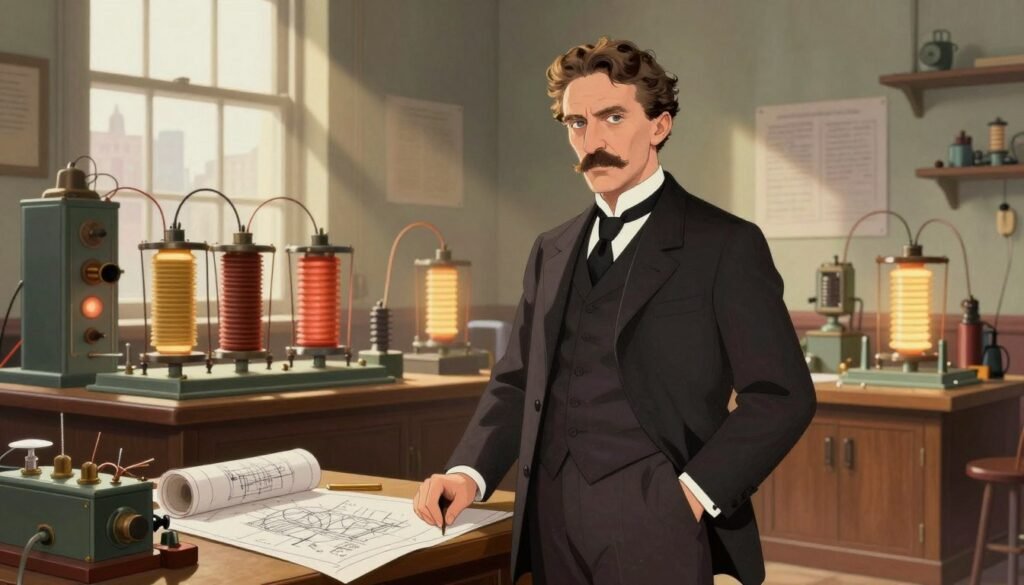
Tesla’s legacy inspires new ideas in electrical engineering. His work on AC systems and dreams for electricity’s future guide us. We’re working on better, greener energy systems because of him.
In conclusion, Nikola Tesla’s work in electrical engineering has changed our world. His ideas on AC systems and his vision for electricity’s future inspire today’s inventors and engineers.
The Legacy of George Washington Carver in Agriculture
George Washington Carver changed farming forever! He found new uses for peanuts and sweet potatoes. This helped farmers all over the world.
Carver made farming better with his research. He taught about crop rotation and soil conservation. He said, “The secret to successful farming is not just about growing crops, but about growing soil.”
“When you do the common things in life in an uncommon way, you will command the attention of the world.” –
At the Tuskegee Institute, Carver taught farmers new ways. He showed them how to grow different crops. This helped farmers make more money. For more on George Washington Carver, check out NCEI’s page on his legacy.
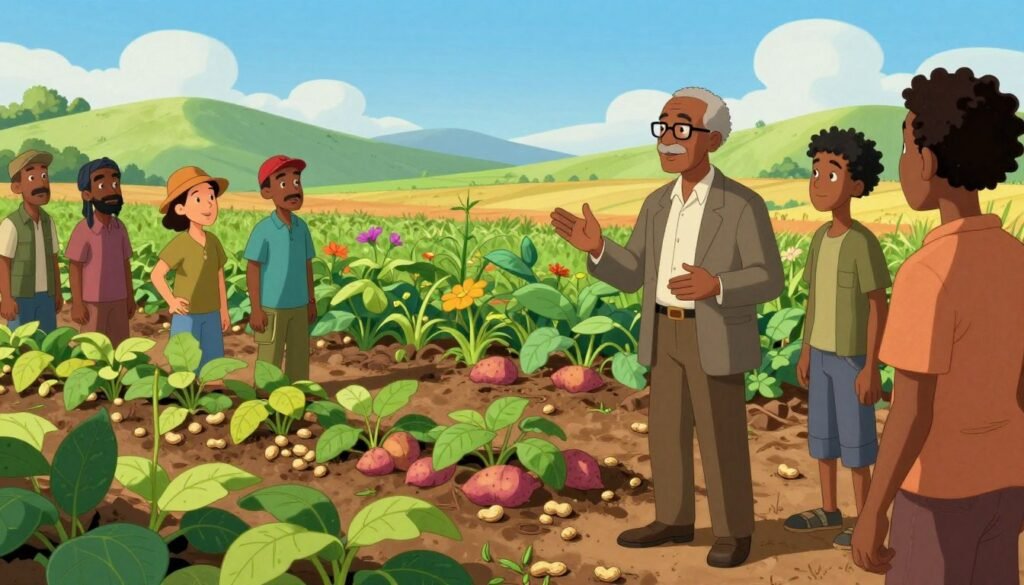
Carver’s work still helps today. His ideas inspire farmers and scientists. By using his methods, farmers can make their soil better, help the environment, and grow more food.
Jonas Salk and the Eradication of Polio
Jonas Salk’s work on the polio vaccine shows the power of medical innovation! In the early 1950s, polio outbreaks were everywhere. They caused a lot of fear and disability.Dr. Salk’s determination to fight this disease led to the inactivated poliovirus vaccine (IPV). This was a big step towards almost eradicating polio worldwide.
The impact of Salk’s vaccine was almost immediate. Before it, polio cases in the US averaged around 38,476 per year from 1949 to 1954. By 1965, that number had dropped to 61 cases. This big drop is thanks to Salk’s pioneering work and his dedication to public health.
As Dr. Salk once said, “The reward for work well done is the chance to do more.” His work on the polio vaccine saved many lives. It also opened the door for more vaccine technology and public health efforts.
The story of Jonas Salk and his fight against polio is inspiring. By creating the polio vaccine, Salk showed us that with hard work and determination, we can beat big health challenges.
“The greatest reward for a scientist is not the accolades or the fame, but the knowledge that their work has made a difference in the lives of others.” – Jonas Salk
Barbara McClintock and the Secrets of Genetics
Meet Barbara McClintock, a trailblazing geneticist. Her work changed how we see genetics! McClintock found transposons in maize chromosomes. This changed how we think about genes.
Genes are not always in the same place on chromosomes. McClintock showed that some genes can move. This was a big idea back then.
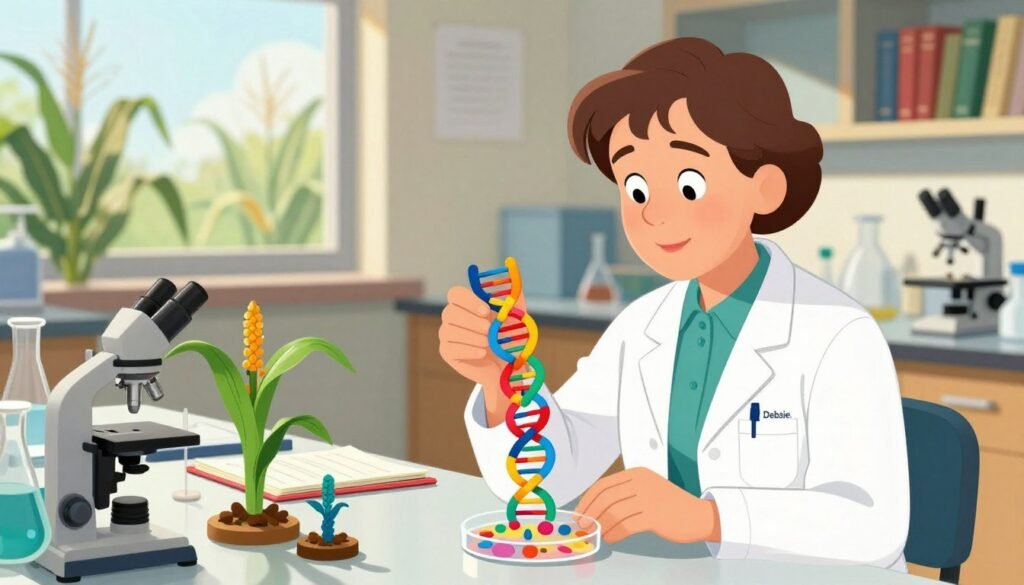
How did McClintock make such a big discovery? She was very careful and patient. She looked at maize kernels to find clues.
At first, people didn’t believe her. But McClintock kept finding more evidence. She proved that transposons exist. Her work helped many scientists after her.
We now know McClintock was a true pioneer in genetics. Her work has helped us understand genes better. She shows us that curiosity and determination can lead to big discoveries!
Richard Feynman and the Quantum Frontier
Richard Feynman was a genius in quantum mechanics and particle physics. He used new ways to understand the quantum world. His work changed how we see things.
Feynman’s path integral formulation was a big breakthrough. It made quantum processes easier to grasp. It looks at all paths a particle could take.
Key Contributions:
- Path Integral Formulation
- Quantum Electrodynamics (QED)
- Nanotechnology and Superfluidity
Feynman won the Nobel Prize in 1965 for QED. This theory explains how light and matter interact. It was a huge achievement.
Feynman was great at teaching. He made hard ideas simple. His books are still loved by many today.
Carl Sagan and the Popularization of Science
Carl Sagan was an astronomer who made science easy for everyone! He worked on “Cosmos: A Personal Voyage” and wrote many books. These helped people understand hard science ideas.
He made science exciting on TV, reaching many homes in America! Sagan explained complex ideas in simple ways. This made him a science hero. His profile shows his love for science inspired many.
“Cosmos” was a big hit, showing the universe and our role in it. It mixed astronomy, biology, and physics in a story. It was seen by millions and translated into many languages!
Sagan taught us to think critically and be skeptical. He wanted us to question and find evidence. This made his audience smarter and more confident!
| Sagan’s Contributions | Impact |
|---|---|
| Television Series “Cosmos” | Reached a global audience, making science accessible |
| Books on Science and Astronomy | Further disseminated scientific knowledge to the public |
| Emphasis on Critical Thinking | Promoted a culture of skepticism and inquiry |
Carl Sagan’s work still inspires us today! He showed us how important science is in our lives. By following his example, we can make our society more curious and informed!
Grace Hopper and the Birth of Modern Computing
Meet Grace Hopper, a trailblazing computer scientist. Her work changed modern computing forever! She was a Navy Rear Admiral and a pioneer in her field.
Grace Hopper helped create COBOL, a key programming language. COBOL’s design was influenced by Hopper’s work on the Harvard Mark I computer. It became a big hit in business and government.
Hopper didn’t just stop at COBOL. She wanted computing to be easier for everyone. Her efforts led to the development of compiler technologies. This made programming languages more complex and sophisticated.
You can learn more about her from Harvard Gazette’s article on Grace Hopper. It talks about her groundbreaking work in computing.
Grace Hopper’s legacy goes beyond her tech work. She inspired many with her curiosity and drive. We keep her memory alive by exploring and discovering new things in tech.
Katherine Johnson and the Mathematics of Space Exploration
Katherine Johnson was a top mathematician at NASA. Her work helped many space missions, like the Apollo 11 moon landing. She made sure astronauts were safe and successful.
She started at NASA when it was hard for women and minorities. But she didn’t let barriers stop her. Her math was key in the early days of space travel.
Katherine Johnson worked on the Apollo 11 mission. She figured out the path for the first moon landing. Her work shows her amazing skill and hard work.
Let’s see some missions she helped with:
| Mission | Year | Katherine Johnson’s Contribution |
|---|---|---|
| Apollo 11 | 1969 | Trajectory calculations for the first moon landing |
| Mercury Program | 1961 | Calculations for the first American in space, Alan Shepard |
| Apollo 13 | 1970 | Helped calculate the safe return trajectory after the explosion on board |
Katherine Johnson’s impact goes beyond her math. She opened doors for women and minorities in STEM. She showed that with hard work, anyone can reach their dreams.
The Best US Scientists Who Shaped Modern Medicine
Modern medicine is thanks to US scientists. They made big discoveries and treatments. These efforts have helped many people live better lives.
Dr. Jonas Salk made a vaccine for polio. This vaccine helped almost wipe out polio worldwide. You can read more about Dr. Salk and others atthis blog post.
Dr. Elizabeth Blackburn found a key to fighting cancer and aging. Her discovery helps us understand and treat these diseases better.
Dr. Barbara McClintock won a Nobel Prize for her genetic work. Her findings help us understand and treat diseases today.
These scientists and others have changed medicine a lot. Their work inspires new scientists and doctors. Their legacy will keep guiding medical research and care.
We celebrate these scientists for their big impact on medicine. Their work shows the ongoing effort for better health care.
Advancing Your Knowledge Through Debsie Gamified Courses
Learn science in a fun way with Debsie’s gamified courses. They make hard ideas easy and fun. Debsie offers learning experiences for kids all over the world. They learn many subjects and can learn in different ways.
At Debsie, we think learning should be exciting. That’s why we made learning fun and interactive. Our games help you understand scientific literacy better.
Interactive Learning at Debsie
Our learning platform is fun and keeps you wanting more. With Debsie, you can:
- Explore many science subjects in fun modules!
- Compete with friends on our leaderboard to stay excited!
- Get learning paths that fit your interests and needs!

Why Gamification Enhances Scientific Literacy
Gamification is more than just a trend. It’s a great way to learn science. Our games make learning fun and engaging. This helps you remember and understand better.
Here are some benefits of gamification in science learning:
- Increased Engagement: Our games grab your attention and keep you interested!
- Improved Retention: Our interactive lessons help you remember what you learn!
- Personalized Learning: Debsie’s AI gives you learning paths that fit you!
Want to learn more about science? Try Debsie’s Gamified Courses today at https://debsie.com/courses. Start your interactive learning journey!
The Impact of American Innovation on Global Technology
From Silicon Valley to the world, American innovation has changed everything. It has shaped our future. The United States is a leader in technology, making big changes in many areas.
Key Breakthroughs: The US has made huge steps in tech, like the internet, mobile phones, and AI. These changes have changed how we talk and get info. They also help businesses and new ideas around the world.

American innovation touches many areas, like health, money, learning, and fun. For example, new medical tech has helped people get better care. Also, new money tech makes deals safer and faster.
The Future is Bright! American innovation will keep making big tech steps. The US spirit of new ideas and starting businesses will lead the way. This will shape our future for many years!
Ethical Considerations in the History of American Science
Exploring American science history, we find many ethical challenges. The drive for knowledge and innovation has sparked debates. These debates have tested scientists’ and society’s moral standards.
Ethical considerations have played a big role in American science. For example, nuclear energy and weapons during World War II raised big questions. The Manhattan Project, which made the atomic bomb, shows the ethical struggles scientists faced.
Medical research in the U.S. has also faced big ethical issues. The Tuskegee Syphilis Study, starting in the 1930s, is a bad example. It involved not treating African American men with syphilis, causing harm and outrage when it was exposed.
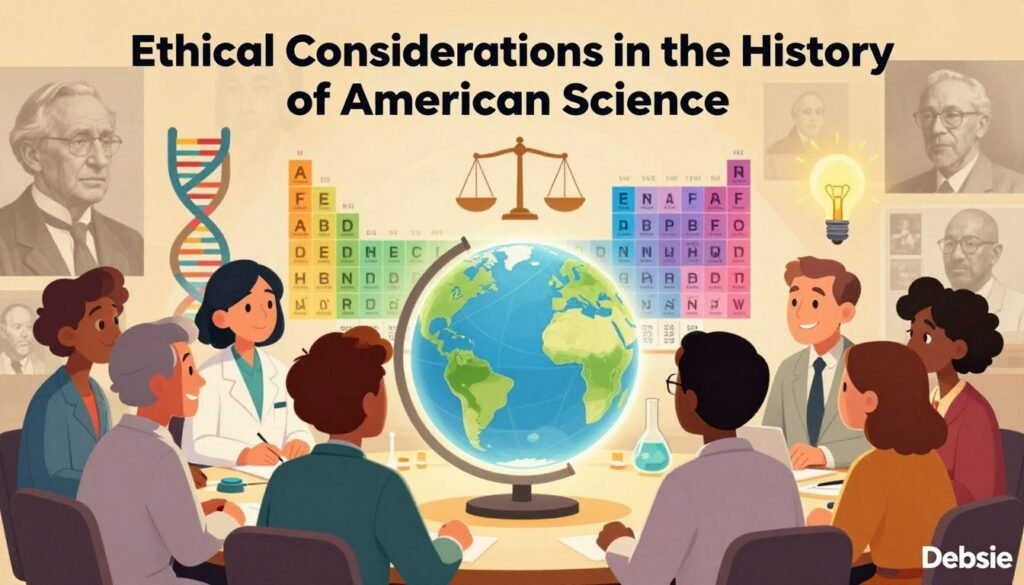
Today, ethical considerations still guide American science. This includes genetic engineering, stem cell research, and climate change. Gene-editing technologies like CRISPR have raised questions about changing human embryos and possible bad effects.
Debsie’s gamified courses can teach you about science’s ethics. They make learning fun and interactive. By looking at American science’s history, we understand the link between science and values.
The story of American science is not just about great achievements. It’s also about the ethics behind these advances. As we go forward, we must keep looking at science’s ethics. This ensures scientific progress benefits everyone and respects human values.
Conclusion
We’ve looked at how US scientists have changed American science and the world. Their discoveries have made our world better and helped people everywhere.
Benjamin Franklin and Katherine Johnson are just a few examples. They showed us how important curiosity and smart thinking are. Their work reminds us that science keeps getting better because we keep trying.
Debsie’s interactive learning is here to help you keep exploring. Our games make learning fun and help you understand science better. This will inspire the next group of US scientists.
The work of these scientists will keep inspiring us. By following their example, we can solve big problems and make the future brighter for everyone.